U.S. Pat. No. 9,364,746
SYSTEM AND METHOD CONFIGURED TO UNLOCK CONTENT WITHIN A VIDEOGAME
AssigneeActivision Publishing, Inc.
Issue DateMay 12, 2014
U.S. Patent No. 9,364,746: System and method configured to unlock content within a videogame
U.S. Patent No. 9,364,746: System and method configured to unlock content within a videogame
Issued June 14, 2016,
to Activision Publishing, Inc.

Summary:
This invention relates to how players can unlock new locations in a video game. Often a video game’s content is divided into separate locations. Generally, how a video game presents content to players is somewhat rigid, and often a predetermined set of tasks must be accomplished in a predetermined order. This patent tries to make the order in which locations and events may be unlocked controlled somewhat by players. In this patent, there are a number of locations, and a group of players may be associated with each location (either real of NPCs). Players may progress through the videogame by moving from one location to the next, performing objectives, and interacting with the players at the locations. Access to the different locations may not be provided initially to a real player. The player may be provided with a given location once the real player has fulfilled the predetermined criteria associated with each location. This may include the performance of tasks or the successful completion of events at one or more locations that are available to the player. This may provide the real player greater flexibility to experience and interact with the video game than games with more rigid predetermined orders.
Abstract:
A system and method are configured to provide a videogame to one or more players. The videogame may involve a series of different sets of content within which players perform activities. A group of players may be associated with the content sets. The players may include virtual players controlled by artificial intelligence and one or more real world players. Players may progress through the videogame by moving from content sets to content sets, performing objectives in the various content sets, and interacting with the players within those content sets.
Illustrative Claim:
1. A system for providing a player with a videogame, the system comprising: one or more physical processors programmed to execute computer program instructions which, when executed, cause the one or more physical processors to: manage multiple virtual geographic locations within the videogame, wherein the multiple virtual geographic locations include a first virtual geographic location that is accessible to the player engaging in the videogame and a second virtual geographic location and a third virtual geographic location that are not accessible to the player initially within the videogame, the second virtual geographic location is associated with a first set of criteria, and the third virtual geographic location is associated with a second set of criteria different from the first set of criteria; unlock the second virtual geographic location for the player to enable the player to access the second virtual geographic location responsive to the player fulfilling the first set of criteria, wherein the first set of criteria includes one or more of performance of one or more first tasks available via the first virtual geographic location or successful participation in one or more first events available via the first virtual geographic location; unlock the third virtual geographic location for the player to enable the player to access the third virtual geographic location responsive to the player fulfilling the second set of criteria, wherein the second set of criteria includes one or more of performance of one or more second tasks available via the first virtual geographic location or successful participation in one or more second events available via the first virtual geographic location; implement artificial intelligence to control one or more virtual players within the videogame, wherein the one or more virtual players includes a first virtual player at the first virtual geographic location; wherein the first set of criteria further includes achievement of a disposition mode for a relationship between the player and the first virtual player; and wherein unlocking the second virtual geographic location for the player further comprises unlocking the second virtual geographic location for the player responsive to the player achieving the disposition mode for the relationship between the player and the first virtual player.
Research By: Rachel Johns
Edited By: Andrew F. Thomas
Illustrative Figure
Abstract
A system and method are configured to provide a videogame to one or more players. The videogame may involve a series of different sets of content within which players perform activities. A group of players may be associated with the content sets. The players may include virtual players controlled by artificial intelligence and one or more real world players. Players may progress through the videogame by moving from content sets to content sets, performing objectives in the various content sets, and interacting with the players within those content sets.
Description
DETAILED DESCRIPTION FIG. 1illustrates a system10configured to provide a videogame to one or more players. The videogame may include a vehicular racing game. The videogame may involve a series of different virtual geographic locations at which players perform activities. A group of players may be associated with each location. The players may include virtual players controlled by artificial intelligence and one or more real players controlled by real world users. Players may progress through the videogame by moving from location to location, performing objectives at the various locations, and interacting with the players at the locations. Access to all of the different locations may not be provided initially to a real player. In some implementations, locations may be associated with predetermined criteria. The real player may be provided with a given location once the real player has fulfilled the predetermined criteria associated with the given location. The criteria may include the performance of tasks and/or the successful completion of events at one or more locations open to the real player. This may provide the real player some flexibility with respect to manner in which the real player experiences and/or interacts with the content within the videogame. For illustrative reasons, system10and its associated methods are described below, in some cases, with respect to a vehicular racing game. This is not intended to be limiting. The principles disclosed herein may be adapted to a variety of other videogame genres, including without limitation, shooters, fighting games, sports games, real-time strategy games, role playing games, and/or other genres. The system10may include a game platform12configured to execute one or more computer program modules to generate sensory stimulation for the one or more players that is associated with the videogame. For example, game platform12may control the generation of visual stimulation (e.g., video), audio stimulation, tactile stimulation, ...
DETAILED DESCRIPTION
FIG. 1illustrates a system10configured to provide a videogame to one or more players. The videogame may include a vehicular racing game. The videogame may involve a series of different virtual geographic locations at which players perform activities. A group of players may be associated with each location. The players may include virtual players controlled by artificial intelligence and one or more real players controlled by real world users. Players may progress through the videogame by moving from location to location, performing objectives at the various locations, and interacting with the players at the locations.
Access to all of the different locations may not be provided initially to a real player. In some implementations, locations may be associated with predetermined criteria. The real player may be provided with a given location once the real player has fulfilled the predetermined criteria associated with the given location. The criteria may include the performance of tasks and/or the successful completion of events at one or more locations open to the real player. This may provide the real player some flexibility with respect to manner in which the real player experiences and/or interacts with the content within the videogame.
For illustrative reasons, system10and its associated methods are described below, in some cases, with respect to a vehicular racing game. This is not intended to be limiting. The principles disclosed herein may be adapted to a variety of other videogame genres, including without limitation, shooters, fighting games, sports games, real-time strategy games, role playing games, and/or other genres.
The system10may include a game platform12configured to execute one or more computer program modules to generate sensory stimulation for the one or more players that is associated with the videogame. For example, game platform12may control the generation of visual stimulation (e.g., video), audio stimulation, tactile stimulation, and/or other stimulation for one or more real players. To control the generation of this sensory stimulation, game platform12may include and/or control one or more of an electronic display, at least one speaker, and/or other devices. The real players may input control information to game platform12via one or more control peripherals14. The game platform12may include a gaming console, a portable gaming console, a personal computer, a handheld device, a mobile communications device, and/or other processing platforms.
The game platform12may be operatively linked to one or more server16. The game platform12may communicate with server16to enable communication between game platform12and other game platforms (e.g., to enable multiplayer modes), to enable software updates of the modules implemented by game platform12to provide the videogame, and/or for other purposes. For example, server16may support a social network that is integrated into the videogame, as described in U.S. patent application Ser. No. 12/390,272, entitled “Social Network System and Method For Use With and Integration into a Video Game,” and filed Feb. 20, 2009, which is hereby incorporated by reference into this disclosure in its entirety.
The one or more computer program modules implemented by game platform12may include a game module18, a location module20, an event module22, a virtual player control module24, and/or other modules. The computer program modules18,20,22,24, and/or other modules may include one or more modules implemented as a software module, a hardware module, a firmware module, and or a module formed from a combination of software, hardware, and/or firmware. The attribution of specific functions to particular ones of modules18,20,22, and24within this disclosure should not be viewed as illustrative and not limiting. The functionality described herein may be performed by other combinations of modules and/or by a variety of different configurations of processors and/or modules.
The game module18may be configured to control game platform12to generate a display, sounds, and/or haptic stimulation for the player that mimics the visual, audio, and/or tactile stimulus experienced by real players during the videogame. For example, if the videogame is a racing videogame, game module18may be configured to control the generation of sensory stimulation that mimics the sensory stimulation experienced during vehicular racing in real life. As such, game module18may include a physics engine, a rendering engine, and/or other information, instructions, and/or modules configured to generate the sensory stimulation associated with the videogame.
The location module20may be configured to manage the separate virtual geographic locations within the videogame. As used herein, the term “location” may refer to virtual locations depicted within the videogame as separate geographic locations. The different locations may based on and/or modeled after real world geographic locations. A location within the videogame modeled after a real world geographic location may include landmarks that are the same as or similar to real world landmarks of the real world geographic location, terrain that is similar to the real world geographic location, flora and/or fauna similar to the real world geographic location, and/or depict other features of the virtual location that are similar to the real features of the real world location. One or more locations may be purely fictional, or based on an aggregation of a plurality of real world geographic locations.
The location module20may store, organize, and/or manage information that enables game module18to render scenes associated with the separate locations, generate sensory stimulation associated with events (e.g., races) that occur at the separate locations, and/or other information related to the locations. Location module20may store, organize, and/or manage information related to associations between individual locations and groups of virtual players that are associated with the individual locations.
As was mentioned above, a real player that begins the videogame may not be provided with access to all of the virtual geographic locations. Locations that are not initially available to the real player may be unlocked for, or made accessible to, the real player upon the fulfillment of predetermined criteria associated with individual ones of the locked, or inaccessible, locations. The predetermined criteria may include the performance of tasks and/or successful participation in events within one or more locations that are unlocked for the real player. The location module20may monitor the activities of the real player within the videogame to determine whether the real player has fulfilled the predetermined criteria associated with one or more locked locations. If the real player has fulfilled such predetermined criteria, the location module may unlock the appropriate locations to provide the real player with access.
By way of example,FIG. 2shows a diagram illustrating the flow of the videogame between a plurality of locations26(illustrated inFIG. 2as locations26a,26b,26c,26d,26e, and26f). The arrows inFIG. 2represent the order in which locations26are unlocked. Within the videogame, a player may move back and forth between locations26(provided once the locations are unlocked) against the grain of the arrows (e.g., from location26bto location26a) and/or between locations26that are not linked by arrows inFIG. 2(e.g., from location26dto location26a).
The predetermined criteria associated with a given location26may include performance of tasks and/or successful participation in events at the location26from which access to the given location is obtained. For example, the predetermined criteria associated with location26dmay include the performance of tasks and/or successful participation in events at location26b. The predetermined criteria associated with a given location26may include performance of tasks and/or successful participation in events at a plurality of locations26accessible to the player prior to the given location26. By way of example, the predetermined criteria associated with location26dmay include the performance of tasks and/or successful participation in events at locations26band26a.
The configuration of locations26within the game illustrated inFIG. 2generally provides a map of the manner in which content within the videogame is made accessible to real players. For example, a real player may be initially be given access to only a single, initial location, such as location26a, and may proceed to unlock other ones of locations26by fulfilling the criteria associated with the locked locations26b-26f. The location module (e.g., location module20) managing locations26may be configured to provide real users with some control over the manner in which they access the locations26. For example, within locations26aand/or26b, a real player may fulfill criteria associated with either (or both) of locations26cand26d. Similarly, various locations26may be unlocked by different sets of criteria. For example, the real player may fulfill a set of criteria associated with location26cthat includes the performance of tasks and/or successful participation in events within location26b, or an at least partially separate set of criteria that includes the performance of tasks and/or successful participation in events within location26e. The location module may define a plurality of different possible paths through the videogame to unlock the various locations26.
The division of the content of videogame into the different locations may enhance the realism of the videogame, and/or may provide real players with some control over the narrative of the overall game. By way of non-limiting example, the division of content into separate geographic locations may mimic the manner in which underground, unsanctioned racing might occur in the real world (e.g., localized racing scenes along predetermined roadway courses). For instance, the videogame may progress from rural, unpopulated racecourses where interference from bystander traffic and/or law enforcement would be unusual to more metropolitan locations where spectators and racers appear unannounced en masse to block off roadways and create racecourses may mimic the viral manner in which information and interests spread in the modern world.
For example, location26amay include an initial location available to real players that includes stretches of road that are largely unused (e.g., a remote, sparsely populated area), thereby lending themselves to informal races between friends. The races conducted by at location26amay make for exciting videos (e.g., machinima of races participated in by the real player at location26a), and the videogame may include players making and selecting video footage for dissemination over the Internet (within the videogame). Once the video footage of the initial location reaches a wider virtual audience within the game, word spreads and the racing scene begins grow.
Inspired by video from location26a, rival racing hotspots (e.g., locations26b-26f) begin to emerge. These rival locations26b-26fmay include, at first, areas that are geographically close to the initial location26a, and then become more and more distant. Players may travel from location26to location26in order to prove themselves within local communities (e.g., the groups of players) at the individual locations26, and/or to the national or international community as a whole (players from all of locations26).
As the videogame progresses, the locations26that become accessible to a player may be less isolated. For example, locations26eand26fmay be more heavily populated, metropolitan locations than locations26aand26b. The races held at these more metropolitan locations may be more notorious than the isolated races at the initial location.
As was mentioned above,FIG. 2illustrates the manner in which a player may somewhat control the manner in which the various locations are unlocked within the videogame. This may enable the player to determine his own “career path” within the game (e.g., through the general story arc outlined above). The open-ended manner in which the content associated with the different locations is accessed may be enhanced by enabling the player to unlock other locations without completing the location he is currently participating in. For example, within the context ofFIG. 2, the player participating in the videogame at location26amay unlock location26bwithout completing location26a. At which point, the player may opt to switch locations and begin to interact with the content associated with location26bwithout completing location26a. The player may return to location26aat his discretion to complete the content associated therewith.
As used herein, a player may be considered to have “completed” a location by successfully performing one or more final tasks and/or events. Completion of a location does not necessarily refer to the performance of all possible tasks and/or events, or even all of the tasks and/or events that can be participated in to move the plot of the videogame along.
One the predetermined criteria associated with the individual ones of locations26may include a threshold number of unlocked, incomplete locations. If the number of locations26that are unlocked and incomplete for a player exceed the threshold, the location module managing locations26may not unlock additional ones of locations26even if the other predetermined criteria associated with the additional one of locations26have been fulfilled. For instance, if the threshold number of unlocked, incomplete locations is 3, and each of locations26a,26b, and26care unlocked and incomplete, the location module managing location26may not unlock locations26dand/or26eeven if the predetermined criteria associated with locations26dand/or26eare fulfilled. Instead, the location module may retain locations26dand/or26eas locked until one of locations26a,26b, or26care completed.
Referring back toFIG. 1, the event module22may be configured to manage the events within the videogame at the various locations. This may include storing the requirements of the events for success, providing the player access to previously locked events at a location, and monitoring the performance of the player within events to determine if the player has been successful. If the videogame is a racing game, the events may include vehicular racing competitions and/or other demonstrations of driving skills.
At a given location, the videogame may include a plurality of events. Each event may include a race, or some other competitive demonstration of racing skill(s). When a player first accesses a location, a preliminary set of the events at the location may be accessible to the player. The preliminary set of events may be a subset of the events associated with the location. To gain access the other events associated with the location, the player may have to fulfill predetermined criteria associated with the other events. The predetermined criteria may include, for example, successful performance of one or more of the preliminary set of events.
Successful performance in an event may or may not include “winning” an event. In addition to, or instead of, winning an event, successful performance in an event may require achieving one or more predetermined goals in the event. As non-limiting examples, the goals may include one or more of:
1. Beat player X;
2. Finish better than X place;
3. Cause X damage to Y player;
4. Get a lap time faster than X;
5. Do a jump at least X distance Y amount of times;
6. Finish with less than X amount of damage;
7. Finish in less than X time;
8. Earn X amount of points, experience points, and/or virtual currency;
9. Finish without receiving a repair;
10. Finish without using a special ability;
11. Overtake X players using a single nitro boost;
12. Finish race with at least X amount of damage;
13. Overtake driver X at least Y times;
14. Do a slide of X distance Y amount of times;
15. Ensure driver X finishes above (or below) Y place;
16. Hit a speed of X;
17. Remain below a speed of X; and
18. Use alternate route X.
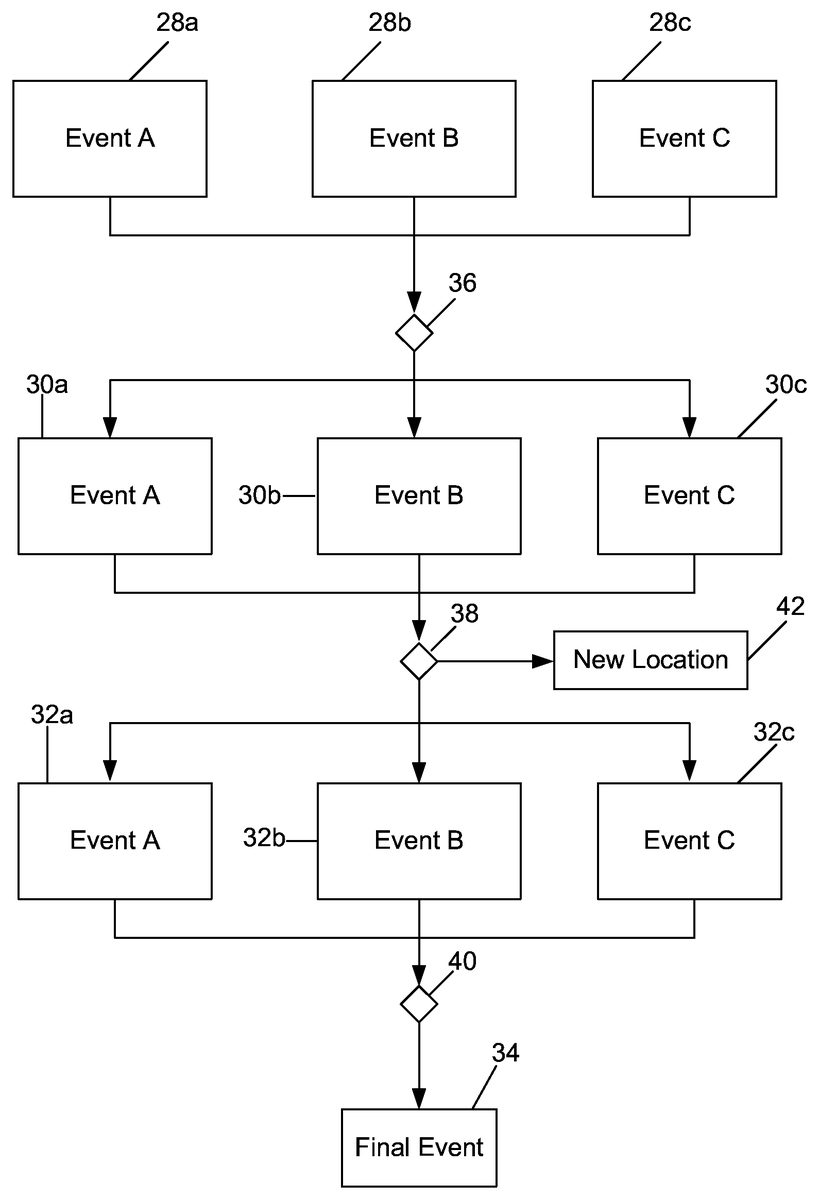
FIG. 3shows a diagram illustrating the flow of the videogame between events associated with a single location within the videogame. The events may include an initial set of events28(illustrated inFIG. 3as events28a,28b, and28c), a second set of events30(illustrated inFIG. 3as events30a,30b, and30c), a third set of events32(illustrated inFIG. 3as events32a,32b, and32c), and a final event34.
Upon gaining access to the location, a player may only have access to the initial set of events28. In order to gain access to the second set of events30, the event module (e.g., event module22inFIG. 1) managing the events shown inFIG. 3may require the player to fulfill criteria associated with the second set of events32. Block36may represent the functionality of the event module in determining whether the player has fulfilled the criteria associated with the second set of events30. For example, the criteria associated with the second set of events30may include performing successfully in 2 of the 3 of events28a,28b, and28c.
Similarly, upon fulfilling the criteria associated with the second set of events30, the player may not be provided with access to the third set of events32until the event module determines that the player has fulfilled criteria associated with the third set of events32. For example, block38may represent the event module determining whether the player has performed successfully in 2 of 3 of events30a,30b, and30c. Then, to gain access to final event34, the player may be required to participate in events30to fulfill criteria associated with final event34. For example, block40may represent the event module determining whether the player has performed successfully in 2 of 3 of events32a,32b, and32cbefore providing the player with access to final event34.
The event module managing the events show inFIG. 3may not dictate to the player the order in which the player performs events within a given set. Since not all of the events at a given level may be required for the event module to provide access to a next set of events (or event), the event module may not dictate to the player which portion of the content within the game the player must access in the course of successfully accomplishing the videogame. This may enhance the gaming experience with the videogame, as players may control to some extent the order in which videogame content is experienced, and the particular tasks that are performed that contribute to finishing the videogame. While conventional videogame systems, such as videogame systems providing vehicular racing videogames, may provide content with tasks and/or events that are optional, players typically progress through the game toward completion by completing all of a predetermined set of “plot moving” tasks and/or events, in addition to interactions with the optional content.
To complete the location associated with events28,30,32, and34, a location module managing the location may require a player to successfully participate in final event34. Within the narrative of the videogame, completing final event34of the location may be commemorated with a special reward or incentive. The special reward or incentive may include, for example, a bonus of points, experience points, and/or virtual currency. The special reward may include, for example, an insignia, a badge, or a patch that can be worn on a representation of the player or a representation of a car driven by the player indicating that the player has completed the location. Completion of all the locations, or some predetermined number of the locations, by completing the final events at the locations may be required before the grand finale of the videogame is accessible to the player.
As was mentioned above, the location module may not require the player to complete the location before providing the player with access to another location. By way of illustration, in addition to the functionality discussed above, block38may represent a determination by the location module of whether the player has fulfilled criteria associated with another location. If the player has fulfilled such criteria, the location module may provide access to the other location in an operation illustrated at block42. The criteria associated with the other location may include the performance of tasks and/or events at the location illustrated inFIG. 3. The criteria may include the same criteria associated with unlocking events32(e.g., successful participation in 2 of the 3 of events30a,30b, and30c), and/or other criteria.
The virtual player control module24may be configured to control the virtual players within the game. As such, virtual player control module24may include artificial intelligence that controls the actions of virtual players within the game. The virtual players may include players that real players compete against in the videogame (e.g., in events), characters that observer or facilitate the events in the videogame (e.g., spectators, equipment or vehicle vendors, mechanics). The virtual player control module24may control the actions of the virtual players in the events within the game, in other contexts within the game, and/or other interactions of the virtual players with real players.
The interactions of the virtual players with a real player may be influenced by relationships of the real player with the different virtual players. The relationships may be dynamically and adaptively determined by virtual player control module24(e.g., they can change automatically over time). For example, the relationships may be determined based on interactions between the real player and the virtual players within the videogame (and/or outside of the videogame). Interactions toward a virtual player by the real player that are hostile or aggressive may result in the virtual player having a hostile or combative disposition or attitude toward the player. Similarly, interactions toward a virtual player by the real player that are felicitous may result in the virtual player having a friendly or cooperative disposition or attitude toward the real player.
The relationships between virtual players and the real player may impact the videogame in that virtual players that are friendly or cooperative toward the real player may help the real player be successful in completing events, while virtual players that are hostile toward the real player may actively hinder the real player from being successful in events.
In order to control virtual players based on the relationships between the virtual players and real players, the virtual player control module24may determine the attitude and/or disposition of individual virtual players to individual real players. To accomplish this, an overarching disposition mode may be assigned by virtual player control module24to the relationship between a real player and a given virtual player based on their interactions. Non-limiting examples of the possible overarching disposition modes including friend, rival, and/or neutral.
The status of relationships between the virtual players and a real player may be conveyed to the real player. The status may be conveyed to the real player, for example, via a visual and/or audio indicator provided to the real player in the game.
The virtual player control module24may switch individual virtual player behaviors toward a real member by a given virtual member on or off based on the disposition mode determined for the relationship between the real player and the given virtual player, and a predetermined profile established for the given virtual player. For instance, for a first disposition mode, the predetermined profile for the given virtual player may dictate that behaviors A, B, and C may be switched on while behaviors D, E, and F may be switched off. If virtual player control module24determines that the relationship between the real player and the given virtual player has changed to a second disposition mode, the predetermined profile may dictate that one or more of behaviors A, B, and C be switched off and/or one or more behaviors D, E, and F be switched on.
Behaviors that may be switched on and/or off by virtual player control module24in accordance with predetermined profiles of virtual players may include on the racetrack moves that are intended to help or hinder real players. For example, such behaviors may include one or more of blocking, sideswiping, ramming from behind, braking with a real member behind, allowing a pass, drafting, allowing drafting, overtaking, and/or other behaviors.
Virtual players may be the keepers of information related to events and/or locations. This information may unlock events and/or locations, or may provide guidance to the real player as to how to be successful within the context of an event or location. If the real player has a hostile relationship with a virtual player that is the keeper of information related to an event or location, the virtual player may withhold the information. If the real player has a friendly relationship with a virtual player that is the keeper of information related to an event or location, the virtual player may provide the information to the real player. The real player may then implement the information to access the previously locked content, be successful at an event or location, or otherwise implement the information.
Each location within the videogame may have a group of virtual players that are associated therewith. The group of virtual players associated with a given location may have one or more traits that are consistent with the virtual geographic setting of the given location, the place in the narrative of the videogame of the location, and/or other features of the given location. For example, in locations that are accessible to a real player early in the narrative of the racing game described above, the groups of virtual players may include tightly knit groups of friends that convene to race in remote, isolated locales for the thrill and adrenaline rush. However, as the real player proceeds through the videogame to locations that are cosmopolitan, the publicity, acclaim and rewards associated with the covert racing provided by the videogame may become more prevalent. As such, the virtual players associated with these locations may be have different motivations than the virtual players experienced early on in the game, and may be less friendly and more aggressive. Similarly, racing tactics employed by the virtual players associated with later locations may be more cutthroat and dangerous.
The groups of virtual players associated with the locations within the game may each have its own social structure. Players, including virtual and real players, may move up and down in status within the group based on one or more of their performance within events, their virtual possessions, their relationships (e.g., friendships and rivalries), and/or other socially significant acts, items, and/or traits. The virtual player control module24may determine the relative status of the players associated with a given location, including a real player playing the videogame and the virtual players associated with the given location.
Progression through the videogame by unlocking content at a location may require more than success in the events associated with the location. Unlocking content at the location (e.g., the criteria associated with locked events and/or locations) may require a real player to progress socially within the group of virtual players associated with the location. In some cases, to complete a location a real player much increase status within the group until the player is the “leader” of the group.
The group of virtual players associated with a location within the videogame may include different types of virtual players. These types of virtual players may include a boss type of virtual player, a nemesis type of virtual player, and/or other types of virtual players. A boss type of virtual player may be the leader of the group. Completion of a location may require the real player to defeat the boss virtual player of the location in the final event of the location. A nemesis type of virtual player may include a virtual player within the group that is attempting to perform the same set of tasks as the real player, and competes directly with the real player throughout the events associated with the location. The nemesis may also compete for resources at the location (e.g., cars, equipment, friendships with other characters) with the real player. Success within one or more events at the location may be judged based on performance relative to the nemesis real player at the location.
Although the invention has been described in detail for the purpose of illustration based on what is currently considered to be the most practical and preferred embodiments, it is to be understood that such detail is solely for that purpose and that the invention is not limited to the disclosed embodiments, but, on the contrary, is intended to cover modifications and equivalent arrangements that are within the spirit and scope of the appended claims. For example, it is to be understood that the present invention contemplates that, to the extent possible, one or more features of any embodiment can be combined with one or more features of any other embodiment.
Claims
- A system for providing a player with a videogame, the system comprising: one or more physical processors programmed to execute computer program instructions which, when executed, cause the one or more physical processors to: manage multiple virtual geographic locations within the videogame, wherein the multiple virtual geographic locations include a first virtual geographic location that is accessible to the player engaging in the videogame and a second virtual geographic location and a third virtual geographic location that are not accessible to the player initially within the videogame, the second virtual geographic location is associated with a first set of criteria, and the third virtual geographic location is associated with a second set of criteria different from the first set of criteria;unlock the second virtual geographic location for the player to enable the player to access the second virtual geographic location responsive to the player fulfilling the first set of criteria, wherein the first set of criteria includes one or more of performance of one or more first tasks available via the first virtual geographic location or successful participation in one or more first events available via the first virtual geographic location;unlock the third virtual geographic location for the player to enable the player to access the third virtual geographic location responsive to the player fulfilling the second set of criteria, wherein the second set of criteria includes one or more of performance of one or more second tasks available via the first virtual geographic location or successful participation in one or more second events available via the first virtual geographic location;implement artificial intelligence to control one or more virtual players within the videogame, wherein the one or more virtual players includes a first virtual player at the first virtual geographic location;wherein the first set of criteria further includes achievement of a disposition mode for a relationship between the player and the first virtual player;and wherein unlocking the second virtual geographic location for the player further comprises unlocking the second virtual geographic location for the player responsive to the player achieving the disposition mode for the relationship between the player and the first virtual player.
- The system of claim 1 , wherein unlocking the second virtual geographic location for the player comprises unlocking, prior to unlocking the third virtual geographic location for the player, the second virtual geographic location for the player responsive to the player fulfilling the first set of criteria prior to fulfilling the second set of criteria.
- The system of claim 2 , wherein the one or more physical processors are further caused to: enable, prior to unlocking the third virtual geographic location for the player, the player to interact with a set of content available via the second virtual geographic location responsive to the unlocking of the second virtual geographic location, wherein the set of content is not available to the player within the videogame prior to the unlocking of the second virtual geographic location.
- The system of claim 3 , wherein the one or more physical processors are further caused to: enable the player to return to the first virtual geographic location after the player travels to the second virtual geographic location, wherein unlocking the third virtual geographic location for the player comprises unlocking, after the player returns to the first virtual geographic location from the second virtual geographic location, the third virtual geographic location for the player responsive to the player fulfilling the second set of criteria.
- The system of claim 1 , where the one or more physical processors are further caused to: enable, without the player completing the first virtual geographic location, the player to interact with a set of content available via the second virtual geographic location responsive to the unlocking of the second virtual geographic location, wherein the set of content is not available to the player within the videogame prior to the unlocking of the second virtual geographic location.
- The system of claim 1 , wherein the player fulfills the first set of criteria and the second set of criteria, and the second virtual geographic location and the third virtual geographic location are unlocked for the player such that the player is enabled to access the second virtual geographic location and the third virtual geographic location.
- The system of claim 1 , wherein the one or more physical processors are further caused to: monitor one or more activities of the player to determine whether the player has fulfilled one or more of the first set of criteria or the second set of criteria, wherein the player is determined to have fulfilled one or more of the first set of criteria or the second set of criteria based on the monitoring of the one or more activities.
- The system of claim 1 , where the one or more virtual players include a first group of virtual players and a second group of virtual players, the first group of virtual players includes virtual players with which the player completes at the first virtual geographic location, and the second group of virtual player includes virtual players against which the player completes at the first geographic location.
- The system of claim 8 , wherein the virtual players of the first group includes the first virtual player.
- A computer-implemented method of providing a player with a videogame, the method being implemented in a computer system comprising one or more physical processors executing computer program instructions which, when executed, perform the method, the method comprising: managing, by the computer system, multiple virtual geographic locations within the videogame, wherein the multiple virtual geographic locations includes a first virtual geographic location that is accessible to the player engaging in the videogame and a second virtual geographic location and a third virtual geographic location that are not accessible to the player initially within the videogame, the second virtual geographic location is associated with a first set of criteria, and the third virtual geographic location is associated with a second set of criteria different from the first set of criteria;unlocking, by the computer system, the second virtual geographic location for the player to enable the player to access the second virtual geographic location responsive to the player fulfilling the first set of criteria, wherein the first set of criteria includes one or more of performance of one or more first tasks available via the first virtual geographic location or successful participation in one or more first events available via the first virtual geographic location;unlocking, by the computer system, the third virtual geographic location for the player to enable the player to access the third virtual geographic location responsive to the player fulfilling the second set of criteria, wherein the second set of criteria includes one or more of performance of one or more second tasks available via the first virtual geographic location or successful participation in one or more second events available via the first virtual geographic location;implementing, by the computer system, artificial intelligence to control one or more virtual players within the videogame, wherein the one or more virtual players includes a first virtual player at the first virtual geographic location;wherein the first set of criteria further includes achievement of a disposition mode for a relationship between the player and the first virtual player;and wherein unlocking the second virtual geographic location for the player further comprises unlocking the second virtual geographic location for the player responsive to the player achieving the disposition mode for the relationship between the player and the first virtual player.
- The method of claim 10 , wherein unlocking the second virtual geographic location for the player comprises unlocking, prior to unlocking the third virtual geographic location for the player, the second virtual geographic location for the player responsive to the player fulfilling the first set of criteria prior to fulfilling the second set of criteria.
- The method of claim 11 , further comprising: enabling, by the computer system, prior to unlocking the third virtual geographic location for the player, the player to interact with a set of content available via the second virtual geographic location responsive to the unlocking of the second virtual geographic location, wherein the set of content is not available to the player within the videogame prior to the unlocking of the second virtual geographic location.
- The method of claim 12 , further comprising: enabling, by the computer system, the player to return to the first virtual geographic location after the player travels to the second virtual geographic location, wherein unlocking the third virtual geographic location for the player comprises unlocking, after the player returns to the first virtual geographic location from the second virtual geographic location, the third virtual geographic location for the player responsive to the player fulfilling the second set of criteria.
- The method of claim 10 , further comprising: enabling, by the computer system, without the player completing the first virtual geographic location, the player to interact with a set of content available via the second virtual geographic location responsive to the unlocking of the second virtual geographic location, wherein the set of content is not available to the player within the videogame prior to the unlocking of the second virtual geographic location.
- The method of claim 10 , wherein the player fulfills the first set of criteria and the second set of criteria, and the second virtual geographic location and the third virtual geographic location are unlocked for the player such that the player is enabled to access the second virtual geographic location and the third virtual geographic location.
- The method of claim 10 , further comprising: monitoring, by the computer system, one or more activities of the player to determine whether the player has fulfilled one or more of the first set of criteria or the second set of criteria, wherein the player is determined to have fulfilled one or more of the first set of criteria or the second set of criteria based on the monitoring of the one or more activities.
- The method of claim 10 , where the one or more virtual players include a first group of virtual players and a second group of virtual players, the first group of virtual players includes virtual players with which the player completes at the first virtual geographic location, the second group of virtual player includes virtual players against which the player completes at the first geographic location, and the virtual players of the first group include the first virtual player.
Disclaimer: Data collected from the USPTO and may be malformed, incomplete, and/or otherwise inaccurate.