U.S. Pat. No. 9,320,969
ONLINE GAME FOR MATCHING TEXT WITH IMAGES
AssigneeZynga Inc.
Issue DateSeptember 26, 2011
Illustrative Figure
Abstract
An online game mechanic matches requests and responses of different data types that include text, image and audio. Request values corresponding to a first data type are sent to users in a distribution list, and those users send response values corresponding to a second data type. Winning response values are selected and announced. In an example embodiment, the request values include a text description that includes at least one word, and the response values include an image file or a reference to an image file.
Description
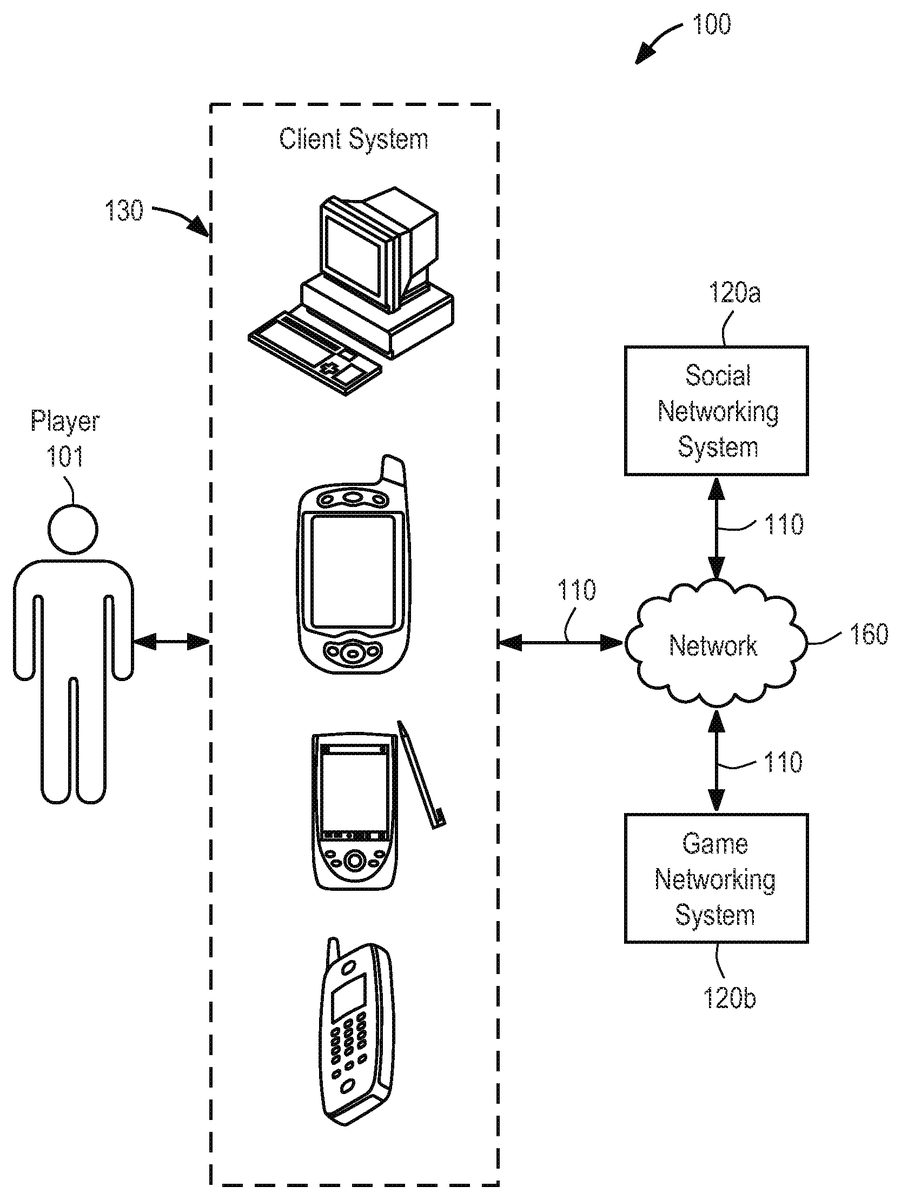
DESCRIPTION OF EXAMPLE EMBODIMENTS FIG. 1illustrates an example of a system for implementing various disclosed embodiments. In particular embodiments, system100comprises player101, social networking system120a, game networking system120b, client system130, and network160. The components of system100can be connected to each other in any suitable configuration, using any suitable type of connection. The components may be connected directly or over a network160, which may be any suitable network. For example, one or more portions of network160may be an ad hoc network, an intranet, an extranet, a virtual private network (VPN), a local area network (LAN), a wireless LAN (WLAN), a wide area network (WAN), a wireless WAN (WWAN), a metropolitan area network (MAN), a portion of the Internet, a portion of the Public Switched Telephone Network (PSTN), a cellular telephone network, another type of network, or a combination of two or more such networks. Social networking system120ais a network-addressable computing system that can host one or more social graphs. Social networking system120acan generate, store, receive, and transmit social networking data. Social networking system120acan be accessed by the other components of system100either directly or via network160. Game networking system120bis a network-addressable computing system that can host one or more online games. Game networking system120bcan generate, store, receive, and transmit game-related data, such as, for example, game account data, game input, game state data, and game displays. Game networking system120bcan be accessed by the other components of system100either directly or via network160. Player101may use client system130to access, send data to, and receive data from social networking system120aand game networking system120b. Client system130can access social networking system120or game networking system120bdirectly, via network160, or via a third-party system. As an example and not by way of limitation, client system130may access game networking system120bvia social networking system120a. Client system130can be any suitable computing device, such as a ...
DESCRIPTION OF EXAMPLE EMBODIMENTS
FIG. 1illustrates an example of a system for implementing various disclosed embodiments. In particular embodiments, system100comprises player101, social networking system120a, game networking system120b, client system130, and network160. The components of system100can be connected to each other in any suitable configuration, using any suitable type of connection. The components may be connected directly or over a network160, which may be any suitable network. For example, one or more portions of network160may be an ad hoc network, an intranet, an extranet, a virtual private network (VPN), a local area network (LAN), a wireless LAN (WLAN), a wide area network (WAN), a wireless WAN (WWAN), a metropolitan area network (MAN), a portion of the Internet, a portion of the Public Switched Telephone Network (PSTN), a cellular telephone network, another type of network, or a combination of two or more such networks.
Social networking system120ais a network-addressable computing system that can host one or more social graphs. Social networking system120acan generate, store, receive, and transmit social networking data. Social networking system120acan be accessed by the other components of system100either directly or via network160. Game networking system120bis a network-addressable computing system that can host one or more online games. Game networking system120bcan generate, store, receive, and transmit game-related data, such as, for example, game account data, game input, game state data, and game displays. Game networking system120bcan be accessed by the other components of system100either directly or via network160. Player101may use client system130to access, send data to, and receive data from social networking system120aand game networking system120b. Client system130can access social networking system120or game networking system120bdirectly, via network160, or via a third-party system. As an example and not by way of limitation, client system130may access game networking system120bvia social networking system120a. Client system130can be any suitable computing device, such as a personal computer, laptop, cellular phone, smart phone, computing tablet, and so forth.
AlthoughFIG. 1illustrates a particular number of players101, social networking systems120a, game networking systems120b, client systems130, and networks160, this disclosure contemplates any suitable number of players101, social networking systems120a, game networking systems120b, client systems130, and networks160. As an example and not by way of limitation, system100may include one or more game networking systems120band no social networking systems120a. As another example and not by way of limitation, system100may include a system that comprises both social networking system120aand game networking system120b. Moreover, althoughFIG. 1illustrates a particular arrangement of player101, social networking system120a, game networking system120b, client system130, and network160, this disclosure contemplates any suitable arrangement of player101, social networking system120a, game networking system120b, client system130, and network160.
The components of system100may be connected to each other using any suitable connections110. For example, suitable connections110include wireline (such as, for example, Digital Subscriber Line (DSL) or Data Over Cable Service Interface Specification (DOCSIS)), wireless (such as, for example, Wi-Fi or Worldwide Interoperability for Microwave Access (WiMAX)) or optical (such as, for example, Synchronous Optical Network (SONET) or Synchronous Digital Hierarchy (SDH)) connections. In particular embodiments, one or more connections110each include an ad hoc network, an intranet, an extranet, a VPN, a LAN, a WLAN, a WAN, a WWAN, a MAN, a portion of the Internet, a portion of the PSTN, a cellular telephone network, or another type of connection, or a combination of two or more such connections. Connections110need not necessarily be the same throughout system100. One or more first connections110may differ in one or more respects from one or more second connections110. AlthoughFIG. 1illustrates particular connections between player101, social networking system120a, game networking system120b, client system130, and network160, this disclosure contemplates any suitable connections between player101, social networking system120a, game networking system120b, client system130, and network160. As an example and not by way of limitation, in particular embodiments, client system130may have a direct connection to social networking system120aor game networking system120b, bypassing network160.
Online Games and Game Systems
In an online computer game, a game engine manages the game state of the game. Game state comprises all game play parameters, including player character state, non-player character (NPC) state, in-game object state, game world state (e.g., internal game clocks, game environment), and other game play parameters. Each player101controls one or more player characters (PCs). The game engine controls all other aspects of the game, including non-player characters (NPCs), and in-game objects. The game engine also manages game state, including player character state for currently active (online) and inactive (offline) players.
An online game can be hosted by game networking system120b, which can be accessed using any suitable connection with a suitable client system130. A player may have a game account on game networking system120b, wherein the game account can contain a variety of information associated with the player (e.g., the player's personal information, financial information, purchase history, player character state, game state). In some embodiments, a player may play multiple games on game networking system120b, which may maintain a single game account for the player with respect to all the games, or multiple individual game accounts for each game with respect to the player. In some embodiments, game networking system120bcan assign a unique identifier to each player101of an online game hosted on game networking system120b. Game networking system120bcan determine that a player101is accessing the online game by reading the user's cookies, which may be appended to HTTP requests transmitted by client system130, and/or by the player101logging onto the online game.
In particular embodiments, player101may access an online game and control the game's progress via client system130(e.g., by inputting commands to the game at the client device). Client system130can display the game interface, receive inputs from player101, transmitting user inputs or other events to the game engine, and receive instructions from the game engine. The game engine can be executed on any suitable system (such as, for example, client system130, social networking system120a, or game networking system120b). As an example and not by way of limitation, client system130can download client components of an online game, which are executed locally, while a remote game server, such as game networking system120b, provides backend support for the client components and may be responsible for maintaining application data of the game, processing the inputs from the player, updating and/or synchronizing the game state based on the game logic and each input from the player, and transmitting instructions to client system130. As another example and not by way of limitation, each time player101provides an input to the game through the client system130(such as, for example, by typing on the keyboard or clicking the mouse of client system130), the client components of the game may transmit the player's input to game networking system120b.
Game Systems, Social Networks, and Social Graphs
In an online multiplayer game, players may control player characters (PCs), a game engine controls non-player characters (NPCs) and game features, and the game engine also manages player character state and game state and tracks the state for currently active (i.e., online) players and currently inactive (i.e., offline) players. A player character can have a set of attributes and a set of friends associated with the player character. As used herein, the term “player character state” can refer to any in-game characteristic of a player character, such as location, assets, levels, condition, health, status, inventory, skill set, name, orientation, affiliation, specialty, and so on. Player characters may be displayed as graphical avatars within a user interface of the game. In other implementations, no avatar or other graphical representation of the player character is displayed. Game state encompasses the notion of player character state and refers to any parameter value that characterizes the state of an in-game element, such as a non-player character, a virtual object (such as a wall or castle), and so forth. The game engine may use player character state to determine the outcome of game events, sometimes also considering set or random variables. Generally, a player character's probability of having a more favorable outcome is greater when the player character has a better state. For example, a healthier player character is less likely to die in a particular encounter relative to a weaker player character or non-player character. In some embodiments, the game engine can assign a unique client identifier to each player.
In particular embodiments, player101may access particular game instances of an online game. A game instance is copy of a specific game play area that is created during runtime. In particular embodiments, a game instance is a discrete game play area where one or more players101can interact in synchronous or asynchronous play. A game instance may be, for example, a level, zone, area, region, location, virtual space, or other suitable play area. A game instance may be populated by one or more in-game objects. Each object may be defined within the game instance by one or more variables, such as, for example, position, height, width, depth, direction, time, duration, speed, color, and other suitable variables. A game instance may be exclusive (i.e., accessible by specific players) or non-exclusive (i.e., accessible by any player). In particular embodiments, a game instance is populated by one or more player characters controlled by one or more players101and one or more in-game objects controlled by the game engine. When accessing an online game, the game engine may allow player101to select a particular game instance to play from a plurality of game instances. Alternatively, the game engine may automatically select the game instance that player101will access. In particular embodiments, an online game comprises only one game instance that all players101of the online game can access.
In particular embodiments, a specific game instance may be associated with one or more specific players. A game instance is associated with a specific player when one or more game parameters of the game instance are associated with the specific player. As an example and not by way of limitation, a game instance associated with a first player may be named “First Player's Play Area.” This game instance may be populated with the first player's PC and one or more in-game objects associated with the first player. In particular embodiments, a game instance associated with a specific player may only be accessible by that specific player. As an example and not by way of limitation, a first player may access a first game instance when playing an online game, and this first game instance may be inaccessible to all other players. In other embodiments, a game instance associated with a specific player may be accessible by one or more other players, either synchronously or asynchronously with the specific player's game play. As an example and not by way of limitation, a first player may be associated with a first game instance, but the first game instance may be accessed by all first-degree friends in the first player's social network. In particular embodiments, the game engine may create a specific game instance for a specific player when that player accesses the game. As an example and not by way of limitation, the game engine may create a first game instance when a first player initially accesses an online game, and that same game instance may be loaded each time the first player accesses the game. As another example and not by way of limitation, the game engine may create a new game instance each time a first player accesses an online game, wherein each game instance may be created randomly or selected from a set of predetermined game instances. In particular embodiments, the set of in-game actions available to a specific player may be different in a game instance that is associated with that player compared to a game instance that is not associated with that player. The set of in-game actions available to a specific player in a game instance associated with that player may be a subset, superset, or independent of the set of in-game actions available to that player in a game instance that is not associated with him. As an example and not by way of limitation, a first player may be associated with Blackacre Farm in an online farming game. The first player may be able to plant crops on Blackacre Farm. If the first player accesses game instance associated with another player, such as Whiteacre Farm, the game engine may not allow the first player to plant crops in that game instance. However, other in-game actions may be available to the first player, such as watering or fertilizing crops on Whiteacre Farm.
In particular embodiments, a game engine can interface with a social graph. Social graphs are models of connections between entities (e.g., individuals, users, contacts, friends, players, player characters, non-player characters, businesses, groups, associations, concepts, etc.). These entities are considered “users” of the social graph; as such, the terms “entity” and “user” may be used interchangeably when referring to social graphs herein. A social graph can have a node for each entity and edges to represent relationships between entities. A node in a social graph can represent any entity. In particular embodiments, a unique client identifier can be assigned to each user in the social graph. In general, this disclosure assumes that at least one entity of a social graph is a player or player character in an online multiplayer game, although this disclosure is applicable to players or player characters that are not characterized as entities of a social graph.
The minimum number of edges required to connect a player (or player character) to another user is considered the degree of separation between them. For example, where the player and the user are directly connected (one edge), they are deemed to be separated by one degree of separation. The user would be a so-called “first-degree friend” of the player. Where the player and the user are connected through one other user (two edges), they are deemed to be separated by two degrees of separation. This user would be a so-called “second-degree friend” of the player. Where the player and the user are connected through N edges (or N−1 other users), they are deemed to be separated by N degrees of separation. This user would be a so-called “Nth-degree friend.” As used herein, the term “friend” means only first-degree friends, unless context suggests otherwise.
Within the social graph, each player (or player character) has a social network. A player's social network includes all users in the social graph within Nmaxdegrees of the player, where Nmaxis the maximum degree of separation allowed by the system managing the social graph (such as, for example, social networking system120aor game networking system120b). In one embodiment, Nmaxequals 1, such that the player's social network includes only first-degree friends. In another embodiment, Nmaxis unlimited and the player's social network is coextensive with the social graph.
In particular embodiments, the social graph is managed by game networking system120b, which is managed by the game operator. In other embodiments, the social graph is part of a social networking system120amanaged by a third-party (e.g., Facebook, Friendster, Myspace). In yet other embodiments, player101has a social network on both game networking system120band social networking system120a, wherein player101can have a social network on the game networking system120bthat is a subset, superset, or independent of the player's social network on social networking system120a. In such combined systems, game network system120bcan maintain social graph information with edge type attributes that indicate whether a given friend is an “in-game friend,” an “out-of-game friend,” or both. The various embodiments disclosed herein are operable when the social graph is managed by social networking system120a, game networking system120b, or both.
FIG. 2shows an example of a social network within a social graph. As shown, Player201can be associated, connected or linked to various other users, or “friends,” within the social network200. These associations, connections or links can track relationships between users within the social network200and are commonly referred to as online “friends” or “friendships” between users. Each friend or friendship in a particular user's social network within a social graph is commonly referred to as a “node.” For purposes of illustration and not by way of limitation, the details of social network200will be described in relation to Player201. As used herein, the terms “player” and “user” can be used interchangeably and can refer to any user or character in an online multiuser game system or social networking system. As used herein, the term “friend” can mean any node within a player's social network.
As shown inFIG. 2, Player201has direct connections with several friends. When Player201has a direct connection with another individual, that connection is referred to as a first-degree friend. In social network200, Player201has four first-degree friends. That is, Player201is directly connected to Friend11211, Friend21221, Friend31231, and Friend41241. In a social graph, it is possible for individuals to be connected to other individuals through their first-degree friends (i.e., friends of friends). As described above, each edge required to connect a player to another user is considered the degree of separation. For example,FIG. 2shows that Player201has three second-degree friends to which he is connected via his connection to his first-degree friends. Second-degree Friend12212and Friend22222are connected to Player201via his first-degree Friend11211, and second-degree Friend42242is connected to Player201via his first-degree Friend31231. The limit on the depth of friend connections, or the number of degrees of separation for associations, that Player201is allowed is typically dictated by the restrictions and policies implemented by social networking system120a.
In various embodiments, Player201can have Nth-degree friends connected to him through a chain of intermediary degree friends as indicated inFIG. 2. For example, Nth-degree Friend1N219is connected to Player201via second-degree Friend32232and one or more other higher-degree friends. Various embodiments may take advantage of and utilize the distinction between the various degrees of friendship relative to Player201.
In particular embodiments, a player (or player character) can have a social graph within an online multiplayer game that is maintained by the game engine and another social graph maintained by a separate social networking system.FIG. 2depicts an example of in-game social network260and out-of-game social network250. In this example, Player201has out-of-game connections255to a plurality of friends, forming out-of-game social network250. Here, Friend11211and Friend21221are first-degree friends with Player201in his out-of-game social network250. Player201also has in-game connections265to a plurality of players, forming in-game social network260. Here, Friend21221, Friend31231, and Friend41241are first-degree friends with Player201in his in-game social network260, and Friend42242is a second-degree friend. In some embodiments, it is possible for a friend to be in both the out-of-game social network250and the in-game social network260. Here, Friend21221has both an out-of-game connection255and an in-game connection265with Player201, such that Friend21221is in both Player201's in-game social network260and Player201's out-of-game social network250.
As with other social networks, Player201can have second-degree and higher-degree friends in both his in-game and out of game social networks. In some embodiments, it is possible for Player201to have a friend connected to him both in his in-game and out-of-game social networks, wherein the friend is at different degrees of separation in each network. For example, if Friend22222had a direct in-game connection with Player201, Friend22222would be a second-degree friend in Player201's out-of-game social network, but a first-degree friend in Player201's in-game social network. In particular embodiments, a game engine can access in-game social network260, out-of-game social network250, or both.
In particular embodiments, the connections in a player's in-game social network can be formed both explicitly (e.g., users must “friend” each other) and implicitly (e.g., the system observes user behaviors and “friends” users to each other). Unless otherwise indicated, reference to a friend connection between two or more players can be interpreted to cover both explicit and implicit connections, using one or more social graphs and other factors to infer friend connections. The friend connections can be unidirectional or bidirectional. It is also not a limitation of this description that two players who are deemed “friends” for the purposes of this disclosure are not friends in real life (i.e., in disintermediated interactions or the like), but that could be the case.
Game Systems and Game Interfaces
A game event may be an outcome of an engagement, a provision of access, rights and/or benefits, or the obtaining of some assets (e.g., health, money, strength, inventory, land, etc.). A game engine determines the outcome of a game event according to a variety of factors, such as the game rules, a player character's in-game actions, player character state, game state, interactions of other player characters, and random calculations. Engagements can include simple tasks (e.g., plant a crop, clean a stove), complex tasks (e.g., build a farm or business, run a café), or other events.
An online game can be hosted by a game networking system, which can be accessed over any suitable network with an appropriate client system (e.g., as inFIG. 10). A player may have a game system account on a game system, wherein the game system account can contain a variety of information about the player (e.g., the player's personal information, player character state, game state, etc.). In various embodiments, an online game can be embedded into a third-party website. The game can be hosted by the networking system of the third-party website, or it can be hosted on the game system and merely accessed via the third-party website. The embedded online game can be hosted solely on a server of the game system or use a third-party vendor server. In addition, any combination of the functions of the present disclosure can be hosted on or provided from any number of distributed network resources. For example, one or more executable code objects that implement all or a portion of the game can be downloaded to a client system for execution.
A webpage-based game interface for an online game may be accessed by a browser client (e.g., MICROSOFT INTERNET EXPLORER, MOZILLA FIREFOX, GOOGLE CHROME). In various embodiments, a user of a client system130can use a browser client to access the online game over the Internet (or other suitable network). A game interface may be automatically generated and presented to the user in response to the user visiting or accessing the game operator's website or a third-party's website from client system130with a browser client. Game system120bcan transmit data to client system130, allowing it to display the game interface, which is typically some type of graphic user interface. For example, the webpage downloaded to client system130may include an embedded call that causes client system130to download an executable object, such as a Flash .SWF object, which executes on client system130and renders the game within the context of the webpage. Other interface types are possible, such as server-side rendering and the like. Typically a game interface is configured to receive signals from the user via client system130. For example, the user may click on a game interface, or enter commands from a keyboard or other suitable input device. The game engine can respond to these signals to allow game play. The display of a game interface may change based on the output of the game engine, the input of the player, and other signals from game system120band client system130.
Typically a game interface can display various game components, such as the game environment, options available to the player (e.g., in-game actions, preferences, settings, etc.), game results, and so forth. Some components of the game interface may be static, while others may be dynamic (e.g., changing with game play). The user may be able to interact with some components (e.g., player character, NPCs, virtual objects, etc.) and not interact with other components (e.g., the background of the virtual world, such as the virtual street or sidewalk). The user may engage in specific in-game actions or activities by providing input to the game interface
Virtual Currency
In various embodiments, players within the game can acquire virtual currency. In such games, the virtual currency might be represented by virtual coins, virtual cash, or by a number or value stored by the server for that player's benefit. Such virtual currency represents units of value for use in the online game system and is analogous to legal currency. Virtual currency can be purchased in one or more actual cash or credit transactions by a player, where the legal currency is transferred using a credit/debit/charge card transaction conveyed over a financial network. In some embodiments, a player may earn virtual currency by taking action in the game. For example, a player may be rewarded with one or more units of virtual currency after completing a task, quest, challenge, or mission within the game. For example, a farming game might reward 10 gold coins each time a virtual crop is harvested.
In some embodiments, virtual currency can be used to purchase one or more in-game assets or other benefits. For example, a player may be able to exchange virtual currency for a desired level, access, right, or item in an online game. In one embodiment, legal currency can be used to directly purchase an in-game asset or other benefit. The player can select the desired in-game asset or other benefit. Once the selections are made, the player can place the order to purchase the in-game asset or other benefit. This order is received by the game system, which can then process the order. If the order is processed successfully, an appropriate financial account associated with the player can be debited by the amount of virtual currency or legal currency needed to buy the selected in-game asset or other benefit.
In some embodiments, multiple types of virtual currency may be available for purchase from the game system operator. For example, an online game may have virtual gold coins and virtual cash. The different types of virtual currency may have different exchange rates with respect to legal currency and each other. For example, a player may be able to exchange $1 in legal currency for either 100 virtual gold coins or $2 in virtual cash, but virtual gold coins may not be exchanged for virtual cash. Similarly, where in-game assets and other benefits can be purchased with virtual currency, they may have different exchange rates with respect to the different types of virtual currency. For example, a player may be able to buy a virtual business object for $10 in virtual cash, but may not purchase the virtual business object for virtual gold coins alone. In some embodiments, certain types of virtual currency can be acquired by engaging in various in-game actions while other types of virtual currency can only be acquired by exchanging legal currency. For example, a player may be able to acquire virtual gold coins by selling virtual goods in a business, but can only acquire virtual cash by exchanging legal currency. In some implementations, virtual cash may also be awarded for leveling up in the game.
Game Mechanic with Matching of Different Data Types
In accordance with certain embodiments, a game mechanic facilitates a game where users match different data types.FIG. 3shows example data types300including text302, image304and audio306. For example text data302may include a standard text format such as American Standard Code for Information Interchange (ASCII) or TXT. Standard formats for image data304include Joint Photographic Experts Group (JPEG) and Tagged Image File Format (TIFF). Standard formats for audio data306include WINDOWS Media Audio (WMA) and Waveform Audio (WAV) used in WINDOWS Personal Computers. A typical application of the game mechanic includes matching a “request” of one type with a “response” of another type.
FIG. 4shows a flowchart that illustrates a method308of matching requests and responses of different data types in an online game according to an example embodiment. A first operation310includes receiving a request that includes request values corresponding to a first data type where the first data type includes one of text302, image304or audio306. A second operation312includes receiving a distribution list for the online game where the distribution list includes one or more users in an online system. Then a third operation314includes sending messages to the one or more users. Each request message includes at least a portion of the request values and a request to respond with values corresponding to a second data type that includes one of text, image or audio and is different from the first data type. These request messages can be sent by conventional means including, for example, email messages, Short Message Service (SMS) messages, or other broadcast messages to the users in the distribution list. A fourth operation316includes receiving one or more response messages from the one or more users, where each response message includes response values corresponding to the second data type. For example, the response messages may include files for the data types listed above or alternatively file pointers or other file references. A fifth operation318includes receiving a selection of winning response values from the response values included in the one or more response messages. As discussed in greater detail below, the winner may be selected by a user who originally provided the request or by other means such as a voting process in the online system. A sixth operation320includes sending one or more announcement messages to one or more of the one or more users to announce the winning response values. In some embodiments, the method may further include awarding point values associated with the online game to a winning user that corresponds to the winning response values.
FIG. 5shows a portion330of an example user interface where new games are announced with a request332to respond with a photo (i.e., image data). In this case there are three independent requests that each include a single word (i.e., text data). John requests a photo match for the word “happy”334, Mary requests a photo match for the word “pretty”336, and Steve requests a photo match for the word “hot”338. In this embodiment the user who receives this interface may select (e.g., by mouse click) any one of these three options based on the word (“happy,” “pretty,” “hot”) and the corresponding player (John, Mary, Steve). Selecting one of these game options facilitates sending a photo response (e.g., though email or an additional window interface). In some embodiments where photos are indexed in a central repository, an index or reference value may be sent. The central repository may be a third-party repository to which a user is provided access, or alternatively, the repository may be included in a server where a user has control over access and content but which is hosted with the game data. Alternatively, an index or reference value or link may be sent, which is a link to a file of a data type on the Internet. Another example embodiment may include a third-party repository with the data mirrored on a central repository. Users may be able to “delete” photos in the third-party repository, thus protecting their privacy, but data may still remain in the central repository, thus preventing syncing errors. Or, in some cases, users may also be able to make a secondary request to delete their photos on even the central repository, but there may be a pre-determined time that data must remain on the server (e.g. 24 hours or 48 hours). Although the example interface330includes an explicit photo request332, the requested data type may be clear from the context, for example, in a photo sharing game. There are multiple channels where a user can select a data type, such as a photo, to send as a photo response. For example, new photos may be taken if the particular hardware has a built-in camera. This interface may be situated directly in the game application. Alternatively, the game application may access the photo repository or album of the built-in camera if photos are taken in alternative locations. In another example embodiment, stock photos may already be provided to a user to provide as a photo response. Similarly, users may also be able to purchase sets of stock photos. When the data is sent, the application may pre-compress the image in order to conserve bandwidth as well as storage space on client devices. For example, images may be converted into thumbnails, or, if the data type is a music file, the image may be converted from a larger WAV file to an MP3 file. In addition to storing photos, the system may also act as a filter. For example, in the example embodiment of a photo sharing game, photos taken or sent may be pornographic or illegal in nature if sent to certain underage individuals. Or, there may be links to images sent to underage individuals. Therefore, in some example embodiments, links may be checked against a whitelist or blacklist to determine if there is illegal or otherwise undesirable content. Alternatively, image recognition may be used to determine whether images are likely to be illegal or otherwise undesirable.
The winning response values may by selected by the player who originally sent the request or from a broader group.FIG. 6shows an example method340of selecting the winning response including sending response values from at least some of the response messages to the user who originally sent the request342and receiving the selection of the winning response values from that user344.FIG. 7shows an example method350of selecting the winning response including receiving a second distribution list, which may be identical with the original distribution list or a subset thereof352. The method350then includes sending response values from at least some of the response messages to the users in the second distribution list with a request to vote for the winning response values354, receiving voting messages from the users in the second distribution list, where each voting message includes a vote for the selection of the wining response values356, and determining the winning response values from the received votes358(e.g., according to the most votes).
FIG. 8shows a portion360of a user interface for choosing (e.g., by mouse click) the winning response to John's request334for a photo match to the word “happy.” In this embodiment, there are three choices illustrated here as happy faces (or smileys), one for Player #1362, one for Player #2364, and one for Player #3366. The choices are listed by player number so that the selection can be made without reference to the source of the submission.
The embodiments shown inFIGS. 5 and 8correspond to examples where the request includes text data and the requested response includes image data. However, other examples in accordance with the data types shown inFIG. 3are possible including a text request and an audio response, an image request and a text response, an image request and an audio response, an audio request and a text response, and an audio request and an image response. Text requests and responses may include one or two words or a larger document or a reference to a document. Image requests and responses may include photos or other graphical images or references to images. Audio requests and responses may include recorded messages or songs or references to recordings. For example, a user may display a single photo to friends and elicit a text response that is a description of that photo, wherein the user selects the best description for that photo.
In some embodiments, requests and response may have associated time windows. For example, after request messages have been sent, response messages may be due within a fixed time period (e.g., 1 day). And the selection of the winning response values may be similarly constrained.
Additional embodiments relate to an apparatus for carrying out any one of the above-described methods (e.g., as a game mechanic), where the apparatus includes a computer for executing computer instructions related to the method. In this context the computer may be a general-purpose computer including, for example, a processor, memory, storage, and input/output devices (e.g., keyboard, display, disk drive, Internet connection, etc.). However, the computer may include circuitry or other specialized hardware for carrying out some or all aspects of the method. In some operational settings, the apparatus or computer may be configured as a system that includes one or more modular units, each of which is configured to carry out some aspects of the method either in software, in hardware or in some combination thereof. For example, the system may be configured as part of a computer network that includes the Internet. At least some values for the results of the method can be saved for later use in a computer-readable medium, including memory units (e.g., RAM (Random Access Memory), ROM (Read Only Memory)) and storage devices (e.g., hard-disk systems, optical storage systems).
Additional embodiments also relate to a computer-readable medium that stores (e.g., tangibly embodies) a computer program for carrying out any one of the above-described methods by means of a computer. The computer program may be written, for example, in a general-purpose programming language (e.g., C, C++) or some specialized application-specific language. The computer program may be stored as an encoded file in some useful format (e.g., binary, ASCII). In some contexts, the computer-readable medium may be alternatively described as a computer-useable medium, a computer-storage medium, a computer-program medium, machine-readable medium or some alternative non-transitory storage medium. Depending on the operational setting, specified values for the above-described methods may correspond to input files for the computer program or computer.
Data Flow
FIG. 9illustrates an example data flow between the components of system500. In particular embodiments, system500can include client system530, social networking system520a, and game networking system520b. The components of system500can be connected to each other in any suitable configuration and using any suitable type of connection. The components may be connected directly or over any suitable network. Client system530, social networking system520a, and game networking system520bcan each have one or more corresponding data stores such as local data store525, social data store545, and game data store565, respectively. Social networking system520aand game networking system520bcan also have one or more servers that can communicate with client system530over an appropriate network. Social networking system520aand game networking system520bcan have, for example, one or more Internet servers for communicating with client system530via the Internet. Similarly, social networking system520aand game networking system520bcan have one or more mobile servers for communicating with client system530via a mobile network (e.g., Global System for Mobile Communications (GSM), Personal Communications Service (PCS), Wireless Personal Area Network (WPAN), Wi-Fi, etc.). In some embodiments, one server may be able to communicate with client system530over both the Internet and a mobile network. In other embodiments, separate servers can be used.
Client system530can receive and transmit data523to and from game networking system520b. This data can include, for example, webpages, messages, game inputs, game displays, HTTP packets, data requests, transaction information, updates, and other suitable data. At some other time, or at the same time, game networking system520bcan communicate data543,547(e.g., game state information, game system account information, page info, messages, data requests, updates, etc.) with other networking systems, such as social networking system520a(e.g., FACEBOOK, MYSPACE, etc.). Client system530can also receive and transmit data527to and from social networking system520a. This data can include, for example, webpages, messages, social graph information, social network displays, HTTP packets, data requests, transaction information, updates, and other suitable data.
Communication between client system530, social networking system520a, and game networking system520bcan occur over any appropriate electronic communication medium or network using any suitable communications protocols. For example, client system530, as well as various servers of the systems described herein, may include Transport Control Protocol/Internet Protocol (TCP/IP) networking stacks to provide for datagram and transport functions. Of course, any other suitable network and transport layer protocols can be utilized.
In addition, hosts or end-systems described herein may use a variety of higher layer communications protocols, including client-server (or request-response) protocols, such as the HyperText Transfer Protocol (HTTP). Other communications protocols, such as HTTP Secure (HTTP-S), File Transfer Protocol (FTP), Simple Network Management Protocol (SNMP), Telnet, and a number of other protocols, may also be used. In addition, a server in one interaction context may be a client in another interaction context. In particular embodiments, the information transmitted between hosts may be formatted as HyperText Markup Language (HTML) documents. Other structured document languages or formats can be used, such as Extensible Markup Language (XML), and the like. Executable code objects, such as JavaScript and ActionScript, can also be embedded in the structured documents.
In some client-server protocols, such as the use of HTML over HTTP, a server generally transmits a response to a request from a client. The response may comprise one or more data objects. For example, the response may comprise a first data object, followed by subsequently transmitted data objects. In particular embodiments, a client request may cause a server to respond with a first data object, such as an HTML page, which itself refers to other data objects. A client application, such as a browser, will request these additional data objects as it parses or otherwise processes the first data object.
In particular embodiments, an instance of an online game can be stored as a set of game state parameters that characterize the state of various in-game objects, such as, for example, player character state parameters, non-player character parameters, and virtual item parameters. In particular embodiments, a game state is maintained in a database as a serialized, unstructured string of text data as a so-called Binary Large Object (BLOB). When a player accesses an online game on game networking system520b, the BLOB containing the game state for the instance corresponding to the player can be transmitted to client system530for processing by a client-side executable object. In particular embodiments, the client-side executable may be a FLASH-based game, which can de-serialize the game state data in the BLOB. As a player plays the game, the game logic implemented at client system530maintains and modifies the various game state parameters locally. The client-side game logic may also batch game events, such as mouse clicks, and transmit these events to game networking system520b. Game networking system520bmay itself operate by retrieving a copy of the BLOB from a database or an intermediate memory cache (memcache) layer. Game networking system520bcan also de-serialize the BLOB to resolve the game state parameters and execute its own game logic based on the events in the batch file of events transmitted by the client to synchronize the game state on the server side. Game networking system520bmay then re-serialize the game state, now modified, into a BLOB and pass this to a memory cache layer for lazy updates to a persistent database.
With a client-server environment in which the online games may run, one server system, such as game networking system520b, may support multiple client systems530. At any given time, there may be multiple players at multiple client systems530all playing the same online game. In practice, the number of players playing the same game at the same time may be very large. As the game progresses with each player, multiple players may provide different inputs to the online game at their respective client systems530, and multiple client systems530may transmit multiple player inputs and/or game events to game networking system520bfor further processing. In addition, multiple client systems530may transmit other types of application data to game networking system520b.
In particular embodiments, a computer-implemented game may be a text-based or turn-based game implemented as a series of web pages that are generated after a player selects one or more actions to perform. The web pages may be displayed in a browser client executed on client system530. As an example and not by way of limitation, a client application downloaded to client system530may operate to serve a set of webpages to a player. As another example and not by way of limitation, a computer-implemented game may be an animated or rendered game executable as a stand-alone application or within the context of a webpage or other structured document. In particular embodiments, the computer-implemented game may be implemented using Adobe Flash-based technologies. As an example and not by way of limitation, a game may be fully or partially implemented as a SWF object that is embedded in a web page and executable by a Flash media player plug-in. In particular embodiments, one or more described webpages may be associated with, or accessed by, social networking system520a. This disclosure contemplates using any suitable application for the retrieval and rendering of structured documents hosted by any suitable network-addressable resource or website.
Application event data of a game is any data relevant to the game (e.g., player inputs). In particular embodiments, each application datum may have a name and a value, and the value of the application datum may change (i.e., be updated) at any time. When an update to an application datum occurs at client system530, either caused by an action of a game player or by the game logic itself, client system530may need to inform game networking system520bof the update. For example, if the game is a farming game with a harvest mechanic (such as Zynga FarmVille), an event can correspond to a player clicking on a parcel of land to harvest a crop. In such an instance, the application event data may identify an event or action (e.g., harvest) and an object in the game to which the event or action applies. For illustration purposes and not by way of limitation, system500is discussed in reference to updating a multi-player online game hosted on a network-addressable system (such as, for example, social networking system520aor game networking system520b), where an instance of the online game is executed remotely on a client system530, which then transmits application event data to the hosting system such that the remote game server synchronizes the game state associated with the instance executed by the client system530.
In a particular embodiment, one or more objects of a game may be represented as an Adobe Flash object. Flash may manipulate vector and raster graphics, and supports bidirectional streaming of audio and video. “Flash” may mean the authoring environment, the player, or the application files. In particular embodiments, client system530may include a Flash client. The Flash client may be configured to receive and run the Flash application or game object code from any suitable networking system (such as, for example, social networking system520aor game networking system520b). In particular embodiments, the Flash client may be run in a browser client executed on client system530. A player can interact with Flash objects using client system530and the Flash client. The Flash objects can represent a variety of in-game objects. Thus, the player may perform various in-game actions on various in-game objects by making various changes and updates to the associated Flash objects. In particular embodiments, in-game actions can be initiated by clicking or similarly interacting with a Flash object that represents a particular in-game object. For example, a player can interact with a Flash object to use, move, rotate, delete, attack, shoot, or harvest an in-game object. This disclosure contemplates performing any suitable in-game action by interacting with any suitable Flash object. In particular embodiments, when the player makes a change to a Flash object representing an in-game object, the client-executed game logic may update one or more game state parameters associated with the in-game object. To ensure synchronization with the Flash object shown to the player at client system530, the Flash client may send the events that caused the game state changes to the in-game object to game networking system520b. However, to expedite the processing and hence the speed of the overall gaming experience, the Flash client may collect a batch of some number of events or updates into a batch file. The number of events or updates may be determined by the Flash client dynamically or determined by game networking system520bbased on server loads or other factors. For example, client system530may send a batch file to game networking system520bwhenever 50 updates have been collected or after a threshold period of time, such as every minute.
As used herein, the term “application event data” may refer to any data relevant to a computer-implemented game application that may affect one or more game state parameters, including, for example and without limitation, changes to player data or metadata, changes to player social connections or contacts, player inputs to the game, and events generated by the game logic. In particular embodiments, each application datum may have a name and a value. The value of an application datum may change at any time in response to the game play of a player or in response to the game engine (e.g., based on the game logic). In particular embodiments, an application data update occurs when the value of a specific application datum is changed. In particular embodiments, each application event datum may include an action or event name and a value (such as an object identifier). Thus, each application datum may be represented as a name-value pair in the batch file. The batch file may include a collection of name-value pairs representing the application data that have been updated at client system530. In particular embodiments, the batch file may be a text file, and the name-value pairs may be in string format.
In particular embodiments, when a player plays an online game on client system530, game networking system520bmay serialize all the game-related data, including, for example and without limitation, game states, game events, and user inputs, for this particular user and this particular game into a BLOB and store the BLOB in a database. The BLOB may be associated with an identifier that indicates that the BLOB contains the serialized game-related data for a particular player and a particular online game. In particular embodiments, while a player is not playing the online game, the corresponding BLOB may be stored in the database. This enables a player to stop playing the game at any time without losing the current state of the game that the player is in. When a player resumes playing the game next time, game networking system520bmay retrieve the corresponding BLOB from the database to determine the most-recent values of the game-related data. In particular embodiments, while a player is playing the online game, game networking system520bmay also load the corresponding BLOB into a memory cache so that the game system may have faster access to the BLOB and the game-related data contained therein.
Systems and Methods
In particular embodiments, one or more described webpages may be associated with a networking system or networking service. However, alternate embodiments may have application to the retrieval and rendering of structured documents hosted by any type of network addressable resource or web site. Additionally, as used herein, a user may be an individual, a group, or an entity (such as a business or third party application).
Particular embodiments may operate in a wide area network environment, such as the Internet, including multiple network addressable systems.FIG. 10illustrates an example network environment600in which various example embodiments may operate. Network cloud660generally represents one or more interconnected networks, over which the systems and hosts described herein can communicate. Network cloud660may include packet-based wide area networks (such as the Internet), private networks, wireless networks, satellite networks, cellular networks, paging networks, and the like. AsFIG. 10illustrates, particular embodiments may operate in a network environment comprising one or more networking systems, such as social networking system620a, game networking system620b, and one or more client systems630. The components of social networking system620aand game networking system620boperate analogously; as such, hereinafter they may be referred to simply as networking system620. Client systems630are operably connected to the network environment via a network service provider, a wireless carrier, or any other suitable means.
Networking system620is a network addressable system that, in various example embodiments, comprises one or more physical servers622and data stores624. The one or more physical servers622are operably connected to network cloud660via, by way of example, a set of routers and/or networking switches626. In an example embodiment, the functionality hosted by the one or more physical servers122may include web or HTTP servers, and FTP servers, as well as, without limitation, webpages and applications implemented using Common Gateway Interface (CGI) script, PHP Hyper-text Preprocessor (PHP), Active Server Pages (ASP), HTML, XML, Java, JavaScript, Asynchronous JavaScript and XML (AJAX), Flash, ActionScript, and the like.
Physical servers622may host functionality directed to the operations of networking system620. Hereinafter servers622may be referred to as server622, although server622may include numerous servers hosting, for example, networking system620, as well as other content distribution servers, data stores, and databases. Data store624may store content and data relating to, and enabling, operation of networking system620as digital data objects. A data object, in particular embodiments, is an item of digital information typically stored or embodied in a data file, database, or record. Content objects may take many forms, including: text (e.g., ASCII, Standard Generalized Markup Language (SGML), HTML), images (e.g., jpeg, tif and gif), graphics (vector-based or bitmap), audio, video (e.g., mpeg), or other multimedia, and combinations thereof. Content object data may also include executable code objects (e.g., games executable within a browser window or frame), podcasts, and so forth. Logically, data store624corresponds to one or more of a variety of separate and integrated databases, such as relational databases and object-oriented databases, that maintain information as an integrated collection of logically related records or files stored on one or more physical systems. Structurally, data store624may generally include one or more of a large class of data storage and management systems. In particular embodiments, data store624may be implemented by any suitable physical system(s) including components, such as one or more database servers, mass storage media, media library systems, storage area networks, data storage clouds, and the like. In one example embodiment, data store624includes one or more servers, databases (e.g., MySQL), and/or data warehouses. Data store624may include data associated with different networking system620users and/or client systems630.
Client system630is generally a computer or computing device including functionality for communicating (e.g., remotely) over a computer network. Client system630may be a desktop computer, laptop computer, personal digital assistant (PDA), in- or out-of-car navigation system, smart phone or other cellular or mobile phone, or mobile gaming device, among other suitable computing devices. Client system630may execute one or more client applications, such as a web browser, to access and view content over a computer network. In particular embodiments, the client applications allow a user of client system630to enter addresses of specific network resources to be retrieved, such as resources hosted by networking system620. These addresses can be Uniform Resource Locators (URLs) and the like. In addition, once a page or other resource has been retrieved, the client applications may provide access to other pages or records when the user “clicks” on hyperlinks to other resources. By way of example, such hyperlinks may be located within the webpages and provide an automated way for the user to enter the URL of another page and to retrieve that page.
A webpage or resource embedded within a webpage, which may itself include multiple embedded resources, may include data records, such as plain textual information, or more complex digitally encoded multimedia content, such as software programs or other code objects, graphics, images, audio signals, videos, and so forth. One prevalent markup language for creating webpages is HTML. Other common web browser-supported languages and technologies include XML, the Extensible Hypertext Markup Language (XHTML), JavaScript, Flash, ActionScript, Cascading Style Sheet (CSS), and, frequently, Java. By way of example, HTML enables a page developer to create a structured document by denoting structural semantics for text and links, as well as images, web applications, and other objects that can be embedded within the page. Generally, a webpage may be delivered to a client as a static document; however, through the use of web elements embedded in the page, an interactive experience may be achieved with the page or a sequence of pages. During a user session at the client, the web browser interprets and displays the pages and associated resources received or retrieved from the website hosting the page, as well as, potentially, resources from other websites.
When a user at a client system630desires to view a particular webpage (hereinafter also referred to as target structured document) hosted by networking system620, the user's web browser, or other document rendering engine or suitable client application, formulates and transmits a request to networking system620. The request generally includes a URL or other document identifier as well as metadata or other information. By way of example, the request may include information identifying the user, such as a user ID, as well as information identifying or characterizing the web browser or operating system running on the user's client computing device630. The request may also include location information identifying a geographic location of the user's client system or a logical network location of the user's client system. The request may also include a timestamp identifying when the request was transmitted.
Although the example network environment described above and illustrated inFIG. 10described with respect to social networking system620aand game networking system620b, this disclosure encompasses any suitable network environment using any suitable systems. As an example and not by way of limitation, the network environment may include online media systems, online reviewing systems, online search engines, online advertising systems, or any combination of two or more such systems.
FIG. 11illustrates an example computing system architecture, which may be used to implement a server622or a client system630. In one embodiment, hardware system700comprises a processor702, a cache memory704, and one or more executable modules and drivers, stored on a tangible computer readable medium, and directed to the functions described herein. Additionally, hardware system700may include a high performance input/output (I/O) bus706and a standard I/O bus708. A host bridge710may couple processor702to high performance I/O bus706, whereas I/O bus bridge712couples the two buses706and708to each other. A system memory714and one or more network/communication interfaces716may couple to bus706. Hardware system700may further include video memory (not shown) and a display device coupled to the video memory. Mass storage718and I/O ports720may couple to bus708. Hardware system700may optionally include a keyboard, a pointing device, and a display device (not shown) coupled to bus708. Collectively, these elements are intended to represent a broad category of computer hardware systems, including but not limited to general purpose computer systems based on the x86-compatible processors manufactured by Intel Corporation of Santa Clara, Calif., and the x86-compatible processors manufactured by Advanced Micro Devices (AMD), Inc., of Sunnyvale, Calif., as well as any other suitable processor.
The elements of hardware system700are described in greater detail below. In particular, network interface716provides communication between hardware system700and any of a wide range of networks, such as an Ethernet (e.g., IEEE 802.3) network, a backplane, and so forth. Mass storage718provides permanent storage for the data and programming instructions to perform the above-described functions implemented in servers622, whereas system memory714(e.g., DRAM) provides temporary storage for the data and programming instructions when executed by processor702. I/O ports720are one or more serial and/or parallel communication ports that provide communication between additional peripheral devices, which may be coupled to hardware system700.
Hardware system700may include a variety of system architectures, and various components of hardware system700may be rearranged. For example, cache704may be on-chip with processor702. Alternatively, cache704and processor702may be packed together as a “processor module,” with processor702being referred to as the “processor core.” Furthermore, certain embodiments of the present disclosure may not require nor include all of the above components. For example, the peripheral devices shown coupled to standard I/O bus708may couple to high performance I/O bus706. In addition, in some embodiments, only a single bus may exist, with the components of hardware system700being coupled to the single bus. Furthermore, hardware system700may include additional components, such as additional processors, storage devices, or memories.
An operating system manages and controls the operation of hardware system700, including the input and output of data to and from software applications (not shown). The operating system provides an interface between the software applications being executed on the system and the hardware components of the system. Any suitable operating system may be used, such as the LINUX Operating System, the Apple Macintosh Operating System, available from Apple Computer Inc. of Cupertino, Calif., UNIX operating systems, Microsoft® Windows® operating systems, Berkeley Software Distribution (BSD) operating systems, and the like. Of course, other embodiments are possible. For example, the functions described herein may be implemented in firmware or on an application-specific integrated circuit.
Furthermore, the above-described elements and operations can be comprised of instructions that are stored on non-transitory storage media. The instructions can be retrieved and executed by a processing system. Some examples of instructions are software, program code, and firmware. Some examples of non-transitory storage media are memory devices, tapes, disks, integrated circuits, and servers. The instructions are operational when executed by the processing system to direct the processing system to operate in accordance with the disclosure. The term “processing system” refers to a single processing device or a group of inter-operational processing devices. Some examples of processing devices are integrated circuits and logic circuitry. Those skilled in the art are familiar with instructions, computers, and storage media.
CONCLUSION
Although only certain embodiments have been described in detail above, those skilled in the art will readily appreciate that many modifications are possible without materially departing from the novel teachings of this disclosure. For example, aspects of embodiments disclosed above can be combined in other combinations to form additional embodiments. Accordingly, all such modifications are intended to be included within the scope of this disclosure.
A recitation of “a”, “an,” or “the” is intended to mean “one or more” unless specifically indicated to the contrary. In addition, it is to be understood that functional operations, such as “awarding,” “locating,” “permitting,” and the like, are executed by game application logic that accesses, and/or causes changes to, various data attribute values maintained in a database or other memory. Unless specifically indicated to the contrary, ordinal identifiers such as “first” and “second” are used herein for labeling purposes only and are not intended to denote any specific spatial or temporal ordering. Furthermore, the labeling of a “first” element does not imply the presence of a “second” element.
The present disclosure encompasses all changes, substitutions, variations, alterations, and modifications to the example embodiments herein that a person having ordinary skill in the art would comprehend. Similarly, where appropriate, the appended claims encompass all changes, substitutions, variations, alterations, and modifications to the example embodiments herein that a person having ordinary skill in the art would comprehend.
For example, the methods, game features and game mechanics described herein may be implemented using hardware components, software components, and/or any combination thereof. By way of example, while embodiments of the present disclosure have been described as operating in connection with a networking website, various embodiments of the present disclosure can be used in connection with any communications facility that supports web applications. Furthermore, in some embodiments the term “web service” and “website” may be used interchangeably and additionally may refer to a custom or generalized Application Programming Interface (API) on a device, such as a mobile device (e.g., cellular phone, smart phone, personal Global Positioning System (GPS), PDA, personal gaming device, etc.), that makes API calls directly to a server. The specification and drawings are, accordingly, to be regarded in an illustrative rather than a restrictive sense. It will, however, be evident that various modifications and changes may be made thereunto without departing from the broader spirit and scope of the disclosure as set forth in the claims and that the disclosure is intended to cover all modifications and equivalents within the scope of the following claims.
Claims
- A method of matching text with images in an online game, comprising: sending a request message from a client device to a host computer system, the request message including a request to respond to a text description with a value corresponding to an image;receiving a plurality of response messages from the host computer system at the client device, each response message including a response value corresponding to a response image submitted by a corresponding user in the online game;generating, at the client device, a user interface including a plurality of user-selectable images, each user-selectable image corresponding to a different response image submitted by a different user in the online game and received from one of the plurality of response messages, the user interface being configured to receive a selection of a winning response image from the user-selectable images, and the winning response image being characterized as a best match selected from the user-selectable images to match the text description from a comparison of the user-selectable images to the text description;and using at least one processor of the client device to send a winning response message to the host computer system from the client device, the winning response message including a winning response value corresponding to the winning response image.
- The method of claim 1 , wherein the text description includes at least one word and each response value corresponds to an image file or a reference to an image file.
- The method of claim 1 , further comprising: receiving, through the user interface, the selection of the winning response image.
- The method of claim 1 , wherein the winning response value includes an image file or a reference to an image file.
- The method of claim 1 , wherein the winning response image represents a visual characterization selected from the user-selectable images as a best visual match for the text description.
- A non-transitory computer-readable medium that stores a computer program for matching text with images in an online game, the computer program including instructions that, when executed by at least one computer, cause the at least one computer to perform operations comprising: sending a request message from a client device to a host computer system, the request message including a request to respond to a text description with a value corresponding to an image;receiving a plurality of response messages from the host computer system at the client device, each response message including a response value corresponding to a response image submitted by a corresponding user in the online game;generating, at the client device, a user interface including a plurality of user-selectable images, each user-selectable image corresponding to a different response image submitted by a different user in the online game and received from one of the plurality of response messages, the user interface being configured to receive a selection of a winning response image from the user-selectable images, and the winning response image being characterized as a best match selected from the user-selectable images to match the text description from a comparison of the user-selectable images to the text description;and sending a winning response message to the host computer system from the client device, the winning response message including a winning response value corresponding to the winning response image.
- The computer-readable medium of claim 6 , wherein the text description includes at least one word and each response value corresponds to an image file or a reference to an image file.
- The non-transitory computer-readable medium of claim 6 , wherein the winning response value includes an image file or a reference to an image file.
- An apparatus to match text with images in an online game, the apparatus comprising at least one processor to perform operations for: a request-sending module configured to send a request message from a client device to a host computer system, the request message including a request to respond to a text description with a value corresponding to an image;a response-receiving module configured to receive a plurality of response messages from the host computer system at the client device, each response message including a response value corresponding to a response image submitted by a corresponding user in the online game;an image-selecting module configured to generate, at the client device, a user interface including a plurality of user-selectable images, each user-selectable image corresponding to a different response image submitted by a different user in the online game and received from one of the plurality of response messages, the user interface being configured to receive a selection of a winning response image from the user-selectable images, and the winning response image being characterized as a best match selected from the user-selectable images to match the text description from a comparison of the user-selectable images to the text description;and a response-sending module configured to send a winning response message to the host computer system from the client device, the winning response message including a winning response value corresponding to the winning response image.
- The apparatus of claim 9 , wherein the text description includes at least one word and each response value corresponds to an image file or a reference to an image file.
- The apparatus of claim 9 , wherein the winning response value includes an image file or a reference to an image file.
Disclaimer: Data collected from the USPTO and may be malformed, incomplete, and/or otherwise inaccurate.