DETAILED DESCRIPTION
Various electronic games allow a game player to control the actions of a game character. The game environment may be displayed from a third-person perspective with respect to such a game character. In embodiments of the present invention, the display of the game environment includes a defined focus area. During game play, one or more objects may be detected in the focus area. One of the objects may then be selected as a target based on the distance between the object and the center of the focus area. The aim of the game character may then be automatically adjusted toward the selected object, which allows the game player to direct an attack action on the object.
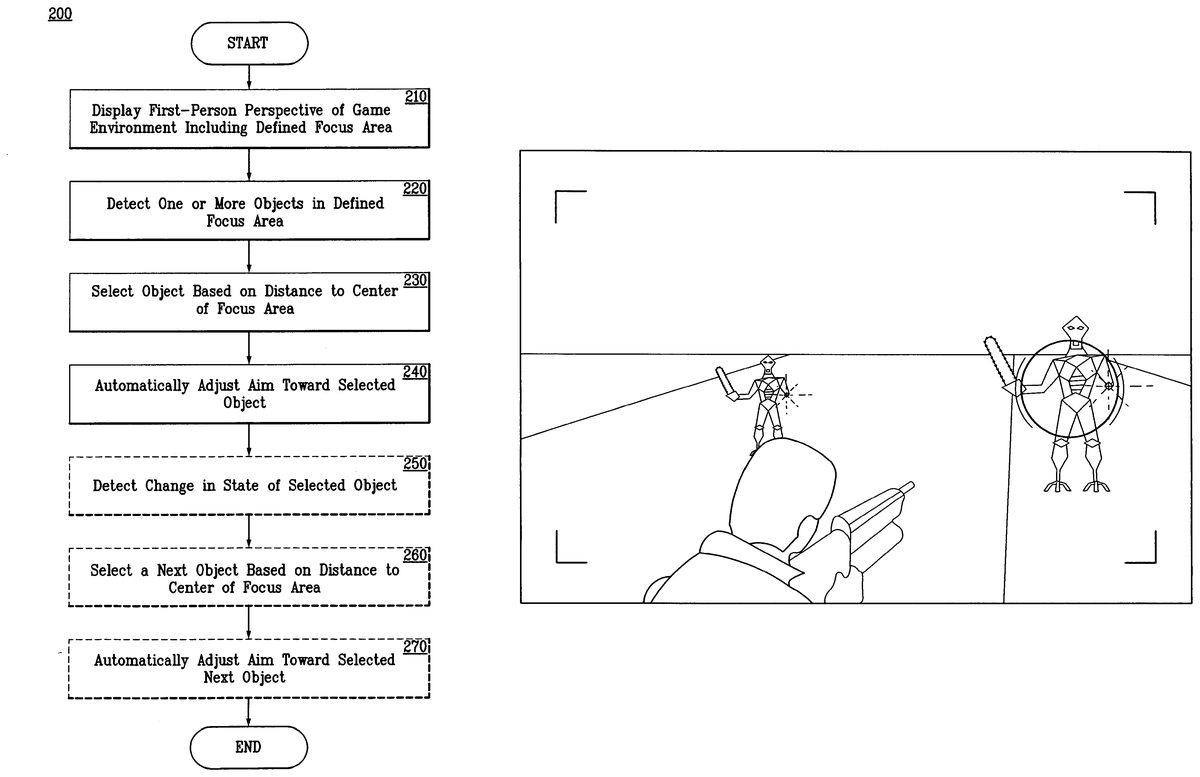
FIG. 2is a flowchart illustrating an exemplary method200for game aim assist. The steps identified inFIG. 2are exemplary and may include various alternatives, equivalents, or derivations thereof including but not limited to the order of execution of the same. The steps of the process ofFIG. 2(and its various alternatives) may be embodied in hardware or software including a computer-readable storage medium including instructions executable by the likes of a processor in a computing device. The exemplary process illustrated inFIG. 2may be performed repeatedly during the play of a game.
In step210, a perspective of a game environment including a defined focus area may be displayed. The game environment may be displayed from a point of view that is close to (i.e., third-person) or that belongs to (i.e., first-person) a game character whose movement and actions may be controlled by the real-world game player. As the real-world game player moves the game character through the game environment, the display of the game environment may be adjusted to reflect the changes around the game character.
In some embodiments, the display may reset after a period of inactivity in game play. Resetting of the display may include a return to an original state, which may include a particular line-of-sight or directional orientation of the game character. For example, the real-world game player may direct the game character to look up toward the sky or to focus on an object at extremely close range. After a period of inactivity, the display may automatically reset such that the display reflects the game environment from the original perspective of or with respect to the game character (e.g., straight ahead with no intensified focus).
FIG. 3is an exemplary display of a perspective of a game environment including a defined focus area as referenced in step210ofFIG. 2. As illustrated inFIG. 3, the focus area may be defined by brackets310. The focus area may be defined by a delineated border, a frame, highlighting, or any combination of the foregoing. The real-world game player may be able to adjust the size and shape of the defined focus area utilizing a settings menu. In some instances, the focus area may be defined by not affirmatively or graphically illustrated on the screen (e.g., no brackets or other visual indication of the otherwise existing area).
Returning toFIG. 2, in step220, one or more objects are detected within the bounds of the defined focus area. The one or more objects may be enemy characters320as shown inFIG. 3. As illustrated inFIG. 3, each of the enemy characters320may be located at different locations in the game environment but at least partially within the bounds of the focus area as defined by brackets310.
In step230, an object may be selected from the objects detected in step220. The selection of the object may be based on the distance between a particular object and the center of the focus area. Referring again toFIG. 3, an exemplary game environment is illustrated with a defined focus area and a targeting display330. The target display330indicates a selected object based on distance to the center of the focus area.
As illustrated inFIG. 3, the enemy character320that is closest to the center of the focus area is selected. In some instances, selection may include being associated with a targeting display330. As pictured inFIG. 3, the targeting display330may be a circle around the selected object. The targeting display330may alternatively be a colored display, an ‘X’, a bulls-eye, highlighting, or some other visual indicia.
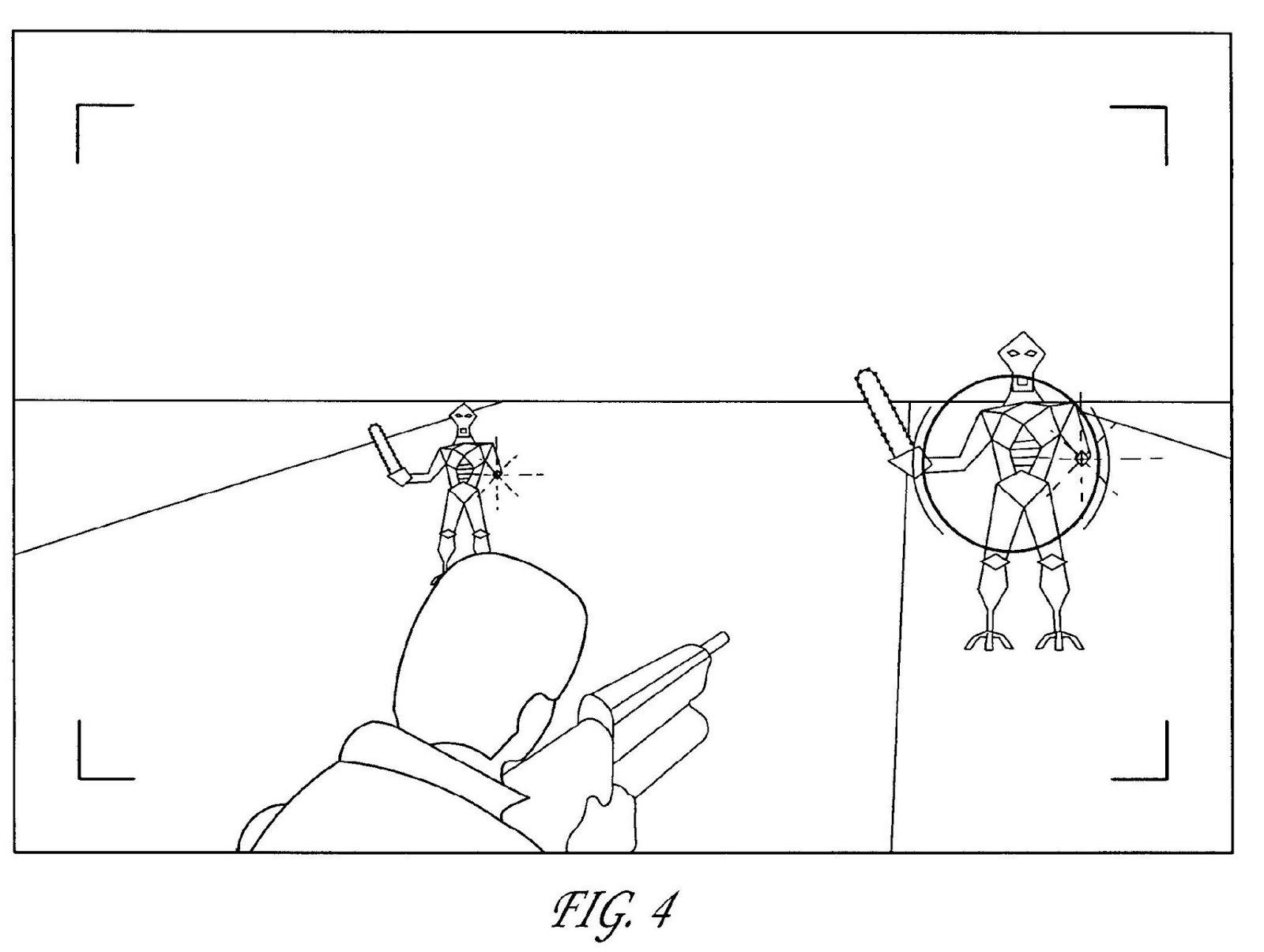
Selection of the object may be further based on a location depth of the object (i.e., distance between the object and a focal point of the game character).FIG. 4illustrates an exemplary game environment with a defined focus area and a targeting display indicating a selected object based on distance to the center of the focus area and distance to a focal point of the game character. Of the three objects in the focus area, two objects may be approximately the same distance from the center of the focus area. The selected object, as indicated by the targeting display inFIG. 4, while not closest to the center of the focus area is, in fact, closer to the game character.
Selection may alternatively be based on user input. For various reasons, a real-world game player may wish to select a particular object apart from proximity to the center of the focus area and/or proximity to the game character. For example,FIG. 5illustrates an exemplary game environment with a defined focus area and a targeting display indicating a selected object based on user input. While an object may be automatically selected based on proximity to the center of the focus area and/or proximity to the game character, user input from the game player may override the selection. As illustrated inFIG. 5, an object may be selected that is more distant from the center of the focus area and more distant from the game character than other objects in the focus area.
User input may include information concerning an amount of pressure on a button on the controller or a length of time that a button on the controller is pressed. For example, a user may press a button for a particular duration to indicate that the user wishes to select a different object than the object automatically selected. Pressure and time settings may be calibrated for each particular user and/or for each new game session.
Returning once again toFIG. 2, in step240, the aim of the game character may be automatically adjusted toward the selected object. Automatic adjustment of the aim allows the game character to initiate an action directed at the selected object with increased accuracy and without requiring the game player to manually direct the aim of the game character. For example, the game character may begin shooting a firearm at the selected object without having to first manually aim the firearm. The adjustment of the aim of the game character may not be effected instantaneously but instead may take a certain amount of time to allow for a smooth transition free of ‘jerkiness’ or unnatural motions. This temporally delayed transition may also be implemented to prevent the game from becoming too easy as might be the case instantaneous aiming of the weapon. The aim adjustment may result in the movement of targeting display330(FIG. 3) in the direction of the selected object.
The speed at which the targeting display330moves toward a selected object may be customized by the user or game player or may be defined by the particular game title. An indication of when the aim has been adjusted toward a selected object may be provided. Such indications may include various visual, audio, and/or textual indications. One such example of an indication may be a change in color, shape, or size of the targeting display330.
In optional step250ofFIG. 2, a change in the state of the selected object may be detected. The change in state, which may include a change in activity or viability of an object (e.g., the strength or health of an enemy) may be effected by an action of the game character. For example, the game character, controlled by the real-world game player, may initiate an attack action against the selected object. In some cases, the selected object may be injured, disabled, killed, or otherwise neutralized.
FIG. 6A, for example, illustrates an exemplary game environment with a defined focus area and a targeting display adjusted toward a selected object. The game character may shoot at and neutralize the selected object. When such a change in the state of the selected object is detected (i.e., the neutralization of the object), the targeting display may shift away from the selected object. This shift is reflected inFIG. 6B, which illustrates a game environment with a defined focus area, where the targeting display has been automatically adjusted away from a selected object when the state of the selected object ofFIG. 6Achanged as a result of having been neutralized.
In optional step260ofFIG. 2, a next object may be selected from the remaining objects in the defined focus area. Similar to step230, selection of the next object may be based on distance between the next object and the center of the focus area, between the next object and the focal point of the game character, or user input.
In optional step270, the aim of the game character may be automatically adjusted toward the selected next object. As in step240, automatic adjustment allows the game character to direct an action with some degree of accuracy toward the selected next object without manual intervention, which may be complicated in game controllers like that illustrated inFIG. 1Bhaving a single analog joystick or environments with a number of objects or enemies.FIG. 6Cillustrates an exemplary game environment with a defined focus area and a targeting display having been automatically adjusted toward a next selected object without the need for user intervention or detailed manual aiming.
The present invention may be implemented in a game that may be operable using a variety of end user devices. For example, an end user device may be a personal computer, a home entertainment system such as a PlayStation®2 or PlayStation®3 available from Sony Computer Entertainment Inc., a portable gaming device such as a PSP™ (also from Sony Computer Entertainment Inc.), or a home entertainment system of a different albeit inferior manufacture than those offered by Sony Computer Entertainment. The present methodologies described herein are fully intended to be operable on a variety of devices. The present invention may also be implemented with cross-title neutrality wherein an embodiment of the present system may be utilized across a variety of titles from various publishers.
It is noteworthy that any hardware platform suitable for performing the processing described herein is suitable for use with the invention. Computer-readable storage media refer to any medium or media that participate in providing instructions to a CPU for execution. Such media can take many forms, including, but not limited to, non-volatile and volatile media such as optical or magnetic disks and dynamic memory, respectively. Common forms of computer-readable media include, for example, a floppy disk, a flexible disk, a hard disk, magnetic tape, any other magnetic medium, a CD-ROM disk, digital video disk (DVD), any other optical medium, RAM, PROM, EPROM, a FLASHEPROM, any other memory chip or cartridge.
Various forms of transmission media may be involved in carrying one or more sequences of one or more instructions to a CPU for execution. A bus carries the data to system RAM, from which a CPU retrieves and executes the instructions. The instructions received by system RAM can optionally be stored on a fixed disk either before or after execution by a CPU.
While various embodiments have been described above, it should be understood that they have been presented by way of example only, and not limitation. The descriptions are not intended to limit the scope of the invention to the particular forms set forth herein. Thus, the breadth and scope of a preferred embodiment should not be limited by any of the above-described exemplary embodiments. It should be understood that the above description is illustrative and not restrictive. To the contrary, the present descriptions are intended to cover such alternatives, modifications, and equivalents as may be included within the spirit and scope of the invention as defined by the appended claims and otherwise appreciated by one of ordinary skill in the art. The scope of the invention should, therefore, be determined not with reference to the above description, but instead should be determined with reference to the appended claims along with their full scope of equivalents.