U.S. Pat. No. 9,295,911
DEVICE FOR THE INTERACTIVE PRACTICE OF VIDEO GAMES
AssigneeBigben Interactive SA
Issue DateSeptember 9, 2013
Illustrative Figure
Abstract
A device for the interactive practice of gymnastics in association with an image and sound system constituting the gymnastics program to be followed by a user. The device includes a platform, a sensor system housed in the platform making it possible to detect the position of the obstacles around the platform, and a connecting system sending the signals coming from the platform sensors to a digital processing unit.
Description
DETAILED DESCRIPTION OF THE DRAWINGS According to an embodiment representedFIG. 1, a device according to an embodiment of the invention is constituted of comprises a platform1having a flat upper portion2supported by four legs3. The device is connected by a bidirectional connecting system4to a digital processing unit5(connected to a display screen6) to which it transmits the signals coming from the device. FIG. 2represents the device according to an embodiment of the invention in perspective. The platform1can be seen, with a flat upper surface2, legs3, on the portion of the platform, a range-finder system6and a lower convex surface7. The flat upper surface2comprises, for example, a surface sensitive to the pressure activated when a user weights on the upper portion of the platform. FIG. 3illustrates a plane cross-sectional view of the upper portion of the platform of the device according to an embodiment of the invention showing the range-finder system. It can be seen on the four sides and the four corners of the platform1, the signal sources8if the infrared range-finder system as well as the associated receivers9. The sources located on the sides are associated with a lens10which diffracts the emitted signal, thus making it possible for the source to cover a more important area, and focus the feedback signal. FIG. 4illustrates the device according to an embodiment of the invention in use, and particularly the positioning of the leg of a user standing on the platform1by range-finders by means of the signal emitted11by the range-finder system6and the signal12reflected by the leg13of the user, to the range-finder system receiver. FIG. 5Arepresents the device according to an embodiment of the invention with the legs removed, and its lower convex surface7resting on the ground. FIG. 5Brepresents the device according to an embodiment of the invention without the legs, and with a user—whose legs13are represented—on ...
DETAILED DESCRIPTION OF THE DRAWINGS
According to an embodiment representedFIG. 1, a device according to an embodiment of the invention is constituted of comprises a platform1having a flat upper portion2supported by four legs3. The device is connected by a bidirectional connecting system4to a digital processing unit5(connected to a display screen6) to which it transmits the signals coming from the device.
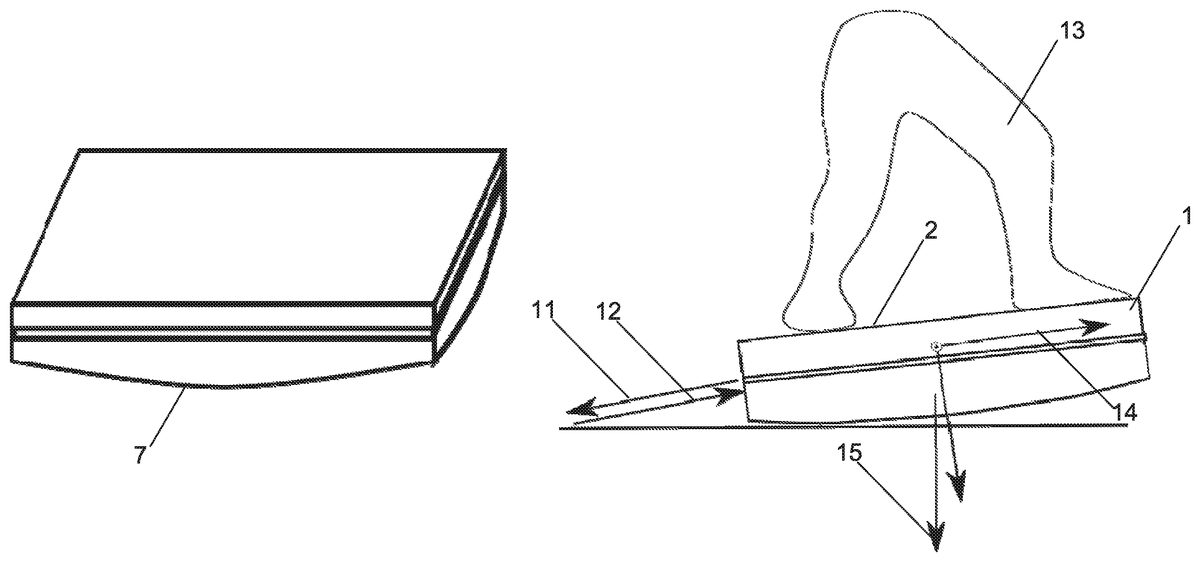
FIG. 2represents the device according to an embodiment of the invention in perspective. The platform1can be seen, with a flat upper surface2, legs3, on the portion of the platform, a range-finder system6and a lower convex surface7. The flat upper surface2comprises, for example, a surface sensitive to the pressure activated when a user weights on the upper portion of the platform.
FIG. 3illustrates a plane cross-sectional view of the upper portion of the platform of the device according to an embodiment of the invention showing the range-finder system. It can be seen on the four sides and the four corners of the platform1, the signal sources8if the infrared range-finder system as well as the associated receivers9. The sources located on the sides are associated with a lens10which diffracts the emitted signal, thus making it possible for the source to cover a more important area, and focus the feedback signal.
FIG. 4illustrates the device according to an embodiment of the invention in use, and particularly the positioning of the leg of a user standing on the platform1by range-finders by means of the signal emitted11by the range-finder system6and the signal12reflected by the leg13of the user, to the range-finder system receiver.
FIG. 5Arepresents the device according to an embodiment of the invention with the legs removed, and its lower convex surface7resting on the ground.
FIG. 5Brepresents the device according to an embodiment of the invention without the legs, and with a user—whose legs13are represented—on the platform. The inclination of the platform is determined at the same time by the obstacle positioning system that detects, via an emitted11and reflected12signal, the proximity with the ground, and also by a system of three orthogonal accelerometers, whereof the three axes14(including two on the plane of the upper surface2of the platform1) are represented, making it possible to evaluate the relative position of the gravity vector15supposed vertical, and hence the inclination of the platform.
According to an embodiment, the signals emitted by the device according to embodiments of the invention will be accompanied by a specific signal making it possible to identify that the emitter of signals is a peripheral device of the same category as the device. Such an identifying signal will make it possible to ensure, in the case of competition or network game systems involving several remote participants that the set of competitors are all provided with a peripheral device of the same type as that of the device according to embodiments of the invention.
According to an embodiment, light-emitting diodes are placed under the upper surface or all along the rim of the platform and indicate to the user, by means of a light signal either the position his/her foot has taken, or, for example in a learning or game framework, the position that it should take. These different features can be managed by means of the image and sound method operating on the digital processing unit to which the device is connected.
The device according to embodiments of the invention can be combined with other interactive accessories that exist for game consoles, and particularly camera type and interactive gamepad accessories. In fact, the device according to embodiments of the invention makes it possible to evaluate the position of the projection of the center of gravity of the user on the upper surface of the platform, be it used as a stable platform or a balance board. This information completes that coming from the peripheral devices of camera and interactive gamepad type establishing a localization of key elements for the user (cutout, position of the hands holding the gamepad . . . ) and makes it possible to evaluate, in combination with the latter and while this is not realizable by any of the indicated peripheral devices on their own, a precise body modelization of the user postures.
Embodiments of the invention described in what precedes by way of example. It is obvious that the skilled person is able to realize the different alternatives of the invention without departing from the scope of the patent.
Claims
- A device for the interactive practice of gymnastics in association with a digital processing unit running a gymnastics program to be followed by a user, the device comprising: a platform including a platform body and one or more removable lets, the platform being provided with a sensor system adapted to detect a position of obstacles around said platform when said one or more removable legs are attached to the platform body, said sensor system being a range-finder system;and an electrical connecting system operably coupling said sensors of said sensor system to said digital processing unit, wherein the position of said obstacles is provided to said digital processing unit, and wherein said platform includes a convex lower portion, and wherein said range-finder system is adapted to indicate an inclination of said platform body by evaluating a distance between said platform body and a ground surface when said one or more removable legs are detached from the platform body.
- The device according to claim 1 , wherein said range-finder system comprises ultrasound, infrared or radio range-finders, or a combination thereof.
- The device according to claim 1 , wherein main axes of the said range-finders are located on a plane parallel with the ground.
- The device according to claim 1 , wherein main axes of said range-finders are directed towards the ground surface, at a defined distance from said platform.
- The device according to claim 1 , wherein said range-finders are positioned at four sides of a smallest rectangle inscribed in an upper surface of said platform.
- The device according to claim 1 , wherein said one or more legs comprises pressure sensors on which the platform body presses.
- The device according to claim 1 , wherein pressure sensors located in the platform body press on said one or more legs of said platform.
- The device according to claim 1 , wherein said platform comprises a system of angle sensors, the angle sensors comprising gyroscopes or accelerometers.
- The device according to claim 1 , wherein said electrical connecting system comprises a bidirectional system for connecting said platform and said digital processing unit.
- The device according to claim 1 , wherein signals emitted by said platform and transmitted by said electrical connecting system comprise a specific signal identifying said device emitting said signals.
- The device according to claim 1 , wherein the sensor system comprises a calibration phase that memorizes closest obstacles around said platform.
- The device according to claim 11 , wherein certain range-finders comprise infrared range-finders placed behind lenses diffracting signals which the range-finders emit and focusing feedback signals.
- The device according to claim 11 , wherein said sensor system is used in order to determine the shape of a foot of a user, pointing facing said platform or sideways, based on said calibration phase.
Disclaimer: Data collected from the USPTO and may be malformed, incomplete, and/or otherwise inaccurate.