U.S. Pat. No. 9,286,767
CHALLENGING PLAYERS IN ONLINE GAME TO COMPETE IN MODULAR GAME
AssigneeZynga Inc.
Issue DateApril 15, 2014
Illustrative Figure
Abstract
Methods, systems, and computer programs are presented for allowing players to challenge other players in an online game to compete by playing a modular game within the online game. One method includes an operation for providing an interface to a first player for challenging a second player to compete in the modular game after detecting completion of the modular game by the first player. The modular game is played within an online game. Further, the method includes operations for sending a challenge to the second player, and for detecting that the second player completed the modular game in response to the challenge. The first player is rewarded a challenge award if the first player obtained a higher score than the second player in the modular game.
Description
DETAILED DESCRIPTION The following embodiments describe methods, devices, systems, and computer programs for playing casino games, more specifically, for playing an online slots game. It will be apparent, that the present embodiments may be practiced without some or all of these specific details. In other instances, well known process operations have not been described in detail in order not to unnecessarily obscure the present embodiments. FIGS. 1A-1Iillustrate the functionality of the slots game, according to several embodiments.FIG. 1Aillustrates the general architecture of the online game. The interactive online game logic provides the logic for executing the online game, including interfaces, features, communications, rewards, paybacks, game behavior, etc. In one embodiment, there is a plurality of slots games associated with the interactive game. The interface provides for a lobby-like access page where the user may select from a plurality of different slots games having different themes. For example, the themes may be from a popular TV show, a popular movie, nature, a children story, etc. In addition, each slots game provides the opportunity to the player to win a bonus game, which is also referred to as a minigame, a module, a modular game, or a supplemental game. When the player wins the bonus, the player enters the modular game, and upon completion of the modular game, the player is rewarded with some asset, which is referred to herein as modular game bonus or minigame bonus. Of course, the reward may be zero if the player loses in the modular game. In other embodiments, the player always gets some reward at the end of the modular game. In one embodiment, the modular game is played within the online game, and the right to play the modular game is won by achieving a requirement in the online game. For example, in a ...
DETAILED DESCRIPTION
The following embodiments describe methods, devices, systems, and computer programs for playing casino games, more specifically, for playing an online slots game.
It will be apparent, that the present embodiments may be practiced without some or all of these specific details. In other instances, well known process operations have not been described in detail in order not to unnecessarily obscure the present embodiments.
FIGS. 1A-1Iillustrate the functionality of the slots game, according to several embodiments.FIG. 1Aillustrates the general architecture of the online game. The interactive online game logic provides the logic for executing the online game, including interfaces, features, communications, rewards, paybacks, game behavior, etc.
In one embodiment, there is a plurality of slots games associated with the interactive game. The interface provides for a lobby-like access page where the user may select from a plurality of different slots games having different themes. For example, the themes may be from a popular TV show, a popular movie, nature, a children story, etc.
In addition, each slots game provides the opportunity to the player to win a bonus game, which is also referred to as a minigame, a module, a modular game, or a supplemental game. When the player wins the bonus, the player enters the modular game, and upon completion of the modular game, the player is rewarded with some asset, which is referred to herein as modular game bonus or minigame bonus. Of course, the reward may be zero if the player loses in the modular game. In other embodiments, the player always gets some reward at the end of the modular game.
In one embodiment, the modular game is played within the online game, and the right to play the modular game is won by achieving a requirement in the online game. For example, in a slots game, the player wins the right to play the modular game when a certain combination of symbols comes up in the slot wheels.
Further, in one embodiment, the initial state of the modular game is independent of a state of progress in the online game, which means that the modular game is initiated always from the same state. This means that when a player challenges another player to play the modular game, the second player will play the same game, although it may vary due to a randomness factor included in a game of chance. However, even when chance is part of the modular game, the odds of winning the modular game are always the same, so when multiple players play the modular game, the odds for winning are the same.
In one embodiment, the modular game is a game that is played with similar conditions (e.g., odds of winning, starting position, difficulty level, etc.) for each of the player that plays the modular game. Therefore, when a player challenges another player, the odds of winning are fair because both players have the same odds. This is different than other competition games where players take turns playing the game. For example, two players playing a chess game will alternate playing, but this is not considered a challenge because every time that a player takes a turn, the position of the board is different, therefore, the odds of winning and the structure of the game at a given turn are different. In a challenge game, the initial state and the odds of winning are the same for both players.
However, chess can also be used as a modular game to challenge another player, if both players are given the same scenario. For example, a challenge game may include a chess problem that includes a chess board and a question, such as “White moves and mates in three moves.” The amount of time required to solve the chess problem is measured, and the player that solves the problem in the least amount of time would be the winner of the challenge.
The minigame accessed when winning the bonus is a modular game, which is different from the slots game, played by the user for a limited amount of time or for a limited number of player actions (e.g., spin the wheels five times). Typically, the player exits the slots game, plays the minigame, and then returns back to the slots game. Some minigames require the player to select objects, and each object provides a mystery reward. Other minigames require spinning different set of wheels, etc. In general, users get excited to play the bonus game because the expected payback for playing the minigame is higher than the payback for playing the regular slots game. Some embodiments of minigames are described in more detail below with reference toFIGS. 4A-4E,5A-5C, and6A-6N. Further, some users enjoy playing minigames because it gives the users a chance to challenge other players.
In one embodiment, each slots game provides minigames that are exclusive to the slots game, but in other embodiments one or more of the minigames may be accessed from two or more of the slots games.
The interactive online game logic interfaces with one or more social networks to gather relationship information for the players of the online game. In addition, the interactive online game logic may also have its own information regarding relationships, established within the game, for the players. Therefore, the first player may have a second player as a friend, where the second player is a friend in the social network of the first player; and the first player may have a third player as a friend, where the first player and the third player are not related in the social network.
A bonus winning logic component manages the logic behind bonus game rewards. The bonus winning logic component manages the odds of winning the bonus, the paybacks for winning the bonus, as well as which type of minigame is played when the bonus is won.
In one embodiment, the bonus winning logic includes playing the slots game using different tiers at different times, where the different tiers provide different odds of winning the bonus in the slots game. More details are provided below regarding the use of tiers inFIGS. 2A and 2B.
The payback control logic manages the average payback over time to the player when playing the online game. In one embodiment, the payback on the game is measured as the ratio of the cost of one bet to the expected return on one bet.
In one embodiment, the player gets paid when winning on the slots game or when winning in the bonus game or when winning a challenge game. The payback control logic manages the paybacks in both aspects of the game in order to keep the payback at a desired level. For example, in one embodiment, the payback is kept at an average of 95% ratio. This means that, over a long period of time, the player will get back about 95% of the money that the player has bet. In other embodiments, different paybacks are possible, such as paybacks in the range of 80% to 100%, although other values are also possible. For example, in one embodiment, the payback may be over 100% if the players play with virtual money and the game is sponsored by a commercial entity, which allows the player to exchange the virtual winnings for some promotional materials.
FIG. 1Bshows a graphical user interface (GUI) for playing an online slots game. It is noted that the embodiments presented herein referred to an online slots game using virtual currency, but the same principles may be applied to real-life money gambling. Of course, the embodiments presented may be applied to real-life money gambling only when their implementation, all or in part, follow the pertinent rules and regulations for real-money gambling. Further, in one embodiment, the slots game includes a random number generator, and for real-money gambling, the random number generator follows the prescribed rules and regulations.
The game illustrated inFIG. 1Bincludes five different wheels, also referred to as reels, and each reel, at the end of each spin, shows three symbols. In other words, there are three rows of symbols: top, middle, and bottom rows. Sometimes, an icon may occupy more than one row, such as the icon on the right wheel ofFIG. 1C. This icon is a large wild icon, which is interpreted as having a wild icon in the top row, a wild icon in the middle row, and a wild icon in the bottom row.
The game provides a chance to win a bonus game when a predetermined combination comes up. In the exemplary embodiment ofFIG. 1D, the winning combination consists of the icon “Bonus” appearing in the center row in wheels 1, 3, and 5. As used herein, the wheels are numbered from 1 to 5 going from left to right. In other embodiments, other combinations or other icons may be used to obtain the bonus. In yet other embodiment, there could be a plurality of different bonuses, and different combinations may be utilized to win one bonus from the plurality of different bonuses.
Embodiments presented herein provide methods for managing the frequency and payback of bonus games. Due to the excitement created when a user wins the bonus, having slots game that provide bonus games more often enhances user enjoyment of the game. However, since bonus games usually result in high paybacks, it is necessary to manage the frequency and payback of bonus games in order to keep the overall payback for the slots game at a desired level.
FIG. 1Eshows a spin resulting in a bonus win because the bonus icons are in the middle row of reels 1, 3, and 5. In addition, the player also has won in the regular slots game, in part due to the wild icon encompassing the three rows of reel number 2.
In one embodiment, players can send gifts to friends in the online game, as illustrated inFIG. 1F. The player may define friends in the online game, or friend information may be obtained from a social network with the permission of the player. When the player selects the send-gifts option, the interface allows the player to select one or more friends from all the friends defined in the social network or in the game (tab “All Friends”), or to select friends defined in the game (tab “Game Friends”), etc.
FIG. 1Gshows an interface provided to the user after a big win. The online game allows the user to share the information with other users, such as on a social network or in some other form, such as a bulletin board for the game, via text or email message, etc.
FIG. 1Hshows the interface for a gift center, where the player can collect gifts from the game or from friends. In one embodiment, the game provides daily gifts (or for some other period) to the player. Then the player may go to the gift center to collect those gifts. In one embodiment, the gifts may be virtual currency (i.e., coins), or free spins on the slots game, or a challenge, etc. The user interface also provides a tab “Results” for checking the history of activities related to gifting.
FIG. 1Iillustrates an interface for gaining special status within the online game. In one embodiment, the special status is called “High Roller.” The interface provides a status bar indicating progress of the player in the online game. In general, the more the player plays, the more the status bar advances. In addition, the status bar may advance due to other social activities performed by the player in the online game, such as inviting friends to play, liking the game on a social network, accepting challenges from friends, sending challenges to friends, sending gifts to friends, playing regularly the online game, looking at promotional offers from sponsors, etc.
As the player advances in the “High Roller” program, the player is given new status badges showing progress. In addition, the program may provide additional gifts and benefits to the player, rewarding the player for playing the slots game.
It is noted that the embodiments illustrated inFIGS. 1A-1Hare exemplary. Other embodiments may utilize different number of wheels, different number of rows visible on the slots game, providing different rewards, utilize a plurality of virtual currencies, utilize real money, etc. The embodiments illustrated inFIGS. 1A-1Hshould therefore not be interpreted to be exclusive or limiting, but rather exemplary or illustrative.
FIG. 2Ais a flowchart of a method for playing bonus games, according to one embodiment. While the various operations in this flowchart are presented and described sequentially, one of ordinary skill will appreciate that some or all of the operations may be executed in a different order, be combined or omitted, or be executed in parallel.
In one embodiment, the slots game includes a plurality of tiers, where each tier has different odds for winning the bonus game. In another embodiment, each of the tiers has a different payback ratio, but it's also possible to have the same payback ratio in each of the tiers.
In one embodiment, the tiers are defined based on the number of times the player has spun the wheels in the slots game since the player started the session, or since the player last won the bonus game. More details regarding tier definition are provided below with reference toFIG. 2B.
In operation202, the player is playing the game in bonus tier 1. In one embodiment, when the player starts playing the slots game, the player starts playing in tier 1, but in other embodiments, the player may start playing the game in other tiers.
From operation202, the method flows to operation204where a check is made to determine if the player has won the bonus while in tier 1. If the player has won the bonus while in tier 1, the method flows to operation214, but if the player has not won the bonus in tier 1, then the method flows to operation206. For example, the player may move to tier 2 after spinning 15 times in tier 1 without winning the bonus, but other number of spins are also possible, as well as some other condition to trigger the change to tier 2 (e.g., a special promotion presented by the game provider).
In operation206, the player plays the slots game with the functionality defined for tier 2. If the player has won the bonus while in tier 2, in operation208, the method flows to operation214, and if the player has not won the bonus while in tier 3, the player moves to operation210to start playing the slots game in tier 3.
In one embodiment, the slots game has three tiers, but other games may have a different number of tiers. In the embodiment described inFIG. 2A, the slots game has three tiers, therefore, the player keeps playing in tier 3 (operation210) until the player wins the bonus, unless the player quits the game before winning the bonus.
When the player wins the bonus in tier 3, or in any other tier as described above, the method flows to operation214where the game checks for what type of bonus the player has won. In one embodiment, the minigames associated with the bonus may be of different types and have different behaviors. In the embodiment ofFIG. 2A, the bonus games are of three types: common bonus, gifting bonus, and challenge bonus.
The common bonus game, in one embodiment, provides a minigame to the player after winning the bonus game. The minigame may be of any kind and be based on chance, or skill (e.g., a memory game). Therefore in operation216, the player plays the common bonus game, collects a reward at the end of the bonus game in operation218, and then the method flows back to operation202, where the player continues playing the game in tier 1. In other words, the spin counter that determines the tiers for the player is reset after winning the bonus.
The gifting bonus provides the player with the opportunity to win virtual currency using free spins on a slots game, which may be the same or different wheels as in the base slots game. Therefore, in operation220the player uses the free spins to win currency, and collects her winnings in operation222. After completion of the gifting bonus, the method flows back to operation202to continue playing the main game in tier 1.
The challenge bonus provides a minigame that requires the user to make selections or to use some other skill. In some challenge games, there is a skill component, such as a challenge game based on memory. Therefore, the result of the challenge bonus is variable. In one embodiment, the results depend on which objects the user selects when given a plurality of options. More details on challenge games are given below with reference toFIGS. 3A-3Cand6A-6N.
After playing the challenge game in operation224, the player collects the rewards from playing the minigame in operation226, and then the game asks the player if the player desires to challenge a friend (see operation228). If the player decides to challenge a friend, the method flows to operation230, and if the player does not desire to challenge a friend the method flows to operation202.
In operation230, the player selects one or more friends for the challenge. When a friend accepts the challenge, the friends play the same challenge minigame as the player, although the setup of the game may be different while keeping the winning odds the same. In one embodiment, the player that gets the most points for playing the challenge game gets an additional reward (e.g., 100 chips). Therefore, the player is motivated to challenge friends because if the friends cannot beat the player, the player will get additional chips. In another embodiment, the player that challenges other players will always get a consolation reward every time a friend plays the challenge game.
From operation230, the method flows to operation232where the challenge is sent to the selected one or more friends. After operation232, the method flows back to operation202where the player resumes to play the slots game in tier-1 mode.
In other embodiments, the bonus game may be awarded after a predetermined number of spins. This way, the player is guaranteed to play a bonus game at least every predetermined number of spins.
In another embodiment, the number of spins between bonus games may be predetermined in advance. For example, a list is defined where each number of the list identifies the number of spins of the wheels between plays of the bonus game. For example, if the list starts with the sequence (20, 35, 15, 45, . . . ), when the player starts playing the slots, the bonus game will be awarded after 20 spins, then, if the player continues playing, another bonus game is awarded after an additional 35 spins, a third bonus game after an additional 15 spins, etc.
In yet another embodiment, the tier may change at each spin. For example, the tier assigned to each spin may be randomized, whereas at each turn, a tier number is assigned with its respective odds for winning the bonus game. This way, the tier may change upwards or downwards during play.
FIG. 2Bis a flowchart of a method for dynamically changing bonus-winning odds, according to one embodiment. In one embodiment, the probability to win the bonus changes depending on how many times the player has spun the wheel since the player started, or since the player last won the bonus.
In one embodiment, the game keeps a spin counter which counts the number of spins of the wheel since the player started the game or since the player won the bonus game. That is, the spin counter is initialized when the game starts and is reinitialized every time the player wins the bonus game.
If the player completes all the spins within a tier without winning, the player is then taken to the next tier (unless the player has reached the last tier). In the next tier, the odds for winning the bonus are improved, in one embodiment.
Initially, the player has a first probability P1 of winning the bonus (e.g., 1/60). This probability P1 stays constant for a fixed number of spins N1 (e.g., 15), unless the player wins the bonus. If the player has not won the bonus after N1 spins, then the player is changed to a new tier and the odds are improved for the player to a new probability P2 (e.g., 1/50) that is better than P1.
In one embodiment, the slots game has three tiers related to bonus rewards, which are defined by the following table.
TABLE 1BonuswinningTierSpinsodds11-151/60216-301/50331 or more1/40
In one embodiment, the online game includes a plurality of variables: the spin count—as described above, the bonus playing tier, the bonus winning odds, and the bonus average payback. The bonus playing tier indicates the tier the player is currently in. The bonus winning odds indicate the probability of winning the bonus, and the bonus average payback indicates the expected value of the payback to the user after playing the minigame.
In one embodiment, the bonus average payback changes according to the tier. For example, the bonus average payback may decrease as the player goes to higher tiers in order to keep the desired payback at the desired level.
In operation252, the variables identified above are reset. In one embodiment, the spin count is set to 0, the bonus playing tier is set to 1, the bonus winning odds are set to 1/60, and the bonus average payback is set to 30%. However, other values are also possible for initializing these variables. When the player starts playing the slots game, the player starts in operation252, and after the player wins the bonus, the player goes back to operation252after playing the minigame.
From operation252, the method flows to operation254where the spin counter is increased each time the player spins the wheels. From operation254, the method flows to operation256where the game spins the wheels.
After spinning the wheels, the method checks, in operation258, if the player has won the bonus. If the player has won the bonus, the method flows to operation260, and if the player has not won the bonus the method flows to operation262.
In operation262, the game checks to see if the player has reached the last spin in the tier before the player is promoted to another tier. In other words, the game checks to see if the spin count is equal to the number defined in the upper range of spins within the tier. Of course, in the last tier the upper level is infinity because there are no more tiers to promote the player to.
From operation262, the method flows to operation264if the player has reached the last spin in the tier, and the method flows to operation252otherwise. In operation264, the game changes tiers for the player. In one embodiment, the tier count variable is incremented, the bonus winning odds are changed in operation266(e.g., from 1/60 to 1/50 when going from tier 1 to tier 2), and the bonus average payback is also changed. In one embodiment, the bonus average payback stays constant. From operation266, the method flows back to operation254to continue playing the slots game.
In operation260, the game provides the minigame to the player and gives the player the reward obtained in the minigame. From operation260, the method flows to operation252where the game is reset, including resetting the variables defined above. For example, the spin counter is reset to 0.
In one embodiment, the game provider wishes to maintain a constant payback over time for players of the game. The payback for the game, also referred to herein as global payback, includes two factors: the payback for playing the slots game (slots_payback), and the payback for playing the bonus games (bonus_payback).
payback=slots_payback+bonus_payback (1)
In one embodiment, the game keeps both slots_payback and bonus_payback constant over time, that is, slots_payback is constant and bonus_payback is constant. For example, a payback of 95% might be divided into 65% payback for playing slots and 30% playback for playing bonus games. For example, in a $10,000 bet, 6500 would be paid back on the base game and 3000 would be paid on the bonus game, on average. However, other values for global payback are also possible, and different splits between slots and bonus paybacks are also possible.
The slots payback is controlled by managing the probabilities associated with the different winning combinations in the slots, and their respective payouts. In one embodiment, the slots payback is controlled by adjusting the number of symbols in each of the reels as well as the frequency of occurrence of the different symbols.
In a computer game, the number of symbols in each reel is not limited physically, as in the case of a real physical slots machine. For example, a physical slots machine may have 22 different stops, which may be weighted. However, an electronic slots game may have reels with hundreds of stops. For example, the number of stops in one reel may be 750, or in the range from 100 to 1000, although other values are also possible.
Managing the slots payback may not require adjustments, because the slots payback is kept constant. However, managing the winning combinations for the bonus games may require adjustments if the odds of winning the bonus changes as the player changes tiers.
In one embodiment, the odds for winning the minigame are changed by increasing the number of bonus symbols in the reels. For example, in a reel with 700 symbols, the game may have a first number of bonus symbols in tier 1, a different number of bonus symbols in tier 2, and yet a different number of bonus symbols in tier 3. For example, the game may start with 75 bonus symbols in the reel in tier 1, increase the number to 175 in tier 2, and increase the number to 350 symbols in tier 3.
In one embodiment, to keep the bonus payback constant, the expected bonus payback is adjusted to compensate for the increase in odds for winning the bonus game. The expected payback may be calculated as follows:
expected payback=probability(winning)×(average reward) (2)
Therefore, if the probability of winning increases, the size of the average win must decrease to keep the expected payback constant. For example, the following table describes the average reward for the different tiers, described above with reference to Table 1, for a one dollar bet.
TABLE 2BonuswinningAverageTierBetoddsrewardPayback1$11/60$18$0.302$11/50$15$0.303$11/40$12$0.30
In other embodiments, the reward distribution may be performed differently across the different tiers. The example of Table 2 provides a constant payback within each tier. However, other embodiments may provide different bonus paybacks in the different tiers, but the overall bonus payback when considering all the tiers, is kept in the desired level (e.g., 30%).
It is noted that the embodiments illustrated inFIGS. 2A and 2Bare exemplary. Other embodiments may utilize different number of tiers, different probabilities, different expected paybacks, etc. The embodiments illustrated inFIGS. 2A and 2Bshould therefore not be interpreted to be exclusive or limiting, but rather exemplary or illustrative.
FIG. 3Ais a flowchart of a method for challenging players in an online game, according to one embodiment. While the various operations in this flowchart are presented and described sequentially, one of ordinary skill will appreciate that some or all of the operations may be executed in a different order, be combined or omitted, or be executed in parallel.
In operation302, the player is playing an online game (e.g., a slots game). Embodiments presented herein are described with reference to a slots game, but the same principles may be utilized for other online games or other computer games.
When the player wins the chance to play the modular game, the method flows to operation304, where the player is able to play the modular game. As a result of playing the modular game, the player will receive a score. The score indicates the degree of success obtained by the player in the modular game. For example, the score of the module game may be one of a raw score number obtained in the game, a number of coins collected, a time spent to complete a task, distance traveled, enemies defeated, etc.
In addition, in one embodiment the player is given other options to get the chance to play the modular game and challenge other players. For example, the player may be able to buy challenges using virtual currency or real currency, or the player may win the opportunity to challenge as an incentive for making a purchase in the online game, or for reaching a milestone in the online game, or as part of a loyalty reward for playing a plurality of days in a row, etc.
The modular game may be of different types, and not necessarily of the same kind as the online game. For example, while playing slots the player may win a chance to play a modular game that is a trivia game (e.g., a trivia game about facts of a movie), or a game of chance but with alternative methods to win coins, or a game of speed (e.g., performing a given task as fast as possible), or solving a puzzle, etc. More details regarding the possible modular games are provided below with reference toFIG. 3C.
After completing the modular game, in operation306the player is given the options to challenge other players. If the player decides to challenge, the method flows to operation308, and if the player skips the options to challenge the method flows back to operation302. In one embodiment, if the player decides not to challenge, a counter indicating the number of challenges available to the player is increased.
In operation308, an interface is provided to the player to select one or more friends to challenge. In one embodiment, the players that can be challenged include friends of the player in a social network or friends of the player in the online game. In another embodiment, the player is also given the option to challenge other people that are not currently friends of the player.
In another embodiment, the player is provided the option to challenge an unknown player (e.g., an open challenge), that is, challenging anyone (e.g., “does anyone want to accept my challenge?). In this case, a board with open challenges is providers to players of the online game, and the players of the online game may access the board to accept challenges from other players, or even to add their own open challenges. In one embodiment, the game may charge the player for posting open challenges (e.g., charging currency against the account of the player).
In one embodiment, the player may choose a jeopardy wager as part of the challenge. This means that when the other player accepts the challenge, a bet is made and the winner of the challenge will win the jeopardy wager from the loser. For example, if the jeopardy wager includes a number of units of currency used in the game, the loser will give the winner the amount of units of currency associated with the jeopardy wager. Further, in one embodiment, the game will charge a wager fee to the winner of the challenge. For example, if the wager fee is 5%, the winner will get 95% of the jeopardy wager, and the game (i.e., “the house”) will get 5% of the jeopardy wager. Other types of wager fees may also be used, such as within the range from 0.5% to 20%.
After the player selects one or more players for the challenge, the game sends the challenge to the selected one or more players. After the challenges are sent in operation308, the method flows back to operation302where the player continues playing the slots game.
If the player receives a notification that the challenge has been completed by another player (operation310), the player is given an option to check the status of the challenge. In operation312a check is made to determine if the player has won the challenge. If the player has not won the challenge the method flows to operation316, an if the player has won the challenge the method flows to operation314.
In operation314, the player collects the reward for winning the challenge. For example, the player may collect a predetermined amount of game currency. In other embodiment, the player also wins some currency even if the player loses. This causes a viral reinforcement so when friends play challenges, the player still gets a reward for the viral interaction even if the player loses.
In another embodiment (not shown), the player is given an option to re-challenge (e.g., double or nothing), where the amount of the reward is doubled and the challenge is re-sent to the other player. The scenario is more likely in games where a wager is placed, as both players have the incentive, and the risk, to replay the challenge.
From operation314, the method flows to operation316where the player is given an option to send a message to the other player. If the player chooses to send a message, the method flows to operation318to send the message, and if the player chooses not to send a message the method flows to operation320, taking the player back to the game.
FIG. 3Bis a flowchart of a method for receiving challenges, according to one embodiment. While the various operations in this flowchart are presented and described sequentially, one of ordinary skill will appreciate that some or all of the operations may be executed in a different order, be combined or omitted, or be executed in parallel.
In operation322, the challenged player plays the slots game. When the player receives the challenge and the player accepts the challenge, the method flows to operation324, where the modular game is played by the challenged player. As a result of playing the modular game, the player receives a score, and in operation326a check is made to determine the winner of the challenge.
If the challenged player has won the challenge, the method flows to operation328where the player collects the challenge reward. If the player has not won the challenge, the method flows to operation330. In another embodiment, a consolation reward is also given to the challenged player when the challenged player loses.
From operation328the method flows to operation330, when an option is presented to the player for sending a message to the challenger. If the player decides not to send a message, the method flows to operation322to go back to playing the slots game. If the player decides to send a message, the method flows to operation332where an interface is provided to enter a message and then send the message to the challenger.
FIG. 3Cis a flowchart of a method for setting up the modular game for the challenge, according to one embodiment. While the various operations in this flowchart are presented and described sequentially, one of ordinary skill will appreciate that some or all of the operations may be executed in a different order, be combined or omitted, or be executed in parallel.
In operation352, the challenged player starts the modular game (i.e., the challenge). In one embodiment, the game sets up the challenge depending on the type of modular game for the challenge. For example, some games will provide an identical scenario to the challenged player, while other games will have different outcomes but with the same probabilities of winning (e.g., both players roll dice and the outcome depends on the points obtained with the dice; although both players may get different rolls of the dice, the odds when rolling the dice are the same for both players).
In operation354, a check is made to determine if the modular game will have an exact same set up as the setup for the challenger when the challenger played the modular game. In the setup is exactly the same, the method flows to operation356and otherwise to operation358.
In operation356, the game provides the challenged player the same exact set up as given to the challenger. For example, a modular game may be a memory game with a plurality of cards face down, and the player has to make pairs of cards by picking up two cards at a time. In this embodiment, the layout of the cards is exactly the same for both players. In another example, the modular game is a trivia game, and the challenged player is given the same questions, in the same order, as the questions given to the challenger. From operation356, the method flows to operation368.
In operation358, a check is made to determine if a “shuffle” is needed. As used herein, a shuffle is referred to herein as the change of a distribution of results for a set of options presented to the player. If a shuffle is required, the method flows to operation360, and if a shuffle is not required the method flows to operation362where the shuffle is done.
The result of the shuffle is a modular game with the same options provided to the challenger but in a different order or layout. For example, the modular game may ask the player to select one hidden prize from a list of 9 choices (see for exampleFIG. 6Iwith options to peak a basket out of nine possible baskets, where each basket covers a different prize to be given when selected).
In the shuffle operation, the prizes associated with each of the choices are redistributed among the choices, where the prizes are the same but associated with different possible picks for the user. From operation360, the method flows to operation368.
In operation362, a check is made to determine if the modular game is a game of chance. As used herein, a game of chance is a game that requires no particular player skills and whose outcome only depends on random events given predetermined winning odds.
If the modular game is a game of chance, the method flows to operation364, and if the modular game is not a game of chance the method flows to operation366. In operation364, the game of chance is set up with the same winning odds as provided to the challenger when the challenger played the modular game. For example, in a slots game, the slots wheels will be set up with the same winning odds as the slots wheels were set for the challenger. From operation364, the method flows to operation368.
In operation366, the game is set up for a skill game, which is a game whose outcome, at least in part, depends on a level of skill of the player. For example, skill games may include trivia games, problem-solving games, puzzles, shooting games, crossword puzzles, games that depend on reaction times, etc.
In one embodiment, the skills game is a trivia game and the skills game is set up with a different set of trivia questions obtains from a database. In other embodiments, other types of tests may be set up for the skills game. In yet another embodiment, the skill game may also be played as an exact same game (e.g., a car race).
From operation366, the method flows to operation368where the challenged player plays the modular game after the setup of the modular game is completed.
It is noted that the embodiments illustrated inFIG. 3Care exemplary. Other embodiments may utilize different types of modular games, have additional types of modular games, combine multiple setup operations (e.g., shuffle some choices and get new trivia questions), etc. The embodiments illustrated inFIG. 3Cshould therefore not be interpreted to be exclusive or limiting, but rather exemplary or illustrative.
FIGS. 4A-4Eillustrate different stages while playing a common bonus game, according to one embodiment.FIG. 4Ashows the image of the display presented to the player after the player has won the bonus game. The interface presents the name of the minigame and gives instruction to the player on how to play the game. In the example shown inFIG. 4A, the slots game has a theme related to the movie “The Wizard of Oz,” and the name of the minigame is “The man behind the curtain.” In addition, a play button is presented so the player can start the minigame.
FIG. 4Bis an image from the paytable interface within the slots game. In one embodiment, the paytable may be accessed from the minigame or from the slots game. The instructions to play the minigame recite, “Pick wizards to reveal either a coin value, one of 4 high-value Gifts (Diploma, Heart Watch, Ruby Slippers or Courage Metal), or the Which. Each gift fills a slot on the Oz meter. Find all 4 to get an extra bonus in the Professor's machine! Picking the Witch ends the bonus.”
FIG. 4Cshows a choice given to the player to select one from three knockers on a door to start the minigame. After the player selects one of the knockers, the minigame starts as shown inFIG. 4D. A matrix of choices is presented to the player, as described above in the instructions.
After the minigame ends, the results are presented to the player, as seen inFIG. 4E. The reward, i.e., Bonus Win, is presented to the user (e.g., 2175), and a button is provided for the user to collect her winnings. After the player collects the winnings, the game returns to the main game for playing slots.
FIGS. 5A-5Cillustrate different stages while playing a gifting bonus game, according to one embodiment. In the gifting bonus, the player gets free spins, or some other free chance game that provides rewards. InFIG. 5A, the game presents the minigame to the player, after the player wins the bonus in the slots game. The player is given 5 free spins, and a play button is provided to start the minigame.
FIG. 5Bis an instructions page from the paytable help page. The name of the minigame is “Glinda's Three Spins.” The instructions recite, “Take 5 free spins. A vertical Wild is active on reel5for the first spin, and moves one reel left with each spin. The game ends when there are no more spins.
FIG. 5Cillustrates a capture of the game described with reference toFIG. 5B. After the player uses up all the free spins, a results page is presented with the total winnings. After the player collects the reward, the game returns to the main game for playing slots.
FIGS. 6A-6Nillustrate different stages while playing a challenge bonus game, according to one embodiment.FIG. 6Ashows the welcome page for the challenge game. The name of this minigame is “The yellow brick road.” A message in the page indicates that the player gets3extra picks if the player meets the goals.
FIG. 6Bshows the instructions page for this game. The instructions recite, “Pick 3 Emeralds to reveal coin values. If their total value reaches the goal amount of the first Progressive award, pick 3 more Emeralds. Keep going until you reach the final Jackpot, or don't reach the next goal. Collect the Progressive award reached!”
After the player selects the play button ofFIG. 6A, the player is taken to an interface for selecting emeralds, as shown inFIG. 6C.FIG. 6Dillustrates the minigame after the player has selected 3 different emeralds.
After the player completes the minigame, the player is given the reward for playing the minigame (not shown), and then the game asks the player if the player wishes to challenge friends.FIG. 6Eillustrates an interface for selecting whether to challenge or not. In the embodiment ofFIG. 6E, the player is presented with the score that the player obtained while playing the game. In addition, the game indicates that the player will win hundred coins for every friend the player outscores while playing this challenge. If the player selects the challenge button, then the interface shown inFIG. 6Fis presented; otherwise, the player is taken back to the main slots game.
If the player selects to challenge, the player may select one or more friends as shown inFIG. 6F. The player is given the option of selecting friends from all the friends of the player, in the social network and in the game, or selecting friends from the slots game. After the player selects one or more friends, the player may press the button “Select and Send” to send the challenge to the selected friends.
When a friend receives the challenge, if the friend accepts the challenge the friend is taken to the minigame, as shown inFIG. 6A. At the end of the challenge, the interface will let the friend know if the friend has beaten the challenger. If the friend beats the challenger, then the friend wins another 100 chips.
Further, when a challenged player completes the challenge, the challenger receives a notification. If the challenged player did not beat the challenger, the challenger will get the additional reward (e.g., 100 chips).
FIG. 6Gillustrates a modular game that combines the chance of winning by spinning the slots wheels and by performing selections from a plurality of hidden rewards. In this game, the option to pick a prize or bonus from the baskets is only given when a certain combination comes up after spinning the wheels (e.g., a basket symbol appears in one or more of the wheels).
If the basket shows up, an interface to pick a basket is provided, as illustrated inFIG. 6H. Behind each basket there is a prize, such as a number of coins, additional spins of the wheels, increase in the multiplier for a winning combination, etc. In one embodiment, the prizes behind each basket are the same for the challenger and the challenged player, but the prizes are shuffled, i.e., the prizes are not in exactly the same positions (unless of course, the result of the shuffle is exactly the same combination, which may occur with a very low probability).
After the player clicks one of the baskets, the prize is revealed (e.g., three additional free spins), as illustrated inFIG. 6I. The player is then taken back to the interface for playing the slots, with the three additional spins. The player will play the slots until the player runs out of spins. Of course, if the basket symbol shows up again in any of the wheels, the interface to pick up a basket will be presented again, but the basket already selected will not be available as a choice.
After the player runs out of spins, the game ends and the player is awarded the bonus win based on the results of spinning the wheels.FIG. 6Jis a screen illustrating a bonus collection interface after the completion of the modular game. In this case, the player has won 695 coins, which will be added to the account of the player. In other embodiments, other types of rewards may be awarded, such as an increase in the game score, a new tool, a new weapon, gain access to a new game feature (e.g., a new world), etc.
After the player collects the rewards of the modular game, the player is given the option to challenge another player, unless the player played the modular game as a challenge.FIG. 6Killustrates an interface for challenging another player. The player is given the score obtained in the modular game, to assist in deciding if the player wants to challenge another player. A challenge button is provided, and if the player selects the challenge button, the player is taken to another interface (such as the one inFIG. 6F) to select the one or more players to challenge.
In another embodiment (not shown), the player is given the option to challenge other players that are not friends of the player, that is, challenging anyone that plays the online game.
In yet another embodiment (not shown), the player is given the option to enter a wager amount for the challenge to bet against the challenged player in the modular game. In one embodiment, a wager fee is discounted from the winner of the challenge, where the wager fee is a percentage of the wager amount.
When the player wins a chance to challenge other players (i.e., the player wins a “challenge”) the player may challenge right away or postpone the challenge until a later time. In one embodiment, an interface to track challenges is provided, as illustrated inFIG. 6L. In one embodiment, the interface lets the player know how many challenges are available, how to check for pending challenges, and the results of completed challenges.
In one embodiment (not shown), a leaderboard for challenges is provided by the game. The leaderboard keeps track of the accumulated score of a player when playing challenges, and the leaderboard includes the player and friends of the player in a social network or in the game. In one embodiment, the leaderboard is used to get additional awards to the leaders, such as getting a super bonus to the weekly winner, or a super challenge, etc. The leaderboard may be reset periodically, such as daily, weekly, monthly, yearly, etc. etc.
FIG. 6Mshows an interface presented after a player completes a challenge. The result of the challenge is presented, whether the challenged player won or lost. If the challenged player won, then the challenged player gets the challenge bonus. In this exemplary interface, a text input box is also provided to send a message to the other player or to share the good news on the social network.
FIG. 6Nshows the interface presented to the challenger, after the challenger is notified that the challenge has been completed by the challenged player. In this case, the challenger did not win so the challenger is informed that the friend won the challenge bonus. The scores for both players are also presented.
In another embodiment (not shown), an additional option is provided to send a new challenge to the second player if the second player won the challenge. In other words, the user is able to re-challenge the other player (e.g., double or nothing). Sometimes, the user may incur a cost (e.g., game currency) to be able to re-challenge, or one of the challenges available to the player is spent to re-challenge.
In yet another embodiment, the game keeps track of the head-to-head challenges between two players and gives a tally of the results. For example, at the end of one challenge the game may display “Your overall score of challenges with John is 5-3.” The tally may keep track of all the challenges between the two players, and the score in head-to-head may be the result of a lifetime of challenges, or the result for a period of time (e.g., in the current month). Thus, the head-two-head score may be reset periodically.
FIGS. 7A-7Bshow the paytable, according to one embodiment. The paytable option may be selected by the player while playing the slots game. This is a help menu that describes instructions for playing the game, including the combinations for winning, and the instructions for the minigames, as previously described.
FIG. 7Adescribes some special icons used in the slots game, such as the wildcard and the bonus game. On the right part ofFIG. 7A, a description is provided regarding the winning combinations in the slots game. The instructions recite, “Win combinations must appear on a single payline starting with the left most reel.” For each of the icons in a winning combination, a number is provided regarding the winnings for matching 3, 4, or 5 symbols.
FIG. 7Billustrates the different paylines for each bet. In one embodiment, each time the player spins, the player bets on 30 paylines, as shown inFIG. 7B. Each payline includes one symbol from each reel, where the symbol can be from the top, metal, or bottom row. Each payline is different, and at the end of each spin, the game presents the winning paylines to the player, if any.
FIG. 8Ais a flowchart of a method for challenging players in an online game, according to one embodiment. While the various operations in this flowchart are presented and described sequentially, one of ordinary skill will appreciate that some or all of the operations may be executed in a different order, be combined or omitted, or be executed in parallel.
In operation802, an interface is provided to a first player for challenging a second player to compete in a modular game after detecting completion of the modular game by the first player, the modular game being played within an online game (see for exampleFIG. 6K).
From operation802, the method flows to operation804where the challenge is sent to the second player if the first player decided to challenge. From operation804, the method flows to operation806for detecting that the second player completed the modular game in response to the challenge. The game then determines who the winner of the challenge is and, in operation808, if the first player obtained a higher score than the second player in the modular game then the first player is awarded a challenge award.
FIG. 8Bis a flowchart of a method for adjusting the bonus winning odds, according to one embodiment. While the various operations in this flowchart are presented and described sequentially, one of ordinary skill will appreciate that some or all of the operations may be executed in a different order, be combined or omitted, or be executed in parallel.
In operation822, user input is received during a session of the online slots game, the user input defined to spin wheels of the online slots game. From operation822, the method flows to operation824for defining an initial tier and one or more additional tiers for play of the online slots game during the session. Each tier is assigned an odds value that increases with each assigned tier, and each tier is defined to have a predefined set of spins.
Further, from operation824, the method flows to operation826where tiers with increased odds are assigned when an option to play a bonus game is not presented during the predefined set of spins for each tier. Further yet, from operation826the method flows to operation828for re-assigning the initial tier upon determining that the bonus game was played during the session.
FIG. 9Ais a Graphical User Interface (GUI) for playing a slots game, according to one embodiment. As used herein, a “friend” of a player refers to a person that has established a social link with the player in the game. For example, a first player has invited a second player to be “buddies” or “friends” in the game, and the second player has accepted, which makes them “friends” in the game. In other embodiments, the friendship in the game is established via a social network, such that friends of the player in the social network become friends of the player in the online game. It is noted that although two persons may be friends in real life, if the two persons have not established a friendship relationship online, they will not be considered friends in the online game. Of course, if two persons do not know each other in real life, and they do not have an online friendship relationship, the two persons will not be friends in the game.
It is also noted that the embodiments described herein are described with reference to the slots online game, but the principles may be utilized in other gambling online games, as well as in gambling real-life games. The embodiments described herein should therefore not be interpreted to be exclusive or limiting, but rather exemplary or illustrative.
The game interface display102includes a slots-playing area, and overhead selection buttons104. The GUI includes a lobby, where the player may select one of several rooms for playing slots games. The rooms have different themes, such as underwater world, desert, city, tropical paradise, battle zone, animal reserve, etc. There could be several instances of a theme, so there may be several rooms with the same theme. Once the player selects a room, the player is presented GUI102to play slots, such as the one shown inFIG. 9A.
There are players going in and out of the slots rooms. There is a lobby, and the player may select from different rooms. For example, there is an underwater room, a desert room, a jungle room, etc. There could be several instances of a room with, for example, 100 people or more.
The slots-playing area includes slot wheels136, a chat area122, and buttons and counters related to the betting in the slots game. The wheels136spin when the player presses (e.g., clicks on) the spin button128. The player is able to enter the amount of lines126to bet on each wheel spin. Each line includes a different combination of locations within each wheel. For example, one line may include the five locations across the center line, while other lines may form different combinations of locations, such as the top location on the first three wheels, followed by the center location on the fourth wheel, and followed by the bottom location on the fifth wheel.
In bet field124the player enters the amount being bet for each line, and the total bet field134indicates the total amount bet in the current spin. Counter142indicates the amount of currency owned by the player for placing bets in the slots game. The total bet amount is equal to the number of lines126times the bet per line124. A maximum lines button130provides a shortcut to the player for betting the maximum number of lines. When the player gets a winning combination of the wheels, the total win field132indicates the amount won. The chat area122allows players in the same room to exchange messages with each other or with the whole community in the room.
It is noted that the embodiments illustrated inFIG. 9Aare exemplary. Other embodiments may utilize different layouts, adventure games, game themes, betting mechanisms, etc. The embodiments illustrated inFIG. 9Ashould therefore not be interpreted to be exclusive or limiting, but rather exemplary or illustrative.
FIG. 9Billustrates an interface for playing a game in a mobile device, according to one embodiment. Once the player selects a theme machine, the player is presented a GUI902to play slots, such as the one shown inFIG. 9B. On the top, the jackpot amount904is displayed. The total amount of currency to bet in the game is presented in field906, and a progress bar908shows the progress made by the player in the current machine. The progress bar908also includes a number of stars earned in the theme machine.
The wheels910spin when the player presses the spin button916. The player is able to enter the amount of lines912being bet on every time the wheels spin. Each of the lines includes a different combination of symbols from the wheels. For example, one line may include the five symbols across the center line, while other lines may form different combinations of symbols, such as the top symbol on the first three wheels, followed by the center symbol in the fourth wheel, and followed by the bottom symbol in the fifth wheel.
In one embodiment, the player must get a specific combination of the wheels to win the jackpot or to win the bonus game. For example, the player must get five “jackpot” symbols across the center line. This means that the jackpot is a random event-based on the probability of obtaining the “jackpot” symbol in each of the wheels. Therefore, in one embodiment, the jackpot is based on luck and not based on other factors, such as when the jackpot reaches a certain value.
In another embodiment, the jackpot size may be also based on other factors besides the probability of the wheels, and the probability to win the jackpot may change when the jackpot reaches a certain size, or a certain age (e.g., elapsed since the jackpot was initialized), etc.
In bet field914the player enters the amount being bet for each line, and the total bet field920indicates the total amount bet in the current spin. The total bet amount is equal to the number of lines912times the bet per line $125. A maximum lines button918provides a shortcut to the player for betting the maximum number of lines.
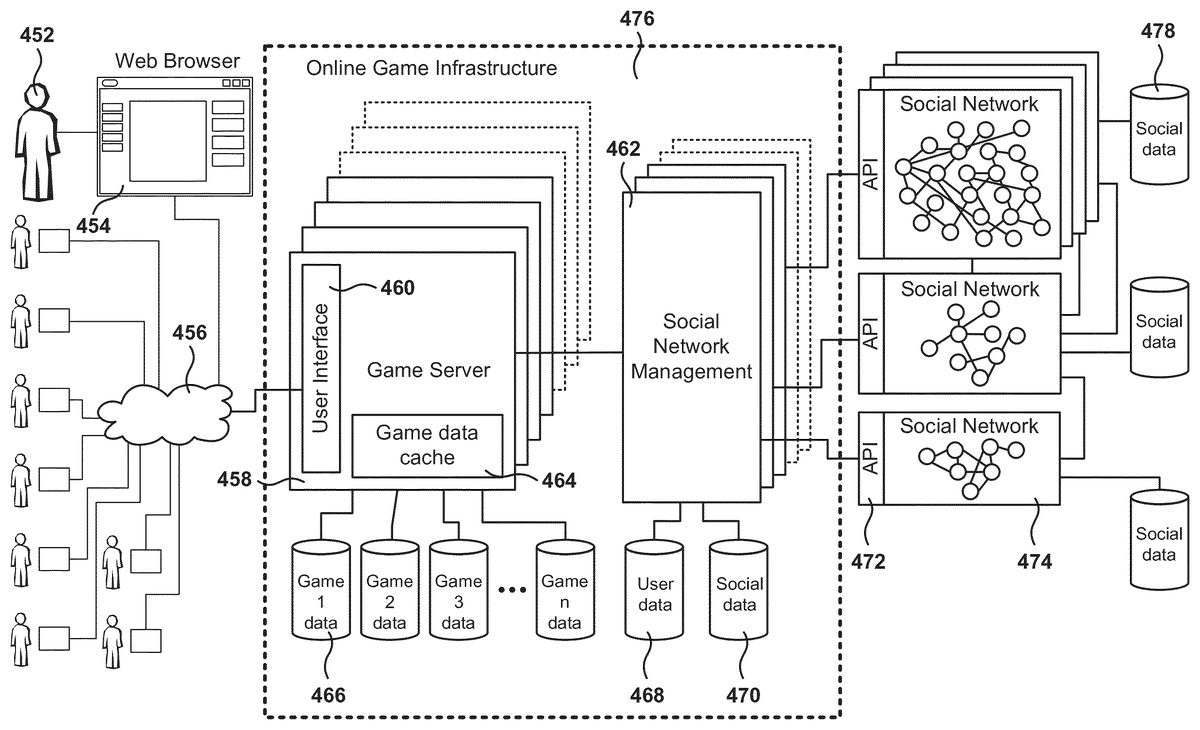
FIG. 10illustrates an implementation of an online game infrastructure, according to one embodiment. The online game infrastructure476includes one or more game servers458, web servers (not shown), one or more social network management servers462, and databases to store game related information. In one embodiment, game server458provides a user interface460for players452to play the online game. In one embodiment, game server458includes a Web server for players452to access the game via web browser454, but the Web server may also be hosted in a server different from game server458. Network456interconnects players452with the one or more game servers458.
Each game server458has access to one or more game databases466for keeping game data. In addition, a single database can store game data for one or more online games. Each game server458may also include one or more levels of caching. Game data cache464is a game data cache for the game data stored in game databases466. For increased performance, caching may be performed in several levels of caching. For instance, data more frequently used is stored in a high priority cache, while data requiring less access during a session will be cached and updated less frequently.
The number of game servers458changes over time, as the gaming platform is an extensible platform that changes the number of game servers according to the load on the gaming infrastructure. As a result, the number of game servers will be higher during peak playing times, and the number of game servers will be lower during off-peak hours. In one embodiment, the increase or decrease of bandwidth is executed automatically, based on current line usage or based on historical data.
One or more social network management servers462provide support for the social features incorporated into the online games. The social network management servers462access social data478from one or more social networks474via Application Programming Interfaces (API)472made available by the social network providers. Each social network474includes social data478, and this social data478, or a fraction of the social data, is made available via API472. As in the case of the game servers, the number of social network management servers462that are active at a point in time changes according to the load on the infrastructure. As the demand for social data increases, the number of social network management servers462increases. Social network management servers462cache user data in database468, and social data in database470. The social data may include the social networks where a player is present, the social relationships for the player, the frequency of interaction of the player with the social network and with other players, etc. Additionally, the user data kept in database468may include the player's name, demographics, e-mail, games played, frequency of access to the game infrastructure, etc.
It is noted that the embodiment illustrated inFIG. 10is an exemplary online gaming infrastructure. Other embodiments may utilize different types of servers, databases, APIs, etc., and the functionality of several servers can be provided by a single server, or the functionality can be spread across a plurality of distributed servers. The embodiment illustrated inFIG. 10should therefore not be interpreted to be exclusive or limiting, but rather exemplary or illustrative.
FIG. 11illustrates an example network environment550suitable for implementing embodiments. Network environment550includes a network560coupling one or more servers570and one or more clients580to each other. In particular embodiments, network560is an intranet, an extranet, a virtual private network (VPN), a local area network (LAN), a wireless LAN (WLAN), a wide area network (WAN), a metropolitan area network (MAN), a portion of the Internet, another network, or a combination of two or more such networks560.
One or more links552couple a server570or a client580to network560. In particular embodiments, one or more links552each includes one or more wired, wireless, or optical links552. In particular embodiments, one or more links552each includes an intranet, an extranet, a VPN, a LAN, a WLAN, a WAN, a MAN, a portion of the Internet, or another link552or a combination of two or more such links552.
Each server570may be a stand-alone server or may be a distributed server spanning multiple computers or multiple datacenters. Servers570may be of various types, such as, for example and without limitation, community server, web server, news server, mail server, message server, advertising server, file server, application server, exchange server, database server, or proxy server. Each server570may include hardware, software, embedded logic components, or a combination of two or more such components for carrying out the appropriate functionalities implemented or supported by server570. For example, a web server is generally capable of hosting websites containing web pages or particular elements of web pages. More specifically, a web server may host HyperText Markup Language (HTML) files or other file types, or may dynamically create or constitute files upon a request, and communicate them to clients580in response to Hypertext Transfer Protocol (HTTP) or other requests from clients580. A mail server is generally capable of providing electronic mail services to various clients580. A database server is generally capable of providing an interface for managing data stored in one or more data stores.
In particular embodiments, one or more data storages590may be communicatively linked to one or more severs570via one or more links552. Data storages590may be used to store various types of information. The information stored in data storages590may be organized according to specific data structures. In particular embodiments, each data storage590may be a relational database. Particular embodiments may provide interfaces that enable servers570or clients580to manage, e.g., retrieve, modify, add, or delete, the information stored in data storage590.
In particular embodiments, each client580may be an electronic device including hardware, software, or embedded logic components or a combination of two or more such components and capable of carrying out the appropriate functionalities implemented or supported by client580. For example and without limitation, a client580may be a desktop computer system, a notebook computer system, a notebook computer system, a handheld electronic device, or a mobile telephone. A client580may enable a network player at client580to access network580. A client580may enable its player to communicate with other players at other clients580. Further, each client580may be a computing device, such as a desktop computer or a work station, or a mobile device, such as a notebook computer, a network computer, or a smart telephone.
In particular embodiments, a client580may have a web browser582, such as Microsoft Internet Explorer, Google Chrome, Or Mozilla Firefox, and may have one or more add-ons, plug-ins, or other extensions. A player at client580may enter a Uniform Resource Locator (URL) or other address directing the web browser582to a server570, and the web browser582may generate a Hyper Text Transfer Protocol (HTTP) request and communicate the HTTP request to server570. Server570may accept the HTTP request and communicate to client580one or more Hyper Text Markup Language (HTML) files responsive to the HTTP request. Client580may render a web page based on the HTML files from server570for presentation to the user. The present disclosure contemplates any suitable web page files. As an example and not by way of limitation, web pages may render from HTML files, Extensible Hyper Text Markup Language (XHTML) files, or Extensible Markup Language (XML) files, according to particular needs. Such pages may also execute scripts such as, for example and without limitation, those written in Javascript, Java, Microsoft Silverlight, combinations of markup language and scripts such as AJAX (Asynchronous Javascript and XML), and the like. Herein, reference to a web page encompasses one or more corresponding web page files (which a browser may use to render the web page) and vice versa, where appropriate.
Web browser582may be adapted for the type of client580where the web browser executes. For example, a web browser residing on a desktop computer may differ (e.g., in functionalities) from a web browser residing on a mobile device. A user of a social networking system may access the website via web browser582.
FIG. 12illustrates an example computer system650for implementing embodiments. In particular embodiments, software running on one or more computer systems650performs one or more operations of one or more methods described or illustrated herein or provides functionality described or illustrated herein. Although methods for implementing embodiments were described with a particular sequence of operations, it is noted that the method operations may be performed in different order, or the timing for the execution of operations may be adjusted, or the operations may be performed in a distributed system by several entities, as long as the processing of the operations are performed in the desired way.
As example and not by way of limitation, computer system650may be an embedded computer system, a system-on-chip (SOC), a single-board computer system (SBC) (such as, for example, a computer-on-module (COM) or system-on-module (SOM)), a desktop computer system, a laptop or notebook computer system, an interactive kiosk, a mainframe, a mesh of computer systems, a mobile telephone, a personal digital assistant (PDA), a server, or a combination of two or more of these. Where appropriate, computer system650may include one or more computer systems650; be stand-alone or distributed; span multiple locations; span multiple machines; or reside in a cloud, which may include one or more cloud components in one or more networks. The one or more computer systems650may perform in real time or in batch mode one or more operations of one or more methods described or illustrated herein.
In particular embodiments, computer system650includes a processor652, memory654, storage656, an input/output (I/O) interface658, a communication interface660, and a bus662. Although this disclosure describes and illustrates a particular computer system having a particular number of particular components in a particular arrangement, embodiments may be implemented with any suitable computer system having any suitable number of any suitable components in any suitable arrangement.
In particular embodiments, processor652includes hardware for executing instructions, such as those making up a computer program. As an example and not by way of limitation, to execute instructions, processor652may retrieve (or fetch) the instructions from an internal register, an internal cache, memory654, or storage656; decode and execute them; and then write one or more results to an internal register, an internal cache, memory654, or storage656. The present disclosure contemplates processor652including any suitable number of any suitable internal registers, where appropriate. Where appropriate, processor652may include one or more arithmetic logic units (ALUs); be a multi-core processor; or include one or more processors652. Although this disclosure describes and illustrates a particular processor, this disclosure contemplates any suitable processor.
In particular embodiments, memory654includes main memory for storing instructions for processor652to execute, or data that can be manipulated by processor652. As an example and not by way of limitation, computer system650may load instructions from storage656or another source (such as, for example, another computer system650) to memory654. Processor652may then load the instructions from memory654to an internal register or internal cache. During or after execution of the instructions, processor652may write one or more results (which may be intermediate or final results) to the internal register or internal cache. Processor652may then write one or more of those results to memory654. One or more memory buses (which may each include an address bus and a data bus) may couple processor652to memory654. Bus662may include one or more memory buses, as described below. One or more memory management units (MMUs) reside between processor652and memory654and facilitate accesses to memory654requested by processor652. Memory654includes random access memory (RAM).
As an example and not by way of limitation, storage656may include a Hard Disk Drive (HDD), a floppy disk drive, flash memory, an optical disc, a magneto-optical disc, magnetic tape, or a Universal Serial Bus (USB) drive or a combination of two or more of these. Storage656may include removable or non-removable (or fixed) media, where appropriate. In particular embodiments, storage656includes read-only memory (ROM). Where appropriate, this ROM may be mask-programmed ROM, programmable ROM (PROM), erasable PROM (EPROM), electrically erasable PROM (EEPROM), electrically alterable ROM (EAROM), or flash memory or a combination of two or more of these.
In particular embodiments, I/O interface658includes hardware, software, or both providing one or more interfaces for communication between computer system650and one or more I/O devices. One or more of these I/O devices may enable communication between a person and computer system650. As an example and not by way of limitation, an I/O device may include a keyboard, keypad, microphone, monitor, mouse, printer, scanner, speaker, still camera, stylus, tablet, touch screen, trackball, video camera, another suitable I/O device or a combination of two or more of these.
Communication interface660includes hardware, software, or both providing one or more interfaces for communication between computer system650and one or more other computer systems650on one or more networks. As an example and not by way of limitation, communication interface660may include a network interface controller (NIC) or network adapter for communicating with an Ethernet or other wire-based network or a wireless NIC (WNIC) or wireless adapter for communicating with a wireless network, such as a WI-FI network. As an example, computer system650may communicate with a wireless PAN (WPAN) (such as, for example, a BLUETOOTH WPAN), a WI-FI network, a WI-MAX network, a cellular telephone network (such as, for example, a Global System for Mobile Communications (GSM) network), or other suitable wireless network or a combination of two or more of these.
In particular embodiments, bus662includes hardware, software, or both coupling components of computer system650to each other. As an example and not by way of limitation, bus662may include an Accelerated Graphics Port (AGP) or other graphics bus, an Enhanced Industry Standard Architecture (EISA) bus, a front-side bus (FSB), a HYPERTRANSPORT (HT) interconnect, an Industry Standard Architecture (ISA) bus, an INFINIBAND interconnect, a low-pin-count (LPC) bus, a memory bus, a Micro Channel Architecture (MCA) bus, a Peripheral Component Interconnect (PCI) bus, a PCI-Express (PCI-X) bus, a serial advanced technology attachment (SATA) bus, a Video Electronics Standards Association local (VLB) bus, or another suitable bus or a combination of two or more of these. Bus662may include one or more buses662, where appropriate. Although this disclosure describes and illustrates a particular bus, this disclosure contemplates any suitable bus or interconnect.
Herein, reference to a computer-readable storage medium encompasses one or more non-transitory, tangible computer-readable storage media possessing structure that may store a computer program or data. As an example and not by way of limitation, a computer-readable storage medium may include a semiconductor-based or other integrated circuit (IC) (such, as for example, a field-programmable gate array (FPGA) or an application-specific IC (ASIC)), a hard disk, an HDD, a hybrid hard drive (HHD), an optical disc, an optical disc drive (ODD), a magneto-optical disc, a magneto-optical drive, a floppy disk, a floppy disk drive (FDD), magnetic tape, a holographic storage medium, a solid-state drive (SSD), a RAM-drive, a Secure Digital card, a Secure Digital drive, or another suitable computer-readable storage medium or a combination of two or more of these, where appropriate. Herein, reference to a computer-readable storage medium excludes any medium that is not eligible for patent protection under 35 U.S.C. §101.
One or more embodiments can also be fabricated as computer readable code on a non-transitory computer readable medium. Herein, reference to software may encompass one or more applications, bytecode, one or more computer programs, one or more executables, one or more instructions, logic, machine code, one or more scripts, or source code, and vice versa, where appropriate.
The present disclosure encompasses all changes, substitutions, variations, alterations, and modifications to the example embodiments herein that a person having ordinary skill in the art would comprehend.
Claims
- A method comprising: detecting completion by a first player of a modular game played within an online game, the first player obtaining a first score in the modular game;obtaining a list of friends of the first player in a social network utilizing an application programming interface (API) to access the social network;providing an interface to the first player for challenging a second player to compete by playing the modular game after detecting the completion of the modular game by the first player, the interface presenting one or more of the friends of the first player in the social network for selection by the first player;sending a challenge to the second player selected by the first player, wherein sending the challenge to the second player includes shuffling locations of rewards associated with possible choices within the modular game, wherein the locations of the rewards are different when the first player and the second player play the modular game;detecting that the second player completed playing the modular game in response to the challenge;and awarding the first player a challenge award if the first score is better than a second score obtained by the second player in the modular game, wherein operations of the method are executed by a processor.
- The method as recited in claim 1 , wherein awarding the first player the challenge award further includes: adding the challenge award to assets of the first player in the online game, wherein the challenge award includes one or more of an amount of currency, increase of game score, a new tool, a new weapon, or access to a game feature.
- The method as recited in claim 1 , wherein the modular game is played within the online game, wherein a right to play the modular game is won by achieving a requirement in the online game, wherein an initial state of the modular game is independent of a state of progress in the online game.
- The method as recited in claim 1 , wherein providing the interface further includes: providing a list of friends of the first player for selecting the second player for the challenge.
- The method as recited in claim 1 , wherein providing the interface further includes: providing an option to the first player to challenge anyone playing the online game.
- The method as recited in claim 1 , further including: providing a messaging interface to the first player for sending a message to the second player in response to detecting that the second player completed the modular game.
- The method as recited in claim 1 , further including: providing an option to the first player to send a new challenge to the second player if the second player won the challenge.
- The method as recited in claim 1 , wherein providing the interface to the first player further includes: receiving a wager amount to bet against the second player in the modular game.
- The method as recited in claim 8 , further including: discounting a wager fee as a percentage of the wager amount.
- The method as recited in claim 1 , further including: providing an option to the first player to buy the challenge;and providing the challenge to the first player as an incentive for making a purchase in the online game.
- The method as recited in claim 1 , further including: providing a leaderboard for challenges in the online game.
- The method as recited in claim 1 , wherein the modular game is one of a skill game or a game of chance.
- The method as recited in claim 1 , further including: updating, after detecting that the second player completed the modular game, a head-to-head tally of challenges played between the first player and the second player;and providing the tally to the first player and the second player.
- The method as recited in claim 1 , further including: sending the challenge to a plurality of players simultaneously when sending the challenge to the second player.
- The method as recited in claim 1 , wherein the interface includes an option for a wager to bet on the challenge to the second player.
- A computer program embedded in a non-transitory computer-readable storage medium, the storage medium comprising: program instructions for detecting completion by a first player of a modular game played within an online game, the first player obtaining a first score in the modular game;program instructions for obtaining a list of friends of the first player in a social network utilizing an application programming interface (API) to access the social network;program instructions for providing an interface to the first player for challenging a second player to compete by playing the modular game after detecting the completion of the modular game by the first player, the interface presenting one or more of the friends of the first player in the social network for selection by the first player;program instructions for sending a challenge to the second player selected by the first player, wherein sending the challenge to the second player includes shuffling locations of rewards associated with possible choices within the modular game, wherein the locations of the rewards are different when the first player and the second player play the modular game;program instructions for detecting that the second player completed playing the modular game in response to the challenge;and program instructions for awarding the first player a challenge award if the first score is better than a second score obtained by the second player in the modular game.
- A method comprising: notifying a second player that a challenge has been received from a first player to compete in a modular game played within an online game;detecting an acceptance by the second player to play the modular game in response to the challenge;providing the modular game to the second player in response to the acceptance, wherein the second player plays the modular game separately and independently from the first player playing the modular game, wherein providing the modular game to the second player further includes shuffling locations of rewards associated with possible choices within the modular game, wherein the locations of the rewards are different when the first player and the second player play the modular game;awarding the second player a challenge award if the second player obtained a better score than the first player in the modular game;and notifying the first player that the second player completed the challenge, wherein operations of the method are executed by a processor.
- The method as recited in claim 17 , wherein providing the modular game to the second player further includes: providing to the second player a same state of the modular game used by the first player to play the modular game.
- The method as recited in claim 17 , wherein providing the modular game to the second player further includes: providing a chance game to the second player with same winning odds provided to the first player.
- The method as recited in claim 17 , wherein the modular game is a skill game, wherein providing the modular game to the second player further includes: obtaining a different set of contests for playing the modular game.
- The method as recited in claim 17 , further including: providing an option to the second player to send a message to the first player after completing the modular game.
- The method as recited in claim 17 , wherein operations of the method are performed by a computer program when executed by one or more processors, the computer program being embedded in a non-transitory computer-readable storage medium.
Disclaimer: Data collected from the USPTO and may be malformed, incomplete, and/or otherwise inaccurate.