U.S. Pat. No. 9,248,372
USING AND EXPORTING EXPERIENCE GAINED IN A VIDEO GAME
AssigneeWargaming.net LLP
Issue DateOctober 5, 2011
Illustrative Figure
Abstract
Methods and systems for awarding experience points to players of video games are disclosed. A video game such as a vehicle-based combat game may award experience of different classes, which allows control over the pace at which certain players advance through the game. Users may be awarded multiple classes of experience points, where a first class of experience may be restricted for use only in unlocking objects in a tech tree of the vehicle in which the first class of experience was earned vehicle, whereas a second class of experience may used to unlock any vehicle or module, not limited by tech tree. In some aspects, experience and/or vehicles/modules may be exported between video games.
Description
DETAILED DESCRIPTION In the following description of the various aspects, reference is made to the accompanying drawings, which form a part hereof, and in which is shown by way of illustration how various features described herein may be practiced. It is understood that other embodiments may be used and structural and functional modifications may be made. FIG. 1illustrates a network environment in which clients101may interact with virtual world servers105to provide a virtual world for users to access. Clients101may include a variety of devices including generic data processing device101a, personal computer (PC)101b, laptop, portable, or netbook computer101c, personal data assistant, mobile phone or device101d, a tablet device (not shown) and the like. Each of clients101may have a network adapter that allows clients101to connect to virtual world servers105through network100. In one example, network100may include an Internet Protocol (IP) based network, e.g., the Internet. Other networks may include cellular networks, cable networks, fiber optic networks, wireless networks, wired network and/or combinations thereof. Network100may further include one or more sub-networks such as wired or wireless local area networks (LANs), wide area networks (WANs), and the like. In one or more arrangements, virtual world servers105may be included in a virtual world server system103that includes multiple linked servers105. Using such a distributed system, servers105may be able to distribute load across each of server105. For example, if server105ais experienced high loads, some of the operations may be passed to either server105bor105cor both. Load may further be distributed based on user geography or on other predetermined bases. Alternatively, the virtual world may be hosted on a single server, e.g., virtual world server105a. Each of servers105may collectively generate and manage a single instance of the virtual world, or each server105a,105band105cmay provide independent instances of the world. An instance of a virtual world, as used herein, describes a stand-alone copy ...
DETAILED DESCRIPTION
In the following description of the various aspects, reference is made to the accompanying drawings, which form a part hereof, and in which is shown by way of illustration how various features described herein may be practiced. It is understood that other embodiments may be used and structural and functional modifications may be made.
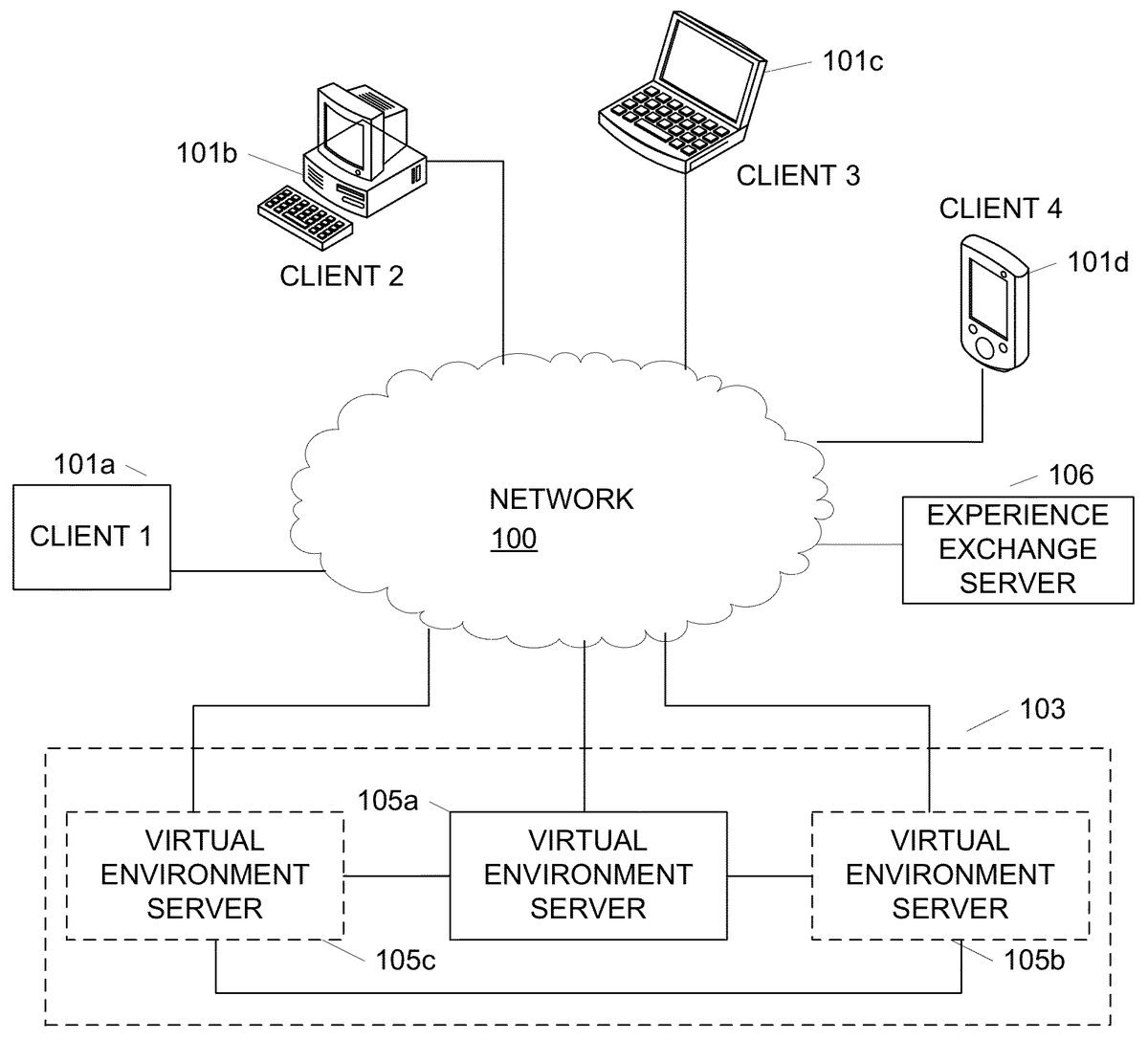
FIG. 1illustrates a network environment in which clients101may interact with virtual world servers105to provide a virtual world for users to access. Clients101may include a variety of devices including generic data processing device101a, personal computer (PC)101b, laptop, portable, or netbook computer101c, personal data assistant, mobile phone or device101d, a tablet device (not shown) and the like. Each of clients101may have a network adapter that allows clients101to connect to virtual world servers105through network100. In one example, network100may include an Internet Protocol (IP) based network, e.g., the Internet. Other networks may include cellular networks, cable networks, fiber optic networks, wireless networks, wired network and/or combinations thereof. Network100may further include one or more sub-networks such as wired or wireless local area networks (LANs), wide area networks (WANs), and the like.
In one or more arrangements, virtual world servers105may be included in a virtual world server system103that includes multiple linked servers105. Using such a distributed system, servers105may be able to distribute load across each of server105. For example, if server105ais experienced high loads, some of the operations may be passed to either server105bor105cor both. Load may further be distributed based on user geography or on other predetermined bases. Alternatively, the virtual world may be hosted on a single server, e.g., virtual world server105a. Each of servers105may collectively generate and manage a single instance of the virtual world, or each server105a,105band105cmay provide independent instances of the world. An instance of a virtual world, as used herein, describes a stand-alone copy of the virtual world that does not interact with or depend on other instances of the virtual world. Depending on the processing load, a virtual world server system103may divide a plurality of users among multiple instances of the virtual world, each hosted on a different server, to reduce or alleviate overloading on a single server or prevent overpopulation. Each server105may be logical or physical, e.g., multiple logical servers may reside and be running on the same physical computing device/server, or servers may be physically separate devices.
The network environment ofFIG. 1. may also associate with one or more experience exchange servers106. As used herein, an experience exchange server106may allow the exchange of one or more classes of user experience points and/or levels between different virtual worlds (e.g., a different game than the game on which the experience points were obtained). The different virtual world may be associated with the virtual world server system103and/or may be associated with one or more different virtual world server systems (not shown).
FIG. 2illustrates an example client device200such as PC101b(FIG. 1) that may be used to access and interact with a virtual world provided by a virtual world server such as server105aofFIG. 1. Client device200may include a variety of components and modules including a processor217, random access memory (RAM)215, read only memory (ROM)213, databases201and203, client software205, output adapter211, input interface209and communication interface207. Software, databases, operating systems, and the like may be stored in nonvolatile memory206(e.g., a magnetic disk or solid state hard drive, or equivalent). Object database201may be configured to store data defining and otherwise associated with an object used by a user of device200to explore and interact with the virtual world. World database203, on the other hand, may be configured to store data for defining and generating the environment in which the objects exist. For example, world database203may store texture maps for rendering a floor or ground, walls, a sky and the like. In another example, world database203may store simulated environments, buildings, trees and other data defining animate or inanimate objects existing in the world, data defining computer controlled characters and the like. Each of database201,203may or may not be a conventional database, and instead may refer to data stored in a memory, accessed as needed by the client software. Data associated with an object or the virtual world may be communicated between client device200and a virtual world server using communication interface207. For example, object positions, attributes and status may be updated or environments may be changed by communicating such data through interface207.
The world and the objects may be rendered by client software205and subsequently sent to output adapter211and display219. The client software205may, in one or more arrangements, be configured to generated three dimensional (3-D) models of the virtual world and components thereof as well as the object corresponding to a user. A user may control the object and interact with the world through input interface209using various types of input devices including keyboard223and mouse225. Other types of input devices may include a microphone (e.g., for voice communications over the network), joysticks, motion sensing devices and/or combinations thereof. In one or more arrangements, music or other audio such as speech may be included as part of the virtual world. In such instances, the audio may be outputted through speaker221.
Client software205, computer executable instructions, and other data used by processor217and other components of client device200may be stored RAM215, ROM213, nonvolatile memory206or a combination thereof. Other types of memory may also be used, including both volatile and nonvolatile memory. Software205may provide instructions to processor217such that when the instructions are executed, processor217, client device200and/or other components thereof are caused to perform functions and methods described herein. In one example, instructions for generating a user interface for interfacing with the virtual world server may be stored in RAM215, ROM213and/or nonvolatile memory206. Client software205may include both applications and operating system software, and may include code segments, instructions, applets, pre-compiled code, compiled code, computer programs, program modules, engines, program logic, and combinations thereof. Computer executable instructions and data may further be stored on some physical form of computer readable storage media (referred to herein as “computer memory”) including, e.g., electrically erasable programmable read-only memory (EEPROM), flash memory or other memory technology, CD-ROM, DVD or other optical disk storage, magnetic cassettes, magnetic tape, magnetic storage and the like.
Referring now toFIG. 3, a virtual world server300may be configured to generate and operate a massive multiplayer online game, such as virtual world or the like. Server300may include processor301, ROM303, RAM305, communication interface307, object position database309, world database311, user database313, server software317, and a statistics database312. Object position database309may be configured to store position information for each object (e.g., based on commands to move a vehicle received from each client). The statistics database312may be configured to store and/or transfer statistics relevant to game operation, including, for example, tracking player achievement and general game server performance.
A world database311may store rules, algorithms and other data for interactions that are available in the world. For example, a manner in which a computer controller character moves or otherwise behaves may be defined in data stored in world database311. Additionally, item information may be defined in world database311so that items may not be modified by each client. In another example, world database311may store location information for non-object items and components. User database313, on the other hand, may be configured to store information describing a user controlling an object. For example, user database313may include account information, user preferences, one or more classes of user experience points and/or levels, payment information, user identification information, character definitions, state tables, and the like. Each of databases309,311,312,313may or may not be a conventional database, and instead may refer to data stored in a memory, accessed as needed by the server software. For example, user database313may in fact be a collection of multiple databases or database tables.
Features described herein may be used with or in a variety of video games, including but not limited to, WORLD OF TANKS™ by Wargaming.net®. Aspects described herein may also be used with other video games and are not limited to any one genre or implementation. Aspects described herein may be implemented in video game application software stored on a computer readable medium, e.g., storage201,203,205,206,213,215,309,311312, and/or313, and executable by a data processing device.
Various aspects of the disclosure provide features and capabilities that enhance game play by providing options through which users can develop strategies to play the video game. According to various aspects described herein, a video game may provide a graphically stimulated virtual world or virtual environment, in which the game takes place, referred to herein interchangeably as a virtual world and as a simulated environment of the video game. The simulated environment may have features similar to actual geographic locations or may have fictional, science fiction or fantasy-themed environments.
According to various aspects, the game may involve multi-player combat-based tournaments combined with an experience-based reward system. As users accomplish predefined tasks or achievements within the game, the player may be given one or more types of reward points. Reward points may subsequently be exchanged for in-game items, goods, features, etc., or otherwise used in accordance with one or more aspects described herein. In one example, reward points may be used to initiate or perform “research” to unlock more powerful, stronger, or otherwise more desirable elements within the game. The discussion below indicates various features and items that may be researched and used, as a player develops a character or vehicle within the game.
FIG. 4illustrates a block diagram of a video game software application401. Each block inFIG. 4illustrates a logical software module or function that performs an action, provides a capability or feature, implements an object, or performs some other aspect of the video game. When the video game software401executes on a data processing system such as a PC or game console, the modules operate collectively to provide a video game experience to a player. The modules illustrated inFIG. 4are illustrative only, and additional or different modules may be used. The same, additional or different modules may be executed in tandem on a server with which each client device is connected.
Video game software401may include, e.g., a game manager module402, which manages the overall operation of the video game and may be the initial module launched when the video game is executed. Video game software401may also include a network module403, which manages network games sessions. A network game session may include e.g., a co-operative campaign with other networked players, or other compartmentalized periods of game play involving players located at discrete network locations. A memory manager module409performs memory management during execution of the video game401. An input module404may receive and interpret user input via a game controller, keyboard, mouse, and the like, and provide the interpreted commands to game manager402, network module403, or other applicable module. UI module405may manage and control the user interface, including the display displayed on the video output device, interpreting input via the input module404, and providing audio output via audio module408.
Various software modules may operate with one or more classes or objects defined and used in the video game401. The classes and objects may be defined with reference to an object module410, and may include portions of executable software code and/or one or more data structures, depending on the object. Each object may be rendered and simulated in the virtual world in accordance with a physics engine407. Video game software401may include other software modules411as needed.FIG. 4illustrates one possible software architecture. Others may be used. Each module depicted inFIG. 4may communicate directly or indirectly with each other module, e.g., by passing objects, data, parameters, input, and output, etc.
A first class of in-game objects may define characters in the video game. Characters may be defined by various attributes associated with the character, e.g., name, physical appearance, skills, etc. Skills may be defined based on a character's genre or task, e.g., gunners, tank commanders, and drivers in the present example. A gunner may have skills such as aiming accuracy and aiming speed, a tank commander may have skills that regulate the overall efficiency of the tank crew, a driver may have skills that determine the vehicle speed or precision of direction. Additional character attributes may include one or more other skills that can improve performance of the character or vehicle so as to enhance the strategic gaming experience such as firefighting skills, the ability to repair vehicles, the ability to camouflage vehicles, and the like.
A second class of in-game objects may define vehicles in the video game. A vehicle may be defined as any simulated inanimate object directly or indirectly controllable by or dependent on an in-game character or user/player. Illustrative vehicles may include tanks, airplanes, ships (and/or submarines), and the like. Vehicles may have various attributes and functions that provide advantageous qualities to the vehicle during combat. For example, some vehicles might be fast with minimal firepower, whereas other vehicles may be slower but extremely powerful. Infinite variations of strength, speed, defense, and any other attribute are possible.
Object module410may provide an array of vehicles, vehicle components, characters and other equipment. Vehicles, vehicle components, characters and other equipment may be defined by one or more objects and instantiated during the game. Each object may have various attributes and functions and provide advantages and disadvantages based thereon. A vehicle component may refer to an upgradeable component of a vehicle, e.g., armor plating, engine, guns, etc.
FIG. 5Aillustrates a block diagram of an instance501of a character object. Object instance501has an object class505(Character). Instance501may acquire one or more attributes from the object class. Attributes507, when examined, define a state of the instance. In this example, the Character has the following attributes: Name511, Qualification512, Training Level513, and Competence514. A character may also have additional skill types509. Additional skill types may include Repair Skills515, Firefighting skills516, and Camouflage skills517. Other skill types, attributes, etc., may also or alternatively be used.
Each attribute may have a particular value. The attribute may have a default value inherited from the Qualification type512. For some attributes, a player may increase attribute value by allocating experience points, gained during gameplay, to the character. Increased attribute value enhances gameplay by improving performance of the vehicle containing the characters. For example, by allocating experience points to the gunner of a tank, the Training Level513may be increased resulting in more accurate gun pointing by a vehicle containing that character, leading to improved vehicle performance during battle. Similarly, the effectiveness of the additional skill types is increased in accordance with the value of the skill. Thus, for example, a Firefighting skill516value of 100% is proportionally more effective than a value of 50%. Increased firefighting effectiveness results in reduced damage to the vehicle in the event of a fire. By staffing a vehicle with characters having improved attributes and skills, vehicle performance is maximized allowing for a more effective performance during game play.
In some embodiments, attributes might not be able to be changed. Qualification512may not be changed; for example, a driver may not be retrained as a gunner. A character's Competence attribute514refers to their ability to operate a specific vehicle type; for example a specific type of tank such as the M3 Stuart tank. Competence514may be changed by retraining the character to operate the same Qualification512on a different vehicle. Changing Competence514may result in a decreased Training Level513in the new vehicle. Additional experience points may be used to raise the Training Level513in the new vehicle. A character may eventually be associated with multiple competence attributes—one per vehicle the character has been associated with.
FIG. 5Billustrates a block diagram of an instance551of a vehicle object. Object instance551has an object class555(Vehicle). Instance551may acquire one or more attributes557from the object class. Attributes557, when examined, define a state of the instance. In this example, object instance551is a Liechttraktor Tank and has attributes associated with tank properties. Exemplary attributes include Name561, Hit Points563, Weight/Load limit564, Engine Power (h.p.)565, Speed Limit566, Hull Armor567, Turret Armor568, Standard Shell Damage569, Standard Shell Penetration570, Rate of Fire571, Turret Traverse Speed572, View Range573, and Signal Range574. These attribute contribute to the vehicle's effectiveness in combat. Attribute types may also have an attribute value, which determines the effectiveness of the attribute function. For example, the Speed Limit attribute566has a value of 46 km/h, which indicates how fast the vehicle can travel. One or more of the attributes, alone or in combination, may be used to assign the vehicle to a subclass. In this example, vehicle551may be in a subclass of tanks referred to as “Light Tanks” based on hit points, speed, armor, etc. Other classes of tanks may include medium tanks and heavy tanks, among others. Subclass may be used to quickly identify to a user a general approximation of attributes associated with a vehicle without requiring the user to review each attribute in detail.
Aspects of the disclosure involve altering object attributes in response to experience obtained within the game. Altering attributes provides for enhancing the skills of the character and enhancing properties of vehicle and vehicle components. Altered attributes provides the game player with vehicle and characters able to compete more effectively against other players.
Using Modules to Upgrade Vehicle Attributes
Vehicle attributes may be altered by adding or upgrading modules associated with a vehicle. A vehicle contains modules classes559. Each module class may contain one of a variety of module types appropriate to the module class. In one example, module classes may include Gun575, Turret576, Engine577, Suspension578, and Radio579. Additional580modules may be added to provide additional functions or otherwise modify vehicle attributes557. Within each class, a vehicle may be outfitted with one module type that falls within the class. For example, five increasingly powerful gun types may be available within the gun class. Similarly, there may be multiple radio types within the radio class. Adding or changing a module type alters vehicle attributes557based on the effectiveness of the newly installed module type. Thus, for example, if the Radio module579type SCR209is replaced by a more advanced module the Signal Range574attribute value may increase based on a signal range value associated with the more advanced module. An increased Signal Range value, in turn, may allow the vehicle to detect enemies at greater distances during game play, making the player more competitive against opponents and resulting in an enhanced gameplay experience for that player.
Experience Points and Research
During game play (e.g., between game sessions), new vehicles and new modules for vehicles may be unlocked by a player in exchange for experience points. In some embodiments, a user might gain points for a single experience class. In other embodiments, points may be earned for two or more different experience classes. Different experience classes may be used to gain access to different features in the game. For example, points earned in a first experience class may be used to allow a user access to a first set of game objects (e.g. vehicles and/or vehicle modules) but not a second, different set of game objects. Points earned in the second experience class may be used to allow a user access to a different set of game objects than the first experience class. The first and second sets may share some objects in common, or may instead be completely distinct.
In one example, where the first experience class is battle experience, battle experience may be used to unlock any object in the same tech tree as the vehicle in which the battle experience was earned, but may not be used to unlock objects not in the same tech tree as the vehicle in which the experience was earned. In this example, where the second experience is free experience, the free experience may be used to unlock any object in any tech tree, regardless of the vehicle in which the free experience was earned.
Collectively, the experience classes may be referred to herein as the “Primary Currency” of the game. Primary Currency is the main route for players to acquire upgraded vehicles, modules, and personnel. A second type of currency, defined herein as “Alternative Currency” may be provided to a player in exchange for alternative compensation, e.g., by completing secondary in-game tasks, completing objectives, or in exchange for the payment of money. In some embodiments, the software may allow some or all of a first experience class to be converted into one or more of the different experience classes. In some aspects, such conversion may only be permitted when a predetermined condition is met. Various predetermined conditions may be imposed. For example, the software may prevent conversion until a vehicle has been upgraded to a particular status. For example, all objects in the same tech tree as a vehicle might be required to be unlocked before conversion from the first experience class to the second experience class is permitted. Such a vehicle is said to be an “elite” vehicle or having acquired elite status. A cost may be imposed on the user for conversion (e.g., Alternative Currency).
In other aspects, players may have the option to convert Battle experience to Free experience under different conditions. For example, “Premium” vehicles may be available to a player in exchange for Alternative Currency. A Premium vehicle may refer to a vehicle similar to an elite vehicle in that the vehicle includes all possible module upgrades and vehicles within the same tech tree family, however, the Premium vehicle may be purchased for the alternative currency whereas the elite vehicle was unlocked using one or more classes of experience through gameplay. Players who purchase Premium vehicles may be permitted to convert Battle experience to Free experience without first achieving any predetermined condition in the Premium Vehicle. In other aspects, predetermined conditions imposed on Premium vehicles might be different from those imposed on non-Premium vehicles.
FIG. 8provides an illustrative example of conversion between two different experience classes. A first class of experience may be defined herein as “Battle” experience. In step801the player receives Battle experience points based on the player's performance during a game session. Battle experience may be accumulated in step801based on various parameters including overall team performance during the battle, vehicle survival, combat activity (actively attacking targets and being attacked by enemies), number of targets detected, number of targets destroyed, critical damage caused to enemy, amount of points awarded for capturing enemy bases. A second class of experience, defined herein as “Free” experience, may also be obtained during play. In step802, the software calculates Free experience as a portion of the Battle experience gained in step801.
Steps803-806illustrate an example of converting points from a first experience class into a second experience class. In step803the player elects to convert Battle experience to Free experience. In step804the system determines whether the Battle experience the player wishes to convert is associated with an Elite Unit. Elite Units are vehicles in which all objects in the tech tree have been unlocked, including any modules that can be used with the vehicle as well as any variations of the vehicle included within the tech tree (see, e.g., medium tank and heavy tank inFIG. 6A). Elite Units may continue to accrue Battle experience during gameplay e.g.801; however, because no further module upgrades for the earning vehicle can be unlocked, the Battle Experience cannot be used to upgrade the Elite Unit. In step804, the system determines whether the predetermined condition for conversion has been met; e.g., whether the vehicle has obtained Elite Unit status804. If Elite Unit status has not been achieved, conversion to Free experience is prevented. On the other hand, if Elite Unit status is achieved for the vehicle, Battle experience earned in the vehicle is converted to Free experience. In step805the system determines how much Alternative Currency (zero or more may be required) is required to convert the Battle experience into Free experience, and reduces the player's Alternative Currency amount accordingly. The user's Free experience is then increased in step806. Battle experience earned in a non-Elite Unit may not be converted into Free experience.
If a user elects not to convert Battle experience to free experience (step803) or the system determines that the vehicle in which the Battle experience points were earned is not an Elite Unit (step804), then the Battle Experience is added to the player's total Battle Experience (step807).
FIG. 9illustrates an example of how the two classes of experience may be used to unlock advanced in-game objects such as vehicles and modules using research. In step901a player may initiate research on a vehicle or module. In step902the game software determines whether the player selected to research a vehicle. If so, in step910the software determines whether the vehicle may be researched using Battle experience. Battle experience might not be used to unlock new vehicles. For example, Battle experience might only be used to unlock vehicles available in the tech tree of the vehicles in which the Battle experience was earned. In some aspects, a hierarchy of vehicles is created within a tech tree; for example, a player might be required to unlock a new vehicle that has lesser attributes before being allowed to unlock other vehicles that have more advantageous attributes. Thus, the player may be required to unlock sequentially the next available vehicle in the earning vehicle's tech tree. If Battle experience may be used to unlock the vehicle, the software determines whether the player has sufficient Battle experience in step911. If so, the new vehicle becomes available (step912) and Battle experience is decreased by the amount of experience spent researching the vehicle (step906).
If Battle experience may not be used to unlock the vehicle (e.g., the vehicle sought to be unlocked is outside the tech tree of the vehicle the player used to earn the Battle experience) the game software might next determine in step913whether the player has accumulated sufficient Free experience to research the selected vehicle. In some aspects, Free experience may be used to unlock any vehicle. If there is sufficient Free experience, then the new vehicle becomes available to the player in step914, and the amount of the Free experience is decreased by the amount of Free experience spent researching the vehicle (step909).
On the other hand, if the player elects to research a module, the software determines in step903whether the module can be researched using Battle experience. Battle experience may be used to research modules that can be mounted on the vehicle that the player used to earn the Battle experience points.FIG. 6Bshows an example of unlockable vehicles arranged in a tech tree format. In step904the software determines whether the player has accumulated sufficient Battle Experience to unlock the module. If so, step905unlocks the module making it available for purchase and mounting on the vehicle. Step906decreases the amount of the player's Battle experience by the amount of experience spent researching the module.
If the software determines in step903the module cannot be researched using Battle experience, then, in step907, the system determines whether the player has sufficient Free experience to unlock the module. If so, step908unlocks the module making it available for purchase and mounting on the vehicle. Step909decreases the amount of the user's Free experience by the amount of experience spent researching the module.
FIG. 6Ashows a screenshot of an example tech tree (also known as a game progress tech tree) for a Medium Tank object KV-13. All modules and available tanks (e.g. T-43) present in the tech tree have been unlocked and are available for player use.FIG. 6Bshows a screenshot of a tank tech tree that may be researched for a T1 Cunningham tank object.FIG. 7is an example of a main screen of an illustrative game.
The use of Alternative Currency (e.g., money) described above may be structured to minimize or eliminate the ability of players to upgrade vehicles or characters simply by spending large amounts of money. In the examples described above, this objective is achieved by limiting access to particularly advantageous game benefits, such as new vehicles, to Free experience. Because Free experience may be awarded to a player at a rate substantially less that the rate Battle experience accumulates, the ability of a beginning player to access new vehicles and upgraded modules is limited. Further, because the only other source of Free experience requires Battle Experience earned on an Elite Unit, a new player may not immediately acquire advanced vehicles by using Alternative Currency.
Making player merit the main route for a player achieving upgraded vehicles is a particularly effective way of retaining players. New players recognize that advancing in the game depends substantially on merit because the game must be played to advance. Players are therefore more inclined to keep playing because they are not dissuaded from developing their vehicle by the possibility that a newcomer may gain advanced status simply by paying money.
Exporting Experience from the First Game
In some aspects, the disclosure provides for exporting objects such as characters, vehicles and modules for use in other video games. After playing a game for a period of time, the player may have gained and spent experience, as well as money, to research, develop, and/or purchase an object551such as a vehicle with advanced attributes and/or an experienced crew501. Over time, however, a player may become less interested in a game due to repetitive gameplay or completion of the game. Player retention can be enhanced by allowing the player to recapture the effort expended in the first game for use in a second game. As used herein, a “second” video game refers to another game that is not merely another instance of the first video game loaded or executing on a different server. The second video game has different mechanics, goals, objectives, features, and/or gameplay from the first video game.
In some aspects of the disclosure, the experience accumulated in a first video game may be exported to a different game. For example, the Battle experience and/or Free experience points may be exported to a second video game to allow the player to acquire objects in the second game. In some examples both may be exportable. In other example, only Free experience may be exported from one game to another.
FIG. 10illustrates an aspect of exporting experience points to a second game. In step1001, the system determines the value of the experience points in the first video game1001for a particular experience class. In step1002, the system contacts a video game1003(e.g., by contacting a central exchange server, using a lookup table, or the like) and may determine, in step1003, the value of experience points in the second video game.
Experience gained in the first video game may but need not be awarded the same value as experience in the second game. Optionally, the second game may employ an exchange rate to alter the value of experience points gained in the first game (steps1004-1006). In step1004, the software determines whether the second game requires that experience points from the first game are converted according to an exchange rate. If so, step1005determines the new value for the first game experience points before adding them, in step1006, to the second game experience points. On the other hand, if there is no need to alter the value of the first games experience points, then, in step1006, the experience points from the first and second game are combined. When experience points are transferred from a first game to a second game the points in the first game may, but need not, be reduced or eliminated from the player's account in the first video game. In step1007, the software determines whether the experience points in the first game should be reduced. The amount of the reduction may be determined by either the first game or the second game (not shown). If the software determines the experience points should be decreased, the points in the first game are decreased (step1008). By allowing the player to retain experience points in the first game, the player is enticed to play the second game while continuing to play the first game. In step1009, the software determines whether there are one or more additional classes of experience that may be exported from the first game to the second game1009. Each class of experience may be subject to a different exchange rate.
In other aspects, the player may directly export game objects. For example, if a player has developed an advanced tank and experienced crew in a first game, that tank and/or crew may be used in a second game that features other modes of combat in addition to tanks, such a ground troops, planes, and/or battleships. In one aspect, the vehicle may be moved or copied to the second game. In another aspect, the user might be able to export a vehicle object out of a first game and then import a comparable vehicle object into a second game. For example, when a user requests to export a tank vehicle having attributes A, B, and C from WORLD OF TANKS to another game involving airplanes (e.g., WORLD OF WARPLANES), an airplane object may be created having similar or comparable attributes as the tank exported from WORLD OF TANKS. A similar or comparable ship, boat, or submarine may be created if the user requests that the vehicle be moved to game involving seaworthy vehicles (e.g., WORLD OF WARSHIPS).
Object instances e.g.551may be exported from a first video game with one or more attributes557and/or one or more modules559associated with the object instance to a second, receiving, video game. In some aspects, all researched modules and vehicles researched and purchased in the first game may be exported to the second game. In other aspects, the second game may dictate which modules and vehicles may be accepted into the second game, and whether they vehicles and modules are accepted as-is, or are imported as a comparable vehicle and/or module.
In other aspects, the first game may allow the player to exchange or “sell” the object instances551(e.g., vehicles, modules, and/or characters) for experience points that can be used to acquire objects in the second game. Such a feature may find particular use where the object and/or attributes might not be appropriate in the context of the second game. For example, a light tank may be appropriate for a second game involving warfare set in the same or a similar era; however, the same tank may be inappropriate for a space-based warfare game. Further, by allowing the player to convert objects back into experience points that may be exported to the second game, the player is rewarded for time and money spent in the first game. The player will therefore be enticed to continue playing games that share the portable experience system, greatly enhancing player retention.
The present aspects have been described in terms of preferred and exemplary embodiments thereof. Numerous other embodiments, modifications and variations within the scope and spirit of the appended claims will occur to persons of ordinary skill in the art from a review of this disclosure.
Claims
- One or more non-transitory computer readable media storing computer executable instructions that, when executed by one or more computer processors, cause a system to perform: defining a first class of experience in a first graphically simulated virtual world hosted on one or more game servers, said graphically simulated virtual world simulating two opposing pluralities of military vehicles, wherein the first class of experience is earned when a user uses a first vehicle in the first plurality in the graphically simulated virtual world against a second vehicle in the second plurality, wherein unless a predetermined condition is met said first class of experience is usable only to unlock objects in a same tech tree as the first vehicle;defining a second class of experience in the first graphically simulated virtual world, wherein the second class of experience is earned when the user uses the first vehicle in the first graphically simulated virtual world, and wherein the second class of experience is usable to unlock vehicles other than the first vehicle, and further usable to upgrade objects not compatible with the first vehicle;and transferring the second class of experience from the first graphically simulated virtual world to a second graphically simulated virtual world, wherein the second graphically simulated virtual world is not another instance of the first graphically simulated virtual world.
- The computer readable media of claim 1 , wherein said instructions, when executed, further cause the system to perform: receiving user input to convert the first class of experience to the second class of experience;when the predetermined condition has been met, converting the first class of experience to the second class of experience;and when the predetermined condition has not been met, preventing conversion of the first class of experience to the second class of experience.
- The computer readable media of claim 1 , wherein the predetermined condition is all objects in the same tech tree as the first vehicle have been unlocked.
- The computer readable media of claim 1 , wherein the predetermined condition is the payment of money by the user.
- The computer readable media of claim 1 , wherein the predetermined condition is the payment of in-game currency by the user.
- The computer readable media of claim 1 , wherein transferring is performed by: determining an exchange rate between the first video game and second video game;removing a user-requested amount of the second class of experience from an account associated with the user in the first video game;and adding experience points to an account associated with the user in the second video game, said added experience points calculated by multiplying the exchange rate by the user-requested amount of the second class of experience.
- A system comprising: a processor;and memory storing computer executable instructions that, when executed by the processor, cause the system to perform: defining a first class of experience in a first graphically simulated virtual world hosted on one or more game servers, said graphically simulated virtual world simulating two opposing pluralities of military vehicles wherein the first class of experience is earned when a user uses a first vehicle in the first plurality in the graphically simulated virtual world against a second vehicle in the second plurality, wherein unless a predetermined condition is met said first class of experience is usable only to unlock objects in a same tech tree as the first vehicle;defining a second class of experience in the first graphically simulated virtual world, wherein the second class of experience is earned when the user uses the first vehicle in the first graphically simulated virtual world, and wherein the second class of experience is usable to unlock vehicles other than the first vehicle, and further usable to upgrade objects not compatible with the first vehicle;and transferring the second class of experience from the first graphically simulated virtual world to a second graphically simulated virtual world, wherein the second graphically simulated virtual world is not another instance of the first graphically simulated virtual world.
- The system of claim 7 , wherein said instructions further cause the system to perform: receiving user input to convert the first class of experience to the second class of experience;when the predetermined condition has been met, converting the first class of experience to the second class of experience;and when the predetermined condition has not been met, preventing conversion of the first class of experience to the second class of experience.
- The system of claim 7 , wherein the predetermined condition is all objects in the same tech tree as the first vehicle have been unlocked.
- The system of claim 7 , wherein the predetermined condition is the payment of money by the user.
- The system of claim 7 , wherein the predetermined condition is the payment of in-game currency by the user.
- The system of claim 7 , wherein transferring is performed by: determining an exchange rate between the first video game and second video game;removing a user-requested amount of the second class of experience from an account associated with the user in the first video game;and adding experience points to an account associated with the user in the second video game, said added experience points calculated by multiplying the exchange rate by the user-requested amount of the second class of experience.
- A method of administering a massive multiplayer online game, comprising: defining a first class of experience in a first graphically simulated virtual world hosted on one or more game servers, said graphically simulated virtual world simulating two opposing pluralities of military vehicles;awarding an amount of the first class of experience to a user in the first graphically simulated virtual world when the user uses a first vehicle in the first plurality in the graphically simulated virtual world to accomplish an objective associated with the first plurality of military vehicles, said objective being defined as mutually exclusive to an objective associated with the second plurality of military vehicle;restricting said first class of experience for use only to unlock objects in a same tech tree as the first vehicle, unless a predetermined condition is met;defining a second class of experience in the first graphically simulated virtual world;awarding an amount of the second class of experience to the user when the user uses the first vehicle in the first graphically simulated virtual world to accomplish the objective;permitting use of the second class of experience to unlock vehicles other than the first vehicle, and further use to upgrade objects not compatible with the first vehicle;and transferring the second class of experience from the first graphically simulated virtual world to a second graphically simulated virtual world, wherein the second graphically simulated virtual world is not another instance of the first graphically simulated virtual world.
- The method of claim 13 , further comprising: receiving user input to convert the first class of experience to the second class of experience;when the predetermined condition has been met, converting the first class of experience to the second class of experience;and when the predetermined condition has not been met, preventing conversion of the first class of experience to the second class of experience.
- The method of claim 13 , wherein the predetermined condition is all objects in the same tech tree as the first vehicle have been unlocked.
- The method of claim 13 , wherein the predetermined condition is a payment by the user.
- The method of claim 13 , wherein transferring comprises: determining an exchange rate between the first video game and second video game;removing a user-requested amount of the second class of experience from an account associated with the user in the first video game;and adding experience points to an account associated with the user in the second video game, said added experience points calculated by multiplying the exchange rate by the user-requested amount of the second class of experience.
Disclaimer: Data collected from the USPTO and may be malformed, incomplete, and/or otherwise inaccurate.