U.S. Pat. No. 9,227,136
Systems and Methods for Integrated Game Play Through the Use of Barcodes on Smart Phones and Hand Held Devices
AssigneeE2interactive Inc
Issue DateSeptember 4, 2013
Illustrative Figure
Abstract
A user device in a system for selling gaming products receives a game play request from a user. Barcode information associated with a barcode at a location is obtained. The user device sends a gaming request associated with the game play request over a wireless network. The barcode information provides for verification that the gaming transaction occurs in a geographical location that is within the jurisdiction of the appropriate gaming authority.
Description
DETAILED DESCRIPTION The disclosed systems and methods make lottery games accessible to a larger segment of the population by providing an end-to-end lottery solution for integrated game play and sale of lottery products on, for example, hand held devices and smart phones using barcode technology. A player operates an application on a mobile device, which may be provided for download or supplied with the device, that allows them to select lottery games and ticketing options. In some embodiments, the selection can be made at any time and location. The selections are recorded, for example in a virtual shopping cart, by the lottery application on the mobile device. The player purchases these recorded items at locations that are, for example, pre-approved by a gaming facilitator and/or a gaming authority. The locations are equipped to verify the presence of the mobile device at the location using a barcode technology. Redemption of winning plays can be automatically deposited into an account associated with the player or at a retail location by use of, for example, a barcode sent to the mobile device. The use of barcode technology with an application distributed to mobile devices allows for the following exemplary advantages:Issuing and managing a trusted execution environment.Assigning trusted area within a trusted execution environment to a specific service.Managing keys for a trusted execution environment.Securely downloading lottery applications to enabled mobile phones, for example by scanning a barcode and directing the user to a secure website to download the application.Personalizing applications.Locking, unlocking and deleting the lottery application according to requests from a user or service provider.Providing secure logging and accounting settlement of all lottery transactions. The gaming facilitator enables secure data storage of lottery transactions at the device level using, for example, a Universal Integrated Circuit Card (UICC) through processing and transaction confirmation. The UICC ...
DETAILED DESCRIPTION
The disclosed systems and methods make lottery games accessible to a larger segment of the population by providing an end-to-end lottery solution for integrated game play and sale of lottery products on, for example, hand held devices and smart phones using barcode technology. A player operates an application on a mobile device, which may be provided for download or supplied with the device, that allows them to select lottery games and ticketing options. In some embodiments, the selection can be made at any time and location. The selections are recorded, for example in a virtual shopping cart, by the lottery application on the mobile device. The player purchases these recorded items at locations that are, for example, pre-approved by a gaming facilitator and/or a gaming authority. The locations are equipped to verify the presence of the mobile device at the location using a barcode technology. Redemption of winning plays can be automatically deposited into an account associated with the player or at a retail location by use of, for example, a barcode sent to the mobile device.
The use of barcode technology with an application distributed to mobile devices allows for the following exemplary advantages:Issuing and managing a trusted execution environment.Assigning trusted area within a trusted execution environment to a specific service.Managing keys for a trusted execution environment.Securely downloading lottery applications to enabled mobile phones, for example by scanning a barcode and directing the user to a secure website to download the application.Personalizing applications.Locking, unlocking and deleting the lottery application according to requests from a user or service provider.Providing secure logging and accounting settlement of all lottery transactions.
The gaming facilitator enables secure data storage of lottery transactions at the device level using, for example, a Universal Integrated Circuit Card (UICC) through processing and transaction confirmation.
The UICC is a physically secure device, an integrated circuit (IC) card, or smart card, that can be inserted and removed from terminal equipment or a mobile device. The UICC may contain one or more applications and may be referred to using different terminology in different territories. A Subscriber Identity Module (SIM) is an application on the UICC containing a mobile subscriber's unique identity.
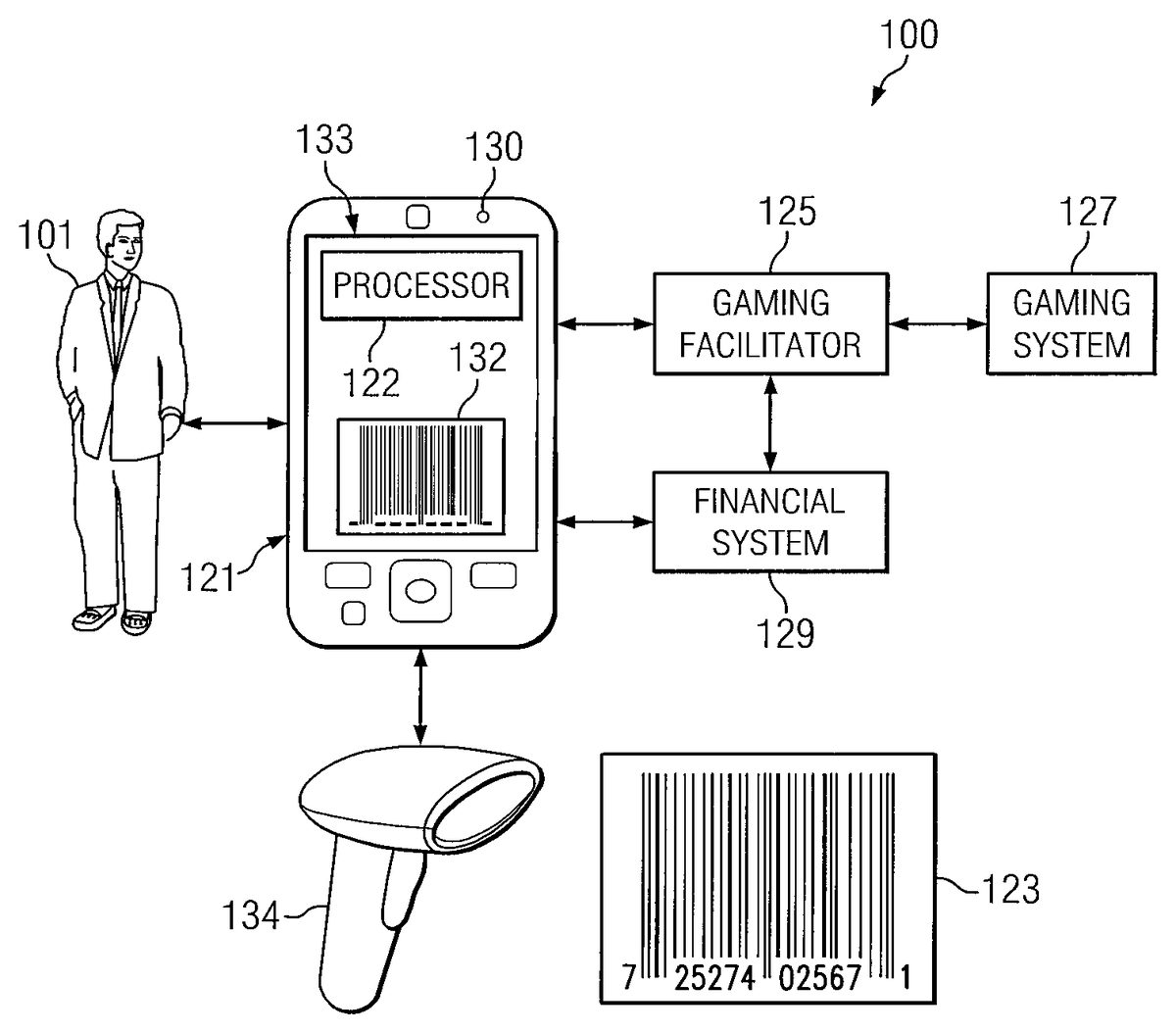
FIG. 1is a schematic diagram illustrating a representative embodiment of a game play system100. A user101may interact with a mobile device121. The mobile device121may be, for example, a handheld device or smart phone that is already familiar to the user101and presents a familiar interface to lottery games. The mobile device121may include a processor122that is configured to execute programming that may be stored on and/or provided to the mobile device121. The mobile device121is equipped to use barcode technology thereby being able to read a barcode123using, for example, a camera130of the mobile device121. Alternatively, or in addition, the mobile device121may be configured to display a barcode132on a display133of the mobile device121to be read by barcode reader134.
By way of example, the barcode123or barcode reader134may be located at an ATM, a gas pump, or any other retail location. The mobile device121may be in communication with the gaming facilitator125, which may be in communication with the gaming system127. The mobile device121may also be in communication system with the financial system129directly and/or through the gaming facilitator125. The financial system129may include, but is not limited to, payment processors, issuer banks, acquirer banks, payment rails, credit networks, etc. The gaming system127may include, but is not limited to, a gaming authority, a gaming operator (for example, state lottery operators), a gaming commission (for example, a state lottery commission), etc.
According to another embodiment, the game could be a location-specific game such as Keno or Bingo. In this embodiment, the gaming system127would be the computer or system that draws the number for game play. The gaming facilitator125would allow the user101to interact with the gaming system127at the facility. Thus, a user101could select a series of numbers on the mobile device121and store those numbers for the next gaming play. At the appropriate time, the user101would take the mobile device121to the barcode reader134to communicate the numbers to the gaming system127for play. For example, the user101may select a button displayed on the display133that causes the mobile device121to generate a barcode that encodes the numbers and display the barcode on the screen. The barcode reader134can then obtain the numbers by reading the barcode. Alternatively, the mobile device121may communicate the numbers to the gaming facilitator125in association with a reference identification assigned by the mobile device121or the gaming facilitator125for the game play. The barcode displayed by the mobile device121encodes this reference identification thereby enabling the retrieval and identification of the numbers when the barcode reader134reads the barcode, which includes the encoded reference identification.
Communications Exchange Server
To sell gaming (or more particularly lottery) tickets through point of sale devices, a communication network is used for communications between a gaming facilitator and gaming partners. Gaming partners are partners that the gaming facilitator interacts with to complete a gaming transaction, such as the gaming system or the financial system. This communication network may have desirable characteristics such as being designed to be secure, reliable, and fast. In an embodiment, each gaming partner may have their own protocol for communicating with and between their systems, servers, and remote devices. Some gaming partners utilize public protocols (e.g., ISO8583) while other gaming partners have generated their own proprietary protocols. To ensure the security of each partner's data and protocols, a server for exchanging communications between a gaming facilitator and a gaming partner may be used.
FIG. 2Ais a schematic diagram of a communications exchange server200that exchanges communications between a gaming facilitator217and a gaming partner201. The communications203,215may include transaction-specific gaming information. In some embodiments, the communications exchange server200is an inbound communications server (as shown) for receiving and sending communications at a gaming facilitator217to and from a gaming partner201. The communications215between the gaming facilitator217and the communications exchange server200are multiple connections which represents a series of parallel requests. The communications203between the communications exchange server200and the gaming partner201are a single connection which represents a series of serialized requests. In those embodiments, the communications exchange server may be located at the gaming facilitator.
In some embodiments, the communications exchange server200is an outbound communications server (not shown) for receiving and sending communications at a gaming facilitator217to and from a gaming partner201. The communications between the gaming facilitator217and the communications exchange server200are a single connection which represents a series of serial requests. The communications between the communications exchange server200and the gaming partner201are multiple connections which represent a series of parallel requests. In those embodiments, the communications exchange server may be located at a gaming partner's site, for example, at a Lottery Operator. A gaming facilitator may send a single request to a communications exchange server that a Lottery Operator send a number of tickets (e.g., “give me 20 tickets”). The communications exchange server may turn that request into a number of requests for one ticket (e.g., 20 requests of, “give me one ticket”), resulting in a number of tickets (e.g., 20 tickets) being generated.
FIG. 2Bis a more detailed schematic diagram of a communications exchange server200that exchanges communications between a gaming facilitator217and a gaming partner201. The device200may include a translation module205, encryption and decryption module209, memory module211, processing (CPU) module207, multiplexer212, and demultiplexer213. The translation module205may translate communications between a gaming facilitator217and a gaming partner201by translating between a communication protocol used by the gaming partner201(e.g., a proprietary format of the gaming partner201) and a communication protocol used by the gaming facilitator217(e.g., a proprietary format of the gaming facilitator217). The encryption and decryption module209may encrypt and/or decrypt communications215between the gaming facilitator217and gaming partner201. For example, data arriving at connection215from the gaming facilitator217may be encrypted. The encryption and decryption module209may decrypt the data such that it can be processed by the communications exchange server at the processor207. Encryption keys may be used and may be updated at arbitrary times. Further, it may be desired that outgoing data at connection215to the gaming facilitator217or at connection203to the gaming partner201be encrypted before it is sent. Accordingly, the encryption and decryption module209may encrypt the data according to encryption protocols used by the gaming partner201and/or gaming facilitator217. The memory module211may store information from the communications203,215between the gaming facilitator217and gaming partner201. The memory module211may also store gaming information. In an embodiment, the memory module211is a cache for storing gaming information and Bank Information. The cache211may store non-transaction specific gaming information. The cache211may also store game-related logic or a portion of game-related logic. The memory module211may also be program memory including logic or instructions accessible by the processor module207. The processing module207may process the communications203,215between the gaming partner201and the gaming facilitator217. The translation module205, encryption and decryption module209, memory module211, and processing module207are communicatively connected.
As discussed above, the communications exchange server200may be considered as an inbound or an outbound communications server. Inbound communications at connection215, from one or more gaming partners201to gaming facilitator217may be multiplexed by the multiplexer212. Outbound communications at connection203from the gaming facilitator217to the one or more gaming partners201may be demultiplexed by the demultiplexer213.
FIG. 2Bdepicts a single translation module205, memory module211, CPU module207, encryption and decryption module209, and communications exchange server200for simplicity purposes only. At any point of connection between a gaming facilitator217and a gaming partner201, multiple communications exchange servers200may be used for a variety of reasons including, but not limited to, redundancy, speed or efficiency of the system, failure diagnostics, ease of system upgradeability, system back-ups, network monitoring, etc. Further, each communications exchange server200may include multiple of any modules in the server200. For example, in some embodiments, the communications exchange server200includes multiple memory modules211and multiple CPU modules207. The communications exchange server200may be made of one or more machines, one or more motherboards, one or more memory modules, etc.
In an embodiment, the communications exchange server200is a computer that translates the gaming partner's communication protocol into a gaming facilitator specific protocol, thereby substantially eliminating the exposure of the partner's protocol to an outside entity. A communications exchange server200may be placed at a gaming partner's data center, either inside or outside of the gaming partner's firewall depending upon a gaming partner's preference. The communications exchange server200connects to gaming facilitator data centers over a gaming facilitator provided connection. In an embodiment, the gaming facilitator provided connection is a high speed, private connection (e.g., an MPLS connection). While this type of connection provides some inherent security, communications to and from the gaming facilitator may be encrypted to provide an additional layer of protection.
Non-transaction specific information (images, game rules, game information, etc.) may be cached on the device200in memory module211, which allows for rapid access to cached data. For transaction specific information, data may be passed from the gaming partner201to the communications exchange server200which then encrypts the data and passes the request to a gaming facilitator217via a gaming facilitator provided connection.
The communications exchange server200may be used with a variety of gaming partners201including, but not limited to, lottery authorities, banking systems, and other payment systems. Further, the communications exchange server200may be located at a gaming partner location or at a gaming facilitator location.
User Registration
In an embodiment, a gaming facilitator system may include a user registration server. The user registration server allows users to register with the gaming facilitator system. Registering may allow users to check to see their play history, set spending limits, to select favorite numbers to be played, and to configure how they wish to be notified of their play status. In an embodiment, users may have an online account with the gaming facilitator system in which they may register, configure and make selections for their account with the gaming facilitator system.
Information identifying the registration of the associated information (the play history, spending limits, favorite numbers, notification configuration, etc) may be stored on the gaming facilitator system or on the mobile device121as a part of or in association with a gaming application stored on the mobile device121.
Play Overview
FIG. 3is a high-level flow diagram illustrating a process for a gaming system transaction such as a lottery transaction. At action301, the mobile device121obtains the gaming application. The application may be obtained directly or indirectly from the gaming facilitator125. The gaming application can be obtained at anytime prior to gaming purchase.
The action301may be omitted if the mobile device already has the gaming application. For example, the gaming application may be preloaded on the mobile device121at the time of purchase of the mobile device121.
At action303, the user101selects a game type and ticketing option for gaming play. Game types include but are not limited to lottery play including draw, instant, and any other games offered by the jurisdiction's gaming authority. Other games may include location-specific games, such as Keno or Bingo. The jurisdiction's gaming authority may limit the available game types to approved game types. The selecting of ticketing options may include a number of tickets, numbers played, etc.
In some embodiments, the user101can select the game type and ticketing options at any time and in any location even prior to entering an approved retail location. In these embodiments, the gaming application may store the selected game type and ticketing options in, for example, a virtual shopping cart to be recalled at a later time to complete the transaction. The gaming application may also record previous selections and favorite selections such as favorite numbers to allow easier selection by the user101.
At action305, the end user presses a “ready to play” or checkout button in the mobile application. The game play system100verifies the location of the mobile device121and facilitates the user101's gaming purchase using a method such as those described inFIGS. 4A and 4B.
FIG. 4Ais a flow diagram illustrating a first exemplary method for verifying the location of the mobile device121and facilitating the user101's gaming purchase.
At action401, the gaming application prompts the user to scan a barcode at the location. The barcode may be scanned by a peripheral device attached to the mobile device121or by the camera130of the mobile device121. The barcode may be a static barcode displayed at the location, for example on a poster or on a gas pump, or a dynamic barcode generated by a device, such as an ATM or a display incorporated in a gas pump, at the location. The barcode may be valid only for a period of time preventing the reuse of an old barcode at another location.
At action403, the gaming application sends a gaming request including the selected game type and ticketing option along with the scanned barcode information to the gaming facilitator125using a mobile network such as Wi-Fi or CDMA/GSM. The scanned barcode information may include the barcode itself as an image file or as information encoded within the barcode that is decoded by the gaming application prior to sending the request.
At action405, the gaming facilitator125processes a location verification of the mobile device121, checks game availability, play limits and other lottery game play parameters. Location verification can be performed by a variety of means. According to one embodiment, the merchant may be required to be included on a list of pre-approved merchants to vend gaming tickets at the location. This list can be maintained by an appropriate authority, such as a facilitator or gaming authority. The gaming facilitator125cross-references the scanned barcode information to determine if the scanned barcode information corresponds with the location. The gaming facilitator125may also cross-reference a period of validity associated with the scanned barcode information to confirm that the scanned barcode is a recent and valid barcode.
According to another embodiment, location verification can be performed by other technology within the mobile device, such as GPS or radio tower triangulation. Ultimately, most gaming facilitators will need to take sufficient steps to confirm that the purchaser of the tickets is physically located within the jurisdiction of the gaming authority to avoid any legal complications associated with selling gaming tickets outside of the jurisdiction of the gaming authority.
At action407, the gaming facilitator125processes transaction payment through, for example, an integrated standardized ticketing system with eWallet platforms or a direct gateway to payment processing partners. The mobile application may also process payment using other methods at a retail location, such as through the use of a Near Field Communications (NFC) Transaction Anchor Point (TAP). In some embodiments, the gaming facilitator125communicates with the payment processing partners to obtain payment.
FIG. 4Bis a flow diagram illustrating a second exemplary method for verifying the location of the mobile device121and facilitating the user101's gaming purchase.
At action451, the gaming application sends a gaming request including the selected game type and ticketing option to the gaming facilitator125using a mobile network such as Wi-Fi or CDMA/GSM. The gaming request is identifiable based on content or a reference identifier assigned by the gaming application or the gaming facilitator125. Thus, communication between the mobile device121and the gaming facilitator125may be one or two way. Note that as explained below, this step is optional in some embodiments.
At action453, the gaming application generates a barcode encoding the reference identifier and displays the barcode on the display133.
At action455, the user presents the displayed barcode to a terminal at the location. The terminal may be, for example, an ATM machine, a gas pump, or a stand alone device. The terminal reads the barcode displayed on the mobile device121and sends a notification to the gaming facilitator125that the barcode was read at the location. The terminal may send an image of the barcode or information encoded by the barcode that is decoded by the terminal.
In another embodiment, the barcode generated by the mobile application includes some or all of the information included in the gaming request, which may reduce the amount of information that is sent from the mobile device121to the gaming facilitator125with a larger portion of the information in the gaming request then being sent by the terminal that reads and decodes the barcode to the gaming facilitator. In the case where all of the information in the gaming request is encoded in the barcode, it is not necessary for the mobile device121to itself send any information to the gaming facilitator125(the information being sent by the terminal reading the barcode) nor is the reference identifier needed. The mobile device121may also transmit information to the terminal over a short range wireless connection such as WiFi or Bluetooth to reduce the amount of information encoded in the barcode.
At action457, the gaming facilitator125processes a location verification of the terminal if needed or required by the gaming system to verify eligibility of play at the location of the terminal, checks game availability, play limits and other lottery game play parameters.
At action459, the gaming facilitator125processes transaction payment through, for example, an integrated standardized ticketing system with eWallet platforms or a direct gateway to payment processing partners. The mobile application may also process payment using other methods at a retail location, such as through the use of a Near Field Communications (NFC) transaction anchor point (TAP). In some embodiments, the gaming facilitator125communicates with the payment processing partners to obtain payment.
Returning now toFIG. 3, at action307, upon payment authorization, the gaming facilitator125sends the ticket request to a computerized gaming system (CGS), such as gaming system127. The gaming system may use a Random Number Generator (RNG) to produce the gaming play. In an embodiment using a “Virtual Instant Ticket,” the RNG may not be used but the purchase will be sent to the CGS for processing and balancing. The gaming system127, in communication with the gaming facilitator125, verifies and completes the gaming transaction. According to another embodiment, pre-existing or favorite numbers can be entered or stored in the mobile device121or at the gaming facilitator125. These numbers are sent to the gaming system127at step307.
At action309, the gaming facilitator125sends the gaming transaction information to the Internal Control System (ICS) of the gaming system127for independent logging. This action is not always requested and may not be present in some embodiments.
At action311, the gaming facilitator125sends a notification of the purchase status to the gaming application. This notification may include, for example, numbers played, ticket serial number, date of draw, and payment authorization code along with other transaction specific information. In some embodiments the notification includes a numeric redemption code, a scannable barcode such as a QR code, or any other type of redeemable code that can be securely sent to the mobile application along with the notification. The barcode or redemption code can be used after a draw to check and claim winning numbers at an existing gaming/lottery terminal or retail location.
In the case where the transaction was not able to be completed, information notifying of the failure to complete may be sent to the mobile device121. The notification may include other information associated with the failure, for example, what exception caused the failure.
In some embodiments, automated paperless receipts are provided to indicate numbers and games played. This notification may be sent via multiple methodologies including email, wireless delivery to mobile devices utilizing SMS text or device specific applications, RSS feed, or feeds into Twitter, Facebook or other social media accounts.
The notification may also include an automated remote notification that may be sent to the user101indicating play status (winner, winner of a certain amount of money, winner with manual redemption, non-winner, winning numbers, what the winning numbers were if the game was lost, game jackpots, game statistics, and other statistics). Notifications may be sent directly to the user101through the gaming application as well as via wireless delivery to a mobile device or email address using, for example, SMS text, email, RSS feed to Twitter, Facebook or other social media account, through device specific apps (i.e. iPhone, BlackBerry, or PDA apps) and, through automated lottery system web sites.
Redemption
When the user101wins a game, the user101will want to redeem his or her winnings. At action313, a winner identification interface of the mobile application utilizes transaction data to query data from the gaming facilitator125to find winning ticket numbers. The data may be separated into three categories: non-winning tickets, winning tickets available for auto-redemption, and winning tickets available for manual claims. An additional winner verification system that a lottery facilitator may provide may be used by a game administrator to verify the integrity of tickets and to validate that a presented ticket is a winner for items that are manually claimed. The gaming facilitator125obtains the queried data from the gaming system127and provides it to the mobile application.
At action315, the mobile application facilitates the redemption of winnings. Redemption may be completed using a variety of methods selected based on, for example, a selection of a preferred method by the user101or the amount of the winnings.
As a first example, the mobile application may provide for the display of the barcode received in the notification in connection with action311. A retail location can then read the barcode to verify the win and provide the winnings.
As a second example, the winnings are automatically deposited to an account associated with the user101. In some embodiments, the user101may tap the mobile device121to a NFC TAP to initiate a transfer of funds through financial system129. An eWallet system may also be accessed for an auto-deposit of winning tickets through a point of sale terminal, debit, and/or credit network to allow for the redemption of winning tickets under a taxable or manually verifiable limit via a pin-less debit card or credit card transaction. A unique terminal number may be used for this transaction, and a pin or card may or may not be used for completion of the transaction.
FIG. 5Ais a schematic diagram illustrating a process for a game play. At action501, the mobile device121downloads the mobile application from the gaming facilitator125. At action503, the user101uses the mobile application running on the mobile device121to select game play and ticketing options. The user101may make the game play and ticketing option selections at anytime prior to entering an approved retail location. At action505, the user101presses a checkout or ready to play button displayed on the mobile device121. At action507, the user scans the barcode123displayed at the retail location. At action509, the mobile device121sends a request associated with the game play request including the barcode information to the gaming facilitator125. The request may include an image of the barcode, a value representing information encoded by the barcode, or other information to verify that the user was in a location at which the barcode was displayed.
At action511, the gaming facilitator125verifies the location of the mobile device121based on the barcode information provided in the game play request. As mentioned previously, the physical location of the user and the mobile device at the time of the payment transaction can have implications for the legality of the transaction, depending upon the laws of the jurisdiction in which the gaming authority is operating.
At action513A, the gaming facilitator125processes payment authorization through a direct gateway with financial system129. In other embodiments, payment may be processed directly between the mobile device121and the financial system129as shown in action513B. In still other embodiments, payment may be processed by tapping the mobile device121to a Near Field Communications (NFC) Transaction Anchor Point (TAP)520as shown in action513C. In this embodiment, the NFC TAP520initiates the payment instruction to the financial system129, as shown in action513D.
At action515, the gaming facilitator125sends a ticketing request to the gaming system127, for example the lottery authority in the jurisdiction, which verifies and completes the gaming transaction.
At action517, the gaming facilitator125sends ticket information and confirmation to the mobile device121.
At action519, the gaming facilitator125sends gaming processing and balancing information including transaction logs to the gaming system127.
FIG. 5Bis a schematic diagram illustrating a process for a game play. At action551, the mobile device121downloads the mobile application from the gaming facilitator125. At action553, the user101uses the mobile application running on the mobile device121to select game play and ticketing options. The user101may make the game play and ticketing option selections at anytime prior to entering an approved retail location. At action555, the user101presses a checkout or ready to play button displayed on the mobile device121. The mobile application generates a barcode that is displayed on the screen of the mobile device121. At action557, the user scans the barcode displayed on the screen of the mobile device121at a terminal570installed at the retail location. The barcode may encode some or all of the information associated with the game play request. The terminal570may be an ATM machine, a gas pump, a stand alone device, etc. At action559A, the mobile device121sends a request associated with the game play request to the gaming facilitator125. The request may include some or all of the information encoded in the barcode. At action559B, the terminal570sends transaction information to the gaming facilitator125informing the gaming facilitator125of the transaction with the mobile device121. The transaction information may include some or all of the information encoded by the barcode. The request may include an image of the barcode, a value representing information encoded by the barcode, or other information to verify that the user was in the location at which the barcode was read.
For example, the barcode may include an identifier number that is preassigned to the mobile device121or randomly generated. The mobile device121may send the gaming request including all the game play parameters and the identifier number to the gaming facilitator125. In such an embodiment, the terminal570may only send the identifier decoded from the barcode to the gaming facilitator125. In receipt of this information, the gaming facilitator125obtains the game play request information and the information needed to verify that the mobile device121was in the same location as the terminal570. In other embodiments, the mobile application may encode all of the game play request information in the barcode read by the terminal570. In such an embodiment, it is not necessary that the mobile device121sends any information to the gaming facilitator125and all of the information needed to obtain the game play request and verify that the mobile device121is in the same location as the terminal570can be provided to the gaming facilitator125by the terminal570. It will be appreciated that the information transmitted to the gaming facilitator125by the mobile device121and the terminal570may be apportioned between these devices in any of a number of ways and the above discussion is exemplary in nature.
At action561, the gaming facilitator125verifies the location of the mobile device121based on the barcode information provided by the terminal570. As mentioned previously, the physical location of the user and the mobile device at the time of the payment transaction can have implications for the legality of the transaction, depending upon the laws of the jurisdiction in which the gaming authority is operating.
At action563A, the gaming facilitator125processes payment authorization through a direct gateway with financial system129. In other embodiments, payment may be processed directly between the mobile device121and the financial system129as shown in action563B. In still other embodiments, payment may be processed by tapping the mobile device121to a Near Field Communications (NFC) Transaction Anchor Point (TAP)572as shown in action563C. In this embodiment, the NFC TAP572initiates the payment instruction to the financial system129, as shown in action563D. In embodiments where the terminal570is capable of performing financial transactions, such as an ATM or a device equipped with a bill reader, the terminal570may register the transaction with the financial system129at action563E and accept the payment from the user.
At action565, the gaming facilitator125sends a ticketing request to the gaming system127, for example the lottery authority in the jurisdiction, which verifies and completes the gaming transaction.
At action567, the gaming facilitator125sends ticket information and confirmation to the mobile device121.
At action569, the gaming facilitator125sends gaming processing and balancing information including transaction logs to the gaming system127.
The above-described playing processes allow for gaming purchases such as lottery games on mobile devices while providing the assurances and verification that the sale of the gamine products occurred within the borders of the government regulating the games.
In some embodiments, the gaming facilitator125provides a retailer signup program as part of the mobile application. Prior to the sale of gaming (e.g., lottery) tickets a retail location or merchant may be required to be included on a list of pre-approved locations or merchants. This list can be maintained by an authority appropriate to ensure that the geographic location of the retail location or merchant has been confirmed. This could be the gaming facilitator or the gaming authority.
Embodiments of the terminal570may include an existing ATM or NFC device at a retailer, a dedicated gaming/lottery device at the retailer, or a device placed in conjunction with a new or existing lottery terminal.
Application Logic
Lottery system logic may reside at a device associated with the lottery system, such as the terminal or the gaming facilitator, within the gaming application on the mobile device, or both at the device and the host.
FIG. 6Ais a schematic diagram illustrating a host-based input system610. With the host-based terminal610, the mobile device611is a user input/display device. The application logic614that determines what happens with each input and provides decision-making for what to display to the user occurs on a remote host612. The host612contains automated lottery system logic and may gather the user input by providing the appropriate screens to the mobile device611(for example, to a gaming application running on the mobile device611) and forwarding the user input to the gaming facilitator613either through an intermediary communications exchange server (not shown) or to the gaming facilitator613directly.
FIG. 6Bis a schematic diagram illustrating a terminal-based input system620. Terminal-based input systems have automated lottery system application logic624on the mobile device621, for example as part of the mobile application stored on the mobile device621. Accordingly, the mobile device621has the ability to walk a user through the game process and may then send the information that the user has selected to a gaming facilitator623either through an intermediary communications exchange server (not shown) or to the gaming facilitator directly.
FIG. 6Cis a schematic diagram illustrating a hybrid-based input system630. Hybrid-based input systems have some application logic634A stored at the mobile device631, for example as part of the mobile application stored on the mobile device631, to gather user input and display the game specific parameters, but also rely on some application logic634B stored at a remote host632to control the automated lottery system flow. An example of this is a cell phone with an automated lottery system application where the application on the phone controls the layout of the screen, receives user input, and performs basic validation (e.g., prevents the user from inputting text into numeric fields). But the cell phone may communicate with a host632to determine the order of the screens to display. The remote host632may communicate with a gaming facilitator633either through an intermediary communications exchange server (not shown) or with the gaming facilitator directly.
FIGS. 7A,7B, and7C are flow diagrams700,720,740illustrating a process for a mobile application-based play of an lottery system presented game. At action702, a mobile application announces the ability for a user to play a game. In some embodiments, the mobile application may present a screen indicating that the mobile application is capable of providing game plays to the user. If a user decides to play a game, the mobile application requests that the user input identification information at action704. For example, the mobile application may ask the user for their preferred language at action704. For example, the mobile application may request that the user swipe a debit card and enter their debit card pin or provide information regarding an account with an eWallet platform at action704.
The mobile application may optionally request that the user verify their age at action706if the user's age has not been verified by previous input at the mobile application. The mobile application may also optionally present a list of game options available through the mobile application at action708. The list may include games that will become available at a future time and an indication that those games will be available in the future.
At action710, the mobile application may present options for the selected game. For example, the mobile application may present the number of tickets available for purchase, game play times available, etc. at action710. The terminal may also ask the user whether they would like to have their numbers sent to them or a link to their numbers sent to them. The mobile application presents the cost associated with the user's selections as well as any necessary legal disclosures at action712. At any point in the process, the user may cancel the transaction at action701.
The user scans a barcode at the retail location, and at action713, the mobile application sends gaming information collected from the user to a gaming facilitator at action B. The barcode may be static displayed at the retail location on a sign or display or it may be dynamic generated by a terminal device such as an ATM or gas pump. The user may be required to make a selection following a prompt displayed on the terminal to request that the terminal display the barcode. In embodiments where the terminal generates a dynamic (for example random) barcode, the terminal may inform the gaming facilitator and/or gaming authority that the barcode has been generated along with an identifier to identify the barcode. The generated barcode may be valid only for a limited time. Static barcodes may also be valid only for a limited time.
As discussed above, in some embodiments, the mobile application displays the barcode, which is read by a terminal at the retail location at action713. The terminal then informs the gaming facilitator of the read barcode.
The gaming facilitator may verify information format of the information sent by the terminal at action722. For example, at action722, the gaming facilitator may determine whether the information is sufficient and complete for a certain game play. The gaming facilitator may also ensure that the information is not corrupt. The gaming facilitator may also verify a user's age if their driver's license was presented at the terminal. If a driver's license is required by the game, but was not presented at the terminal, the gaming facilitator may cancel the transaction. If the transaction is canceled, the terminal may display a cancel message indicating the reason for the cancellation.
At action723, the gaming facilitator verifies the location of the user. For example, the gaming facilitator may verify the location of the terminal that generated the barcode by referring to a pre-approval of the terminal with the gaming facilitator and/or the lottery authority. The gaming facilitator may also refer to a list of barcodes that are currently valid.
The gaming facilitator may also confirm the location of the retail location at which the barcode was read in embodiments where the mobile application generates the barcode.
At optional action724, the gaming facilitator may look up the user to determine preferences for that user. These preferences can include a list of pre-stored or favorite numbers to be used in the game play. Other preferences can include whether the user desires automatic redemption of winning plays, or manual redemption through the delivery of a redemption code to the mobile device121.
At optional action726, the gaming facilitator may determine whether the user has opted out of the gaming system, whether the user has already hit their spending limit for a certain time period, etc. If either determination is affirmatively made at optional action726, then the gaming facilitator sends a message back to the mobile application to display to the user at action738and the process may begin again with the same or a new user at action A. If the determination is not affirmatively made at optional action726, then the process continues.
At action727, the gaming facilitator may request a transfer of funds for the transaction. For example, the gaming facilitator may request that a payment processor verify the user PIN number, whether enough funds are available in the user account for the transaction, and to transfer the funds. The payment processor determines whether the pin is correct and whether funds are available and sends a response to the gaming facilitator. The gaming facilitator receives the response from the payment processor at action728. The response may include, for example, verification from the payment processor whether the PIN is correct, whether funds are available, and/or whether the funds were transferred. If the gaming facilitator receives verification that the PIN is correct, that sufficient funds are available, and that the funds have been transferred at action730, the gaming facilitator generates random numbers or uses user-specified numbers for the game play at action732. If the gaming facilitator receives notification that the PIN is incorrect, that sufficient funds are not available, or that the funds were not transferred at action730, the gaming facilitator sends a message back to the terminal to display to the user at action738and the process may begin again with the same or a new user at action A. A request for the desired number of tickets and games along with game information is sent by the gaming facilitator to the lottery operator at action C.
The lottery operator validates information received from the gaming facilitator and generates tickets if the information is validated at action742. The gaming facilitator determines whether the tickets were generated correctly at action744. If the tickets were not generated correctly, the gaming facilitator requests a funds reversal to the payment processor, and the payment processor may reverse the funds back to the user account at action756. The gaming facilitator sends a message back to the mobile application to display to the user at action738and the process may begin again with the same or a new user at action A. If the tickets were generated correctly, the gaming facilitator will store game play information at action746. The gaming facilitator sends to the terminal game play numbers, transaction numbers, and a confirmation of the transaction. The mobile application may prompt the user to indicate whether to receive a receipt electronically or obtain a barcode for use in redeeming winnings at action748. If the mobile device is equipped with a printer or configured to access a printer, the mobile application may prompt the user to indicate whether to receive a printed receipt. If the user selects to print the receipt, the terminal prints the receipt at action752and the process may begin again with the same or a new user at action A. If the user selects to receive the receipt electronically, the terminal gathers user information and sends the electronic receipt at action750. The process may begin again with the same or a new user at action A.
Host-based mobile applications are mobile applications that receive instructions from a host instead of having internal local logic. Accordingly, a process for a host-based play of a lottery system presented game is slightly different than the mobile application-based play. A host-based terminal is connected to a host from the beginning of a transaction or at each step requiring new information between user actions, whereas a mobile application-based terminal might connect to the host or to a gaming facilitator after certain decisions and actions are taken by a user during a transaction. Being connected earlier allows the host-based mobile application to query a gaming facilitator database for information about the user at an earlier time in the transaction. This is also the case for mobile application-based play flow where the mobile application has a substantially constant connection such as with a network connection like Wi-Fi or CDMA/GSM.
FIGS. 8A,8B, and8C are flow diagrams800,820,840illustrating a process for a host-based play (and mobile application-based play where the mobile application has a substantially constant connection) of an automated lottery system presented game. At action802, a mobile application announces the ability for a user to play a game. For example, the mobile application may present a screen indicating that the mobile application is capable of providing game plays to the user. If a user decides to play a game, the mobile application requests that the user input identification information at action804. In some embodiments, the mobile application may ask the user for their preferred language at action804. In some embodiments, the mobile application may request that the user swipe a debit card and enter their debit card pin or provide information regarding an account with an eWallet platform at action804.
In an embodiment, at optional action805, the gaming facilitator may determine whether the user has opted out of the automated gaming system, whether the user has already hit their spending limit for a certain time period, etc. If either determination is affirmatively made at optional action805, then the gaming facilitator system cancels the transaction at action801. The system may send a message back to the mobile application to display to the user and the process may begin again with the same or a new user at action A. If the determination is not affirmatively made at optional action805, then the process continues at action806.
The mobile application also requests that the user verify their age at action806if the user's age has not been verified by previous input at the terminal. The mobile application sends card information to a gaming facilitator (via a mobile device) at action808to determine whether the user is a registered user. The mobile application may present a list of game options available at the user's location at action810. The list may include games that will become available at a future time and an indication that those games will be available in the future. At action812, the mobile application may present options for the selected game. For example, the mobile application may present the number of tickets available for purchase, game play times available, etc. at action812. The mobile application may also ask the user whether they would like to have their numbers sent to them or a link to their numbers sent to them. The mobile application presents the cost associated with the user's selections as well as any necessary legal disclosures at action814. At any point in the process, the user may cancel the transaction at action801.
The userscans a barcode at the retail location, and at action815, the mobile application sends gaming information collected from the user to a terminal host at action B. The barcode may be static displayed at the retail location on a sign or display or it may be dynamic generated by a terminal device such as an ATM or gas pump. The user may be required to make a selection following a prompt displayed on the terminal to request that the terminal display the barcode. In embodiments where the terminal generates a dynamic (for example random) barcode, the terminal may inform the gaming facilitator and/or gaming authority that the barcode has been generated along with an identifier to identify the barcode. The generated barcode may be valid only for a limited time. Static barcodes may also be valid only for a limited time.
As discussed above, in some embodiments, the mobile application displays the barcode, which is read by a terminal at the retail location at action815. The terminal then informs the gaming facilitator of the read barcode.
At action822, a terminal host determines based on the information sent from the mobile application that the transaction is a gaming facilitator transaction. The host may forward the information to the gaming facilitator. The gaming facilitator may verify information format of the information sent by the mobile application at action824. For example, at action824, the gaming facilitator may determine whether the information is sufficient and complete for a certain game play. The gaming facilitator may also ensure that the information is not corrupt. The gaming facilitator may also verify a user's age if their driver's license was presented at the terminal. If a driver's license is required by the game, but was not presented at the terminal, the gaming facilitator may cancel the transaction. If the transaction is canceled, the terminal may display a cancel message indicating the reason for the cancellation.
At action825, the gaming facilitator verifies the location of the user. For example, the gaming facilitator may verify the location of the terminal that generated the barcode by referring to a pre-approval of the terminal with the gaming facilitator and/or the lottery authority. The gaming facilitator may also refer to a list of barcodes that are currently valid.
The gaming facilitator may also confirm the location of the retail location at which the barcode was read in embodiments where the mobile application generates the barcode.
In an embodiment, at optional action826, the gaming facilitator may look up the user to determine preferences for that user. At action826, the gaming facilitator may determine whether the user has opted out of the gaming system, whether the user has already hit their spending limit for a certain time period, etc. If either determination is affirmatively made at action826, then the gaming facilitator sends a message back to the mobile application (e.g., via the mobile device) host to display to the user at action838and the process may begin again with the same or a new user at action A. If the determination is not affirmatively made at action826, then the process continues.
At action827, the gaming facilitator may request a transfer of funds for the transaction. For example, the gaming facilitator may request that a payment processor verify the user PIN number, whether enough funds are available in the user account for the transaction, and to transfer the funds. The payment processor determines whether the pin is correct and whether funds are available and sends a response to the gaming facilitator. The gaming facilitator receives the response from the payment processor act action828. The response may include, for example, verification from the payment processor whether the PIN is correct, whether funds are available, and/or whether the funds were transferred.
The gaming facilitator receives verification from the payment processor whether the PIN is correct, whether funds are available, and/or whether the funds were transferred at action828. If the gaming facilitator receives verification that the PIN is correct, that sufficient funds are available, and that the funds have been transferred at action830, the gaming facilitator generates random numbers or uses user-specified numbers for the game play at action832. If the gaming facilitator receives notification that the PIN is incorrect, that sufficient funds are not available, or that the funds were not transferred at action830, the gaming facilitator sends a message back to the terminal (e.g., via the terminal host) to display to the user at action838and the process may begin again with the same or a new user at action A. A request for the desired number of tickets and games along with game information is sent by the gaming facilitator to the lottery operator at action C.
The lottery operator validates information received from the gaming facilitator and generates tickets if the information is validated at action842. The gaming facilitator determines whether the tickets were generated correctly at action844. If the tickets were not generated correctly, the gaming facilitator requests a funds reversal to the payment processor, and the payment processor may reverse the funds back to the user account at action856. The gaming facilitator sends a message back to the terminal to display to the user at action838and the process may begin again with the same or a new user at action A. If the tickets were generated correctly, the gaming facilitator will store game play information at action846. The gaming facilitator sends to the terminal (e.g., via the terminal host) game play numbers, transaction numbers, and a confirmation of the transaction. The terminal may prompt the user to indicate whether to print a receipt at the terminal or receive a receipt electronically at action848. If the user selects to print the receipt, the terminal prints the receipt at action852and the process may begin again with the same or a new user at action A. If the user selects to receive the receipt electronically, the terminal gathers user information and sends the electronic receipt at action850. The process may begin again with the same or a new user at action A.
FIG. 9is a schematic diagram illustrating a gaming facilitator system900. System900may include a terminal910, a payment processor920, a gaming facilitator reporting data center930, a gaming authority940, gaming authority operators950and gaming facilitator transaction data center960.
The gaming facilitator transaction data center960is in communication with the terminal910, the payment processor920, the gaming facilitator reporting data center930and the gaming authority940. Using alternative connectivity, the gaming facilitator transaction data center960may be in communication with the gaming authority operators950. In some embodiments, the communication with the gaming facilitator transaction data center950may be made via communications exchange servers961,963and965. Firewalls921,931,941,942,951,952and967-974provide isolation between various systems and components in the system900.
The payment processor920may include payment processor data center923. The payment processor920connects with the gaming facilitator transaction data center960via a secure connection (e.g., MPLS or other “private” connection) between the firewall921at the payment processor920and the firewall968at the gaming facilitator transaction data center960.
The gaming facilitator reporting data center930may include reporting system934and reporting database936. The gaming facilitator reporting data center930connects with the gaming facilitator transaction data center960via a secure connection (e.g., MPLS or other “private” connection) between the firewall931at the gaming facilitator reporting data center930and the firewall969at the gaming facilitator transaction data center960.
The gaming authority940may include a reporting interface944and a transaction validation database946. The gaming authority940connects with the gaming facilitator transaction data center960via a secure connection (e.g., MPLS or other “private” connection) between the firewall941at the gaming authority940and the firewall973at the gaming facilitator transaction data center960. Also, the gaming authority940connects with the firewall932of the gaming facilitator reporting data center930via a secure connection (e.g., MPLS or other “private” connection.
The gaming authority operators950may include a lottery ops (operations)954, an FEP956and lottery terminals958. The lottery ops954is in communication with the FEP956, which is in communication with the lottery terminals958. The gaming authority operators950connects with the gaming authority950via a secure Ethernet connection (e.g., B to B API) between the firewall942at the gaming authority940and the firewall951at the gaming authority operators950. Alternate connectivity may be provided between the firewall974of the gaming facilitator transaction data center960and the firewall952of the gaming authority operators950.
The gaming facilitator transaction data center960may include a gaming facilitator FEP980, core logic982, transaction logic984, lottery logic986, a gaming facilitator database988and logging security990. The core logic982, the transaction logic984and the lottery logic986are in communication with one another. The core logic982is in communication with the gaming facilitator FEP980through firewall975. The gaming facilitator database988is in communication with the transaction logic984. The logging security990is in communication with the gaming facilitator980, the core logic982, the transaction logic984and the gaming facilitator database988.
It will be appreciated that the above discussion of a ticket, a gaming ticket, a lottery ticket, etc is not limited to a particular type of ticket or transaction and the embodiments described above are applicable to all types of electronically facilitated transactions including, among other things, e-ticketing, the sale of e-tickets, etc.
While various embodiments in accordance with the disclosed principles have been described above, it should be understood that they have been presented by way of example only, and are not limiting. Thus, the breadth and scope of the invention(s) should not be limited by any of the above-described exemplary embodiments, but should be defined only in accordance with the claims and their equivalents issuing from this disclosure. Furthermore, the above advantages and features are provided in described embodiments, but shall not limit the application of such issued claims to processes and structures accomplishing any or all of the above advantages.
Additionally, the section headings herein are provided for consistency with the suggestions under 37 C.F.R. 1.77 or otherwise to provide organizational cues. These headings shall not limit or characterize the invention(s) set out in any claims that may issue from this disclosure. Specifically and by way of example, although the headings refer to a “Technical Field,” such claims should not be limited by the language chosen under this heading to describe the so-called technical field. Further, a description of a technology in the “Background” is not to be construed as an admission that technology is prior art to any invention(s) in this disclosure. Neither is the “Summary” to be considered as a characterization of the invention(s) set forth in issued claims. Furthermore, any reference in this disclosure to “invention” in the singular should not be used to argue that there is only a single point of novelty in this disclosure. Multiple inventions may be set forth according to the limitations of the multiple claims issuing from this disclosure, and such claims accordingly define the invention(s), and their equivalents, that are protected thereby. In all instances, the scope of such claims shall be considered on their own merits in light of this disclosure, but should not be constrained by the headings herein.
Claims
- A device for selling gaming products, comprising: a barcode interface;a communication interface that communicates over a wireless network;and a processor configured to receive a game play request from a user, conduct a barcode transaction including barcode information using the barcode interface, and upon completing the barcode transaction, send a gaming request associated with the game play request and including the barcode information over the communication interface, wherein the gaming request is approved based on: determining, based on the barcode information, a location of the user at the time of conducting the barcode transaction, determining the user is located in an approved jurisdiction associated with a gaming authority for the gaming request, determining a period of validity associated with the barcode information, and determining the period of validity associated with the barcode information has not lapsed, and wherein the location of the user is determined after the game play request is received from the user.
- The device of claim 1 , further comprising: a display that displays an option to complete a gaming transaction;and a user interface that detects the user selecting the option, wherein the processor is configured to conduct the barcode transaction after the user selects the option.
- The device of claim 1 , further comprising: a memory, wherein the processor is configured to store the game play request in the memory.
- The device of claim 1 , wherein the barcode interface is an imaging device configured to read a barcode, and the processor is configured to obtain barcode information encoded in the barcode, and send the barcode information over the communication interface.
- The device of claim 4 , wherein the imaging device is a camera integrated in a mobile device or a dedicated barcode reader.
- The device of claim 1 , wherein the gaming request is approved further based on: determining a merchant associated with the location of the user at the time of conducting the barcode transaction;cross-referencing a list of approved merchants associated with the gaming request at the location;and determining the merchant is present on the list of approved merchants.
- The device of claim 1 , wherein the barcode interface is a display configured to display a barcode readable by a terminal configured to read the barcode, and the processor is configured to generate the barcode encoding the barcode information.
- The device of claim 1 , wherein the device is a smart phone.
- The device of claim 1 , wherein the communication interface is a cellular interface or a Wi-Fi interface.
- A device for facilitating the sale of gaming products, comprising: a first communication interface that communicates with a user device over a network;a second communication interface that communicates with a gaming authority over a second network;and a processor configured to: receive a game play request from the user device over the first communication interface, receive barcode information from the user device, determine, based on the barcode information, a location of the user device, determine the user device is located in an approved jurisdiction associated with the gaming authority, determine a period of validity associated with the barcode information, and determine the period of validity associated with the barcode information has not lapsed, wherein the location of the user device is determined after the game play request is received from the user device.
- The device of claim 10 , wherein the device further comprises or further interacts with a gas pump.
- The device according to claim 10 , wherein the processor is configured to send a ticketing request corresponding with the game play request to the gaming authority over the second network, and send a notification including a result of the ticketing request to the user device over the first network.
- The device according to claim 10 , wherein the user device includes a barcode interface, the game play request includes information identifying a barcode, and the processor is configured to verify the location of the user device based on the information identifying the barcode.
- The device according to claim 10 , further comprising a barcode interface, wherein the user device is configured to operate with the barcode interface, the device and the user device share barcode information using the barcode interface.
- A method for selling gaming product, comprising: receiving, by a user device, a game play request from a user;obtaining barcode information associated with a barcode at a location;sending a gaming request associated with the game play request to a gaming facilitator;sending the barcode information to the gaming facilitator;determining a location of the user device based on the barcode information;determining the user device is located in an approved jurisdiction associated with a gaming authority for the gaming request determining a period of validity associated with the barcode information;determining the period of validity associated with the barcode information has not lapsed;obtaining payment authorization associated with the game play request;sending a ticketing request corresponding with the gaming request to the gaming authority;and sending a result of game play associated with the ticketing request to the user device, wherein the location of the user device is determined after the game play request is received from the user device.
- The method of claim 15 , further comprising: reading, by an imaging device includes in the user device, the barcode to obtain the barcode information.
- The method of claim 15 , wherein the user device sends the barcode information to the gaming facilitator.
- The method of claim 15 , wherein the user device displays the barcode associated with the barcode information, a terminal reads the barcode to obtain the barcode information, and the terminal sends the barcode information to the gaming facilitator.
- The method of claim 15 , further comprising maintaining a list of approved barcode information, wherein the determining the user device is located in the approved jurisdiction comprises determining that the barcode information that has been sent to the gaming facilitator is included in the list of approved barcode information.
- The method of claim 15 , wherein the user device is a smart phone.
- A non-transitory computer readable medium encoded thereon with a program that when executed by a processor of a user device, causes the processor to perform a method comprising: receiving a game play request from a user, obtaining barcode information associated with a barcode at a location, and sending a gaming request including the barcode information and associated with the game play request over a wireless network to a gaming facilitator, wherein the gaming request is approved based on: determining, based on the barcode information, a location of the user at the time of obtaining the barcode information, determining the user is located in an approved jurisdiction associated with a gaming authority for the gaming request, determining a period of validity associated with the barcode information, and determining the period of validity associated with the barcode information has not lapsed, and wherein the location of the user is determined after the game play request is received from the user.
Disclaimer: Data collected from the USPTO and may be malformed, incomplete, and/or otherwise inaccurate.