U.S. Pat. No. 9,218,706
VIDEO GAME PROCESSING APPARATUS AND VIDEO GAME PROCESSING PROGRAM
AssigneeKABUSHIKI KAISHA SQUARE ENIX
Issue DateNovember 28, 2012
Illustrative Figure
Abstract
A video game processing apparatus is provided. Game information on first and second game modes for a video game is stored in a game information memory. In a case where a video game start request is received, progress of the video game in a first game mode is controlled in accordance with an instruction inputted using a first controller. A player is induced to carry out a game mode shifting operation in a case where it is determined that predetermined conditions are satisfied. A second controller is caused to move from a storage state to an exposed state in a case where the game mode shifting operation is received. Progress of the video game in the second game mode is controlled in accordance with an instruction inputted using the second controller in a case where the second controller is caused to move to the exposed state.
Description
DETAILED DESCRIPTION OF THE INVENTION Hereinafter, one embodiment of the present invention will be described with reference to the appending drawings. FIG. 1is a configuration diagram showing an example of an appearance configuration of an arcade video game machine (arcade game apparatus)10according to one embodiment of the present invention. As shown inFIG. 1, in the arcade video game machine10, two speakers12for outputting an audio and a display device13for displaying an image are arranged on a front and upper portion of a housing11. The display device13is configured by a CRT, a liquid crystal display or the like. A coin slot14into which a coin for starting a video game is dropped and a card discharge port15for discharging a card for the video game (will be described later, hereinafter, referred to simply as a “card”) to the outside are arranged on a front and lower portion of the housing11. There is a controller arrangement region in which various kinds of controllers are arranged between the display device13and the coin slot14. A steering type controller C1that is a steering-shaped controller is arranged substantially in the center of the controller arrangement region. Further, a player operation button16is arranged substantially in the center of the steering type controller C1(that is, arranged at a portion in which a klaxon is arranged in a handle of a general vehicle). Moreover, a bar-shaped controller (shift lever)18is arranged at an upper side of the steering type controller C1. Both the steering type controller C1and the shift lever18are mainly used when a player plays a first game mode (will be described later) among video games played in the arcade video game machine10. Namely, both the steering type controller C1and the shift lever18are mainly operated in order to cause a video game of the first game mode to proceed. Hereinafter, the steering ...
DETAILED DESCRIPTION OF THE INVENTION
Hereinafter, one embodiment of the present invention will be described with reference to the appending drawings.
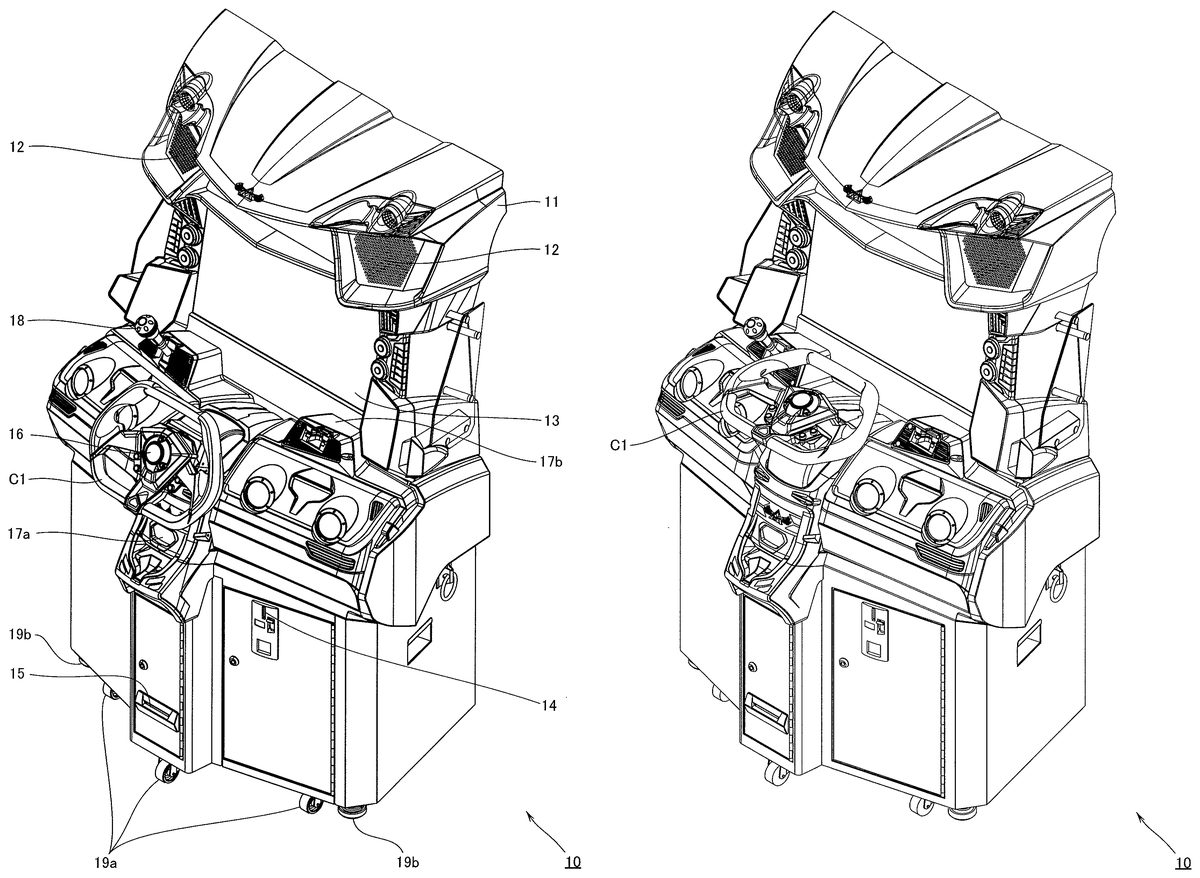
FIG. 1is a configuration diagram showing an example of an appearance configuration of an arcade video game machine (arcade game apparatus)10according to one embodiment of the present invention. As shown inFIG. 1, in the arcade video game machine10, two speakers12for outputting an audio and a display device13for displaying an image are arranged on a front and upper portion of a housing11. The display device13is configured by a CRT, a liquid crystal display or the like. A coin slot14into which a coin for starting a video game is dropped and a card discharge port15for discharging a card for the video game (will be described later, hereinafter, referred to simply as a “card”) to the outside are arranged on a front and lower portion of the housing11.
There is a controller arrangement region in which various kinds of controllers are arranged between the display device13and the coin slot14. A steering type controller C1that is a steering-shaped controller is arranged substantially in the center of the controller arrangement region. Further, a player operation button16is arranged substantially in the center of the steering type controller C1(that is, arranged at a portion in which a klaxon is arranged in a handle of a general vehicle). Moreover, a bar-shaped controller (shift lever)18is arranged at an upper side of the steering type controller C1. Both the steering type controller C1and the shift lever18are mainly used when a player plays a first game mode (will be described later) among video games played in the arcade video game machine10. Namely, both the steering type controller C1and the shift lever18are mainly operated in order to cause a video game of the first game mode to proceed. Hereinafter, the steering type controller C1is called a “steering C1” arbitrarily.
A scanner17aprovided with a card insertion slot (will be described later) for inserting a card is arranged at a lower portion of the controller arrangement region. The scanner17areads out code data written on a card inserted in the card insertion slot.
Further, a scanner17bprovided with a card insertion slot for inserting a card on which user information is registered is arranged above the controller arrangement region and at substantially the reverse side of a position of the shift lever18with respect to the steering type controller C1. The scanner17breads out the user information described on the card inserted into the card insertion slot. In this regard, the scanner17aand the scanner17bmay be configured by one scanner.
Further, a plurality of casters19aare provided on a bottom surface of the housing11. The casters19amake it possible to move the arcade video game machine10readily. An adjuster19bfor adjusting a height of the arcade video game machine10is arranged at the front side of the bottom surface of the housing11. The adjuster19ballows the arcade video game machine10to be installed regardless of a concave-convex shape of an installation place. Moreover, a shield case20(not shown in the drawings) is arranged inside the housing11. A substrate on which a control circuit is mounted and the like are stored in the shield case20.
Next, a physical action of the arcade video game machine10will be described.
FIG. 2is a configuration diagram showing an appearance configuration of the arcade video game machine10when a position (or posture) of the steering type controller C1is changed by the player, for example. As shown inFIG. 2, the steering type controller C1is configured so that an angle of root portion thereof can be changed. In this regard, in the present embodiment, the steering type controller C1is locked (or fixed) until a predetermined condition is satisfied. In a case where the predetermined condition I satisfied, the lock of the steering type controller C1is released, and this makes it possible to change its position (or posture). In this regard, the arcade video game machine10may be configured so that the position change of the steering type controller C1does not rely on a human power, or a mechanism to assist a human power is provided. Further, in a case where the steering type controller C1is moved to a predetermined position (evacuation position), the steering type controller C1is locked at the spot (or with the posture). In the present embodiment, a position of the steering type controller C1in the arcade video game machine10is controlled by means of a steering type controller driving section CD1(not shown in the drawings).
FIG. 3is a configuration diagram showing an appearance configuration of the arcade video game machine10when the steering type controller C1is moved to a predetermined position (in the present embodiment, the position shown inFIG. 2) and a lever type controller C2thereby appears. As shown inFIG. 3, as the lever type controllers C2, four controllers (lever-shaped controller or lever type controller) C2are arranged two by two at both sides of the steering type controller C1. Each of the lever type controllers C2has a handle (or grip) with a size as much as a person can grab in one hand. In this regard, in the present embodiment, a frame CL is provided around each of the lever type controllers C2, and each of the lever type controllers C2is configured so as to be capable of rotating along the frame CL. Further, a trigger type controller C3is provided on each of the lever type controllers C2. The lever type controller C2and the trigger type controller C3are mainly used when the player plays a second game mode (will be described later) in the video game played in the arcade video game machine10. Namely, the lever type controller C2and the trigger type controller C3are mainly operated in order to cause the video game in the second game mode to proceed. Hereinafter, in some cases, the lever type controller C2is called a “gyro lever C2”, and the trigger type controller C3is called a “trigger C3”. In this regard, the lever type controller C2may be configured so as not to be capable of rotating, and may be configured so that an instruction by the player can be inputted.
In this regard, in a case where two players fight against each other using one arcade video game machine10, one player first carries out the video game by a drive mode using the steering type controller C1, and the other player then carries out the video game by the drive mode using the steering type controller C1. After the video game by the drive mode is carried out by the two players, the two players carry out the video game by a battle mode based on the results using the two gyro levers C2for each player.
The lever type controller C2is caused to move, by means of a lever type controller driving section CD2(not shown in the drawings), from an initial position (as shown inFIG. 1, the position at which the player cannot operate; that is, the position at which the lever type controller C2does not appear) to a specific position (as shown inFIG. 3, the position at which the player can operate; that is, the position at which the lever type controller C2appears), in a case where a position of the steering type controller C1becomes a state (the state shown inFIGS. 2 and 3) moved upward from an arrangement at the start of the video game (the state shown inFIG. 1) when a condition (will be described later) is satisfied during progress of the video game.
More specifically, in the state shown inFIG. 1, the lever type controller C2is stored inside the arcade video game machine10. In a case where the steering type controller C1is held up (in a case where the steering type controller C1becomes the state shown inFIG. 2), a part of the arcade video game machine10is driven, and the lever type controllers C2are caused to move forward. Namely, in the present embodiment, each of the lever type controllers C2is configured so as to be capable of moving from a storage state to an exposed state. In this regard, a method of driving the two kinds of controllers is not limited to this. The arcade video game machine10may be configured so that, in a case where a first controller is moved to a position at which the player cannot operate the first controller (or inconvenience position), a second controller is moved to a position at which the player can operate the second controller (or convenience position). Further, in the present embodiment, the arcade video game machine10is configured so that each of the controllers C1, C2is returned to an initial position when the video game is terminated.
Next, an internal configuration of the arcade video game machine10will be described.
FIG. 4is a block diagram showing an example of a circuit configuration of the arcade video game machine10. As shown inFIG. 4, in the arcade video game machine10, a control circuit (computer apparatus)20ais contained within a shield case20. The control circuit20aincludes a CPU21, a ROM22, a RAM23, an image processing section24, an audio processing section26, an audio outputting section27, an input/output control section28, and a communication control section29.
The CPU21has a function to carry out a video game processing program stored in the ROM22and a function to carry out various kinds of controls for causing the video game provided in the arcade video game machine10to proceed in response to an operation of the player. In this regard, the CPU21includes an internal timer.
The video game processing program carried out by the CPU21, and various kinds of data that are not changed in accordance with progress of the video game are stored in the ROM22. The RAM23is used as a work area for the CPU21, and data that are changed in accordance with progress of the video game are stored in the RAM23.
The image processing section24is connected to a display section25, and causes the display section25to display a game screen according to progress of the video game and/or an operation of the player in accordance with a control of the CPU21. The display section25is configured by a liquid crystal display, for example. In this regard, in the present embodiment, the case where one display screen is provided in the arcade video game machine10will be described as an example. For that reason, the display device13is the same as the display section25. Therefore, hereinafter, explanation using the display section25will be provided.
The audio processing section26is connected to the audio outputting section27, and causes the audio outputting section27to output an audio in accordance with a control of the CPU21in response to progress of the video game and an operation of the player.
The input/output control section28is connected to each of a coin inserting sensor14S; the steering type controller driving section CD1; the lever type controller driving section CD2; the player operation button16; a scanner17(scanners17a,17b); and a card discharging section15D for discharging cards stacked on a card stacker (not shown in the drawings) from the card discharge port15. The coin inserting sensor14S detects insertion of a coin from the coin slot14. The steering type controller driving section CD1includes a sensor (not shown in the drawings) for detecting a state of the steering type controller C1. Further, the lever type controller driving section CD2includes a sensor (not shown in the drawings) for detecting a state of the lever type controller C2.
Various kinds of signals including a detected signal of the coin inserting sensor14S, an input signal of the player operation button16, a signal indicating data read out from the card by the scanner17, a detected signal that the steering type controller C1moves to the predetermined position, and a detected signal that the lever type controller C2moves to the specific position are inputted into the CPU21via the input/output control section28. Further, the instruction to cause the lever type controller C2to move to the specific position, and the instruction to cause the steering type controller C1and the lever type controller C2to move to the respective initial positions are transmitted to the respective driving sections (that is, the steering type controller driving section CD1and the lever type controller driving section CD2) from the CPU21via the input/output control section28.
The communication control section29is connected to other apparatus (an external apparatus)50, and controls transmission and reception of information to and from the connected other apparatus50. The other apparatus50connected to the communication control section29may be another arcade video game machine that has the same configuration as the arcade video game machine10. The other arcade video game machine thus connected may be placed adjacent to the arcade video game machine10, and may be connected to the arcade video game machine10via a dedicated line. Alternatively, the other arcade video game machine thus connected may be placed at a remote location, and may be connected to the arcade video game machine10via a communication line such as a telephone line or the Internet. Further, the other apparatus50connected to the communication control section29may be a management computer for a video game arcade in which the arcade video game machine10is placed or the like. In this regard, the CPU21, the ROM22, the RAM23, the image processing section24, the audio processing section26, the input/output control section28, and the communication control section29are connected to each other via an internal bus31. Further, the configuration of the arcade video game machine10is not limited to this configuration. For example, the arcade video game machine10may be configured so that various kinds of data such as data that are changed in accordance with progress of the video game are stored in an external storage device (information memory).
In the arcade video game machine10according to an example of the present embodiment, in order to select a player character that is to participate in a video game and fight an enemy character, a card on which information on characters that can be selected as the player character is written is used. Some cards of a plurality of cards are provided as basic cards separately from execution of the video game. Further, when a coin is inserted in order to newly carry out a video game, one piece of new card is provide. In this regard, the arcade video game machine10may be configured so that the player character that the player can select even though the player has no card is set up.
Next, a card used in the arcade video game machine10according to an example of the present embodiment will be described. Display indicating character information regarding a name of a character and a status, and code data are drawn on a card30. In this regard, in a case of the present embodiment, any one kind of player character of plural kinds of characters that can be cause to participate in the video game as the player character is drawn on per one piece of card. When the scanner17areads out the code data, the character drawn on the card30appears in the video game as the player character.
Further, in the present embodiment, the code data, by which information on the player character at the vehicle form and information on the player character at a battle form different from the vehicle form (for example, the animal form or the humanoid robot form) can be specified, are drawn on one piece of card.
In this regard, the code data are obtained by coding data for uniquely identifying the card30. The card used in the present embodiment contains, in addition to the data indicating the character information as described above, code data indicating an item by which an offensive power of the player character is raised and an item by which the content of the command is changed, for example.
Next, “ultrarapid transformation” that is a feature of the video game carried out in the arcade video game machine10will be described. The “ultrarapid transformation” according to the present embodiment denotes a video game system in which the player character that finishes driving the course with the vehicle form transforms the vehicle form into the battle form (hereinafter, referred to as a “robot form”) and the player character starts to battle against an enemy character transformed into the robot form. Hereinafter, processing from the time when three player characters constituting a team of the player (that is, each character having the vehicle form and the robot form, arbitrarily referred to as a “machine”) and three machines constituting an enemy team (the enemy may be other player or a computer. Hereinafter, the machine at the enemy side is referred to as an “enemy character” or “enemy machine”) go down to a battle map to the time when information on the battle such as a technique (or skill: action) of each machine and EP (that is, Energy Point: the video game is over when the point becomes zero) of the whole team is displayed denotes “ultrarapid transformation” or “ultrarapid transformation processing”.
The arcade video game machine10is characterized in that a game mode before the ultrarapid transformation (that is, a game mode in which the player character with a vehicle form drives on a predetermined course in accordance with an operation of the steering C1by the player: a drive mode) and a game mode after the ultrarapid transformation (that is, a game mode in which the player character with a robot form battles against an enemy character in accordance with an operation of the gyro lever C2by the player: a battle mode) are different game modes (in particular, a game mode in which a genre and a controller to be used are different from each other). In the present embodiment, the “drive mode” is called a “first game mode”, and the “battle mode” is called a “second game mode” arbitrarily, whereby the respective modes are distinguished.
Next, an example of various kinds of data (information) stored in the RAM23will be described.
In the present embodiment, the RAM23includes a character information storage section23a; a first game mode information storage section23b; a second game mode information storage section23c; a player character managing table23d; and an input command managing table23e.
The character information storage section23ais a storage area for storing the character information that is information regarding at least one kind of character. The character information contains information indicating a form of each character in the first game mode and a form of each character in the second game mode.
FIG. 5is an explanatory drawing showing an example of a storage state of the character information stored in the character information storage section23a. As shown inFIG. 5, the character information contains: a character ID; various kinds of information on a character in the first game mode; and various kinds of information on a character in the second game mode. More specifically, the character information contains information for specifying a driving form of the character in the first game mode (in the present embodiment, referred to as a “vehicle form” because the character is only a “vehicle”) and driving performance. Further, the character information contains information for specifying a battle form of the character in the second game mode, battle performance, and an action of the character (in the present embodiment, “technique”) that is carried out in response to an instruction (battle command) inputted using the shuttle lever C2. In this regard, in the present embodiment, the case where a robot form, for example, a humanoid robot form is adopted as the battle form will be described as an example. In this case, the battle form is not limited to the humanoid robot form. The battle form may be a form different from the form in the first game mode. However, it is preferable to adopt a form by which the player is caused to easily recognize that operability for the form, such as an animal form or an airplane form, is different from that for the vehicle form. Further, it is preferable to adopt a form by which the player is caused to easily recognize that the form is transformed from the vehicle form by setting up the same color (or the like) as that of the vehicle form.
In this regard, in the present embodiment, the case where the video game is carried out using a character having a vehicle form and a robot battle form will be described as an example. However, a form of the operational object in the first game mode may be the same as that in the second game mode, but the controllers used by the player may be configured so as to be different from each other.
In the present embodiment, in the battle mode, the player character carries out, in accordance with the instruction content by the shuttle lever C2, any of a “normal attack” set up as a general (safe) attack, a “burst attack” set up as a more powerful attack than the normal attack, and a “counter attack” set up as a more powerful attack than the normal attack carried out only in a case where an attack instructed for the other side is a burst attack. In this regard, in the present embodiment, the arcade video game machine10is configured so that the normal attack is carried out when the right gyro lever C2, when viewed from the front face, is pressed into, the burst attack is carried out when the left gyro lever C2is pressed into, and the counter attack is carried out when both the gyro levers C2are pressed into almost at the same time.
Each of the first game mode information storage section23band the second game mode information storage section23cis a storage area for storing various kinds of information necessary for carrying out each of the game modes. In this regard, the arcade video game machine10may be configured so that the information on the “ultrarapid transformation” is stored in at least one of the first game mode information storage section23band the second game mode information storage section23c. Alternatively, the arcade video game machine10may be configured so that the information on the “ultrarapid transformation” is stored in other storage area. Further, the arcade video game machine10may be configured so that each piece of information is stored in one storage area (game information memory).
FIG. 6is an explanatory drawing showing an example of a storage state of the second game mode information stored in the second game mode information storage section23c. Here, as an example of the game information, correlation information of the “technique” contained in the second game mode information will be described as an example. In the present embodiment, the correlation information is information indicating the content of “technique”. The “technique” is an action that each character is caused to carry out in accordance with a combination of an instruction, which can be inputted using the gyro lever C2, and the content, which can be instructed to an enemy character (that is, an instruction that can be inputted by other player in a case where the enemy is the other player).
As shown inFIG. 6, the correlation information is configured so that the content of “techniques” carried out by the player character and the enemy character is determined in accordance with the content of an instruction by the player and the content of an instruction by the enemy. Namely, for example, in a case where the player instructs a “normal attack” and the enemy (that is, a match-up player or computer) instructs a “normal attack”, each character carries out the “normal attack” each other. In a case where the player instructs a “counter attack” and the enemy instructs the “normal attack”, a character of the player (that is, the player character) carries out an attack weaker than the “counter attack” and the “normal attack” (that is, counter failure), and only a character of the enemy carries out the “normal attack”. Further, in a case where one instructs the “counter attack” and the other instructs a “burst attack”, the character of the one party carries out the “counter attack” as a “burst break”, and the character of the other party does not carry out the “burst attack” (that is, action impossible).
The player character managing table23dis a storage area in which information regarding a character (the player character) specified by the player as the character to be operated among the character information is registered. The arcade video game machine10updates the character information registered in the player character managing table23din accordance with progress of the video game correspondingly.
The input command managing table23eis a storage area in which an instruction (input command) inputted using each of the controllers is registered. In the present embodiment, in the battle mode, development of the video game thereafter is determined in accordance with the input command registered in the input command managing table23e. The processing carried out at the battle mode will be described later in detail (seeFIGS. 12 and 14).
Next, an operation of the arcade video game machine10according to the present embodiment will be described.
FIG. 7is a flowchart showing an example of game processing carried out by the arcade video game machine10. The game processing is started when the coin inserting sensor14S detects that a coin is dropped from the coin slot14. In the game processing according to the present embodiment, processing from the time when a player1determines a player character that becomes his or her operational object to the time when a video game is terminated is carried out. In this regard, the content of processing with no relationship to the present invention may be omitted.
The CPU21first controls the card discharging section15D to discharge a piece of card30from the cards30stacked in the card stacker (Step S101).
Next, the CPU21transmits an instruction to the image processing section24, and causes the display section25to display a screen (card insertion instruction screen) for instructing the player to insert one piece of card30held by the player into a card insertion slot17R (Step S102).
When the card30is inserted into the card insertion slot17R by the player, the CPU21causes the scanner17ato read out code data stored in the card30(Step S103).
When the scanner17ais caused to read out the code data, the CPU21determines whether the inserted card30is a card indicating a main character or not (Step S104). Here, for example, in a case where the code data indicates an item, the CPU21determines that the card30is not the card indicating the main character (“No” at Step S104), and causes the processing flow to shift to the process at Step S102. In this regard, the arcade video game machine10may be configured so that, at this time, the CPU21determines, in accordance with a predetermined rule, information on a character that is to be the main character (main character information) among the character information stored in the character information storage section23aand causes the processing flow to shift to a process at Step S109(will be described later).
On the other hand, in a case where the code data indicates a character, the CPU21determines that the card30is a card indicating the main character (“Yes” at Step S104); transmits an instruction to the image processing section24; and causes the display section25to display an instruction screen for inserting a card indicating a sub character (Step S105).
Subsequently, the CPU21determines whether insertion of a card is received or not (Step S106). Here, in a case where it is determined that the insertion of the card is not received because, for example, the player receives a selection operation, which specifies that a card is not inserted (“No” at Step S106), the CPU21carries out processing set up in advance as “processing to supply a rental car” (Step S107). More specifically, the CPU21determines, in accordance with a predetermined rule, information on a character that is to be the sub character (sub character information) among the character information stored in the character information storage section23a, and causes the processing flow to shift to a process at Step S109(will be described later).
On the other hand, in a case where it is determined that the insertion of the card is received (“Yes” at Step S106), the CPU21determines whether the inserted card is a card indicating the sub character or not (Step S108). Here, in a case where it is determined that the inserted card is not the card indicating the sub character (“No” at Step S108), the CPU21causes the processing flow to shift to the process at Step S105.
On the other hand, in a case where it is determined that the inserted card is the card indicating the sub character because, for example, the inserted card is a card indicating a character different from the main character (“Yes” at Step S108), the CPU21reads out information indicating the main character (main character information) and the sub character information from the character information storage section23a, and registers them in the player character managing table23d(Step S109).
When the character information is registered, the CPU21starts the first game mode processing for controlling progress of the video game on the basis of the first game mode (Step S200).
FIG. 8is a flowchart showing an example of the first game mode processing carried out by the arcade video game machine10according to the present embodiment. In the first game mode processing, processing to control progress of the video game in the first game mode in accordance with an instruction inputted using the first controller is carried out. In this regard, the content of processing with no relationship to the present invention may be omitted.
When the first game mode processing is started, the CPU21refers to the first game mode information storage section23bto carry out processing for representation of appearance of a character participating a battle (or representation of appearance of a machine participating a battle) (Step S201). In the present embodiment, the CPU21transmits an instruction to the image processing section24, and carries out processing to cause the display section25to display a game screen including the player character, which is indicated by the character information registered in the player character managing table23d(the first game mode screen) and the like.
Subsequently, the CPU21transmits an instruction to the image processing section24, and causes the display section25to display a course information display screen (Step S202). In the course information display screen, information on a course on which the player character with a vehicle form drives is displayed.
When the display section25is caused to display the course information display screen, the CPU21controls progress of the video game in the first game mode in accordance with an instruction inputted using the steering C1(Step S203). In the present embodiment, the CPU21causes the display section25to display an action (for example, drift or the like) according to a course status, which includes a traveling direction of a main character with a vehicle form in accordance with a rotation angle of the steering C1. In this regard, in the present embodiment, the main character (main machine) is controlled so as to accelerate regardless of an instruction by the player, and the CPU21determines a speed of the main character in accordance with a deceleration or boost (ultra acceleration) operation on the basis of an operation of the shift lever18. Further, an action of the sub character is to be controlled so as to follow the main character.
FIG. 9is an explanatory drawing showing an example of the game screen (first game screen) when the video game proceeds on the basis of the first game mode. As shown inFIG. 9, a bonus item BI arranged on the course (hereinafter, referred to as an “item”); an item acquired number display region101indicating the number of acquired items by the player1; a time limit display region102; a course outline display region103; a player character PC1as a main character; and an EP display region105for displaying a total EP of the main character PC1and two sub characters PC2, PC3(not shown in the drawings) are provided in a first game screen. In this regard, in the present embodiment, the total EP is displayed in a gauge form (that is, a form in which the amount of EP is indicated by increase or decrease of a meter in a gauge) in the EP display region105.
In conjunction with control of the progress of the first game mode, the CPU21determines whether a shift condition to the second game mode is satisfied or not (Step S204). Here, the CPU21continues progress of the video game in the first game mode until it is determined that a shift condition set up in advance is not satisfied (“No” at Step S204). Here, in the present embodiment, as the shift condition to the second game mode (second game mode shift condition), “any one of a condition that the player character runs out the course and a condition that a predetermined period of time elapses since the player character starts driving is satisfied” is set up. In this regard, the second game mode shift condition is not limited to this condition. For example, the second game mode shift condition may be a condition independent of progress of the video game in the first game mode (for example, a condition “a predetermined force termination button is pressed”, a condition “a specific period of time elapses until the video game is started” or the like). Namely, the arcade video game machine10may be configured so that the CPU21determines a condition independently of a control result in the first game mode. Further, in the present embodiment, the shift condition to the second game mode is stored in the first game mode information storage section23bas the first game mode information.
On the other hand, in a case where it is determined that the shift condition to the second game mode is satisfied because, for example, the player character terminates driving of the course (“Yes” at Step S204), the CPU21calculates evaluation of the content of play in the first game mode (the first game mode evaluation) (Step S205). In the present embodiment, the CPU21calculates a numerical value as the first game mode evaluation using a predetermined computational expression that utilizes a clear time of the course and the number of acquired items. In this regard, the CPU21registers the calculated first game mode evaluation in the player character managing table23d, and causes the display section25to display a first game mode evaluation screen (Step S206).
Subsequently, the CPU21carries out game mode shifting processing for shifting the game mode from the first game mode to the second game mode (Step S300).
FIG. 10is a flowchart showing an example of game mode shifting processing carried out by the arcade video game machine10according to the present embodiment. In this regard, the content of processing with no relationship to the present invention may be omitted.
When the game mode shifting processing is started, the CPU21informs the player1of the content of a game mode shifting operation, which is an operation for shifting the ongoing game mode (Step S301). In the present embodiment, the CPU21outputs an audio for announcement “push up the steering to set up the ultrarapid transformation”, for example. In this regard, a method of informing such announcement is not particularly limited. For example, the arcade video game machine10may be configured so that the display section25is caused to display a screen for informing a player of the content of the game mode shifting operation.
When the player1is informed of the content of the game mode shifting operation, the CPU21determines whether the game mode shifting operation is received or not (or whether the game mode shifting operation is detected or not) (Step S302). Here, in a case where it is determined that the game mode shifting operation is received on the basis of notification from the steering type controller driving section CD1(“Yes” at Step S302), the CPU21transmits an instruction to the image processing section24, and causes the display section25to display a shift representation screen for informing the player1of shift (or transition) of the game mode (Step S303).
When the display section25is caused to display the shift representation screen, the CPU21transmits an instruction to the lever type controller driving section CD2, and causes the second controller (lever type controller, or gyro lever) C2to move to a specific position (Step S304).
Then, in a case where it is determined that the movement of the second controller is completed (“Yes” at Step S305), the CPU21starts the second game mode processing to control progress of the video game by the second game mode (Step S400). In this regard, in the present embodiment, the CPU21determines that the movement of the second controller is completed in a case where the second controller is moved to the specific position and the CPU21receives, from the lever type controller driving section CD2, a notification that the second controller is fixed.
FIG. 11is a flowchart showing an example of second game mode processing carried out by the arcade video game machine10according to the present embodiment. In the second game mode processing, processing to control progress of the video game in the second game mode in accordance with an instruction inputted using the second controller different from the first controller is carried out. In this regard, the content of processing with no relationship to the present invention may be omitted.
In the second game mode processing, the CPU21first specifies the content influenced (the content of influence) by the first game mode evaluation to the second game mode (Step S401). In the present embodiment, the CPU21specifies a changed value of a status of the character in accordance with a rule stored in the second game mode information storage section23c.
When the content of influence is specified, the CPU21updates battle related information in accordance with the content of influence thus specified (Step S402). Here, the “battle related information” is information related to a battle between the player character with a battle form and an enemy character, and contains an offensive power of each character, EP and the like, for example. In the present embodiment, the CPU21updates the information registered in the player character managing table23din order to raise the status of the player character as the item bonus. Thus, the CPU21reflects the result of progress of the video game in the first game mode into progress of the video game in the second game mode.
When the battle related information is updated, the CPU21transmits an instruction to the image processing section24, and causes the display section25to display a battle related information display screen for presenting the battle related information to the player1(Step S403).
When the display section25is caused to display the battle related information display screen, the CPU21transmits an instruction to the image processing section24in accordance with elapse of a predetermined period of time, for example, and causes the display section25to display a command input screen for encouraging the player1to input a command (Step S404).
FIG. 12is an explanatory drawing showing an example of the command input screen. As shown inFIG. 12, the player characters (that is, the main character PC1and the two sub characters PC2, PC3) that become input targets of commands (that is, target for which “technique” to be carried out is set up); enemy characters NPC1, NPC2; an enemy icon display region201for displaying an icon of each enemy character; an enemy EP display region202for displaying a total EP of all the enemy characters in the form of a gauge; and a battle turn number display region for displaying the number of battle turns are provided in the command input screen. Here, the “battle turn” denotes the number of times of technique sequence carried out after an input of a command. In a case where the number of battle turns is “1”, this means a first input of a command in a battle.
When the display section25is caused to display the command input screen, the CPU21determines whether insertion of a card is received or not (Step S405). Here, in a case where it is determined that insertion of the card is not received (“No” at Step S405), the CPU21causes the processing flow to shift to a process at Step S408(will be described later).
On the other hand, in a case where it is determined that insertion of the card is received (“Yes” at Step S405), the CPU21determines whether the received card is a special card in which an effect to assist a battle is set up or not (Step S406). Here, in a case where it is determined that the received card is not the special card (“No” at Step S406), the CPU21determines that the insertion of the card is invalid, and causes the processing flow to return to the process at Step S405.
On the other hand, in a case where it is determined that the received card is the special card (“Yes” at Step S406), the CPU21registers the content according to the special card in the input command managing table23e(Step S407). In this regard, in the present embodiment, the CPU21registers, in response to the situation that the trigger C3is pulled after the special card is inserted, the content according to the inserted special card in the input command managing table23e. Further, in a case where two players carry out a video game using one arcade video game machine10, the CPU21registers the content according to the inserted special card in the input command managing table23efor the player corresponding to the pulled trigger C3.
Subsequently, the CPU21determines whether an input of a command using the second controller C2is received or not (Step S408). Here, in a case where it is determined that the input of the command using the second controller C2(that is, an instruction by the player1) is received (“Yes” at Step S408), the CPU21refers to the player character managing table23d, and registers a “waza (i.e., technique)” according to the received command in the input command managing table23e(Step S409).
When the “technique” is registered in the input command managing table23e, the CPU21determines whether any “technique” for each character is registered or not (Step S410). Namely, the CPU21determines whether any “technique” is registered for both the player character and the enemy character or not. Here, in a case where it is determined that a “technique” for each character is not registered (“No” at Step S410), the CPU21causes the processing flow to shift to the process at Step S404. In this regard, in the present embodiment, the content of the command input screen is updated in accordance with the character for which no “technique” is registered. Namely, in the command input screen, for example, the player character for which no “technique” is registered is distinguishably displayed.
On the other hand, in a case where it is determined that a “technique” for each character is registered (“Yes” at Step S410), the CPU21starts battle processing for realizing a battle between characters according to the inputted command (Step S500).
FIG. 13is a flowchart showing an example of battle processing carried out by the arcade video game machine10according to the present embodiment. In this regard, the content of processing with no relationship to the present invention may be omitted.
In the battle processing, the CPU21first determines a combination of the player character and an enemy character in accordance with an action order determined on the basis of the character information (Step S501). In the present embodiment, the CPU21determines an action order of each character in a predetermined method in which a random number is added to a speed of each of all characters that participate in the battle, and then, combine the player character with an enemy character that has an action order closest with the action order of the player character.
When the combination of the characters is determined, the CPU21updates the input command managing table23eon the basis of the correlation information (seeFIG. 6) (Step S502).
When the input command managing table23eis updated on the basis of the correlation information (that is, when a “technique” carried out in accordance with the combination of the respective characters is determined), the CPU21transmits an instruction to the image processing section24, and causes the display section25to display a combination display screen indicating a combination of the characters (Step S503).
Subsequently, the CPU21determines whether or not the content according to the special card has been registered in the input command managing table23efor the player or the enemy (Step S504). Here, in a case where it is determined that the content according to the special card has been registered (“Yes” at Step S504), the CPU21carries out processing in accordance with the registered content (the content according to the special card) (Step S505), and causes the processing flow to shift to a process at Step S507(will be described later).
On the other hand, in a case where it is determined that the content according to the special card has not been registered (“No” at Step S504), the CPU21refers to the input command managing table23e, and carries out the “technique” for each character in accordance with the action order (Step S506).
Then, after the “technique” for one character is carried out or after the “techniques” for all characters are carried out, the CPU21determines whether the EP of either the player or the enemy becomes zero (0) or not (Step S507). Here, in a case where it is determined that the EPs of both the player and the enemy do not become zero (“No” at Step S507), the CPU21causes the processing flow to shift to the process at Step S403in the second game mode processing.
On the other hand, in a case where it is determined that the EP of either the player or the enemy becomes zero (“Yes” at Step S507), the CPU21calculates evaluation of the player in the second game mode (second game mode evaluation) on the basis of calculation standard set up in advance (Step S508).
When the second game mode evaluation is calculated, the CPU21applies an experience point according to the first game mode evaluation and the second game mode evaluation to the card indicating the main character (or the card in which the user information is registered) (Step S509). In this regard, a method of applying the experience point is not particularly limited. The arcade video game machine10may be configured so as to write data to the card. Alternatively, the arcade video game machine10may be configured to manage the card so as to associate identification information indicated by the card with the experience point.
When the experience point is applied to the card, the CPU21transmits an instruction to the image processing section24, and causes the display section25to display a battle result display screen including the second game mode evaluation (Step S510).
When the battle result display screen is caused to display, the CPU21causes the processing flow to shift to the process at Step S110in the game processing (seeFIG. 7). In the process at Step S110in the game processing, the CPU21determines whether the video game is to be terminated or not (Step S110). A method of determining termination of the video game is not particularly limited. For example, it may be configured so that the CPU21transmits an instruction to the image processing section24and the display section25is caused to display a continue screen for confirming the intention of the player.
Although the arcade video game machine10has been described as an example in the embodiment described above, it is possible to apply the content of the video game to other video game processing apparatuses such as a home-use video game machine and a mobile video game machine.
As explained above, in the embodiment described above, the video game processing apparatus (for example, the arcade video game machine10) for controlling progress of the video game by displaying an operational object (for example, the player character) operated by a player on a display screen, the progress of the video game containing a fight against an enemy character is configured so as to: include the game information memory (for example, the first game mode information storage section23band the second game mode information storage section23c) for storing game information on the first game mode (for example, the drive mode) and the second game mode (for example, the battle mode) for the video game, the second game mode being a game mode different from the first game mode; receive the video game start request (for example, insertion of a coin) from the player1; control progress of the video game in the first game mode in accordance with an instruction inputted using the first controller (for example, the steering type controller C1) in a case where the video game start request receiver receives the video game start request; determine whether the predetermined condition (for example, the second game mode shift condition) is satisfied or not (for example, Step S204); induce the player1to carry out a game mode shifting operation in a case where it is determined that the predetermined condition is satisfied, the game mode shifting operation being an operation set up as the operation to shift the game mode (for example, Step S301); receive the game mode shifting operation by the player1; cause the second controller (for example, the lever type controller C2) to move from the storage state to the exposed state in a case where the game mode shifting operation receiver receives the game mode shifting operation; and controlling progress of the video game in the second game mode (for example, the battle mode) in accordance with an instruction inputted using the second controller in a case where the second controller mover causes the second controller to move to the exposed state. Therefore, it is possible to provide a match-up type video game with rich variation, which can keep interest of a player in the video game.
Namely, the player can merely play the two battle modes, and the player is caused to use the different controllers for the respective modes. For that reason, it is useful to keep interest of the player in the video game. Further, since it is possible to give the player himself or herself a chance to move his or her body (exercise) as the game mode shifting operation, it becomes possible for the player to divert himself or herself effectively. In this regard, the arcade video game machine10may be configured so that the “predetermined condition” is a condition regarding a control result in the first game mode. By configuring the arcade video game machine10in this manner, it becomes possible to improve relevance between the plurality of game modes.
Further, in the embodiment described above, the video game processing apparatus (for example, the arcade video game machine10) is configured so that the game mode shifting operation is an operation to cause a position of the first controller (for example, the steering type controller C1) to move to a predetermined evacuation position wherein the predetermined evacuation position does not lie in the way when to operate the second controller (for example, the lever type controller C2). Since the plurality of controllers are arranged in such a manner, it becomes possible to prevent operability of the respective controllers from being lowered. Further, it becomes possible to improve the degree of freedom of appearance design of the arcade video game machine.
Further, in the embodiment described above, the video game processing apparatus (for example, the arcade video game machine10) is configured so that the first controller has a steering shape, the first game mode is the drive mode in which the player operates a vehicle, the second controller is a lever-shaped controller provided with a trigger, and the second game mode is a battle mode in which a robot operated by the player carries out a battle against the enemy character. Therefore, it is possible to provide a video game machine by which the player can play plural genres of video games as one machine (housing). Namely, conventionally, in particular, in the field of an arcade video game machine, a different controller is generally used depending upon a genre of a video game, there has thus been a problem that it is difficult to integrate the controller with a good usability. However, by configuring the plurality of controllers so that their arrangement can be changed, it is possible to solve such a problem.
Further, in the embodiment described above, the video game processing apparatus (for example, the arcade video game machine10) is configured so as to: include the operational object information memory (for example, the character information storage section23a) for storing operational object information, the operational object information containing information regarding at least one kind of the operational object (for example, the character), the information indicating a form in the first game mode (for example, the driving form) and a form in the second game mode (for example, the battle form); receive an input of card information, the card information containing identification information of the operational object; specify the operational object (for example, one main character and two sub characters) as the operational object of the player in each of the game modes on the basis of the received card information, the operational object indicating a predetermined number of pieces of operational object information among the operational object information stored in the operational object information memory (for example, specify the operational object by registering the character information in the player character managing table23d); display the specified operational object on the display screen with a form according to each of the game mode; and reflect a result of progress of the video game in the first game mode (for example, the first game mode evaluation) to progress of the video game in the second game mode (for example, Step S402). Therefore, it is possible to correlate the different game modes with each other, and it becomes possible to improve interest of the player in the video game.
Further, in the embodiment described above, the arcade video game machine10is configured so that the game information (for example, the second game mode information) contains correlation information (seeFIG. 6) that is information indicating the content of a process to be carried out in accordance with a combination of an instruction that can be inputted using the second controller in the second game mode and the content that can be instructed to the enemy character; and the video game processing apparatus (for example, the arcade video game machine10) refers to the correlation information to determine the content of a process carried out in accordance with the instruction inputted using the second controller (for example, Step S502). Therefore, it becomes possible to entertain the player with consideration of move of the enemy.
In this regard, although it has not been mentioned particularly in the embodiment described above, the video game processing apparatus (for example, the arcade video game machine10) may be configured so that in the battle processing (seeFIG. 13), a burst power gauge increasing bonus is applied to the player when an operation of the gyro lever C2or the trigger C3is received timely at the moment of hit during a technique sequence (for example, during execution of the technique at Step S505). Further, in a case where the arcade video game machine10is configured in such a manner, the arcade video game machine10may be configured so that plural times of trigger timing are set up for the normal attack.
In this regard, in the embodiment described above, the video game processing apparatus (for example, the arcade video game machine10) carries out various kinds of processings described above in accordance with the control program (for example, the video game processing program) stored in a storage device (the ROM22) with which the video game processing apparatus itself is provided.
INDUSTRIAL APPLICABILITY
The present invention is useful to provide a match-up type video game with rich variation, which can keep interest of a player in the video game.
Claims
- A video game processing apparatus for controlling progress of a video game by displaying an operational object operated by a player on a display screen, the progress of the video game containing a fight against an enemy character, the video game processing apparatus comprising: a memory configured to store game information on a first game mode and a second game mode for the video game, the second game mode being different from the first game mode;a receiver configured to receive a video game start request from the player;a first controller configured to control the progress of the video game in the first game mode in accordance with an instruction inputted using a first controller when the video game start request receiver receives the video game start request;a processor configured to determine whether a predetermined condition is satisfied, to induce the player to carry out a game mode shifting operation when the predetermined condition is satisfied, to determine whether a game mode shifting operation is received from the player, and to cause a second controller to move from a storage state to an exposed state when the game mode shifting operation is received, the game mode shifting operation being an operation to shift a game mode;and the second controller configured to control the progress of the video game in the second game mode in accordance with an instruction inputted using the second controller when the processor causes the second controller to move to the exposed state, wherein the second controller is different than the first controller, and in the storage state, the second controller is unexposed to the player.
- The video game processing apparatus according to claim 1 , wherein the game mode shifting operation causes the first controller to move to a predetermined evacuation position, the predetermined evacuation position not being within an operational range of the second controller.
- The video game processing apparatus according to claim 1 , wherein the first controller is a steering type controller, the first game mode is a drive mode in which the player operates a vehicle, the second controller is a lever type controller provided with a trigger, and the second game mode is a battle mode in which a character operated by the player carries out a battle against the enemy character.
- The video game processing apparatus according to claim 1 , further comprising: a card receiver configured to receive an input of card information, the card information containing identification information of the operational object;and a display configured to display the operational object on a display screen with a form for each of the first game mode and the second game mode, wherein the memory is further configured to store operational object information regarding at least one kind of the operational object, the operational object information indicating the form of the operational object in the first game mode and the form of the operational object in the second game mode, the processor is configured to specify the operational object of the player in each of the first game mode and the second game mode on the basis of the card information received by the card receiver, the operational object indicating a predetermined number of pieces of the operational object information stored in the memory.
- The video game processing apparatus according to claim 4 , wherein the processor applies an experience point of the game in the first mode and an experience point of the game in the second mode to the card information received by the card receiver.
- The video game processing apparatus according to claim 1 , wherein the game information contains correlation information that is information indicating a content of a process to be carried out in accordance with a combination of an instruction that is inputted using the second controller in the second game mode and a content that is instructed to the enemy character, and the second controller is configured to refer to the correlation information to determine the content of the process carried out in accordance with the instruction inputted using the second controller.
- The video game processing apparatus according to claim 1 , wherein the processor applies an experience point of the game in the first mode to an experience point of the game in the second mode.
- The video game processing apparatus according to claim 1 , wherein the second game mode is a battle based on results of the first game mode.
- The video game processing apparatus according to claim 1 , wherein the processor is further configured to specify a content influenced by the first game mode to the second game mode.
- The video game processing apparatus according to claim 9 , wherein the content influenced includes a changed value of a status of a player character operated by the player.
- The video game processing apparatus according to claim 1 , wherein the processor is configured to determine whether the predetermined condition occurs based on the player finishing a driving course.
- The video game processing apparatus according to claim 1 , wherein the processor is configured to determine whether the predetermined condition occurs based on a predetermined period of time elapsing.
- The video game processing apparatus according to claim 1 , wherein the processor is configured to determine whether the predetermined condition occurs independently of a control result of the first game mode.
- A non-transitory computer-readable medium including a video game processing program for controlling progress of a video game by displaying an operational object operated by a player on a display screen, the progress of the video game including a fight against an enemy character, the video game processing program causing a computer to execute: receiving a video game start request from the player;controlling the progress of the video game in a first game mode on the basis of game information stored in a memory in accordance with an instruction inputted using a first controller when the video game start request is received, the game information being related to the first game mode and a second game mode of the video game, the second game mode being different from the first game mode;determining whether a predetermined condition is satisfied;inducing the player to carry out a game mode shifting operation when the predetermined condition is satisfied, the game mode shifting operation being an operation to shift a game mode;receiving the game mode shifting operation from the player;causing a second controller to move from a storage state to an exposed state when the game mode shifting operation is received;and controlling the progress of the video game in the second game mode in accordance with an instruction inputted using the second controller when the second controller is caused to move to the exposed state, wherein the second controller is different than the first controller, and in the storage state, the second controller is unexposed to the player.
Disclaimer: Data collected from the USPTO and may be malformed, incomplete, and/or otherwise inaccurate.