U.S. Pat. No. 9,205,330
TEMPORAL RANKING IN VIRTUAL WORLDS
AssigneeInternational Business Machines Corp
Issue DateDecember 21, 2007
Illustrative Figure
Abstract
Embodiments of the present invention address deficiencies of the art in respect to virtual world navigation and provide a method, system and computer program product for applying temporal rankings to elements in a virtual world. In an embodiment of the invention, a method for temporally ranking locations in a virtual world can be provided. The method can include timing a duration of visit for different locations in a virtual world, computing a temporal score for the different locations, and displaying a ranking of the locations by temporal score. For instance, computing a temporal score for the different locations can include computing a sum of durations for each of the different locations, or computing an average of durations for each of the different locations, to name two examples. Optionally, computing a temporal score for the different locations also can include filtering the durations according to a date or time range.
Description
DETAILED DESCRIPTION OF THE INVENTION Embodiments of the present invention provide a method, system and computer program product for temporally ranking locations in a virtual world. In accordance with an embodiment of the present invention, a number of virtual visitors visiting different locations in a virtual world can be recorded along with a duration of time spent visiting each different location. Thereafter, the duration of time spent for each visitor for each different location can be combined with other recorded durations of time for different virtual visitors for the same location in order to generate a temporal score for the location. Finally, the temporal scores for different locations in the virtual world can be compared to identify more popular locations in the virtual world. In further illustration,FIG. 1pictorially illustrates a process for temporally ranking locations in a virtual world. As shown inFIG. 1, a virtual world110can be provided to include multiple different locations120such as stores, houses, restaurants, parks, theaters, social clubs, office buildings, offices, rooms and the like. The virtual world110further can be provided to permit interactions between virtual visitors130and the locations120. In this regard, as it is well-known in the art, the virtual visitors130can be visually and logically represented in the virtual world110as avatars granted the freedom of spatial movement throughout the virtual world110. Notably, a temporal ranking processor300can be coupled to the virtual world110and communicatively coupled to the different locations120. The temporal ranking processor300can include a monitor150configured to detect when individual ones of the virtual visitors130visit individual ones of the locations120. The temporal ranking processor300further can include a timer140configured to time a duration in which each of the virtual visitors130visits with the different ones of the locations120. In consequence, the temporal ranking processor300can produce a temporal ranking160of the different locations120in accordance with a number of visits by the ...
DETAILED DESCRIPTION OF THE INVENTION
Embodiments of the present invention provide a method, system and computer program product for temporally ranking locations in a virtual world. In accordance with an embodiment of the present invention, a number of virtual visitors visiting different locations in a virtual world can be recorded along with a duration of time spent visiting each different location. Thereafter, the duration of time spent for each visitor for each different location can be combined with other recorded durations of time for different virtual visitors for the same location in order to generate a temporal score for the location. Finally, the temporal scores for different locations in the virtual world can be compared to identify more popular locations in the virtual world.
In further illustration,FIG. 1pictorially illustrates a process for temporally ranking locations in a virtual world. As shown inFIG. 1, a virtual world110can be provided to include multiple different locations120such as stores, houses, restaurants, parks, theaters, social clubs, office buildings, offices, rooms and the like. The virtual world110further can be provided to permit interactions between virtual visitors130and the locations120. In this regard, as it is well-known in the art, the virtual visitors130can be visually and logically represented in the virtual world110as avatars granted the freedom of spatial movement throughout the virtual world110.
Notably, a temporal ranking processor300can be coupled to the virtual world110and communicatively coupled to the different locations120. The temporal ranking processor300can include a monitor150configured to detect when individual ones of the virtual visitors130visit individual ones of the locations120. The temporal ranking processor300further can include a timer140configured to time a duration in which each of the virtual visitors130visits with the different ones of the locations120. In consequence, the temporal ranking processor300can produce a temporal ranking160of the different locations120in accordance with a number of visits by the virtual visitors130to the different locations120and also a duration in which the virtual visitors130visit with the different locations120.
The process described herein can be embodied within a virtual world data processing system. In illustration,FIG. 2schematically depicts a virtual world data processing system configured for temporally ranking locations in a virtual world. The system can include a host server210communicatively coupled to different computing clients220over computer communications network240. The host server210can support the operation of a virtual world server250configured to generate a virtual world and provide access thereto over the computer communications network240to end users interacting with the virtual world by way of a content browser230. Each of the end users can be represented in the virtual world with a respective avatar.
Notably, temporal ranking logic270can be coupled to the virtual world server250by way of the host server210. The temporal ranking logic270can include program code enabled to track virtual visitors to different locations in the virtual world provided by the virtual world server. The program code of the temporal ranking logic270further can be enabled to time a duration of each visit to a location by a virtual visitor in the virtual world. Consequently, the program code of the temporal ranking logic270can produce a set of rankings260for the different locations. The rankings can range from a list of most popular locations, to a detailed listing of durations of visits, to a listing of an average duration of visits. Of course, the rankings can be filtered by time of day, day of week or month of year, and period comparisons can be provided comparing rankings from one period to the next.
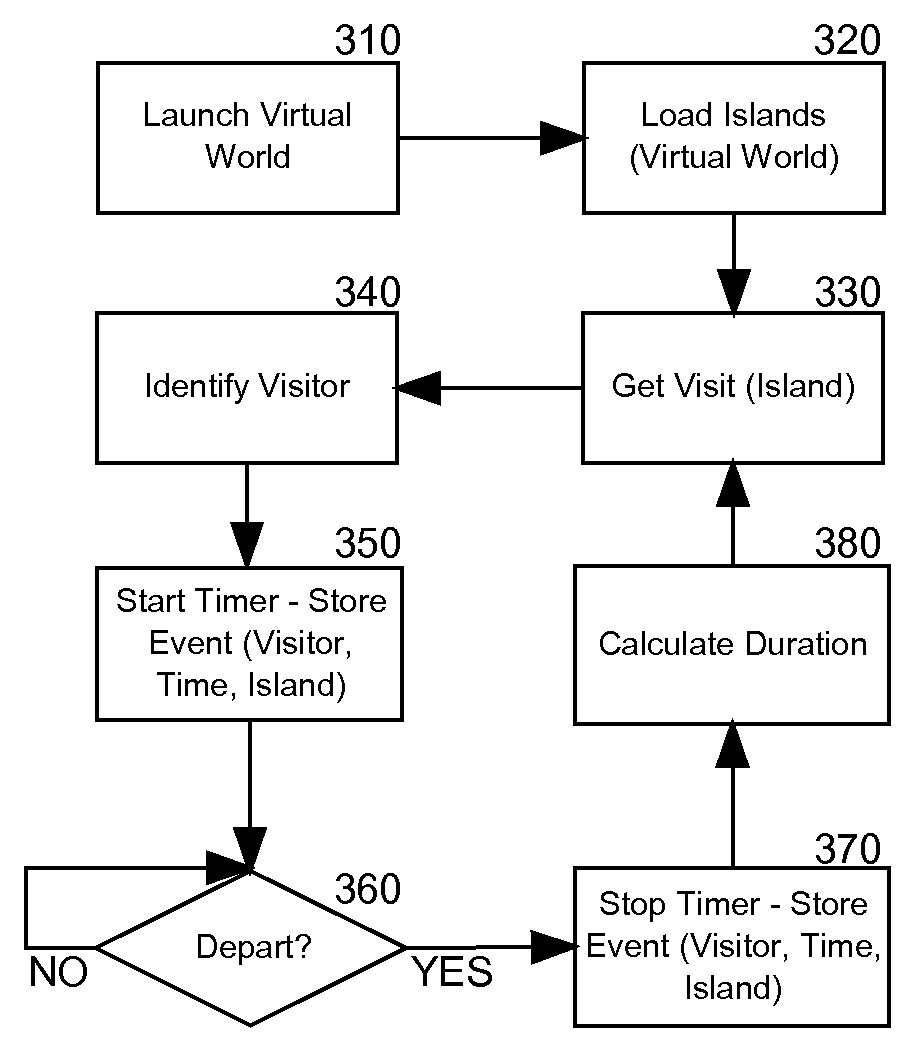
In further illustration of the operation of the temporal ranking logic270,FIG. 3is a flow chart illustrating a process for temporally ranking locations in a virtual world. Beginning in block310, a virtual world can be launched for interaction with different end users and in block320, different locations can be loaded within the virtual world, such as different stores, houses, restaurants, parks, theaters, social clubs, office buildings, offices, rooms and the like. In block330, a visit can be detected by an end user in a location in the virtual world. In consequence, in block340the visitor to the location can be identified either directly (e.g., by name), or indirectly in terms of demographics (e.g. male, female, age, etc.). In the latter circumstance, the privacy of the visitor to the location can be protected at the discretion of the visitor according to preferences of a security policy for the visitor.
In block350, a timer can start for the visit and the visit can be stored in connection with the visitor, the time and the location. With the stored information, real-time information pertaining to a most popular location can be readily determined. In decision block360, so long as the visitor has not left the location, the timer can continue to run. In decision block360, if it is determined that the visitor has left the location, in block370the timer can stop and the departure from the location can be stored in connection with the visitor, the time and the location. Thereafter, in block380the duration of the visit to the location can be computed for subsequent reporting, for instance, a list of the “stickiest” locations or most popular locations in the virtual world according to a sum of visit durations for each location, or an average duration of a visit for each location. The process then can repeat through block330for a next visit by a visitor to a location in the virtual world.
Embodiments of the invention can take the form of an entirely hardware embodiment, an entirely software embodiment or an embodiment containing both hardware and software elements. In a preferred embodiment, the invention is implemented in software, which includes but is not limited to firmware, resident software, microcode, and the like. Furthermore, the invention can take the form of a computer program product accessible from a computer-usable or computer-readable medium providing program code for use by or in connection with a computer or any instruction execution system.
For the purposes of this description, a computer-usable or computer readable medium can be any apparatus that can contain, store, communicate, propagate, or transport the program for use by or in connection with the instruction execution system, apparatus, or device. The medium can be an electronic, magnetic, optical, electromagnetic, infrared, or semiconductor system (or apparatus or device) or a propagation medium. Examples of a computer-readable medium include a semiconductor or solid state memory, magnetic tape, a removable computer diskette, a random access memory (RAM), a read-only memory (ROM), a rigid magnetic disk and an optical disk. Current examples of optical disks include compact disk-read only memory (CD-ROM), compact disk-read/write (CD-R/W) and DVD.
A data processing system suitable for storing and/or executing program code will include at least one processor coupled directly or indirectly to memory elements through a system bus. The memory elements can include local memory employed during actual execution of the program code, bulk storage, and cache memories which provide temporary storage of at least some program code in order to reduce the number of times code must be retrieved from bulk storage during execution. Input/output or I/O devices (including but not limited to keyboards, displays, pointing devices, etc.) can be coupled to the system either directly or through intervening I/O controllers. Network adapters may also be coupled to the system to enable the data processing system to become coupled to other data processing systems or remote printers or storage devices through intervening private or public networks. Modems, cable modem and Ethernet cards are just a few of the currently available types of network adapters.
Claims
- A method for temporally ranking locations in a virtual world, the method comprising: timing a duration of each visit to each of different locations in a virtual world by participants of the virtual world;computing a temporal score for the different locations based on the duration data;and, displaying a ranking of the locations by the temporal score.
- The method of claim 1 , wherein computing the temporal score for the different locations, comprises computing a sum of durations for each of the different locations.
- The method of claim 1 , wherein computing the temporal score for the different locations, comprises computing an average of durations for each of the different locations.
- The method of claim 1 , wherein computing the temporal score for the different locations, further comprises filtering the durations according to a date range.
- The method of claim 1 , wherein computing the temporal score for the different locations, further comprises filtering the durations according to a time range.
- The method of claim 1 , further comprising associating an identity of each visitor for each visit with a respective duration of visit for a location in the virtual world.
- A virtual world data processing system comprising: a virtual world executing in a host server and configured for communicative coupling to a plurality of computing clients over a computer communications network;a plurality of locations persisting in the virtual world;and, temporal ranking logic coupled to the virtual world, the temporal ranking logic comprising program code enabled to time a duration of each visit to each of the different locations in the virtual world by participants of the virtual world, to compute a temporal score for the different locations based on the duration data, and to display a ranking of the locations in the virtual world by the temporal score.
- The system of claim 7 , wherein the locations comprise virtual locations selected from the group consisting of stores, houses, restaurants, parks, theaters, social clubs, office buildings, offices and rooms.
- The system of claim 7 , wherein the locations comprise a social interest forum.
- The system of claim 7 , wherein the program code enabled to compute the temporal score for the different locations, comprises program code enabled to compute a sum of durations for each of the different locations.
- The system of claim 7 , wherein the program code enabled to compute the temporal score for the different locations, comprises program code enabled to compute an average of durations for each of the different locations.
- The system of claim 7 , wherein the program code enabled to compute the temporal score for the different locations, further comprises program code enabled to filter the durations according to a date range.
- The system of claim 7 , wherein the program code enabled to compute the temporal score for the different locations, further comprises program code enabled to filter the durations according to a time range.
- The system of claim 7 , wherein the temporal ranking logic further comprises program code enabled to associate an identity of each visitor for each visit with a respective duration of visit for a location in the virtual world.
- A computer program product comprising a non-transitory computer usable medium embodying computer usable program code for temporally ranking locations in a virtual world, the computer program product comprising: computer usable program code for timing a duration of each visit to each of different locations in a virtual world by participants of the virtual world;computer usable program code for computing a temporal score for the different locations based on the duration data;and, computer usable program code for displaying a ranking of the locations by the temporal score.
- The computer program product of claim 15 , wherein the computer usable program code for computing the temporal score for the different locations, comprises computer usable program code for computing a sum of durations for each of the different locations.
- The computer program product of claim 15 , wherein the computer usable program code for computing the temporal score for the different locations, comprises computer usable program code for computing an average of durations for each of the different locations.
- The computer program product of claim 15 , wherein the computer usable program code for computing the temporal score for the different locations, further comprises computer usable program code for filtering the durations according to a date range.
- The computer program product of claim 15 , wherein the computer usable program code for computing the temporal score for the different locations, further comprises computer usable program code for filtering the durations according to a time range.
- The computer program product of claim 15 , further comprising computer usable program code for associating an identity of each visitor for each visit with a respective duration of visit for a location in the virtual world.
Disclaimer: Data collected from the USPTO and may be malformed, incomplete, and/or otherwise inaccurate.