U.S. Pat. No. 9,186,587
Distribution of Electronic Game Elements
AssigneeIndividual
Issue DateOctober 4, 2012
Illustrative Figure
Abstract
A system, method, and computer-readable storage medium for using electronic advertising resources as mechanisms to enable individuals to participate in electronic games alone or in conjunction with other players.
Description
DESCRIPTION OF EMBODIMENTS Various embodiments of the invention are discussed in detail below. While specific implementations are discussed, it should be understood that this is done for illustration purposes only. A person with ordinary skill in the relevant art will recognize that other components and configurations may be used without parting from the spirit and scope of the invention. The present invention is described herein mainly in terms of an individual accessing the Internet, such as via a personal computer (e.g., a desktop computer, a laptop computer, a tablet computer), a mobile phone, a multipurpose mobile device (e.g., a smartphone, a personal electronic assistant, an iPod, etc.). This is not to be construed as limiting as the present invention may be applicable to any electronic network accessible to a user via a network-appropriate device. For example, the present invention may be applied to broadcast networks (e.g., cable, satellite, etc.), mobile networks, interactive television systems, kiosk systems, and any technologies that enable the electronic distribution of content. Advertisement Game Network (AGN) As illustrated byFIG. 1, the present invention pertains to advertisement game network (AGN)100. Although only a single instance of each component is depicted, this is for illustrative purposes only and is not to be construed as limiting. Furthermore, although each component is depicted and described herein as separate, this is not to be construed as limiting, and components may be combined per implementation. For example, ad server system106and game server system114may be combined into one component and/or be maintained by the same entity or affiliated entities. For example, AGN100may interact with several, disparate ad server systems106, such as servers run by Google, Yahoo, Microsoft, and AOL. The components of the system may interact with one another via network104, which may be an applicable electronic network, such as the Internet or ...
DESCRIPTION OF EMBODIMENTS
Various embodiments of the invention are discussed in detail below. While specific implementations are discussed, it should be understood that this is done for illustration purposes only. A person with ordinary skill in the relevant art will recognize that other components and configurations may be used without parting from the spirit and scope of the invention.
The present invention is described herein mainly in terms of an individual accessing the Internet, such as via a personal computer (e.g., a desktop computer, a laptop computer, a tablet computer), a mobile phone, a multipurpose mobile device (e.g., a smartphone, a personal electronic assistant, an iPod, etc.). This is not to be construed as limiting as the present invention may be applicable to any electronic network accessible to a user via a network-appropriate device. For example, the present invention may be applied to broadcast networks (e.g., cable, satellite, etc.), mobile networks, interactive television systems, kiosk systems, and any technologies that enable the electronic distribution of content.
Advertisement Game Network (AGN)
As illustrated byFIG. 1, the present invention pertains to advertisement game network (AGN)100. Although only a single instance of each component is depicted, this is for illustrative purposes only and is not to be construed as limiting. Furthermore, although each component is depicted and described herein as separate, this is not to be construed as limiting, and components may be combined per implementation. For example, ad server system106and game server system114may be combined into one component and/or be maintained by the same entity or affiliated entities. For example, AGN100may interact with several, disparate ad server systems106, such as servers run by Google, Yahoo, Microsoft, and AOL. The components of the system may interact with one another via network104, which may be an applicable electronic network, such as the Internet or a mobile network.
Access mechanism116be a device that may access network104. For example, access mechanism116may be a personal computer (e.g., a desktop computer, a laptop computer, a tablet computer), a mobile phone, a multipurpose mobile device (e.g., a smartphone, a personal electronic assistant, an iPod, etc.), a television, a kiosk, an electronic sign or digital billboard, etc. Access mechanism116may include software, hardware, or a combination thereof configured to enable the viewing and the inputting of information by the user. For example, access mechanism116may include a web browser, such as Microsoft Internet Explorer or Mozilla Firefox, or a mobile app, such as a specialized app or browsing app. AGN100may be accessible via various embodiments of access mechanism110, such as those specific to particular types of devices, and a user may employ any combination of these devices. For example, a user may begin participating in an ad game via a mobile phone and later continue via a television. In one scenario, a software application may ease use of AGS116. A web browser “add-on,” a Web service, a mobile app, installed software, etc. may enable functionality that eases authentication and game play. The software application may enable cloud-based computing. For example, the software application may synchronize with data stored in a user account. The software application may store a user's credentials and preference information, thereby enabling automatic user authentication and seamless interaction with game server system114. For example, the software application may provide user credentials to game server system114, authentication service system130, or social networking service system128.
Ad server system106may be maintained by an ad entity, which may be an organization or individual that distributes electronic ads. An ad entity may be an ad provider (e.g., Google AdSense), an advertising agency, an individual advertiser, a newspaper (e.g., with classified ads), etc. Ad server system106may maintain ad data108, which may include any data relevant to an electronic ad, such as electronic advertising content. Ad manager110may enable the transmission and retrieval of data within ad server system106and may also enable ad server system106to interact with external mechanisms. The term “electronic ad” is not to be construed as limiting and may pertain to electronic data associated with an advertisement in various forms as would be appropriate to the related system component. For example, in relation to a server or a Web service, an electronic ad may pertain to a data record and/or computer code. In relation to access mechanism110, an electronic ad may pertain to a visual representation of an advertisement along with other data, such as a link. An electronic ad may include a video, an image, textual data, and/or any other advertising medium. An electronic ad may include data indicative of a particular item for sale, such as an item offered at eBay.com, Amazon.com, etc.
Game server system114may enable an individual to participate in an ad game via network104. Game server system114may store game data112necessary for game play. For example, game data112may include graphical data, such as Flash files, image files, game code, etc. Game server system114may store user data126. User data126may include user account information, including a user's status in a particular game, a history of a user's play, user identification data (including a user identifier, as described below), access mechanism identifiers, etc. Game manager124may manage the transmission and retrieval of data within game server system114and may also enable game server system114to interact with external mechanisms. Additionally, game server system114may include a game creation mechanism132to enable game designers to create games to be played via game server system114. Game creation mechanism132may produce an AGN code that may be included in an application, such as a Web page, to enable the application for game play, as described in further detail below. The term “application” as used hereon may include any electronic medium capable of displaying electronic data, such as an electronic ad or game element. For example, an application may be a Web page, a video game, a mobile app, a digital sign, an electronic billboard, etc. Although the present invention is described primarily herein in terms of the distribution of game elements via an ad space included in a Web page, this is not to be construed as limiting. It is to be understood that the concepts described herein may be applicable to any mechanisms or mediums involving the distribution of electronic content.
Digital provider system102may maintain any data necessary for the display of an application. In one example embodiment, digital provider system102may be a publisher Web server system maintaining any data necessary for the display of a Web page. In another example embodiment, digital provider system102may be a mobile app server system maintaining any data necessary for display and use of a mobile app. For example, as a user browses the Internet via access mechanism116, access mechanism116may interact with digital provider system102to obtain Web content to display to the user. Digital provider system102may be maintained by a digital provider, which may be any entity that employs electronic channels (e.g., Web sites, electronic games, mobile apps, etc). to distribute content. For example, a digital provider may be a newspaper, a blogger, a retailer, an ad entity, a Web publisher, a mobile app service provider, etc. Social networking service system128may include a server configured to enable social networking, such as Facebook, Twitter, Google+, MySpace, etc. Social networking service system128may be considered a particular embodiment of digital provider system102and any instance of “digital provider system102” may be also be considered applicable to “social networking service system128.”
Authentication service system130may be a service employed by one or more of the mechanisms of AGN100to enable the authentication of a user. Authentication service system130may authenticate users on behalf of game server system114, rather than game server system114itself. As mentioned, game server system114may interact with social networking service system128. Social networking service system114may handle user authentication instead of, or in addition to, game server system114or authentication service system130. In one embodiment, game server system114interfaces with Facebook, Google, and/or other similar services, such that for the majority of users for the majority of the time, no prompting of user credentials is necessary when the user is already logged into one of those other services using access mechanism116. For example, authentication service system130may enable a user to login to an account maintained by game server system114or digital provider system102. In some scenarios, authentication service system130may be incorporated in other system mechanisms. For example, authentication service system130may include a service such as oAuth and OpenID.
AGN Code
An AGN code may be a computer code, such as JavaScript code, HTML (including HTML5), or similar medium, that causes communication of an instruction to retrieve game-element data. The AGN code may cause communication of the instruction directly to game server system114or may cause the game server to be accessed by way of an ad server. The AGN code optionally also enables a user to participate in an ad game via access mechanism116. When an application (e.g., Web page) is enabled with an AGN code, the AGN code may direct digital provider system102to interact with game server system114(either directly or via ad server system106) to retrieve and distribute one or more game elements to the user, thereby enabling ad game play. To participate in AGN100, a digital provider, such as a Web publisher, may embed an AGN code within a designated area of an application, such as an ad space. For example, a Web publisher may place an AGN code in an ad space. The digital provider may embed the AGN code with an ad code received from an ad entity. On its own, the ad code may direct digital provider system102to retrieve an electronic ad from ad server system106for distribution to a user via access mechanism116. In one scenario, an ad entity may provide the digital provider with an ad code that already includes an AGN code. In an alternate embodiment, a digital provider may include an AGN code in an application independent of an ad code. For example, a Web publisher may include an AGN code in an ad space by itself rather than include the AGN code with an ad code. In one embodiment, an AGN code may interact with the associated application to determine its content and the game element retrieved and distributed may be associated with the application content. When included in an application, an AGN code may cause communication of an instruction to game server system114, either directly or via ad server system106, to retrieve game-element data for distribution at via the application. The instruction may include a user identifier identifying a user account.
User Data
User data126may include user accounts for each user. A user account may include various data associated with the user, such as contact information (e.g., name, email address, phone number, mailing address, etc.), a user's status in one or more games, a history of a user's game play, access mechanism identifiers, etc. The user account may also include user identification data, such as authentication credentials (e.g., login name and password), a user identifier, etc. A user identifier may be assigned to an individual upon user registration and may be used as a reference to the appropriate user account. The user identifier may be included in an identification token transmitted from game server system114to access mechanism116. An identification token may be a tracking cookie or another identification medium and may be employed to identify the user, or access mechanism116, as the user navigates the Internet. Access mechanism116may store the identification token and/or a user identifier, thereby enabling the user to be identified by AGN code-enabled applications.
Game server system114may include a social network mechanism, such as an application programming interface (API), that enables interaction with social networking service system128, such as Facebook, Twitter, Google+, etc. One or more elements of relationship information and user data may be stored in association with a user's social network account in addition to, or instead of, being associated with a user account at game server system114.
Electronic Ad Game Play via Game Server System
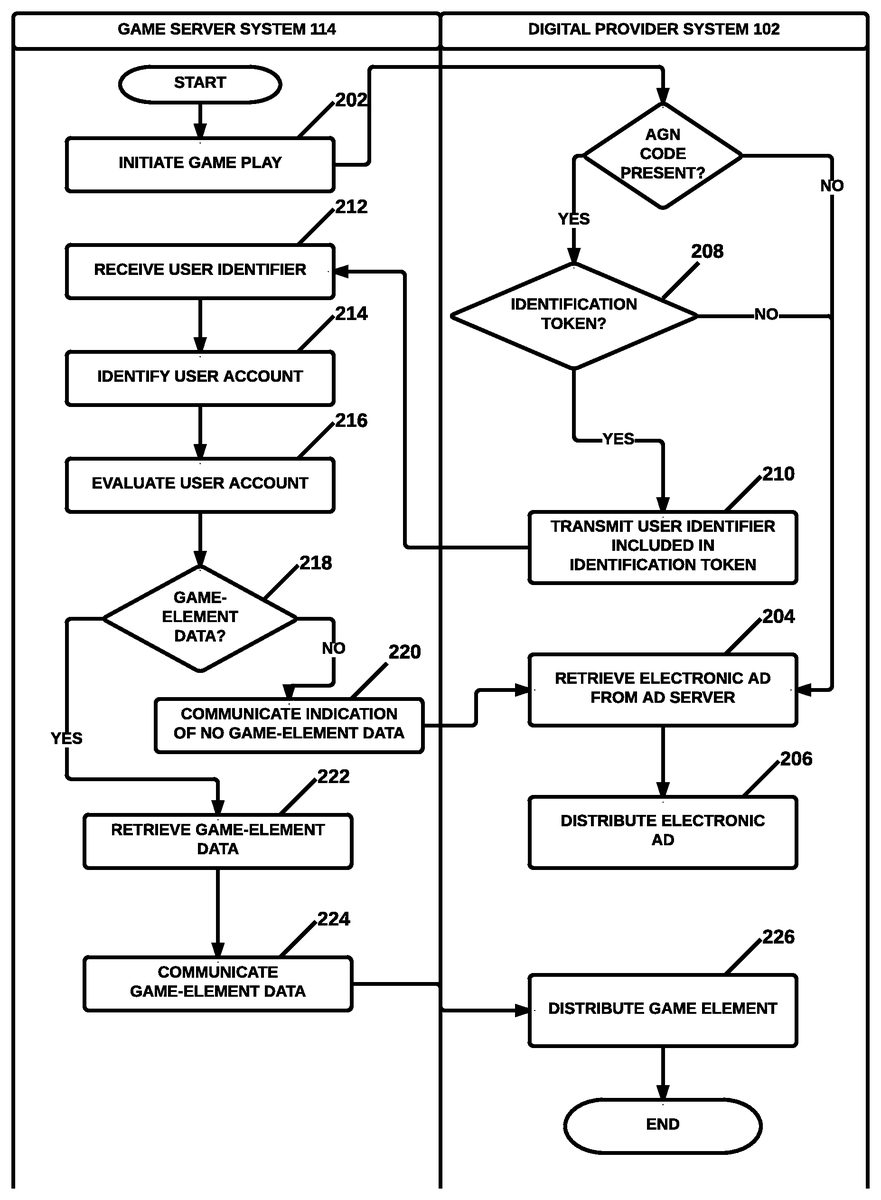
FIG. 2illustrates a flowchart of an embodiment of a process for participating in an ad game via AGN100. Game server system114may initiate game play for a user (step202) in various fashions. A user may initiate participation in a game manually by accessing a Web page, employing a browser add-on (e.g., a toolbar, a web browser extension, etc.), via a mobile app, or other means. The user may be required to provide authentication credentials. Authentication credentials may be maintained via access mechanism116and may be provided automatically on subsequent accesses. Once the user has been identified, game server system114may access or, if need be, generate, an identification token associated with the appropriate user account and transmit the identification token to access mechanism116. If access mechanism116already has stored an identification token, it need not be retransmitted. In one scenario, as long as access mechanism116maintains a stored user identification token, the user need not reenter authentication credentials and may automatically participate in an ad game. Alternatively, a user may be required to provide authentication credentials (either manually or by selecting to transmit stored credentials) to activate a stored identification token.
As a user interacts via access mechanism116with an application provided via digital provider system102, the user may be presented with one or more ad spaces. If an AGN code is not present in an ad space, digital provider system102may communicate an instruction to ad server system106to retrieve an electronic ad (step204) and distribute it via the ad space (step206). An ad space identifier may be communicated that indicates an appropriate format for the electronic ad, such as the appropriate dimensions, colors, text size, etc. If the ad space has been enabled with an AGN code, the digital provider system102may determine if access mechanism116has an identification token indicating that the user is participating in an ad game (step208). If access mechanism116does not have such an identification token, digital provider system102may retrieve an electronic ad from ad server system106(step204) and distribute it via the ad space (step206). If an identification token has been stored, digital provider system102, via the AGN code, may communicate an instruction to retrieve game-element data to game server system114and the instruction may include the user identifier included in the identification token (step210). The instruction may include an ad space identifier that indicates an appropriate format for the game-element data, such as the appropriate dimensions, colors, text size, etc. The ad space identifier may be necessary to ensure that the retrieved game-element data can be displayed properly within the application. Game server system114may receive the user identifier (step212) and employ it to identify an appropriate user account (step214). Game server system114may evaluate the user account in regard to which games (if any) the user is participating in, the user's status in a game, etc. (step216). Game server system114may determine if there is appropriate game-element data to be served based upon this evaluation (step218). For example, a user may be participating in a blackjack game and game server system114may determine how many virtual cards have been distributed to the user. Game-element data may be determined at random, either within the confines of a particular game a user is playing or at random in general. In the aforementioned blackjack game example, the game may be designed to distribute a random card corresponding to one of the fifty-two cards included in a standard deck of playing cards, accounting for previously distributed cards. Alternatively, the game element distributed may be completely random. For example, game server system114may enable users to participate in ten games and may randomly select a game element from any of these ten games to distribute to the user.
If there is no appropriate game element to be served, game server system114may communicate an indication of this to digital provider system102(step220), which may retrieve an electronic ad from ad server system106(step204) and distribute it via in the ad space (step206). If there is appropriate game-element data, game server system114may retrieve any data necessary to distribute the game element, such as graphical elements (e.g., a flash file, image files, etc.) (step222) and communicate the game-element data to the digital provider system102(step224). Game-element data may be retrieved from game server system114itself (e.g., game data112) or from an external source indicated by the game's designer upon game creation. For example, one or more elements of game data may be retrieved from ad server system106or another external storage location. Per the received game-element data, digital provider system102may distribute a game element to the user in the AGN-enabled ad space (step226).
The game element distributed enables a user to participate in a game. Although it need not, a game element may include one or more piece of electronic advertising content. For example, a game element may be sponsored by an ad entity and may include associated advertising. Although the game element may contain advertising content, it may also involve enjoyable game play, and therefore may entice the user to direct his attention to it, rather than the core content of the application. This may provide the associated ad entity with greater results than a typical electronic ad. A complete game may be sponsored by an ad entity and may be part of an advertising campaign. Participating in and/or completing a game may enable a user to receive a discount coupon, a free sample, or another incentive. Games may be aimed at various demographic groups. For example, a game may be designed to appeal to book lovers and the object of the game may be to collect classic books for a virtual library. When the library is full, the user may receive an reward, such as a discount at Amazon or Barnes and Noble.
Electronic Ad Game Play via Ad Server System
In another embodiment, an AGN code may instruct digital provider system102to query ad server system106, rather than game server system114, regarding game participation. If access mechanism116has an identification token, digital provider system102may transmit a user identifier included with the identification token to ad server system106. Ad server system106may maintain a registry of games it offers. If ad server system106determines that the received user identifier indicates the user is participating in a game, ad server system106may transmit the user identifier to game server system114. Game server system114may attempt to identify the appropriate user record and proceed as previously described. Alternatively, as aforementioned, ad server system106and game server system114may be the same system (or may be components of the same system) and ad server system106may be equipped to function as gamer server system114. By relaying such data through ad sever106, ad server system106may log which game elements have been viewed via at game server system114in addition to recording whether an electronic ad has been viewed. In one embodiment, game server system114is maintained by an ad entity and/or game server system114may be a component of ad server system106.
Anonymous Game Play
In one embodiment, game server system114need not identify a user in order to enable game participation. This may enable a user whose access mechanism116does not have an identification token to play, such as a user who has not played before, has opted not to install an identification token, or has removed (e.g., purposely or accidentally deleted) the identification token. If an ad space has been enabled with an AGN code, digital provider system102may contact game server system114(either directly or via ad server system106) regardless of whether access mechanism116has an identification token. If a user identifier has been obtained, game server system114may react accordingly. If a user identifier has not been obtained, game server system114may retrieve a non-specific game element and relay the non-specific game element to digital provider system102for distribution. For example, a non-specific game element may be a bonus reward applicable to multiple games, a playing card, a die roll, etc.
If the user responds to the distributed game element, game server system114may initiate an identification procedure, such as by prompting the user to create a user account, distributing an identification token to be stored by access mechanism116, etc. In one embodiment, a user may be identified solely by an identification token, so there may be no need to store personal data in a user account. Once access mechanism116has an identification token, game server system114may identify the user by an anonymous user identifier. An anonymous user identifier may be a unique code or data element that identifies the user but is not be associated with any identifying information. Therefore, game server system114may recognize that user “452356” is playing a game, but there may be no further data indicating who user “452356” is, where he is located, etc. Game server system114may, for example, track an anonymous user identifier in order to monitor games played, game status, etc.
Social Gaming
Game participants may interact with one another via game server system114and/or an eternal service, such as social networking service system128. Users may share virtual game pieces, request assistance from other players, help another player, share scores or game results, share rewards, etc. A player may be enabled to assist another player with a particular section of a game or obstacle within a game. For example, a game element may include a riddle or problem and a player may be enabled to request and receive help (i.e., via game server system114and/or social networking service system128) from other users participating in the game via AGN100. Alternatively, or additionally, a user may be enabled to prompt unknown users to provide assistance. For example, game server system114may communicate a post to social networking service system128encouraging other social network users to join the game (e.g., “Dave needs your help! Join in on the fun!”).
Example Games
Traditionally, video games are restricted by the platform on which they are played. For example, video games played on game consoles, such as the Xbox 360, Nintendo DS, Nintendo Wii, and PlayStation3, require that the game console, or the game cartridge/disk, contain all the necessary game elements. Conversely, AGN100may employ the Internet as the game platform, enabling the game to be played across multiple virtual locations (e.g., Web pages), significantly broadening the gaming experience.
AGN100may enable games of various kinds An AGN game may involve a user collecting various game pieces, with the user winning when he has collected a sufficient amount or appropriate type of game pieces. As another example, an AGN game may simulate a board game and a retrieved game element may request a user roll virtual dice to determine how many places his game piece may move. An AGN game may be a puzzle or a challenge to solve, such as a virtual jigsaw puzzle or an interactive game level. As another example, a user may navigate from one Web page to the next attempting to collect food for a virtual pet. An AGN game may involve fantasy elements and a user may control a hero battling monsters in order to obtain treasure and magical weapons.
AGN100may enable games that require instant actions, that include interactive elements, etc. For example, AGN100may enable game play akin to Pac-Man, Tetris, a downhill skiing simulator, a car racing simulator, etc. Conversely, AGN100may enable games that are slower paced and that involve a user making calculated steps. For example, AGN100may enable game akin a virtual pet game, a board game, a role-playing game, a farming game, a card game, etc.
A game may be designed to direct the user from one Web page to another. For example, a game may be modeled after blackjack and when a user selects a game element distributed via an ad space, the game element may direct him to another Web page to receive his card. The process may repeat until the user finishes the game (e.g., “holds” his hand, hits twenty one, or exceeds twenty one). As another example, a user may move a virtual playing piece from one Web page to another, collecting items or solving problems as each new game element is distributed. As aforementioned, a game element may be distributed at random. For example, a game may involve a user collecting points, items, or other rewards as the user navigates the Web, and the amount and frequency that such items are distributed may be randomly determined.
It is to be understood that the aforementioned examples are provided for illustrative purposes solely and are not to be construed as limiting. Any type of game may be designed to be played via AGN100.
Interacting with an Advertisement Storage System
In addition to interfacing with the components and entities previously described, AGN100may be configured to interact with an advertisement storage system, such as the one described in application Ser. No. 12/764,906, filed Apr. 21, 2010, entitled “System and Method for Improving E-Commerce.” This application, and any application claiming priority to it, is incorporated by reference herein, in entirety, for all purposes. For example, game server system114may interact with the personal advertisement storage system server disclosed in the aforementioned application and thereby enable a user to store and share game elements. In one embodiment, the game server system114and the advertisement storage server may be components of the same system and may be managed by the same service provider.
According to example embodiments of the present invention, components of AGN100, including digital provider system102, ad server system106, game server system114, access mechanism116, social networking service system128, and authentication service system130, may be implemented by various means. Means for implementing the systems, mechanisms and modules may include hardware, alone or under direction of one or more computer program code instructions, program instructions or executable computer-readable program code instructions from a computer-readable storage medium.
In one example, one or more apparatuses may be provided that are configured to function as or otherwise implement the systems, mechanisms and modules shown and described herein. Generally, an apparatus of exemplary embodiments of the present invention may comprise, include or be embodied in one or more fixed or portable computing devices, a number of examples of which are provided above. The apparatus may include one or more of each of a number of components such as, for example, a processor connected to memory.
The processor is generally any piece of hardware that is capable of processing information such as, for example, data, computer-readable program code, instructions, etc. (generally “computer programs,” e.g., software, firmware, etc.), and/or other suitable electronic information. More particularly, for example, the processor may be configured to execute computer programs, which may be stored onboard the processor or otherwise stored in the memory. The processor may be a number of processors, a multi-processor core or some other type of processor, depending on the particular implementation. In another example, the processor may be embodied as or otherwise include one or more application-specific integrated circuits (ASICs), field-programmable gate arrays (FPGAs), etc. Thus, although the processor may be capable of executing a computer program to perform one or more functions, the processor of various examples may be capable of performing one or more functions without the aid of a computer program.
The memory is generally any piece of hardware that is capable of storing information such as, for example, data, computer programs and/or other suitable information. The memory may include volatile memory and/or non-volatile memory, and may be fixed or removable. Examples of suitable memory include random access memory (RAM), read-only memory (ROM), a hard drive, a flash memory, a thumb drive, an optical disk, a magnetic tape or some combination of the above. In various instances, the memory may be referred to as a computer-readable storage medium which, as a non-transitory device capable of storing information, may be distinguishable from computer-readable transmission media such as electronic transitory signals capable of carrying information from one location to another. Computer-readable medium as described herein may generally refer to a computer-readable storage medium or computer-readable transmission medium.
In addition to the memory, the processor may also be connected to one or more interfaces for displaying, transmitting and/or receiving information. The interfaces may include a communications interface and/or one or more user interfaces. The communications interface may be configured to transmit and/or receive information, such as to and/or from other apparatus(es), network(s), etc. The communications interface may be configured to transmit and/or receive information by physical (wireline) and/or wireless communications links.
The user interfaces may include a display and/or one or more user input interfaces. The display may be configured to present or otherwise display information to a user, suitable examples of which include a liquid crystal display (LCD), light-emitting diode display (LED), plasma display panel (PDP), etc. The user input interfaces may be wireline or wireless, and may be configured to receive information from a user into the apparatus, such as for processing, storage and/or display. Suitable examples of user input interfaces include a microphone, image or video capture device, keyboard or keypad, joystick, touch-sensitive surface (separate from or integrated into a touchscreen), etc. The user interfaces may further include one or more interfaces for communicating with peripherals such as printers, scanners, etc.
As indicated above, program code instructions may be stored in memory, and executed by a processor, to implement functions of the systems, mechanisms and modules described herein. As will be appreciated, any suitable program code instructions may be loaded onto a computer or other programmable apparatus from a computer-readable storage medium to produce a particular machine, such that the particular machine becomes a means for implementing the functions specified herein. These program code instructions may also be stored in a computer-readable storage medium that can direct a computer, a processor or other programmable apparatus to function in a particular manner to thereby generate a particular machine or particular article of manufacture. The instructions stored in the computer-readable storage medium may produce an article of manufacture, where the article of manufacture becomes a means for implementing functions described herein. The program code instructions may be retrieved from a computer-readable storage medium and loaded into a computer, processor or other programmable apparatus to configure the computer, processor or other programmable apparatus to execute operations to be performed on or by the computer, processor or other programmable apparatus.
Execution of the program code instructions may produce a computer-implemented process such that the instructions executed by the computer, processor or other programmable apparatus provide operations for implementing functions described herein. Execution of instructions by a processor, or storage of instructions in a computer-readable storage medium, supports combinations of operations for performing the specified functions. It will also be understood that one or more functions, and combinations of functions, may be implemented by special purpose hardware-based computer systems and/or processors which perform the specified functions, or combinations of special purpose hardware and program code instructions.
These and other aspects of the present invention will become apparent to those skilled in the art by a review of the preceding detailed description. Although a number of salient features of the present invention have been described above, the invention is capable of other embodiments and of being practiced and carried out in various ways that would be apparent to one of ordinary skill in the art after reading the disclosed invention. Therefore, the description should not be considered to be exclusive of these other embodiments. Also, it is to be understood that the phraseology and terminology employed herein are for the purposes of description and should not be regarded as limiting.
Claims
- A game server comprising a processor and a memory storing executable instructions that, in response to execution by the processor, cause the game server to at least: receive, at the processor, an instruction from a Web page server to retrieve a Web page game element for distribution into an ad space included in a Web page, the ad space being configured to include a computer code that communicates to the processor the instruction to retrieve the Web page game element, the instruction including a user identifier identifying a user account associated with a user and including an ad space identifier that indicates an appropriate format for the Web page game element based upon the ad space included in the Web page;identify, by the processor, the user account stored in the memory and associated with the user via the user identifier;determine, by the processor, if the memory stores an appropriate Web page game element for the user account to be distributed to the ad space included in the Web page;and if the memory stores an appropriate Web page game element for the user account to be distributed to the ad space included in the Web page, cause by the processor communication of the appropriate Web page game element for display into the ad space;and if the memory does not store an appropriate Web page game element for the user account to be distributed to the ad space included in the Web page, cause by the processor communication of an indication to the Web page server to retrieve an electronic ad from an ad server to display into in the ad space.
- The game server of claim 1 , wherein the processor being caused to determine the appropriate Web page game element for the user account comprises the processor being caused to determine the appropriate Web page game element based upon the content of the user account.
- The game server of claim 1 , wherein the processor being caused to determine the appropriate Web page game element for the user account comprises the processor being caused to determine the appropriate Web page game element at random.
- The game server of claim 1 , wherein the memory stores further executable instructions that, in response to execution by the processor, cause the processor to retrieve the appropriate Web page game element from a source external to the game server.
- The game server of claim 4 , wherein the source external to the game server is an ad server.
- The game server of claim 1 , wherein the processor being caused to receive the instruction to retrieve the Web page game element comprises the processor being caused to receive the instruction via an ad server and the processor being caused to cause communication of the appropriate Web page game element comprises the processor being caused to cause communication of the appropriate Web page game element via the ad server.
- A method to distribute a game element, the method comprising: receiving, by a processor of a game server, the game server comprising the processor and a memory, an instruction from a Web page server to retrieve a Web page game element for distribution into an ad space included in a Web page, the ad space being configured to include a computer code that communicates to the processor the instruction to retrieve the Web page game element, the instruction including a user identifier identifying a user account associated with a user and including an ad space identifier that indicates an appropriate format for the Web page game element based upon the ad space included in the Web page;identifying, by the processor, the user account stored in the memory and associated with the user via the user identifier;determining, by the processor, if the memory stores an appropriate Web page game element for the user account to be distributed to the ad space included in the Web page;and if the memory stores an appropriate Web page game element for the user account to be distributed to the ad space included in the Web page, causing by the processor communication of the appropriate Web page game element for display into the ad space, and if the memory does not store an appropriate Web page game element for the user account to be distributed to the ad space included in the Web page, causing by the processor communication of an indication to the Web page server to retrieve an electronic ad from an ad server to display into in the ad space;wherein receiving the instruction, identifying the user account, evaluating the user account, causing communication of the appropriate Web page game element, and causing communication of the indication are operations performed by the game server including the processor and the memory storing executable instructions that when executed by the processor cause the game server to perform the respective operations.
- The method of claim 7 , wherein determining the appropriate Web page game element for the user account comprises the processor determining the appropriate Web page game element based upon the content of the user account.
- The method of claim 7 , wherein determining the appropriate Web page game element for the user account comprises the processor determining the appropriate Web page game element at random.
- The method of claim 7 , further comprising the processor retrieving the appropriate Web page game element from a source external to the game server.
- The method of claim 10 , wherein the source external to the game server is an ad server.
- The method of claim 7 , wherein receiving the instruction to retrieve the Web page game element comprises the processor receiving the instruction via an ad server and causing by the processor communication of the appropriate Web page game element comprises causing by the processor communication of the appropriate Web page game element via the ad server.
- A computer-readable storage medium having computer-readable program code portions stored therein that, in response to execution by a processor of a game server, cause the processor to at least: receive an instruction from a Web page server to retrieve a Web page game element for distribution into an ad space included in a Web page, the ad space being configured to include a computer code that communicates to the processor the instruction to retrieve the Web page game element, the instruction including a user identifier identifying a user account associated with a user and including an ad space identifier that indicates an appropriate format for the Web page game element based upon the ad space included in the Web page;identify the user account stored in a memory of the game server and associated with the user via the user identifier;determine if the memory stores an appropriate Web page game element for the user account to be distributed to the ad space included in the Web page;and if the memory stores an appropriate Web page game element for the user account to be distributed to the ad space included in the Web page, cause communication of the appropriate Web page game element for display into the ad space;and if the memory does not store an appropriate Web page game element for the user account to be distributed to the ad space included in the Web page, cause communication of an indication to the Web page server to retrieve an electronic ad from ad server to display into in the ad space.
- The computer-readable storage medium of claim 13 , wherein the processor being caused to determine the appropriate Web page game element for the user account comprises the processor being caused to determine the appropriate Web page game element based upon the content of the user account.
- The computer-readable storage medium of claim 13 , wherein the processor being caused to determine the appropriate Web page game element for the user account comprises the processor being caused to determine the appropriate Web page game element at random.
- The computer-readable storage medium of claim 13 having further computer-readable program code portions stored therein that, in response to execution by the processor, cause the processor to retrieve the appropriate Web page game element from a source external to the game server.
- The computer-readable storage medium of claim 16 , wherein the source external to the game server is an ad server.
- The computer-readable storage medium of claim 13 , wherein the processor being caused to receive the instruction to retrieve the Web page game element comprises the processor being caused to receive the instruction via an ad server and the processor being caused to cause communication of the appropriate Web page game element comprises the processor being caused to cause communication of the appropriate Web page game element via the ad server.
Disclaimer: Data collected from the USPTO and may be malformed, incomplete, and/or otherwise inaccurate.