U.S. Pat. No. 9,180,377
SYSTEM, PROGRAM, AND METHOD FOR GENERATING IMAGE OF VIRTUAL SPACE
AssigneeDeNA Co Ltd
Issue DateNovember 14, 2013
Illustrative Figure
Abstract
A computer program according to an embodiment of the present invention comprises: a grouping module configured to group the plurality of objects into a plurality of groups; a reference point determination module configured to determine a reference point and a group fixation point in the virtual space for each of the plurality of groups; a viewpoint control module configured to control positions of the viewpoint and the fixation point in the virtual space; and a display control module configured to display, on the display device, the view of the virtual space as viewed from the viewpoint toward the fixation point. While events are generated in the particular group among the plurality of groups, the viewpoint control module according to an embodiment of the present invention fixes the viewpoint at the reference point of the particular group and the fixation point at a group fixation point of the particular group.
Description
DESCRIPTION OF EXAMPLE EMBODIMENTS FIG. 1is a block diagram schematically illustrating a system according to an embodiment of the present invention. The system according to an embodiment of the present invention may be configured to generate a view of a virtual space containing a plurality of objects. As shown, the system according to an embodiment of the present invention may comprise a server10and a client terminal30. In the embodiment shown inFIG. 1, the server10may cooperate with the functions of the client terminal30to provide an online battle game to the user of the client terminal30. In the battle game, a battle may be performed between a plurality of player objects operated by the player and a plurality of non-player objects operated by the computer. In this embodiment, a view of a virtual space of the battle game may be displayed on the display of the client terminal30. The embodiment shown inFIG. 1wherein a view of a virtual space of the online battle game is generated is merely one embodiment of the present invention. It should be noted that the present invention can be applied to various virtual spaces containing a plurality of objects. In the embodiment shown inFIG. 1, the server10may be communicatively connected to the client terminal30via a network20such as the Internet and provide the client terminal30with online game services (such as services related to online battle games). For example, the server10may process a game message (e.g., a message related to operations of a player object (or a player character) or a message that a quest has been started) received from the client terminal30in accordance with a predetermined game logic (or a program for implementing the game logic), and send a result of the process to the client terminal30. The server10may also provide various game data required for progress of ...
DESCRIPTION OF EXAMPLE EMBODIMENTS
FIG. 1is a block diagram schematically illustrating a system according to an embodiment of the present invention. The system according to an embodiment of the present invention may be configured to generate a view of a virtual space containing a plurality of objects.
As shown, the system according to an embodiment of the present invention may comprise a server10and a client terminal30. In the embodiment shown inFIG. 1, the server10may cooperate with the functions of the client terminal30to provide an online battle game to the user of the client terminal30. In the battle game, a battle may be performed between a plurality of player objects operated by the player and a plurality of non-player objects operated by the computer. In this embodiment, a view of a virtual space of the battle game may be displayed on the display of the client terminal30. The embodiment shown inFIG. 1wherein a view of a virtual space of the online battle game is generated is merely one embodiment of the present invention. It should be noted that the present invention can be applied to various virtual spaces containing a plurality of objects.
In the embodiment shown inFIG. 1, the server10may be communicatively connected to the client terminal30via a network20such as the Internet and provide the client terminal30with online game services (such as services related to online battle games). For example, the server10may process a game message (e.g., a message related to operations of a player object (or a player character) or a message that a quest has been started) received from the client terminal30in accordance with a predetermined game logic (or a program for implementing the game logic), and send a result of the process to the client terminal30. The server10may also provide various game data required for progress of the games to the client terminal30. As will be described later, the server10may provide the client terminal30with a view of a virtual space related to the game performed on the client terminal30(or battle log information and viewpoint information used to generate the view). The battle log information and the viewpoint information will be described in detail later. AlthoughFIG. 1shows only one client terminal30, the server10may be communicatively connected to a plurality of client terminals30.
As shown, the server10may include a processor11, a main memory12, a user I/F13, a communication I/F14, and a storage15. These components may be electrically connected to each other via a bus not shown. The processor11may load an operating system and various programs for implementing the game logic into the main memory12from the storage15, and may execute commands included in the loaded programs. The main memory12may be used to store a program to be executed by the processor11, and may be formed of, for example, a dynamic random access memory (DRAM).
The user I/F13may include, for example, an information input device such as a keyboard or a mouse for accepting an input from an operator, and an information output device such as a liquid crystal display for outputting calculation results of the processor11. The communication I/F14may be implemented as hardware, firmware, or communication software such as a transmission control protocol/Internet protocol (TCP/IP) driver or a point-to-point protocol (PPP) driver, or a combination thereof, and may be configured to be able to communicate with the client terminal30via the network20.
The storage15may be formed of, for example, a magnetic disk drive and store various programs such as a game control program for implementing the game logic. The storage15may also store various data used in the game. The various data that may be stored in the storage15may also be stored on a database server communicatively connected to the server10and physically separate from the server10.
In an embodiment, the server10may be a web server for managing a web site including a plurality of hierarchical web pages. The client terminal30may fetch HTML data for rendering these web pages from the server10and analyze the fetched HTML data to render a game screen on a display of the client terminal30. A player may provide various inputs to the client terminal30via the game screen thereby to interact with a game provided by the server10(e.g., the player may operate a player object with instructions or select a menu). The storage15may store the HTML data for rendering the web page. The HTML data may be composed of HTML code written in a markup language such as HTML. The HTML code may be associated with various images. Additionally, the HTML data may include programs written in script languages such as ActionScript™ and JavaScript™.
Thus, the server10may manage the web site for providing game services and deliver web pages constituting the web site in response to a request from the client terminal30, thereby progressing the game. A game provided through such a web page is sometimes called a browser game.
In another embodiment of the present invention, a game application program may be executed on the client terminal30in an execution environment such as an OS or middleware, such that the game application program and the server10may cooperate with each other to provide a game. The game application program may be stored on, e.g., a storage15or a storage25and downloaded onto the client terminal30in response to a request from the client terminal30. The game application programs may include, on execution on the client terminal30, instruction sets for processing game data provided by the server10and various data such as image data referred to when the instruction sets are executed. The game application programs may be created in, for example, object oriented languages such as Objective-C™ and Java™. The game application programs may be stored on the storage15, the external storage25, or other storages not shown.
In response to a delivery request from the client terminal30, the game application programs stored on a storage such as the storage15may be delivered to the client terminal30. The delivered game application programs may be received by the client terminal30via a communication I/F34under the control by the processor31. The received game application programs may be stored on, e.g., the storage35. The application software may be launched in accordance with the player's operation on the client device30and may be executed on a platform, such as an OS or middleware, implemented on the client device30.
The server10may process messages from the game application programs in accordance with a predetermined game logic and return various information indicating a result of the processing to the game application program, thereby to control the progress of the game. In the embodiment shown inFIG. 1, the server10may have a function of processing, in accordance with a predetermined battle logic, a battle between a player object operated by a player and a non-player object operated by a computer in accordance with a predetermined logic.
The game application programs executed on the client terminal30may receive, from the server10, battle log information indicating the contents of the battle process. The battle log information will be described in detail later. The game application program may generate a view of the virtual space based on the viewpoint information indicating the position of the viewpoint in the virtual space (described later) and the battle log information received from the server, and display the generated view (game screen) on the display of the client terminal30. The player can progress the game while watching the game screen displayed on the display of the client terminal30.
Thus, the game application programs are executed on the client terminal30such that the functions of the game application programs and the functions of the server10cooperate with each other to progress the game. A game provided through such game application programs is sometimes called an application game. The present invention can be applied to both browser games and application games.
The server10may also include a function to authenticate a player at start of the game and perform charging process in accordance with progression of the game. The games provided by the server10may include desired games having a virtual space containing a plurality of objects, such as action games, role playing games, and baseball games. The types of the games implemented by the server10and the client terminal30(or the game application programs executed on the client terminal30) are not limited to those explicitly described herein.
Next, client terminal30will be described below. The client terminal30according to an embodiment of the present invention may be a desired information processing device including at least one of an environment for rendering web pages of a game web site fetched from the server10on a web browser and an application execution environment for executing game application programs. Non-limiting examples of the client terminal30may include mobile phones, smartphones, tablet terminals, personal computers, electronic book readers, and game consoles.
As shown, the client terminal30according to an embodiment of the present invention may include a processor31, a main memory32, a user interface (I/F)33, a communication I/F34, and a storage35, and these components may be electrically connected to one another via a bus36.
The processor31may load various programs such as an operating system into the main memory32from the storage35, and may execute commands included in the loaded programs. The main memory32may be used to store a program to be executed by the processor31, and may be formed of, for example, a dynamic random access memory (DRAM).
The user I/F33may include an information input device for receiving inputs from the player and an information output device for outputting an operation result of the processor31; and the user I/F33may include a display device such as a liquid crystal display having a touch screen. The communication I/F34may be implemented as hardware, firmware, or communication software such as a transmission control protocol/Internet protocol (TCP/IP) driver or a point-to-point protocol (PPP) driver, or a combination thereof, and may be configured to be able to communicate with the server10via the network20.
The storage35may comprise, for example, a magnetic disk drive or a flash memory and store various programs such as an operating system. When receiving a game application program from the server10via the communication I/F34, the storage35may store the received game application program.
The client terminal30may include, for example, browser software for interpreting an HTML file (HTML data) and rendering a screen; this browser software may enable the terminal device30to interpret the HTML data fetched from the server10and render web pages corresponding to the received HTML data. Further, the client terminal30may include plug-in software (e.g., Flash Player distributed by Adobe Systems Incorporated) embedded into browser software; therefore, the terminal device30can fetch from the server10a SWF file embedded in HTML data and execute the SWF file by using the browser software and the plug-in software.
In the client terminal30, the game application program may be launched in accordance with the operation by the player and executed on a platform implemented on the client terminal30. When a game application program is executed on the client terminal30, for example, animation or an operation icon designated by the program may be displayed on a screen of the client terminal30. The player may enter an instruction for progressing the game through the user I/F33of the client terminal30.
The processor11of the server10and the processor31of the client terminal30according to an embodiment of the present invention may execute various computer program modules. The computer program modules executed in the server10and the client terminal30and other computer program modules as required may implement the function of the system of the present invention that may display a view of a virtual space containing a plurality of objects on a display device.
As shown, the computer program modules executed by the processor11of the server10may include a game control module41and a battle process module42. Meanwhile, the computer program modules executed by the processor31of the client terminal30may include game module61for displaying a view of a virtual space on the display of the client terminal, a reception module62for receiving various instructions from the user of the client terminal30, and a sending module63for sending to the server10a message indicating various instructions from the player received by the reception module62.
A part or all of the modules provided to the server10shown inFIG. 1may also be executed by the processor31of the client terminal30or a processor of other devices; and a part or all of the modules provided to the client terminal30may also be executed by the processor11of the server10or a processor of other devices. For a standalone game wherein a virtual space is provided by the client terminal30executing the application programs without communication with the server10, the system of the present invention may be configured such that a part or all of the modules illustrated inFIG. 1to be executed on the server10are executed on the client terminal.
The modules executed on the server10will be further described below. For example, the game control module41according to an embodiment of the present invention may process a game message from the client terminal30in accordance with predetermined game logic and provide various game data for executing the battle game to the client terminal30, thereby to control the progress of the game. For example, when receiving from the client terminal30an item use message for instructing a player object to use an item, the game control module41may perform a process of causing the player object to use the designated item, and may provide item use information indicating the result (e.g., recovery of life) to the client terminal30. The game data provided by the game control module41may include, for example, object data related to the player objects and the non-player objects and quest data related to the quest experienced by the player. Also, the game control module41may provide a chat function and a messaging function to encourage communication between players.
The battle process module42according to an embodiment of the present invention may perform a battle process between a player object and a non-player object in accordance with predetermined battle logic. The battle process may include, for example, a battle between a plurality of player objects controlled based on instructions from the player and a plurality of non-player objects controlled based on predetermined logic independently of the instructions from the player. In an embodiment, the game is a turn-based game, wherein each player object performs various actions such as movement and attack during a turn of the player, followed by each non-player object performing the same various actions during a turn of the computer.
As shown inFIG. 1, the battle process module42may comprise a movement control module51, an object selection module52, a grouping module53, a reference point determination module54, a route determination module55, a viewpoint control module56, an event generation module57, and a display control module58. These modules will be described below.
The movement control module51according to an embodiment of the present invention may control movement of a plurality of objects arranged in a virtual space (game space) within the virtual space. For example, the movement control module51may determine the position to which an object moves in a turn, based on a game message received from the client terminal30for instructing a player object to move and predetermined logic related to movement of objects. For example, each object may have its movement range assigned thereto and may be controlled to move to a position within the movement range.
The object selection module52according to an embodiment of the present invention may select one or more event generation objects satisfying a predetermined event generation condition in each turn. In the embodiment, the events may be related to battle games and may include, for example, attack events, item events, special effect events, and conversation events. For example, each of the plurality of objects may have its attack range assigned thereto within which to attack other objects; and when an object is within the attack range of another object, it may be determined that the predetermined event generation condition is satisfied for the other object. In an embodiment, it may be determined whether an object is within the attack range based on the position of the object having been moved by the movement control module51. The events specifically described herein are mere examples; events of the present invention may include any events generated in relation to one or more objects in a virtual space. The event generation condition for an object is not limited to those related to the above event generation area.
The grouping module53according to an embodiment of the present invention may group a plurality of objects in a virtual space into a plurality of groups in each turn. For example, the grouping module53may group a plurality of objects in a virtual space in each turn such that one or more event generation objects selected by the object selection module52may be in the same group as the objects for which the one or more event generation objects generate events. For example, in the case where the above event is an attack event corresponding to an attack by one object on another object in a battle game, the one object, having an attack range assigned thereto within which to attack in the virtual space, and other objects present within the attack range (objects to be attacked by the one object) may be grouped in a same group. When a plurality of event generation objects are in the virtual space, the above grouping process may be performed for each of the plurality of event generation objects in the order determined based on a particular characteristic of the plurality of event generation objects. For example, the particular characteristic of the objects may indicate agility of the object. The grouping may also be performed by the grouping module53not in each turn but at a predetermined timing in or after starting of a game (e.g., a timing determined by an instruction from the player). The groups established at starting of a game or a predetermined timing may be either updated at starting of a new turn or retained even after starting of a new turn.
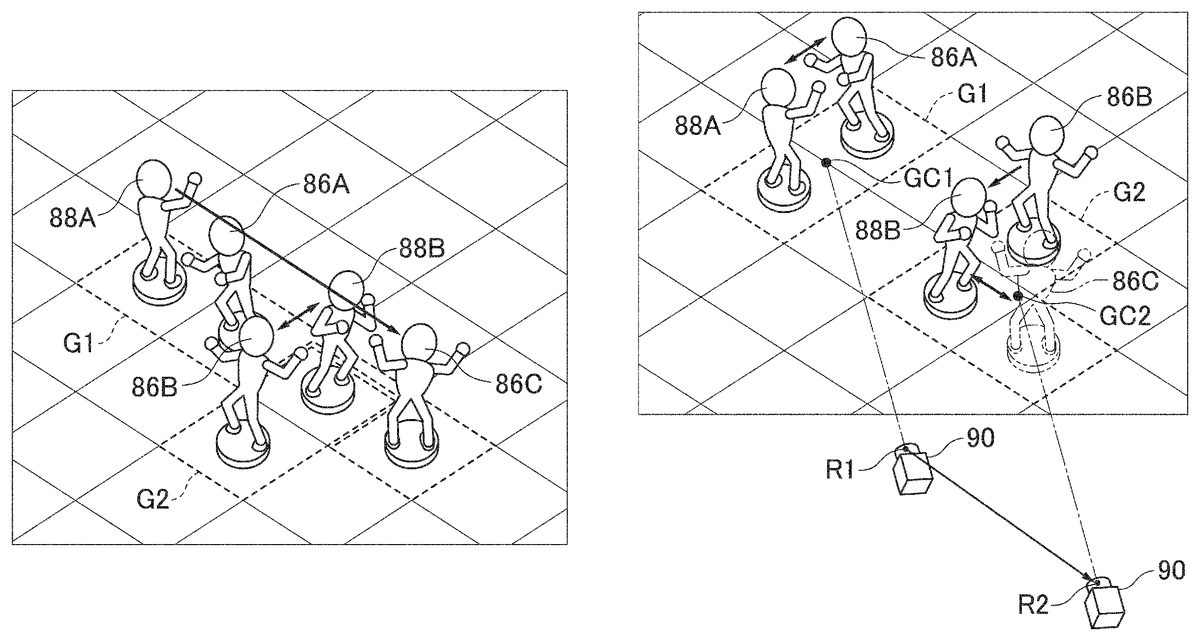
The grouping of objects according to the present invention will now be described with reference toFIGS. 2 to 6.FIGS. 2 to 6schematically illustrate objects included in a virtual space and is referred to for description of the grouping in an embodiment of the present invention. The virtual space shown inFIGS. 2 to 6have a field divided into squares; and in the squares may be arranged the objects86A to86C representing player characters operated by the player (hereinafter referred to simply as “player objects86A to86C”) and the objects88A and88B representing non-player characters operated by the computer in accordance with predetermined logic (hereinafter referred to simply as “non-player objects88A and88B”). For example, the movement control module51may determine the arrangement of the player objects86A to86C and the non-player objects88A and88B shown inFIGS. 2 to 6.
FIGS. 2 to 6illustrate examples of grouping of a plurality of objects based on an attack event in the virtual space. InFIGS. 2 to 6, the arrows between objects indicate the direction of attack. More specifically, the example shown inFIG. 2includes a bidirectional arrow between the player object86A and the non-player object88A, which may indicate that the player object86A and the non-player object88A may attack each other. Likewise, other arrows indicate the direction of attack; in the example shown inFIG. 2, the player objects86B and86C attack the non-player object88B, and the non-player object88B attacks the player object86C.
In the example shown inFIG. 2, the event generation condition for an attack event is that there is an object of the opposite camp in adjoining squares of the field. To the player objects, the opposite camp may refer to the non-player objects; and to non-player objects, the opposite camp may refer to the player objects. The object selection module52may determine whether the individual objects satisfy the event generation condition based on the positions of the objects in the field, and select objects satisfying the event generation condition as event generation objects. In the example shown inFIG. 2, each of the player objects86A to86C and the non-player objects88A and88B is placed in a square adjoining a square having one of the objects of the opposite camp placed therein; therefore, the object selection module52may select all of the player objects86A to86C and the non-player objects88A and88B as event generation objects.
In the example shown inFIG. 2, the grouping module53may group the player objects86A to86C and the non-player objects88A and88B selected as event generation objects such that an attacking object and an object attacked thereby (attacked object) are in a same group. More specifically, the player object86A and the non-player object88A attack each other as described above; and thus the player object86A and the non-player object88A are grouped into a group G1. The player objects86B and86C attack the non-player object88B, and the non-player object88B attacks the player object86C; and thus the player objects86B and86C and the non-player objects88B are grouped into a group G2.
FIG. 3shows another example of grouping. InFIG. 3, the event generation area of the player object86B may be determined such that the player object86B can attack an object in a square not adjoining the square of the player object86B. The example shown inFIG. 3is different from the example shown inFIG. 2in that the player object86B attacks the non-player object88A distant from the player object86B. In the example shown inFIG. 3, the player object86B attacks the non-player object88A; therefore, the player object86B is grouped into the group G1.
FIG. 4shows still another example of grouping. The example shown inFIG. 4is different from the example shown inFIG. 3in that the non-player object88B attacks the player object86B instead of the player object86C. The non-player object88B, which attacks the player object86B instead of the player object86C, is grouped into the group G1. Also, the player object86C, which attacks the non-player object88B grouped into the group G1, is also grouped into the group G1. As a result, all of the five objects in the example shown inFIG. 4are grouped into the group G1. The grouping process may be performed in the order determined by a particular characteristic such as agility of the event generation objects (the player objects86A to86C and the non-player objects88A and88B). For example, in the example shown inFIG. 4, if the agility of the objects decreases in the order of the player object86A, the player object86C, the non-player object88A, the non-player object88B, and the player object86B, a grouping process may be started from the player object86A having the highest agility. That is, the player object86A and the non-player object88A attacked by the player object86A are grouped in a same group. Next, another grouping process may be started from the player object86C having the second highest agility; and the player object86C and the non-player object88B attacked by the player object86C are grouped in a same group. Next, still another grouping process may be started from the non-player object88A having the third highest agility; and the non-player object88A and the player object86A attacked by the non-player object88A are grouped in a same group. However, in the example shown inFIG. 4, the player object86A and the non-player object88A are already grouped in a same group by the grouping process started from the player object86A; therefore, no group is newly formed in the grouping process started from the non-player object88A. Likewise, a grouping process may be performed for all the event generation objects in the virtual space. In the examples other than shown inFIG. 4, a grouping process may also be likewise performed in the order of a particular characteristic of the event generation objects.
FIG. 5shows still another example of grouping. InFIG. 5, the event generation area for the non-player object88A may be determined such that the non-player object88A can attack a plurality of objects (the player objects86B and86C) in squares not adjoining the square of the non-player object88A. Since the non-player object88A attacks the player objects86B and86C, the non-player object88A and the player objects86B and86C are grouped in the group G1. Also, since the player object86A and the non-player object88B attack each other, the player object86A and the non-player object88B are grouped into the group G2. In another embodiment, it may be possible that the non-player object88A can attack only one of the player objects86B and86C included in the event generation area of the non-player object88A, and the attacked object (e.g., the player object86B) and the non-player object88A should be grouped in a same group while the player object86C should be grouped in a different group.
FIG. 6shows still another example of grouping. InFIG. 6, the event generation area of the non-player object88A may be determined such that the non-player object88A can attack a plurality of objects arranged in a line (the player objects86A and86C). Thus, the non-player object88A and the player objects86A and86C are grouped into the group G1. Although the non-player object88B is also placed in the line across the player objects86A and86C, the non-player object88B, which is in the same camp as the non-player object88A, is not attacked by the non-player object88A; therefore, the non-player object88B is not grouped into the group G1. Meanwhile, since the player object86B and the non-player object88B attack each other, the player object86B and the non-player object88B are grouped into the group G2.
The grouping described with reference toFIGS. 3 to 6are mere examples; and the present invention can employ any method of grouping such that an object generating an event (event generation object) and an object subjected to the event are grouped into a same group. The events employed for grouping are not limited to those described above and may include various events in the virtual space.
The reference point determination module54according to an embodiment of the present invention may determine a reference point and a group fixation point in the virtual space for each of the groups formed by the grouping module53in each turn. In an embodiment described later, when a viewpoint is at a reference point of a particular group, the fixation point of the viewpoint is positioned at the group fixation point of the particular group. In an embodiment, one reference point and one group fixation point may be determined for each group.
In an embodiment, the position corresponding to the centroid of a plurality of objects included in a group may be selected as the group fixation point. However, the group fixation point of the present invention is not limited to the centroid of the objects included in the group, and may be, for example, a position (e.g., the center) in a square in which one of the objects included in the group is placed or a position corresponding to the centroid of a plurality of player objects included in the group. For example, when a group includes an object corresponding to a commander in a battle game, the group fixation point may be at the position of the object corresponding to the commander. Thus, the group fixation point may be set at the position of an object noticeable to the player.
The position of a reference point in the virtual space will be further described with reference toFIG. 7.FIG. 7schematically shows arrangement of reference points R1 and R2 in an embodiment of the present invention. As will be described later, a viewpoint (virtual camera)90may move to the reference points R1 and R2. The arrangement of the objects and the method of grouping in the virtual space shown inFIG. 7are the same as those shown inFIG. 2. InFIG. 7, the group fixation point of the group G1 is set at the centroid GC1 of the player object86A and the non-player object88A included in the group G1; and the group fixation point of the group G2 is set at the centroid GC2 of the three objects: the player objects86B and86C and the non-player object88B included in the group G2.
The coordinates indicating the position of the reference point of a particular group may be found by, for example, converting the coordinates indicating the position of the group fixation point of the same group. In the example shown inFIG. 7, the coordinates of the reference point R1 of the group G1 may be set in a particular direction and at a particular distance from the coordinates indicating the position of the group fixation point of the group G1 (the centroid GC1). Likewise, the coordinates of the reference point R2 of the group G2 may be set in a particular direction and at a particular distance from the coordinates indicating the position of the group fixation point of the group G2 (the centroid GC2). That is, the coordinates of the reference point of a group may be set in a particular direction (e.g., z-axis) and at a particular distance from the coordinates indicating the position of the group fixation point of the group. Various coordinate transformations may be employed to find the coordinates of a reference point from the coordinates of a group fixation point. Additionally, the coordinate transformations applied may be either the same for all the groups or different depending on the groups.
The route determination module55according to an embodiment of the present invention may determine, in each turn, a route that can be followed by the viewpoint90based on the reference points of the groups determined by the reference point determination module54. In an embodiment, a route may be formed by connecting, in a predetermined order, the reference points of the groups determined by the reference point determination module54. The route of a viewpoint will be further described with reference toFIG. 8.FIG. 8schematically shows an entire virtual space in an embodiment of the present invention.
As shown inFIG. 8, a virtual space VS according to an embodiment of the present invention may include a two-dimensional field containing a plurality of objects (inFIG. 8, objects are hidden for simple illustration). As described above, the reference point determination module54may set the group fixation points at the centroids GR1 to GR4 of the objects for each group. In the example shown inFIG. 8, the reference points R1 to R4 are set in a particular direction and at a particular distance from the centroids GR1 to GR4, respectively.
As described above, the route determination module55may determine the route of the viewpoint90by connecting the reference points R1 to R4 in a predetermined order. In an embodiment, the “predetermined order” may be determined based on the positions of the reference points with respect to a particular base point BP in the virtual space VS. In an embodiment as shown inFIG. 8, the base point BP may be set at one of the corners of the rectangularly formed two-dimensional field of the virtual space VS. In an embodiment, the distances from the base point BP to the group fixation points GC1 to GC4 may be compared with each other; and the moving route of the viewpoint90may be determined in the ascending order of these distances. In the example shown inFIG. 8, the distance from the base point BP is longer in the order of the group fixation point GC1, the group fixation point GC2, the group fixation point GC3, and the group fixation point GC4; therefore, the route of the viewpoint90may be set via the reference point R1 corresponding to the group fixation point GC1, the reference point R2 corresponding to the group fixation point GC2, the reference point R3 corresponding to the group fixation point GC3, and the reference point R4 corresponding to the group fixation point GC4. In this case, the route determination module55may set the route of the viewpoint90on the route connecting the reference point R1, the reference point R2, the reference point R3, and the reference point R4 in this order.
The method of determining the route of the viewpoint90may be varied desirably. For example, the route determination module55may search for group fixation points in the virtual space along a predetermined search route starting from the base point BP, and connect reference points corresponding to group fixation points in the order of finding the group fixation points thereby to form the route of the viewpoint90. For example, the search route for group fixation points may start from the base point BP and extend in parallel with the x-axis to the x-axis edge of the virtual space in the row where y=0, and continue to the row where y=1 extending likewise from the point where x=0 to the x-axis edge of the virtual space. The search may be continued with the value of y incremented by 1 until the y-axis edge of the virtual space is reached. The route of the viewpoint90may be formed by connecting the reference points corresponding to the group fixation points in the order of finding the group fixation points in the route. In the example shown inFIG. 8, this method of determining a route of the viewpoint90may form a route connecting the reference point R2, the reference point R1, the reference point R3, and the reference point R4 in this order. The method of determining the route of the viewpoint90applicable to the present invention is not limited to those explicitly described herein but may be various within the scope of the invention.
Alternatively, the route determination module55may determine the route of the viewpoint90independently of the base point BP. For example, the route determination module55may determine the order of the groups based on the characteristics of the objects (or event generation objects) included in the groups determined by the grouping module53, and determine the order of the reference points of the groups in accordance with the order of the groups. For example, characteristic values indicating the agility of the objects may be averaged for each group to rank the groups in the descending order of the averaged values; and the viewpoint90may be moved via the reference points in the descending order of the ranking of the groups. Thus, the route of the viewpoint90may be determined based on the agility of the objects such that the viewpoint90may move first to the groups including objects with higher agility.
The viewpoint control module56according to an embodiment of the present invention may move the viewpoint90along the route determined by the route determination module55. In the example shown inFIG. 8, the viewpoint control module56may move the viewpoint90along the route connecting the reference point R1, the reference point R2, the reference point R3, and the reference point R4 in this order. Also, in synchronization with the movement of the viewpoint, the fixation point may be moved along the route connecting the group fixation point GC1, the group fixation point GC2, the group fixation point GC3, and the group fixation point GC4 in this order. In an embodiment, the viewpoint90can move along the route determined by the route determination module55in only one direction (in the above example, the direction from the reference point R1 to the reference point R2, from the reference point R2 to the reference point R3, and from the reference point R3 to the reference point R4), but not in the reverse direction (from the reference point R2 to the reference point R1, from the reference point R3 to the reference point R2, and from the reference point R4 to the reference point R3).
In each turn, the event generation module57according to an embodiment of the present invention may generate, in accordance with predetermined game logic, various events such as an attack event and an item use event on each of one or more event generation objects included in the each of the groups generated by the grouping module53. For example, in response to movement of the viewpoint90to a reference point of a particular group under control by the viewpoint control module56, the event generation module57may cause an event generation object included in the particular group to generate an event.
Referring back toFIG. 2, how the event generation module57causes an event to be generated will now be described. As described above, events generated in the example shown inFIG. 2may include an attack event on the non-player object88A by the player object86A, an attack event on the player object86A by the non-player object88A, an attack event on the non-player object88B by the player objects86B and86C, and an attack event on the player object86C by the non-player object88B. In response to movement of the viewpoint90to the reference point of the group G1, the event generation module57may generate events of the player object86A and the non-player object88A included in the group G1. In an embodiment of the present invention, the attack events may be generated in the order determined based on predetermined characteristics assigned to each of the event generation objects. In an embodiment of the present invention, the predetermined characteristics may indicate agility assigned to each of the objects. When an attack event is generated, a result of the attack (e.g., damage imparted on the attacked object) may be calculated based on the characteristics of the attacking object (offense power, etc.) and the characteristics of the attacked object (defense power, etc.).
After the viewpoint90moves to the reference point of the group G1, the viewpoint control module56according to an embodiment of the present invention may fix the viewpoint90at the reference point of the group G1 during the events generated by the event generation objects included in the group G1 (i.e., the player object86A and the non-player object88A). The viewpoint control module56may move the viewpoint90to the reference point of the group G2 after all the event generation objects included in the group G1 have generated an event. Thus, the viewpoint90may be fixed at the reference point of the group G1 while the objects included in the group G1 generate events. When the viewpoint90is moved to the reference point of the group G2, the event generation module57may generate the events of the event generation objects included in the group G2 (the player objects86B and86C and the non-player object88B). The viewpoint control module56may fix the viewpoint90at the reference point of the group G2 while the event generation objects included in the group G2 generate events. Thus, the viewpoint90may be fixed at the reference point of each of the groups while the event generation objects included in the group generate events.
The viewpoint control module56according to an embodiment of the present invention can move the fixation point of the viewpoint90in synchronization with the viewpoint90. To move the fixation point in synchronization with the viewpoint90, the viewpoint control module56according to an embodiment of the present invention may determine the route of the fixation point by connecting the group fixation points in a predetermined order. In an embodiment of the present invention, the viewpoint control module56may fix the fixation point of the viewpoint90at the group fixation point (the centroid GC1) of the group G1 and, when the viewpoint90moves to the reference point of the group G2, the viewpoint control module56may move the fixation point to the group fixation point (the centroid GC2) of the group G2 in synchronization with the movement of the viewpoint90. Thus, both the viewpoint90and the fixation point can be fixed while the event generation objects included in the group G1 generate events; therefore, the events generated by the event generation objects included in the group G1 can be represented with stable images.
The display control module58according to an embodiment of the present invention may display, in each turn, a view of the virtual space as seen from the viewpoint (e.g., the viewpoint90) on a display device. The display device may include, for example, a display of the client terminal30. For example, the display control module58according to an embodiment of the present invention may generate battle log information indicating the contents of battle processes performed in the modules and viewpoint information related to the viewpoint in the battle processes, and generate, in each turn, a view of the virtual space based on the battle log information and the viewpoint information. When the present invention is used for an application other than battle games, a view of a virtual space can be generated based not on the battle log information but on virtual space information indicating the events and actions of objects in the virtual space of the application.
The battle log information in an embodiment of the present invention may include data indicating various events representing the contents of the battle process in each turn and data indicating the results of the events, such as movement data indicating the positions of the objects after movement and the moving routes, attack event data indicating attack events by the objects, damage data indicating the magnitude of damage imparted on the objects in the attack events, and earned point data indicating the points such as experience points earned by the player objects. The battle log information in the present invention is not limited to that specifically described herein and may include various information indicating the contents of the battle process performed by the battle process module42.
The viewpoint information in an embodiment of the present invention may include viewpoint position data indicating the positions of the viewpoint at some timings from the start of the battle process in the turn, fixation point data indicating the positions of the viewpoint at some timings from the start of the battle process in the turn, and field angle data indicating the field angles of the viewpoint at some timings from the start of the battle process in the turn. For example, the viewpoint data may be generated based on the data indicating the route of the viewpoint90and the route of the fixation point calculated by the route determination module56.
For example, the display control module58according to an embodiment of the present invention can generate a view of the virtual space including images representing movement of the objects (movement images) based on the movement data of the objects and the viewpoint information during movement of the objects (information indicating the positions of the viewpoint, the positions of the fixation points, and the field angle). Also, the display control module58can generate a view of the virtual space including images representing attacks by the objects (attack event images) based on the attack event data of the objects, and the viewpoint information during the attack events.
The display control module58according to an embodiment of the present invention may send thus generated view of the virtual space to the client terminal30such that the view of the virtual space is displayed on the display of the client terminal30. Further, the display control module58according to another embodiment of the present invention can send the battle log information and the viewpoint information to the client terminal30.
In an embodiment of the present invention, the game module61of the client terminal30may display, on the display of the client terminal30, the view of the virtual space received from the display control module58of the server10. In another embodiment of the present invention, the game module61may generate a view of the virtual space based on the battle log information and the viewpoint information received from the display control module58of the server10, and display thus generated view on the display. The game module61can display, on a display device, a view of the virtual space managed by the server10as seen from the viewpoint controlled as described above. Thus, the display control module58may send the generated view of the virtual space to the client terminal30or send the battle log information and the viewpoint information to the client terminal30, such that the view of the virtual space may be displayed on the display of the client terminal30.
FIGS. 9 and 10show examples of a view of a virtual space in an embodiment of the present invention.FIG. 9shows an example of a view of a virtual space shown inFIG. 7wherein the fixation point at the group fixation point of the group G1 is seen from the viewpoint at the reference point R1; andFIG. 10shows an example of a view of a virtual space shown inFIG. 7wherein the fixation point at the group fixation point of the group G2 is seen from the viewpoint at the reference point R2. As in the embodiment shown inFIGS. 9 and 10, the view82of the virtual space of a battle game may be displayed on the touch screen of the client terminal30. The view82of the virtual space may contain icons for using a menu screen and messaging functions of the game, and other various objects for the player to make input operations; these icons and objects are not shown in the drawings. As shown inFIGS. 9 and 10, the view wherein a fixation point at the group fixation point of a group is seen from the viewpoint at the reference point of the group may include all the objects included in the group. For example, when the virtual space contains a large number of objects, the viewpoint control module56may adjust the field angle (viewing angle) of the viewpoint90such that all the objects included in the group are included in the view.
The reception module62according to an embodiment of the present invention can receive instructions from the player to the player objects86A to86C. The player can make instructions to the player objects86A to86C by making a predetermined operation (e.g., tap, double tap, or drag) on the regions of the touch screen provided to the client terminal30where the player objects86A to86C are displayed. The instructions from the player to the player objects may include various instructions related to a battle with the non-player objects88A and88B, for example, movement to a particular square, attack on the non-player units88A and88D, and use of an item.
The messages indicating various instructions from the player received by the reception module62may be sent to the server10via the network20by the sending module63according to an embodiment of the present invention. As stated above, the server10may perform various processes based on the received messages in accordance with predetermined game logic.
Referring next toFIG. 11, description will now be made on the flow of the process of generating a display screen of the virtual space in a turn of a battle process in accordance with an embodiment of the present invention. In step S102, the first to be performed when a turn is started in a battle game, each of a plurality of objects arranged in the virtual space (game space) may be moved to other positions in the virtual space in accordance with predetermined logic. Not all the objects in the virtual space need to be moved; objects to be moved may be moved to particular positions in accordance with predetermined logic. The movement of the objects may be controlled by, for example, the above-described movement control module51.
Next, step S104may be performed where one or more event generation objects satisfying a predetermined event generation condition may be selected from among a plurality of objects included in the virtual space. As described above, an example of the event may be an attack event on one object by another object. The selection of the event generation object may be performed by, for example, the above-described object selection module52. For example, in the example shown inFIG. 2, all of the player objects86A to86C and the non-player objects88A and88B may be selected as event generation objects for performing an attack event on another object.
Next, step S106may be performed where the plurality of objects in the virtual space may be grouped in a plurality of groups. For example, the grouping may be performed such that one or more event generation objects selected in step S104may be in the same group as the objects for which the one or more event generation objects generate events. The grouping may be performed by, for example, the grouping module53described above.
Next, step S108may be performed where a reference point and a group fixation point may be determined in the virtual space for each of the plurality of groups formed in step S106. For example, the position of the centroid of a plurality of objects included in a group may be selected as the group fixation point. The position of the reference point of a group may be determined based on the position of the group fixation point of the group. The positions of the reference point and the fixation point may be determined by, for example, the reference point determination module54described above.
Next, step S110may be performed where the moving route of viewpoint may be determined based on the positions of the reference points determined in step S108. As described above, the moving route of the viewpoint may be determined by, for example, connecting the reference points of the groups in a predetermined order. The moving route may be determined by, for example, the route determination module55as described above.
Next, step S112may be performed where the viewpoint is moved along the moving route determined in step S110, and events may be generated in accordance with the position of the viewpoint. In the example shown inFIG. 7, for example, when the viewpoint90is moved to the reference point R1 of the group G1, the event generation objects included in the group G1 (that is, the player object86A and the non-player object88A) may generate their own events. More specifically, the player object86A may generate an attack event on the non-player object88A, and the non-player object88A may generate an attack event on the player object86A. During both of the attack events of the player object86A and the non-player object88A, the viewpoint90may be fixed at the reference point R1, and the fixation point may be fixed at the group fixation point of the group G1 (corresponding to the centroid GC1).
After the events generated by the event generation objects included in the group G1 are terminated, the viewpoint90may be moved to the reference point R2 of the group G2. When the viewpoint90is moved to the reference point R2 of the group G2, the event generation objects included in the group G2 (that is, the player objects86B and86C and the non-player object88B) may generate their own events. During the attack events of the event generation objects of the group G2, the viewpoint90may be fixed at the reference point R2, and the fixation point may be fixed at the group fixation point of the group G2 (corresponding to the centroid GC2). In step S112, the position and the field angle of the fixation point of the viewpoint may be determined at any time, in addition to the position of the viewpoint. For example, the viewpoint control module56described above may control the position and the field angle of the viewpoint and the fixation point; and the event generation module57described above may control the generation of events by the event generation objects.
Next, step S114may be performed where a view of the virtual space as seen from the viewpoint moving in the virtual space may be generated based on the processing in steps S102to S112and other processing; and the generated view of the virtual space may be displayed on the display device. The display device may be, for example, a display of the client terminal30shown inFIG. 1. The view of the virtual space may include images representing movement of an object and images representing an attack by an object. For example, movement images representing movement of an object may be generated based on data related to the position of the object at start of a turn, movement data related to movement of the object determined in step S102, and viewpoint information indicating the position of the viewpoint, the position of the fixation point, and the field angle during movement of the object.
In step S114, the attack event images representing an attack event between objects may be generated. The attack event images may be generated based on attack event data indicating an attack event generated in step S112, and viewpoint information indicating the position of the viewpoint, the position of the fixation point, and the field angle determined in step S112. Thus, the view of the virtual space in a turn may include movement images representing movement of an object and attack event images representing an attack event by an object. The display device may first display the movement images generated as above representing movement of the object, and then display the attack event images representing an attack event between the objects. For example, the display control module58described above may thus control display of the view of the virtual space.
With further reference toFIGS. 7,9, and10, examples of views of the virtual space displayed on the display of the display device will now be described. As described above, in an embodiment, the viewpoint90may be fixed at the reference point R1 and the fixation point may be fixed at the group fixation point of the group G1 (corresponding to the centroid GC1) during the attack events of both the player object86A and the non-player object88A; therefore, events generated by the event generation objects included in the group G1 may be represented by the images as the player sees the fixation point fixed at the group fixation point of the group G1 from the viewpoint fixed at the reference point R1.FIG. 9shows an image (attack event image) as the player sees the fixation point fixed at the group fixation point of the group G1 from the viewpoint fixed at the reference point R1. As shown, the attack event coordinates may be displayed such that the group fixation point GC1 of the group G1 (the centroid of the player object86A and the non-player object88A) is positioned at the substantial center of the display. Next, when the viewpoint moves to the reference point R2 of the groups G2, images as the player sees the fixation point fixed at the fixation point GC2 of the group G2 from the viewpoint fixed at the reference point R2 may be generated as attack event images corresponding to the group G2. As shown inFIG. 10, the attack event images corresponding to the group G2 may be displayed such that the group fixation point GC2 of the group G2 (the centroid of the player objects86B and86C and the non-player object88B) is positioned at the substantial center of the display. Thus, in response to the movement of the viewpoint from the reference point R1 to the reference point R2, the view displayed on the display device may be changed from the image shown inFIG. 9to the image shown inFIG. 10. The user watching the display device may feel like the virtual space has moved in the direction of lower right of the figures.
When the view of the virtual space in a turn is thus generated, the process of generating a view for the turn may be terminated, and the process of generating a view for the next turn may be started as necessary. In the embodiment shown inFIG. 11, grouping is performed after the turn is started; but it may also be possible that the grouping be performed before the turn is started (e.g., at start of the game or at a predetermined timing designated by the player), as described above. Also, it may be possible that the processes in the embodiment shown inFIG. 11other than the grouping be performed before start of the turn as necessary.
In the view of the virtual space as described above, a reference point may be set for each of the plurality of groups including a plurality of objects in the virtual space; and the viewpoint may move to the reference points set for the individual groups in a predetermined order. Therefore, the viewpoint may move for a smaller number of times than in a conventional viewpoint control method wherein the viewpoint moves to each object position. Particularly, in an embodiment, event images representing events in a groups (e.g., attack event images) may be represented as images as the player sees the fixation point fixed at the group fixation point from the viewpoint fixed at the reference point of the group; therefore, the events generated by the objects included in the group can be seen in a stable images (with less movement of the viewpoint). The position of the fixation point may be fixed at a group fixation point set for the group. Accordingly, the view of the virtual space displayed in accordance with the embodiment can represent generation of events in the virtual space with a smaller number of movements of the viewpoint than conventional views wherein the viewpoint is moved to each of the objects generating events.
In the embodiments above, objects which are not event generation objects and are not subjected to the events generated by the event generation objects (hereinafter referred to as “no-action objects”) may not be included in any of the group; therefore, the viewpoint may not be moved to the positions corresponding to the no-action objects. It should be noted that there is less necessity of moving the viewpoint such that the view may include the no-action objects independent of the events.
Even if the processes and the procedures described herein are executed by a single apparatus, software piece, component, or module, such processes and procedures may also be executed by a plurality of apparatuses, software pieces, components, and/or modules. Even if the data, tables, or databases described herein are stored in a single memory, such data, tables, or databases may also be dispersed and stored in a plurality of memories included in a single apparatus or in a plurality of memories dispersed and arranged in a plurality of apparatuses. The elements of the software and the hardware described herein can be integrated into fewer constituent elements or can be decomposed into more constituent elements.
With respect to the use of substantially any plural and/or singular terms herein, those having skill in the art can translate from the plural to the singular and/or from the singular to the plural as is appropriate to the context.
The procedures described herein, particularly those described with a flowchart, are susceptible of omission of part of the steps constituting the procedure, adding steps not explicitly included in the steps constituting the procedure, and/or reordering the steps. The procedure subjected to such omission, addition, or reordering is also included in the scope of the present invention unless diverged from the purport of the present invention.
LIST OF REFERENCE NUMBERS
10server11,31processor15,25,35storage30client terminal41game control module42battle process module51movement control module52object selection module53grouping module54reference point determination module55route determination module56viewpoint control module57event generation module58display control module61game module62reception module
Claims
- A system for generating a view of a virtual space comprising: one or more memories storing a computer program;and one or more processors for executing the computer program stored on the one or more memories, wherein the computer program comprises instructions for: selecting a plurality of event generation objects from a plurality of objects placed in the virtual space, each of the plurality of event generation objects is configured to generate an event to interact with one or more other objects in the virtual space defined by a predetermined event generation condition;grouping the plurality of objects placed in the virtual space into a plurality of groups;determining a reference point and a group fixation point in the virtual space for each of the plurality of groups;configuring positions of a viewpoint and a fixation point in the virtual space;and displaying, on the display device, the view of the virtual space as viewed from the viewpoint toward the fixation point, wherein each of the plurality of event generation objects are grouped in a same group with one or more other objects and each of the plurality of event generation objects interacts with one or more other objects within the same group, and configuring the positions of the viewpoint and the fixation point in the virtual space further includes determining whether at least one event generation object in a first group generates one or more first events;and if it is determined that at least one event generation object in the first group generates one or more first events, configuring the viewpoint at the reference point of the first group and the fixation point at the group fixation point of the first group.
- The system of claim 1 wherein the computer program-further comprises instructions for: generating one or more second events when the viewpoint is configured at the reference point of the first group and/or when the fixation point is configured at the group fixation point of the first group.
- The system of claim 2 wherein the computer program further comprises instructions for: generating the one or more first events and the one or more second events in an order determined based on a characteristic assigned to each of the one or more event generation objects included in the first group.
- The system of claim 1 wherein the computer program further comprises instructions for: setting the group fixation point of each of the plurality of groups at a centroid of the objects included in the each of the plurality of groups.
- The system of claim 1 wherein the computer program further comprises instructions for: determining whether all event generation objects in the first group have generated events;and if it is determined that all event generation objects in the first group have generated events, configuring the viewpoint to the reference point of a second group different from the first group and the fixation point to the group fixation point of the second group.
- The system of claim 1 wherein the virtual space is a game space related to a battle game performing battles between the plurality of objects;and the events are related to the battle game.
- The system of claim 1 , wherein the predetermined event generation condition includes a preset range within which the each of the plurality of event generation objections generates the event to interact with the one or more other objects.
- A non-transitory computer-readable storage medium storing a computer program for causing a display device to display a view of a virtual space including a plurality of objects placed in the virtual space, the computer program causing one or more computer processors to function as: an object selection unit configured to select a plurality of event generation objects from a plurality of objects, each of the plurality of event generation objects is configured to generate an event to interact with one or more other objects in the virtual space defined by a predetermined event generation condition;a grouping unit configured to group the plurality of objects placed in the virtual space into a plurality of groups;a reference point determination unit configured to determine a reference point and a group fixation point in the virtual space for each of the plurality of groups;a viewpoint control unit configured to configure positions of a viewpoint and a fixation point in the virtual space;and a display control unit configured to display, on the display device, the view of the virtual space as viewed from the viewpoint toward the fixation point, wherein the grouping unit is configured to group the plurality of objects such that each of the plurality of event generation objects are grouped in a same group with the one or more other objects and each of the plurality of event generation objects interacts with one or more other objects within the same group, and the viewpoint control module is further configured to determine whether at least one event generation object in a first group generates one or more first events;and if it is determined that at least one event generation object in the first group generates one or more first events, configure the viewpoint at the reference point of the first group and the fixation point at the group fixation point of the first group.
- A method using one or more processors for causing a display device to display a view of a virtual space including a plurality of objects placed in the virtual space, the method comprising the steps of: selecting a plurality of event generation objects from the plurality of objects, each of the plurality of event generation objects is configured to generate an event to interact with one or more other objects in the virtual space defined by a predetermined event generation condition;grouping the plurality of objects placed in the virtual space into a plurality of groups;determining a reference point and a group fixation point in the virtual space for each of the plurality of groups;configuring positions of a viewpoint and a fixation point in the virtual space by the one or more processors;and displaying, on the display device, the view of the virtual space as viewed from the viewpoint toward the fixation point, wherein, in the step of grouping, the plurality of objects are grouped such that each of the plurality of event generation objects are grouped in a same group with the one or more other objects and each of the plurality of event generation objects interacts with one or more other objects within the same group, and the step of configuring the positions of the viewpoint and the fixation point in the virtual space further includes determining whether at least one event generation object in a first group generates one or more first events;and if it is determined that at least one event generation object in the first group generates one or more first events, configuring the viewpoint at the reference point of the first group and the fixation point at the group fixation point of the first group.
Disclaimer: Data collected from the USPTO and may be malformed, incomplete, and/or otherwise inaccurate.