U.S. Pat. No. 9,180,374
METHOD AND APPARATUS FOR PLAYING COMPUTER-BASED VIDEO GAMES ON TELEVISION
AssigneeAcer Cloud Technology Inc.
Issue DateDecember 5, 2011
Illustrative Figure
Abstract
Techniques for providing a hybrid platform for video games are disclosed. To enjoy the video and audio quality a TV could provide, all game actions with a video game are provided via a TV. However, the video game itself is running on a generic personal computer (PC). In one embodiment, a device is provided to receive various game actions by a game player with the video game. The game hub provides an (wired or wireless) interface for transferring signals representing the game actions to the PC, in return the PC provides digital streams to the TV for display.
Description
DETAILED DESCRIPTION OF THE INVENTION In the following description, numerous specific details are set forth to provide a thorough understanding of the present invention. The present invention may be practiced without these specific details. The description and representation herein are the means used by those experienced or skilled in the art to effectively convey the substance of their work to others skilled in the art. In other instances, well-known methods, procedures, components, and circuitry have not been described in detail since they are already well understood and to avoid unnecessarily obscuring aspects of the present invention. Reference herein to “one embodiment” or “an embodiment” means that a particular feature, structure, or characteristic described in connection with the embodiment can be included in at least one implementation of the invention. The appearances of the phrase “in one embodiment” in various places in the specification are not necessarily all referring to the same embodiment, nor are separate or alternative embodiments mutually exclusive of other embodiments. Further, the order of blocks in process, flowcharts or functional diagrams representing one or more embodiments do not inherently indicate any particular order nor imply limitations in the invention. FIG. 1shows a prior art configuration100including a TV102and a game console104being interacted with a controller106. The game console104is typically loaded with a game or games108dedicated for the type of the game console104. A player uses the controller106with other possible accessories to control or manipulate the video game108being executed in the game console104but being displayed on the TV102. Although the game console104may or may not be connected to a server or another game console via the Internet, the game console104displays all resulting video sequences (video and audio signals) on the TV102. One important feature ofFIG. 1is that the game console104includes all the necessary logics in an enclosure to execute ...
DETAILED DESCRIPTION OF THE INVENTION
In the following description, numerous specific details are set forth to provide a thorough understanding of the present invention. The present invention may be practiced without these specific details. The description and representation herein are the means used by those experienced or skilled in the art to effectively convey the substance of their work to others skilled in the art. In other instances, well-known methods, procedures, components, and circuitry have not been described in detail since they are already well understood and to avoid unnecessarily obscuring aspects of the present invention.
Reference herein to “one embodiment” or “an embodiment” means that a particular feature, structure, or characteristic described in connection with the embodiment can be included in at least one implementation of the invention. The appearances of the phrase “in one embodiment” in various places in the specification are not necessarily all referring to the same embodiment, nor are separate or alternative embodiments mutually exclusive of other embodiments. Further, the order of blocks in process, flowcharts or functional diagrams representing one or more embodiments do not inherently indicate any particular order nor imply limitations in the invention.
FIG. 1shows a prior art configuration100including a TV102and a game console104being interacted with a controller106. The game console104is typically loaded with a game or games108dedicated for the type of the game console104. A player uses the controller106with other possible accessories to control or manipulate the video game108being executed in the game console104but being displayed on the TV102. Although the game console104may or may not be connected to a server or another game console via the Internet, the game console104displays all resulting video sequences (video and audio signals) on the TV102. One important feature ofFIG. 1is that the game console104includes all the necessary logics in an enclosure to execute a video game108and output signals directly to the TV102.
The game console104, where the logic and graphics of a video game are computed and processed, has an (its own) enclosure with power sourcing from an electrical outlet or batteries. The signals of game controller(s)106and associated accessories are connected and funneled into the game console104directly with wired or wireless means that in turns manipulates and controls the video game on the TV102.
FIG. 2shows a prior art configuration200of a PC video game. The configuration200is essentially a generic PC including a PC monitor202, a computing base204, a keyboard206and a controller (or mouse)208. Different from a game console, a generic PC is not specifically designed for playing a video game rather for running as many applications/programs as possible. In a sense, the PC is not optimized for running a video game but may have a sufficient amount of computing power to run the video game and display the video game right on the PC monitor202. In general, a game player must sit near the PC and look at the PC monitor202while playing the game. Nevertheless, the configuration200ofFIG. 2is not a preferable setting for group entertainment.
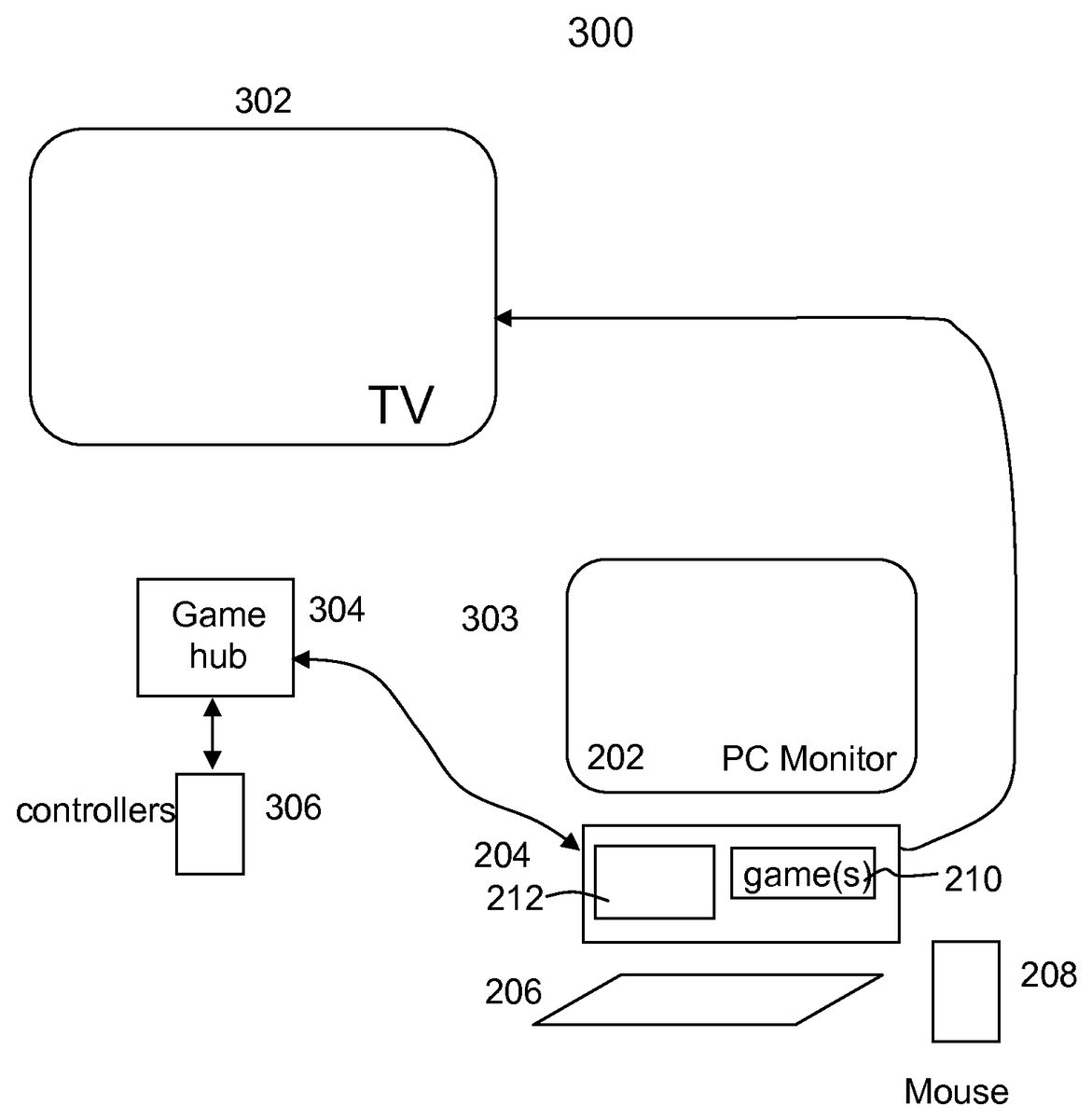
FIG. 3shows an exemplary configuration300according to one embodiment of the present invention. The configuration300includes a TV302and a PC303, and a game hub304. In general, a TV is placed in a large room (e.g. a family room) for group entertainment while the PC is placed in a small room (e.g., a home office). One of the important benefits, advantages and features in the present invention is to utilize the best of a TV and a generic PC to achieve what a game console could provide and more, allowing a game to be played in front of a TV while using the vast computing resources available on the PC303.
According to one embodiment, on one end, the game hub303is placed in the vicinity of the TV302and coupled to a number of game controllers via a wired or wireless means (e.g., IR, RF or bluetooth). On the other end, the game hub303communicates with the PC303via a wireless means (e.g., RF, or WiFi) to transmit commands or interactions (i.e., game actions) from game controllers being used by game players. In other words, the PC303runs the game and executes the game actions from the game players while the TV302displays the game with the game actions from the game players.
FIG. 4shows an exemplary function block diagram400of a game hub that may be used inFIG. 3. The game hub400may support in theory as many players as needed. The game hub400as shown inFIG. 4supports up to four game players at a time, thus including four controller interfaces402. Each of the controller interfaces402works independently in a sense that the game hub400functions as long as there is one controller connected to one of the controller interfaces402. A user may manipulate a controller while looking at a TV to, for example, make a turn, run or punch an in-game object. Depending on implementation, signals or data representing game actions from the controller are coupled to the game hub304. A microprocessor404executes one or more modules stored in memory408via a bus406to process the data representing the game actions from the player. A circuit414, collectively representing all other logics in the game hub400, is provided to convert the data into a proper form before the data is transported to a PC via a transceiver or an interface410. Those skilled in the art may understand that, depending on how the data is transported to the PC, the circuit414and the transceiver410may be implemented differently. There are a number of methods available and well known in the art (e.g., RF, Bluetooth or WiFi).
In one embodiment, the interface412is provided to be coupled to one or more sensors. Depending on implementation, examples of the sensors include, but may not be limited to, motion sensors, video cameras, temperature sensors, accelerometers, gyroscopes or magnetic field sensors. With one or more appropriate sensors coupled to the interface412, a video game may be played with more excitement or with other actions from the game players. Accordingly, the game actions as described herein may include sensor data should one or more sensors be provided or supported by the game hub400.
It should be noted that the PC303inFIG. 3is not exclusively designed for playing a game. Besides games210, the PC303may be installed with other programs212, for example, including Microsoft Office and an Internet browser. The PC303runs video games and can be used for other applications, for example, running Word, PowerPoint in Microsoft Office or browsing the Internet, communicating with other devices (e.g., servers or PCs).
InFIG. 3, the logic and graphics of a video game are computed and processed in the PC303that has an enclosure with power sourcing from an electrical outlet or batteries. The majority of the signals of game controller(s) with possible associated accessories are funneled by a wired or wireless means into the game hub304that has its own enclosure with power sourcing from an electrical outlet or batteries, and then, the signals of the game hub304are by a wired or wireless means funneled into the PC304. In return, the PC304manipulates the video game in accordance with the signals of the game hub304and controls the video game on the PC304and sends the resulting video game sequences (uncompressed digital streams) back to the TV. The game hub304serves as an intermediary and collects majority of the signals from the game controller(s) and accessories.
According to one embodiment, the game hub304can be controlled to operate the PC303without having to go to the PC303for operation. Keys or buttons on a game controller may be configured to function like a mouse or a remote controller. Through the game hub304that communicates with the PC, a user or game player may turn on or off the PC303, cause the PC303to display a list of games available from which the user may select one game to run. In another embodiment, a user may run an Internet browser in the PC to browse the Internet or run a program/application. One exemplary application is a photo display. Without gathering a group of people in a small office, a user may simply use a game controller to cause the PC303to start a photo presentation to the group of people in a large family room, typically with much more comfortable seating. All comments and entries made on a game controller are transported to the PC303as if the game controller was a mouse.
In general, a PC is more resourceful than an enclosed game console. According to one embodiment, the PC is equipped with programs or plug-in modules that are stored in memory or storage212. A game player may run the programs or modules to be associated with a video game to make the video game more controllable in a sense that a game player may set up where a video game may be restarted, store stats and data pertaining to the game in a game controller, or a portable device, and start up the game from another new computing device without having to start all over again. In one application, a user may email saved data pertaining to a video game to another PC where the video game may be started as if it was continued from the original PC.
One problem that exists with a PC is a relatively longer time to boot, or invoke up an operating system (e.g., Windows, Mac or Linux). Although the problem may be resolved over time, one embodiment of the present invention is to install, what is commonly referred to as a software virtual machine. The software virtual machine co-exists but is not part of the operating system on the PC. This virtual machine allows a game player to turn on and run quickly a video game without invoking the traditional operating system. The game player in this situation could enjoy a video game play on the TV without having to wait for the relatively longer boot (or invoking) time of the traditional operating system.
As described above, the communication between the game hub and the PC can be carried over the air (wireless). To have a secure environment, the PC may be installed a security module, likewise on the game hub, to have the communication secured between the PC and the game hub. Without a PC, many features that otherwise could not be done in a game console can now be implemented because the PC nowadays could be much powerful than a game console in terms of available resources.
FIG. 5shows another exemplary configuration500according to one embodiment of the present invention. The configuration500includes a TV502and a PC503, where the TV502and the PC503are coupled via a game hub504. On one end, the game hub503is placed in the vicinity of the TV502and supplies video and audio signals to the TV502by a set of cables or a wireless means (e.g., RF, wireless HDMI or HD). On the other end, the game hub504communicates with the PC503via a wireless means (e.g., RF, Bluetooth or WiFi) to transmit commands or interactions (collectively game) from game controllers being used by game players and receive uncompressed digital streams from the PC503. In other words, the PC503runs the game and executes commands from the game players and produce corresponding uncompressed digital streams to the game hub503that in return causes the TV302to display the game with the game actions from the game players. Thus the game hub504acts also as a bridge to facilitate a connection between the TV502and the PC503.
FIG. 6shows an exemplary function block diagram600of a game hub that may be used inFIG. 5. The game hub600may support in theory as many players as needed. The game hub600as shown inFIG. 6supports up to four game players at a time, thus including four controller interfaces602. Each of the controller interfaces602works independently in a sense that the game hub600functions as long as there is one controller connected to one of the controller interfaces602. A user may manipulate a controller while looking at a TV to, for example, turn, run or punch a in-game object. Depending on implementation, signals or data representing the signals of the game actions from the controller are transported to the game hub604. A microprocessor604executes one or more modules stored in memory608via a bus606to process the data representing the game actions from the player. A circuit614, collectively representing all other logics in the game hub600, is provided to convert the data into a proper form before the data is transported to a PC via a transceiver610. Those skilled in the art may understand that, depending on how the data is transported to the PC, the circuit614and the transceiver610may be implemented differently. There are a number of methods available and well known in the art. Likewise, the circuit614receives uncompressed digital streams from the PC and processes and drives the TV though video and audio drivers612(e.g., amplifiers).
FIG. 7shows another configuration700according to one embodiment of the present invention, in which functions of a game hub are integrated with a PC703. As described above, the PC703runs a video game and provides video and audio signals directly to a TV702uncompressed digital streams (e.g. wireless HDMI or HD). In any case, the game actions from one or more controllers706are coupled directly to the PC703via a wireless means (e.g., RF, IR, or Bluetooth) in this embodiment. As described above, a TV is usually placed in a large room (e.g. a family room) for group entertainment while the PC is placed in a small room (e.g., a home office). Since a game player plays the video game in front of the TV and is relatively far from the PC, the controller being used by the player is thus also relatively far from the PC703.
According to the embodiment, the PC703is equipped with an add-on adaptor, also referred to as an accessory (not shown), that is provided to receive interaction signals from the controller, likely via a wireless means. The accessory may be connected to the PC703by a USB connection. In accordance with the interaction signals, the PC703manipulates the game being executed therein and provides uncompressed digital streams to the TV702via a cable or a wireless means.
The foregoing description of embodiments is illustrative of various aspects/embodiments of the present invention. Various modifications to the present invention can be made to the preferred embodiments by those skilled in the art without departing from the true spirit and scope of the invention as defined by the appended claims. Accordingly, the scope of the present invention is defined by the appended claims rather than the foregoing description of embodiments.
Claims
- A device to facilitate a video game to show on a television while the video game is running on a computer, the device comprising: at least a controller interface to accommodate a game controller and receive signals from the game controller to be manipulated by a user;a first interface to the computer;a second interface to a television;a microprocessor configured to perform operations of: processing the signals from the game controller;causing the processed signals to be transported to the computer via the first interface;receiving digital streams from the computer;and coupling the digital streams to the television via the second interface, and wherein the device operates independently, and is disposed in the vicinity of the television and the game controller, and remotely located from the computer, the game controller is used to remotely turn on/off the computer and execute a computer-based non-gaming application.
- The device as recited in claim 1 , wherein the computer is not a game console, and located remotely with respect to the television.
- The device as recited in claim 1 , wherein said coupling the digital streams to the television via the second interface comprises: converting the digital streams to a signal in compliance with a TV standard;and transmitting the signal to the television by a wireless means or by one or more cables.
- The device as recited in claim 1 , wherein said causing the processed signals to be transported to the computer via the first interface comprises transmitting the processed signals to the computer by a wireless means.
- The device as recited in claim 1 , wherein the computer-based non-gaming application includes a photo display application.
- The device as recited in claim 1 , wherein the computer is installed with programs or modules to be associated with the video game to make the video game more controllable in a sense that the player decides where the video game restarts, transport stats and data pertaining to the video game and start up the video game from another computing device without having to start the video game all over again.
- The device as recited in claim 2 , wherein the digital streams from the computer are uncompressed video streams and audio streams.
- The device as recited in claim 2 , wherein the digital streams from the computer are compressed video streams and audio streams.
- The device as recited in claim 3 , wherein the wireless means includes one of RF, wireless HDMI and wireless HD.
- The device as recited in claim 7 , wherein the microprocessor is configured to convert the uncompressed video streams to a signal in compliance with a TV standard to drive the television.
- The device as recited in claim 8 , wherein the microprocessor is configured to decompress the compressed video streams to produce a signal in compliance with a TV standard to drive the television.
- The device as recited in claim 8 , wherein the compressed video streams are decompressed in the television.
- A method for playing a video game shown on a television while the video game is running on a computer, the method comprising: receiving in a device signals from a game controller to be manipulated by a user;processing in the device the signals from the game controller;causing the processed signals to be transported to the computer from the device via a first interface in the device;receiving in the device digital streams from the computer;and coupling the digital streams to the television via a second interface in the device, wherein the device operates independently, is disposed near the television and the game controller, and remotely located from the computer, the game controller is used to remotely turn on/off the computer and execute a computer-based non-gaming application.
- The method as recited in claim 13 , wherein the computer is not a game console, and located remotely with respect to the television.
- The method as recited in claim 13 , wherein said coupling the digital streams to the television via a second interface comprises: converting the digital streams to a signal in compliance with a TV standard;and transmitting the signal to the television by a wireless means or by a cable.
- The method as recited in claim 13 , wherein said causing the processed signals to be transported to the computer via the first interface comprises transmitting the processed signals to the computer by a wireless means.
- The method as recited in claim 13 , wherein the computer-based non-gaming application includes a photo display application.
- The method as recited in claim 13 , wherein the computer is installed with programs or modules to be associated with the video game to make the video game more controllable in a sense that the player decides where the video game restarts, transport stats and data pertaining to the video game and start up the video game from another computing device without having to start the video game all over again.
- The method as recited in claim 14 , further comprising converting the digital streams to a signal in compliance with a TV standard to drive the television.
- The method as recited in claim 16 , wherein the wireless means includes one of RF, bluetooth and WiFi.
Disclaimer: Data collected from the USPTO and may be malformed, incomplete, and/or otherwise inaccurate.