U.S. Pat. No. 9,162,146
METHOD AND SYSTEM FOR VIRTUAL MOBILE GAME SESSION DISCOVERY AND PLAYER MATCHING
AssigneeGOOGLE TECHNOLOGY HOLDINGS LLC
Issue DateJune 15, 2012
Illustrative Figure
Abstract
A system for establishing multi-party wireless game sessions includes a game session broker and at least two wireless units. Each wireless unit includes a first wireless device having relatively low power consumption and a second wireless device having relatively high power consumption. The game session broker receives a session ready message that includes location information for a first player and search for a second player having location information matching the location information for the first player. Finding a matching player, the game session broker sends session available messages to wireless units associated with the first and second players. Session ready messages are sent and session available message are received via first wireless devices. Upon receiving the session available message, the first and second players can establish a wireless game session using their respective second wireless devices.
Description
DETAILED DESCRIPTION Referring now to the drawings, and firstFIG. 1, a system according to the present invention is designated generally by the numeral101. System101includes a packet radio service (e.g., GPRS, EDGE, CDMA) system103. Packet radio service system103enables a mobile unit, such as mobile game unit105, to access both a data network, such as the Internet107, and a public switched telephone network (PSTN)109. An originating mobile switching center (MSC-O)111provides an interface between a packet radio service system such as GPRS system103and PSTN109. In one embodiment where the packet radio service is GPRS, an HLR113provides MSC-O111subscriber and location information for the mobile units in its home area. A Gateway mobile switching center (G-MSC)115is connected to MSC-O111and a visitor location register (VLR)117. VLR117provides location information to HLR113. A servicing mobile switching center (MSC-S.)119is connected to G-MSC115and a VLR121. VLR121provides location information to HLR113. MSC-S119is connected to a plurality of base stations, including base stations123and124, which use digital control channels (DCCHs) for paging and registration of mobile units and their respective areas. A Gateway GPRS support node print (GGSN)125provides an interface between Internet107and GPRS system103. A GPRS HLR127provides GGSN125with location and subscriber information. GGSN125and GPRS HLR127are in communication with a servicing GPRS support node (SGSN)129, which communicates with mobile units in its area through a plurality of base stations, including base stations131and132. Base stations131and132use packet control channels (PCCHs) for paging and registration of mobile units in their respective areas. System101includes a game session broker135. As will be explained in detail hereinafter, game session broker135communicates with mobile game units105and133. Game session broker135maintains game player profile information. Game session broker135maintains location information for registered mobile game units and it provides session availability information to registered mobile game units. While the present invention is illustrated and described with reference to interactive multiparty games, it will be recognized ...
DETAILED DESCRIPTION
Referring now to the drawings, and firstFIG. 1, a system according to the present invention is designated generally by the numeral101. System101includes a packet radio service (e.g., GPRS, EDGE, CDMA) system103. Packet radio service system103enables a mobile unit, such as mobile game unit105, to access both a data network, such as the Internet107, and a public switched telephone network (PSTN)109. An originating mobile switching center (MSC-O)111provides an interface between a packet radio service system such as GPRS system103and PSTN109. In one embodiment where the packet radio service is GPRS, an HLR113provides MSC-O111subscriber and location information for the mobile units in its home area. A Gateway mobile switching center (G-MSC)115is connected to MSC-O111and a visitor location register (VLR)117. VLR117provides location information to HLR113. A servicing mobile switching center (MSC-S.)119is connected to G-MSC115and a VLR121. VLR121provides location information to HLR113. MSC-S119is connected to a plurality of base stations, including base stations123and124, which use digital control channels (DCCHs) for paging and registration of mobile units and their respective areas.
A Gateway GPRS support node print (GGSN)125provides an interface between Internet107and GPRS system103. A GPRS HLR127provides GGSN125with location and subscriber information. GGSN125and GPRS HLR127are in communication with a servicing GPRS support node (SGSN)129, which communicates with mobile units in its area through a plurality of base stations, including base stations131and132. Base stations131and132use packet control channels (PCCHs) for paging and registration of mobile units in their respective areas.
System101includes a game session broker135. As will be explained in detail hereinafter, game session broker135communicates with mobile game units105and133. Game session broker135maintains game player profile information. Game session broker135maintains location information for registered mobile game units and it provides session availability information to registered mobile game units. While the present invention is illustrated and described with reference to interactive multiparty games, it will be recognized that embodiments of the invention may be applied to multiparty interactive sessions in general.
Those skilled in the are will recognize that GPRS system103is only one example of a wireless cellular communication system. GPRS system103enables communication between game session broker135and mobile game units105and133either via PSTN109or Internet107. However, game units105and133may also communicate with game session broker135solely through a cellular telephone system. Additionally, while game session broker135is illustrated inFIG. 1as being outside GPRS system103, those skilled in the art will recognize that a game session broker could be part of the infrastructure of a cellular communication system.
System101may include one or more wireless local area network (WLAN) (e.g., WiFi) access points137and139. WLAN access points137and138may be interconnected by a local area network (LAN)139. LAN139may be connected to Internet107. As is known to those skilled in the art, mobile game units105and133may communicate with WLAN access points137or138and with each other either through WLAN access points137and/or138or directly with each other via ad hoc wireless communications. Mobile game units105and133may be GPS enabled, whereby they can obtain location information from one or more GPS satellites141.
Referring now toFIG. 2, a block diagram of a game enabled wireless telephone is designated generally by the numeral201. A controller203receives inputs from and provides outputs to various devices. Game enabled wireless telephone201includes a low-power radio205, which in the preferred embodiment is a cellular phone transceiver. Game enabled wireless telephone201also includes at least one high-power radio207. High-power radio207may be a WLAN transceiver (e.g., WiFi) or any high-power transceiver in addition to low-power radio205. In some embodiments of a game enabled wireless telephone, there can be plurality of high-power transceivers. In addition, a game enabled wireless telephone may include a radio for short range communications, such as Bluetooth.
Game enabled wireless telephone201includes a speaker209and a microphone211coupled to controller203. Game enabled wireless telephone201also includes a display213coupled to controller203. Display213may be a touch screen display. Game enabled wireless telephone201also includes a keypad and other user input device, the indicated generally at215. In the embodiment ofFIG. 2, game enabled wireless telephone includes a GPS receiver217couple to controller203. Finally, memory219is coupled to controller203.
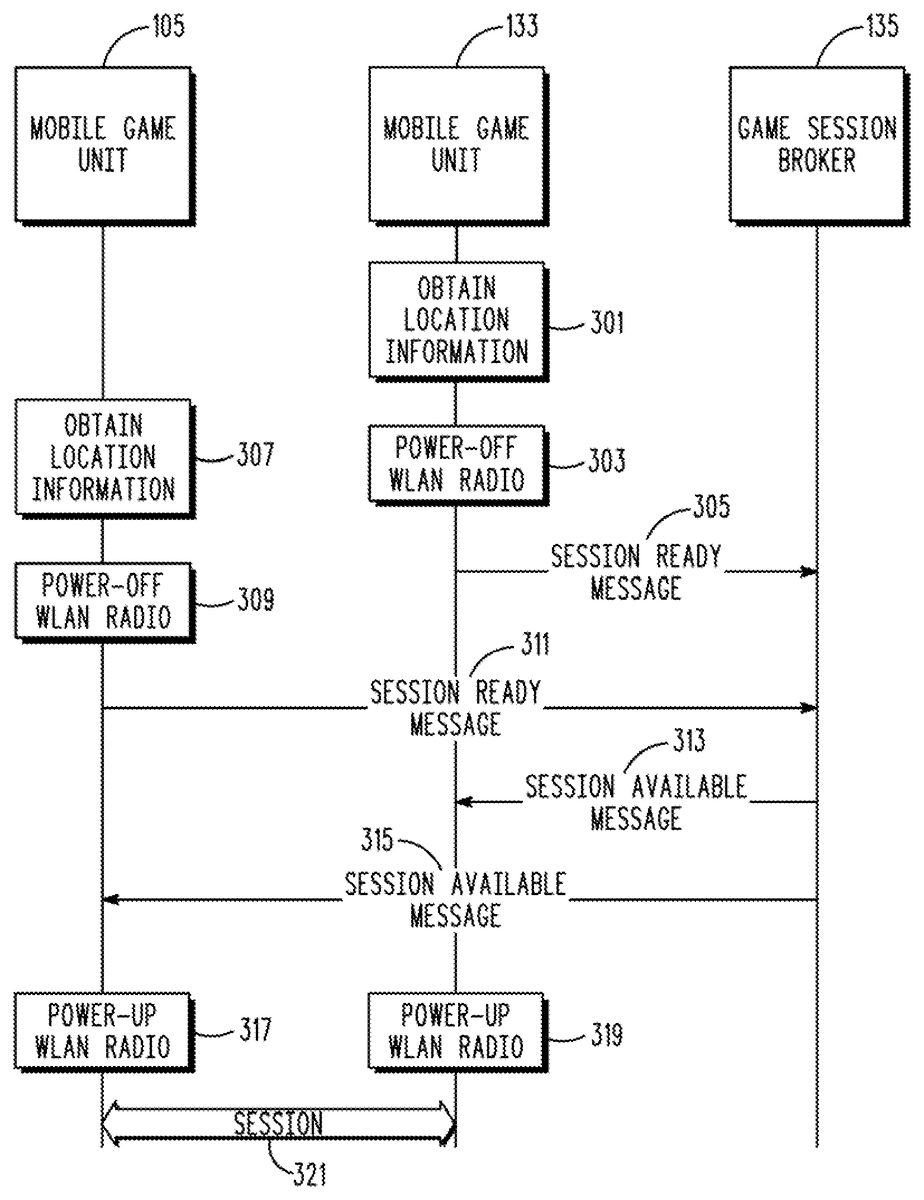
FIG. 3illustrates a high level call flow diagram signaling according to an embodiment of the present invention. Mobile game unit133obtains location information, as indicated generally at block301. Location information may be obtained using the GPS system or by measuring the signal strength of access points (e.g., WLAN access point or a collocated Bluetooth device) in the vicinity of mobile game unit133. After obtaining location information using one or more radio interfaces (e.g., WLAN or Bluetooth), mobile game unit133can power off the radio interfaces that are either idle or in high power consumption, as indicated at block303. Then, as will be described in detail hereinafter, mobile game unit133sends a session ready message305to game session broker135.
Similarly, mobile game unit105obtains location information, as indicated at block307, and powers off its WLAN radio, as indicated at block309. Then, mobile game unit105sends a session ready message311to game session broker135. As will be explained in detail hereinafter, game session broker135maintains game profile information for registered mobile game units and it maintains location information for mobile game units that are available for play. When mobile game session broker135receives a session ready message it determines if another available mobile game unit is located near the mobile game unit from which it received the session ready message. In an example inFIG. 3, game session broker135determines that mobile game units105and133are located near each other. Game session broker135sends session available messages313and315to mobile game units133and105, respectively. In response to receiving session available messages, mobile game units105and133power up their respective WiFi radios, as indicated at blocks317and319, respectively. Then, mobile game units105and133may establish a wireless game session321. Session321may be carried out over an ad hoc wireless network or through a WLAN access point or through a radio that is different from the radio interface used for uploading session information.
FIG. 4illustrates a session ready message format according to an embodiment of the present invention. In the embodiment ofFIG. 4, location information is obtained with reference to one or more of WLAN access points. The format ofFIG. 4includes a unit ID field401, which contains an identifier for the wireless unit. It can be in the form of identifier such as a telephone number. The format ofFIG. 4includes a time field403, which indicates the time period during which the mobile game unit will be available for game play. In the embodiment ofFIG. 4, the time period is specified as a number of minutes following the sending time of the session ready message. In other embodiments, the time available for play could be specified in terms of an end time. In other embodiments, the time may be indefinite, in which case the player is maintained in the list of available players until the player logs out. The message format ofFIG. 4includes a service set identifier (SSID) field405. SSID field405contains a unique identifier for each WiFi access point within range of the mobile game unit. Finally, the format ofFIG. 4includes a signal strength field407, which contains the signal strength measured by the mobile game unit for each WLAN access point within range of the mobile game unit.
FIG. 5illustrates a session ready message format according to another embodiment of the present invention. The message format ofFIG. 5includes a unit ID field, which contains the identification of the sending mobile game unit. The message format ofFIG. 5includes a time field, which specifies the time during which the mobile game unit is available for play. Finally, the message format includes a position field505(e.g., relative or fixed position such as GPS, CellID, or position relative to fixed access points), which contains fixed or relative geographical coordinates of the game unit.
FIG. 6illustrates a list of available players according to an embodiment of the present invention. The list of available players is maintained by game session broker135. When game session broker135receives a session ready message, it populates the list of available players with the unit ID601, location603, and playtime window605of the mobile game unit from whom the game ready message is received. In one embodiment of the present invention, players are registered with the game session broker135. Game session broker135maintains profile information for each registered player. Profile information may include such things as preferred games607, preferred players,609, session technology611, and proximity613.
FIG. 7illustrates a high-level flowchart of mobile game unit processing according to the present invention. In one embodiment where a mobile game unit is GPS enabled and/or WLAN enabled, the mobile game unit waits for user input, as indicated generally at block701. If, as determined at decision block703, the user wishes to send a game session ready message, the mobile game unit determines, at decision block705, if its WLAN radio is in the power off condition. If not, the mobile game unit powers off its WLAN radio, as indicated at block707. Then, the mobile game unit determines, at decision block709, if it is GPS enabled. If so, the mobile game unit captures its GPS coordinates, as indicated at block711. If, as determined at decision block709, the mobile game unit is not GPS enabled, the mobile game unit powers on its WLAN radio at block713. Then, as indicated at block715, the mobile game unit searches for a WLAN access point. If, as determined at decision block717, a WLAN access point is not found, the mobile game unit displays a session not available message to the user at block719and processing returns to block701. If, as determined at decision block717, an access point is found, the mobile game unit measures the signal strength associated with the access point at block721. Then, the mobile game unit searches for a next access point, as indicated at block723. If, as determined at decision block725, a next access point is found, then the mobile game unit measures its signal strength at block727and returns to block73. The mobile game unit continues to search for and measure access point signal strength until, no more access points are found. Then, the mobile game unit turns off its WLAN radio, as indicated at block729.
After the mobile game unit has determined its position, either with reference to captured GPS coordinates or WLAN access point signal strength, the mobile game unit prompts the user to enter a time window and then waits for user input, as indicated at block731. In some embodiments, the user may not be prompted to enter a time, in which the session availability time is indefinite. Upon receipt of the time window input, the mobile game unit sends a session ready message to the game session broker and waits for a session available message, as indicated at block733. In some embodiments, the mobile game unit may periodically determine its position and send a new session ready message whenever its position has changed since its last session ready message. Upon receipt of a session available message, the mobile game unit displays session available, as indicated at block735. The game unit may also issue an audible signal to alert the user that a session is available. Then, as indicated at block737, the mobile game unit powers on its WLAN radio and finds and sets up a game session, as indicated at block739.
FIG. 8illustrates a high-level flowchart of an embodiment for the session broker processing according to the present invention. When the session broker receives a session ready message, as indicated at block801, the session broker determines, at decision block803, if their GPS position is specified. If not, the game session broker calculates a position with reference to WLAN access point signal strengths, as indicated at block805. The game session broker knows the geographic position of each WLAN access point in its area. The game session broker is able to estimate distance from signal strength. Accordingly, the game session broker can determine a mobile game unit's position by solving a range or triangulation problem. Additionally, if two mobile game units are in proximity to the same WLAN access point, then they are in proximity to each other. Those two mobile game units may establish a game session directly with each other through an ad hoc wireless network or through the WLAN access point. Similarly, if two mobile game units are in proximity to different WLAN access points that are members of the same LAN, they can establish a wireless game session through that LAN.
After having determined the sending game unit's position, the session broker determines, at decision block807, if the player is on the list of active players. If so, the session broker updates the list of active players with the player's position and session availability information, as indicated at block809. If the player is not already on the list of active players, then the session broker adds the player ID with its position and session availability time window to the list of active players, as indicated at block811. Then, the game session broker searches the list of active players for a match, as indicated generally at block813. The search for matches includes at least a search of matching locations. As used herein, locations are matching if the mobile game units can establish a wireless game session either through one or more WLAN access points or directly through an ad hoc wireless network. The search may also include search for a preferred players, preferred technology, and preferred games. If, as determined at decision block815, there is a match, the session broker sends session available messages to each matching player, as indicated at block817. If, as determined at decision block811, there are no matches, then the session broker sends a received message to the player, at block819.
FIG. 9is a high-level flowchart of active player list cleanup processing according to an embodiment of the present invention. Periodically, the session broker goes to a first entry on the list of active players, as indicated at block901. The session broker tests at decision block903if time is expired for the first entry. If so, the entry is removed from the list, as indicated at block905. Then, the session broker tests, at decision block907, if there are more entries in the list. If so, goes to the next entry on the list. In the embodiment of the invention in which a player remains on the active player list until the play logs off, the session broker would remove the player from the active player list upon receipt of a log off message from the player.
From the foregoing, it may be seen that embodiments of the invention are well adapted to overcome the shortcomings of the prior art. While the invention has been illustrated and described with respect to presently preferred embodiments, those skilled in the art, given the benefit of this disclosure, will recognize alternative embodiments. Accordingly, the foregoing disclosure is intended for purposes of illustration and not of limitation.
Claims
- A method of establishing a multiparty wireless interactive session using a first game-enabled mobile unit, the first game-enabled mobile unit comprising a first wireless radio and a second wireless radio, method comprising the steps of: the first game-enabled mobile unit obtaining location information identifying a location of the first game-enabled mobile unit;the first game-enabled mobile unit turning off the first wireless radio in response to obtaining the location information;the first game-enabled mobile unit sending, via the second wireless radio, a session ready message including the location information to a session broker that maintains game player profile information;the first game-enabled mobile unit receiving, via the second wireless radio, a session available message from the session broker based on an identification of a second game-enabled mobile unit within a certain distance of the first game-enabled mobile unit;and in response to receiving the session available message, the first game-enabled mobile unit initiating a session with the second game-enabled mobile unit via the first wireless radio.
- The method as claimed in claim 1 , wherein the second wireless radio consumes less power than the first wireless radio.
- The method as claimed in claim 2 , wherein the second wireless radio includes a cellular telephone radio.
- The method as claimed in claim 2 , wherein the first wireless radio includes a wireless local area network radio.
- The method as claimed in claim 2 , wherein the first wireless radio includes a Bluetooth radio.
- The method as claimed in claim 1 , wherein the location information includes proximity information with respect to at least one wireless local area network access point.
- The method as claimed in claim 6 , wherein the proximity information includes strength of a signal received from the access point.
- The method as claimed in claim 1 , wherein the location information includes a GPS position of the first game-enabled mobile unit.
- The method as claimed in claim 1 , including: turning on the first wireless radio in response to the first game-enabled mobile unit receiving the session available message.
- The method as claimed in claim 1 , further comprising: the first game-enabled mobile unit sending, via the second wireless radio, a new session ready message including new location information to the session broker if the location of the first game-enabled mobile unit changes.
- A mobile device, comprising: an interactive wireless radio including: a first radio having a first power consumption;a second radio having a second power consumption, the second power consumption being less than the first power consumption, wherein the mobile device is to: obtain location information identifying a location of the mobile device;turn off the first radio in response to obtaining the location information;send, via the second radio, a session ready message including the location information to a session broker that maintains user profile information;receive, via the second radio, a session available message from the session broker based on an identification of a second mobile device within a certain distance of the first mobile device;and establish, via the first radio, a multiparty wireless session with the second mobile device in response to receiving the session available message.
- The mobile device of claim 11 , wherein the mobile device further is to: send, via the second radio, a new session ready message including new location information to the session broker if the location of the mobile device changes.
- The mobile device of claim 12 , wherein the mobile device is to obtain the location information via a GPS receiver.
- The mobile device of claim 12 , wherein the mobile device is to obtain the location information via measuring a signal strength using the first radio.
- The mobile device of claim 12 , wherein the mobile device further is to: turn on the first wireless radio in response to the first game-enabled mobile unit receiving the session available message.
- A session broker apparatus, comprising: at least one interface to a wireless telephone system, and wherein the session broker apparatus stores user profile information and is to: receive, via the at least one interface to the wireless telephone system, a first session ready message transmitted from a first wireless unit via a wireless radio having a first power consumption, the first session ready message including location information for the first wireless unit;receive, via the at least one interface to the wireless telephone system, a second session ready message transmitted from a second wireless unit via a second wireless radio having a second power consumption, the second session ready message including location information for the second wireless unit;identify that a location of the second wireless unit is within a certain range of the location of the first wireless unit;and send, via the at least one interface to the wireless telephone system, a session available message to the first wireless unit and the second wireless unit, wherein the session available message causes the first wireless unit and the second wireless unit to communicate with each other using respective third and fourth wireless radios having power consumption greater than the first power consumption and the second power consumption, respectively.
Disclaimer: Data collected from the USPTO and may be malformed, incomplete, and/or otherwise inaccurate.