U.S. Pat. No. 9,061,206
VIDEO GAME SYSTEM USING PRE-GENERATED MOTION VECTORS
AssigneeActiveVideo Networks, Inc.
Issue DateJuly 8, 2005
Illustrative Figure
Abstract
A method and related system of generating a frame of video is disclosed. In the method, a request is received. For instance, the request may initiate a video game. A motion search between an object in a subsequent frame of video and the object in a current frame of video is performed. A pre-determined motion vector for the object is selected. The object in the subsequent frame of video may correspond to a set of pre-encoded macro-blocks and the performing the motion search may include searching a corresponding set of macro-blocks associated with the current frame of video. The pre-encoded macro-blocks may be pre-encoded prior to the request. The motion vector may be pre-determined prior to the request.
Description
Like reference numerals refer to corresponding parts throughout the drawings. DETAILED DESCRIPTION OF EMBODIMENTS Reference will now be made in detail to embodiments, examples of which are illustrated in the accompanying drawings. In the following detailed description, numerous specific details are set forth in order to provide a thorough understanding of the present invention. However, it will be apparent to one of ordinary skill in the art that the present invention may be practiced without these specific details. In other instances, well-known methods, procedures, components, and circuits have not been described in detail so as not to unnecessarily obscure aspects of the embodiments. An improved method, and related system, for offering interactive video games using networks, such as those in satellite systems, cable television systems (CATV), the Internet, wide area networks, local area networks and/or telephone systems, is described. As described below, the method and system utilizes efficient digitizing of video-game content corresponding to frames and/or fields of video-game images (henceforth referred to as frames of video) to reduce a communication bandwidth and thereby increase a number of users or players (henceforth referred to as users) that may be supported. The term video game includes video games, other forms of computer-implemented recreational application programs, and non-recreational application programs, such as news, weather and/or sports. Players or users refer to one or more humans that participate in one or more video games. In particular, frames of video images or updates to one or more frames of video corresponding to one or more video games (including single and/or multi-player video games) are generated using a plurality pre-encoded tiles or macro-blocks, which are encoded prior to a request to initiate the one or more video games. A macro-block includes a set of pixels, for example, a 16-by-16 array of pixels. Generating the frames ...
Like reference numerals refer to corresponding parts throughout the drawings.
DETAILED DESCRIPTION OF EMBODIMENTS
Reference will now be made in detail to embodiments, examples of which are illustrated in the accompanying drawings. In the following detailed description, numerous specific details are set forth in order to provide a thorough understanding of the present invention. However, it will be apparent to one of ordinary skill in the art that the present invention may be practiced without these specific details. In other instances, well-known methods, procedures, components, and circuits have not been described in detail so as not to unnecessarily obscure aspects of the embodiments.
An improved method, and related system, for offering interactive video games using networks, such as those in satellite systems, cable television systems (CATV), the Internet, wide area networks, local area networks and/or telephone systems, is described. As described below, the method and system utilizes efficient digitizing of video-game content corresponding to frames and/or fields of video-game images (henceforth referred to as frames of video) to reduce a communication bandwidth and thereby increase a number of users or players (henceforth referred to as users) that may be supported. The term video game includes video games, other forms of computer-implemented recreational application programs, and non-recreational application programs, such as news, weather and/or sports. Players or users refer to one or more humans that participate in one or more video games.
In particular, frames of video images or updates to one or more frames of video corresponding to one or more video games (including single and/or multi-player video games) are generated using a plurality pre-encoded tiles or macro-blocks, which are encoded prior to a request to initiate the one or more video games. A macro-block includes a set of pixels, for example, a 16-by-16 array of pixels. Generating the frames of video may include interrelating dc coefficients in adjacent macro-blocks, selecting a pre-determined motion vector and compensation data for adjacent macro-blocks, calculating a motion vector and compensation data for adjacent macro-blocks, and/or quantization factors for adjacent macro-blocks. The use of pre-encoded macro-blocks takes advantage of the fact that some or all of the content in a video game may remain unchanged in multiple, successive frames of video (for example, user actions may leave some or all of the content unchanged). As a consequence, some or all of the content may be pre-encoded. This may reduce the complexity and/or cost associated with implementing the video-game system in a networked environment, for example, by simplifying the infrastructure and/or reducing the computational resources needed to generate the frames of video images. In addition, encoding (compressing) the content may also reduce a data rate in a data stream corresponding to the frames of video.
The plurality of pre-encoded macro-blocks may be generated and stored in a bank of individually addressable pre-encoded macro-blocks. This may allow a subset of the plurality of pre-encoded macro-blocks to be shared, for example, in two or more video games, in two or more frames of video and/or in two or more instances of a video game. This sharing may also reduce the cost and/or complexity of implementing the video-game system in a networked environment. It may also allow the video-game system to support multi-player video games with less infrastructure.
In some embodiments, a respective frame of video is generated using a subset of the plurality of pre-encoded macro-blocks and a reference grid. The reference grid includes indices and/or pointers to macro-blocks, with each box or entry in the reference grid corresponding to a location in the respective frame of video. Comparing a previous frame of video with the respective frame of video allows the respective frame of video to be generated by positioning appropriate pre-encoded macro-blocks at appropriate indices and/or pointers corresponding to the reference grid. The comparison may include the tile indices at the corresponding and/or a adjacent positions of the previous frames tile grid. The comparison, therefore, involves indices for macro-blocks as opposed to the full set of pixels in the frame of video. This may result in a significant reduction in an amount of computation.
In some embodiments, a plurality of macro-blocks may also be generated during one or more video games. After a request for a video game is received, some of these macro-blocks may be generated once, and then used in multiple video frames. This may include, for example, macro-blocks for information that is not available until the video game is requested, such as those corresponding to text (a user name) or simple animation. As will be explained in more detail below, motion vectors and/or compensation data corresponding to the animation may also be pre-encoded. Other macro-blocks may be dynamically generated in response to one or more user commands during the video game. The one or more user commands may determine a change in a game state for the video game, such as that based on a respective user action for a respective user or a respective set of users. Such dynamically generated macro-blocks may correspond to objects in the video game, such as one or more sprites (i.e., programmable, movable, high-resolution graphic images, which are also referred to as movable object blocks).
In some embodiments, a subset of the plurality of pre-encoded macro-blocks may include un-compressed pixel information as well as compressed, pre-encoded pixel data. During generation of the one or more frames of video, the dynamically generated macro-blocks may include a combination of the un-compressed pixel information for a plurality of pre-encoded macro-blocks and image information corresponding to one or more objects. The combination may include blending and/or superimposing the image information corresponding to the one or more objects with the un-compressed pixel information.
The method and system transmit the generated video-game content to a user device for display. The generated video-game content may correspond to difference information relative to previous video-game content transmitted to the user device. The system allows multiple sets of users to simultaneously and independently play a single executable copy the video game. A respective set of users may include one or more users. Each set of users may have a respective game state for the video game. In this way, the system improves an efficiency of resource utilization and an overall cost effectiveness.
In an exemplary embodiment, the method and system are compatible with an MPEG compression standard, including MPEG2. This compatibility allows the one or more frames of video generated using the method and system to be displayed using commercially available chip sets.
Video Game System
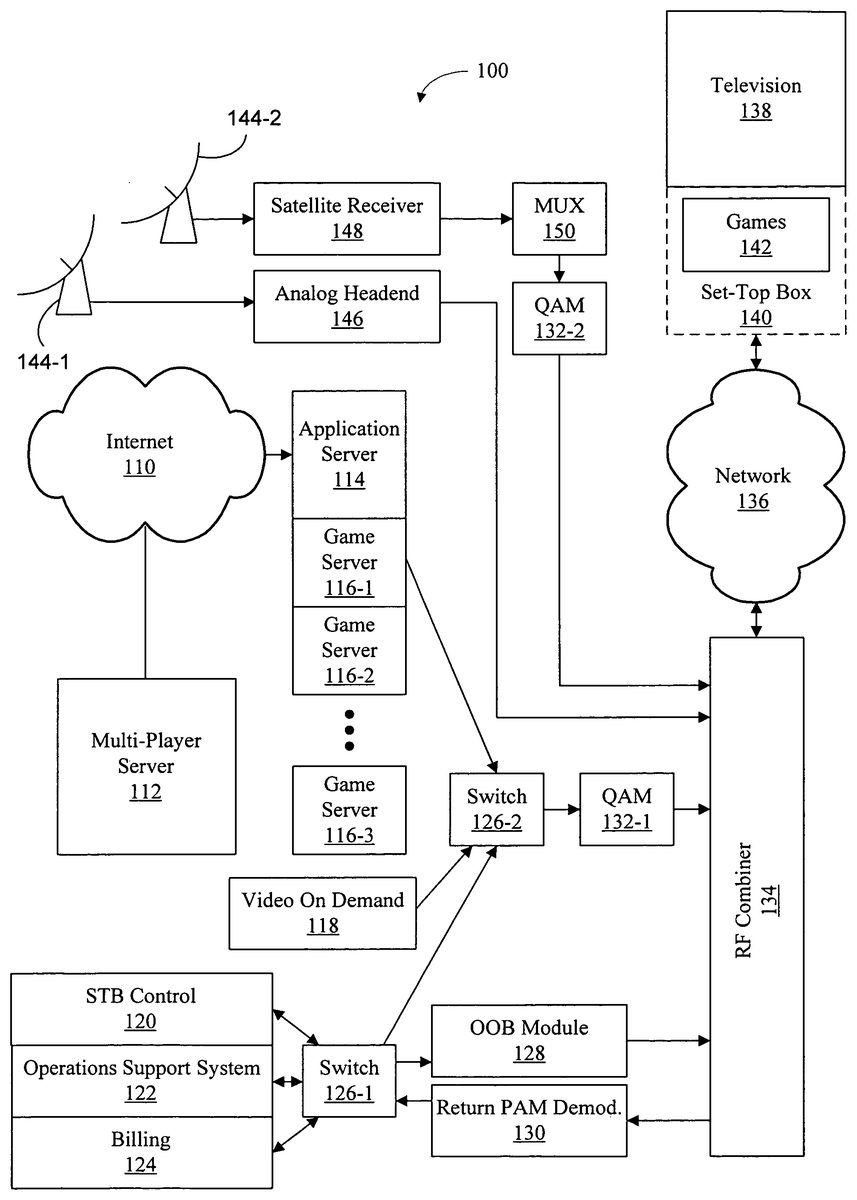
FIG. 1is a block diagram illustrating an embodiment of a cable television system100for receiving orders for and providing content, such as one or more video games, to one or more users (including multi-user video games). Several content data streams may be transmitted to respective subscribers and respective subscribers may, in turn, order services or transmit user actions in a video game. Satellite signals, such as analog television signals, may be received using satellite antennas144. Analog signals may be processed in analog headend146, coupled to radio frequency (RF) combiner134and transmitted to a set-top box (STB)140via a network136. In addition, signals may be processed in satellite receiver148, coupled to multiplexer (MUX)150, converted to a digital format using a quadrature amplitude modulator (QAM)132-2(such as 256-level QAM), coupled to the radio frequency (RF) combiner134and transmitted to the STB140via the network136. Video on demand (VOD) server118may provide signals corresponding to an ordered movie to switch126-2, which couples the signals to QAM132-1for conversion into the digital format. These digital signals are coupled to the radio frequency (RF) combiner134and transmitted to the STB140via the network136. The STB140may display one or more signals, include those corresponding to video-game content discussed below, on television or other display device138. WhileFIG. 1illustrates one subscriber STB140and television or other display device138, in other embodiments there may be additional subscribers, each having one or more STBs and/or televisions or other display devices.
The cable television system100may also include an application server114and a plurality of game servers116. The application server114and the plurality of game servers116may be located at a cable television system headend. While a single instance or grouping of the application server114and the plurality of game servers116are illustrated inFIG. 1, other embodiments may include additional instances in one or more headends. The servers and/or other computers at the one or more headends may run an operating system such as Windows, Linux, Unix, or Solaris.
The application server114and one or more of the game servers116may provide video-game content corresponding to one or more video games ordered by one or more users. In the cable television system100there may be a many-to-one correspondence between respective users and an executed copy of one of the video games. The application server114may access and/or log game-related information in a database. The application server114may also be used for reporting and pricing. One or more game engines (also called game engine modules)1848(FIG. 18) in the game servers116are designed to dynamically generate video-game content using pre-encoded blocks. In an exemplary embodiment, the game servers116use encoding that is compatible with an MPEG compression standard.
The video-game content is coupled to the switch126-2, converted to the analog format in the QAM132-1. In an exemplary embodiment with 256-level QAM a narrowcast sub-channel (having a bandwidth of approximately 6 MHz, which corresponds to approximately 38 Mbps of digital data) may be used to transmit 10 to 30 video-game data streams for a video game that utilizes between 1 and 4 Mbps.
These digital signals are coupled to the radio frequency (RF) combiner134and transmitted to STB140via the network136. The Applications server114may also access, via Internet110, persistent player or user data in a database stored in multi-player server112. The applications server114and the plurality of game servers116are further described below with reference toFIG. 18.
The STB140may include a client application, such as games142, that receives information corresponding to one or more user actions and transmits the information to one or more of the game servers116. The game applications142may also store video-game content prior to updating a frame of video on the television138. The television138may be compatible with an NTSC format or a different format, such as PAL or SECAM. The STB140is described further below with reference toFIG. 18.
The cable television system100may also include STB control120, operations support system122and billing system124. The STB control120may process one or more user actions, such as those associated with a respective video game, that are received using an out-of-band (OOB) sub-channel using return pulse amplitude (PAM) demodulator130and switch126-1. There may be more than one OOB sub-channel. While the bandwidth of the OOB sub-channel(s) may vary from one embodiment to another, in one embodiment, the bandwidth of each OOB sub-channel corresponds to a bit rate or data rate of approximately 1 Mbps. The operations support system122may processes a subscriber's order for a respective service, such as the respective video game, and update the billing system124. The STB control120, the operations support system122and/or the billing system124may also communicate with the subscriber using the OOB sub-channel via the switch126-1and the OOB module128, which converts signals to a format suitable for the OOB sub-channel. Alternatively, the operations support system122and/or the billing system124may communicate with the subscriber via another communications link such as an Internet connection or a communications link provided by a telephone system.
The various signals transmitted and received in the cable television system100may be communicated using packet-based data streams. In an exemplary embodiment, some of the packets may utilize an Internet protocol, such as User Datagram Protocol (UDP). In some embodiments, networks, such as the network136, and coupling between components in the cable television system100may include one or more instances of a wireless area network, a local area network, a transmission line (such as a coaxial cable), a land line and/or an optical fiber. Some signals may be communicated using plain-old-telephone service (POTS) and/or digital telephone networks such as an Integrated Services Digital Network (ISDN). Wireless communication may include cellular telephone networks using an Advanced Mobile Phone System (AMPS), Global System for Mobile Communication (GSM), Code Division Multiple Access (CDMA) and/or Time Division Multiple Access (TDMA), as well as networks using an IEEE 802.11 communications protocol, also known as WiFi, and/or a Bluetooth communications protocol.
WhileFIG. 1illustrates a cable television systems, the system and methods described may be implemented in a satellite-based system, the Internet, a telephone system and/or a terrestrial television broadcast system. The cable television system100may include additional elements and/or remove one or more elements. In addition, two or more elements may be combined into a single element and/or a position of one or more elements in the cable television system100may be changed.
Attention is now directed towards several embodiments of methods of operations for generating one or more frames of video using pre-encoded macro-blocks. These methods may be implemented in the cable television system100to provide content, including one or more video games, to one or more users. As noted above, a macro-block corresponds to a set of pixels. In an exemplary embodiment of encoding of macro-blocks using an MPEG-compatible compression standard, such as MPEG2, a block may correspond to an 8-by-8 array of pixels and a macro-block may correspond to a 16-by-16 array of pixels.
Generating One or More Frames of Video
FIG. 2is a flow diagram illustrating an embodiment of a process200of generating a frame of video. A request is received (210). The request may initiate a video game. A frame of video is generated using a plurality of pre-encoded macro-blocks (i.e., macro-blocks that are pre-encoded prior to the request) (212). The process200may include fewer operations or additional operations. In addition, two or more operations may be combined and/or the order of the operations may be changed.
FIG. 3is a flow diagram illustrating an embodiment of a process300of generating a frame of video. As in the process200described above, a request is received (210). A plurality of macro-blocks are generated once or dynamically (310). A frame of video is generated using a plurality of pre-encoded macro-blocks (that are pre-encoded prior to the request) and the plurality of generated macro-blocks (312). The process300may include fewer operations or additional operations. In addition, two or more operations may be combined and/or the order of the operations may be changed.
FIG. 4is a flow diagram illustrating an embodiment of a process400of generating a frame of video. Once again, the process400includes receiving a request (210). In addition, a command is received (410). The command may correspond to a user action or an action of a set of users in a video game. After receiving the command, and in response to the command, a frame of video is generated using a plurality of pre-encoded macro-blocks (that are pre-encoded prior to receiving the request), a plurality of post-encoded macro-blocks (encoded after receiving the request and prior to receiving the command), and a plurality of dynamically generated macro-blocks (encoded after receiving the command) (412). The process400may include fewer operations or additional operations. In addition, two or more operations may be combined and/or the order of the operations may be changed.
FIG. 5is a flow diagram illustrating an embodiment of a process500of generating a frame of video. A plurality of pre-encoded macro-blocks are generated (510). The plurality of pre-encoded macro-blocks are stored in a bank of pre-encoded macro-blocks (512). A frame of video is generated using at least a subset of the plurality of pre-encoded macro-blocks (514). The process500may include fewer operations or additional operations. In addition, two or more operations may be combined and/or the order of the operations may be changed.
The pre-encoded macro-blocks in embodiment500may be individually accessible allowing a subset of the plurality of pre-encoded macro-blocks to be shared between two or more video games, to be shared between two or more frames of video, and/or to be shared between two or more instances of a video game. A subset of the stored plurality of pre-encoded macro-blocks may include un-compressed pixel information. As discussed below with reference toFIG. 10, providing pre-encoded macro-blocks that also include un-compressed pixel information allows dynamic macro-blocks to be generated that combine image information corresponding to an object with the uncompressed pixel information from one or more pre-encoded macro-blocks.
Attention is now directed towards several embodiments of pre-encoding and one-time and/or dynamically generation of macro-blocks for use in generating a frame of video.FIG. 6is a block diagram illustrating an embodiment600of one or more banks610of pre-encoded macro-blocks612and a 2-dimensional tile, array or reference grid614. The number of pre-encoded macro-blocks612that are included in the banks610may depend on the respective video game that will use the pre-encoded macro-blocks and the amount of predictable animation associated the with video game. Thus simple games, with simple animations have fewer pre-encoded macro-blocks than complex games with more scenes, characters and predictable animations. In exemplary embodiments there are approximately 16,000, 50,000, 60,000 or 100,000 pre-encoded macro-blocks612. The reference grid614is arranged in a plurality of rows616and columns618that sub-divide the reference grid614into a plurality of boxes. Each row616corresponds to a slice620in a frame of video. Each box of the grid614(each entry in the grid) stores an index or a pointer for identifying and positioning a macro-block when generating a frame of video. A plurality of the grid entries may reference pre-encoded macro-blocks, while other grid entries in the grid614reference dynamically generated macro-blocks (i.e., macro-blocks generated after the initiation of game execution, such as macro-blocks generated in response to a latest or recent command by a user of the game). In other words, each box in the grid614stores a pointer or reference to a respective macro-block (at least some of which are pre-encoded macro-blocks), and the position of the box in the grid614identifies the position of the identified macro-block in a video frame. In an exemplary embodiment, the macro-blocks (including the pre-encoded macro-blocks612) each represent a 16-by-16 array of pixels, and there are 30 rows616and 40 columns618of macro-blocks or grid entries corresponding to a VGA video frame. In other embodiments, there are 30 rows and 45 columns of macro-blocks or grid entries corresponding to a digital embodiment of NTSC.
In many video games, at least a subset of the content in a respective frame of video may be substantially unchanged with respect to a previous or subsequent frame of video. This situation may arise in a video game be because a user has not entered a command (such as providing instructions using a user interface device), i.e., there hasn't been a user action. Alternatively, depending on the respective video game, there may be a subset of the content that is not user addressable, i.e., that is unaffected even if the user enters a command (for example, an image in the background of the frame of video). This information is available to the game developer and may be utilized to select which macro-blocks to pre-encode or compress, and which macro-blocks to both pre-encode and also store un-compressed pixel information. The macro-blocks identified by the reference grid614may be modified in accordance with a game state for the respective video game, i.e., in accordance with user commands. A synthesizer module1852(FIG. 18) in a respective game engine1848(FIG. 18) may use a current state of the reference grid614to select and/or position an appropriate subset of the pre-encoded macro-blocks612at appropriate indices (or using appropriate pointers) in the reference grid614to generate a frame of video. In addition to allowing game resources to be shared, this approach may also reduce the infrastructure and/or the cost associated with generating frames of video corresponding to one or more video games. In particular, generating the frame of video may involve a comparison of two indices or pointers (to macro-blocks), corresponding to a previous state of the reference grid614and the current state of the reference grid614, as opposed to comparison of all the pixels in the corresponding macro-blocks.
FIG. 7is a flow diagram illustrating an embodiment700of a process of generating at least a frame of video. Operations in embodiment700may be grouped in pre-coding operations710and video frame generating operations720. The pre-coding operations710may be performed in one or more game servers116(FIG. 1) and/or the pre-coding operations710may be performed by a game developer or game distributor prior to the loading of game assets onto the cable television system100(FIG. 1). Pre-coding operations710include performing a two-dimensional discrete cosine transformation (DCT) (712), quantization (714) and run-length encoding (716) of one or more macro-blocks (such as the pre-encoded macro-blocks612inFIG. 6) and/or on one or more blocks in a respective macro-block. As discussed further below with reference toFIG. 8, the DCT (712) results in a several DC coefficients and several sets of AC coefficients that corresponding to image information for the macro-block. The quantization (714) includes determining a quantization factor for a respective macro-block. The run-length encoding (716) may include a Huffman encoding operation.
The pre-coding operations710may optionally include calculating one or more motion vectors (to a nearest half pixel) and/or correction data (718), which is added to a macro-block after a displacement corresponding to one of the motion vectors to obtain a final macro-block in the frame of video. Pre-coding a motion vector for a macro-block is particularly useful when a video game includes a known animation sequence that repeats during execution of the video game. Pre-coding more than motion vector for a macro-block may be useful when an object in a video game moves in different directions during different animation sequences. The resulting one or more motion vectors and/or correction data may be stored in corresponding macro-blocks612(FIG. 6) in one or more of the banks610(FIG. 6). Note that pre-encoding motion vectors (i.e., calculating the one or more motion vectors and/or correction data718) is distinct from dynamic motion estimation (i.e., on the fly motion estimation) that is implemented in MPEG-compatible compression, such as MPEG2.
During generation of the frame of video (720), adjacent macro-blocks are interrelated (722). The interrelating operation (722) may include determining one or more DC coefficients, completing the calculation of one or more motion vectors and/or correction data, and/or the quantization factor for the respective macro-block. A resulting data stream of macro-blocks may be compatible with an MPEG compression standard. In an exemplary embodiment, the pre-coding710may complete substantially 90% of the encoding needed to generate an MPEG compatible frame of video. The last 10% includes determining relative information, which depends on information in previous or subsequent macro-blocks, and is accomplished by interrelating (722) spatially and/or temporally adjacent macro-blocks. Determining the one or more DC coefficients is discussed further below with reference toFIGS. 8 and 9, determining of the quantization factor is discussed further below with reference toFIG. 9, and completing the calculation of one or more motion vectors and/or correction data is also discussed further below with reference toFIG. 10.
The flow diagram700may include fewer operations or additional operations. In addition, two or more operations may be combined and/or the order of the operations may be changed.
FIG. 8is a block diagram illustrating an embodiment800of chrominance and luminance blocks in a macro-block. The macro-block includes four luminance (Y) blocks810and two chrominance (U and V) blocks812. The blocks810and812include AC and DC coefficients associated with the pre-encoding710illustrated inFIG. 7. In an exemplary embodiment, the luminance blocks810correspond to 8×8 arrays of pixels, one chrominance block (such as chrominance block812-1) corresponds to U information for the macro-block and one chrominance block (such as chrominance block812-2) corresponds to V information for the macro-block. In other embodiments, the macro-block my be generated based on composite video information, such as RGB, and the blocks in embodiment800may be modified accordingly.
Each luminance block810inFIG. 8has a DC coefficient814and each chrominance block812has a DC coefficient816. The DC coefficients814and816specify an average brightness and chrominance (red or blue), respectively, for the macro-block. The DC coefficients814and816are represented in the macro-block800as values relative to the DC coefficients for adjacent blocks. Thus, DC coefficient814_2is represented by the difference between the DC coefficient for luminance block810-2and the DC coefficient for luminance block810-1; DC coefficient814_3is represented by the difference between the DC coefficient for luminance block810-3and the DC coefficient for luminance block810-2; DC coefficient814_4is represented by the difference between the DC coefficient for luminance block810-4and the DC coefficient for luminance block810-3; i.e., these DC coefficients814are determined ‘internal’ to the macro-block. DC coefficient814_1, DC coefficient816_1and DC coefficient816_2are determined relative to an adjacent macro-block. This is illustrated inFIG. 9, which is a block diagram illustrating an embodiment900of inter-relating adjacent macro-blocks. Specifically, at least 3 DC coefficients for macro-block912may be determined using one or more adjacent macro-block914in a frame of video910. In an exemplary embodiment, macro-block914_3is used as the adjacent macro-block when computing the representation of the DC coefficients for macro-block912.
If the quantization factor for the macro-block912is different from the quantization factor of an adjacent macro-block, such as the macro-block914_3, the interrelating operation (722) inFIG. 7may include adding the quantization factor to a header for the macro-block912in a data stream corresponding to the frame of video910.
As discussed previously, since animation sequences that repeat a pre-determined sequence of macro-blocks in a linear or circular fashion are known to a game developer, these macro-blocks may be pre-encoded and stored (for example, in one or more of the banks610inFIG. 6) with one or more motion vectors and/or correction data. The motion vectors and/or correction data calculated (718) (FIG. 7) during pre-encoding (710) (FIG. 7) contain relative information. As a consequence, when the frame of video is generated (720) (FIG. 7) the calculation may be completed (i.e., adjacent macro-blocks may be interrelated and the motion vector and/or the correction data may be finalized). In MPEG-compatible embodiments, when the frame of video containing one of these animation sequences is transmitted, instead of transmitting a full intra-coded macro-block a predictive macro-block including motion vector and delta or difference information with respect to a region of the previous video frame of video may be transmitted. The motion vector in a predictive macro-block indicates the location of an array of pixels (e.g., a 16 by 16 array of pixels) to be used as the starting point for constructing a tile of the current video frame. The motion vector indicates a position relative to the tile, such as Tx+X pixels and Ty+Y, where Tx,Ty is the tile position and X,Y is the relative position specified by the motion vector. The motion vector may point to an array that overlaps two or four tiles of the previous video frame. When the motion vector has a null value, the starting point for the tile is the tile's pixel array in the previous video frame. The delta or difference information specifies how to modify the starting point pixel array to produce the pixel array for a tile in the current video frame. Note that MPEG-compatible compression, such as MPEG2, has several types of macro-blocks. An intra-coded macro-block is self contained, i.e., it contains all the information needed to define image information for a corresponding set of pixels in the frame of video. Predictive macro-blocks contain a range of information, ranging from an empty macro-block (only a header is transmitted) to a macro-block containing both a motion vector and delta or difference information (i.e., relative information). MPEG2 compression and the various types of macro-blocks are discussed further below with reference toFIGS. 12-14.
The pre-encoding (710) (FIG. 7) may include a motion search of adjacent macro-blocks to calculate the motion vector and/or correction data (718) (FIG. 7). During generation of the frame of video (720) (FIG. 7), the synthesizer module1852(FIG. 18) in a respective game engine1848(FIG. 18) may verify that the motion estimation (the motion vector and/or correction data) calculated during the pre-encoding (710) (FIG. 7) is correct for the current game state (for example, that a dialog box does not overlay the macro-blocks in the animation sequence). This may be implemented by checking for the presence of corresponding macro-block indices in the reference grid614(FIG. 6) at one or more expected locations in a previous frame of video. In an exemplary embodiment, one known object in a respective animation sequence is tracked. For a motion vector having a half-pixel accuracy, comparisons with up to four previous macro-blocks overlapped by the source array of 16 by 16 pixels (or macro-block locations) may be performed.
FIG. 10is a block diagram illustrating an embodiment1000of comparing frames of video. A current frame of video1012is compared to a previous frame of video1010to identify an object1016. The comparison results in a difference of delta1014map including the object1016and a corresponding modified region1018. As described above, such a comparison may be used in motion estimation for pre-encoded animation sequences. As described below, it may also be used for generating frames of video containing objects or sprites using dynamically generated or encoded macro-blocks, as described inFIGS. 3 and 4, and described further below.
While various embodiments of systems and methods that use both pre-encoded macro-blocks and dynamically generated macro-blocks have been described, many additional embodiments using various combinations of pre-encoded and dynamically generated macro-blocks are possible. Depending on the number and speed of the processors in a video-game system (e.g., the system shown inFIG. 18), more or less of the image information in the one or more frames of video may be pre-encoded. In general, however, there are a subset of objects in a respective video game that are responsive to user commands. Since a behavior of these objects is unknown in advance, such objects may be encoded dynamically.
Given the additional time available to an encoder during the pre-encoding operations (710) (FIG. 7), the encoder may use floating-point arithmetic for operations such as the DCT (712) (FIG. 7). In addition, the quantization operation (714) (FIG. 7) may chose an optimal quantization factor for a respective macro-block from up to, say, 30 possible values. While such implementations may provide superior compression and/or image quality, they may be time consuming. As a consequence, dynamic encoding of objects or sprites may utilize fast encoding. Fast encoding may include fixed-point (integer) multiplication during the DCT operation (712) (FIG. 7). In addition, the quantization factor for the respective macro-block may be selected from a smaller set. For example, the quantization factor for the respective (16×16) macro-block may be the largest quantization factor for the four 8×8 blocks in the macro-block. If a resulting data rate exceeds a desired upper bound, the quantization factor that achieves the desired upper bound may be calculated directly. While this quantization factor may be sub-optimal (all the bits available may or may not be used), the calculation may be quicker than that used during pre-encoding (710) (FIG. 7). Thus, for dynamic encoding there may be a trade off between image quality and the overall encoding time.
One or more dynamically generated macro-blocks corresponding to one or more objects or sprites may be combined with at least a portion of one or more pre-encoded macro-blocks. Combining macro-blocks and sprites may include blending or mixing and/or superposition. For example, blending may include alpha blending, where an effective transparency of the object or sprite is varied over a range of pixels. Superposition may utilize a chroma key, which may indicate what portion of the pre-encoded macro-blocks are background image information. Some of the pre-encoded macro-blocks612(FIG. 6) may include, in addition to the pre-encoded pixel information, un-compressed pixel information to facilitate the combining. In an exemplary embodiment, the dynamically generated macro-blocks for the object or sprite of size m by n macro-blocks may correspond to the modified region1018(FIG. 10) and may include an array of m+1 by n+1 macro-blocks due to pixel accurate alignment. During the combining, the object or sprite may be combined with an n+1 by m+1 array of pre-encoded macro-blocks.FIG. 11is a block diagram illustrating an embodiment1100of combining pre-encoded macro-blocks1112and objects1114in a frame of video1110. Object1114_1is superimposed over macro-block1112_1. Object1114_2is blended with macro-block1112_2.
In light of the preceding description, during a video game the current frame of video may be generated in accordance with the current game state using the reference grid614(FIG. 6). Appropriate pre-encoded macro-blocks612(FIG. 6) may be assembled based on corresponding indices in the reference grid614(FIG. 6). The appropriate pre-encoded macro-blocks may have been encoded prior to the beginning of the video game and/or at the beginning of the video game (for example, macro-blocks corresponding to a user name). The appropriate pre-encoded macro-blocks may be interrelated (722) (FIG. 7). One or more animation sequences may be included in the current frame of video. Position(s) or indices for one or more macro-blocks in the one or more animation sequences may be determined based on a comparison with a previous frame of video and/or using pre-encoded motion estimation (including one or more motion vectors and/or correction data). The pre-encoded motion estimation may also be interrelated (722) (FIG. 7) when the current frame of video is generated. Dynamically generated or encoded macro-blocks corresponding to an object or sprite, which is responsive to user commands in the video game, may be generated on the fly or in real time and combined into the current frame of video. The combining may include blending and/or superimposing the dynamically generated macro-blocks with at least a portion of the pre-encoded macro-blocks. To facilitate the combining, some of the pre-encoded macro-blocks may be stored with un-compressed pixel information.
Data Streams
Attention is now directed towards embodiments of a group of pictures (GOP) and the related data streams corresponding to one or more frames of video for a video game. In MPEG compression, such as MPEG2, there are several types of frames, including Intra (I) frames and Predictive (P) frames. I frames include a plurality of slices, each containing intra-coded macro-blocks (which were discussed previously). All of the macro-blocks in an I frame must be present. P frames contain a plurality of slices. The slices may include intra-coded macro-blocks and predictive macro-blocks (which were discussed previously). Each slice must have at least two macro-blocks (the first and last macro-block in the slice). Predictive macro-blocks may be empty (i.e., only a header is transmitted). Alternatively, one or more predictive macro-blocks in a slice may be skipped. An address increment in a subsequent macro-block indicates how many skipped macro-blocks there were. In the exemplary embodiment of a frame of video having 40 columns and 30 rows, there will be 30 slices. For a P frame, each slice will have at least a first and a last macro-block. Therefore, the address increment in the predictive macro-blocks in this embodiment ranges from 1 to 39.
In some embodiments, when a video game commences an I frame is transmitted. The I frame may correspond to an all black image to keep the resulting data rate below an upper bound. After the I frame is transmitted, the remainder of the data stream during the video game may utilize P frames. The P frames may contain relative or differential information from one frame of video to the next, i.e., the P frames may contain update information (note that DC coefficients may not need to be interrelated for predictive coded macro-blocks in P frames). Note that frames of video that use a common set of pre-encoded macro-blocks (as described in the preceding paragraph) may have substantially unchanged AC coefficients (corresponding to the DCT operation (712) inFIG. 7) and/or substantially unchanged quantization factors (corresponding to the quantization operation (714) inFIG. 7).
Image information in the current frame of video that is unchanged with respect to the previous frame of video may not be transmitted. This may be accomplished by transmitting one or more empty or skipped predictive macro-blocks. If an entire frame of video remains unchanged, a P frame containing skipped and empty predictive macro-blocks may be transmitted. In an exemplary embodiment, the empty P frame will have 30 slices each containing two empty predictive macro-blocks. Transmitting an empty P frame may also be used to keep a decoder1914(FIG. 19) in a STB1900(FIG. 19) from under flowing. The P frame may be transmitted as a sequence of slices spread out over a period of time. This may also assist in keeping the data rate below an upper bound. Such a bounded data rate may reduce the infrastructure and costs associated with providing one or more video games to one or more users in a networked environment such as the cable television system100(FIG. 1). For example, the bounded data rate may prevent a respective data stream for one or more users from temporarily utilizing a significant fraction of the available resources in the system or a network, such as the network136(FIG. 1). In exemplary embodiments, the upper bound may be 0.03, 0.1, 0.16, 0.25 or 0.33 of a corresponding MPEG data stream containing I frames. The data stream may include 30 P frames per second. In some embodiments, the conservation of transmission bandwidth achieved through the use of these techniques may enable a 20-fold increase in a number of users or user sets per game engine1848(FIG. 18) with respect to existing video-game systems.
As noted previously, for pre-encoded animation sequences in one or more frames of video either intra-coded macro-blocks or predictive coded macro-blocks, each containing at least a motion vector and/or correction data, may be used. The macro-block choice may depend on the amount of information to be transmitted. This, in turn, may depend on a complexity of the one or more frames of video and/or on the difference or delta from one frame of video to the next. In some embodiments, the choice is in accordance with the data rate. Note that pre-encoded macro-blocks corresponding to an animation sequence will have substantially unchanged AC coefficients (corresponding to the DCT operation (712) inFIG. 7) and/or quantization values (corresponding to the quantization operation (714) each time the sequence runs, i.e., each time the sequence is included in the data stream.
The use of P frames, and in particular predictive macro-blocks, may pose a challenge if an error occurs during transmission and/or decoding. Such errors may propagate from one frame of video to the next. To prevent unbounded propagation, a rolling update may be used. One or more slices containing intra-coded macro-blocks (i.e., one or more I frame slices) may be included in a P frame after a time interval. Over a period of time, including several P frames, a complete set of intra-coded macro-blocks (including at least one for every tile of the video frame) may be transmitted, thereby ‘restoring’ the a current frame of video to a known condition. For example, in a system in which the P frame rate is 30 frames per second, and each frame includes 30 slices, each P frame may include an respective I frame slice. As a result, all slices of the video frame are restored at least once per second. In another example, every second P frame includes a respective I frame slice, thereby restoring all slices of the video frame once per two seconds. In essence, such a rolling update may function as a form of error correction. The one or more slices of intra-coded macro-blocks may, therefore, be transmitted even if the frame of video remains substantially unchanged (for example, the game state is substantially unchanged).
FIG. 12is a flow diagram illustrating an embodiment of a process1200of generating a data stream corresponding to at least a frame of video. A request is received (1210). For instance, the request may be a request to being execution of a video game. A plurality of macro-blocks (encoded prior to the request), including an I frame, are transmitted (1212). The process1200may include fewer operations or additional operations. In addition, two or more operations may be combined and/or the order of the operations may be changed.
FIG. 13is a flow diagram illustrating an embodiment of a process1300of generating a data stream corresponding to at least a frame of video. The request is received (1210). The plurality of macro-blocks (encoded prior to the request), including an I frame, are transmitted (1212). A sequence of P frames, each including additional pluralities of macro-blocks, including a subset that are pre-encoded prior to the request are transmitted (1310). Some P frames include one or more intra-frame slices, as described above. Some P frames include one or more empty or skipped macro-blocks. The process1300may include fewer operations or additional operations. In addition, two or more operations may be combined and/or the order of the operations may be changed.
FIG. 14is a block diagram illustrating an embodiment of a data stream1400that includes a sequence of video frames. An I frame1410and a plurality of P frames1414are transmitted. The I frame1410includes a plurality of intra-coded macro-blocks1412. Some P frames1414, such as P frame1414-2, contain predictive macro-blocks1416, one or more empty predictive macro-blocks1418and one or more skipped predictive macro-blocks. An address increment1422greater than 1 in a predictive macro-block indicates that one or more skipped predictive macro-blocks preceded the predictive macro-block, such as predictive macro-block1416-2. Some P frames1414, such as P frame1414-4, also contain one or more slices, such as slice1420. The slice1420includes intra-coded macro-blocks1412.
Infinite Playing Field
Many existing video games include a large map corresponding to a playing field. One or more users scroll inside the map in accordance with user commands. The one or more users, however, only experience or see (for example, on a display) a small portion of the map at any instance in time. If the playing field is large (thousands of pixels in both dimensions), significant amounts of information may be conveyed to the STB140(FIG. 1) even though only a small portion is needed at any instance in time.
Some existing video games address this challenge using registers and the game state to define a current playing field, and thereby reduce the amount of information that may be conveyed to the STB140(FIG. 1) at any instance in time. The use of an MPEG-compatible data stream, such as the data stream1400(FIG. 14), may offer alternative approaches to implementing a playing field that effectively has an infinite extent while simultaneously reducing the amount of information that may be conveyed to the STB140(FIG. 1) at any instance in time.
In particular, MPEG2 defines two display extension headers that may be included in a packetized elementary stream1614(FIG. 16) corresponding to a frame of video. A sequence display extension (SDE) defines how much encoded information is displayed, i.e., a display size or magnification, and a picture display extension (PDE) defines an offset for each frame of video.
In one embodiment, the SDE is used to define a visual portion of a macro-block that is smaller than the encoded information. As a consequence, the effective playing field is reduced compared to the full frame of video sent to the STB140. This is illustrated inFIG. 15, which is a block diagram showing an embodiment of an effective playing field in a frame of video1500. While the frame of video1500has a number of rows616and columns618, a displayed image1514that is defined by the SDE and PDE has a guard band1510and1512in each dimension of the frame of video1500. In an exemplary embodiment, there are 30 rows616of macro-blocks and 40 columns618of macro-blocks, and the guard bands1510,1512are each 1 macro-block wide, i.e., the effective playing field that is actually displayed at any one time has a size corresponding to 29 macro-blocks by 39 macro-blocks.
If, for example, the user issues commands that move the displayed image1514to the right, a horizontal component of the PDE is incremented by 1. Should the horizontal component of the PDE exceed 15, the frame of video may be resent with all macro-blocks shifted to the right by 1 macro-block (a motion vector of 32 half pixels) and the PDE is reset to 0. Subsequently, if the user issues commands that continue to move the displayed image1514to the right, the frame of video may be resent when the horizontal component of the PDE exceeds 15. In this example, resending the frame of video would include sending a series of slices in a P frame, and each of the slices would contain two predictive macro-blocks with the motion vector and one intra-coded macro-block corresponding to new image information (on the right) that was now included in the displayed image1514. In this way, the MPEG-compatible encoding of the data stream1400(FIG. 14) reduces the amount of information that is transmitted to the STB140(FIG. 1) and allows the playing field to have an effective extent that is effectively infinite.
Latency
Encoding the data stream1400(FIG. 14) invariably represents a trade off between complexity (the data rate) and the quality of the resulting image. In addition, the amount of information that may be transmitted is also a function of the amount of change from one frame of video to a subsequent frame of video, and the size of the data buffer in a decoder1914(FIG. 19). The data buffer size sets an upper bound on the decoding latency for frames of video in the STB140.
Latency occurs because there is often a difference between a time of arrival of data at the decoder1914(FIG. 19) and a time when decoding of the data commences. Typically, a maximum latency is a time duration for transmitting a frame of video equal in size to the data buffer (since transmission of the respective frame of video must be complete when decoding starts). In existing systems using MPEG2 compression, the maximum latency is typically about 300 ms. These existing systems often use this time delay to send different amounts of information (I frames and/or P frames) as needed, i.e., transmission of one or more frames of video may be spread during this time interval. In this way, existing systems may keep the data rate bounded.
Video games pose several additional challenges in this regard. Unlike existing MPEG encoders, the data rate is not pre-allocated since the user commands (actions) are not known in advance, i.e., the video-game encoder may not be able to look ahead. As a consequence, the maximum latency is very low, for example, one frame period. In an exemplary embodiment, the latency at the encoder may be less than 50 ms (for example, 30 or 40 ms) and a round trip latency, including any delays associated with a remote control in a game controller1924(FIG. 19), may be less than 100 ms. The low latency implies that there is a limited time to transmit the frame of video (before decoding begins) and, thus, a limited time window in which to spread out information in the data stream1400(FIG. 14) in order to keep the data rate bounded.
The encoding approach described previously offers several advantages in this regard. Notably, the use of P frames allows information to be spread out, as needed, to keep the data rate bounded and accommodates low latency. In some embodiments, if the synthesizer module1852(FIG. 18) in the game engine1848(FIG. 18) determines that a number of bits in an update to the frame of video exceeds a transmit time for one frame period, one or more P frames containing only empty and/or skipped predictive macro-blocks (or alternately, containing a plurality of empty and/or skipped predictive macro-blocks) may be transmitted during a short time period (e.g., about 1 millisecond of an approximately 33.33 millisecond frame period), thereby preventing decoder1914(FIG. 19) underflow. The update information may then be transmitted in a P frame over a time period that exceeds one frame period, and in some cases is two or more frame periods. For example, three nearly empty P frames (corresponding to a previous frame of video) may be transmitted and then a P frame containing the update information (i.e., corresponding to the current frame of video) may be transmitted over approximately 3 to 3.9 frame periods, thereby keeping the data rate bounded. When this approach is used, the STB140(FIG. 1) may update the television138(FIG. 1) in a manner that reduces image changes and/or discontinuities. For example, the frame of video may be updated incrementally (as update information is received) or after all the update information is received.
MPEG data streams include headers that allow the encoder to synchronize itself (i.e., define the latency) with the decoder1914(FIG. 19), and these headers can be used to implement the above-described approach to keeping the data rate bounded. This is illustrated inFIG. 16, which shows a block diagram illustrating an embodiment1600of a data stream. A transport packet1610including a header with a program clock reference (PCR) time1612is transmitted periodically (for example, every 200 ms). The packetized elementary stream1614for a video frame packet includes a frame header with a presentation stamp time (PTS)1616and one or more slices1618. Each slice1618contains two or more macro-blocks1620. The PCR time defines the time of arrival of data at the decoder1914(FIG. 19). The PTS is in the time base of the PCR time, i.e., it is a time difference or delta. The PTS defines when decoding and presentation of a video frame in the decoder starts. Typically, the transport packet1610includes some 188 bytes and the packetized elementary stream1614includes some 10-200 kB.
FIG. 17is a flow diagram illustrating an embodiment of a process1700of generating a data stream corresponding to at least a frame of video. A number of bits corresponding to a frame of video is determined (1710). A length of time (the transmit time) needed to transmit the number of bits is determined (1712). It is also determined whether the transmit time exceeds the length of time corresponding to a frame period (1714). One or more P frames including a plurality of empty or skipped macro-blocks are transmitted if the transmit time exceeds the length of time corresponding to the frame period (1716). The process1700may include fewer operations or additional operations. In addition, two or more operations may be combined and/or the order of the operations may be changed.
Pre-Encoded Video and Audio
In some embodiments, one or more pre-encoded video sequences may be combined with a frame of video that includes synthesized video-game image information. For example, a video game may include an image of a television or other display device on which a video sequence is displayed. If the one or more pre-encoded video sequences are contained in one or more subsets of an image area corresponding to the video-game image information, i.e., the frame of video corresponds to the video-game image information and includes a region with a pre-encoded video sequence, such a combination may be less problematic. The synthesized video-game image information may be excluded from one or more rectangular regions where the video sequences take place. However, if the video-game information is contained in one or more subsets of the image area corresponding to a pre-encoded video sequence, i.e., the frame of video corresponds to the pre-encoded video sequence and includes a region with the video-game image information, the combination may be more challenging. In this case, the pre-encoded video sequence may be encoded using a compatible approach to that used to encode the video-game image information. Thus, the pre-encoded video sequence may be encoded such that it has the same GOP, and thus the same data stream format, as the video-game information. This may allow one or more subsets in frames of video in the video sequence to be excluded from use as a motion source in motion estimation computations. The two data streams may, therefore, be merged in the encoding domain while preventing the video-game image information from corrupting the pre-encoded video sequence. A resulting data stream for a respective frame of video will have a combination of macro-blocks, including those for the video sequence and those for the video-game image information. The pre-encoded video-game macro-blocks may have a broader range of AC coefficients and quantization values than the video-game image information (which may be substantially the same for multiple frames of video). In addition, motion vectors inside the one or more regions with pre-encoded video sequences may not refer to regions with the video-game image information (and vice versa).
One or more frames of video in the respective video game may also include audio information. The audio information may be generated using pre-compressed blocks. Each pre-compressed audio block may correspond to respective frame of video, i.e., they may be generated on a frame basis. In an exemplary embodiment, a Dolby audio encoding format, such as Dolby Audio Coding-3 (AC3), may be used.
In some embodiments, a transient sound effect may be implemented by temporarily replacing background sound. Background sound, such as music, may be present during a plurality of frames of video over an extended time period. Transient sound effects may be present during one or more frames of video, but over a smaller time interval than the background sound. To smooth a transition from the transient sound effect back to the background sound, the background sound may be attenuated and the volume slowly increased over several frames of video during the transition.
In some embodiments, however, the background sound and the transient sound effect may be mixed together (i.e., both may be present substantially currently). One way to implement such mixing would be to decode pre-encoded audio blocks, perform the mixing and then recode the audio blocks. In an alternate embodiment, a modified AC3 encoding format may be used. Existing AC3 encoding interrelates and intermixes audio corresponding to five point one surround-sound channels (front left, front right, front center, back left, back right and low frequency effects). In the alternate embodiment, a first subset of the channels including one or more of the surround-sound channels may correspond to the background sound and a second subset of the channels including one or more of the surround-sound channels may correspond to the transient sound effect. The first and the second subsets of the channels may be encoded separately. This may facilitate blending or mixing of pre-encoded blocks corresponding to the background sound and the transient sound effect on the fly, i.e., without decoding, mixing and then re-encoding.
Hardware and Data Structures
Attention is now directed towards several embodiments of hardware for generating one of more frames of video corresponding to one or more video games using pre-encoded macro-blocks.FIG. 18is a block diagram illustrating an embodiment of a video-game system1800. The video-game system1800may include at least one data processor, video processor and/or central processing unit (CPU)1810, one or more optional user interfaces1814, a communications or network interface1820for communicating with other computers, servers and/or one or more STBs (such as the STB140inFIG. 1), memory1822and one or more signal lines1812for coupling these components to one another. At least the one data processor, video processor and/or central processing unit (CPU)1810may be configured or configurable for multi-threaded or parallel processing. The user interface1814may have one or more keyboards1816and/or displays1818. The one or more signal lines1812may constitute one or more communications busses.
Memory1822may include high-speed random access memory and/or non-volatile memory, including ROM, RAM, EPROM, EEPROM, one or more flash disc drives, one or more optical disc drives and/or one or more magnetic disk storage devices. Memory1822may store an operating system1824, such as LINUX, UNIX or WINDOWS, that includes procedures (or a set of instructions) for handling basic system services and for performing hardware dependent tasks. Memory1822may also store communication procedures (or a set of instructions) in a network communication module1826. The communication procedures are used for communicating with one or more users using STBs, such as the STB140(FIG. 1), and with other servers and computers in the video-game system1800.
Memory1822may also include the following elements, or a subset or superset of such elements, including an applications server module1828(or a set of instructions), a game asset management system module1830(or a set of instructions), a session resource management module1834(or a set of instructions), a player management system module1836(or a set of instructions), a session gateway module1842(or a set of instructions), a multi-player server module1844(or a set of instructions), one or more game server modules1846(or sets of instructions), and a bank1856for storing macro-blocks. The game asset management system module1830may include a game database1832, including pre-encoded blocks and executable code corresponding to one or more video games. The player management system module1836may include a player information database1840including information such as user's name, account information, transaction information, preferences for customizing display of video games on the STB140(FIG. 1), high scores for the video games played, rankings and other skill level information for video games played, and/or a persistent saved game state for video games that have been paused and may resume later. Each instance of the game server module1846may include one or more game engine modules1848, synthesizer module1852and one or more compression engine modules1854. The game engine modules1848may also include games states1850corresponding to one or more sets of users playing one or more video games. The bank1856may include pre-encoded macro-blocks1858corresponding to one or more video games, pre-encoded macro-blocks with pixel information1860corresponding to one or more video games, and/or dynamically generated or encoded macro-blocks1862corresponding to one or more video games.
The game server modules1846may run a browser application, such as Windows Explorer, Netscape Navigator or Mozilla from FireFox, to execute instructions corresponding to a respective video game. The browser application, however, may be configured to not render the video-game content in the game server modules1846. Rendering the video-game content may be unnecessary, since the content is not displayed by the game servers, and avoiding such rendering enables each game server to maintain many more game states than would otherwise be possible. The game server modules1846may have one or multiple processors. Video games may be executed in parallel by multiple processors. Games may also be implemented in a multi-threaded operating system.
AlthoughFIG. 18shows the video-game system1800as a number of discrete items,FIG. 18is intended more as a functional description of the various features which may be present in a video-game system rather than as a structural schematic of the embodiments described herein. In practice, and as recognized by those of ordinary skill in the art, the functions of the video-game system1800may be distributed over a large number of servers or computers, with various groups of the servers performing particular subsets of those functions. Items shown separately inFIG. 18could be combined and some items could be separated. For example, some items shown separately inFIG. 18could be implemented on single servers and single items could be implemented by one or more servers. The actual number of servers in a video-game system and how features, such as the game server modules1846and the game engine modules1848, are allocated among them will vary from one implementation to another, and may depend in part on the amount of information stored by the system and/or the amount data traffic that the system must handle during peak usage periods as well as during average usage periods.
FIG. 19is a block diagram illustrating an embodiment of a set top box (STB)1900, such as the STB140(FIG. 1). The STB1900transmits order information and information corresponding to user actions, and receives video-game content using the network136. Received signals are processed using network interface1910to remove headers and other information in the data stream containing the video-game content. The resulting signals are processed in tuner1912, to select frequencies corresponding to one or more sub-channels, and in decoder1914. In an exemplary embodiment, the decoder1914is an MPEG2 decoder. In other embodiments, the decoder1914may be an MPEG-compatible decoder or a decoder for another video-compression standard. The video-game content output from the decoder1914is converted to an appropriate format for driving display1922using display driver1916. User commands or actions input to the game controller1924are received by device interface1918and forwarded to the network interface1910for transmission. The STB1900may optionally include a user interface1920, such as a keyboard, buttons, and/or a liquid crystal or other display.
The game controller1924may be a dedicated video-game console, such as those provided by Sony Playstation®, Nintendo®, Sega® and Microsoft Xbox® or a personal computer. The game controller1924may receive information corresponding to one or more user actions from a game pad, keyboard, joystick, microphone, mouse, one or more remote controls, one or more additional game controllers or other user interface such as one including voice recognition technology. The display1922may be a cathode ray tube or a liquid crystal display in a television, a computer or a portable device, such as a video game controller1924or a cellular telephone.
The STB1900may have an embedded operating system such as Linux, OS9 or Windows, or a real-time operating system (e.g., VxWorks by Wind River Systems, Inc.) suitable for use on industrial or commercial devices.
In some embodiments, the STB1900may perform a smoothing operation on the received video-game content prior to displaying the video-game content. In some embodiments, received video-game content is decoded and displayed on the display1922in real time as it is received. In other embodiments, the STB1900stores the received video-game content until a full frame of video is received. The full frame of video is then decoded and displayed on the display1922.
Attention is now directed towards an embodiment of a data structure, such as one of the banks610(FIG. 6), for pre-encoded macro-blocks.FIG. 20is a block diagram illustrating an embodiment of a data structure in a bank2000of pre-encoded macro-blocks. The bank2000includes multiple entries2010for pre-encoded macro-blocks2012(the compressed ac coefficients of the intra and predicted blocks and the dc coefficient deltas of the second, third and forth luminance block of an intra macroblock), meta data2014, and optional un-compressed pixel information2016. The meta data2014may include the quantization factor, one or more DC coefficients and/or information corresponding to up to four other macro-blocks to which the macro-block may be compared (for pre-encoded animation sequences that utilize motion estimation, including one or more motion vectors and/or correction values).
The system and method described may be implement in hardware and/or software. Instructions may be implement in a high-level procedural language, an object-oriented programming language or in an assembly or machine language. The programming language may be compiled or interpreted. In addition, general purpose and special purpose micro-processors, as well as application specific integrated circuits may be utilized.
The foregoing descriptions of specific embodiments of the present invention are presented for purposes of illustration and description. They are not intended to be exhaustive or to limit the invention to the precise forms disclosed. Rather, it should be appreciated that many modifications and variations are possible in view of the above teachings. The embodiments were chosen and described in order to best explain the principles of the invention and its practical applications, to thereby enable others skilled in the art to best utilize the invention and various embodiments with various modifications as are suited to the particular use contemplated.
Claims
- A method, comprising: at a video game system comprising one or more video game servers: receiving a request to initiate execution of a video game;during execution of the video game, generating encoded frames of video using a plurality of pre-encoded macro-blocks, the generating comprising selecting a pre-encoded motion vector for a respective macro-block in a current frame, the pre-encoded motion vector corresponding to displacement of an object in the current frame as compared to a previous frame;and transmitting the encoded frames of video to a user device for decoding and display, wherein the object corresponds to a set of the pre-encoded macro-blocks, and wherein the pre-encoded macro-blocks are pre-encoded prior to the request to initiate execution of the video game, and the pre-encoded motion vector is pre-encoded prior to the request to initiate execution of the video game.
- The method of claim 1 , wherein the generating further comprises determining correction data, wherein the correction data are added to the set of the pre-encoded macro-blocks corresponding to the object in the current frame of video.
- The method of claim 1 , wherein the transmitting comprises transmitting a predictive macro-block containing the pre-encoded motion vector in a data stream, wherein the data stream corresponds to the current frame of video.
- The method of claim 1 , wherein the object is represented in an animation sequence.
- The method of claim 1 , wherein the set of the pre-encoded macro-blocks includes two macro-blocks.
- The method of claim 1 , wherein the set of the pre-encoded macro-blocks includes two macro-blocks in a horizontal direction and two macro-blocks in a vertical direction.
- A method, comprising: at a video game system comprising one or more video game servers: receiving a request to initiate execution of a video game;and during execution of the video game: transmitting an encoded previous frame of video corresponding to a first array of macro-blocks to a user device for decoding and display;generating an encoded current frame of video, the generating comprising, for a macro-block of the current frame of video, selecting a pre-encoded motion vector pre-determined prior to the request to initiate execution of the video game, the pre-encoded motion vector corresponding to displacement of an object in the current frame as compared to the previous frame;and when the pre-encoded motion vector meets predefined criteria with respect to the previous frame and the current frame of video, transmitting the current frame of video to the user device for decoding and display, the current frame of video comprising the pre-encoded motion vector.
- The method of claim 7 , wherein the criteria is an encoding efficiency.
- The method of claim 7 , wherein the criteria is an amount of correction data that is less than a predefined threshold.
- An apparatus, comprising: one or more processors;and memory storing one or more programs configured to be executed by the one or more processors, the one or more programs including: instructions for receiving a request to initiate execution of a video game;instructions for generating, during execution of the video game, encoded frames of video using a plurality of pre-encoded macro-blocks, comprising instructions for selecting a pre-encoded motion vector for a respective macro-block in a current frame, the pre-encoded motion vector corresponding to displacement of an object in the current frame as compared to a previous frame;and instructions for transmitting the encoded frames of video to a user device for decoding and display, wherein the object corresponds to a set of the pre-encoded macro-blocks, and wherein the pre-encoded macro-blocks are pre-encoded prior to the request to initiate execution of the video game, and the motion vector is pre-encoded prior to the request to initiate execution of the video game.
- The apparatus of claim 10 , wherein the instructions for generating further comprise instructions for determining correction data and adding the correction data to the set of the pre-encoded macro-blocks corresponding to the object in the current frame of video.
- The apparatus of claim 10 , wherein the instructions for transmitting comprise instructions for transmitting a predictive macro-block containing the pre-encoded motion vector in a data stream, wherein the data stream corresponds to the current frame of video.
- The apparatus of claim 10 , wherein the object is to be represented in an animation sequence.
- The apparatus of claim 10 , wherein the set of the pre-encoded macro-blocks includes two macro-blocks.
- The apparatus of claim 10 , wherein the set of the pre-encoded macro-blocks includes two macro-blocks in a horizontal direction and two macro-blocks in a vertical direction.
- An apparatus, comprising: one or more processors;and memory storing one or more programs configured to be executed by the one or more processors, the one or more programs including: instructions for receiving a request to initiate execution of a video game;instructions for transmitting, during execution of the video game, an encoded previous frame of video corresponding to a first array of macro-blocks to a user device for decoding and display;instructions for generating, during execution of the video game, an encoded current frame of video, the instructions for generating comprising instructions for selecting a pre-encoded motion vector pre-encoded prior to the request to initiate execution of the video game, the pre-encoded motion vector corresponding to displacement of an object in the current frame as compared to the previous frame;and instructions for transmitting the current frame of video to the user device for decoding and display when the pre-encoded motion vector meets predefined criteria with respect to the previous frame and the current frame of video, the current frame of video comprising the pre-determined motion vector.
- The apparatus of claim 16 , wherein the criteria is an encoding efficiency.
- The apparatus of claim 16 , wherein the criteria is an amount of correction data that is less than a predefined threshold.
Disclaimer: Data collected from the USPTO and may be malformed, incomplete, and/or otherwise inaccurate.