Illustrative Figure
Abstract
A user interface for a virtual world controls and allows registering new characters and also registering achievement when the user has carried out a number of different items.
Description
DETAILED DESCRIPTION The present application describes additional aspects, actions and activities and additional structure, for adding to a website of the type described in U.S. Pat. No. 7,421,569 and as shown generally inFIG. 1. It should be understood, however, that the aspects described herein are not limited to use with the system described inFIG. 1. These aspects can be used with other kinds of websites and/or games; for example, any website that allows user interaction can be used with this system. An embodiment describes new operations using the website illustrated inFIG. 1. In an embodiment, and in websites such as the Webkinz® website, users carry out activities to earn virtual cash that is usable on the website. The virtual cash can be used to purchase items that are usable on the website, e.g., virtual food, furniture, virtual clothing or other items. The embodiments describe special user interface sets that allow user/player access to many different features in a simplified manner, and that shows user information for a selected item in the virtual world while providing options for controlling that item. Achievements are intangible rewards to mark accomplishments in the Tail Towns™ virtual world. Achievements are a type of collectible, and can also be used in some cases as a measure of the player's progress. In an embodiment, the player is represented by a villager that is an avatar associated with the player. These achievements are attached to the player's account. Unlike collectable items that can be traded and/or sold, achievements are personal, and according to an embodiment, they cannot be transferred or sold. The inventors have found that achievements build the players' attachment to the virtual world/game. By way of their villagers' achievements, players are given a sense of accomplishment, and are able to reflect on and review what they ...
DETAILED DESCRIPTION
The present application describes additional aspects, actions and activities and additional structure, for adding to a website of the type described in U.S. Pat. No. 7,421,569 and as shown generally inFIG. 1. It should be understood, however, that the aspects described herein are not limited to use with the system described inFIG. 1. These aspects can be used with other kinds of websites and/or games; for example, any website that allows user interaction can be used with this system. An embodiment describes new operations using the website illustrated inFIG. 1.
In an embodiment, and in websites such as the Webkinz® website, users carry out activities to earn virtual cash that is usable on the website. The virtual cash can be used to purchase items that are usable on the website, e.g., virtual food, furniture, virtual clothing or other items.
The embodiments describe special user interface sets that allow user/player access to many different features in a simplified manner, and that shows user information for a selected item in the virtual world while providing options for controlling that item.
Achievements are intangible rewards to mark accomplishments in the Tail Towns™ virtual world. Achievements are a type of collectible, and can also be used in some cases as a measure of the player's progress. In an embodiment, the player is represented by a villager that is an avatar associated with the player. These achievements are attached to the player's account. Unlike collectable items that can be traded and/or sold, achievements are personal, and according to an embodiment, they cannot be transferred or sold.
The inventors have found that achievements build the players' attachment to the virtual world/game. By way of their villagers' achievements, players are given a sense of accomplishment, and are able to reflect on and review what they have succeeded at in the game. This helps remind them of the “fun” in the game, which helps prolong their investment in the game.
Achievements also provide short and long term goals for players without unbalancing the game. These goals drive the collector and achiever types of players, which again creates a deeper attachment to the game.
Achievements are rewards that mark accomplishments in a social environment or game (e.g., Tail Towns™).FIG. 2shows a player's profile page, and shows how icons representing the achievements are stored and displayed. Each Achievement has a unique system name and is representative of a different task set having been completed defined according to its condition/trigger. In particular, an achievement has a listing of condition(s) that the player via his villager must accomplish before triggering and earning the achievement reward.
Each achievement has an achievement title, which is the published name of the achievement. This title can be displayed over a villager's head on her public profile, e.g. beneath her name and/or nickname in a smaller font (FIG. 4).
A simple graphical (2D) icon200can represent each achievement.FIG. 2shows the achievement inventory that can be associated with a game or social environment. Each achievement icon can be unique or representative of the type of achievement. The area205shows the achievement icons which have been awarded to a player, which are shown in a first specified way (e.g., use of color or shading or image on the icon to distinguish between different status of displayed achievements).
There can be different types of achievement: those associated with a player, villager, or with the village itself. The inventory inFIG. 2shows different tabs for the player212, villager213(e.g., a player can own multiple villagers) and village214. Each achievement is displayed under an appropriate tab. There are also other achievement types such as “known locked achievement” icons210as well as “unknown locked achievement” icons220. A known locked achievement is one that has yet to be earned, but the player is aware of the achievement and the conditions which must be satisfied to earn the achievement. The unknown locked achievements220are kept secret from the player until the player satisfies the criteria and earns them.
In different embodiments, the player may know that she is working towards receiving an unknown achievement, even though she may be unaware as to which of her actions will result in obtaining the achievement.
Some unknown locked achievements can transform into known locked achievements (before they are fully awarded) after a previous achievement is earned. For example, once a player meets a Novice Quester criteria (e.g., completes 10 quests) to earn the Novice Quester achievement, the next achievement, a Veteran Quester achievement, changes from unknown to known. Once the player completes the criteria for Veteran Quester, the user is awarded the achievement.
Known achievements are unambiguously marked on the player's profile achievement pane as soon as they have been initiated. For example, a “Sunflower Collector” achievement requires the player to collect 20 sunflowers. As soon as the player collects his first sunflower, the achievement appears as one of the known locked icons such as210, is grayed out (to indicate that it has not yet been earned), and shows its corresponding achievement card (seeFIG. 4below) upon rollover of the icon. The achievement card includes the name of the achievement, a list of conditions for attaining the achievement as well as the player's progress towards meeting the conditions: “Sunflower Collector. Collect 20 Sunflowers. 1/20”
Each Achievement has a hidden “tag” associated with it. The achievement tags are: gamer, collector, crafter, socialite, or some other tags. The game may use these tags to classify the lifestyle of the player who receives these achievement tags.
In an embodiment, the achievements are automatically awarded when the player meets the criteria. They may be associated with the sound effects such as “Zing-zing-zing!” In addition, there can also be a system message that is delivered and displayed in a villager's chat history. This can also cause a trigger animation of the villager, such as causing the villager to jump up excitedly or causing a sparkle effect in the air.
If the achievement has a related reward item, the player receives an in-game mail notification which indicates that she has received this reward item.
According to one embodiment, a player can only earn each achievement once. Even if the user meets the criteria again, the achievement (and corresponding reward item) will not be awarded again.
FIG. 3illustrates the information that is revealed when rolling over an achievement icon300with a cursor or mouse. The achievement name310is displayed.
As mentioned above,FIG. 4demonstrates that hovering the cursor over a known achievement icon400displays its associated achievement card405. The achievement card405includes a special achievement badge410which may include or consist of the achievement icon image and/or some other graphical description of the achievement. Unknown achievement icons do not display achievement cards until they become known.
At least some achievements have titles, which are awarded once a particular achievement is earned. A title can be given to a player after a particular achievement is earned or after a collection of achievements have been earned. For example, a player that earns his first 5 achievements may be given the title Master Achievement Earner. For individual achievements that come with a title, the title410is specific to the achievement earned. According to an embodiment, a player can assign any of her achievement titles to any of her villagers. There are no restrictions to this, and the player might assign a different title to each villager; the same title to each villager; mix and match; or keep some (or all) villagers without titles. Titles are displayed whenever the villager's name is displayed.
The date earned415is also shown.420shows the number of the player's friends that have also earned the same achievement.425provides other statistics such as the percentage of all players who have earned this achievement.430explains the activities or actions that were completed to earn the achievement.
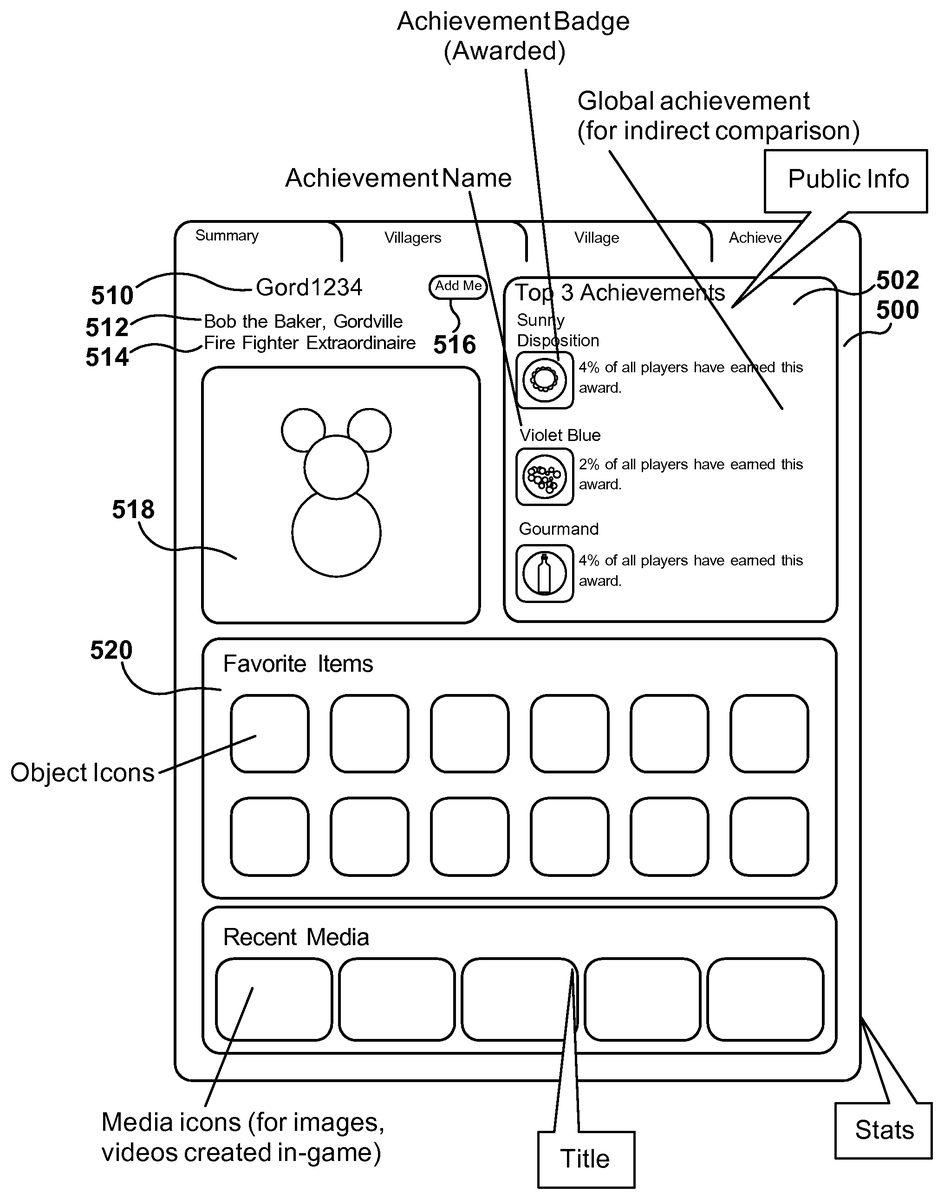
FIG. 5illustrates the public profile of a user and illustrates the different ways in which a user can display his achievements. The public profile500may include a top three achievements page502, where the user can select the achievement badges that she is most proud of. For each of the top three achievements shown, the representative icon, title of the achievement, and global statistics are available to view by a spectator. In this embodiment, they do not show the conditions needed to earn that achievement. For a complete list, players can display all of their achievements on their personal web pages in the social environment.
The public profile500can also show a user's username510, villager name512, and the villager title514. It also includes an “add-a-friend” icon516which requests that the user be added as a friend. It provides a 3-D view of the player's current villager518(e.g., active villager), and also provides a number of object icons representing the user's favorite items520.
Although only a few embodiments have been disclosed in detail above, other embodiments are possible and the inventors intend these to be encompassed within this specification. The specification describes specific examples to accomplish a more general goal that may be accomplished in another way. This disclosure is intended to be exemplary, and the claims are intended to cover any modification or alternative which might be predictable to a person having ordinary skill in the art. For example, other kinds of items can be maintained as items in the achievements, besides the specific items described herein.
Also, the inventors intend that only those claims which use the words “means for” are intended to be interpreted under 35 USC 112, sixth paragraph. Moreover, no limitations from the specification are intended to be read into any claims, unless those limitations are expressly included in the claims. The computers described herein may be any kind of computer, either general purpose, or some specific purpose computer such as a workstation. The computer may be an Intel (e.g., Pentium or Core 2 duo) or AMD based computer, running Windows XP or Linux, or may be a Macintosh computer. The computer may also be a handheld computer, such as a PDA, cellphone, or laptop.
The programs may be written in C or Python, or Java, Brew or any other programming language. The programs may be resident on a storage medium, e.g., magnetic or optical, e.g. the computer hard drive, a removable disk or media such as a memory stick or SD media, wired or wireless network based or Bluetooth based Network Attached Storage (NAS), or other removable medium or other removable medium. The programs may also be run over a network, for example, with a server or other machine sending signals to the local machine, which allows the local machine to carry out the operations described herein.
Where a specific numerical value is mentioned herein, it should be considered that the value may be increased or decreased by 20%, while still staying within the teachings of the present application, unless some different range is specifically mentioned. Where a specified logical sense is used, the opposite logical sense is also intended to be encompassed.
Claims
- A system comprising: a computer, providing output information in a form to be displayed on a display screen, said output information including virtual world information indicative of a virtual world with which a user can interact, said computer controlling registering a number of different virtual characters with which the user can interact in the virtual world, said computer also maintaining information about actions taken by the user, comparing said actions to a sequence of actions that is necessary to obtain an achievement icon, and providing said user with said achievement icon when said user has carried out all of said sequence of actions, and displaying achievement icon information on at least one user information page in the virtual world, where said user information page shows first achievement icons that have been awarded, second achievement icons that have not been awarded but where actions to obtain the achievement award are known, and third achievement icons that have not been awarded but where actions to obtain the achievement award are not known;and where said first achievement icons that have been awarded are shown in a first way, said second achievement icons that have not been awarded but are known are shown in a second way that is distinguishable from the first way, and said third achievement icons that have not been awarded and are not known are shown in the third way different than the first and second ways, wherein said achievement icon that has been awarded includes an achievement card which shows a level of achievement of the user, a numerical count of a number of the user's friends who have earned the same achievement, and said sequence of actions which were taken to earn the achievement.
- A system as in claim 1 , wherein said achievement card also shows a total percentage of all participants in the virtual world who have earned the achievement.
- A system as in claim 1 , wherein said page of achievement icons shows achievement icons that cannot yet be obtained by a user.
- A system as in claim 3 , wherein said page of achievement icons also shows achievement icons that have been started but have not yet been awarded, because the user has not completed the entire sequence of actions but where the user has completed some part of said sequence of actions.
- A system as in claim 4 , wherein said page of achievement icons also shows other achievement icons which have not been started, and where the user is not given information about what will be necessary to complete the other achievement Icons.
- A system as in claim 1 , wherein said virtual characters can be traded in the virtual world, but said achievement icons cannot be traded in the virtual world.
- A system as in claim 1 , wherein said achievement icon is awarded when the user has collected a specified number of virtual objects in the virtual world.
- A method comprising: sending from a server computer system to a client computer over a network, output information in a form to be displayed on a display screen, said output information including virtual world information indicative of a virtual world with which a user can interact;registering, in the server computer system, a number of different virtual characters with which the user can interact in the virtual world;maintaining information about actions taken by the user in the virtual world in the server computer system;comparing said actions to a sequence of actions that is necessary to obtain an achievement icon;and providing said user with said achievement icon as part of said output information when said user has carried out all of said sequence of actions, and displaying said achievement icon on at least one user information page in the virtual world, and where said user information page shows first achievement icons that have been awarded, second achievement icons that have not been awarded but where actions to obtain the achievement award are known, and third achievement icons that have not been awarded but where actions to obtain the achievement award are not known;and where said first achievement icons that have been awarded are shown in a first way, said second achievement icons that have not been awarded but are known are shown in a second way that is distinguishable from the first way, and said third achievement icons that have not been awarded and are not known are shown in the third way different than the first and second way, wherein said achievement icon that has been awarded includes an achievement card which shows a level of achievement of the user, a numerical count of a number of the user's friends who have earned the same achievement, and said sequence of actions which were taken to earn the achievement.
- A method as in claim 8 , wherein said achievement card also shows a total percentage of all participants in the virtual world who have earned the achievement.
- A method as in claim 8 , wherein said page of achievement icons shows achievement icons that cannot yet be obtained by a user.
- A method as in claim 10 , wherein said page of achievement icons also shows achievement icons that have been started but have not yet been awarded, because the user has not completed the entire sequence of actions but where the user has completed some part of said sequence of actions.
- A method as in claim 11 , wherein said page of achievement icons also shows other achievement icons which have not been started, and where the user is not given information about what will be necessary to complete the other achievement icons.
- A method as in claim 8 , further comprising allowing said virtual characters to be traded in the virtual world, but preventing said first achievement icons from being traded in the virtual world.
- A method as in claim 8 , wherein said achievement icon is awarded when the user has collected a specified number of virtual objects in the virtual world.
Disclaimer: Data collected from the USPTO and may be malformed, incomplete, and/or otherwise inaccurate.