U.S. Pat. No. 9,022,868
METHOD AND SYSTEM FOR CREATING A VIRTUAL WORLD WHERE USER-CONTROLLED CHARACTERS INTERACT WITH NON-PLAYER CHARACTERS
AssigneeGanz
Issue DateFebruary 10, 2012
Illustrative Figure
Abstract
A method of providing an interactive virtual environment is provided. The method includes using a computer system to receive registration information, establish an account for a user and associating a virtual character with the account. In response to an interaction between the virtual character and a non-player character in the virtual environment, task information is served over the communication network for presenting the user controlling the virtual character with a request from the non-player character to perform a task. An invitation is received over the communication network inviting at least one additional virtual character to participate in performing the task. In response to receiving an acceptance of the task on behalf of the additional virtual character, task content is served over the communication network to allow both the virtual character and the additional virtual character to take actions to perform the task included in the request.
Description
DETAILED DESCRIPTION OF THE INVENTION Certain terminology is used herein for convenience only and is not to be taken as a limitation on the present invention. Relative language used herein is best understood with reference to the drawings, in which like numerals are used to identify like or similar items. Further, in the drawings, certain features may be shown in somewhat schematic form. It is also to be noted that the phrase “at least one of”, if used herein, followed by a plurality of members herein means one of the members, or a combination of more than one of the members. For example, the phrase “at least one of a first widget and a second widget” means in the present application: the first widget, the second widget, or the first widget and the second widget. Likewise, “at least one of a first widget, a second widget and a third widget” means in the present application: the first widget, the second widget, the third widget, the first widget and the second widget, the first widget and the third widget, the second widget and the third widget, or the first widget and the second widget and the third widget. FIG. 1shows an illustrative embodiment of a computer system10for providing a virtual world in which users can participate, optionally as a team, in an activity. As shown, the computer system10includes at least one, and optionally a plurality of user computers12, each remotely located from one another. For instance, the user computers12can each optionally be located at a different home, in a different geographic location, where different users of the virtual world reside. Each user computer12can be a general purpose computer including a non-transitory computer-readable memory such as a hard disk drive storing computer executable instructions, and a processing component that is operable to ...
DETAILED DESCRIPTION OF THE INVENTION
Certain terminology is used herein for convenience only and is not to be taken as a limitation on the present invention. Relative language used herein is best understood with reference to the drawings, in which like numerals are used to identify like or similar items. Further, in the drawings, certain features may be shown in somewhat schematic form.
It is also to be noted that the phrase “at least one of”, if used herein, followed by a plurality of members herein means one of the members, or a combination of more than one of the members. For example, the phrase “at least one of a first widget and a second widget” means in the present application: the first widget, the second widget, or the first widget and the second widget. Likewise, “at least one of a first widget, a second widget and a third widget” means in the present application: the first widget, the second widget, the third widget, the first widget and the second widget, the first widget and the third widget, the second widget and the third widget, or the first widget and the second widget and the third widget.
FIG. 1shows an illustrative embodiment of a computer system10for providing a virtual world in which users can participate, optionally as a team, in an activity. As shown, the computer system10includes at least one, and optionally a plurality of user computers12, each remotely located from one another. For instance, the user computers12can each optionally be located at a different home, in a different geographic location, where different users of the virtual world reside. Each user computer12can be a general purpose computer including a non-transitory computer-readable memory such as a hard disk drive storing computer executable instructions, and a processing component that is operable to execute the computer-executable instructions. A monitor15or other suitable display device is operable to display the virtual world to the users, and an optional speaker can generate audible output relating to the portions of the virtual world displayed by the monitor15.
The user computers12can communicate with a storage server14and a content server16over a communication network18. Registration server14receives communications transmitted by the user computers12over the communication network18. For instance, the information input by users using the user computers12during the registration process described below is transmitted to the registration server14. White the user computers12the registration server14also includes a processing component and a non-transitory computer readable memory such as a hard disk drive. A database of valid registration codes, an algorithm for identifying a valid registration code, or a combination thereof can be stored by the hard disk drive provided to the registration server14. Computer executable instructions also stored by the hard drive provided to the registration server14are executable by the processing component of the registration server14to evaluate registration information such as a registration code received via the communication network18in determining whether such information is valid.
The content server16is configured to serve content over the vacation network18to be received by the user computers12. The content server16can be a web server, for example, including a processing component that executes computer-executable instructions stored on a hard drive to transmit website content according to the HTTP via the communication network18. Access to the website content, or a portion thereof, provided by the content server16can optionally be restricted, and limited to those who have paid a fee to acquire a registration code that has been successfully validated by the registration server14.
Although the registration server14and the content server16are shown inFIG. 1as separate components forming part of a distributed network, it is to be understood that the registration server14and the content server16can be implemented with a single server terminal, or a plurality of server terminals. The plurality of server terminals can optionally be located at different geographic locations, and optionally designated to service those geographic locations and geographic locations nearby.
An example of the communication network can include a wide area network (“WAN”) such as the Internet, a local area network (“LAN”) such as localized 802.11 wireless communication networks and Ethernet networks, or a combination thereof.
Users can access the virtual world by entering a uniform resource locator (“URL”) into a web browser application running on the user computer12, for example. In response to entering the URL the user computer12can access the content at the network address associated with that URL, can be stored by the memory provided to the content server16. The content server16can serve content over the communication network18required by the user computer12to display the splash screen20appearing inFIG. 2. The splash screen20includes a play option22to be selected by users who are already members of the virtual world to revisit the virtual world. Such users will enter wall began information such as a username and password combination, for example, to access their accounts.
On the other hand, users who wish to join the virtual world can select the join option24. In response to selecting the join option24, the content server16can serve content over the communication network18to allow the user computer12to the display a screen26(FIG. 3) presenting the user the option28to become a full, paid member and the option30to join on a trial basis. To become a paid member, a user is required to enter into the user computer12a registration code or other information purchased by the user. For example, user may have purchased toy such as a stuffed animal, for example, bearing a tag with a secret code printed thereon. Although the user technically purchased the stuffed animal rather than purchasing the code by itself, the secret code is considered to be part of the purchase, and is considered to have been purchased by the user for a fee.
Users who are unsure whether they want to purchase the right to access the virtual world as a paid member, can select the option30to join the virtual world on a trial basis. Users who join on a trial basis can optionally be granted restricted access to the virtual world. Restricted access can include at least one of: gaining access to less than all of the content within the virtual world that is accessible by paid members, and gaining access to the virtual world for a limited period of time, such as 15 days for example.
Whether joining as a paid member or on a trial basis, the user is presented a virtual form35(FIG. 4) transmitted to, and displayed by the user computer12requesting information about the user. The user is prompted to enter login information such as a username in the username field32and the password in the password field34. Upon subsequently returning to the virtual world after the registration process is complete, this login information can be entered by the user to regain access to the virtual world via a user account created on behalf of the user during registration. In addition to the login information, the virtual form35includes background information37about the user such as the user's birthday and gender.
The virtual form35also includes a contact field39in which the user is to enter an e-mail address or other contact information of a parent or other legal custodian. As part of the registration process, an e-mail or other electronic communication will be transmitted by the registration server14to the parent or legal guardian associated with the e-mail address or other contact information. This e-mail or other electronic communication also includes a hyperlink to a website where the parent or legal guardian can enter their approval that the user be granted access to the virtual world. E-mail or other electronic communication can include instructions for confirming the parent's or legal guardian's consent instead of, or in addition to the hyperlink. Until the parent's or legal guardian's consent is received, the user will be granted restricted access to the virtual world.
For those who elect to join as paid members, a code field41will be included as part of the virtual form35. The registration code accompanying the stuffed animal or other information suitable to establish that the user has indeed paid a fee required to gain access to the virtual world as a paid member is to be entered into this code field41. The registration code or other information entered into the code field41is transmitted to the registration server14via the communication network18for validation. Just as for those who elect to join on trial basis, those wishing to join as paid members are also required to submit the e-mail address or other contact information in the contact field39. Even though such users have paid the fee, consent from a parent or other legal guardian is also required prior to gaining full access to all content within the virtual world.
Once the user has registered, either as a paid member or on a trial basis, the user is granted access to control a virtual character44(FIG. 5) in the virtual world. As shown inFIG. 5, content is served from the content server16over the communication network18to be received by the user computer12to present the virtual character44in a home zone46associated with that virtual character44. The home zone46includes a virtual structure such as a home48belonging to the virtual character44in the virtual world. The home zone46also includes an outdoor area such as a yard and optionally a garden belonging to the virtual character44. The home zone46is specific to the virtual character44, that is, the home zone46is not a public area such as a community, or public portion of the virtual world. In other words, only the user controlling the virtual character44and those other users who are invited or otherwise granted permission by the user controlling the virtual character44to visit the home zone46of the virtual character44may do so. According to alternate embodiments, however, the user controlling the virtual character44may elect to allow uninvited guest virtual characters controlled by other users to visit.
The home48can optionally be themed to reflect the appearance of the virtual character44. For instance, the virtual character44can be a virtual hamster. Accordingly, the home48in the home zone46four that virtual hamster can have an appearance that at least somewhat resembles a tube maze commonly constructed for real-life hamsters. The home48can include an interior that is customizable by the user controlling the virtual character44. The user can construct mazes by combining generally tubular maze segments and groom connectors that again have an appearance resembling the tubes and rooms, constructed for real-life hamsters. Other users who are invited to visit the home zone46can be granted access to such mazes within the home48thereby presenting challenges to the user's friends.
In addition to the home zone46, the virtual world includes a plurality of other zones that are publicly accessible by all members of the virtual world.FIG. 6shows an illustrative embodiment of a world map50that can be used by the user to navigate between zones. As shown, the plurality of other zones include a plurality of unrestricted zones52to which users are granted access upon joining the virtual world and without satisfying any other criteria required to gain access to those unrestricted zones52. Additionally a plurality of restricted zones54are included in the virtual world. Each restricted zone54requires the user controlling the virtual character44to satisfy at least one additional criterion is a prerequisite to gaining full access to those restricted zones54. For example, the user may be required to achieve an experience level exceeding the threshold experience level for each of the restricted zones54. According to another embodiment, the user controlling the virtual character44may be required to complete a predetermined task, or complete a collection within the virtual world as a condition to gaining access to a restricted zone54.
The virtual character44can visit each of the other zones in the virtual world that have been unlocked, or otherwise rendered unrestricted. In the unlocked zones the virtual character44will occasionally encounter one or a plurality of different non-player characters (“NPC”)60. Rather than being controlled by a human user in real time by inputting commands via a user computer12at a time when an action by the NPC60is to be carried out, a NPC60is an automated character whose behavior is controlled by the execution of computer-executable instructions transmitted by the content server16, locally residing on the user computer12, or a combination thereof. The computer-executable instructions for each NPC60can be specified by a proprietor of the website comprising virtual world, for example, to establish a desired behavior for those NPC's60.
Each zone within the virtual world can include at least one, and optionally a plurality of different NPCs60. One or more of the NPCs60can optionally be found in two or more zones, and can optionally include an appearance consistent with a theme for a particular zone within the virtual world. For example, one of the zones within the virtual world can have an Arctic theme and an NPC60within that zone can have the appearance of a snowman.
When the virtual character44encounters a NPC60in a public zone64as shown inFIG. 7, an icon62can appear, providing an indication of the NPC's identity. The user can use an input peripheral provided to the user computer12, such as a conventional mouse for example, to select the icon62and initiate an interaction with the NPC60. Each interaction of the virtual character44with a particular NPC60is recorded in the user account to which the virtual character44is registered. The quantity and optionally the type (e.g., simply communicating with the NPC60, giving a gift to the NPC60, or honoring a request from the NPC60, etc . . . ) of the interactions affect a relationship level between that particular NPC60and the virtual character44. Additionally, other factors such as the manner in which a task is performed can serve to improve the relationship level between the virtual character44and the NPC60that assigned the task. For instance, the NPC's reaction to the completion of a task can vary depending on how the task is performed. For example, unbeknownst to the virtual character44(and possibly at least one additional virtual character as explained below) participating in a collection task during which jewels are to be collected, finding and collecting several pink jewels with the virtual character44will elicit a stronger reaction by the NPC60than finding and collecting green jewels. Finding and collecting the pink jewels can also improve the relationship level between the virtual character44and the NPC60to a greater extent than finding and collecting green jewels. The participants will learn of the NPC's preference at the conclusion of the task when the NPC60issues a reaction to the performance of the task. For example, a communication from the NPC60can include a comment praising the collection of pink jewels instead of green jewels, allowing the participants to get to know the NPC60that assigned the task. By learning to please the NPC, such as by collecting pink jewels, the participant can optionally receive prizes of greater value than if the participant collects all green jewels. But since the value of the different jewels is initially unknown, this allows the participants the opportunity to get to know the NPC. The relationship level is a measure of how familiar that particular NPC60and the virtual character44are with each other, and can affect the content of the communications as well as the tasks offered by the NPC60to the virtual character44. The NPC60may also exhibit varying degrees of behavior (e.g., animation, reactions to the completion of a task, etc . . . ) when interacting with the virtual character44based on the relationship level72.
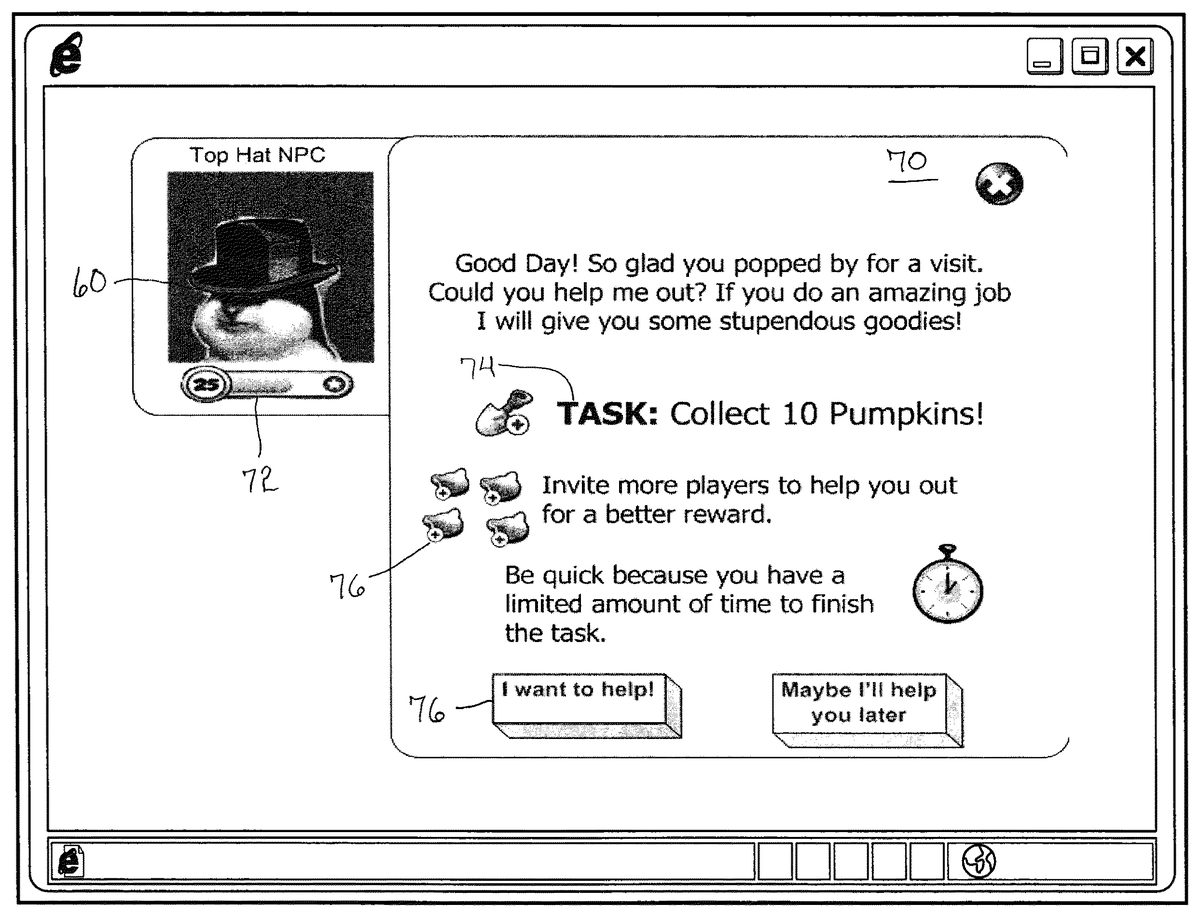
In response to the user selecting the icon62, the content server16serves content that is to be displayed to the user via the user computer12as a communication from the NPC60to the virtual character44. The communications from the NPC60can include a task assigned to the virtual character44.FIG. 8shows an illustrative embodiment of a communication window70displayed to the user by the user computer12, including the content specified by the information served by the content server16. In addition to the content of the communication, the communication window also includes a scale72or other suitable display indicating the relationship level between the virtual character44and the particular NPC60encountered by the virtual character44.
According to the present embodiment, the content of the communication window70presents the user with a task74. For this example, the task74is a scavenger hunt, requiring the user to move the virtual character44throughout the zone64and collect 10 pumpkins hidden throughout the zone64in which the virtual character44encountered the NPC60. The user can elect to perform the task requested by the NPC alone by simply selecting a button76to initiate performance of the task74. Upon selecting the button76the communication window70will close and the virtual character44will once again be displayed within the zone64, where the virtual character44will move about in search of the pumpkins
The virtual character44is given a predetermined time limit to complete the task and can collect each pumpkin simply by running into them as they are located. The time limit afforded for completion of the task can vary depending upon the experience level of the virtual character44, the relationship level72between the virtual character44in the NPC60that assigned the task, or a combination thereof. For example, a virtual character44that has been registered in the virtual world for a significant period of time has a high experience level, and will be afforded less time than a novice to perform the task74. Likewise, the virtual character44having the relationship level72shown inFIG. 8will be given less time to perform the task than another virtual character having a lower relationship level.
According to alternate embodiments, the task74assigned by the NPC60can optionally vary depending upon the relationship level72. For instance, the task74to collect 10 pumpkins may be assigned to the virtual character44having the relationship level72as shown inFIG. 8. In contrast, another virtual character having a lesser relationship level72than that shown inFIG. 8maybe requested to collect five pumpkins instead, or may be requested to perform a “lesser” task for which a smaller prize than that awarded for collecting pumpkins is awarded if the task is successfully completed. Alternately, the other virtual character having the lesser relationship level may be assigned a completely different task74such as to compete in a race against the NPC60. Generally speaking however, the lesser the relationship level72the easier the task74assigned by the NPC60, and optionally the lesser the potential value of the prize to be awarded for successfully completing the task. Likewise, the greater the relationship level72, the more difficult the task75is assigned by the NPC60, and the greater potential for reward. Further, to keep the virtual world interesting, there may be a plurality of tasks74available to be assigned to the virtual character44for different ranges of the relationship level72and/or experience level. The content server16can serve content via the communication network18to allow the NPC60to randomly assign one of the plurality of tasks available for a given relationship level72to the virtual character44. Thus, encountering the same NPC60with the virtual character44more than once with substantially the same relationship level72can result in a different task74being presented to the virtual character44each time. However, a recovery period during which the virtual character44can not encounter the NPC60to perform another task follows successful completion of the task74. The user must wait until the recovery period expires before re-encountering that NPC60to perform another task and thereby earn a prize as a reward for successfully completing the task and bolstering the relationship level72.
Rather than performing the task74alone, the user can select an invite icon76to invite one or more other users registered in the virtual world to take part in the performance of the task74. The user can invite more than one other user, but the number of other users that can be invited can optionally be capped, such as four or fewer. The user controlling the virtual character44that approached the NPC60can invite other users in a variety of different ways. For example, as shown inFIG. 9, another virtual character45within a predetermined proximity of the NPC60approached by the virtual character44can be selected by the user controlling the virtual character44using a mouse or other suitable computer input peripheral connected to the user computer12. Only those virtual characters45within a predetermined distance of the NPC60and/or virtual character44are visible to the user control in the virtual character44. Other virtual characters outside of this distance are not displayed by the user computer12. The other virtual character45can be controlled by a user unknown to the user controlling the virtual character44. According to alternate embodiments, the user controlling the virtual character44can access a list of other registered users in the virtual world known to the user controlling the virtual character44by selecting an icon47. The list can be assembled by extending invitations to become friends to other users in the virtual world, by participating in a task74with another user in the virtual world, or any other desired manner.
In addition to the relationship level72, the number of participants will affect at least one of: the task assigned, the goal of the task, the time afforded for completion of the task, the difficulty of the task, and the prize to be awarded for completion of the task. For example, Table 1 relates the number of participants for a task74to the goal (i.e., the number of objects that must be collected to successfully complete the task) of the task74. According to an embodiment, a sole participant must collect only 10 objects (e.g., pumpkins) Two participants must collect a total of 25 objects between them within the time allotted. Three participants must collect a total of 40 objects between them within the time allotted, and so on.
TABLE 1# of players# of objects to collect110225340455570685
For tasks74involving multiple participants, each participant can optionally be required to contribute a certain amount to each task74. For example, each of three participants in a task requiring collection of 40 pumpkins may be required to collect a minimum of five objects in order for the task74to be successfully completed. If each participant succeeds in collecting more than five objects in performing the task74each participant will be awarded a prize for completing that task74. If, however, one of the three participants fails to collect at least five objects, the two participants who found at least their minimum requirement of five objects will be awarded a prize but the participant who failed to do so will not be awarded a prize. In such a circumstance, the total prize pool can be split two ways instead of three, or two thirds of the prize pool originally offered for completion of the task74can be awarded to the two who satisfied their quota. Alternate embodiments can optionally withhold a prize from all participants if at least one of the participants fails to find the minimum number of objects.
According to another embodiment, the time afforded for completion of the task74involving multiple participants can be greater than the time afforded for completion of the task74involving a sole participant. Table 2 shows how the time allotment for a task74can be scaled based on the number of participants. According to the present example, a solo participant required to collect 10 objects is afforded 2 min. to complete the task74. Two participants, however, are required to collect 25 objects and are afforded 2 min. and 30 sec. to complete the task74. Just as in other embodiments, each participant may be required to contribute a predetermined minimum amount towards completion of the task74, and the prize awarded for successfully completing the task74can optionally be scaled based on the number of participants, the number of participants who satisfied their quota, or a combination thereof.
TABLE 2# of players# of objects to collectTime Limit1102 mins2252 mins 30 secs3403 mins4554 mins 30 secs5705 mins6855 mins 30 secs
Table 3 provides an example of how prizes can be scaled based on the number of participants performing a task74. As shown, a single participant can expect to earn 0 to 15 points for successfully completing the task74. Two participants can expect to earn a total of 15 to 30 points between them for successfully completing the task74. The total prize to be awarded to the participants can optionally be based on 100 point scale, with each participant adding approximately 20 points to the total prize pool.
TABLE 3Number of PlayersPrize Value Range1 Player0-152 Player15-303 Player30-454 Player45-605 Player60-756 Player75-100
Regardless of how the prize is broken down, each point awarded can represent at least one of: an amount of virtual currency (i.e., not legal tender, but a monetary representation redeemable in the virtual world), a contribution toward the relationship level with the NPC60that assigned task74, a contribution toward the experience level of the virtual character44, and a virtual object to be used by the virtual character44in the virtual world.
According to alternate embodiments, one or more virtual characters44performing a task74can optionally compete against the NPC60, and optionally one or more additional NPCs, such as in a race, for example. The number of NPCs competing may be scaled based on the number of user participants, and more NPC's can be entered in the race than need to beaten to successfully complete the task74(e.g., if at least two NPCs must be beaten, there can be three NPCs entered). And again, a minimum number NPCs that must be beaten for the task to be considered successfully completed can also optionally be scaled. The prize can also be split based on how the participants place relative to each other and/or the NPCs. Table 4 illustrates how the number of participants can affect such a task74.
TABLE 4# of Players# of NPC's to raceTime LimitHow you win1 Players12 minutesBeat 1 NPC2 Players22.5 minutesBeat at least oneNPC. User whocomes in firstgets greaterprize thansecond user.3 Players33 minutesBeat at least twoNPC's. User whocomes in firstgets greaterprize. Otherusers get thesame value prize4 Players43.5 minutesBeat at leastthree NPC's.User who comesin first gets agreater prize.The others getthe same valueprize.5 Players64 minutesBeat at leastthree NPC's.User who comesin first gets theprize. The othersget the samevalue prize.6 Players74.5 minutesBeat at leastthree NPC's.User who comesin first gets theprize. The othersget the samevalue prize.
For any of the multiple-participant tasks, content can be transmitted by the content server16to the user computer12indicating the performance of each participant relative to at least one other participant. For example,FIG. 10shows an illustrative embodiment of a graphical scale80indicating that a first user has collected approximately half of the minimum quota to be collected by that user. Likewise the scale82indicates that a second user has collected approximately ¾ (75%) of the minimum quota of objects to be collected by the user to successfully complete the task74. The scales80,82can optionally be served to be visible to each user participating in the task74to give each user an idea of whether they are on pace to successfully complete the task74or not.
Illustrative embodiments have been described, hereinabove. It will be apparent to those skilled in the art that the above devices and methods may incorporate changes and modifications without departing from the general scope of this invention. It is intended to include all such modifications and alterations within the scope of the present invention. Furthermore, to the extent that the term “includes” is used in either the detailed description or the claims, such term is intended to be inclusive in a manner similar to the term “comprising” as “comprising” is interpreted when employed as a transitional word in a claim.
Claims
- A method of providing an interactive virtual environment, the method comprising: with a computer system, receiving registration information and establishing an account for a user;the computer system associating a virtual character with the account and transmitting character content over a communication network for moving the virtual character in the virtual environment in response to control commands input by the user;transmitting NPC content over the communication network for providing a non-player character in the virtual world, where said non player character is controlled by said computer system and not by the user in the virtual world;receiving a request over the communication network to interact the virtual character with the non-player character in the virtual world;in response to an interaction between the virtual character and the non-player character, serving task information over the communication network for presenting the user controlling the virtual character with a request from the non-player character to perform a task, and transmitting content to present the user with an invitation tool that is selectable by the user after being presented with the task to extend an invitation to an additional virtual character controlled by another user to participate in performance of the task presented to the user;receiving the invitation over the communication network inviting the additional virtual character to participate in performing the task presented to the user controlling the virtual character;in response to receiving an acceptance of said invitation to participate in the performance of the task on behalf of said additional virtual character, serving task content over the communication network to allow both the virtual character and the additional virtual character to take actions to perform the task included in the request;and establishing a value for a variable parameter of the task after receiving said acceptance of the invitation, said value being specific to a number of virtual characters controlled by different users that have accepted an invitation to participate in performance of the task and where said value is established by selecting one of multiple different values available to be selected as the variable parameter for the task presented to the user.
- The method of claim 1 , wherein the registration information comprises a code accompanying a toy purchased for the user, and the virtual character comprises an appearance that resembles the toy.
- The method of claim 1 further comprising limiting a number of invitees that can receive the invitation to participate in performing the task to less than a predetermined threshold.
- The method of claim 3 , wherein the predetermined threshold is 4 invitees.
- The method of claim 1 , wherein said establishing the value for the variable parameter comprises establishing a time limit among multiple different time limits for performing the task.
- The method of claim 5 , wherein the time limit for performing the task with a plurality of the virtual characters controlled by different users is longer than the time limit for performing the task with just the virtual character controlled by the user.
- The method of claim 1 further comprising transmitting prize scaling information over the communication network for establishing a prize pool that is to be distributed to the virtual character and the additional virtual character in response to successful completion of the task, wherein a value of the prize pool is determined based at least in part on the number of virtual characters controlled by different users that participate in performing the task.
- The method of claim 7 , wherein the prize pool is divided equally among each of the virtual characters controlled by different users that participate in performing the task.
- The method of claim 7 , wherein the prize pool is pro-rated among each of the virtual characters controlled by different users that participate in performing the task based at least in part on a result of each an effort expended by each one of the virtual characters controlled by different users in performing the task.
- The method of claim 1 further comprising: transmitting quota information over the communication network for establishing a of each of the virtual character and the additional virtual character toward successful completion of the task for the task to be considered successfully completed;and transmitting result information over the communication network indicating whether each of the virtual character and the additional virtual character satisfied the minimum contribution.
- The method of claim 10 further comprising, in response to a failure of at least one of the virtual character and the additional virtual character to satisfy the minimum contribution, awarding a prize to another one of the virtual character and the additional virtual character that satisfied the minimum contribution without awarding the prize to the at least one of the virtual character and the additional virtual character that failed to satisfy the minimum contribution.
- The method of claim 10 further comprising, in response to a failure of at least one of the virtual character and the additional virtual character to satisfy the minimum contribution, withholding a prize from both the virtual character and the additional virtual character.
- The method of claim 1 , wherein the task comprises a challenge involving a competition where at least one of the non-player character and a second non-player character competes against at least one of the virtual character and the additional virtual character.
- The method of claim 1 further comprising maintaining a relationship level between the virtual character and the non-player character, wherein the relationship level is based on at least one of: a quantity of interactions between the virtual character and the non-player character, a type of each interaction between the virtual character and the non-player character;and a performance, by the virtual character, of a task assigned by the non-player character.
- The method of claim 14 , wherein the relationship level is based at least in part on the performance, by the virtual character, of the task assigned by the non-player character, and the performance of the task comprises a collecting a preferred object within the virtual environment instead of another object.
- A method of providing an interactive virtual environment, the method comprising: with a computer system, receiving registration information and establishing an account for a user;the computer system associating a virtual character with the account and transmitting character content over a communication network for moving the virtual character in the virtual environment in response to control commands input by a user;transmitting NPC content over the communication network for providing a non-player character in the virtual world, where said non player character is controlled by said computer system and not by the user in the virtual world;receiving a request over the communication network to interact the virtual character with the non-player character in the virtual world;in response to an interaction between the virtual character and the non-player character, serving task information over the communication network for presenting the user controlling the virtual character with a request from the non-player character to perform a task;receiving an invitation over the communication network inviting an additional virtual character to participate in performing the task;in response to receiving an acceptance of said task on behalf of said additional virtual character, serving task content over the communication network to allow both the virtual character and the additional virtual character to take actions to perform the task included in the request;and transmitting goal scaling information over the communication network for establishing a goal that is to be accomplished by the virtual character and the additional virtual character for successful completion of the task, wherein the goal for the task is variable and scaled according to the goal scaling information based at least in part on a number of participants that participate in performing the task.
Disclaimer: Data collected from the USPTO and may be malformed, incomplete, and/or otherwise inaccurate.