U.S. Pat. No. 9,013,408
GAME CONTROLLER WITH CLICKABLE TRACKBALL
AssigneeRazer (Asia-Pacific) Pte. Ltd.
Issue DateDecember 30, 2009
Illustrative Figure
Abstract
An improved user input device is disclosed whereby the device is equipped with a trackball in addition to other control devices, such as an analog stick controller (e.g., thumbstick or joystick). The trackball is mounted in such a way that it projects both upwardly and downwardly from the device body in the vertical plane. The user is able to touch and use the trackball from both the upper and lower directions. In a preferred embodiment, the trackball is clickable, affording greater control and ease of use.
Description
While the invention is susceptible to various modifications and alternative forms, specific embodiments have been shown by way of example in the drawings and will be described in detail herein. It should be understood, however, that the invention is not intended to be limited to the particular forms disclosed. Rather, the invention is to cover all modifications, equivalents, and alternatives falling within the spirit and scope of the invention as defined by the appended claims. DESCRIPTION OF PREFERRED EMBODIMENTS As summarized above, embodiments of the invention provide a computer input device such as a gamepad having advantageous control and ergonomic benefits. With the invention, a user can enjoy the benefits and advantages of a joystick-type controller and an integrated trackball. FIG. 2demonstrates a principal embodiment of the invention. A controller1integrates a conventional thumbstick2and a trackball3. For example, when playing an FPS game, a character's displacement may be controlled via the left thumbstick, and viewpoint is controlled by a right trackball. As will be readily understood by a person of skill in the art, however, other possible permutations pertaining to using a trackball fall within the scope of the invention (e.g., left trackball, right thumbstick/right trackball, left digital pad or digital buttons, etc.). FIG. 3illustrates a side view of the embodiment shown inFIG. 2. As shown inFIG. 3, an ergonomic design in a game controller meant to be held in one or both hands, independent of any supporting surface, where the trackball3can be manipulated from both the top and bottom of the controller while still using the hand to support the controller. Referring toFIG. 3, the trackball3may be accessed from above (in the example shown, by the thumb of the right hand of user4) or below (typically by the fingers of the right hand of user4). This provides flexibility to the ...
While the invention is susceptible to various modifications and alternative forms, specific embodiments have been shown by way of example in the drawings and will be described in detail herein. It should be understood, however, that the invention is not intended to be limited to the particular forms disclosed. Rather, the invention is to cover all modifications, equivalents, and alternatives falling within the spirit and scope of the invention as defined by the appended claims.
DESCRIPTION OF PREFERRED EMBODIMENTS
As summarized above, embodiments of the invention provide a computer input device such as a gamepad having advantageous control and ergonomic benefits. With the invention, a user can enjoy the benefits and advantages of a joystick-type controller and an integrated trackball.
FIG. 2demonstrates a principal embodiment of the invention. A controller1integrates a conventional thumbstick2and a trackball3. For example, when playing an FPS game, a character's displacement may be controlled via the left thumbstick, and viewpoint is controlled by a right trackball. As will be readily understood by a person of skill in the art, however, other possible permutations pertaining to using a trackball fall within the scope of the invention (e.g., left trackball, right thumbstick/right trackball, left digital pad or digital buttons, etc.).
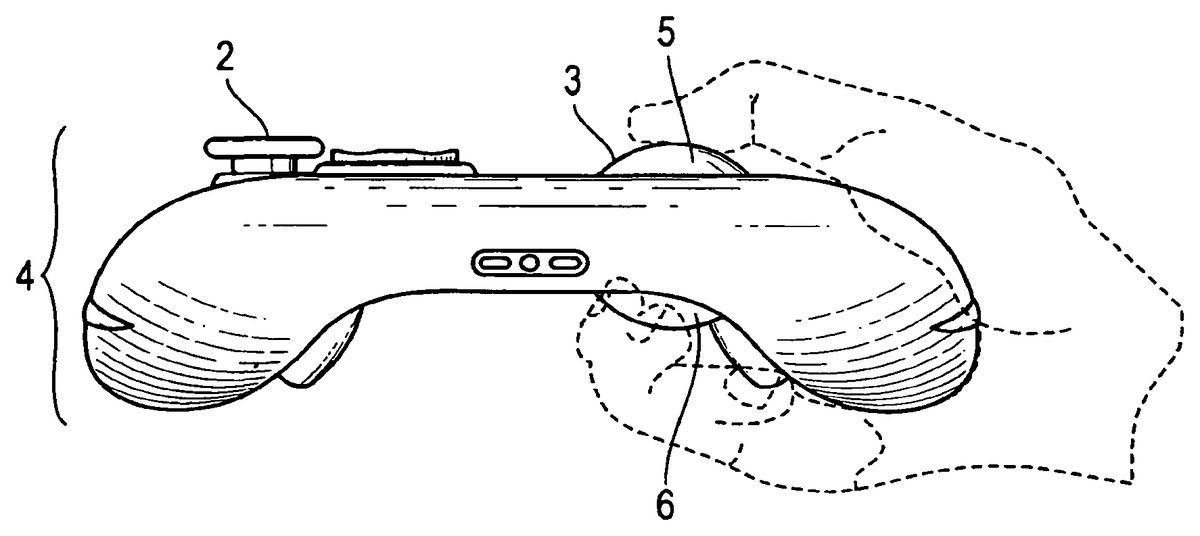
FIG. 3illustrates a side view of the embodiment shown inFIG. 2. As shown inFIG. 3, an ergonomic design in a game controller meant to be held in one or both hands, independent of any supporting surface, where the trackball3can be manipulated from both the top and bottom of the controller while still using the hand to support the controller. Referring toFIG. 3, the trackball3may be accessed from above (in the example shown, by the thumb of the right hand of user4) or below (typically by the fingers of the right hand of user4). This provides flexibility to the user's preference to use either or both of these options when desired. This assists greatly in fine degree control as well as speed, since a user in this case can use three or more fingers to rapidly manipulate the trackball3while still maintaining a firm grip on the controller (as well as possibly using his fingers to actuate other buttons). A user in this case may be able to more rapidly turn the ball than if just using the thumb, and he will also be able to exercise greater fine degree control by using his fingers and thumb to arrest, brake or reverse the trackball motion as needed.
The trackball3can thus approximate the typical FPS function of the mouse in a PC environment. If a user4moves a trackball3a specific distance, for example, the character's point of view can change the specific corresponding degree. This approach thus resolves issues of accuracy associated with joystick-type controllers, while maintaining compactness and integration in a single handheld controller.
The system and method also encompasses devices that may cause the trackball3to emulate the function of an analog/digital stick (which would be desirable to maintain compatibility with games only designed to operate with the older method of controlling viewpoint), since this ergonomic design and use of a trackball still provides advantages over a two analog/digital joystick configuration, although the benefit would not be as great as described above.
In an alternative embodiment depicted inFIG. 4, the middle section of the trackball can be attached to the game controller through an assembly of coupling and hinge assembly10, providing the ability to “click” the trackball much like a computer mouse button. The trackball3is exposed on both the upper5and lower6surfaces so that it can be manipulated by the user4with fingers either above or below the game controller, in the downward7and upward8directions, respectively. Within the controller itself, there are optical/laser tracking sensors to monitor the movement of the trackball3. The clicking mechanism will be discussed in connection withFIG. 5.
As shown inFIG. 5, the coupling and hinge assembly9can be comprised of upper11and lower12subassemblies. Upper subassembly11comprises actuator13and upper tact switch14. Lower/bottom subassembly12comprises optical/laser tracking systems15,17and a lower tact switch16. So mounted, the trackball3can be actuated by pressing or clicking it downwards (when the fingers are placed on top) and/or by pressing or clicking upwards (when the fingers are placed below). The actuation of the trackball clicking can be detected by at least one tact switch (14,16) within the controller and in contact with the trackball3. These tact switches (14,16) are able to detect the movement of the trackball3or specifically, the clicking action of the trackball3, from both directions (upwards and downwards) and send a signal to the game or game console to perform certain prescribed functions.
In a preferred embodiment, the trackball3may also be actuated by pressing on it (either upwards8or downwards7) more than one time quickly in succession (e.g., a double-clicking action), which may actuate, for example, a different command in the game or game console.
Note that aspects of the above invention can be beneficially applied to other user input devices, including rumble pads, control pads and joypads. Thus, while the present invention has been described with reference to one or more particular embodiments, those skilled in the art will recognize that many changes may be made thereto without departing from the spirit and scope of the present invention. Each of these embodiments and obvious variations thereof is contemplated as falling within the spirit and scope of the claimed invention, which is set forth in the following claims.
Claims
- A computer controller comprising: a device body;and a trackball for providing a first signal and a second signal, said trackball having upper, middle and lower portions, said trackball rotatably mounted to said device body with a coupling assembly in contact with said middle portion of said trackball, said coupling assembly comprising an upper subassembly and a lower subassembly;wherein the first signal is provided by a tracking system communicatively coupled to said lower subassembly;wherein said first signal is enabled upon selective rotation of one of said upper and lower portions of said trackball: wherein said second signal is provided by one of a first switch situated at the upper subassembly and a second switch located at the lower subassembly;and wherein said second signal is enabled upon a depression of one of said upper and lower portions of said trackball.
- The computer controller of claim 1 , wherein said first switch and said second switch is a tact switch communicatively coupled to said trackball, whereby said tact switch is activated upon the depression of one of said upper and lower portions of the trackball.
- The computer controller of claim 1 , wherein said computer controller is a gamepad.
- The computer controller of claim 1 , further comprising a stick controller located on a left side of said device body, wherein said trackball is located on a right side of said device body.
- The computer controller of claim 4 , wherein said stick controller is a joystick.
- The computer controller of claim 4 , wherein said stick controller is a thumbstick.
- The computer controller of claim 1 , wherein said tracking system comprises a laser optical tracking system and an optical tracking system.
- The computer controller of claim 1 , wherein said coupling assembly further comprises an actuator.
- The computer controller of claim 1 , wherein said computer controller is a d-pad.
- A computer controller comprising: a device body: and a clickable trackball for providing a first signal and a second signal, said trackball having upper, middle and lower portions, said trackball rotably mounted to said device body with a coupling assembly in contact with said middle portion of said trackball, thereby leaving said upper and lower portions exposed for selective rotation by a user, said coupling assembly comprising an upper subassembly and a lower subassembly;wherein said first signal is provided by a tracking system communicatively coupled to said lower subassembly;wherein said first signal is enabled upon selective rotation of one of said upper and lower portions of the trackball;wherein said second signal is provided by one of a first switch situated at the upper subassembly and a second switch located at the lower subassembly;wherein said second signal is enabled upon a depression of one of said upper and lower portions of the trackball;and wherein said upper and lower portions of the trackball are independently operable from each other.
- The computer controller of claim 10 , wherein said trackball emulates a digital and analog stick.
- The computer controller of claim 10 , wherein said tracking system comprises two optical tracking systems.
- The computer controller of claim 10 , wherein said first switch and said second switch comprises a tact switch communicatively coupled to said trackball, whereby said tact switch is activated upon the depression of one of said upper and lower portions of the trackball.
- The computer controller of claim 10 , wherein said computer controller is a gamepad.
- The computer controller of claim 10 further comprising a joystick.
- The computer controller of claim 15 , wherein said joystick is located on a left side of said device body, and said trackball is located on a right side of said device body.
- The computer controller of claim 10 , further comprising a thumbstick.
- The computer controller of claim 12 , wherein said computer controller is a d-pad.
- The computer controller of claim 10 , wherein said tracking system is a laser tracking system.
Disclaimer: Data collected from the USPTO and may be malformed, incomplete, and/or otherwise inaccurate.