U.S. Pat. No. 9,004,998
SOCIAL INTERACTION DURING ONLINE GAMING
AssigneeEmpire Technology Development LLC
Issue DateNovember 2, 2012
Illustrative Figure
Abstract
Technology is described for enabling social interaction during online gaming. In some examples, the technology can include receiving from a remote device a movement signal indicating an actual movement of a human sports player during a real sporting event in which the human sports player is participating; receiving from a local control device a control signal from a user, wherein the control signal indicates input to a simulation; comparing the received movement signal with the received control signal; computing based on the comparison a score to award to the user; and awarding the computed score to the user.
Description
DETAILED DESCRIPTION In the following detailed description, reference is made to the accompanying drawings, which form a part hereof. In the drawings, similar symbols typically identify similar components, unless context dictates otherwise. The illustrative embodiments described in the detailed description, drawings, and claims are not meant to be limiting. Other embodiments may be utilized, and other changes may be made, without departing from the scope of the subject matter presented herein. It will be readily understood that the aspects of the present disclosure, as generally described herein, and illustrated in the Figures, can be arranged, substituted, combined, separated, and designed in a wide variety of different configurations, all of which are explicitly contemplated herein. Technology is disclosed for enabling social interaction while participating in online gaming (“the technology”). In various embodiments, the technology enables a user (e.g., a video game player or passive user) to be virtually placed in the milieu of a real event, e.g., a real sporting event. The technology can enable users, e.g., video game players who are playing multiplayer video games, to interact with other users and even real sports players (also “sports players”) participating in the real sporting event. Thus, the technology enables video game players to pit their “avatars” against real sports players in the real sports players' sports. In various embodiments, the technology can enable one or more video game players to participate using a video game console, e.g., by viewing output on a television or projection screen and providing input via a video game controller. The technology may compare input provided by a video game player to inputs measured or observed of a real sports player, and compute a score based on the comparison. The technology may then award points based on how close the video game player's inputs are to the ...
DETAILED DESCRIPTION
In the following detailed description, reference is made to the accompanying drawings, which form a part hereof. In the drawings, similar symbols typically identify similar components, unless context dictates otherwise. The illustrative embodiments described in the detailed description, drawings, and claims are not meant to be limiting. Other embodiments may be utilized, and other changes may be made, without departing from the scope of the subject matter presented herein. It will be readily understood that the aspects of the present disclosure, as generally described herein, and illustrated in the Figures, can be arranged, substituted, combined, separated, and designed in a wide variety of different configurations, all of which are explicitly contemplated herein.
Technology is disclosed for enabling social interaction while participating in online gaming (“the technology”). In various embodiments, the technology enables a user (e.g., a video game player or passive user) to be virtually placed in the milieu of a real event, e.g., a real sporting event. The technology can enable users, e.g., video game players who are playing multiplayer video games, to interact with other users and even real sports players (also “sports players”) participating in the real sporting event. Thus, the technology enables video game players to pit their “avatars” against real sports players in the real sports players' sports. In various embodiments, the technology can enable one or more video game players to participate using a video game console, e.g., by viewing output on a television or projection screen and providing input via a video game controller. The technology may compare input provided by a video game player to inputs measured or observed of a real sports player, and compute a score based on the comparison. The technology may then award points based on how close the video game player's inputs are to the real sports player's inputs. The technology can also enable the video game player to observe what the real sports player observes, e.g., by viewing signals from one or more image capture devices (e.g., cameras, video cameras, three-dimensional cameras) situated near the real sports player. As an example, the technology may be used in car racing. In this example, one or more sensors may sense inputs of a race car driver (who is the real sports player in this example), e.g., steering wheel inputs, brake inputs, accelerator inputs, gear changer inputs, etc.; and compare a video game player's inputs at a video game controller.
The technology may simulate various aspects of the real sports player's physical experience, e.g., so that the video game player can also view and indeed feel almost everything the race car driver does. The simulation may include one or more projection screens, video monitors, three-dimensional displays, vibration devices, and/or other output devices. The technology may select various devices near the real sports player from which to receive inputs for the simulation, e.g., cameras, vibration detectors, motion sensors, microelectromechanical systems (MEMS), global positioning systems, etc.
In various embodiments, a video game player may sign up to play online. The video game player may select a set of real sports players to be measured against. As an example, the video game player may select two sports players. If inputs from a first of the sports players can no longer be received (e.g., because of a communications failure or the first sports player is no longer competing), the technology may select a second (e.g., backup) sports player. The technology may also adjust the accumulated points or scores if the second player is selected, e.g., to account for differences in performance of the two sports players.
The technology may also adjust the accumulated points or scores based on inputs. As an example, if the video game player's inputs are nearly identical to the selected sports player's inputs, additional points may be awarded. The more disparity there is between the video game players inputs and the real sports player's inputs, fewer points are awarded. If the video game player makes a move that would lead to a negative outcome (e.g., a car crash or spinout), points may be deducted.
During the sporting event, the technology can collect and broadcast inputs from real sports players in nearly real time. As an example, a device proximate to the real sports player can collect inputs, e.g., from various sensors, cameras, etc., and broadcast the collected inputs to the simulators employed by the video game players. The simulators, in turn, may compare the inputs of the video game players to the broadcast inputs, and provide this information to a server for computation of scores, comparison of the scores with scores for other players, awarding prizes based on the scores, etc.
In various embodiments, the technology may enable players using various computing devices (e.g., full motion simulators, personal computing devices, tablet computing devices, handheld computing devices, etc.) to participate, and may adjust scores to account for the different devices. As an example, a video game player using a handheld computing device may be disadvantaged by not being able to fully view camera inputs because that player cannot anticipate upcoming changes in road conditions or course layouts as well as a player using a full motion simulator and projection system.
In various embodiments, spectators viewing the sporting event—whether live or remotely—may also employ aspects of the technology without playing a video game. As an example, spectators may select various camera angles, receive vibration simulations, etc. They may employ some aspects even while seated as a spectator at a live event.
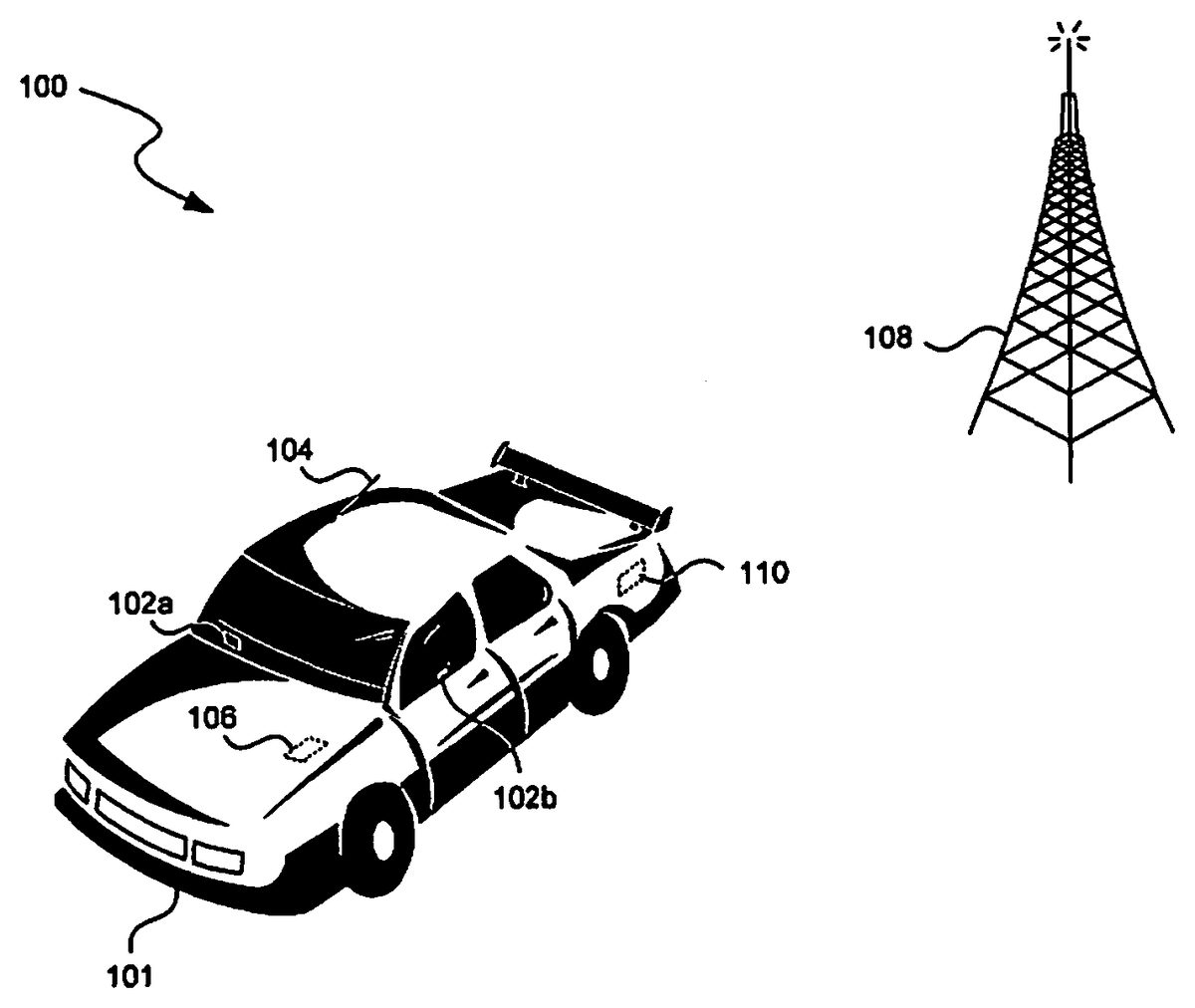
Turning now to the figures,FIG. 1is an environmental diagram illustrating an environment100in which the technology may operate in some embodiments. The environment100can include a sports apparatus, e.g., a sports car101. The sports apparatus can be an apparatus that a sports player may use during a sporting event. Other examples of sports apparatuses are bats, balls, rackets, clubs, or indeed any sports paraphernalia. The sports car101can include a front camera102aand a side camera102bthat can approximate what the real sports player (e.g., a race car driver) views. Other cameras (e.g., rear facing, etc.) may also be employed. The sports car101may also include an antenna104, e.g., to communicate information from the sports car101to a user's video game console (not illustrated), e.g., via an antenna108. The sports car101may include sensors, e.g., sensors106and110to observe the sports player's movements, the sports apparatus's movements, proximity to other devices or equipment, etc. These movements and other information can be communicated to the user's video game console.
FIG. 2is an environmental diagram illustrating an environment200in which the technology may operate in some embodiments. The environment200can include a console or set-top box204(e.g., a video game console), display device206(e.g., a projector, monitor, television, etc.) and a controller208(e.g., a video game controller). A user202(e.g., a video game player) may operate the video game controller208to interact with a simulation, e.g., a video game that is simulated by the console204. The user202can provide input to the simulation via the controller208, a microphone (not illustrated), or by using other input devices. Output from the simulation can be visually indicated in the display206, provided via a tactile response on the controller208, and/or provided aurally using speakers (not shown). In various embodiments, various types of input and output can be employed. As an example, the user202may occupy a specially designed seat or other enclosure (not illustrated) that provides various types of simulated feedback. In various embodiments, various input and output devices may be employed. These can include keyboards, joysticks, mouse, handheld or other game controllers, balls, etc. The input devices may be general purpose or specific to a particular sport.
In various embodiments, the user202may employ a full motion simulator, surround screen (e.g., a panoramic display), etc. As an example, the full motion simulator may be in the shape of a race car.
FIG. 3is a block diagram illustrating components300employed by the technology in various embodiments. The components300can include a network302, e.g., the Internet or an intranet, that enables one or more computing devices, e.g., a first game console304a, a second game console304b, and a server306, to exchange communications with one another. As an example, the game consoles304aand304bmay receive communications from the server306to indicate information collected from sensors proximate to a sports player.
FIG. 4is a flow diagram illustrating a routine400that the technology may invoke in various embodiments, e.g., to compute scores based on a comparison between a video game player's movements (e.g., inputs) and a sports player's movements (e.g., inputs). The routine400begins at block402. The routine then continues at block404, where it receives a movement signal indicating movement of a sports player during a sporting event. As an example, the routine may receive input from various sensors proximate to the sports player, e.g., MEMS sensors, that are broadcast to video game consoles. The routine then continues at block406, where it receives a control signal from a user using a simulator, e.g., executing at a video game console. As an example, the routine may receive inputs from a game controller that the user employs. The routine then continues at block408, where it compares the received movement signal to the received control signal. The routine then continues at block410, where it computes a score based on the comparison. The routine then continues at block412, where it awards the computed score to the user. The routine then continues at block414, where it activates a motion simulator. The routine then continues at block416, where it returns.
Those skilled in the art will appreciate that the logic illustrated inFIG. 4and described above, and in each of the flow diagrams discussed below, may be altered in a variety of ways. For example, the order of the logic may be rearranged, sublogic may be performed in parallel, illustrated logic may be omitted, other logic may be included, etc. In various embodiments, portions of the routine may be executed by a server computing device, a client computing device, or other computing devices.
FIG. 5is a flow diagram illustrating a routine500that the technology may invoke in various embodiments, e.g., to enable a video game player to experience (e.g., view, hear, feel, etc.) what a sports player does and/or experiences. The routine begins at block502. The routine then continues at block504, where it receives identifications of two sports players and a selection of a first sports player. In various embodiments, the technology can enable a user to specify one, two, or more sports players. The routine then continues at block506, where it observes movement (e.g., inputs) of the selected sports player. The routine then continues at block508, where it transmits the observed movement signals to a control device proximate to the user. As an example, a race car may include a component that collects and broadcasts input received from MEMS sensors, steering wheel, brake, accelerator, GPS, etc. As another example, a soccer game may include sensors along fields and goalposts, and a transmitter or radiofrequency identification chip embedded in a soccer ball. In some embodiments, the technology can be particularly suited to activities that require the user to be almost static, e.g., sitting, standing, moving side to side, moving back and forth, etc., in a limited area. As an example, in baseball, the user stands at home plate in the living room and can swing away; when a hit occurs the end user is not required to run the bases. In this way the baseball batter application provides a game scenario and training tool. Using the technology from a pitcher's viewpoint, a user can throw a simulated baseball in the living room at a real live batter which could teach ball control and other pitching nuances as the user would have to anticipate the pitch the real pitcher is about to throw. The routine then continues at block510, where it causes the control device to actuate a motion simulator based on the transmitted movement signal. As an example, a full motion simulator employed by a user may simulate motions, sounds, sights, etc. The routine then continues at block512, where it receives a specification of a view. As an example, the routine may receive an indication of a forward view, a reverse view, a side view, etc. The routine then continues at block514, where it identifies a camera that is capable of providing the specified view. The routine then continues at block516, where it forwards signals from the identified camera, e.g., to the game console that the user is using. The routine then continues at decision block518, where it determines whether the movement signal for the first sports player can no longer be observed. As an example, if the sports player's communications devices become dysfunctional or if the sports player's car has crashed, that sports player's movement signals may no longer be received. If that is the case, the routine continues at block520. Otherwise, the routine continues at block522, where it returns. At block520, the routine selects the second identified sports player. The routine then loops to block506.
FIG. 6is a block diagram illustrating an example computing device600that is arranged in accordance with at least some embodiments of the present disclosure. In a very basic configuration602, computing device600typically includes one or more processors604and a system memory606. A memory bus608may be used for communicating between processor604and system memory606.
Depending on the desired configuration, processor604may be of any type including but not limited to a microprocessor (μP), a microcontroller (μC), a digital signal processor (DSP), or any combination thereof. Processor604may include one more levels of caching, such as a level one cache610and a level two cache612, a processor core614, and registers616. An example processor core614may include an arithmetic logic unit (ALU), a floating point unit (FPU), a digital signal processing core (DSP Core), or any combination thereof. An example memory controller618may also be used with processor604, or in some implementations memory controller618may be an internal part of processor604.
Depending on the desired configuration, system memory606may be of any type including but not limited to volatile memory (such as RAM), non-volatile memory (such as ROM, flash memory, etc.) or any combination thereof. System memory606may include an operating system620, one or more applications622, and program data624. Application622may include a simulator component626that is arranged to compress data using one or more compression methods. Program data624may include movement data628(e.g., input data), as is described herein. In some embodiments, application622may be arranged to operate with program data624on operating system620such that rotation of displayed information is enabled or disabled, e.g., depending on an orientation of the display. This described basic configuration602is illustrated inFIG. 6by those components within the inner dashed line.
Computing device600may have additional features or functionality, and additional interfaces to facilitate communications between basic configuration602and any required devices and interfaces. For example, a bus/interface controller630may be used to facilitate communications between basic configuration602and one or more data storage devices632via a storage interface bus634. Data storage devices632may be removable storage devices636, non-removable storage devices638, or a combination thereof. Examples of removable storage and non-removable storage devices include magnetic disk devices such as flexible disk drives and hard-disk drives (HDD), optical disk drives such as compact disk (CD) drives or digital versatile disk (DVD) drives, solid state drives (SSD), and tape drives to name a few. Example computer storage media may include volatile and nonvolatile, removable and non-removable media implemented in any method or technology for storage of information, such as computer readable instructions, data structures, program modules, or other data.
System memory606, removable storage devices636and non-removable storage devices638are examples of computer storage media. Computer storage media includes, but is not limited to, RAM, ROM, EEPROM, flash memory or other memory technology, CD-ROM, digital versatile disks (DVD) or other optical storage, magnetic cassettes, magnetic tape, magnetic disk storage or other magnetic storage devices, or any other medium which may be used to store the desired information and which may be accessed by computing device600. Any such computer storage media may be part of computing device600.
Computing device600may also include an interface bus640for facilitating communication from various interface devices (e.g., output devices642, peripheral interfaces644, and communication devices646) to basic configuration602via bus/interface controller630. Example output devices642include a graphics processing unit648and an audio processing unit650, which may be configured to communicate to various external devices such as a display or speakers via one or more AN ports652. Example peripheral interfaces644include a serial interface controller654or a parallel interface controller656, which may be configured to communicate with external devices such as input devices (e.g., keyboard, mouse, pen, voice input device, touch input device, etc.) or other peripheral devices (e.g., printer, scanner, etc.) via one or more I/O ports658. An example communication device646includes a network controller660, which may be arranged to facilitate communications with one or more other computing devices662over a network communication link via one or more communication ports664.
The network communication link may be one example of a communication media. Communication media may typically be embodied by computer readable instructions, data structures, program modules, or other data in a modulated data signal, such as a carrier wave or other transport mechanism, and may include any information delivery media. A “modulated data signal” may be a signal that has one or more of its characteristics set or changed in such a manner as to encode information in the signal. By way of example, and not limitation, communication media may include wired media such as a wired network or direct-wired connection, and wireless media such as acoustic, radio frequency (RF), microwave, infrared (IR) and other wireless media. The term computer readable media as used herein may include both storage media and communication media.
Computing device600may be implemented as a portion of a small-form factor portable (or mobile) electronic device such as a cell phone, a personal data assistant (PDA), a personal media player device, a wireless web-watch device, a personal headset device, an application specific device, or a hybrid device that include any of the above functions. Computing device600may also be implemented as a personal computer including both laptop computer and non-laptop computer configurations.
FIG. 7is a flow diagram illustrating a routine the technology may invoke in various embodiments. In various embodiments, the technology performs a method700comprising: receiving702from a remote device a movement signal indicating an actual movement of a human sports player during a real sporting event in which the human sports player is participating; receiving704from a local control device a control signal from a user, wherein the control signal indicates input to a simulation; comparing706the received movement signal with the received control signal; computing708based on the comparison a score to award to the user, and awarding710the computed score to the user. The method can further comprise comparing the awarded score to a set of scores awarded to other users. The method can further comprise receiving an indication to provide a view in a specified direction; transmitting an indication of the specified direction; and receiving a video sequence wherein the video sequence is representative of a view in the specified direction in relation to the human sports player. The video sequence may be received from one of multiple remote video cameras located proximate or affixed to the sports player. The technology may receive, record, and/or playback various sounds, e.g., ambient noise, speech, sounds, etc. The method can further comprise receiving movement signals in three dimensions. The method can further comprise receiving control signals in at least two dimensions. The method can further comprise simulating via a motion simulator movement based on the received control signals. The method can further comprise simulating via a motion simulator movement based on the received movement signal. The method can further comprise displaying on one or more panoramic images proximate to the user a view observed by one or more cameras proximate to the sports player.
In various embodiments, the technology includes a system, comprising: a remote system, proximate to a human sports player participating in a real sporting event, configured to observe inputs provided by a human sports player indicative of a desired movement, and/or actual movements of the human sports player to receive signals from one or more cameras; to transmit indications of the observations as movement signals; and to transmit a video sequence based on the signals received from at least one of the cameras; and a local system, proximate to a user participating in a simulation of the real sporting event, configured to receive inputs from the user; compare the inputs received from the user with received movement signals; and compute based on the comparison a score to award to the user. The system can further comprise a component configured to award the computed score to the user, an electronic game; and/or one or more microelectromechanical systems (MEMS) sensors to observe movement of the human sports player in multiple directions, wherein each MEMS sensor is configured to detect movement and/or rotation in one or more axes. The remote system can comprise a global positioning system antenna. The remote system can comprise a radio frequency identification unit. The local system can comprise a motion simulator and/or one or more panoramic displays.
FIG. 8is a flow diagram illustrating a routine the technology may invoke in various embodiments. In various embodiments, the technology includes one or more computer-readable storage devices storing instructions, the instructions comprising: observing802movement of a first human sports player during a real sporting event in which the first human sports player is participating; transmitting804to a control device remote from the real sporting event a movement signal indicating the observed movement; and causing806the control device to actuate a motion simulator based on the movement signal. The instructions can further comprise: receiving808from the control device a signal specifying a view; identifying810a camera for the specified view; receiving812a signal from the identified camera; and transmitting814a video sequence to the control device based on the received signal from the identified camera. The instructions can further comprise: receiving identifications of two or more sports players; if movement of the first human sports player cannot be observed during the real sporting event, selecting a second human sports player during the real sporting event; ceasing transmission of movement signals indicating observed movements of the first human sports player; and automatically starting transmission of movement signals indicating observed movements of the second human sports player.
In various embodiments, the technology includes one or more digital audio sound recording and playback mechanisms enabling the end user to receive live interactive sounds from the ambient environment presently occupied by the sports player, e.g., a race car, its driver and the drivers spotter; a jet airplane engine, its pilot and an air traffic controller; a space shuttle, its astronauts and mission control officials.
From the foregoing, it will be appreciated that various embodiments of the present disclosure have been described herein for purposes of illustration, and that various modifications may be made without departing from the scope of the present disclosure. Accordingly, the various embodiments disclosed herein are not intended to be limiting, with the true scope being indicated by the following claims.
Claims
- A method performed by a computing system having a processor and memory, comprising: receiving from a remote device a movement signal indicating an actual movement of a human sports player during a real sporting event in which the human sports player is participating;receiving from a local control device a control signal from a user, wherein the control signal indicates input to a full motion simulator;comparing the received movement signal with the received control signal;actuating the full motion simulator based on the received movement signal;computing based on the comparison a score to award to the user;and awarding the computed score to the user.
- The method of claim 1 further comprising comparing the awarded score to a set of scores awarded to other users.
- The method of claim 1 further comprising: receiving an indication to provide a view in a specified direction;transmitting an indication of the specified direction;and receiving a video sequence wherein the video sequence is representative of a view in the specified direction in relation to the human sports player.
- The method of claim 3 , wherein the video sequence is received from one of multiple remote video cameras located proximate to the sports player.
- The method of claim 1 further comprising receiving movement signals in three dimensions.
- The method of claim 5 further comprising receiving control signals in at least two dimensions.
- The method of claim 1 further comprising displaying on one or more panoramic images proximate to the user a view observed by one or more cameras proximate to the sports player.
- The method of claim 1 wherein the full motion simulator comprises a seat configured to provide simulated feedback.
- The method of claim 1 wherein the full motion simulator comprises an enclosure configured to provide simulated feedback.
- A system, comprising: a remote system, proximate to a human sports player participating in a real sporting event, configured to observe inputs provided by the human sports player indicative of a desired movement, and/or actual movements of the human sports player;to receive signals from one or more cameras;to transmit indications of the observations as movement signals;and to transmit a video sequence based on the signals received from at least one of the cameras;and a local system, proximate to a user participating in a simulation of the real sporting event, configured to receive inputs from the user;compare the inputs received from the user with received movement signals;actuate a full motion simulator based on the received movement signal;and compute based on the comparison a score to award to the user.
- The system of claim 10 further comprising a component configured to award the computed score to the user.
- The system of claim 11 further comprising an electronic game.
- The system of claim 10 wherein the remote system comprises one or more microelectromechanical systems (MEMS) sensors to observe movement of the human sports player in multiple directions, wherein each MEMS sensor is configured to detect movement and/or rotation in one or more axes.
- The system of claim 10 wherein the remote system comprises a global positioning system antenna.
- The system of claim 10 wherein the remote system comprises a radio frequency identification unit.
- The system of claim 10 wherein the local system comprises the full motion simulator.
- The system of claim 10 wherein the local system comprises one or more panoramic displays.
- The system of claim 10 wherein the local system comprises one or more audio sound recording and playback mechanisms.
- A non-transitory computer-readable medium storing executable instructions which, if executed by a computing component, cause the computing component to perform operations comprising: receiving from a remote device a first movement signal indicating an actual movement of a first human sports player during a real sporting event in which the first human sports player is participating;receiving from a local control device a control signal from a user, wherein the control signal indicates input to a full motion simulator;comparing the received first movement signal with the received control signal;actuating the full motion simulator based on the received first movement signal;computing based on the comparison a score to award to the user;and awarding the computed score to the user.
- The non-transitory computer-readable medium of claim 19 , further storing executable instructions which, if executed by a computing component, cause the computing component to perform operations further comprising: receiving an indication to provide a view in a specified direction;transmitting an indication of the specified direction;and receiving a video sequence wherein the video sequence is representative of a view in the specified direction in relation to the first human sports player.
- The non-transitory computer-readable medium of claim 19 , further storing executable instructions which, if executed by a computing component, cause the computing component to perform operations further comprising: selecting a second human sports player participating in the real sporting event;in accordance with the selecting of the second human sports player, receiving from the remote device a second movement signal indicating an actual movement of the second human sports player during the real sporting event in which the second human sports player is participating;in accordance with receiving the second movement signal, automatically ceasing actuating the full motion simulator based on the received first movement signal;and automatically starting: comparing the received second movement signal with the received control signal;actuating the full motion simulator based on the received second movement signal;computing, based on the comparison of the received second movement signal with the received control signal, a score to award to the user;and awarding the computed score to the user.
Disclaimer: Data collected from the USPTO and may be malformed, incomplete, and/or otherwise inaccurate.