U.S. Pat. No. 8,992,328
METHOD, APPARATUS, AND RECORDING MEDIUM FOR PLAYING GAME WITH SERVER TRANSFERRING IN ONLINE GAME ENVIRONMENT
AssigneeBluehole Studio, Inc.
Issue DateNovember 16, 2012
Illustrative Figure
Abstract
Disclosed are a method, an apparatus, and a recording medium for playing a game with server transferring in an online game environment. The method includes: receiving identification information for login from a first client; transmitting online game environment information to the first client; performing an advance operation of the server transferring for a server transferring of a second client with an outside server; receiving data for playing the game transmitted from the outside server or the second client; transmitting a resulting data of game play, in which the received data is applied to the online game environment, to the outside server or the second client, which has transmitted the data for playing the game; and storing a result of an interaction generated between the first client and the second client in a game history of the first client.
Description
MODE FOR THE INVENTION Hereinafter, exemplary embodiments of the present invention will be described with reference to the accompanying drawings.FIG. 1illustrates a construction of an online game to which embodiments of the present invention are applied. InFIG. 1, a computer30, a notebook computer40, and a PDA (Personal Digital Assistant)/smartphone20, which are an embodiment of a client, are connected to a game server group110through an internet so that an online game can be played. The servers may be servers divided by a network, that is, servers physically separated from each other, or independent processes, which are logically independent. InFIG. 1, the clients20,30, and40access the server group110via the internet100. In the server group, the server111, which a corresponding client will access, can be preset. The server transferring according to an embodiment of the present invention means that when the client accessing an online game server group including a plurality of servers transfers to another server while playing a game in one server, the client successively plays the game by using a part of history information of the game, which the client has played so far, in the server, to which the client has transferred. Hereinafter, a server in which the client originally plays the game is referred to as a base server, and a server to which the client has transferred is referred to as a transferring server. The game server group includes the base server and the transferring server. The game server group may selectively include a center server or a relay server. The center server and the relay server may include a user database for identifying identification information of a user accessing the client and a history database for storing a game history of the user. FIG. 2is a signal flow diagram illustrating a process of server transferring when the ...
MODE FOR THE INVENTION
Hereinafter, exemplary embodiments of the present invention will be described with reference to the accompanying drawings.FIG. 1illustrates a construction of an online game to which embodiments of the present invention are applied.
InFIG. 1, a computer30, a notebook computer40, and a PDA (Personal Digital Assistant)/smartphone20, which are an embodiment of a client, are connected to a game server group110through an internet so that an online game can be played. The servers may be servers divided by a network, that is, servers physically separated from each other, or independent processes, which are logically independent.
InFIG. 1, the clients20,30, and40access the server group110via the internet100. In the server group, the server111, which a corresponding client will access, can be preset.
The server transferring according to an embodiment of the present invention means that when the client accessing an online game server group including a plurality of servers transfers to another server while playing a game in one server, the client successively plays the game by using a part of history information of the game, which the client has played so far, in the server, to which the client has transferred.
Hereinafter, a server in which the client originally plays the game is referred to as a base server, and a server to which the client has transferred is referred to as a transferring server. The game server group includes the base server and the transferring server. The game server group may selectively include a center server or a relay server. The center server and the relay server may include a user database for identifying identification information of a user accessing the client and a history database for storing a game history of the user.
FIG. 2is a signal flow diagram illustrating a process of server transferring when the game server group includes only the base server and the transferring server according to an embodiment of the present invention.
The client209performs a login process with the base server201S210. The base server201may include the user database storing information required for the login process, such as an ID, a password, etc. The login process includes transmission of the identification information and the password of the player to the base server201by the client209, permission of an access of the player after identifying the identification information and the password of the player by the base server201, and simultaneous transmission of online game environment information in accordance with the corresponding identification information by the base server201. When the login process is performed, the client209receives game-related data and then the game is played S212. When the game is based on a map, the game-related data includes information with regard to adjacent locations of a current location, objects, other players, and monsters. In a process of playing the game of step S212, the player can interact with the other players, the monsters, and the adjacent objects. The interaction includes all of battles, movements of the objects, and acquisition generated between game entities, conversation between players, or actions of helping each other. A part or all of the interactions or situation changes generated in the process of playing the game is stored in the history database. The storage enables the client209to use intact play information of the game, which the client has previously played, when the client209again accesses the base server201to play the game after stopping an access to the server201. The history database includes information required for the successive game, such as a skill, a level, possessed items according to the skill and the level, weapons, supernatural powers, a score, a location, environment of acquired items, etc., and the information may be diversely configured according to a characteristic of the game.
The client209makes a request for the server transferring to the base server201while the game is played S214. The client209can request to transfer a particular server, and the base server201can search for the server to be transferred by the request of the client. The base server201performs an advance operation of the server transferring with the transferring server202S220. The advance operation of the server transferring includes providing the transferring server202with information required for playing the game by the client209. The information may include history data, login information of the client209, or identification information of the client209.
When the advance operation of the server transferring is completed, the base server201provides the client209with the transferring-related information. An embodiment of the provided information includes information including an address of the transferring server202, information required for the login, temporary identification information to be used in the transferring server202, etc. The temporary identification information provides functions of preventing overlapped identification information from being generated, and enabling the transferring server to distinguish the original game players from the transferred clients.
Then, the client209performs the login process with the transferring server202by using the provided information S230. When the login is succeeded, the client209plays the game in the transferring server202S232.
In the process of playing the game, the transferring server202can selectively update the game history to the base server S240and S242. That is, the transferring server202can update the history data of the base server201. The process of updating the game history may be performed at regular intervals, or performed in a point where the update is generated. As another embodiment, when the game is terminated in step S250, the transferring server202can update the game history of the base server201so as to update the history information generated by the game, which has been played so far S260.
As an embodiment of the game played in the transferring server202,FIG. 2provides a game, in which the client209functions as the monster in a map or a world provided in the transferring server202. For example, it is supposed that A and B who play the game as players in a first server (base server) transfer to a second server (transferring server). In the second server, C, D, and E play the game as players, and M and N play the game as monsters. The game, in which the players C, D, and E join a battle with the monsters M and N, may be played in the second server. At this time, when the players A and B transfer to the second server, the second server may control such that the players C, D, and E recognize the players A and B as the monsters. As a result, the players C, D, and E join a battle with the players A and B as well as the monsters M and N. The players A and B, of course, join a battle with the players C, D, and E, and can obtain a performance level of the game or a score in the second server.
FIG. 3is a signal flow diagram illustrating a process in which the client accesses the transferring server via the base server to play the game when the game server group includes only the base server and the transferring server according to another embodiment of the present invention.
FIG. 3includes the client309, the base server301, and the transferring server302. The login process S310, the game play in the base server301S312, and the process of making a request for the server transferring in the base server301S314may be performed identically to S210, S212, and S214ofFIG. 2.
After the client309makes a request for the server transferring to the base server301S314, the base server301performs an advance operation of the server transferring with the transferring server302S320. At this time, since the client309accesses the transferring server302via the base server301, the advance operation required for the server transferring can be performed. For example,FIG. 3includes providing the transferring server302with information required for playing the game in the transferring server302via the base server301by the client309. Game history data can be provided to the transferring server302in real-time because the game history data is transmitted via the base server301. When the advance operation between the base server301and the transferring server302is completed or is in progress, the client309performs the advance operation with the base server301S322. Subsequently, the player of the client309plays the game in a game space (e.g. world, map, etc.) provided by the transferring server302. The client309can move the player or make the player take actions in order to play the game, or perform an operation for making a request for information of the game space. That is, the client309transmits data for playing the game S330. The data for playing the game includes a distance and a speed related to the movement, an action in a battle process, an action for acquiring items, an action for making a request for adjacent information, etc., and the data may be diversely configured according to a characteristic of the game. The base server301transmits the data to the transferring server302S332. Although it is not illustrated in figures, the game history can be updated while the base server301transmits the data for playing the game to the transferring server302or before and after the base server301transmits the data for playing the game to the transferring server302. The transferring server302, which has received the data for playing the game, plays the game and then transmits resulting data of the game play S340. That is, the resulting data of the game play may be information with regard to the game space affected after the player moves in a certain direction, and may include a battle result when the player joins a battle with other entities. Further, the resulting data of the game play may include a result of item acquisition, capacity according to the item acquisition, a score change, etc. Moreover, the resulting data of the game play may include information for updating adjacent situations in which other players or entities in other game spaces are changed although the player of the client309does not perform any action. The base server301receives the resulting data of the game play transmitted from the transferring server302, and then transfers the resulting data of the game play to the client309. Further, the base server301can update the game history by analyzing the resulting data of the game play S344. Subsequently, steps S330to S344may be repeatedly performed while the game is played. When the client309terminates the game S350, the base server301and the transferring server302perform an operation in accordance with the game termination S352. In the process of the game termination, the game history may be updated S354.
FIG. 4includes the base server401, the relay server403, and the transferring server402of the game server group according to an embodiment of the present invention.FIG. 4illustrates a process in which the client409plays the game in the base server401, and then plays the game in the transferring server by performing the server transferring.
The login process performed by the client409with the base server401S410, the process of game play S412, the request for the server transferring S414, the advance operation of the server transferring S420, and the process of providing the transferring-related information S422are identical to steps S210,212, S214, S220, and S222ofFIG. 2described above, so that the description of steps S410, S412, S414, and S420can be replaced with the corresponding description ofFIG. 2.
The client409provided with the transferring-related information performs the login process to the transferring server402S430. Then, the client409plays the game in the transferring server S432. In this case, the game history is not temporarily stored in the transferring server402, but is transmitted to the relay server403and then the relay server403performs the game history update S440and S442. A part of the information may be, of course, stored in the transferring server402in order to play the game. When the game is completed and terminated S450, the transferring server402updates the game history, which should be stored in the base server401after the game termination, to the relay server403S452. When the update is completed, the relay server403performs the game history update with the base server401S460.
FIG. 5is a signal flow diagram illustrating a process in which the server transferring is performed when the game server group includes the base server, the transferring server, and the relay server according to an embodiment of the present invention.
The login process performed by the client509with the base server501S510, the process of game play S512, and the request for the server transferring S514are identical to steps S310, S312, and S314ofFIG. 3described above, so that the description of steps S510, S512, and S514can be replaced with the corresponding description ofFIG. 3.
When the client509makes a request for the server transferring to the base server501S514, the base server501performs an advance operation of the server transferring with the relay server503for relaying the server transferring S520. In this process, the relay server can also perform the advance operation of the server transferring with the transferring server502S522. The advance operation of the server transferring S520performed between the base server501and the relay server503may include processes, in which the client509accesses the relay server503and the client509identifies information of the server502to be transferred. Meanwhile, the advance operation of the server transferring S522performed between the relay server503and the transferring server502may include processes, in which information of the client509and the base server501is shared and network information is set in order to update the game history. Then, the relay server503provides the base server501with the transferring-related information generated by a result of step S522, and the base server501provides the client509with a part or all of the received transferring-related information S526. Subsequently, the client509starts playing the game and transmits data for playing the game to the relay server503S530. The data for playing the game is transmitted to the relay server503S530, and the relay server503transmits the data to the transferring server502S532. Although it is not illustrated in figures, the game history can be updated while the relay server503transmits the data for playing the game to the transferring server502or before and after the relay server503transmits the data for playing the game to the transferring server502. The transferring server502, which has received the data for playing the game, plays the game and transmits resulting data of the game play to the relay server503S540. After receiving the resulting data of the game play transmitted from the transferring server502, the relay server503transmits the resulting data of the game play to the client509S542. In this process, the relay server503may, of course, transmit only a part of the information. Further, the relay server503can update the game history by analyzing the resulting data of the game play S544. Then, steps S530to S544may be repeatedly performed while the game is played. Subsequently, when the client509terminates the game S550, the relay server503and the transferring server502perform an operation in accordance with the game termination S552. In the process of the game termination or after the process of the game termination, the relay server503and the base server501update the game history stored in the relay server503S554. As a result, information of the game played in the transferring server502is stored in the base server501, and then the client509can play the game by using the game history stored in the base server501when the client509accesses the base server501at a later time.
Unlike embodiments ofFIGS. 2,3,4, and5, the client can acquire information of the transferring server and then directly make a request for the server transferring to the transferring server.
FIG. 6is a flow chart illustrating an operating process of the server of the game server group according to an embodiment of the present invention.
The server provides both functions of the base server and the transferring server. That is, a device, which is the base server for a particular client, can be a transferring server for another client. Inversely, a device, which is the transferring server for a particular client, can be a base server for anther client.
The clients according to the present invention are divided into a local client and a remote client. One client can be the local client or the remote client depending on whether the server is the base server or the transferring server from the point of view of the server. For example, the clients209,309,409, and509inFIGS. 2,3,4, and5described above are the local clients from the point of view of the base servers201,301,401, and501, while the clients209,309,409, and509are the remote clients from the point of view of the transferring servers202,302,402, and502.
The server receives a message including a request for an access of a first client S610. The message may be transmitted by the first client, or by an outside server or a relay server, which the first client accesses.
Through an analysis of the received message, it can be identified whether the first client is the local client or the remote client S615. The above identification is implemented by using identification information of the client included in the message including a request for the access of the first client, a message type, etc.
When the first client is the local client, the server performs the login process with the first client S620. The prior game information, which is the game history information, of the player who logs in through the first client is stored in the server, and the server provides the first client with a function of the base server. The first client can play the game after the login process. That is, the server provides the function of the base server. In the above process, the server receives a message including a request for the server transferring S622. When the server receives the message including a request for the server transferring, the server should allow the first client to access an outside transferring server directly or through the server, so as to play the game. Therefore, the server performs an advance operation of the server transferring for the outside transferring server or the relay server, and then performs the server transferring for the first client by using information received by a result of the advance operation S624. Subsequently, the first client plays the game in a game environment of the transferring server, and updates the game history generated in the process of playing the game in real-time or at a particular point S626.
Meanwhile, when the first client is the remote client in step S615, the server is operated as the transferring server. Meanwhile, the message in step S610may be transmitted by the outside base server or the relay server as described with reference toFIGS. 2,3,4, and5. However, unlike that, the message may be directly requested by the first client. Therefore, the server performs an advance operation of the server transferring with the devices (base server, relay server, and first client), which have transmitted the message in step S610S640. In this process, the server receives all or a part of the game history of the first client from the base server of the first client or the relay server of the first client, and can temporarily store the received game history. Subsequently, the server accesses the first client directly or indirectly through the base server, relay server, etc., and then receives data, which is generated by the first client, for playing the game S642.
The server applies the received data to the game environment, and transmits a result of the application to the devices (one of the first client, the base server, and the relay server), which have transmitted the data for playing the game S644. And then, the server transmits the game history of the first client to the base server of the first client or the relay server of the first client, so as to perform the game history update S646. Subsequently, the first client plays the game by repeatedly or selectively performing steps S642, S644, and S646.
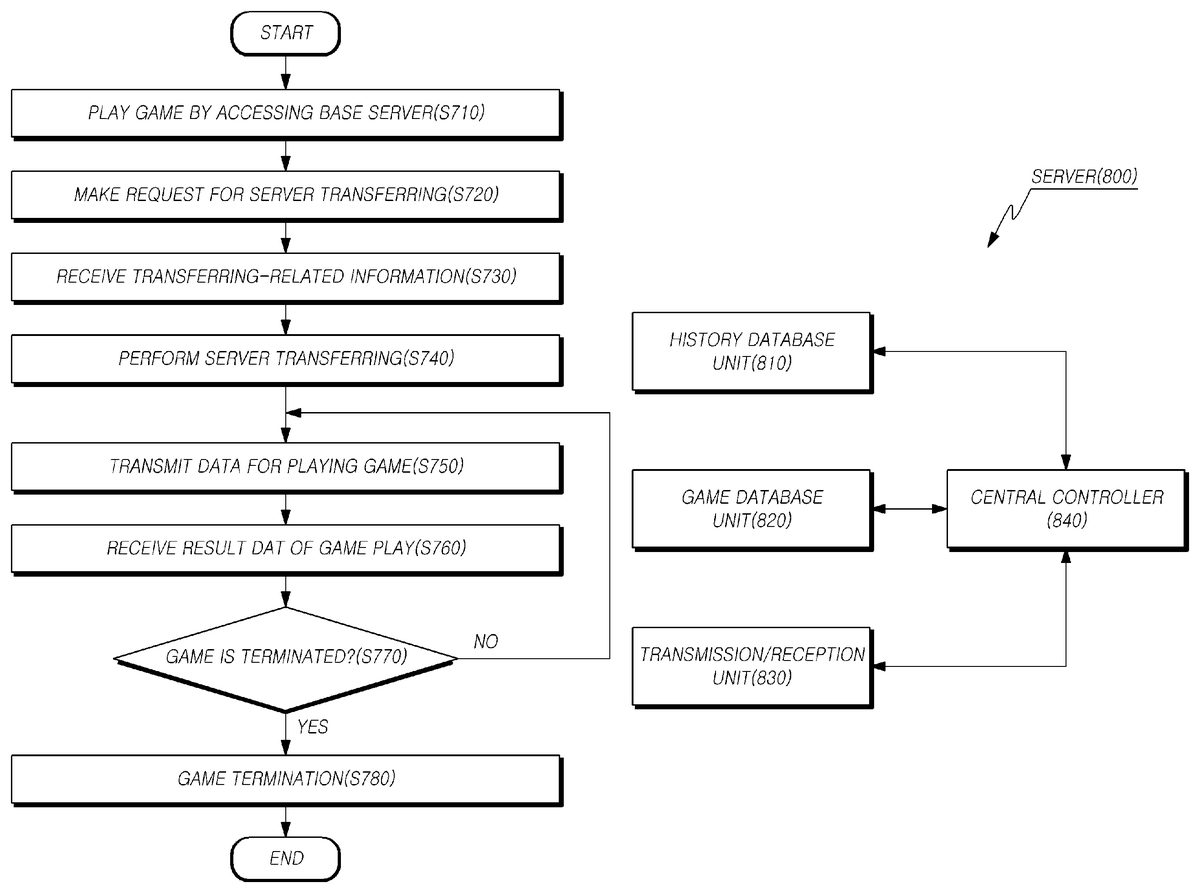
FIG. 7is a flow chart illustrating an operating process of the client according to an embodiment of the present invention.FIG. 7illustrates a process in which the client plays the game in an online game environment of the transferring server after the client accesses the base server and then performs the server transferring.
First, the client accesses the base server S710. In the process of playing the game by accessing the base server, the client can perform the server transferring to an outside server. The client makes a request for the server transferring for the base server or the outside server (transferring server or relay server) S720. After an advance operation of the server transferring is performed, the client receives the transferring-related information S730. The transferring-related information may include a network construction, information, which should be shared between the servers, and information, which should be shared between the client and the server.
After receiving the transferring-related information, the client performs the server transferring S740. The server transferring may be performed by methods in which the client accesses the transferring server via the base server or the relay server as shown inFIGS. 3 and 5, or the client directly accesses the transferring server as shown inFIGS. 2 and 4. After performing the server transferring, the client transmits data for playing the game S750. As described above, the data includes control information inputted from the client in order to play the online game. The data includes information of indicating movements to the player, or indicating predetermined actions such as the battle or the item acquisition to the player. When the player is controlled, the client can indicate that the movements, the battle, and the item acquisition of the player are performed in the transferring server. Further, the client receives the resulting data of the game play including information generated to other players by the actions of the player, or results generated by performing actions such as the battle, the movements, and the item acquisition of other players S760. When the client accesses the transferring server directly or indirectly, the data transmission/reception can be also performed directly or indirectly.
Then, steps S750and S760may be repeatedly performed before the game is terminated. Although there is no change of the player, changed situations of other players may be identified through step S760.
When the game is terminated S780, the game history update between the transferring server and the base server or the relay server and the base server may be performed.
FIG. 8is a block diagram illustrating a construction of the base server or the transferring server according to an embodiment of the present invention. The server inFIG. 8may be the base server for a particular client, and the transferring server for another client.
The entire construction of the server800includes a history database unit810, a game database unit820, a transmission/reception unit830, and a central controller840.
The transmission/reception unit830transmits/receives data through a network. The transmission/reception unit830receives identification information for performing the login, a message of making a request for the server transferring, and data generated in the process of playing the game from the client, provides response data in response to the reception, for example, data including the transferring-related information, transmits the game resulting data of the game play, or transmits data including information with regard to a game environment when the first login is performed to the client. Further, the transmission/reception unit830can transmit/receive data in order to perform the server transferring with an outside server.
The history database unit810stores the game history of the local client, and temporarily stores the game history of the remote client.
The game database unit820stores online game data required for playing the game. For example, the online game data may include information required for forming a map in playing the online game, information of many structures in the map, monster information, etc. The game database unit820includes information required for playing the game, and the information may be modified or added by the participation of the players. Therefore, although all the servers initially store the same data to the game database unit820, the game data may become different from each other by various players playing the game through the clients accessing the servers. According to an embodiment of the present invention, the game data stored in the game database unit820by the base server and the transferring server may differ from each other.
The central controller840performs the online game by controlling the transmission/reception unit830, the history database unit810, and the game database unit820.
Referring to a function of the central controller840in more detail, the central controller840controls the transmission/reception unit830such that the local client and the remote client can play the game in the same online game environment, and allows the resulting data of the game play to be transmitted to the local client and the remote client directly or indirectly. The above includes the process in which the base server or the transferring server ofFIGS. 2,3,4, and5diversely transmits/receives information for the local client and the remote client.
Further, the central controller840can control the transmission/reception unit830such that the game history of the remote client temporarily stored in the history database unit810is transmitted to the base server of the remote client or the relay server of the remote client.
Also, the central controller840can control the transmission/reception unit830such that the resulting data (resulting data of game play) generated by playing the game through the base server or the relay server of the remote client is transmitted to the transmission/reception unit830.
The central controller840can provide the functions of the base servers and the transferring servers ofFIGS. 2,3,4, and5described above. Therefore, the central controller840controls the server800such that the base servers and the transferring servers ofFIGS. 2,3,4, and5perform the login, the game, and the server transferring with the client.
FIG. 9is a block diagram illustrating a construction of the client according to an embodiment of the present invention.
InFIG. 9, the client900includes the transmission/reception unit930, a storage unit920, an outputting unit910, and the central controller940. Referring toFIG. 9in more detail, the transmission/reception unit930transmits/receives data to/from the server. The transmission/reception unit930provides a function of exchanging the data with an outside device. The storage unit920stores the resulting data of the game play. The resulting data of the game play may be stored temporarily or permanently. The outputting unit910controls the resulting data of the game play and an output of environment information of the game, and has a function of converting the resulting data of the game play to graphical data and then outputting the converted data.
The central controller940controls the above construction elements such that the game can be played in the server transferring environment. The central controller940can control such that the transmission/reception unit930transmits/receives identification information required for in the login to the first server, and the transmission/reception unit930transmits a message including a request for the server transferring to the first server. The first server may be the base server. Further, the central controller940accesses the first server or a second server to perform the transferring, receives the resulting data of the game play from the accessed server, and then stores the resulting data of the game play. The second server may be the relay server or the transferring server. The client inFIG. 9provides the functions of the clients inFIGS. 2,3,4, and5.
FIG. 10illustrates a construction of information stored in the history database unit according to an embodiment of the present invention.
History information1000is an embodiment of information, which can be stored in the history database unit of the server. Player identification information (PID, Player ID) means identification information of a character in the game. Through server identification information (SID, Server ID), it is identified whether a corresponding player is a player of the client accessing the outside server.
Referring to each of the players, both player-1and player-3are players of the remote client transferred from the outside server, which is a server-1. Further, a player-5also is a player of the remote client transferred from the outside server, which is a server-2. Therefore, when the remote client terminates an access, information of the players is transmitted to the original servers, which are server-1and server-2. The above may be performed in the history update process described above.
A Player-2and a player-4have “0” as the SID. This means that the player-2and the player-4are players of the local client. The server continuously stores the game history information of the player-2and the player-4. Even when the player-2and the player-4access the server again at a later time after terminating an access, the server allows the player-2and the player-4to play the game by using the corresponding information.
Since the player-1, the player-3, and the player-5, which are players of the remote client, are players transferred from the outside server, the server may indicate the players as subjects, which the player-2and the player-4should overcome, like the monsters. The server may also indicate the player-2, the player-4, and the play-5as the monsters to the player-1and the player-3transferred from the same server to play the game.
Various conditions may be added to the game played by the server transferring described above, for example, a condition, in which only players having a specific level or energy in the base server can transfer to the outside server, may be added. In this case, the base server may provide the client, through which the player having a level higher than the specific level logs in, with the resulting data of the game play including an indication of a space, which can be transferred to the outside server. Further, the client, through which the player logs in, displays the received resulting data of the game play and enables the player to transfer to the outside server. The above process corresponds to the processes of the server transferring requests inFIGS. 2,3,4, and5. Moreover, the process of the server transferring request may be started by a particular player. For example, when a leader player among a plurality of players makes a request for the server transferring and other players provide an interface corresponding to the server transferring, a plurality of players can transfer to the same outside server.
A competition structure in the server and a competition structure between the servers can be provided through the game played by the server transferring. Further, the game history generated in the competition structure between the servers can be successively used.
FIG. 11is a signal flow diagram illustrating a case in which the game history database unit is commonly stored in one server according to another embodiment of the present invention.
InFIG. 11, the history Database (DB) server1103stores the game histories of players of all clients. Therefore, the base server1101and the transferring server1102should perform the game history update with the history DB server1103, regardless of whether the client is the local client or the remote client.
First, the client1109makes a request for the login to the base server1101S1110. The base server1101makes a request for data and a game history, which are required for the login, to the history DB server1103in order to perform the login requested from the client1109, and then receives the data and the history S1112. At this time, the data required for the login includes personal information of a player performing the login through a corresponding client.
Subsequently, the base server1101transmits the login data and the game history to the client1109S1114, and then plays the game S1120. At this time, since the game history database is stored in the central history DB server1103, the game history update is performed while the game is played S1122.
Subsequently, the client1109makes a request for the server transferring to the base server1101while the game is played S1130. The client1109can make a request for transferring a particular server, and the base server1101can search for the server to be transferred to by the request of the client. The base server1101performs an advance operation of the server transferring with the server, which has been searched or requested to be transferred S1132. The advance operation includes providing the transferring server1102with information required for playing the game by the client1109. Since the history data is stored in the history DB server1103, the base server1101is not required to separately provide the transferring server1102with the history data. Meanwhile, the base server1101can provide the transferring server1102with login or identification information of the client1109. Meanwhile, when information of the level, the ranking, and the possessed items of the client1109is also stored in the history DB server1103, the base server is not required to separately provide the transferring server1102with the information. However, the base server can provide the transferring server1102with information in a range that the transferring server1102can identify the client1109to be transferred.
When the advance operation is completed, the base server1101provides the client1109with the transferring-related information S1134. An embodiment of the provided information may be information including an address of the transferring server1102, information required for the login, or temporary identification information to be used in the transferring server1102. When the identification information of users is independently managed for each of the servers, the client1109may be allocated the temporary identification information because identification information of a particular user of the base server1101cannot be used in the transferring server1102without change. When the history DB server1103manages information of users of all servers, it is not necessary to separately allocate the information.
Subsequently, the client1109plays the game with the transferring server1102S1142. The transferring server1102updates the game history generated in the process of playing the game to the history DB server1103S1150and S1152. Then, when the game is terminated S1160, the game history update is completed S1162.
Even if it was described above that all of the components of an embodiment of the present invention are coupled as a single unit or coupled to be operated as a single unit, the present invention is not necessarily limited to such an embodiment.
CROSS-REFERENCE TO RELATED APPLICATION
This application claims priority from and the benefit under 35 U.S.C. §119 of a Korean Patent Application No. 10-2010-0047415, filed on May 20, 2010, which is hereby incorporated by reference for all purposes as if fully set forth herein.
Claims
- A method for playing a game with a server transferring in an online game environment, the method comprising: receiving, by a base server, identification information for login from a first client;transmitting, from the base server, online game environment information to the first client such that the first client plays the game on the base server;performing, between the first client and the base server, a first server transferring operation for the first client, and between the base server and an outside server, a second server transferring operation for the first client such that when the first server transferring operation and the second transferring operation are completed, the first client plays the game with a second client on the outside server;transmitting, from the first client, data for playing the game to the outside server or the second client;receiving, by the base server, a resulting data of the game from the outside server or the second client after the received data are applied to the online game environment;and transmitting, via the base server, a result of an interaction generated between the first client and the second client from the outside server or the second client to the first client to update a game history of the first client.
- A method for playing a game with a server transferring in an online game environment, the method comprising: transmitting, from a first client server, identification information for login to a base server;transmitting, from the first client server, a message including a request for server transferring to the base server;accessing, from the first client server, the base server or a transferring server to be transferred;transmitting, from the first client server, data for playing the game to the accessed base server or the accessed transferring server such that when the transmitting data is completed, the game is played on the accessed base server or the accessed transferring server;receiving, by the first client server, a resulting data of the game from the accessed base server or the accessed transferring server.
- A method for playing a game with a server transferring in an online game environment, in an online game server system comprising a first server and a second server providing an online game, the method comprising: providing, via a first server, the game by performing a first login for a first client such that the game is played on the first server;providing, via a second server, the game by performing a second login with a second client such that the game is played on the second server;performing, from the first server and the second server, an operation of the server transferring such that when the operation of the server transferring is completed, the first client and the second client play the game in the second server;transmitting, from the second server, a resulting data of the game to the first client and the second client;and transmitting, from the second server, a game history of the first client to the first server.
Disclaimer: Data collected from the USPTO and may be malformed, incomplete, and/or otherwise inaccurate.