U.S. Pat. No. 8,992,321
APPARATUS AND METHOD FOR DISPLAYING PLAYER CHARACTER SHOWING SPECIAL MOVEMENT STATE IN NETWORK GAME
AssigneeKabushiki Kaisha Square Enix
Issue DateSeptember 27, 2013
U.S. Patent No. 8,992,321: Apparatus and method for displaying player character showing special movement state in network game
U.S. Patent No. 8,992,321: Apparatus and method for displaying player character showing special movement state in network game
Issued March 31, 2015 to Kabushiki Kaisha Square Enix
Priority Date December 30, 2011
Summary:
U.S. Patent No. 8,992,321 (the ‘321 Patent) is for all the players who like to show off their extra special moves. In a network game with multiple players, if a player makes a special move, this can potentially greatly influence the progress of the game. However, when a player is participating in a network game, the screen displayed on each player’s screen generally shows each individual player’s character. Therefore, a player may not be able to see the special move of another player which significantly influences the game. This brings about a problem that the excitement of the game is not enhanced.
This patent helps to resolve these problems by allowing each player in a network game to focus on a player’s character showing a special move. When one of the player characters makes a special move, not only the display screen of that player’s device focuses on the move, but the display screens of the devices of the other players in the party focus on the move as well. This allows for a flashy player to show off their impressive abilities.
Abstract:
In a network game, player characters manipulated by individual players of video game apparatuses belong to the same party to battle with an opponent character. When a player character making a special move is not present in the party, the display screen of each video game apparatus becomes a screen focusing on the player character of the player who uses this video game apparatus. When one of the player characters makes a special move, not only the display screen of the video game apparatus corresponding to this player, but also the display screens of the video game apparatuses corresponding to the other player characters in the party become screens focusing on the player character which makes the special move.
Illustrative Claim:
1. A network game system including a server apparatus and a plurality of terminal apparatuses connected to the server apparatus over a network, players who respectively use the plurality of terminal apparatuses manipulating player characters to participate in a game provided by the server apparatus, wherein the server apparatus comprises: a movement information receiver that receives movement information transmitted from each of the plurality of terminal apparatuses; a game processor that progresses with the game on the basis of the movement information received by the movement information receiver; a special character determiner that determines whether a presence of a special player character showing a predetermined special movement state is identified on the basis of the movement information received by the movement information receiver; and a game information transmitter that transmits game information according to a progress state of the game progressed by the game processor to at least one of the plurality of terminal apparatuses, wherein each terminal apparatus of the plurality of terminal apparatuses comprises: a display; an input; a game information receiver that receives the game information; a graphics processor that causes the display to display an image based on the game information received by the game information receiver; and a movement information transmitter that transmits the movement information on a movement of a player character according to an input by a player from the input to the server apparatus, wherein the graphics processor includes: a normal-mode image display that causes the display to display a normal image basing on the player character of the player who uses the terminal apparatus and a progress state of the game when the special character determiner determines that there is no special player character showing the special movement state; and a special-mode image display that causes the display to display a special image basing on the special player character showing the special movement state and the progress state of the game when the special character determiner determines that there is the special player character showing the special movement state.’
Research By: Rachel Johns
Illustrative Figure
Abstract
In a network game, player characters manipulated by individual players of video game apparatuses belong to the same party to battle with an opponent character. When a player character making a special move is not present in the party, the display screen of each video game apparatus becomes a screen focusing on the player character of the player who uses this video game apparatus. When one of the player characters makes a special move, not only the display screen of the video game apparatus corresponding to this player, but also the display screens of the video game apparatuses corresponding to the other player characters in the party become screens focusing on the player character which makes the special move.
Description
BEST MODE FOR CARRYING OUT THE INVENTION An embodiment of the invention will now be described with reference to the accompanying drawings. FIG. 1is a block diagram showing the general configuration of a network system where a network game according to this embodiment is played. As illustrated, the network system includes a plurality of video game apparatuses100connected to a server apparatus200over a network151like the Internet. In a game which is applied to this network game system, each player who uses the video game apparatus100moves his/her own player character (hereinafter referred to as “player's own player character”) on a field formed in virtual space (game space) common to all the players. Each player forms a party composed of the player's own player character and player characters which are moved by other players (hereinafter referred to as “other player characters”). The game progresses party by party. When the party moves on a field and reaches a predetermined point in the progress of the game, the party battles with an opponent character encountered there. The individual player characters belonging to the party can get an experience value by defeating the opponent character in the battle. The acquisition of the experience value can allow each player to power up the player's own player character, so that the player can defeat a stronger opponent character. FIG. 2is a block diagram showing the configuration of the video game apparatus100shown inFIG. 1. As illustrated, the video game apparatus100has a main body101as its main unit. The main body101includes a control unit103, a RAM (Random Access Memory)105, a hard disk drive (HDD)107, a sound processor109, a graphics processor111, a DVD/CD-ROM drive113, a communication interface115, and an interface unit117, all of which are connected to an internal bus119. The sound processor109of the main body101is connected to a sound output device125or ...
BEST MODE FOR CARRYING OUT THE INVENTION
An embodiment of the invention will now be described with reference to the accompanying drawings.
FIG. 1is a block diagram showing the general configuration of a network system where a network game according to this embodiment is played. As illustrated, the network system includes a plurality of video game apparatuses100connected to a server apparatus200over a network151like the Internet.
In a game which is applied to this network game system, each player who uses the video game apparatus100moves his/her own player character (hereinafter referred to as “player's own player character”) on a field formed in virtual space (game space) common to all the players. Each player forms a party composed of the player's own player character and player characters which are moved by other players (hereinafter referred to as “other player characters”). The game progresses party by party.
When the party moves on a field and reaches a predetermined point in the progress of the game, the party battles with an opponent character encountered there. The individual player characters belonging to the party can get an experience value by defeating the opponent character in the battle. The acquisition of the experience value can allow each player to power up the player's own player character, so that the player can defeat a stronger opponent character.
FIG. 2is a block diagram showing the configuration of the video game apparatus100shown inFIG. 1. As illustrated, the video game apparatus100has a main body101as its main unit. The main body101includes a control unit103, a RAM (Random Access Memory)105, a hard disk drive (HDD)107, a sound processor109, a graphics processor111, a DVD/CD-ROM drive113, a communication interface115, and an interface unit117, all of which are connected to an internal bus119.
The sound processor109of the main body101is connected to a sound output device125or a speaker, and the graphics processor111is connected to a display device121having a display screen122. A recording medium (in this embodiment, DVD-ROM or CD-ROM)131is mountable in the DVD/CD-ROM drive113. The communication interface115is connected to the network151. A light emitting unit160, a reception unit161, and a memory card162are connected to the interface unit117.
The control unit103includes a CPU (Central Processing Unit), and a ROM (Read Only Memory), and executes a program stored in the HDD107or on the recording medium131to control the main body101. The control unit103includes an internal timer. The RAM105is used as a work area for the control unit103. The HDD107is a storage area for storing programs and data. When instructed to output sounds by a program which is being executed by the control unit103, the sound processor109interprets the instruction and outputs sound signals to the sound output device125.
The graphics processor111maps image data in a frame memory112(which is shown outside the graphics processor111inFIG. 2but is actually provided in a RAM included in a chip composing the graphics processor111) in accordance with a drawing instruction output from the control unit103, and outputs video signals to display images on the display screen122of the display device121. One frame time of images in the video signals output from the graphics processor111is, for example, 1/30 sec. There are two sets of frame memories112, one for writing and the other for reading, which are switched from one to the other for each frame period.
The DVD/CD-ROM drive113reads out programs and data from the recording medium131. The communication interface115is connected to the network151to communicate with other computers. The light emitting unit160includes a plurality of LEDs having light irradiating directions different from one another, and is located in a position having a predetermined relation with the display device121(above or under the display device121).
The input device163includes a light receiver163a, an acceleration sensor163b, and a transmission unit163c. The light receiver163areceives light emitted from each LED included in the light emitting unit160. The number and positions of LEDs whose lights can be received by the light receiver163avary depending on the direction of the input device163. The acceleration sensor163bincludes a multi-axis acceleration sensor having three or more axes, and detects the inclination and three-dimensional motion of the input device163. The input device163has directional keys and a plurality of operation buttons.
The transmission unit163ctransmits an infrared signal according to the condition of the input device163, more specifically, an infrared signal according to the light receiver163a, the inclination of the input device163, the direction and speed of the motion of the input device163which are detected by the acceleration sensor163b, and inputs from the directional keys and the operation buttons of the input device163. The infrared signal transmitted from the transmission unit163cis received by the reception unit161as input data from the input device163.
The input device163is used to perform a predetermined process, such as moving a player character (to be described later) by operating the directional keys. The directional keys are also used to move a cursor, and the operation buttons are used input predetermined instructions. The action of a player character (to be described later) is sequentially selected by the player operating the directional keys, and the selection is set by operating a specific operation button. A special move which gives a stronger damage than the damage given by a normal attack on an opponent character in a battle is affected by a combination of operations of the input device163. The player character which has made a special move makes a more showy action, such as making a big jumping, than that made in the normal attack. This special move will be further described later.
The interface unit117outputs input data received by the input unit161to the RAM105. The control unit103interprets the input data and performs an arithmetic operation. In response to an instruction from the control unit103, the interface unit117stores data representing the progress state of the game stored in the RAM105in the memory card162, and reads out data on the game stored in the memory card162at the time the game has been suspended, and transfers the data to the RAM105.
The programs and data for playing the game on the video game apparatus100are initially stored in, for example, the recording medium131. The data stored in the recording medium131includes graphic data for creating objects present in the game space (the field formed in the game space, the player's own player character, other player characters, the opponent characters). The programs and data which are stored in the recording medium131are read out by the DVD/CD-ROM drive113and are loaded onto the RAM105at the time of execution. The control unit103processes the programs and data loaded onto the RAM105, outputs a drawing instruction to the graphics processor111, and outputs a sound output instruction to the sound processor109. Intermediate data which is produced while the control unit103is performing the processing is stored in the RAM105.
FIG. 3is a block diagram showing the configuration of the server apparatus200shown inFIG. 1. As shown, the server apparatus200has a main body201as its main unit. The main body201includes a control unit203, a RAM205, a hard disk drive (HDD)207, a DVD/CD-ROM drive213, and a communication interface215, all of which are connected to an internal bus219. A recording medium (DVD-ROM or CD-ROM)231is mounted in the DVD/CD-ROM drive213.
The control unit203includes a CPU and a ROM, and executes a program stored in the HDD207or on the recording medium231to control the server apparatus200. The control unit203includes an internal timer that measures a current time. The RAM205is used as a work area for the control unit203. The HDD207is a storage area for storing programs or data. The communication interface215is connected to the network151to communicate with each video game apparatus100.
The programs and data for playing a network game on the server apparatus200are initially stored in, for example, the recording medium231, and are installed in the HDD207therefrom. The programs and data are read out from the HDD207and are loaded onto the RAM205at the time of execution. The control unit203processes the programs and data loaded onto the RAM205, and progresses with the network game based on data transmitted from each video game apparatus100. Intermediate data which is produced while the control unit203is performing the processing is stored in the RAM205.
In the network game according to this embodiment, a field is formed in virtual three-dimensional space as space where player characters move, each player moves the player's own player character on the field by operating the input device163to thereby progress with the game. A position in the virtual three-dimensional space where the field is formed is uniquely specified by coordinates in a world coordinate system (X, Y, Z). Graphic data of each object present on the field is formed by a plurality of polygons with vertices whose coordinates are indicated by coordinates in the world coordinate system.
A player character is formed by a plurality of polygons with vertices whose coordinates are indicated by coordinates in a local coordinate system (x, y, z). A substantially center point of a player character is set as a reference point. The position of a player character in the virtual three-dimensional space is indicated by the coordinates of the reference point in the world coordinate system. The direction of a player character is represented by angles formed by individual axes of the local coordinate system to the respective axes of the world coordinate system.
At the time of performing a display process, the coordinates of the characteristic points of every object (vertices of each polygon) included in a visible range are converted to coordinates in the world coordinate system. The moving direction of a player character is decided based on the positional relation between the position of the player character in the current frame period and the position of the player character in the previous frame period.
How characters in the virtual three-dimensional space including the player characters of the individual players move in the space is displayed on the display screen122through perspective transformation of the virtual three-dimensional space with a virtual camera, and is identified by the individual players.FIG. 4exemplarily illustrates how the perspective transformation takes place. A virtual camera301is placed in the virtual three-dimensional space, and an image projected on a virtual screen302is an image to be displayed on the display screen122.
The position of the virtual camera301is a viewpoint303, the direction of the virtual camera301is a visual axis304, and a region formed by four lines connecting the viewpoint303to the vertices of the virtual screen302at the four corners is a visual field305. The size of the virtual screen302is fixed, so that with the width of the visual field305set, the position of the virtual screen302is decided, while with the position of the virtual screen302set, the width of the visual field305is decided.
Since the visual axis304passes through the center point of the virtual screen302, a reference point (reference position of a player character300herein) always comes to the center point of the display screen. A clip surface306is set at a predetermined distance from the viewpoint303in the direction of the visual axis304, so that a clipping range or a range in the virtual three-dimensional space where an image is generated through perspective transformation (i.e., visible range) ranges from the virtual screen302to the clip surface306in the range of the visual field305.
The player character300serving as a reference point becomes another player character which is making a special move when the video game apparatus100is receiving exclusive camera information (by which another player character which is making a special move can be specified) transmitted from the server apparatus200while the other player character is making the special move. Otherwise, the player character300to be a reference point is the player's own player character which is manipulated by the player using each respective video game apparatus100.
As apparent from the above, the coordinate system that is used to project an image on the virtual screen302is a viewpoint coordinate system (X′, Y′, Z′), and the direction of the visual axis304is the Z′ axis of the viewpoint coordinate system. Coordinates in the world coordinate system (including coordinates converted from coordinates in the local coordinate system) are converted to coordinates in the viewpoint coordinate system after which a process for perspective transformation including a process of deleting a hidden screen to be discussed next is carried out.
In case of generating an image projected on the virtual screen302through perspective transformation, it is necessary to a hidden-screen deletion of deleting a screen which is hidden due to presence of another object on a front screen. A Z-buffer method is used herein as the method for the hidden-screen deletion. After converting coordinates in the world coordinate system to coordinates in the viewpoint coordinate system, the control unit103sends the coordinates of the individual characteristic points and a drawing instruction to the graphics processor111. Based on the drawing instruction, the graphics processor ill updates the value of the Z buffer so as to leave data (values of Z′) of points on the front screen (small points with the Z′ coordinates) for the individual characteristic points, and maps image data into the frame memory112for the points every time the values are updated.
The perspective transformation should be premised on that the position of the viewpoint303of the virtual camera301, the direction of the visual axis304, the size of the visual field305(distance from the viewpoint303to the virtual screen302), and the distance from the viewpoint303to the clip surface306(hereinafter called “clipping distance”) have been decided. The position of the virtual screen302is naturally determined once those parameters are decided.
When the video game apparatus100is not receiving exclusive camera information, the position of the viewpoint303is kept at a given distance from the player's own player character in a predetermined direction, and moves following up the movement of the player character300. The direction of the visual axis304is set constant so as to always face the reference point of the player's own player character. It is assumed that the size of the visual field305and the clipping distance are basically set to the same size.
When the video game apparatus100is receiving exclusive camera information, the position of the viewpoint303moves to a position indicated by the exclusive camera information (this position is kept at a given distance from another player character making a special move in a predetermined direction, and moves following up the movement of this another player until termination of the special move). The direction of the visual axis304is set constant so as to always face the reference point of the special-move making player character. It is assumed that the size of the visual field305and the clipping distance are basically set to the same size.
In the game provided by the network game system according to the embodiment, the player character300which becomes a reference to control the virtual camera301is decided, and deciding this position permits the range of the virtual three-dimensional space to be displayed on the display screen122to be uniquely determined. The positions and operational states of player characters including the player character300in the game space are managed by the server apparatus200as will be described later.
To progress with the network game according to the embodiment, data which is managed by the server apparatus200will be described.FIGS. 5A and 5Bshow tables which are managed by the server apparatus200to play the network game according to the embodiment.FIG. 5Ashows a party management table400managing states for the individual parties present in the network game according to the embodiment.FIG. 5Bshows a character management table410which is generated for each party to manage the positions, the movement states, etc. of player characters which form the party.
The party management table400shown inFIG. 5Astores a party ID401, a participant character ID402, and a battle flag403for each party. The party ID401is identification information for uniquely identifying each party present on the field. The participant character ID402includes all character IDs (to be described later) forming the party. The battle flag403indicates whether the party is bound by a process relating to a battle. The battle flag403is ON (1) when the party is engaging with a battle, and is OFF (0) otherwise.
The character management table410shown inFIG. 5Bstores at least a character ID411, a destination address412, name information413, position information414, movement state information415, and HP information416for each of player characters forming a party. The character ID411is identification information for uniquely identifying each player character present on a field. The destination address412is an IP address assigned to specify a video game apparatus100which manipulates an individual player character. The name information413is used as information to display the name of a player character on the display screen122.
The position information414indicates the position of a player character on a field or a battle field. The movement state information415indicates in what movement state (mode which is changed by movement) a player character is, and is updated according to movement information transmitted from each video game apparatus100. While the player character is making a special move, the movement information is added with information indicating such a movement.
The HP information416indicates the value of HP of the player character (value of capability indicating a survival value of each player character in the game space, and normally, the game cannot continue when the value becomes “0”). Although HP is increased/decreased according to the progress of the game, HP information416is not changed while another player character is making a special move (the HP information416of the player character making a special move may be changed).
Because data managed by the video game apparatus100does not contain data characterizing the invention except for data received from the server apparatus200(which is temporarily stored in the RAM105), its detailed description will not be given. When exclusive camera information is stored in the RAM105as data received from the server apparatus200, however, control on the virtual camera301is changed according to the exclusive camera information.
In the network game system according to the embodiment, in accordance with a movement instruction input (it is input by, for example, selecting a movement item from a menu operating the directional keys and setting the input operating a “O” button) through the input device163by a player using each video game apparatus100, the control unit103specifies the movement state of the player character of the player, and transmits movement information indicative of the specified movement state to the server apparatus200. When the specified movement state is a movement state at any point of time from the initiation of a special move to the end thereof, the movement information is added with information indicative of the special move.
For each party, game progress information indicating the position and movement state of each player character belonging to the party and the position and movement state of each non-player character (including each opponent character) against which the party is battling is transmitted to each video game apparatus100from the server apparatus200. When a player character making a special move is present in the party (regardless of whether it is the player's own player character or another player character), exclusive camera information (e.g., the ID of this player character and information on the position at which the virtual camera301is controlled) for controlling the virtual camera301based on the player character making the special move is added to the game progress information.
The video game apparatus100acquires game progress information transmitted from the server apparatus200every frame period (but re-acquires game progress information of the previous frame when failing the acquisition of the game progress information). When exclusive camera information is not added to the game progress information, the video game apparatus100controls the virtual camera301based on the player character corresponding to this video game apparatus100, and receives the movement instruction input from the input device163.
When exclusive camera information is added to the acquired game progress information, the video game apparatus100controls the virtual camera301based on the player character specified by the exclusive camera information, not the player character corresponding to this video game apparatus100, and does not receive the movement instruction input from the input device163. In other words, when exclusive camera information is added, i.e., when there is another player character making a special move, a screen basing on the player's own player character is switched to a screen basing on this special-move making player character. At the time of switching the screen basing on the player's own player character to the screen basing on the special-move making player character, a predetermined transition screen is displayed for a given period of time. A predetermined transition screen is likewise displayed for a given period of time when switching a screen basing on a special-move making player character to a screen basing on the player's own player character.
While the network game system according to the embodiment presents a player character making a special move with a predetermined effect display (e.g., displaying a flare around the player character), information indicating what effect display will be taken is included in the game progress information. When there is a player character making a special move in the party, therefore, the same screen is displayed on the display devices121of the video game apparatuses100excluding a case where a transition screen is displayed (excluding the video game apparatus100whose player's own player character is the player character making a special move).
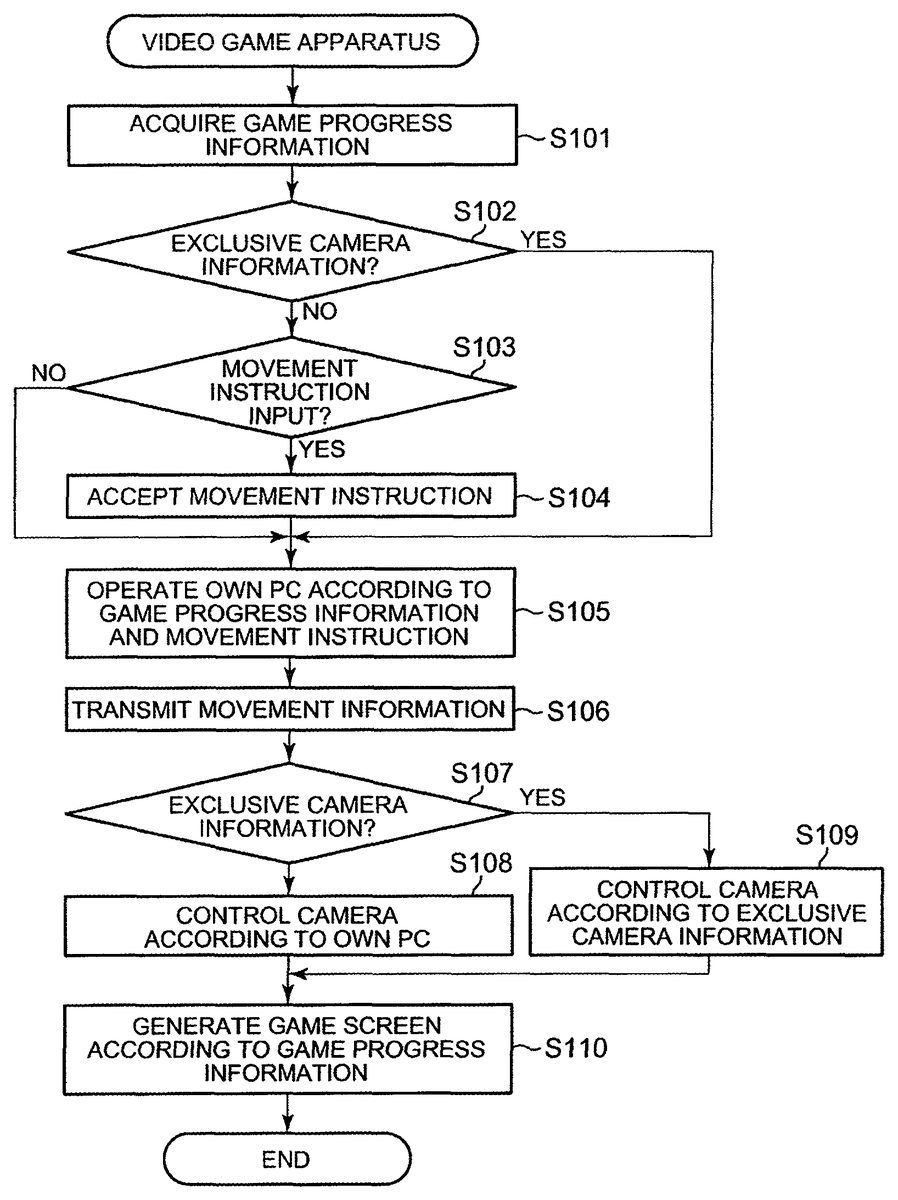
The following will describe routines which are carried out by the network game system according to the embodiment.FIG. 6is a flowchart illustrating a routine which is executed by the video game apparatus100.FIG. 7is a flowchart illustrating a routine which is executed by the server apparatus200. The routine which is carried out by the video game apparatus100includes processes other than the steps illustrated in the flowchart inFIG. 6, and the routine which is carried out by the server apparatus200includes processes other than the steps illustrated in the flowchart inFIG. 7.FIGS. 6 and 7illustrate steps which are executed particularly in connection with the invention, steps which are executed in manners similar to the conventional manners may be omitted.
The control unit103of the video game apparatus100carries out the routine of the flowchart illustrated inFIG. 6every frame period. The control unit103fetches game progress information, transmitted from the server apparatus200and saved in the reception buffer in the RAM105, into a predetermined area in the RAM105before the frame period starts (step S101). When the acquisition of the game progress information has failed before the start of the frame period, the control unit103proceeds with the routine assuming that the game progress information fetched in the predetermined area in the RAM105in the previous frame period has been fetched therein.
The control unit103determines whether exclusive camera information is added to the game progress information acquired in step S101(step S102). When the exclusive camera information is added to the game progress information, the control unit103proceeds to a process in step S105directly. When the exclusive camera information is not added to the game progress information, the control unit103determines whether the an movement instruction on the player's own player character is input from the input device163before the frame period starts (step S103). When no movement instruction is input, the control unit103proceeds to a process in step S105directly.
When a movement instruction is input, the control unit103accepts the movement instruction and stores it in the predetermined area in the RAM105(step S104). The movement instruction stored in the RAM105is kept stored in the RAM105until the entire movement of the player's own player character based on the movement instruction is completed. Then, the control unit103proceeds to the process in step S105.
In step S105, the control unit103specifies the movement state of the player's own player character according to the game progress information stored in the RAM105in the present frame period and the movement instruction stored in the RAM105. If a movement instruction is stored in the present frame period for the first time, the control unit103causes the player's own player character to start the movement according to the movement instruction. When a movement instruction corresponding to the movement which has already started is still stored in the RAM105, the control unit103causes the player's own player character to continue the movement according to the movement instruction.
When exclusive camera information is added to the game progress information stored in step S101, a movement instruction, even when input from the input device163, is not fetched, so that the control unit103does not cause the player's own player character to start the movement. When the movement instruction fetched in the previous frame period or earlier is stored in the RAM105, the control unit103continues the movement of the player's own player character according to the movement instruction.
Next, the control unit103causes the communication interface115to transmit movement information indicative of the specified movement of the player's own player character and the position of the player's own player character to the server apparatus200over the network151(step S106).
The control unit103determines again whether exclusive camera information is added to the game progress information acquired in step S101(step S107). When the exclusive camera information is not added to the game progress information, the control unit103controls the virtual camera301according to the position and movement state of the player's own player character indicated by the game progress information. More specifically, the control unit103sets the position of the viewpoint303of the virtual camera301in a predetermined position which is determined according to the position of the player's own player character, and sets the direction of the visual axis304of the virtual camera301using the reference point of the player's own player character as a reference point (step S108). Accordingly, the position of the virtual screen302and position of the clip surface306are uniquely determined. Then, the control unit103proceeds to a process in step S110.
When the exclusive camera information is added to the game progress information, the control unit103controls the virtual camera301according to the exclusive camera information added to the game progress information. More specifically, the control unit103sets the position of the viewpoint303of the virtual camera301in a predetermined position which is determined according to the position of a player character (player's own player character or another player character) indicated by the exclusive camera information and sets the direction of the visual axis304of the virtual camera301using the reference point of the player character as a reference point (step S109). Accordingly, the position of the virtual screen302and position of the clip surface306are uniquely determined. Then, the control unit103proceeds to the process in step S110.
In step S110, the control unit103generates a display screen122according to the game progress information acquired in step S101(actually, a screen to be displayed on the display device121in a next frame or any subsequent frame). More specifically, the control unit103perspectively transforms each object present in the virtual space (the player's own player character and other player characters included in the visible range, and the terrain of a field, and an object for an effect display) on the virtual screen302, converts the coordinates of the vertices of each polygon forming each of the objects to the coordinates in the viewpoint coordinate system. The control unit103outputs a drawing instruction together with information of each polygon forming each of the objects (including the converted coordinates in the viewpoint coordinate system) to the graphics processor111. The routine that is carried out by the control unit103of the video game apparatus100in the present frame period is terminated.
The graphics processor ill which has received the drawing instruction from the control unit103maps the image of each polygon, provided together with the drawing instruction, into the frame memory112by referring to the Z buffer. The graphics processor111reads an image mapped into the frame memory112every frame period, and outputs a video signal which is the read image added with a sync signal to the display device121. As a result, a game image showing the player's own player character (when there is no exclusive camera information) or a player character making a special move (when there is exclusive camera information) positioned in the center of the display screen122is displayed.
The control unit203of the server apparatus200carries out the routine of the flowchart illustrated inFIG. 7every frame period (the time interval as one frame period in the video game apparatus100). The control unit203fetches game progress information, transmitted from the video game apparatus100and saved in the reception buffer in the RAM205, into a predetermined area in the RAM205before the frame period starts (step S201). The control unit203updates the position information414and movement state information415of each player character in the table inFIG. 5B(step S202).
The control unit203determines for each party whether there is a player character making a special move (step S203). With regard to a party which does not have a player character making a special move, the control unit203proceeds to a process in step S205without setting the exclusive camera. With regard to a party which has a player character making a special move, the control unit203sets the exclusive camera according to the player character making the special move, and temporarily saves information indicative of the setting (step S204). Then, the control unit203proceeds to the process in step S205.
In step S205, for each party, the control unit203generates game progress information indicating the position and movement state of each player character belonging to the party, and further indicating the position and movement state of a non-player character present near the party. With regard to a party which has a player character making a special move, exclusive camera information according to the exclusive camera set in step S204is included in the game progress information. The control unit203transmits the generated game progress information to each video game apparatus100. The game progress information to be transmitted is for the party in which the player character of the player using each video game apparatus100is present. The routine that is carried out by the control unit203of the server apparatus200in the present frame period is terminated.
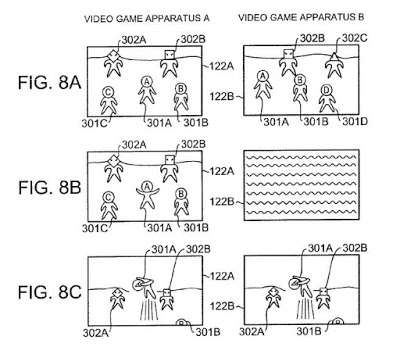
The following will explain, by way of a specific example, display images in a battle which are displayed on the display screen122of the video game apparatus100constituting the network game system according to the embodiment, particularly, display images when one of the players makes a special move in a battle.FIGS. 8A to 8Eare diagrams showing specific examples of display screens of individual video game apparatuses100during a battle.
In this example, it is assumed that there are four player characters301A to301D forming a party, and the player character301A thereamong will make a special move in a battle with opponent characters302A to302C. Hereinafter, the video game apparatus100corresponding to the player character which makes a special move is referred to as “video game apparatus A”, and a video game apparatus100corresponding to a player character which does not make a special-move is referred to as “video game apparatus B”. Display screens122A,122B which are displayed on the display devices121of the video game apparatuses A, B at the same timing are shown time-sequentially inFIGS. 8A to 8E.
It is assumed that none of the player characters forming the party have made a special move at the timing inFIG. 8A. The display screen122A of the video game apparatus A shows an image showing a player character301A or the player's own player character of the player who uses the video game apparatus A in the center (because the visual axis304of the virtual camera301is directed toward the player character301A). The display screen122B of the video game apparatus B shows an image showing a player character301B or the player's own player character of the player who uses the video game apparatus B in the center (because the visual axis304of the virtual camera301is directed toward the player character301B).
Suppose that the player of the video game apparatus A manipulates the input device163to cause the player's own player character to start a special move. The display screen122A of the video game apparatus A shows an image showing a player character301A or the player's own player character of the player who uses the video game apparatus A in the center. The display screen122B of the video game apparatus B shows a transition screen for switching the image showing the player character3015in the center to the image showing the player character301A in the center.
It is assumed that displaying the transition screen is terminated at the timing inFIG. 8C, and the player character301A or the player's own player character of the player using the video game apparatus A continues the special move which has started at the timing inFIG. 8B. The display screen122A of the video game apparatus A shows an image showing the player character301A or the player's own player character of the player using the video game apparatus A in the center. Because the game progress information transmitted from the server apparatus200includes exclusive camera information, the display screen122B of the video game apparatus B also shows an image showing the player character301A in the center (due to the visual axis304of the virtual camera301being directed toward the player character301A).
It is assumed that the player character301A or the player's own player character of the player using the video game apparatus A has completed the special move which has started at the timing inFIG. 8D. The display screen122A of the video game apparatus A shows an image showing the player character301A or the player's own player character of the player using the video game apparatus A in the center. The display screen122B of the video game apparatus B shows a transition screen for switching the image showing the player character301A in the center to the image showing the player character301B in the center.
Displaying the transition screen is terminated at the timing inFIG. 8E. As in the case ofFIG. 8A, the display screen122A of the video game apparatus A shows an image showing the player character301A or the player's own player character of the player using the video game apparatus A in the center. The display screen122B of the video game apparatus B also shows an image showing the player character301B or the player's own player character of the player using the video game apparatus B in the center.
In the network game system according to the embodiment, as described above, a plurality of player characters respectively using a video game apparatuses100participate in a game provided by the server apparatus200. Of the player characters participating in the game, two or more player character form a party, and the player characters belonging to the party cooperate with each other to battle with an opponent character.
Each video game apparatus100generates a display screen122indicating the progress state of the game based on game progress information which is transmitted from the server apparatus200every frame period according to the progress state of the game, and displays the display screen122on the display device121. The display screen122to be displayed on the display device121of each video game apparatus100is normally a screen basing on the player character of the player using the video game apparatus100(i.e., screen showing the player character positioned in the center by directing the visual axis304of the virtual camera301toward this player character).
Each player character which is caused to participate in the game provided by the server apparatus200is moved according to a movement instruction input from the input device163by the player who uses the corresponding video game apparatus100. Depending on the movement instruction input by the player, the player character may make a special move in a battle. Movement information including information on the presence/absence of a special move is transmitted to the server apparatus200from each video game apparatus100to update the position information414and movement state information415of each player character stored in the table in the server apparatus200.
Referring to the movement state information415stored in the table, the server apparatus200determines for each party whether there is a player character making a special move. The server apparatus200transmits the game progress information including exclusive camera information to each video game apparatus100of the player belonging to the party which is determined to have a player character making a special move. The exclusive camera information serves to specify a player character making a special move in the party, and control the virtual camera301according to the special-move making player character.
When there is a player character making a special move, not necessarily the player's own player character, and thus each video game apparatus100is receiving exclusive camera information, each video game apparatus100displays a screen basing on the special-move making player character (i.e., screen showing the special-move making player character positioned in the center by directing the visual axis304of the virtual camera301toward this player character) on the display device121.
A special move is a more powerful attack on an opponent character than a normal attack, and its action is more showy than the action of a normal attack. A player character making a special move significantly affects the progress of a battle, and the special-move making player character being seen by every player in the same party increases the lively feeling of the game. Since the player who has made the player's own player character to make a special move by inputting an movement instruction from the input device163can cause the other players in the same party to see the special move with a showy action, the player's desire to stand out most (to make the player's own player character stand out) in the game is fulfilled.
The player character making a special move is provided with an effect display like a flare, so that the other players can be caused to see not only the action of a special move but also the effect display accompanying the action, the lively feeling of the game is increased further, not to mention that the player's desired to stand out in the game is fulfilled.
While there is a player character making a special move, and a screen basing on the player character who has made a special move is displayed on the video game apparatuses100of all the players, a movement instruction from the input device163is not accepted. This can prevent the showy action of the special-move making player from being interfered with the movements of the other player characters.
Because a movement instruction from the input device163for any player character other than the player character who has made a special move is not accepted, even if a screen basing on the player character who has made a special move is displayed on the video game apparatus100of each of the other players, hiding his/her own player character, the operation on the video game apparatus100does not cause inconvenience. While a screen basing on the player character who has made a special move is displayed, the HP information416of each of the other player characters than the special-move making player character is not changed. Because the player's own player characters of the players who manipulate the player characters other than the player character who has made the special move will not be disabled to battle while the manipulation is being disabled, those players may not have big complains about their own player characters being disabled.
At the time of switching a screen basing on the player's own player character to a screen basing on another player character making a special move, or at the time of switching a screen basing on another player character making a special move to a screen basing on the player's own player character, a predetermined transition screen is displayed for a given period of time. This can prevent any player who has experienced the screen transition from feeling uncomfortable about an abrupt change in the player character displayed in the center of the display screen122.
The invention is not limited to the foregoing embodiment, and is modifiable and applicable in various forms. Some modifications of the embodiment which are applicable to the invention will be described blow.
According to the embodiment, an exclusive camera is set for a player character making a special move in a party, and the video game apparatuses100corresponding to all the player characters belonging to the party to display a screen basing on the player character making the special move. Of course, the criterion to select a player character for which the exclusive camera is set is not limited to this criterion, and the exclusive camera may be set for a player character which is in a some sort of a special movement state.
When there is a player character which is making a predetermined dance as the special movement state, for example, the exclusive camera may be set for the player character making the predetermined dance. In this case, the movements of other player characters than the player character making the predetermined dance for which the exclusive camera is set can be made to match the movement of the player character making the predetermined dance for which the exclusive camera is set regardless of the manipulation on the input devices163by the corresponding players.
For example, player characters other than the player character making a predetermined dance may dance as back dancers for the player character making the predetermined dance (with exactly the same choreography or with a choreography including different portions). The player characters other than a player character making a predetermined dance may cheer the player character making the predetermined dance. Alternatively, the player characters other than a player character making a predetermined dance may not make any special movement but see the player character making the predetermined dance.
According to the embodiment, when there is a player character making a special move in a party, and the video game apparatuses100of the other players in the same party generate screens basing on the special-move making player character, the HPs of the player characters other than the special-move making player character are not changed. In such a case, of course, the player characters other than the special-move making player character cannot have their HPs changed, or can be made not to be put at any disadvantage in the game. Even when there is a player character making a special move in the party, the player characters other than the special-move making player character may be made to get a benefit, such as increasing the HP.
According to the embodiment, while an exclusive camera is set for a player character making a special move in a party, and a screen basing on the special-move making player character is displayed on the video game apparatuses100corresponding to all the player characters belonging to the party, a movement instruction input from the input device163is not accepted. When there is a movement instruction already accepted, however, the movement of the player character based thereon may be interrupted, and the movement of this player character may be resumed when the special move ends and the setting of the exclusive camera is released. Alternatively, the movement instruction may be canceled so that the movement of this player character may not be resumed upon termination of the special move.
According to the embodiment, each video game apparatus100specifies the movement state of the player character corresponding to the video game apparatus100based on the a movement instruction input from the input device163. Instead, each video game apparatus100may transmit information indicating a movement instruction input from the input device163itself, and the server apparatus200upon reception thereof may specify the movement state of each player character based on the received movement instruction.
In this case, regarding a party which is determined to have a player character making a special move, the control unit203of the server apparatus200may be configured not to move a player character other than the special-move making player character even when receiving information indicative of a movement instruction corresponding to such a player character. Even those player characters which are disabled to move under such control can be set not to be put at a disadvantage like a reduction in HP in the game.
According to the embodiment, control on the virtual camera301for displaying a screen based on a player character which is making a special move according to exclusive camera information on each video game apparatus100in a party is determined beforehand. Control on the virtual camera301when there is a player character making a special move in a party may be previously designed so that how each player will make a special move through an input from the input device163, and may be registered in the table in the server apparatus200.
For example, when the player's own player character of the player A makes a special move, the viewpoint303of the virtual camera301may be set directly above the player's own player character. When the player's own player character of the player B makes a special move, the viewpoint of the virtual camera301may be set in front of the player's own player character. Accordingly, when the player character of the player A is making a special move, the video game apparatuses100of all the players in the party display an image viewing the player's own player character of the player A directly thereabove, and when the player's own player character of the player B makes a special move, the video game apparatuses100of all the players in the party display an image viewing the player's own player character of the player B directly from the front.
Even if the movement of a special move is the same between a case where the player character of the player A is making a special move, and a case where the player character of the player B is making a special move, screens to be displayed on the individual video game apparatuses100in the same party differ from one another. This provides a variety of display modes for screens of the game, thus increasing the enjoyment on the screens. Because each player causes other players to see the movement of the player's own player character according to his/her own preference, the player's desire to stand out in the game can be satisfied more.
Control on the virtual camera301to display a screen basing on a player character making a special move on each video game apparatus100according to exclusive camera information may be designed in such a way that how each player is to perform when another player character makes a special move by an input from the input device163. In this case, it is unnecessary to register the setting in the table in the server apparatus200.
For example, the player A may set the position of the viewpoint303of the virtual camera301directly above the special-move making player character. The player B may set the position of the viewpoint303of the virtual camera301in front of the special-move making player character. When the player character of the player C is making a special move, the video game apparatus100of the player A displays an image viewing the player character of the player C directly thereabove, and the video game apparatus100of the player B displays an image viewing the player character of the player C in front thereof.
Accordingly, each player sets a screen displayed on the display device121to his/her own preferred screen, even when another player character makes a special move so that a screen basing on the special-move making player character, not the player's own player character, is displayed on the display device121, thus reducing complaints if any resulting from no screen basing on the player's own player character being displayed. Because the player of a player character which has made a special move can cause other players to view a screen basing on the player's own player character, though screens to be displayed on the video game apparatuses100in the same party differ from one another, the player's desired to stand out in the game can be satisfied.
According to the embodiment, when exclusive camera information is added to game progress information acquired in each frame period, the control unit103of the video game apparatus100disregard movement information on the player's own player character, if input from the input device163, and does not accept the input movement instruction. That is, in a frame period where exclusive camera information is added to game progress information, inputting of a movement instruction from the input device163is made invalid.
By way of contrast, even in a frame period where exclusive camera information is added to game progress information, inputting of a movement instruction from the input device163may be accepted. In this case, however, although the accepted movement instruction is stored in the RAM105, the movement state of the player's own player character is not specified based on the movement instruction accepted in the frame period where the exclusive camera information is added to the game progress information, thus preventing movement information according to the movement instruction from being transmitted to the server apparatus200.
Upon reception of game progress information to which exclusive camera information is not added in a new frame period (not just a next frame period), the movement state of the player's own player character should be specified based also on the movement instruction accepted in the frame period where the exclusive camera information is added to the game progress information, so that movement information according to the movement instruction is transmitted to the server apparatus200.
In other words, when a movement instruction is input from the input device163in a frame period where exclusive camera information is added to game progress information, the movement of the player's own player character based on the movement instruction may be delayed until game progress information which is not added with exclusive camera information is received. Even in the case where the movement of the player's own player character based on an input movement instruction is delayed, it is possible not to put the player at a disadvantage such as reduction in HP information416, as in the case where inputting of a movement instruction from the input device163is made invalid.
The embodiment of the invention has been described by way of example where a three-dimensional game which generates a game screen through perspective transformation of virtual three-dimensional space with the virtual camera301directing the visual axis304toward the player's own player character or another player character making a special move according to the presence/absence of exclusive camera information. The invention can however applied to a two-dimensional game (including a two-dimensional game which can be viewed as a pseudo three-dimensional game) which displays part of the two-dimensional game as a game screen.
For example, when there is no player character which is making a special move in a party in a two-dimensional game, each video game apparatus100displays a region with a given area around the player's own player character as a game screen. When there is a player character which is making a special move in a party, every video game apparatus100corresponding to the party may display a region with a given area around the special-move making player character as a game screen.
Although it is determined whether or not an exclusive camera is set party by party in the foregoing embodiment, an entire game may be set as a unit for determining whether or not to set an exclusive camera in a game where the number of participants in the game is limited to a certain number, such as a sports game or a fighting game, a game not one like RPG where a large number of players participate. When a player character which is in a special movement state like making a special move is present, for example, all the video game apparatuses100which are used by the individual players participating in the game may generate a screen basing on the player character in the special movement state.
According to the embodiment, the video game apparatus100or a dedicated game apparatus is used as a device which becomes the platform to play a video game. According to the invention, however, a general-purpose personal computer or the like which includes components similar to those of the video game apparatus100and has a network connecting capability may be constructed a platform. A portable game apparatus (including a cellular phone having a capability of running applications) which is configured to have the display device121and the sound output device125accommodated in the same casing as the casing of the main body101.
A semiconductor memory card may be adopted as the recording medium131in place of a DVD-ROM or CD-ROM. A card slot where the memory card is inserted may be provided in place of the DVD/CD-ROM drive113. In case of a general-purpose personal computer, the program and data according to the invention may be provided in the form of being prestored on the HDD107, not stored in the recording medium131. Any recording medium may be optionally used to store and provide the program and data according to the invention according to the physical form of the hardware and the distribution form.
According to the embodiment, the program and data for the video game apparatus100are stored in the recording medium131for distribution. Instead, the program and data may be stored on a fixed disk apparatus included in the server apparatus located on a network, and distributed to the main body101via the network151. The video game apparatus100can save the program and data, received at the communication interface115from the server apparatus200, in the HDD107, and load them into the RAM105at the time the program is run. The program and data which are used in the server apparatus200may be stored on a fixed disk apparatus included in another server apparatus located on a network151, and distributed to the main body201via the network151.
Claims
- A network game system including a server apparatus and a plurality of terminal apparatuses connected to the server apparatus over a network, players who respectively use the plurality of terminal apparatuses manipulating player characters to participate in a game provided by the server apparatus, wherein the server apparatus comprises: a movement information receiver that receives movement information transmitted from each of the plurality of terminal apparatuses;a game processor that progresses with the game on the basis of the movement information received by the movement information receiver;a special character determiner that determines whether a presence of a special player character showing a predetermined special movement state is identified on the basis of the movement information received by the movement information receiver;and a game information transmitter that transmits game information according to a progress state of the game progressed by the game processor to at least one of the plurality of terminal apparatuses, wherein each terminal apparatus of the plurality of terminal apparatuses comprises: a display;an input;a game information receiver that receives the game information;a graphics processor that causes the display to display an image based on the game information received by the game information receiver;and a movement information transmitter that transmits the movement information on a movement of a player character according to an input by a player from the input to the server apparatus, wherein the graphics processor includes: a normal-mode image display that causes the display to display a normal image basing on the player character of the player who uses the terminal apparatus and a progress state of the game when the special character determiner determines that there is no special player character showing the special movement state;and a special-mode image display that causes the display to display a special image basing on the special player character showing the special movement state and the progress state of the game when the special character determiner determines that there is the special player character showing the special movement state.
- The network game system according to claim 1 , further comprising: an input disabler that disables the input by the player from the input for a predetermined period of time when the special character determiner determines that there is the special player character showing the special movement state.
- The network game system according to claim 2 , wherein the predetermined period of time is when the graphics processor causes the display to display the special image basing on the special player character showing the special movement state.
- The network game system according to claim 1 , wherein, when the special character determiner determines that there is the special player character showing the special movement state, the game processor progresses with the game so as not to put the player characters other than the special player character showing the special movement state at a disadvantage in the game.
- The network game system according to claim 1 , wherein the special character determiner applies different standards to at least two player characters to determine whether the presence of the special player character showing the special movement state is identified.
- The network game system according to claim 1 , wherein, when the game information receiver does not receive the game information for a predetermined period of time, the graphics processor causes the display to display the image basing on the game information that has been received before a specific time of period.
- The network game system according to claim 1 , wherein the server apparatus further comprises: a controller that controls at least one player character other than the special player character showing the special movement state to become a movement state according to the special movement state when the special character determiner determines that there is the special player character showing the special movement state.
- A server apparatus for providing a game, the server apparatus being connected to each of a plurality of terminal apparatuses over a network, a plurality of players manipulating player characters to progress with the game, the server apparatus comprising: a movement information receiver that receives movement information transmitted from each of the plurality of terminal apparatuses, the movement information relating to a movement of a corresponding player character according to an input of a corresponding player toward an input provided in a corresponding terminal apparatus;a game processor that progresses with the game on a basis of the movement information received by the movement information receiver;a special character determiner that determines whether presence of a special player character showing a predetermined special movement state is identified on the basis of the movement information received by the movement information receiver;and a game information transmitter that transmits game information according to a progress state of the game progressed by the game processor to at least one terminal apparatus of the plurality of terminal apparatuses, wherein the game information transmitter transmits the game information for causing a display provided in the terminal apparatus to display a normal image basing on a player character of a player who uses the terminal apparatus and the progress state of the game when the special character determiner determines that there is no special player character showing the special movement state, and wherein the game information transmitter transmits the game information for causing the display provided in the terminal apparatus to display a special image basing on the special player character showing the special movement state and the progress state of the game when the special character determiner determines that there is the special player character showing the special movement state.
- A non-transitory computer-readable medium including a program, the program being executable by a computer for providing a game, the computer being connected to a plurality of terminal apparatuses over a network, a plurality of players manipulating player characters to progress with the game, the program allowing the computer to function as: a movement information receiver that receives movement information transmitted from each of the plurality of terminal apparatuses, the movement information relating to a movement of a corresponding player character according to an input of each of the plurality of players toward an input provided in a corresponding terminal apparatus;a game processor that progresses with the game on a basis of the movement information received by the movement information receiver;a special character determiner that determines whether presence of a special player character showing a predetermined special movement state is identified on the basis of the movement information received by the movement information receiver;and a game information transmitter that transmits game information according to a progress state of the game progressed by the game processor to at least one terminal apparatus of the plurality of terminal apparatuses, wherein the program further allows the computer to function as the game information transmitter to transmit the game information for causing a display provided in the terminal apparatus to display a normal image basing on a player character of a player who uses the terminal apparatus and the progress state of the game when the special character determiner determines that there is no special player character showing the special movement state, and wherein the program also allows the computer to function as the game information transmitter to transmit the game information for causing the display to display a special image basing on the special player character showing the special movement state and the progress state of the game when the special character determiner determines that there is the special player character showing the special movement state.
Disclaimer: Data collected from the USPTO and may be malformed, incomplete, and/or otherwise inaccurate.