U.S. Pat. No. 8,968,096
GAME SERVER AND PLAYER CONTROL PROGRAM
AssigneeSquare Enix Co Ltd
Issue DateNovember 4, 2011
Illustrative Figure
Abstract
A game server through which a game can be played by operating one's own operation character in a virtual space therein, has a memory that stores an attainment state of a succeeding quest every each player every partial quest, controller that controls not to execute the partial quest that has been already cleared again, judger that judges whether each game terminal is able to execute the partial quest when inputting an order entry notice showing execution of the partial quest through cooperation play, and a changer that rewrites and changes attainment state of the partial quest into “before execution of quest” for the game terminal judged to be impossible to execute such a partial quest so as to execute the partial quest.
Description
PREFERRED EMBODIMENT An embodiment of the invention is now explained, referring to appended drawings. FIG. 1shows two or more game terminals1A,1B,1C . . . (Actually, extremely many game terminals1exist although the figure exemplarily shows only three game terminals1) and a game server3connected with the game terminals1A,1B,1C via a public communication line2, such as the Internet and a public telephone line. Each of the game terminals1A,1B,1C . . . has a main body1abuilding a computer therein and a controller1bas an input device is connected with the main body1a. The game server3as the game server computer has a main controller5, and a communication controller7connected with the public communication line2, a game proceeding controller8, a quest proceeding controller9, a program memory10for storing game program of MMORPG, and a quest control memory11are connected with the main controller5via a bus line6.FIG. 1exemplarily shows only portions pertinent to the invention, but does not show the whole structure of an actual game server3. The game server3as shown inFIG. 1executes functions shown in respective blocks as shown inFIG. 1in such a manner that a computer reads and executes game program and the other well-known control program stored in a memory, such as the program memory10so that a CPU or a memory (not shown) time-dividedly operates by multitask. But, it is also possible to structure the game server3by hardwares corresponding to the respective blocks. Otherwise, it is also possible to control each block by a CPU or a MPU dispersedly provided in each block. The game terminal1and the game server3have the above-mentioned structures. In order to play an online game, such as a MMORPG for players, each player operates his (her) own game terminal1so as to connect with the game server3through the public communication line2, and executes the game in such a manner that the player operates to move ...
PREFERRED EMBODIMENT
An embodiment of the invention is now explained, referring to appended drawings.
FIG. 1shows two or more game terminals1A,1B,1C . . . (Actually, extremely many game terminals1exist although the figure exemplarily shows only three game terminals1) and a game server3connected with the game terminals1A,1B,1C via a public communication line2, such as the Internet and a public telephone line. Each of the game terminals1A,1B,1C . . . has a main body1abuilding a computer therein and a controller1bas an input device is connected with the main body1a.
The game server3as the game server computer has a main controller5, and a communication controller7connected with the public communication line2, a game proceeding controller8, a quest proceeding controller9, a program memory10for storing game program of MMORPG, and a quest control memory11are connected with the main controller5via a bus line6.FIG. 1exemplarily shows only portions pertinent to the invention, but does not show the whole structure of an actual game server3.
The game server3as shown inFIG. 1executes functions shown in respective blocks as shown inFIG. 1in such a manner that a computer reads and executes game program and the other well-known control program stored in a memory, such as the program memory10so that a CPU or a memory (not shown) time-dividedly operates by multitask. But, it is also possible to structure the game server3by hardwares corresponding to the respective blocks. Otherwise, it is also possible to control each block by a CPU or a MPU dispersedly provided in each block.
The game terminal1and the game server3have the above-mentioned structures. In order to play an online game, such as a MMORPG for players, each player operates his (her) own game terminal1so as to connect with the game server3through the public communication line2, and executes the game in such a manner that the player operates to move an operation character that is set corresponding to each player in a virtual space formed in a memory in the game server3so that the operation character take actions according to a predetermined scenario controlled by the game server3. The game program executed by the game server3is stored in the game program memory10in the game server3, and does main controls in the online game. In each game terminal1, the game program for controlling the terminal for executing a desired online game by connecting with the game server3is stored in a predetermined memory.
As mentioned above, many quests are set in the game scenario according to the game program. Among such quests, a succeeding quest comprised of two or more partial quests may be set. That is, a succeeding quest A is set as a quest that can be done in MMORPG as shown inFIG. 5, and the succeeding quest A is comprised of five partial quests1to5. The quest proceeding controller9controls to execute the partial quests1to5in the orders of the partial quest1→the partial quest2→the partial quest3→the partial quest4→and the partial quest5, and it is set that the player should execute the quests1to5in such an order without fail.
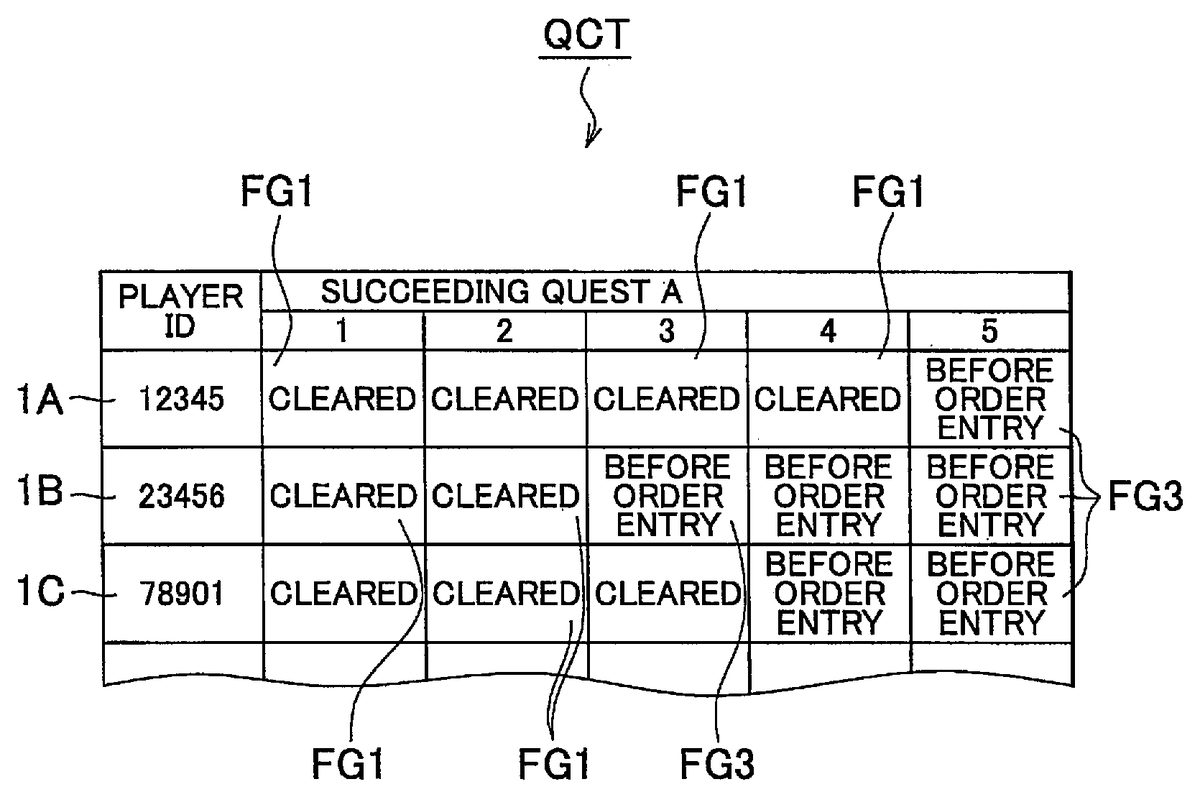
The quest proceeding controller9controls attainment states of all quests including the succeeding quest A every each player (player ID attached to each player) as a quest execution control table in the quest control memory11, and the control state is shown as shown inFIG. 2, for example, in such a manner that “cleared” flag FG1is stored in the memory if the player has already cleared the quest, “during order entry” flag FG2is stored if the player is receiving the order of the quest, and “before order entry” flag FG3is stored if the player has not yet received the order of the quest.
Among the quests, “cooperation play” to be done through two or more players cooperating with each other is set, and the succeeding quest A as shown inFIG. 5is set as “cooperation play” to be done by three players in cooperation with each other according to the game program. Then, if the player selects to execute the succeeding quest A, that is, if the order entry of the succeeding quest A is notified (order entry notice) to the game server3from some game terminal (such as the game terminal1A), the game proceeding controller8judges whether the order entries of the succeeding quest of a group including the game terminal1A have been notified from the other game terminals1(players), and if the order entry of the succeeding quest have been notified from the other game terminals (such as the game terminals1B,1C), the game proceeding controller8reads information of attainment states of the succeeding quest every each player out of the quest execution control table of each player ID that corresponds to the game terminals1A,1B and1C from which the order entry notice of the quest has been outputted by searching the quest control memory11at once.
If the order entry of the quest of the group including the game terminal1A has not been notified from the other game terminal1(player), the game proceeding controller8sends a message of inviting to receive the order of the quest in cooperation with the other game terminals1to the game terminal1A that outputted the order entry notice so as to secure a proper scenario proceeding.
After the order entry notices of the quest were outputted from the game terminal group of the game terminals1A,1B and1C to the game server3and the information of attainment of the corresponding succeeding quest was read out of the quest execution control table, the quest proceeding controller9prepares a succeeding quest control table QCT for respective players ID corresponding to the game terminals1A,1B and1C through which the order entry notices of the succeeding quest A were outputted to the game server3according to the game program, as shown inFIG. 2. The succeeding quest control table QCT is made by editing the information of attainment of the partial quests comprising the succeeding quest A for each player ID read out of the quest execution control table, and the quest proceeding controller9controls execution of the quest in the respective game terminals1A,1B and1C, while referring to the states of attainment of the partial quests shown in the succeeding quest control table QCT.
That is, the quest proceeding controller9judges the order of which partial quest of the succeeding quest A the order entry notice outputted this time through each of the game terminals1A,1B and1C receives based upon the player ID (inFIG. 2, the player ID of the game terminal1A is “12345”, the player ID of the game terminal1B is “23456”, and the player ID of the game terminal1C is “78901”) of each game terminal1that outputted the order entry notice of the succeeding quest A by referring to the state of attainment of the partial quests1to5of each game terminal1(player) in the succeeding quest A. The order entry notice from each game terminal1stores the partial quest that receives the order this time and information for specifying the other game terminals1that receives the order of the partial quest2together (that play the cooperation play) together with a cooperation play execution flag, and such a judgment is easy thereby.
And, the quest proceeding controller9judges the partial quest that the respective game terminals1A,1B and1C can receive the order based upon the succeeding quest control table QCT. According to the game program, the quest proceeding controller9controls such that the partial quests should be executed in order starting from 1, and the partial quest that has already been cleared is not possible to be executed again, but the game program includes such a cooperation play procedure that the partial quest to be executed with another players in cooperation with each other is temporarily allowed to be executed even if the partial quest has already been cleared.
InFIG. 2for example, in a normal control the player is receiving the order of the partial quest5in the game terminal1A (the player ID is “12345”) and it is not possible to receive a new order of the partial quest in the succeeding quest A and is possible to execute only the partial quest5which order is receiving. In the game terminal1B (the player ID is “23456”), only the partial quest1has been cleared and it is possible to receive the order of only partial quest2next. In the game terminal1C (the player ID is “78901”), the partial quests1through3have been cleared and it is possible to receive the order of only partial quest4next.
If the order entry notices outputted from the game terminals1A,1B and1C are ones of receiving the order of the partial quest2as the cooperation play, the quest proceeding controller9judges which of the game terminals1A,1B and1C that outputted the order entry notices has a qualification for receiving the order of the partial quest2from the information of attainment of the partial quests of the succeeding quest A. In such a case, the judgment is that the game terminal1B can receive the order of the partial quest2(can execute the partial quest2), and the other game terminals1A and1C are not possible to receive the order of the partial quest2. If the judgment is that the order entry notice includes a notice showing that the cooperation play is done and at least one of the game terminals1has a qualification for receiving the order of the partial quest shown in the order entry notice, the quest proceeding controller9starts the cooperation play procedure based upon the cooperation play execution flag shown in each order entry notice.
As shown inFIG. 6, in the cooperation play procedure, the state of attainment of the partial quest2of the succeeding quest control table QCT is rewritten and updated from “before entry order” into “during order entry” for the terminal having the qualification judged to have the qualification for receiving order of the partial quest2, that is, the game terminal1B, in Step S1as shown inFIG. 3. Subsequently, in Step S2the state of attainment of the succeeding quest A at the time when the game server3received the order entry notices of the other game terminals1A and1C that have already cleared the partial quest2but play the cooperation play in cooperation with the terminal having the qualification, that is the game terminals1A and1C as the cooperation terminals is temporarily stored in a buffer memory that is not shown (temporary memory). That is, the states of attainment of the succeeding quest A of the game terminals1A (the player ID=12345) and1C (the player ID=78901) of the succeeding quest control table QCT ofFIG. 2are stored in the buffer memory.
Subsequently, the cooperation play procedure proceeds to Step S3, and the quest proceeding controller9notifies the game terminals1A (the player ID=12345) and1C (the player ID=78901), the cooperation terminals that the present states of attainment of the succeeding quest A are temporarily preserved and changed through the communication controller7and the public communication line2. Receiving this, each cooperation terminal outputs a signal showing that the player allows to temporarily store and change the state of attainment of the succeeding quest A to the game server3through the controller1bthat is input means. In response to this, the quest proceeding controller9of the game server3enters Steps S4and S5of the cooperation play procedure, and does the procedure of rewriting the succeeding quest control table QCT so as to allow to receive the order of the partial quest the order of which the cooperation terminals received together with the terminal having the qualification.
A “cleared” flag is stored at the address of the partial quest that the cooperation terminals have already cleared in the succeeding quest control table QCT, so that the quest proceeding controller9is not able to allow the cooperation terminals to execute the partial quest2as it is since the scenario proceeding of the succeeding quest A may fail in the above-mentioned state. However, the succeeding quest control table QCT is temporarily rewritten for two or more game terminals1to which the cooperation play is requested through the cooperation play procedure. That is, the state of attainment of the succeeding quest A of the game terminal1A (player ID=12345) and1C (player ID=78901) is rewritten from “cleared-cleared-cleared-cleared-during order entry” into “cleared-during order entry-before order entry-before order entry-before order entry” for the game terminal1A (player ID=12345) and from “cleared-cleared-cleared-before order entry-before order entry” into “cleared-during order entry-before order entry-before order entry-before order entry” for the game terminal1C (player ID=78901). No specific procedure is done on the game terminal1B that is the terminal having the qualification since the partial quest2has been updated into “during order entry” in Step S1.
The succeeding quest control table QCT has been thus rewritten and changed from the state at the time of the order entry notice of the cooperation play ofFIG. 2into the state as shown inFIG. 3, in all game terminals1A,1B and1C that participate in the cooperation play, the partial quest2that is a subject for the cooperation play becomes “during order entry” and the partial quests3to5after the partial quest2become “before order entry”, that is, “before execution of quest”. The quest proceeding controller9enters Step S7after confirming that all partial quests3to5after the partial quest2that is a subject of the cooperation play of all game terminals1A,1B and1C that participate in the cooperation play are “before order entry” in Step S6, and allows all game terminals1A,1B and1C that participate in the cooperation play to execute the partial quest2.
Receiving this, the players of the respective game terminals1A,1B and1C execute the partial quest2in the game server3(Step S8ofFIG. 6). In the succeeding quest control table QCT of the respective game terminals1A,1B and1C that participate in the cooperation play, the partial quest3and the subsequent partial quests are “before order entry (before execution of quest)” in all game terminals1, so that the partial quest2of the succeeding quest A is executed in each game terminal1without failing the scenario of the succeeding quest A.
When clearing the partial quest2, the quest proceeding controller9enters Step S9of the cooperation play procedure, and the state of attainment of the partial quest2of the terminal having the qualification, that is, the game terminal1B in the succeeding quest control table QCT in the quest control memory11is changed from “during order entry” into “cleared” as shown inFIG. 4, and for the game terminals1A and1C, the cooperation terminals judged that it is not possible to execute the partial quest2, the state of attainment of the quest at the time of receiving the order of the cooperation play that was stored in buffer memory in Step S2is read out and the state of attainment of the partial quest of each cooperation terminal is recovered to the state before receiving the order of the cooperation play. Through such a procedure, the game terminals1A and1C that are the cooperation terminals can return to the states of attainment of the succeeding quest A before the cooperation play with the game terminal1B. Such return operations of the states of attainment of the game terminals1A,1C that are cooperation terminals may be done through instructions from the respective game terminals1A and1C. Then, the player of the cooperation terminal may be able to receive the orders of the partial quest2that was done through cooperation play this time and the subsequent partial quests that have been already cleared again.
After the game terminals1A and1C that are cooperation terminals return to the states of attainment of the succeeding quest A before the cooperation play with the game terminal1B and “cleared” fag is stored for the partial quest2that is the subject for the cooperation play in the terminal having qualification in the succeeding quest control table QCT as shown inFIG. 4, the contents of the quest execution control table in the quest control memory11is updated into the contents of succeeding quest control table QCT and the execution of the partial quest2is finished. In a case ofFIG. 4, the partial quest5of the game terminal1A was “during order entry” before the cooperation play ofFIG. 2, but is “before order entry” after the cooperation play. In this embodiment, such a procedure is done since the game server3does not record the state of proceeding of the partial quest of each game terminal1. If the quest proceeding controller9records the state of proceeding of the quest in each partial quest, the corresponding partial quest, the partial quest5in this case may be changed from “before order entry” into “during order entry” after the cooperation play so that the partial quest5can be restarted from a predetermined scenario position in the partial quest5that the game terminal1A was executing when the game terminal1A started the cooperation play.
Claims
- A game server connected with two or more game terminals through a communication line, each of the two or more game terminals having a player associated therewith, wherein each player is discrete from other players and having an operation character assigned to the player, each of said two or more game terminals configured for the player associated with said each of said two or more game terminals to play a game online by operating the player's operation character in a virtual space provided in said game server, wherein said game is a quest that is to be cleared by the players through a cooperation play session among the players, said game server comprising: a memory unit in which attainment information representing a state of attainment of said quest for each of said players is stored, wherein the attainment information identifies whether a given player has previously cleared the quest;and a quest proceeding controller configured for: performing an execution controller that prevents execution of the quest for any player who has previously cleared that quest based upon said attainment information;performing an execution judger that determines whether or not one of the two or more game terminals is able to execute said quest, based upon said attainment information of said quest for the player associated with said one of the two or more game terminals;if the execution judger has determined from the attainment information for the player that the player has previously cleared said quest, and the order entry notice is for executing said quest as part of a new cooperation play session, performing an order entry state changer that changes the attainment information of said quest for the player, thus, identifying the player as not yet having cleared said quest;and performing a cooperation play allower that allows said two or more game terminals to execute said quest as part of the new cooperation play session.
- The game server according to claim 1 further comprising: a temporary memory that temporarily stores said attainment information for the player before the attainment information is changed by said order entry state changer;and the quest proceeding controller further configured for performing an attainment information recoverer that restores said attainment information in said memory unit by retrieving the attainment information stored in said temporary memory upon completion of said new cooperation play session.
- The game server according to claim 1 , wherein said attainment information of said quest stored in said memory unit can be one of the following three cases, 1) a case where a player has already cleared said quest, 2) a case where a player is receiving an order for said quest, and 3) a case where a player has not yet been received an order for said quest.
- The game server according to claim 1 , wherein said quest is a succeeding quest that is comprised of two or more partial quests, said partial quests are determined to be executed in a predetermined order, said order entry notice is a notice showing said partial quest is to be executed by said new cooperation play session, and said execution judger determines whether or not said particular game terminal is able to execute said partial quest, based upon said attainment information associated with said player.
- A computer readable non-transitory tangible medium that stores a player control program to be used in a game server computer, said game server connected with two or more game terminals through a communication line, each of the two or more game terminals having a player associated therewith, wherein each player is discrete from other players and having an operation character assigned to the player, each of said two or more game terminals configured for the player associated with said each of said two or more game terminals to play a game online by operating the player's operation character in a virtual space provided in said game server computer, wherein said game is a quest that is to be cleared by the players associated with each of the two or more game terminals through a cooperation play session among said players, said player control program, when executed by said game server computer, enables said game server computer to function as the following: a controller that stores attainment information in a memory, wherein the attainment information representing a state of attainment of said quest for each of said players;an execution controller that prevents execution of the quest for any player who has previously cleared that quest based upon said attainment information;an execution judger that determines whether or not one of the two or more game terminals is able to execute said quest, based upon said attainment information of said quest for the player associated with said one of the two or more game terminals, when said player inputs an order entry notice for executing said quest as part of a new cooperation play session from the one of the two or more game terminals;an order entry state changer that changes the attainment information of said quest for the player that inputted said order entry notice, thus identifying the player as not yet having cleared the quest, if the execution judger has determined from the attainment information for the player that the player has previously cleared said quest, and the order entry notice is for executing said quest as part of a new cooperation play session;and a cooperation play allower that allows said two or more game terminals to execute said quest.
- The computer-readable non-transitory tangible medium that stores player control program according to claim 5 , wherein said player control program further enables said game server computer to function as the following: a controller that controls to temporarily store said attainment information of said quest for the player in a temporary memory before the attainment information is changed by said order entry state changer;and an attainment information recoverer that restores said attainment information in said memory upon completion of said new cooperation play session by retrieving the attainment information stored in the temporary memory.
- The computer-readable non-transitory tangible medium that stores player control program according to claim 5 , wherein said attainment information of said quest stored in said memory can be one of the following three cases, 1) in a case where a player has already cleared said quest, 2) in a case where a player is receiving an order for said quest, and 3) a case where a player has not yet been received an order of said quest.
Disclaimer: Data collected from the USPTO and may be malformed, incomplete, and/or otherwise inaccurate.