U.S. Pat. No. 8,944,919
NETWORK GAME SYSTEM FOR EXECUTING EVENT IN NETWORK GAME
AssigneeKabushiki Kaisha Square Enix
Issue DateNovember 17, 2011
U.S. Patent No. 8,944,919: Network game system for executing event in network game
U.S. Patent No. 8,944,919: Network game system for executing event in network game
Issued February 3, 2015 to Square Enix

Summary:
This patent relates to a network game such as an MMORPG in which multiple players participate. When an event occurs in a network game, a movie may be played back to each player’s device so players can watch the movie at the same time. However, there are players with a variety of skills, so it is likely experienced players have already seen such a movie. From the viewpoint of just playing back a movie generally, each player may be allowed to freely skip the movie. When an event such as a battle immediately follows the end of a movie, however, the timing may vary among the players. It is not desirable that while some players are watching a movie, the others may start the battle.
Therefore, this patent was created to reliably restrain players from freely playing an event in a game which should be played together. When the party battles an opponent, the server simultaneously transmits movie playback information to each player’s device. Each of the players can skip the movie, and a screen is displayed on the screen of each player that skipped the movie. When information is received from each player’s device that indicates playback of the movie has ended, the server simultaneously transmits battle start information to each player. Therefore, players can coordinate to take down a boss together.
Abstract:
A network game system includes a server apparatus and a plurality of video game apparatuses connected to the server apparatus. A party includes player characters of a plurality of players. When the party battles with an opponent character, the server apparatus simultaneously transmits movie playback information to each video game apparatus for starting playback of a movie. Each of the players can skip the movie at a desired timing. A screen is displayed on each video game apparatus that has skipped the movie until the battle starts. When information is received from each video game apparatus that indicates playback of the movie has ended, the server apparatus simultaneously transmits battle start information to each video game apparatus.
Illustrative Claim:
1. A network game system including a server apparatus, and a plurality of terminal apparatuses connected to the server apparatus over a network, the server apparatus comprising: an event occurrence information transmitter that transmits event generating information to each of the terminal apparatuses when a predetermined event generation condition for playing an event in a game is met during the game, the terminal apparatuses comprising a party in the game and cooperating to play the event during the game; an end-of-preparation notifying information receiver that receives end-of-preparation notifying information transmitted from each of the terminal apparatuses of the party; and an event start information transmitter that simultaneously transmits event start information to all of the terminal apparatuses of the party on condition that the end-of-preparation notifying information receiver has received the end-of-preparation notifying information from all of the terminal apparatuses of the party, each terminal apparatus of the terminal apparatuses of the party comprising: an event occurrence information receiver that receives the event occurrence information transmitted from the event occurrence information transmitter; an event preparation image display that, upon reception of the event occurrence information at the event occurrence information receiver, displays an event preparation image on a display device included in the terminal apparatus and enables termination of a display of the event preparation image at a desired timing in response to a termination instruction from a player using the terminal apparatus; an end-of-preparation notifying information transmitter that transmits the end-of-preparation notifying information to the server apparatus when the display of the event preparation image is terminated; an event start information receiver that receives the event start information transmitted from the event start information transmitter; a standby processor that executes a predetermined standby process until the event start information receiver receives the event start information after the end-of-preparation notifying information transmitter has transmitted the end-of-preparation notifying information; and an event processor that executes the event during the game when the event start information receiver receives the event start information, wherein the server provides an advantage to a first game apparatus of the party over a second game apparatus of the party when the end-of-preparation notifying information receiver of the server receives the end-of-preparation notifying information from the first game apparatus before the second game apparatus.
Research By: Rachel Johns
Illustrative Figure
Abstract
A network game system includes a server apparatus and a plurality of video game apparatuses connected to the server apparatus. A party includes player characters of a plurality of players. When the party battles with an opponent character, the server apparatus simultaneously transmits movie playback information to each video game apparatus for starting playback of a movie. Each of the players can skip the movie at a desired timing. A screen is displayed on each video game apparatus that has skipped the movie until the battle starts. When information is received from each video game apparatus that indicates playback of the movie has ended, the server apparatus simultaneously transmits battle start information to each video game apparatus.
Description
BEST MODE FOR CARRYING OUT THE INVENTION An embodiment of the invention will now be described with reference to the accompanying drawings. A network game according to the embodiment is an MMORPG which progresses as a plurality of players who participate in the network game at the same time cause their own player characters in a battle field as virtual space to battle with an opponent character present in the field. In this network game, a player forms a party of a plurality of player characters composed of the player's own player character and player characters of the other players. A plurality of player characters belonging to the party co-progress with the battle. FIG. 1is a block diagram showing the general configuration of a network system where a network game according to this embodiment is played. As illustrated, the network system includes a plurality of video game apparatuses100connected to a server apparatus200over a network151like the Internet. FIG. 2is a block diagram showing the configuration of the video game apparatus100shown inFIG. 1. As illustrated, the video game apparatus100has a main body101as its main unit. The main body101includes a control unit103, a RAM (Random Access Memory)105, a hard disk drive (HDD)107, a sound processor109, a graphics processor111, a DVD/CD-ROM drive113, a communication interface115, and an interface unit117, all of which are connected to an internal bus119. The sound processor109of the main body101is connected to a sound output device125or a speaker, and the graphics processor111is connected to a display device121having a display screen122. A recording medium (in this embodiment, DVD-ROM or CD-ROM)131is mountable in the DVD/CD-ROM drive113. The communication interface115is connected to the network151. A light emitting unit160, a reception unit161, and a memory card162are connected to the interface unit117. The control unit103includes a CPU (Central Processing Unit), and a ROM (Read Only ...
BEST MODE FOR CARRYING OUT THE INVENTION
An embodiment of the invention will now be described with reference to the accompanying drawings.
A network game according to the embodiment is an MMORPG which progresses as a plurality of players who participate in the network game at the same time cause their own player characters in a battle field as virtual space to battle with an opponent character present in the field. In this network game, a player forms a party of a plurality of player characters composed of the player's own player character and player characters of the other players. A plurality of player characters belonging to the party co-progress with the battle.
FIG. 1is a block diagram showing the general configuration of a network system where a network game according to this embodiment is played. As illustrated, the network system includes a plurality of video game apparatuses100connected to a server apparatus200over a network151like the Internet.
FIG. 2is a block diagram showing the configuration of the video game apparatus100shown inFIG. 1. As illustrated, the video game apparatus100has a main body101as its main unit. The main body101includes a control unit103, a RAM (Random Access Memory)105, a hard disk drive (HDD)107, a sound processor109, a graphics processor111, a DVD/CD-ROM drive113, a communication interface115, and an interface unit117, all of which are connected to an internal bus119.
The sound processor109of the main body101is connected to a sound output device125or a speaker, and the graphics processor111is connected to a display device121having a display screen122. A recording medium (in this embodiment, DVD-ROM or CD-ROM)131is mountable in the DVD/CD-ROM drive113. The communication interface115is connected to the network151. A light emitting unit160, a reception unit161, and a memory card162are connected to the interface unit117.
The control unit103includes a CPU (Central Processing Unit), and a ROM (Read Only Memory), and executes a program stored in the HDD107or on the recording medium131to control the main body101. The control unit103includes an internal timer. The RAM105is used as a work area for the control unit103, and temporarily stores information on the positions of player characters to be described later, HP (Hit Point which will be described later), etc. The HDD107is a storage area for storing programs and data. When instructed to output sounds by a program which is being executed by the control unit103, the sound processor109interprets the instruction and outputs sound signals to the sound output device125.
The graphics processor111maps image data in a frame memory112(which is shown outside the graphics processor111inFIG. 2but is actually provided in a RAM included in a chip composing the graphics processor111) in accordance with a drawing instruction output from the control unit103, and outputs video signals to display images on the display screen122of the display device121. One frame time of images in the video signals output from the graphics processor111is, for example, 1/30 sec. There are two sets of frame memories112, one for writing and the other for reading, which are switched from one to the other for each frame period.
The DVD/CD-ROM drive113reads out programs and data from the recording medium131. The communication interface115is connected to the network151to communicate with other computers. The light emitting unit160includes a plurality of LEDs having light irradiating directions different from one another, and is located in a position having a predetermined relation with the display device121(above or under the display device121).
The input device163includes a light receiver163a, an acceleration sensor163b, and a transmission unit163c. The light receiver163areceives light emitted from each LED included in the light emitting unit160. The number and positions of LEDs whose lights can be received by the light receiver163avary depending on the direction of the input device163. The acceleration sensor163bincludes a multi-axis acceleration sensor having three or more axes, and detects the inclination and three-dimensional motion of the input device163. The input device163has directional keys and a plurality of operation buttons.
The transmission unit163ctransmits an infrared signal according to the condition of the input device163, more specifically, according to the inclination of the input device163and the direction and speed of the motion of the input device163which are detected by the acceleration sensor163b, and inputs from the directional keys and the operation buttons of the input device163. The infrared signal transmitted from the transmission unit163cis received by the reception unit161as input data from the input device163.
The interface unit117outputs input data received by the input unit161to the RAM105. The control unit103interprets the input data and performs an arithmetic operation. In response to an instruction from the control unit103, the interface unit117stores data representing the progress state of the game stored in the RAM105in the memory card162, and reads out data on the game stored in the memory card162at the time the game has been suspended, and transmits the data to the RAM105. Though not shown, a keyboard is used as the input device to input characters in a chat function to be described later. The keyboard may be of a type which inputs a signal to the interface unit117via the input device163, or of a type which directly inputs a signal to the interface unit117.
The programs and data for playing the game on the video game apparatus100, and data on a movie itself, etc. are initially stored in, for example, the recording medium131. The programs and data for the game, and data on a movie itself, etc. stored in the recording medium131are read out by the DVD/CD-ROM drive113and are loaded onto the RAM105at the time of execution. The control unit103processes the programs and data loaded onto the RAM105, outputs a drawing instruction to the graphics processor111, and outputs a sound output instruction to the sound processor109. Intermediate data which is produced while the control unit103is performing the processing is stored in the RAM105.
FIG. 3is a block diagram showing the configuration of the server apparatus200shown inFIG. 1. As shown, the server apparatus200has a main body201as its main unit. The main body201includes a control unit203, a RAM205, a hard disk drive (HDD)207, a DVD/CD-ROM drive213, and a communication interface215, all of which are connected to an internal bus219. A recording medium (DVD-ROM or CD-ROM)231is mounted in the DVD/CD-ROM drive213.
The control unit203includes a CPU and a ROM, and executes a program stored in the HDD207or on the recording medium231to control the server apparatus200. The control unit203includes an internal timer that measures a current time. The RAM205is used as a work area for the control unit203. The HDD207is a storage area for storing programs or data. The communication interface215is connected to the network151to communicate with each video game apparatus100.
The programs and data for playing a network game on the server apparatus200are initially stored in, for example, the recording medium231, and are installed in the HDD207therefrom. The programs and data are read out from the HDD207and are loaded onto the RAM205at the time of execution. The control unit203processes the programs and data loaded onto the RAM205, and progresses with the network game based on data transmitted from each video game apparatus100. Intermediate data which is produced while the control unit203is performing the processing is stored in the RAM205.
The following will explain a battle on a battle field in the network game according to the embodiment. A plurality of player characters forming a plurality of parties, and a plurality of opponent characters are present on the field in the network game. A battle between player characters and an opponent character (the following description will be given of a case where the number of opponent characters in one battle according to the embodiment is one) takes place on a battle field. When a plurality of player characters compose a party, a battle with an opponent character is fought between the party and the opponent character.
In the battle, each player character and the opponent character fight against each other, and the HP (Hit Point which will be discussed later) of each player character and the HP of the opponent character decrease every time they are attacked. Any player character or the opponent character whose HP becomes 0 is disabled. When the HP of the opponent character becomes 0, disabling the opponent character, the player characters win the battle with, and can engage in a battle with a new opponent character.
A battle may be fought with an intermission of a given period during which a movie is played back. This movie is a dynamic image relating to a battle which follows the termination of the movie, so that each player will watch the movie on his/her own video game apparatus100. When the movie terminates, each player is placed on the battle field to engage in the battle with the opponent character.
Each player may stop playing back the movie by operating the input device163before the given period elapses. The termination of the playback of a movie without waiting for the elapse of the given period is called skipping a movie. The player character of a player who performs an operation to skip the movie is placed on the battle field before those of players who have not yet stopped playing back the movie. The player characters of the players who have not yet stopped playing back the movie stay posted off the battle field. The display screen122of the video game apparatus100which has skipped the movie shows how individual player characters are placed on the battle field.
The player character which is associated with the video game apparatus100which has skipped the movie moves into the battle field from outside thereof. At this time, the display screen122of the video game apparatus100that is associated with the player character which has already skipped the movie earlier and has been placed on the battle field shows how the player characters moving onto the battle field from outside thereof appear. Differences in the player characters on the battle field and in the player characters outside the battle field, both on the display screen122, and how those player characters are moving thereon will be described in detail in the description of specific examples of the display screen122which will be given later.
The position of a player character on the battle field in a battle (hereinafter referred to as “battle position”) will be described. The battle position is determined in the order of the individual video game apparatuses100which terminate the movie (specifically, in the order the server apparatus200receives information on the termination of the movie (skip input, information on the end of the movie to be described later)). The battle position will be described below on a case where three player characters compose a party.
A first player character associated with the video game apparatus100which has skipped the movie earliest and a third player character associated with the video game apparatus100which has played back the movie till the latest time are posted at battle positions far from the opponent character. A second player character associated with the video game apparatus100which has skipped the movie next to the first player character is posted at a battle position close to the opponent character.
As the individual players are placed at battle positions at different distances from the opponent character in a battle this way, the frequency of attacks on each player character by the opponent character in an actual battle and the damage level of an attack on each player character by the opponent character (the amount of reduction in HP in a single attack) vary. The second player character close to the opponent character has a high frequency of attacks by the opponent character and a high damage level, whereas the first and third player characters far from the opponent character have low frequencies of attacks by the opponent character and low damage levels.
When a player skips the movie quickest or plays it back till the latest time, the player can place his/her own player character at an advantageous battle position with respect to the opponent character. On the other hand, when a player skips the movie next to the quickest player, the player places his/her own player character at a disadvantageous battle position.
An advantage/disadvantage in a battle may be determined by which one of attributes, fire, water or wind, each player and an opponent character have. For example, an opponent character which has the attribute of fire has a high damage level on a player character having the attribute of water, and a low damage level on a player character having the attribute of wind. An opponent character which has the attribute of wind has a high damage level on a player character having the attribute of fire, and having a low damage level on a player character which has the attribute of water. This is true of the damage level of a player character on an opponent character.
The attributes of fire, water and wind have what is called three-way standoff (each attribute is advantageous and disadvantageous over the other two attributes, respectively). Even if the battle position at a close battle distance is disadvantageous for a player character over the opponent character, therefore, when the attribute of the player character is advantageous over the attribute of the opponent character (e.g., when the player character has the attribute of fire whereas the opponent character has the attribute of water), the positioning of the player character at a battle position close to the opponent character should not necessarily be disadvantageous over the opponent character.
In case of a first battle with an opponent character, such an attribute of the opponent character may be found out when player characters which have all the three attributes actually engage in the battle with the opponent character and attack on the opponent character (from the high/low damage levels), but cannot be known before the battle starts. However, each player may have an opportunity in viewing a hint, or a video image suggesting which attribute the opponent character has in a movie played back by each video game apparatus100before the battle.
Because such a hint in a movie cannot be viewed naturally if a player performs a skip operation before the hint is shown in the movie, an early skip operation to get an advantageous battle position results in missing the hint, and hesitating to perform a skip operation not to miss the hint is likely to miss an advantageous battle position. Specific examples of the timing of displaying such a hint will be discussed in the later description of specific examples of display screens.
A player character which has terminated the playback of a movie earlier and is placed on the battle field will stand by until the playback of the movie is terminated on the video game apparatuses100of all the player characters composing the party and all the player characters are placed on the battle field. In the standby mode, a player can manipulate the input device to have a chat using a chat function provided in the network game.
In standby mode, each player can change the equipment (e.g., a weapon or protective equipment) of his/her player character, or practice the movement of the player character in a battle (e.g., practice of what is called a deadly skill or the like). Changing the equipment of a player character can suppress the amount of reduction in its own HP by a single attack by the opponent character, or increase the amount of reduction in HP of the opponent character. As for a party composed of three or more player characters, two player characters may simultaneously enter the standby mode until a battle starts, the action of each of the other player characters is controlled by the video game apparatus100of that player character except for the action into the battle field originated from the termination of the movie, and is not affected at all by the operations of the players associated with the other player characters in standby mode.
A description will be given of data which is managed by the server apparatus200and data which is stored in the video game apparatus100for the progress of the network game according to the embodiment.FIGS. 4A and 4Bare diagrams showing tables which are managed by the server apparatus200to execute the network game according to the embodiment.
FIG. 4Ashows a party management table400managing statuses for individual parties present in the network game according to the embodiment.FIG. 4Bshows a character management table410which is generated for each party and manages information on the positions, appearances, etc. of characters composing the party.
A party ID401, a participant character ID402, a battle flag403, and a before-battle flag404are stored in the party management table400shown inFIG. 4Afor each party. The party ID401is identifying information for uniquely identifying each party present on the field. The participant character ID402indicates character IDs (to be described later) of all player characters composing the party. The battle flag403indicates whether a party is restricted by a process (including a battle itself and playback of a movie) relating to a battle, and is ON (1) during a battle, and is OFF (0) otherwise.
The before-battle flag404indicates whether any player character associated with a the video game apparatus100which is playing back a movie is present in the player characters composing the party. The before-battle flag404is ON (1) when such a player character is present, and is OFF (0) otherwise. Because playback of a movie is carried out as a previous step to a battle, the battle flag403is always ON when the before-battle flag404is ON, so that the before-battle flag404will not be ON when the battle flag403is OFF.
A character ID411, a destination address412, name information413, form information414, attribute information415, position information416, HP information417, equipment information418, and a movie-ON flag419are stored in the character management table410shown inFIG. 4Bfor each character composing the party.
The character ID411is identifying information for uniquely identifying each player character present on the field. The destination address412represents an IP address assigned to specify the video game apparatus100which manipulates each respective player character. The name information413is used as information for displaying the name of a player character on the display screen122. The form information414is information used to represent the appearance (build, face, etc.) of a player character on the field.
The attribute information415is information representing which one of the attributes, fire, water or wind, a player character has. The position information416is information representing a battle position on the field or the battle field. The HP information417is information representing the value of the HP of the player character.
The equipment information418represents information on a weapon or the like equipped on the player character, and allows the player to see the appearance of the player character equipped with the weapon or the like (equipped with a sword, wearing a helmet, or the like) on the display screen122. The movie-ON flag419is information representing whether the video game apparatus100manipulating each respective player character is playing back a movie. The movie-ON flag419is ON (1) when the movie is being played back, and is OFF (0) when the movie is terminated.
As information for playing back a movie on each video game apparatus100is transmitted, the movie-ON flag419associated with all the video game apparatuses100is updated to “1”. As the server apparatus200receives information indicating that an input on skipping has been input from each video game apparatus100or information indicating that a movie has been played back to the end, the movie-ON flag419of said each video game apparatus100is updated to “0”.
FIG. 5is a diagram showing the structure of data stored in the video game apparatus100. A character ID501, a party ID502, name information503, form information504, attribute information505, position information506, HP information507, equipment information508, a movie-ON flag509, and other-player-character information510are stored in the video game apparatus100.
The character ID501is unique to the player character which is manipulated by the video game apparatus100where the character ID501is stored, and is the same as the character ID411stored in the character management table410. The character ID501and the character ID411uniquely specify a player character on a field and a battle field, and a video game apparatus100manipulating the player character.
The party ID502is the ID of a party composed of the player character which is manipulated by this video game apparatus100as a member, and corresponds to the party ID401stored in the party management table400. This corresponding relation can uniquely specify to which party the player character of the video game apparatus100belongs. The name information503, the form information504, the attribute information505, the position information506, the HP information507, and the equipment information508have the same contents as those pieces of information stored in the character management table410, so that exchanging information between the video game apparatus100and the server apparatus200allow those two groups of information to be consistent with each other during the progress of the game.
The movie-ON flag509is updated to “1” by reception of information for playing back a movie transmitted from the server apparatus200, and updated to “0” as information indicating that a movie will be played back is skipped, or a movie has been played back to the end.
The other-player-character information510is data needed to display player characters other than a local player character on the display screen122of each video game apparatus100, and represents information on other player characters transmitted from the server apparatus200. Information on other player characters composing the same party is managed as the other-player-character information510for each player character in the character management table410transmitted from the server apparatus200. The other-player-character information510includes the same pieces of information as the character ID411, the destination address412, the name information413, the form information414, the position information416, the equipment information418, and the movie-ON flag419for each of the other player characters belonging to the same party.
The progress of the network game according to the embodiment, and the flow of data in the network game will be described. A party composed of a plurality of player characters in this network game will battle with an opponent character on a battle field. While this battle may be started after playback of a movie on the video game apparatus100which manipulates each respective player character, each player can skip the movie on his/her own video game apparatus100.
Even when a player skips a movie on his/her own video game apparatus100, a video game apparatus100which manipulates another player character composing the party may still be playing back the movie. The battle following the movie will not start until the movie is terminated (regardless of the movie's being skipped or being played back to the end) on the video game apparatuses100of all the player characters composing the party, and the player character of any video game apparatus100which has terminated the movie is set in standby mode.
FIGS. 6A to 6Eillustrate the flow of data from the point when playback of a movie has started before a battle till the point when playback of the movie is terminated on the video game apparatuses100of all the player characters composing the party. It is assumed herein that the video game apparatuses100of a party composed of three player characters terminate the movie in order (not simultaneously).
As shown inFIG. 6A, information for causing each video game apparatus100to play back a movie (hereinafter, movie playback information) is transmitted from the server apparatus200. As a result, after the playback of the movie has started, the player character of one video game apparatus100performs an operation to skip the movie in playback first, as shown inFIG. 6B, information on a skip input originated from the operation (hereinafter, skip input information) is transmitted to the server apparatus200from the video game apparatus100.
When the server apparatus200receives the first movie skip input information, standby information including the character IDs411, the destination addresses412, the name information413, the form information414, the equipment information418, and the movie-ON flag419of other player characters composing the same party (hereinafter simply “standby information”), and the position information416which is updated to position information associated with the battle position of the local player character according to the order in which the movie has been terminated are transmitted from the server apparatus200to the video game apparatus100which has transmitted the skip input information. In this case, because this video game apparatus100has terminated the movie earliest, the video game apparatus100receives the position information416updated to position information of a battle position distant from the opponent character.
When a second movie skipping operation is performed on a video game apparatus100which manipulates another player character composing the same party, as shown inFIG. 6C, the skip input information is transmitted to the server apparatus200from this video game apparatus100. The server apparatus200which has received the skip input information transmits standby information including the position information416updated with position information on battle positions according to the order in which the movie has been terminated to the video game apparatus100which has skipped the movie and the video game apparatus100which has skipped the movie previously. Because this is the second termination of the movie to the previous termination of the movie done by the first video game apparatus100, the video game apparatus100which has transmitted this skip input information receives position information representing a battle position close to the opponent character.
As shown inFIG. 6D, skip input information associated with a last movie skipping operation, or end-of-movie information originated from the movie's being viewed to the end is transmitted to the server apparatus200from a video game apparatus100which has played back the movie to the end. The server apparatus200which has received the skip input information transmits standby information including the position information416updated with position information on battle positions according to the order in which the movie has been terminated to all the video game apparatuses100. Because this is the last termination of the movie, the video game apparatus100which has terminated the movie last receives position information representing a battle position distant from the opponent character.
As the video game apparatuses100associated with all the other player characters composing the same party have terminated playing back the movie, the battle will start. In starting the battle, to allow all the video game apparatuses100to execute a process associated with the battle at the same time, battle start information is transmitted to all the video game apparatuses100from the server apparatus200after a given period of time elapses from the transmission of the last standby information, as shown inFIG. 6E.
The following will describe routines which are respectively executed by the server apparatus200and the video game apparatuses100which are included in the network game system according to the embodiment.FIG. 7Ais a flowchart illustrating a battle routine which is executed by the server apparatus200, andFIG. 7Bis a flowchart illustrating a battle routine which is executed by the video game apparatuses100.
As shown inFIG. 7A, in the battle routine of the server apparatus200, the control unit203of the server apparatus200sets the battle flag403stored in the party management table 4000N (updates the flag to “1”) for the party which engages in the battle associated with the battle routine (step S101). The control unit203determines whether a movie is played back in the battle (step S102). When a movie is played back in the battle, movie playback information for playing back the movie on the video game apparatuses100at the same time is transmitted to the video game apparatuses100associated with all the player characters composing the party which engages in the battle (step S103). Movie playback information used herein is not data on a movie itself, but information for playing back the movie which is stored in the recording medium131of each video game apparatus100.
When the movie playback information is transmitted, the control unit203sets the before-battle flag404stored in the party management table 4000N (updates the flag to “1”) for the party which engages in the battle (step S104). The control unit203sets the movie-ON flags419stored in the character management table410ON (updates the flag to “1”) for all the player characters in the party (step S105).
Then, the control unit203performs a stand-by-for-battle process (step S106). In the stand-by-for-battle process, a process to be executed in connection to the video game apparatus100which has skipped the movie earlier and is in standby mode until the battle starts (until playback of the movie is terminated on every video game apparatus100) when playback of the movie has not terminated on every video game apparatus100yet is carried out. For example, a process associated with transmission/reception of messages in a chat with the chat function is executed, or when the equipment of a player character has been changed, reception of data on a change in the contents of the equipment information418stored in the character management table410of the server apparatus200or a process of changing the contents is carried out to change the contents.
After the stand-by-for-battle process in step S106, the control unit203determines whether skip input information associated with a movie skipping operation performed by a player is received (step S107). When having determined that skip input information has not been received yet, the control unit203determines whether end-of-movie information transmitted from any video game apparatus100as a consequence of the movie's having been played back to the end and finished without being skipped is received (step S108). When having determined that the end-of-movie information has not been received yet too, the control unit203returns to step S106.
When it is determined in step S107that the skip input information is received, or when it is determined in step S108that the end-of-movie information is received, the control unit203sets the movie-ON flag419stored in the character management table410OFF (updates the flag to “0”) for the player character of the video game apparatus100which has transmitted the received information (step S109). The control unit203updates the position information416stored in the character management table410with position information of a battle position which is decided based on the order of terminating the movie.
The control unit203transmits standby information in the updated character management table410to the video game apparatuses100associated with all the player characters in standby mode (step S110). The control unit203determines whether the movie-ON flag419stored in the character management table410is OFF (updated with “0”) for all the player characters composing the party (step S111). When it is determined that the movie-ON flag419is not OFF for all the player characters, the control unit203returns to step S106.
When it is determined that the movie-ON flag419is OFF for all the player characters, the control unit203resets the before-battle flag404stored in the party management table400OFF (updated with “0”) (step S112). When a given period of time elapses after the before-battle flag404is set OFF in step S112, or after it is determined in step S102that playback of a movie will not be executed in the battle, the control unit203simultaneously transmits battle start information for executing an in-battle process to the video game apparatuses100associated with all the player characters composing the party which engages in the battle (step S113). The control unit203executes the in-battle process (step S114), and terminates the actual process which is associated with the battle. Because this in-battle process is not related to the invention, its description will be omitted.
As shown inFIG. 7B, in the battle process of the video game apparatus100, the control unit103of the video game apparatus100determines whether the video game apparatus100has received the battle start information transmitted from the server apparatus200(step S201). When having determined that the battle start information has not been received yet, the control unit103determines whether the movie playback information transmitted from the server apparatus200has been received (step S202). When having determined that the movie playback information has not been received too, the control unit103returns to step S201.
When having determined that the movie playback information has been received, the control unit103sets the movie-ON flag509stored in the video game apparatus 1000N (updates the flag to “1”) (step S203). Then, the control unit103starts playing back the movie in response to an instruction indicated by the received movie playback information to play back the movie (step S204). The control unit103determines whether the player has performed a movie skipping operation to enter a movie skip input (step S205). When having determined that there is the skip input, the control unit103transmits skip input information to the server apparatus200(step S206).
When having determined that there is no skip input, the control unit103determines whether the movie has been played back to the end (step S207). When having determined that the movie has not been played back to the end, the control unit103returns to step S205. When having determined that the movie has been played back to the end, the control unit103transmits end-of-movie information to the server apparatus200(step S208).
After the end-of-movie information is transmitted as a result of the movie's having been played back to the end, or after the skip input information is transmitted in step S206, the control unit103resets the movie-ON flag509stored in the video game apparatus100OFF (updates the flag to “0”) (step S209). The control unit103determines whether the standby information transmitted from the server apparatus200has been received (step S210). When having determined that the standby information has been received, the control unit103updates information on the local player character stored in the video game apparatus100and the other-player-character information510based on the contents of the standby information (step S211).
The control unit103determines whether 1/30 sec is elapsed from the battle process or from the previous 1/30 sec (step S212). When it is determined that 1/30 sec is elapsed, the control unit103displays on the display screen122a display image generated by perspective transformation of space above the battle field where the local player character is present (step S213). After the display image is displayed in step S213, or after it is determined that 1/30 sec is not elapsed in step S212, the control unit103determines whether the battle start information transmitted from the server apparatus200has been received (step S214).
When having determined that the battle start information has not been received yet, the control unit103executes the stand-by-for-battle process (step S215). In the stand-by-for-battle process on the video game apparatus100, for example, an input of a message associated with the chat function, a process associated with data transmission/reception, update of the equipment information508associated with updating the equipment of the player character, if changed, and a process of transmitting the changed content to the server apparatus200, or a process associated with the action of the player character according to input information associated with the player's manipulation of the input device163in case of practicing the action of the player character in the battle is executed. After the stand-by-for-battle process, the control unit103returns to step S210.
When it is determined in step S201or step S214that the battle start information has been received, the control unit103executes the in-battle process (step S216), and terminates the battle process. Because this in-battle process is not related to the invention, its description will be omitted.
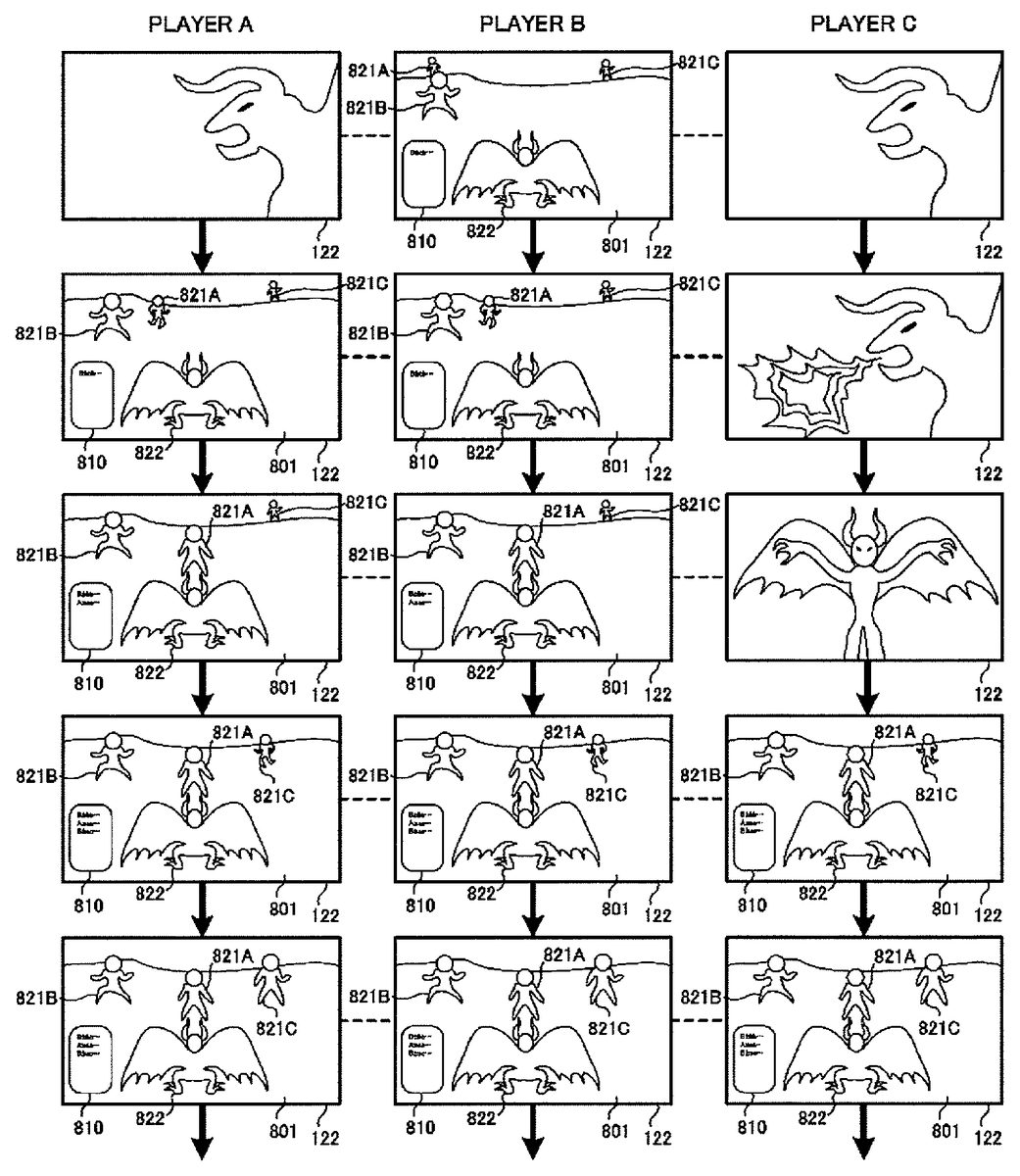
The following will describe playback of a movie before a battle in the network game, termination of the playback, and the situation in standby mode by way of specific examples of the display image displayed on the display screen122of the video game apparatus100included in the network game system according to the embodiment.FIGS. 8A to 8Eare diagrams showing specific examples of images displayed on the display screens122of individual video game apparatuses prior to a battle against the opponent character.
FIGS. 8A to 8Eshow a player A, a player B and a player C as the players who manipulate the respective video game apparatuses100on the assumption that there are three player characters composing a party.FIG. 8Ashows the display screens122of the individual video game apparatuses100at the same timing.FIG. 8Bshows the display screen122of each video game apparatus100at a timing later than the timing inFIG. 8A. Likewise,FIG. 8Cshows the display screen122of each video game apparatus100at a timing later than the timing inFIG. 8B,FIG. 8Dshows the display screen122of each video game apparatus100at a timing later than the timing inFIG. 8C, andFIG. 8Eshows the display screen122of each video game apparatus100at a timing later than the timing inFIG. 8D.
In the specific examples, the player B performs the movie skipping operation earliest after playback of the movie has started, so that the display screen122of the video game apparatus100associated with the player B enters the battle standby mode. As the player A performs the movie skipping operation next, the display screen122of the video game apparatus100associated with the player A enters the standby mode. In the remaining part of the movie after the playback of the movie is terminated through the movie skipping operation by the player A, a hint on the attribute of the opponent character against which the battle will be engaged is viewed. As the video game apparatus100associated with the player C plays back the movie to the end, the display screen122of the video game apparatus100associated with the player C enters the standby mode last.
At the timing shown inFIG. 8A, the display screen122of the video game apparatus100associated with the player B who has performed the movie skipping operation earliest is already in standby mode, and a message board810which is used for chatting, and an opponent character822and a player character821B of the player B both on a battle field801are displayed on the display screen122. In contrast, the display screens122of the video game apparatuses100associated with the other players A, C keep playing back the movie.
Since the player B has terminated the movie earliest, the display screen122of the video game apparatus100which is manipulated by the player B shows the player character821B associated with player B placed in a battle position distant from the opponent character822, and displays a display image showing that condition. Player characters821A,821C of the players A, C who keep playing back the movie on the respective video game apparatuses100are displayed smaller than the player character821B outside the battle field801.
At the timing shown inFIG. 8B, as the player A performs the movie skipping operation, the display screen122of the video game apparatus100associated with the player A and the display screen122of the video game apparatus100of the player B display the way the player character821A of the player A moves to a battle position on the battle field801from outside the battle field801. While the video game apparatus100which is manipulated by the player C keeps playing back the movie, a display image which gives a hint on the attribute of the opponent character822is displayed, enabling only the player C to view the hint.
At the timing shown inFIG. 8C, a standby state where the player character821A of the player A is placed in a battle position is displayed on the display screen122of the video game apparatus100which is manipulated by the player A. This battle position is close to the opponent character because the termination of the movie through the movie skipping operation by the player A is second to the termination of the movie done by the player B. The player character821C of the player C who has not terminated playing back the movie is displayed smaller than the player characters821A,821B who are already in standby mode and are placed in battle positions on the battle field801.
Update information of the equipment information418which is stored in the character management table410of the server apparatus200by changing the equipment of the player character821in standby mode is not transmitted until the battle start information immediately before starting the battle is transmitted to each video game apparatus100. Even when any one of the players A, B changes the equipment of his/her own player character821, thereby changing the form of the player character821on the display screen122, a change in the form of the player character821originated from a change in the equipment may not be displayed on the display screens122of the video game apparatuses100which are manipulated by the other players.
At the timing shown inFIG. 8D, the video game apparatus100which is manipulated by the player C finishes playing back the movie to the end, and the display screen122of this video game apparatus100, like the display screens122of the video game apparatuses100of the players A, B, displays the way the player character821C of the player C moves to a battle position on the battle field801from outside the battle field801.
At the timing shown inFIG. 8E, a display image showing all the player characters821including the player character821C of the player C placed in battle positions on the battle field801is displayed on the display screens122of all the video game apparatuses100. Because the video game apparatus100of the player C has played back the movie to the end, the battle position of the player character821C is distant from the opponent character822.
In the network game according to the embodiment, as described above, the server apparatus200manages the progress of a battle between a party composed of player characters821which are respectively manipulated by a plurality of players, and the opponent character822. When a battle is accompanied with playback of a movie as pre-processing, the server apparatus200transmits the movie playback information to each video game apparatus100to permit the movie to be played back on the video game apparatus100of each of the players composing the party.
The video game apparatus100which has received the movie playback information displays the movie on its display screen122, and transmits information indicative of the termination of the playback of the movie when the playback is terminated, to the server apparatus200. On condition that the server apparatus200has received the information indicative of the termination of the playback of the movie from the video game apparatuses100of all the players composing the party, the server apparatus200simultaneously transmits the battle start information to execute the battle process at the same time to all the video game apparatuses100.
As each player performs the movie skipping operation on the input device163of each video game apparatus100, playback of the movie can be terminated halfway at the desired timing of the player. Until the battle process is executed on each video game apparatus100, the video game apparatus100is in standby mode. This makes it possible to assure that all the players belonging to the same party which should progress with the game in cooperation of all the members engage in the battle in the progress of the game played by the individual players.
Because each player can chat with other players using the chat function in this standby mode, players experienced in the game who have viewed the movie several times may not be bored in spending the time until the battle takes place. In standby mode, each player can practice the action of his/her player character821by manipulating the input device163and change the equipment of the player character821. For example, a player can permit the player character to make an action (e.g., deadly skill) involving a difficult manipulation in a battle, so that the player can spend the time without being bored until the battle starts.
Even when beginners in the game view the movie to the end, such viewing of the movie will not bother experienced players, thus encouraging the beginners to actively participate in the game. What a player can do in standby mode is not only chatting, but also changing the equipment of his/her player character821, so that the player can elaborately prepare for the battle with the opponent character822.
The player characters821composing the party are displayed on the display screen122of each video game apparatus100in standby mode, the player characters821which are in standby mode are placed on the battle field801, whereas the player character821which has not yet terminated playing back the movie on the video game apparatus100is placed outside the battle field801, and is displayed smaller than the player characters821placed on the battle field801. The player characters821placed outside the battle field801moves in a manner of appearing on the battle field801to a battle position according to the order the playback of the movie is terminated when playback of the movie on the video game apparatus100is terminated.
The same condition in standby mode is displayed on the display screen122of any video game apparatus100which is set in the standby mode (though practice in the action of the player character821which reflects the manipulation by each player in standby mode, and a change in display originated from a change in equipment are not displayed), so that it is possible to easily see, through the display device, which one the players composing the party is the player of a video game apparatus100in standby mode, or the player who is playing back the movie. In other words, a player character which is still in standby mode and is not displayed on the display screen122means that its player has not terminated viewing the movie, so that other players who are still watching the movie can be identified easily.
When the members of the same party for a long period of time play the game to fight battles as mentioned above a number of times, individual players are likely to see the tendency of each player such that some players tend to always terminate a movie quickly or tend to always view a movie longer. This display of a screen where only the player characters of the players who have terminated viewing a movie appear is helpful in establishing communication with the players with one another, such as prompting a player who is always viewing a movie longer to skip the movie quickly.
Because the player characters821appearing on the battle field801appear in the order the playback of a movie is terminated, the players can get the feeling of being in live about a battle which will take place soon, making the game fun even in standby mode to wait for the initiation of the battle.
Whether the player character821appearing on the battle field801is placed in a battle position advantageous over the opponent character822(the first or third player to terminate viewing the movie) or is placed in a battle position disadvantageous over the opponent character822(the second player to terminate viewing the movie) varies depending on the order the players terminate viewing the movie. This gives a strategic aspect to the timing at which each player terminates the movie (including skipping the movie halfway and playing back the movie to the end), improving the entertainment of the game.
The individual player characters821and the opponent character822have their own attributes which have a what is called three-way standoff relation. This provides an advantage/disadvantage relation between the player characters821and the opponent character depending on the attributes. Accordingly, even if a battle position is disadvantageous over the opponent character, the relation in attribute between the player character821and the opponent character822may be advantageous over the opponent character822, thus giving a strategic aspect to the timing at which each player terminates the movie and which determines the battle position. This further improves the entertainment of the game.
Depending on a movie, an image which gives a hint on the opponent character822(attribute of the opponent character822) with which the player characters821will fight a battle to be engaged later may be displayed while the movie is played back. So, a player who has seen such an image to be a hint may progress with a subsequent battle more advantageously than a player who has skipped the movie before the image to be a hint is displayed. Accordingly, a strategy of allowing a player to decide whether to perform the movie skipping operation to terminate the playback of the movie before viewing an image to be a hint or to view such an image is added to the strategy of determining the timing of terminating the movie, thus further improving the entertainment of the game.
When a player performs a movie skipping operation on each video game apparatus100, the skip input information is transmitted to the server apparatus200as information indicating the end of the movie, whereas when the movie is played back to the end, the end-of-movie information is transmitted to the server apparatus200as information indicating the end of the movie. Every time the server apparatus200receives the information, the server apparatus200does not transmit information on the mode of each player character821(information on the action, equipment, etc.) to each video game apparatus100except for transmission of standby information to each video game apparatus100in standby mode. As a result, although the server apparatus200reduces the amount of transmission of, or the number of transmissions of, information associated with the display in standby mode, each video game apparatus100will know whether the player characters821composing the party are playing back a movie or are in standby mode, thus relieving the load on the processing of the server apparatus200.
The invention is not limited to the foregoing embodiment, and may be applied in various other forms. Modifications of the embodiment to which the invention is adaptable will be described below.
In the network game according to the embodiment, when a given period of time elapses after the server apparatus200receives information on the end of playback of a movie from the video game apparatus100that has terminated playing back the movie last, and then transmits standby information associated with the player character of this video game apparatus100to the video game apparatuses100of all the player characters composing a party, the server apparatus200transmits battle start information to synchronize the start of a battle. Instead of this synchronization, after reception of standby information associated with the player character821of the video game apparatus100that has terminated playing back the movie last, each video game apparatus100may measure a predetermined period of time from the transmission time included in the received information, and the elapse of the given period of time is set as the timing for starting a battle. This scheme can reduce the amount of data transmitted from the server apparatus200, thus relieving the load on the processing of the server apparatus200.
In the network game according to the embodiment, as a movie is skipped, the server apparatus200transmits standby information to each video game apparatus100in standby mode. Instead of this approach, the standby information may be transmitted to the video game apparatus100that is playing back a movie. At this time, upon reception of the standby information, the video game apparatus100that is playing back the movie may update various kinds of data based on the standby information, and continue to play back the movie.
In the network game according to the embodiment, a movie skipping operation is performed using the input device163to skip a movie without playing it back to the end. Instead of this scheme, a player may previous set his/her own video game apparatus100to automatically skip a movie when playback of the movie starts on the video game apparatus100(i.e., to automatically terminate the movie at the same time as playback of the movie starts). A player may be able to set information indicating that playback of a movie on his/her own video game apparatus100is unnecessary in the server apparatus200beforehand.
In the network game according to the embodiment, when a movie before a battle is skipped so that the player character821is in standby mode, it is possible to change the equipment of the player character821and practice the action thereof. If there is another player character821in standby mode, however, the equipment of the former player character821and the equipment of the another player character821may be set to be exchangeable with each other. When an item or the like to recover the HP of a player character is available in addition to the equipment, the player of this player character may exchange such an item with another item owned by the player of another player character821in standby mode.
In the network game according to the embodiment, the battle positions of the player characters821composing a party are decided by the order (skipping operation, playback of the movie to the end) in which playback of a movie on the video game apparatuses100of the individual player characters821have been terminated, and any player character821which has terminated playing back the movie earlier is set in standby mode until playback of the movie on every video game apparatus100is terminated. Instead of this approach, each player may set the equipment of his/her own player character821before a battle, and the battle positions of the player characters821may be decided by the order of finishing the setting of the equipment (specifically, the order in which a player performs an operation to indicate the end of the setting using the input device163, and input information transmitted based on the input information is processed by the server apparatus200).
Although the types of modes of battle positions in a battle are not particularly discussed in the foregoing description of the network game according to the embodiment, there may be plural types of modes of battle positions. Although the foregoing embodiment has been explained by way of example where there are three player characters821, the number of the player characters821may be four or more. This modification ensures diversification of the types of modes of battle positions, thus increasing available choices for the battle position where the player will place his/her own player character821. This improves the entertainment of the game.
When there are plural types of modes of battle positions this way, the mode of the battle position may be set to any one of the modes of battle positions before a movie is played back, or may be determined at random battle by battle. The mode of the battle position that is determined at random may be displayed as a hint in the display image in the movie which is being played back.
In the network game according to the embodiment, a battle is fought with the number of opponent characters822being one. Of course, the number of opponent characters822in a battle may be two or more. The advantage/disadvantage of the battle position of a player character821over each of the opponent characters822in a battle may vary according to the deployment of a plurality of opponent characters822on the battle field801.
When a battle involving three player characters821composing a party and two opponent characters822, for example, the player characters821can take more complicated battle positions, such as battle positions distant from one opponent character822but close to the other opponent character822, or battle positions reversed to the former battle positions, or battle positions distant from both opponent characters822or close to both other opponent characters822. This expands the strategy for each player in deciding which battle position his/her own player character821should take, i.e., in deciding at which timing playback of a movie should be terminated, thereby further improving the entertainment of the game.
There may be plural types of opponent characters822which may have different damage levels and different magnitudes of the values of HP. The deployment of such plural types of opponent characters822on the battle field may be determined according to the combination of the opponent characters in fighting a battle. The battle positions may be determined at random battle by battle. The types and deployment of the opponent characters822may be displayed as a hint in a display image while the movie is being played back.
Although a plurality of player characters821composing a party battle against the opponent character822in a battle to defeat the opponent character822in the foregoing embodiment, parties each composed of a plurality of player characters821may battle against each other in addition to, or instead of the way of fighting a battle in the embodiment. In this case, a same event (playback of a movie, or the like) may be performed with respect to all the player characters821which participate in the battle, or different events may be performed party by party. In this case, the battle should start on condition that events associated with all the player characters821are terminated. Accordingly, the advantage/disadvantage of the battle positions of the local player characters in one party varies according to the deployment of the player characters821of the opponent party. As a result, the entertainment of the game is improved further.
Although the display screen122of the video game apparatus100that is still playing back a movie does not show other than an image associated with the movie being played back (e.g., the image being the message board810for chatting), the number of players who have already skipped the movie may be displayed at a corner of the display screen122without dropping the visibility of the movie. Because the timing at which a player performs a movie skipping operation is associated with the decision on the battle position of his/her own player character821, displaying the number of players who have already skipped the movie this way further expands the strategy for each player in the movie skipping operation, thus improving the entertainment of the game.
In the network game according to the embodiment, some battles are engaged after a movie is played back. However, the network game according to the embodiment is applicable to a case where tutoring of a battle is carried out instead of playing back a movie, or together with playback of a movie. Accordingly, a beginner on the game checks the tutorial once, whereas a player who has checked the tutorial and is associated with a player character belonging to the same party as the beginner need not see it again, and can be relieved of the troublesome restraint. In the period where a player skips the tutorial and waits for other players, the player can change the equipment or practice the action of his/her own player character, so that the player will not be bored waiting for other players and can effectively use the standby period.
Although a plurality of player characters821cooperate with one another to progress with the game, and battle with an opponent character822after playback of a movie in the network game according to the embodiment, the invention may be adapted to any game which needs synchronization for the progress of the game after an event such as playback of a movie is performed. For example, the invention is adaptable to a race (such as car race or horse race) which actually starts after some event associated with the race is performed, or sports (such as soccer or baseball) whose game is actually played after some event associated with the game.
In the network game according to the embodiment, a race or sports may be played as a minigame in addition to execution of a battle. In this case, the aforementioned tutoring may be carried out before this minigame. The starting positions or the like may be decided for a race, or the positions or the like of players may be decided for sports, according to the order of the players terminating the event.
An MMORPG has been explained as a network game by way of example in the foregoing description of the embodiment. Of course, the invention may be adapted to even a simulation game where multiple players can participate as long as the game is a network game which involves changes in the progress of the game, such as a battle and an event (playback of a movie, tutoring, or the like).
According to the embodiment, the video game apparatus100or a dedicated game apparatus is used as a device which becomes the platform to play a video game. According to the invention, however, a general-purpose personal computer or the like which includes components similar to those of the video game apparatus100and has a network connecting capability may be constructed a platform. A portable game apparatus (including a cellular phone having a capability of running applications) which is configured to have the display device121and the sound output device125accommodated in the same casing as the casing of the main body101.
A semiconductor memory card may be adopted as the recording medium131in place of a DVD-ROM or CD-ROM. A card slot where the memory card is inserted may be provided in placed of the DVD/CD-ROM drive113. In case of a general-purpose personal computer, the program and data according to the invention may be provided in the form of being prestored on the HDD107, not stored in the recording medium131. Any recording medium may be optionally used to store and provide the program and data according to the invention according to the physical form of the hardware and the distribution form.
According to the embodiment, the program and data for the video game apparatus100are stored in the recording medium131for distribution. Instead, the program and data may be stored on a fixed disk apparatus included in the server apparatus located on a network, and distributed to the main body101via the network. The video game apparatus100can save the program and data, received at the communication interface115from the server apparatus200, in the HDD107, and load them into the RAM105at the time the program is run.
Claims
- A network game system including a server apparatus, and a plurality of terminal apparatuses connected to the server apparatus over a network, the server apparatus comprising: an event occurrence information transmitter that transmits event generating information to each of the terminal apparatuses when a predetermined event generation condition for playing an event in a game is met during the game, the terminal apparatuses comprising a party in the game and cooperating to play the event during the game;an end-of-preparation notifying information receiver that receives end-of-preparation notifying information transmitted from each of the terminal apparatuses of the party;and an event start information transmitter that simultaneously transmits event start information to all of the terminal apparatuses of the party on condition that the end-of-preparation notifying information receiver has received the end-of-preparation notifying information from all of the terminal apparatuses of the party, each terminal apparatus of the terminal apparatuses of the party comprising: an event occurrence information receiver that receives the event occurrence information transmitted from the event occurrence information transmitter;an event preparation image display that, upon reception of the event occurrence information at the event occurrence information receiver, displays an event preparation image on a display device included in the terminal apparatus and enables termination of a display of the event preparation image at a desired timing in response to a termination instruction from a player using the terminal apparatus;an end-of-preparation notifying information transmitter that transmits the end-of-preparation notifying information to the server apparatus when the display of the event preparation image is terminated;an event start information receiver that receives the event start information transmitted from the event start information transmitter;a standby processor that executes a predetermined standby process until the event start information receiver receives the event start information after the end-of-preparation notifying information transmitter has transmitted the end-of-preparation notifying information;and an event processor that executes the event during the game when the event start information receiver receives the event start information, wherein the server provides an advantage to a first game apparatus of the party over a second game apparatus of the party when the end-of-preparation notifying information receiver of the server receives the end-of-preparation notifying information from the first game apparatus before the second game apparatus.
- The network game system according to claim 1 , wherein the game provided by the server apparatus progresses with a local player character moved by each of the players using the terminal apparatuses of the party in response to an input from an input device included in the terminal apparatus, the server apparatus further comprises a standby information transmitter that, until the end-of-preparation notifying information receiver receives the end-of-preparation notifying information from all of the terminal apparatuses of the party after the event occurrence information transmitter has transmitted the event occurrence information, transmits standby information to an end-of-preparation-notifying-information-received terminal apparatus, the end-of-preparation-notifying-information-received terminal apparatus being any one of the terminal apparatuses of the party which has the end-of-preparation notifying information already received at the end-of-preparation notifying information receiver, the standby information permitting a standby image to be displayed on display device of the end-of-preparation-notifying-information-received terminal apparatus, the player character of any player using the end-of-preparation-notifying-information-received terminal apparatus appearing on the standby image, each of the terminal apparatuses of the party further comprises a standby information receiver that receives the standby information transmitted from the standby information transmitter, and the standby processor includes a standby image display that displays the standby image on the display device included in the terminal apparatus as the predetermined standby process based on the standby information received at the standby information receiver.
- The network game system according to claim 2 , wherein the standby processor includes a standby character manipulator that allows the local player character included in the standby image displayed on the display device included in the terminal apparatus to take an action in the standby image according to an input from the input device.
- The network game system according to claim 3 , wherein the event is a battle of the player character against at least one opponent character, and the standby character manipulator allows an action that is executable by the player character in the battle to be taken in the standby image.
- The network game system according to claim 2 , wherein the standby information represents an end-of-preparation-notifying-information-received terminal apparatus among the terminal apparatuses of the party, and is transmitted to every end-of-preparation-notifying-information-received terminal apparatus every time the end-of-preparation notifying information receiver receives the end-of-preparation notifying information from any one of the terminal apparatuses of the party, and the standby image display generates the standby image based on the information representing the end-of-preparation-notifying-information-received terminal apparatus received as the standby information, and displays the generated standby image on the display device included in the terminal apparatus.
- The network game system according to claim 2 , wherein the event start information represents an end-of-preparation-notifying-information-received terminal apparatus whose end-of-preparation notifying information has been received last by the end-of-preparation notifying information receiver in the terminal apparatuses of the party.
- The network game system according to claim 1 , wherein the event preparation image display of each terminal apparatus terminates the display of the event preparation image as each of the players using the terminal apparatuses of the party inputs a termination instruction through the input device included in the terminal apparatus while the event preparation image is being displayed.
- The network game system according to claim 1 , wherein the event preparation image display of each terminal apparatus terminates the display of the event preparation image according to presetting based on an input regarded as the termination instruction made by each of the players using the terminal apparatuses of the party through the input device included in the terminal apparatus before the event preparation image is displayed.
- The network game system according to claim 1 , wherein a degree of advantage of each of the players using the terminal apparatuses of the party on the event varies according to a timing at which the server apparatus has received the end-of-preparation notifying information.
- The network game system according to claim 1 , wherein the standby image is a dynamic image showing information useful for each of the players using the terminal apparatuses of the party to advantageously progress with the event with passage of time.
- The network game system according to claim 1 , wherein a position of each of the game apparatuses of the party is determined in an order that the end-of-preparation notifying information receiver of the server receives the end-of-preparation notifying information from each of the terminal apparatuses of the party.
- The network game system according to claim 1 , wherein a frequency of a second event during the event is determined based on an order that the end-of-preparation notifying information receiver of the server receives the end-of-preparation notifying information from each of the terminal apparatuses of the party.
- The network game system according to claim 1 , wherein the event is a battle in the game, and a battle position of each of the game apparatuses of the party is determined in an order that the end-of-preparation notifying information receiver of the server receives the end-of-preparation notifying information from each of the terminal apparatuses of the party.
- The network game system according to claim 13 , wherein a frequency of attack on each of the game apparatuses of the party during the battle is determined based on the battle position of each of the game apparatuses of the party.
- The network game system according to claim 1 , wherein the server provides the second game apparatus with a hint via the event preparation image which is not received by the first game apparatus.
- The network game system according to claim 1 , wherein the standby processor of each terminal apparatus of the party enables the player using the terminal apparatus to change an article of a corresponding player character of the terminal apparatus during the predetermined standby process.
- The network game system according to claim 1 , wherein a first terminal apparatus of the party and a second terminal apparatus of the party cooperate in the predetermined standby process after the end-of-preparation notifying information transmitter of each of the first terminal apparatus and the second terminal apparatus has transmitted the end-of-preparation notifying information when the end-of-preparation notifying information transmitter of a third terminal apparatus of the party has not transmitted the end-of-preparation notifying information.
- A game apparatus among a plurality of game apparatuses connected to a server apparatus over a network, the game apparatus comprising: an event occurrence information receiver that receives event occurrence information transmitted from the server apparatus when a predetermined event generation condition for playing an event in a game is met during the game, the game apparatus and the other game apparatuses comprising a party in the game and cooperating to play the event during the game;an event preparation image display that, upon reception of the event occurrence information at the event occurrence information receiver, displays an event preparation image on a display device included in the game apparatus and enables termination of a display of the event preparation image at a desired timing in response to a termination instruction from the player using the game apparatus;an end-of-preparation notifying information transmitter that transmits the end-of-preparation notifying information to the server apparatus when the display of the event preparation image is terminated;an event start information receiver that receives event start information to be simultaneously transmitted to all game apparatuses of the party on condition that the server apparatus has received the end-of-preparation notifying information from all of the game apparatuses of the party;a standby processor that executes a predetermined standby process until the event start information receiver receives the event start information after the end-of-preparation notifying information transmitter has transmitted the end-of-preparation notifying information;and an event processor that executes the event during the game when the event start information receiver receives the event start information, wherein the game apparatus receives an advantage, provided from the server, over an other game apparatus of the party when the server receives the end-of-preparation notifying information from the game apparatus before the other game apparatus.
- A non-transitory computer readable recording medium recording a program which is executed by each of a plurality of computers connected to a server apparatus over a network, the program allowing the computers to function as: an event occurrence information receiver that receives event occurrence information transmitted from the server apparatus when a predetermined event generation condition for playing an event in a game is met during the game, the computers comprising a party in the game and cooperating to play the event during the game;an event preparation image display that, upon reception of the event occurrence information at the event occurrence information receiver, displays an event preparation image on a display device included in the computer and enables termination of a display of the event preparation image at a desired timing in response to a termination instruction from the player using the computer;an end-of-preparation notifying information transmitter that transmits the end-of-preparation notifying information to the server apparatus when the display of the event preparation image is terminated;an event start information receiver that receives event start information to be simultaneously transmitted to all of the computers of the party on condition that the server apparatus has received the end-of-preparation notifying information from all of the computers of the party;a standby processor that executes a predetermined standby process until the event start information receiver receives the event start information after the end-of-preparation notifying information transmitter has transmitted the end-of-preparation notifying information;and an event processor that executes the event during the game when the event start information receiver receives the event start information, wherein a first computer of the party receives an advantage, provided from the server, over a second computer of the party when the server receives the end-of-preparation notifying information from the first computer before the second computer.
Disclaimer: Data collected from the USPTO and may be malformed, incomplete, and/or otherwise inaccurate.