U.S. Pat. No. 8,939,836
INTERACTIVE GAME CONTROLLING METHOD FOR USE IN TOUCH PANEL DEVICE MEDIUM
AssigneeFourier Information Corp
Issue DateApril 10, 2013
Illustrative Figure
Abstract
The present invention relates to an interactive game controlling method for use in a touch panel device medium. The game includes a virtual hot zone, a virtual display range, at least one self-acting virtual object displayed on the touch panel device. An interactive program that allows users to interact with the virtual object in the virtual hot zone is executed in response to a finger tapping on the virtual hot zone. The method includes the steps of: a) receiving a touch and sensing the motion of the touch; b) moving the virtual display range where the virtual object is included in a direction opposite to the direction which the touch is moving; c) executing the interactive program to allow the user to interact with the virtual object when the virtual object is relocated to the virtual hot zone and the virtual hot zone receives a change in state of touch.
Description
DETAILED DESCRIPTION OF THE INVENTION The foregoing and other features and advantages of the invention may be more completely understood in consideration of the following detailed description of various embodiments of the invention in connection with the accompanying drawings, wherein similar numerals designate like parts. As shown inFIG. 3, the touch panel device medium, in which the interactive game controlling method according to the invention is to be used, includes a conventional touch panel device8and a processor device (not shown) provided in the touch panel device8. The touch panel device8comprises multiple pixels to make up images on the screen and is adapted to detect and identify the number of finger touches and the state and speed of finger motions on the touch panel device8and then transmit the received signals to the processor device. The received signals are computed in the processor device and then presented in the form of images and/or audio information in accordance with the executed program, which are adapted for the user to watch or identify. According to this embodiment, the interactive game controlling method is illustrated as a first-person shooter game (FPS) as shown inFIG. 3. For the purpose of convenience in illustration, an area in the touch panel device is defined to be a virtual display range12, and a visual hot zone is demonstrated as a foresight of a gun at the center ofFIG. 3and illustrated herein as a virtual shooting zone13. Any virtual figure that is displayed on the touch panel device without controlled by the user is defined as a self-acting virtual object11. Now referring the flow chart shown inFIG. 4, the touch panel device8initially receives a finger touch in Step401. In this embodiment, the touch panel device8detects and identifies the number of the initial points of the finger touch and senses the ...
DETAILED DESCRIPTION OF THE INVENTION
The foregoing and other features and advantages of the invention may be more completely understood in consideration of the following detailed description of various embodiments of the invention in connection with the accompanying drawings, wherein similar numerals designate like parts.
As shown inFIG. 3, the touch panel device medium, in which the interactive game controlling method according to the invention is to be used, includes a conventional touch panel device8and a processor device (not shown) provided in the touch panel device8. The touch panel device8comprises multiple pixels to make up images on the screen and is adapted to detect and identify the number of finger touches and the state and speed of finger motions on the touch panel device8and then transmit the received signals to the processor device. The received signals are computed in the processor device and then presented in the form of images and/or audio information in accordance with the executed program, which are adapted for the user to watch or identify. According to this embodiment, the interactive game controlling method is illustrated as a first-person shooter game (FPS) as shown inFIG. 3. For the purpose of convenience in illustration, an area in the touch panel device is defined to be a virtual display range12, and a visual hot zone is demonstrated as a foresight of a gun at the center ofFIG. 3and illustrated herein as a virtual shooting zone13. Any virtual figure that is displayed on the touch panel device without controlled by the user is defined as a self-acting virtual object11.
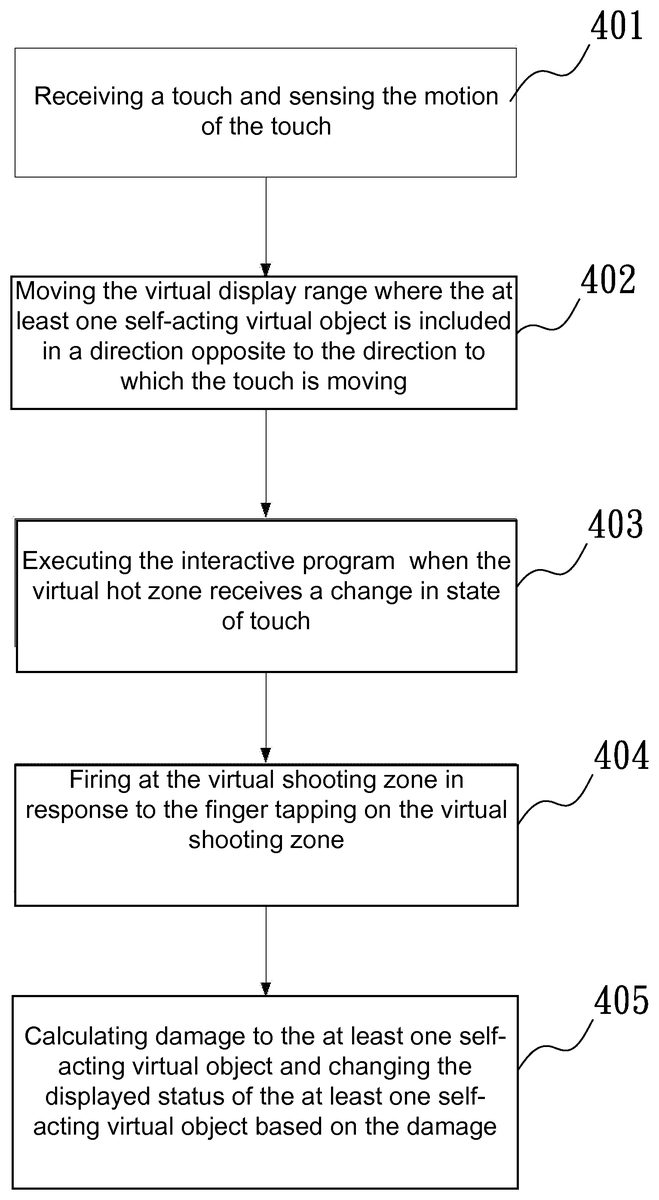
Now referring the flow chart shown inFIG. 4, the touch panel device8initially receives a finger touch in Step401. In this embodiment, the touch panel device8detects and identifies the number of the initial points of the finger touch and senses the subsequent motion of the finger touch. In Step402, when the touch panel device8identifies that the finger touch has one initial touch point and the subsequent motion of the finger touch is a finger dragging motion, the virtual display range12is moved in a direction opposite to the direction to which the finger dragging motion is advancing.
Afterwards, when the touch panel device8displays the self-acting virtual object11, namely, an enemy character, at top-left of the gaming image as shown inFIG. 5, and the virtual shooting zone13is shown at the center of gaming image, the player may want to relocate the enemy character within the virtual shooting zone13to expose the enemy character under his/her gun fire. Unlike the conventional video games where the player has to turn gun muzzle to aim at the enemy character, the method according to this embodiment allows the player to touch the enemy character with a finger and then drag the enemy character right-downwardly as indicated by the solid arrow to relocate it within the virtual shooting zone13. That is to say, the finger dragging motion inputs a vector21for dragging the enemy character into the virtual shooting zone13, by which the processor device generates an opposite vector having an equal magnitude (as indicated by the dashed arrow). The opposite vector controls the rotation and movement of the visual angle of the gaming image, so that the virtual display range12is moved left-upwardly in an opposite direction of the vector21, whereby the self-acting virtual object11located in the virtual display range12looks as if it is shifted right-downwardly.
The following step403is shown inFIG. 6. When the self-acting virtual object11is placed at the virtual shooting zone13, the player could tap on the virtual shooting zone13, which is located at the center of touch panel device8, to open fire. The processor device activates an interactive firearm firing program when the virtual shooting zone13senses the finger tapping and, therefore, receives a change in state of touch. In Step404, the player interacts with the self-acting virtual object11by activating the firearm firing program to open fire at the virtual shooting zone13. Finally, in Step405, the damage to the self-acting virtual object11is calculated based on the region tapped by the finger. For example, there would cause minor damage to the enemy if the player only attacks the enemy's limb. On the contrary, the enemy would be one hit killed if player attacks the enemy's vital point. Meanwhile, the displayed status of the virtual object is changed based on the damage.
It is apparent to those who have ordinary skill in the art that the change in state of touch described above is not limited to the finger tapping on the virtual shooting zone13after the enemy character enters the virtual shooting zone13, but also includes stopping the finger dragging motion after the enemy character is moved into the virtual shooting zone13and removing the finger from the touch panel device, which is defined herein as a release of the finger dragging motion. Therefore, the state of touch is illustrated to be a finger dragging motion according to the second preferred embodiment of the invention as shown inFIG. 7. In the case where the player doesn't release the finger dragging motion immediately after the enemy character is dragged within the virtual shooting zone13by the vector22, the enemy would be able to escape right upwards following a path111as indicated by the dotted line. In this case, the player may relocate the enemy character to the center of gaming image by inputting a vector23which is opposite to the direction which the enemy character is escaping along the path111. As shown inFIG. 9, when the enemy is relocated within the virtual shooting zone, the player may fire at the virtual shooting zone by releasing the finger dragging motion within the virtual shooting zone while changing the visual angle.
As such, when the player drags the enemy character to the virtual shooting zone with a finger and then removes the finger from the touch panel device, the processor device moves and shifts the virtual display range in a direction opposite to the finger dragging direction to track the enemy character and immediately activates the firearm firing program to open fire at the enemy character now relocated within the virtual shooting zone in response to the removal of the finger from the touch panel device. By virtue of the technical features described above, the command of moving the virtual shooting zone is integrated with the command of opening fire, thereby simplifying the operation. In short, taking advantage of the simplified operation mode, the present invention not only improves the convenience of changing the visual angle of the gaming image, but also realizes an integrated operation of changing the visual angle of the gaming image and firing at the virtual shooting zone. Therefore, the present invention greatly facilitates the diversity and convenience in game controlling.
Some conventional video games provide a virtual button for the player to adjust the visual field. As described above, the addition of the virtual bottom could result in an operational burden to the player. According to the third preferred embodiment of the invention shown inFIG. 10, in the case where the player touches the touch panel device with two fingers concurrently, the touch panel device detects and identifies a two-point touch which is distinct from a one-point touch. When the player touches the enemy character with two fingers and subsequently moves the two fingers toward a certain direction along the surface of the touch panel device while sliding the two fingers away from each other to increase an interval therebetween, the finger movement generates two motion vectors24,25, whereby the virtual display range is zoomed-in and the enemy character is relocated at the midpoint of the end points of the two vectors24,25using one-half of the sum vector of the two vectors24,25as a motion vector for relocating the enemy character. Due to the three vectors, the player may enlarge the size of the enemy character while dragging it to a certain spot simultaneously. Meanwhile, the processor device is programmed to open fire when the enemy character is relocated within the virtual shooting zone. Accordingly, the embodiment disclosed herein integrates the command of zooming-in the virtual display range, the command of relocating the enemy character and the command of opening fire.
Furthermore, according to the fourth preferred embodiment of the invention as shown inFIG. 11, the invention comprises an automatic lock-on function. That is to say, when the self-acting virtual object11enters the virtual shooting zone, the player could input a lock-on command by, for example, drawing a circle surrounding the self-acting virtual object11, so that the self-acting virtual object11is locked-on in the virtual shooting zone, allowing the virtual shooting zone and the virtual display range to intimately follow up the movement of the self-acting virtual object11. As the self-acting virtual object11is locked on, the player can take his time to perform other actions. For example, the player can switch his weapon from one to another, and then calmly taps on the self-acting virtual object11to annihilate it.
It should be noted that the concept of the present invention is not limited for use in a shooting game and is also applicable to a role-playing games (abbreviated as R.P.G.) as described below, in which the virtual hot zone is a virtual conversation area. According to the fifth preferred embodiment of the invention shown inFIG. 12, the character3controlled by the player may be locked-on to track the movement of a non-player character6(NPC6). During the period of locked-on, the player can focus on management of the dialog box7which shows the dialogue with NPC. The invention can also be used when the player finds a treasure chest or a gate. In this case, the treasure chest and the gate each functions as a self-acting virtual object adapted to be opened up when dragged to a central spot of the gaming image.
By virtue of moving the virtual display range in a direction opposite to the direction to which the finger dragging motion is advancing as a means to track the self-acting virtual object in combination with performing a change in state of touch, such as a finger-tapping and a release of finger dragging motion, on the virtual hot zone, the invention generates a variety of virtual activities on a touch panel device by executing predetermined processing programs corresponding to the respective virtual activities, without using multiple complicated commands. Therefore, in the light of the technical features disclosed herein, the gaming operation becomes more easily than the conventional video games and simply requires changing touch points and touch state to accurately realize a variety of virtual activities. It doesn't need to keep one eye on many things, the player would not fall into the situation of multitasking when playing the game. In this way, it reduces the operational complexity of the game.
It should be noted that the visual hot zone can be displayed elsewhere besides at the center of the touch panel device, such as at a lower central spot, at a left central spot or at a right central spot of the touch panel device, depending on design need. It is unnecessary for the visual hot zone to be shown in the form of a circle or other geometric shapes, as long as the player can clearly know where it is according to the game instructions.
In summary, the interactive game controlling method disclosed herein provides different operation modes responsive to different numbers of touch points and touch motions. As a result, the player doesn't have to concern about the state of each operation command at all times. On one hand, it makes the game more user-friendly and easy-to-play. On the other hand, the player doesn't have to carry out every operation by himself, but leaves some commands to be executed by the processor device. In this way, the player could focus on the command control in other aspects, so as to lower the complexity of the game. The invention goes out of the boundary of the virtual buttons, thus facilitating the use of the medium space and expanding the visual area of the screen. The invention is also applicable to laptop computers, smart phones, portable game stations and so on.
While the invention has been described with reference to the preferred embodiments above, it should be recognized that the preferred embodiments are given for the purpose of illustration only and are not intended to limit the scope of the present invention and that various modifications and changes, which will be apparent to those skilled in the relevant art, may be made without departing from the spirit and scope of the invention.
Claims
- An interactive game controlling method for use in a touch panel device medium comprising a touch panel device provided with a plurality of cells and a processor device, wherein the touch panel device is adapted to detect and identify the number of one or more initial points of a touch and sensing the motion of the touch;and wherein the interactive game includes a virtual hot zone, a virtual display range and at least one self-acting virtual object displayed on the touch panel device, and wherein an interactive program that allows a user to interact with the at least one self-acting virtual object in the virtual hot zone is executed in response to a finger tapping on the virtual hot zone, the interactive game controlling method comprising the steps of: a) receiving a touch and sensing the motion of the touch;b) moving the virtual display range where the at least one self-acting virtual object is included in a direction opposite to the direction to which the touch is moving;and c) executing the interactive program to allow the user to interact with the at least one self-acting virtual object when the at least one self-acting virtual object is relocated to the virtual hot zone and the virtual hot zone receives a change in state of touch.
- The interactive game according to claim 1 , wherein the interactive game is a shooting game and the virtual hot zone is a virtual shooting zone, and wherein the change in state of touch in the step c) is a finger tapping, and wherein the interactive program is a firearm firing program and the step c) comprises the sub-steps of: c1) firing at the virtual shooting zone in response to the finger tapping on the virtual shooting zone;and c2) calculating damage to the at least one self-acting virtual object and changing the displayed status of the at least one self-acting virtual object based on the damage.
- The interactive game according to claim 2 , further comprising, subsequent to the step b), a step d) of zooming-in the virtual display range with respect to the touch point, so that the at least one self-acting virtual object is enlarged proportionally within the virtual display range.
- The interactive game according to claim 2 , further comprising, subsequent to the step b), a step e) of locking the at least one self-acting virtual object in the virtual shooting zone when the at least one self-acting virtual object is relocated to the virtual shooting zone, so that the virtual display range is moving along with the at least one self-acting virtual object.
- The interactive game according to claim 1 , wherein the interactive game is a shooting game and the virtual hot zone is a virtual shooting zone, and wherein the motion of the touch in step a) is a finger dragging motion and the change in touch condition in the step b) is a release of the finger dragging motion, and wherein the interactive program is a firearm firing program and the step c) comprises the sub-steps of: c3) firing at the virtual shooting zone in response to the release of the finger dragging motion within the virtual shooting zone;and c4) calculating damage to the at least one self-acting virtual object and changing the displayed status of the at least one self-acting virtual object based on the damage.
- The interactive game according to claim 5 , further comprising, subsequent to the step b), a step d) of zooming-in the virtual display range with respect to the touch point, so that the at least one self-acting virtual object is enlarged proportionally within the virtual display range.
- The interactive game according to claim 5 , further comprising, subsequent to the step b), a step e) of locking the at least one self-acting virtual object in the virtual shooting zone when the at least one self-acting virtual object is relocated to the virtual shooting zone, so that the virtual display range is moving along with the at least one self-acting virtual object.
Disclaimer: Data collected from the USPTO and may be malformed, incomplete, and/or otherwise inaccurate.