U.S. Pat. No. 8,905,838
DETECTING GAME PLAY-STYLE CONVERGENCE AND CHANGING GAMES
AssigneeEmpire Technology Development LLC
Issue DateJune 26, 2012
Illustrative Figure
Abstract
Gaming technologies for detecting convergence in game play and then changing a game to overcome or inhibit convergence are generally described. In one example, a representative gaming method can include: providing a game simultaneously to a plurality of computing devices; identifying a game scenario type that includes game tests provided to the computing devices; obtaining game actions from the computing devices in response to the game tests; determining a convergence of the game actions across the computing devices that pass the game tests; and changing the game tests of the game scenario type such that the game actions of the convergence fail the changed game tests. The game can be a MMORPG, the game scenario can be a battle; the game tests can be opponents; the game actions can be battle actions; and convergence can be repeated game action patterns that defeat opponents in the battles.
Description
DETAILED DESCRIPTION In the following detailed description, reference is made to the accompanying drawings, which form a part hereof. In the drawings, similar symbols typically identify similar components, unless context dictates otherwise. The illustrative embodiments described in the detailed description, drawings, and claims are not meant to be limiting. Other embodiments may be utilized, and other changes may be made, without departing from the spirit or scope of the subject matter presented herein. It will be readily understood that the aspects of the present disclosure, as generally described herein, and illustrated in the figures, can be arranged, substituted, combined, separated, and designed in a wide variety of different configurations, all of which are explicitly contemplated herein. Generally, an online game can be enjoyed by players when there is sufficient quality of experience (“QoE”) in playing the game. Maintaining the QoE can be important for long-term success of a game, especially a MMORPG that is configured to be continued and played over a substantial period of time or even played indefinitely. After a player becomes bored of a game (e.g., from low QoE) or the game becomes predictable, the player may switch to another game. As such, it can be beneficial to change a game to keep some excitement (e.g., from high QoE) and/or unpredictability so that a player feels incentivized to continue playing the same game over a substantial period of time. Accordingly, the present technology includes gaming systems, gaming networks, and gaming methods for maintaining or improving QoE in a game. The game can be any computer game that is played with multiple computing devices that communicate with each other and/or one or more gaming systems, such as a gaming system having one or more centralized game computing systems that host the game. The QoE can be improved by ...
DETAILED DESCRIPTION
In the following detailed description, reference is made to the accompanying drawings, which form a part hereof. In the drawings, similar symbols typically identify similar components, unless context dictates otherwise. The illustrative embodiments described in the detailed description, drawings, and claims are not meant to be limiting. Other embodiments may be utilized, and other changes may be made, without departing from the spirit or scope of the subject matter presented herein. It will be readily understood that the aspects of the present disclosure, as generally described herein, and illustrated in the figures, can be arranged, substituted, combined, separated, and designed in a wide variety of different configurations, all of which are explicitly contemplated herein.
Generally, an online game can be enjoyed by players when there is sufficient quality of experience (“QoE”) in playing the game. Maintaining the QoE can be important for long-term success of a game, especially a MMORPG that is configured to be continued and played over a substantial period of time or even played indefinitely. After a player becomes bored of a game (e.g., from low QoE) or the game becomes predictable, the player may switch to another game. As such, it can be beneficial to change a game to keep some excitement (e.g., from high QoE) and/or unpredictability so that a player feels incentivized to continue playing the same game over a substantial period of time.
Accordingly, the present technology includes gaming systems, gaming networks, and gaming methods for maintaining or improving QoE in a game. The game can be any computer game that is played with multiple computing devices that communicate with each other and/or one or more gaming systems, such as a gaming system having one or more centralized game computing systems that host the game. The QoE can be improved by detecting convergence in game play actions by multiple players over multiple computing devices, and then changing the game so that the game play actions that had become convergent are no longer beneficial or successful for use in the game. After the game has been changed, the players may need to learn and adapt to the changes and develop new game play actions to find a way to play the game to overcome the obstacles or accomplish goals of the game, such as by overcoming game scenarios or game tests.
In some embodiments, a reduction in QoE of playing a game can arise due to convergent game play. Convergent game play can be described as a phenomena that occurs when a player determines a successful game play action pattern having a number of game actions, which is somehow passed on to other players so that a group of players are implementing the same game play action pattern. Here, a “game play action” can include an input, keystroke or other response from a player to the game when the player is actively playing the game, and thereby the player implements the “game play action.” The game play action can be a single response, which can be exemplified in a game having battles as a single game play action battle move, such as a hit, kick, spell, weapon fire, missile file, or the like. Often, a single game play action can be insufficient to overcome a game scenario, game test, game level, game opponent, game battle, or other feature, challenge, or task in a game. As such, a player may need to implement multiple game play actions in a game play action pattern for success. The “game play action pattern” can include a number of game actions that are implemented in a pattern. Each player can implement game play actions to play the game, and thereby the “game play actions” can generally be referred to as “game actions” by the players.
A game action pattern can be any combination of game actions that are implemented together by a player by interacting with a computing device running the game. For example, a game having battles can include a player implementing a game action pattern having a combination of any of the following battle moves: hit, kick, spell, weapon fire, missile file, or the like. In some instances, the game action pattern can be implemented in a manner so as to have a sequence of game actions or sequences of game action combinations. Generally, a game action pattern can have a sequence of two or more game actions. Some game action patterns can be complex and include four, five, or higher number of game actions in a specific game action pattern where the game actions can be repeatedly and frequently implemented together in the same game action pattern. For example, a game action pattern for a battle game can include the following sequences: hit+spell; or hit+kick+spell. A game action pattern may often be repeated in the exact sequence by a player after the game action pattern is determined to be successful.
Many computing devices that run games provide keyboards, mouse input devices, knobs and buttons or the like that, when actuated in the proper manner and sequence, can cause a game action or game action pattern so that some type of player activity happens in the game. Many games may be provided with a list of knob and button actuations that can generate specific game actions or game action patterns, such as a special fight move or fight move sequence. When a combination of game actions arises from a keyboard, mouse input device knob and button actuation, and the combination of game actions becomes sequential and repeated a number of times, the combination of game actions can be considered to be a game action pattern. While various types of input can be implemented with the computing device running the game in order to generate a combination of game actions, the game actions can be analyzed for a common game action pattern, which game action pattern can be analyzed for convergent game play. For example, the computing device can record the high-level or abstracted game play actions (e.g., “sword attack,” “bow and arrow attack,” “crossbow attack,” “spell of fire magic,” “spell of frost magic,” or the like) and analyze the game play actions for a pattern that is repeated. When a pattern of game play actions is repeated, convergence may be determined. Accordingly, convergent game play can occur when a number of players adopt the same game action pattern.
Convergent game play can be described to occur when two or more specific game actions become “co-occurrent” or have “co-occurrence,” and such co-occurrent game actions are implemented repeatedly and frequently over a population of players. As used herein, when specific game actions become “co-occurrent” or have “co-occurrence,” two or more specific game actions are implemented together in a combination or sequence during game play by a player. That is, two or more specific game actions are implemented together and/or in sequence in a game action pattern so that the two or more game actions are “co-occurrent” or have “co-occurrence” with respect to the game play. For example, the game action patterns “hit+spell” or “hit+kick+spell” can have co-occurrence with respect to the individual actions (e.g., hit, kick, or spell). When two or more game actions become co-occurrent, there is an indication that at least one player is converging game play to the co-occurrent game actions. When the frequency of occurrence of co-occurrent game actions increases or passes a threshold, the co-occurrent game actions may be considered to be convergent with respect to at least one player.
When the co-occurrent game actions start being used by multiple players, for example, against a common test, then the co-occurrent game actions may be considered to be convergent game actions or be part of convergent game play.
FIG. 1includes a schematic representation of a gaming network112adapted to detect convergent game play in a game played over the gaming network112, arranged in accordance with at least some embodiments described herein. The gaming network112can include a gaming system110operably coupled to a network114that is also operably coupled with a number of computing devices116that are operated by a number of players118. The gaming system110can include a game module120, a game scenario module122, a game test module124, a gaming server126, an input stream channel128, a logging module130, a first log database132, a second log database134, a pattern detection module136, a convergence analyzing module138, a schedule module140, a game change module142, an output stream channel144, and a data mining module146. While the various components of the gaming system110are shown to be connected with lines that show the components being operably coupled in a specific configuration, any of the components in the gaming system110can be operably coupled together and can be capable of communicating data therebetween.
The gaming system110can be any type of computing system with one or more computers that can operate alone or together to run a game and to transmit game data of the game to the computing devices116, to receive game data from the computing devices116, and to analyze the game data. The gaming system110can include one or more computer-readable data storage devices (not shown) that can be configured to store game data, where the game data can include data regarding game scenarios and game tests as well as game actions or game action patterns that are implemented by any one of the players118. For example, game data can be saved in the game module120. Additionally, the gaming system110can include one or more processors (not shown) that are configured to process game data or otherwise function as a processor in the gaming system110. The game module120can include computer-readable instructions that are executable by the processor to implement the game. The gaming system110can include one or more computing modules (not shown) that can be configured to implement any standard computing process or gaming process as well as any data analytical process. The gaming system110can implement a method for detecting convergent game play and changing a game in response to the convergent game play as described herein.
The gaming system110may be a unitary computing system or a distributed computing system with a number of centralized computing centers that cooperate to facilitate the game. This configuration can be found in online games where a centralized computing center in one geographical location can host certain aspects or regions of the game, while other centralized computing centers in other geographical locations can host other aspects or regions of the game. The computing devices116can hop between the different centralized computing centers of a gaming system110depending on the manner in which the game is played. However, each of the centralized computing systems can cooperate with each other such that the players118experience continuity in game play that feels like the game is seamless. Accordingly, in some embodiments, any number of centralized computing systems that run the game may be referred to collectively as the gaming system110.
The network114can be a local network, a regional network, or a world-wide network such as the Internet, which can include one or more public or private local area networks (LANs), wide area networks (WANs), or other network configurations, that can facilitate game play on a number of computing devices116that are operably coupled to the network114.
The computing devices116can be a same type of computing device or different types of computing devices116, and may be referred to as gaming devices when running a game. Any number of computing devices116can be included in the gaming network112, which can range from two or three computing devices116, to hundreds, thousands or millions of computing devices116. The computing devices116can be general home computers, gaming computers (e.g., Xbox 360, Wii, Sony Playstations, etc.), desktop computers, laptop computers, notebook computers, netbook computers, tablet computers, hand-held devices, smart phones, or any other computing device. The computing devices116can each be operated by an individual player118. Different players118may operate different computing devices116. Each of the computing devices116can include one or more user interfaces (not show), which can vary depending on the computing devices116, and can include an output user interface and an input user interface. An example output user interface may include, but is not limited to, a display screen, a speaker, a vibrator, or combinations thereof. An example input user interface may include, but is not limited to, a standard keyboard, buttons, a mouse, a stylus, a touch pad, a scroll knob, a touch screen, or combinations thereof. The players118can interface with the computing devices116through the user interfaces to receive game data, and in response to a game scenario or game test, and to input game actions into the computing devices116to generate game action data. That is, the game action data can be derived from the game actions that are input by the players118into the computing devices116, which implementations of game actions can include one or more keystrokes or other interactions with an input user interface of the computing devices116. As such, game action data can represent the game actions input into the computing devices116by the players118.
The interconnectivity of the gaming system110with the computing devices116that are operating the game with the players118allows for game play data to be received and stored by the gaming system110. During the game, each player118can implement a series of game actions into their computing device116to interact with the game. The series of game actions implemented by the player118can be in response to game tests posed by the game, and the game actions implemented by the player118can be an attempt to pass or otherwise overcome the game tests. For example, the game tests can include a certain battle or a battle against a certain monster or enemy, and thereby the series of player game actions can be implemented to win the battle or defeat the certain monster or enemy (e.g., overcome the game tests). The series of game actions can be received and stored by the gaming system110for analysis of convergence in the game action patterns.
The gaming server126can be configured to be operably coupled to and provide a game simultaneously to a number of computing devices116. The gaming server126can be operably coupled to the game module120, game scenario module122, and/or game test module124to implement the game such that the game can be played on the computing devices116. The game scenario module122can be configured to provide game scenarios to the gaming server126. The game test module124can be configured to provide game tests to the gaming server126. In some embodiments, the game scenario module122and the game test module124can be part of the overall game module120. In these and other embodiments, the game scenario module122can be configured to implement the game scenarios, and the game test module124can be configured to implement the game tests of the game scenarios. The game module120can include the game and can facilitate game play through the gaming server126, and can be configured to run the game and exchange game data with the gaming server126. The game module120can include or be coupled to the scenario module122that is configured to provide game scenarios to the gaming server126and receive game data to modulate the game scenarios during game play. The game module120can include or be coupled to the game test module124that is configured to provide game tests to the gaming server126and to receive game data to modulate the game tests during game play. The game test module124can provide appropriate game tests in accordance with the game scenarios. As such, the game scenario module122can determine the types of game tests for certain game scenario types and the game test module124can process the game tests and provide the game tests for game play. The game can include computer-executable instructions that can be stored on the one or more a computer-readable data storage devices (not shown), and run on one or more processors (not shown) or through one or more modules, such as the game module120, of the gaming system110.
Generally, a game scenario module122can include one or more game scenarios that can be represented by a scene or situation in the game. Game scenarios can vary depending on the type of game. The game scenarios can include game play output that is provided to the players118by the computing devices116. The game play output can include one or more game objects that are interacted with by player objects that are controlled by the players118, through implementing game play input into the computing devices116. The game objects can include opponents in a battle, and the player objects can include avatars of the players118. For example, the game scenarios can include battle scenarios that provide battle game data to the players118, such battle game data can include visual, sound, and vibratory stimulus, as game play output that causes the players118to provide battle game actions as game play input.
The game test module124can provide a game test to the players118that can be overcome or passed before the players118can move on or progress through the game. Each game scenario can have specific types of game tests. The game tests can include a challenge, quest, task, puzzle, battle, opponent, level boss, monster, or the like. Game tests can be designed to be overcome by game actions for each player118to progress through the game. However, game action patterns may be learned by the players118that overcome game tests in general, that overcome particular types of game tests, (e.g., monsters) or that overcome a specific game test (e.g., a specific monster).
The gaming server126can be configured to receive game action data from the computing devices116, and may be coupled to the input stream channel128as illustrated inFIG. 1. The input stream channel128may function as a conduit for game action data received by the gaming server126to be stored and/or processed by components of the gaming system110. The input stream channel128can be operably coupled to the logging module130. Generally, the logging module130can be configured to receive and record game action data from the input stream channel128, where the game action data is input into the computing devices116by the players118and transmitted over the network114to the gaming system110. As such, the logging module130can be configured to receive game data of the game actions from the computing devices116in response to game tests of the game scenarios. Also, the logging module130can record logs of any type of game data, such as battle game actions in response to battle scenarios or opponent tests, which may include any data for any of the opponents of the battles and the game actions implemented by the players118in response to the battles and/or opponents.
The logging module130can determine whether game data can be logged in the first log database132and/or in the second log database134. The first log database132can be operably coupled to the logging module130, and can have data of the game actions for the game tests. The game actions can include responses by the players118to the game tests, which game actions can be logged in the logging module130, and recorded in the first log database132and/or in the second log database134. The second log database134can be operably coupled to the logging module130, and have game actions for the game tests associated with individual computing devices116. In some embodiments, the first log database132may include game actions for the whole game while the second log database132may include game actions per player.
The first log database132can be configured to include first log data of the game actions for the game tests received from the computing devices116. The first log data of the first log database132can be independent of a specific computing device116. However, the first log data of the first log database132can be arranged to associate the game actions with the game tests. The second log database134can include second log data of the game actions for the game tests associated with the particular computing devices116that received the game actions from the players118. That is, the second log data of the second log database134can be arranged to be associated with a specific computing device116or specific player118.
The pattern detection module136can be operably coupled to the first log database132and/or the second log database134, and may be capable of obtaining game data from the logging module130or the gaming server126. The pattern detection module136can be configured to calculate frequencies of occurrence of the game action patterns from the first log database132, and can be configured to select co-occurrent game actions of the game action patterns having frequencies of occurrence exceeding a predetermined threshold (e.g., frequency of occurrence threshold). Accordingly, the pattern detection module130can extract co-occurrent game actions with high frequencies of occurrence from the first log database132. The extracted co-occurrent game actions can have high co-occurrence probabilities. The pattern detection module136can be configured to include the calculated frequency of occurrence values of the extracted game actions from the first log database132. The pattern detection module136can also include extracted co-occurrent game actions of the game action patterns from the first log database132that exceed the frequency of occurrence threshold.
The convergence analyzing module138can be operably coupled to the second log database134and to the pattern detection module136. The convergence analyzing module138can be configured to determine convergence of game actions across the number of computing devices116that pass the game tests of the game. The convergence analyzing module138can be configured to calculate the frequency of occurrence in the second log database134for the co-occurrent game actions of the game action patterns extracted by the pattern detection module136from the first log database132. Accordingly, the convergence analyzing module138can be configured to calculate frequency of occurrence of co-occurrent game actions of the second log database134for the extracted game action patterns from the pattern detection module136to determine convergence of game action patterns in response to the game tests. The convergence analyzing module138can determine co-occurrent game actions that are included in convergent game action patterns in the second log database134, when the same co-occurrent game actions are used by a number of the computing devices116. The more computing devices116that use the same game action patterns, the higher the frequency of occurrence, and thereby the higher frequency of occurrence in the second log database134indicates convergent game action patterns. Also, as the number of players using the same game action patterns increases, the likelihood of convergent game action patterns increases across a population of the computing devices116.
In some embodiments, the convergence analyzing module138can be configured to automatically detect convergence in play styles during a game for a number of different computing devices116. The term “play style” can be considered to include the game play output (e.g., game provided to players118) and the game play input (e.g., game actions implemented by the players118that respond to the game play output) such that the players118implementing the game actions can have a preferred set of game actions or preferred game action patterns that are repeated in response to the game scenarios and game tests. The players118can develop their own unique play style; however, successful and advantageous play styles can be passed between players118, such as being posted online, in forums, or distributed during the game.
The convergence analyzing module138can operate in real time during game play to monitor for convergence in play styles, or operate intermittently or periodically on a scheduled regimen to monitor for convergence. The convergence analyzing module138can use game play output data and game play input data for any period of time or duration of game play that is in real time or from saved data. The convergence analyzing module138can thereby automatically detect convergence in play style so that the gaming system110can implement a proper strategy (e.g., via the schedule module140) to change the gaming system110or game module120, to change the reaction of the game to the convergent play style such that the convergent play style has reduced success and the players118are incentivized to reduce use of the convergent play style.
The convergence analyzing module138can operate by combining analysis of a number of game action logs (e.g., the first log database132) that have a log of the game actions in response to the game tests (e.g., battle against opponent), conducted in a game scenario (e.g., general battle), and analysis of additional game action logs (e.g., the second log database134) for a game test of the players118. The players118can be an arbitrary or defined number of players118or group of players118that is a fraction of the total number of players118, or it can be all of the players118. Upon analysis, the convergence analyzing module138can determine whether there is convergence when game action patterns are found to be repeated frequently across a population of players118.
The schedule module140can be configured to schedule certain actions for the gaming system110, such as scheduling game changes in response to a determination of convergent game play. Accordingly, systematically changing the game in a manner that changes the game play during actual play or during scheduled game down times can be implemented to prevent players118from getting tired of playing the game by implementing a game change to overcome or inhibit convergent game play. As such, the schedule module140can provide information regarding the schedule of the game change to the output stream channel144so that the appropriate output data can be facilitated on schedule by the gaming server126.
In some embodiments, the schedule module140can be used in methods for implementing scheduling of game changes. The game changes can include changes to the game software, game module120, game scenario module122, game test module124, gaming server126, or gaming system110in general. The changes to the game scenarios or game tests can be configured such that the changes overcome, counteract or inhibit convergent game play. The game can be scheduled for change in accordance with maintaining or improving the QoE. For example, the game can be scheduled to be changed by a game change protocol that can automatically detect the timing at which users may be getting tired of current game scenarios or game tests by determining convergent game play, and then scheduling the game change.
In example embodiments, the schedule module140can be configured as a QoE-aware game system change scheduler that can be implemented to change the game in response to a need to maintain or improve QoE, such as in response to convergent game play. As such, the schedule module140can receive data related to QoE, and can schedule game changes to maintain or improve QoE as well as to inhibit degradation of QoE. The schedule module140can schedule game changes to occur at defined times and can issue notifications to computing devices116, and thereby the players118can be aware of gaming system changes and can schedule their gaming sessions to avoid interference from a scheduled game change.
The game change module142can be configured to change the game when game play convergence is determined. The game change module142can be configured to receive data regarding convergent game play from the convergence analyzing module138, and can then implement a protocol to change the gaming system110or game module120to change the game. As descried herein, a change to the game can be implemented by changing the gaming system110, the gaming server126, or the game module120as well as the scenario module122and/or the test module124in a manner such that the game is changed. The game change module142can change the game by receiving convergent game action patterns and changing the game so that these received convergent game action patterns are no longer effective in the game. The game change module142can either create the game change or receive the game change from an outside source, and then implement the protocol for changing the game.
The game change module142can be configured or otherwise programmed to function in a certain manner after convergence of game play has been detected. That is, the game change module142can be programmed with a game change in response to convergent game play. The types of responsive programmed functions to convergent game play can be selected from actions that can inhibit or reverse the convergent game play. Some examples of responsive programmed functions can include the gaming system110being changed in some manner so that game action patterns involved in the convergence become less useful, such as changing the game itself, changing the game module120, changing the game scenario module122, changing the game test module124, changing the implementation of the game by the gaming server126, reducing effectiveness of game action patterns against game tests, or other changes that overcome the convergent game play.
In some embodiments, the gaming system110can include the data mining module146that may be configured to mine game data, such as data related to game actions implemented by a number of computing devices116. The data mining module146can be configured to mine the game play data for certain properties. The game action data in general and game action data in response to specific game tests can be mined to identify co-occurrent game actions (e.g., game action patterns) implemented by the computing devices116that are repeated and used frequently over a period of time. The data mining module146can also mine the game data to identify the different game tests provided to computing devices116running the game, and to identify game tests that are subject to convergent game action patterns.
The process of data mining implemented by the data mining module146can use a protocol that is configured to detect auto-programs, cheat programs, player bots, or other like non-human players to detect game play actions that are repetitive and frequent over a number of computing devices116. For example, the data mining protocol can modify a technology for detecting auto-programs, such as cheating programs that perform battling actions on behalf of users and automatically accumulate experience points and items. See Mehrabi and Haghighat (Afshin Mehrabi and Abolfazl Toroghi Haghighat, “Discovering the Rules in a Poker Player's Mind Based on the Association Rule Mining”, In Proceedings of the 2009 International Conference on Computer Technology and Development—Volume 02 (ICCTD '09), Vol. 2, IEEE Computer Society, Washington, D.C., USA, 189-193). In these and other embodiments, the particular data that is mined can be set to be repetitive and frequent co-occurrent game actions for individual computing devices116, a number of computing devices116, a defined population or group of computing devices116, or all of the computing devices116. The data mining can alternately or additionally be performed by the data mining module146to find convergent game actions amongst a group of the computing devices116in response to game tests.
The gaming system110can be configured to prevent degradation of QoE over a substantial period of game play by a number of players118on computing devices116. That is, the QoE can be maintained so that the players118continue to play the game. The QoE can be maintained by changing the game to keep it fun and interesting to play. The substantial period of game play can be intermittent or continuous. By being “intermittent,” the game can be played by a player118that plays for periods of time separated by breaks. However, some games can be “continuous” and played on an ongoing basis without any interruption or breaks in play. In both the intermittent and continuous game plays, the total number of minutes played in the game or the total time that has lapsed in the real world can be the basis for a period of time of game play. The length of time for a substantial period of game play can range from playing the game over a number of days, weeks, months or even years. An example of a substantial period of time of game play in terms of real world time can include three weeks of intermittent play in the evenings before bed. Alternatively, a substantial period of time can be in terms of time in the game, which may be exemplified by fifty or one hundred or more total hours of game play.
In some instances, QoE degradation can be prevented by changing the game play of the game, such as a changing the response of the game to convergent game play. The “game play” can be considered to include the game play output of the game that is provided by the gaming server126and received by the players118via the computing devices116, and/or the “game play” can include game play input implemented by the players118that includes game play actions (i.e., game play actions can be considered to be game actions by a player) being input into the computing devices116in response to the game play output, as well as the correlation and combination of output of the game and input by the players118and how the output and input interact in the game. Accordingly, “game play” can be referenced as game play output that is received by the players118from the computing devices116, and can include game play input that is received by the computing devices116from the players118, and the correlation or combination of the game play output and the game play input. The game play can be changed after convergence to a game action pattern is detected. The change in game play can be implemented so that the game actions that were the subject of convergence become less successful or no longer successful in the game play after the game change. The game play can be changed so that the game action patterns for particular game scenarios or game tests that were successful and subject to convergence are no longer successful or beneficial for the particular game scenarios or game tests in which the game play action patterns were utilized and previously successful.
The changed game play can be implemented for a variety of reasons related to game play convergence, such as keeping a level of fairness between players118involved in a convergence of game actions with those players118that are not involved in the convergence of game play. For example, a game action pattern, such as a combination of keystrokes, can be identified as being successful to overcome a game test, and the knowledge of the combination of keystrokes can be dispersed through a number of players118. Players118that know the combination of keystrokes of the game action pattern can have an advantage over players118that don't know the game action pattern. As such, detecting a convergence in use of a specific combination of keystrokes (e.g., convergence in game action pattern), and changing the game so that the specific combination of keystrokes or game action pattern is no longer successful can prevent QoE degradation.
In some embodiment, the QoE of a game can be maintained or improved by implementing a fully automatic or semi-automatic convergence detection scheme by the convergence analyzing module138. The convergence analyzing module138can be operably coupled with the game change module142that is configured to determine a change to the game to overcome or inhibit the convergent game play. That is, the game change module142can create a change to the game that maintains or improves QoE. The game change module142can be operably coupled with the schedule module140that can schedule a game change. By being fully automatic, the game can be automatically changed by the game change module142creating a change to the game in response to detection of game play convergence by the convergence analyzing module138. By being semi-automatic, the game can be changed manually, such as by a human creating the game change and then implementing the game change via the gamming system110. For example, the game change can be created outside of the gaming system110and then introduced into the game change module142.
The embodiments described herein may be applicable to a wide variety of games that are played on computing devices116that communicate with the gaming system110. Any game that provides game tests to computing devices116and receives game actions from the computing devices116in response to that game tests can be analyzed for convergent game play and changed as described herein. The game can be of any genre or theme, including games that can be configured to obtain game data of game tests (e.g., game play output data) and responsive game action data (e.g., game play input data). For example, the keystrokes, joystick actuation, button activation, or combinations thereof, patterns thereof, or other manual actions that implement the responsive game action in response to a game test can be recorded and analyzed by the gaming system110for convergence.
FIG. 2includes a flow diagram that describes a method200for detecting convergent game play and changing a game, arranged in accordance with at least some embodiments described herein. The method200can include the following operations: “Provide Game” (block210); “Identify Game Scenario and Game test” (block212); “Obtain Responsive Game Actions” (block214); “Determine Game Play Convergence” (block216); and “Change Game” (block218).
With combined reference toFIGS. 1-2, the method200can include providing a game simultaneously to a number of computing devices116(“Provide Game” block210). The Internet can be used as the network114for providing the game as well as receiving game actions from the computing devices116.
The method200can include identifying at least one game scenario type of the game that includes at least one game test provided to the computing devices116(“Identify Game Scenario And Game Test” block212). It may be beneficial for the gaming system110to log the different game tests so that convergent game play can be analyzed for game tests generally or for specific game tests.
The method200can include obtaining game actions from the computing devices116in response to the game tests of the game scenarios (“Obtain Responsive Game Actions” block214). As such, the players118can interact with the game via the computing devices116so that the game actions that are input into the computing devices116are transmitted to the gaming system110.
The method200can include determining convergence of the game actions across the computing devices116that pass the game tests (“Determine Game Play Convergence” block216). Here, the game actions can be analyzed for co-occurrent game actions that are repeated by a number of computing devices116, and which can be successful for overcoming the game tests.
After convergence is determined, the game can be changed. As such, the method200can include changing the game tests of the game scenarios such that the game actions of the convergence fail the changed game tests (“Change Game” block218).
One skilled in the art will appreciate that, for this and other processes and methods disclosed herein, the functions performed in the processes and methods may be implemented in differing order. Furthermore, the outlined steps and operations are only provided as examples, and some of the steps and operations may be optional, combined into fewer steps and operations, or expanded into additional steps and operations without detracting from the essence of the disclosed embodiments.
FIG. 3includes a flow diagram that describes a method300for detecting convergent game play, arranged in accordance with at least some embodiments described herein. The method300can include the following operations: “Record First Log Data” (block310); “Record Second Log Data” (block312); “Extract Game Actions From First Log Data” (block314); “Calculate Frequency Of Occurrence Of Game Actions In Second Log Data” (block316); and “Compare Frequency Of Occurrence Of Game Actions With Threshold” (block318). As with all of the methods described herein, the method300ofFIG. 3can be used alone or in conjunction with any other method described herein.
With combined reference toFIGS. 1 and 3, the method300can include recording first log data into the gaming system110(“Record First Log Data” block310), where the first log data can include the game actions for the game tests received from the computing devices116. The computing system110can record the first log data into the first log database132that is independent of a specific computing device116, and arranged with respect to the game tests associated with the game actions. The first log data can be represented by Table 1 below, which is for an example game having battles.
The method300can include recording second log data into the gaming system110(“Record Second Log Data” block312), where the second log data can include the game actions for the game tests from the individual computing devices116. That is, the gaming system110can record the second log data into the second log database134that is dependent on a specific computing device116. The second log data can be represented by Table 2 below, which may also be for the example game having battles. The second log data can be recorded by any manner in which the gaming system110can record and store data, such as with the computer-readable data storage devices.
The method300can include extracting one or more game actions with high co-occurrence from the first log data in the first log database132(“Extract Game Actions From First Log Data” block314). Accordingly, data mining protocols can be used to mine the game data of the game actions for game action patterns that repeat or occur frequently during the game or in response to general or specific game scenarios or in response to general or specific game tests. The mined game actions can be co-occurrent game actions, especially co-occurrent game actions that are repeated by a number of computing devices116.
The method300can include calculating frequency of occurrence of the extracted game actions in the second log data of the second log database134(“Calculate Frequency Of Occurrence Of Game Actions In Second Log Data” block316). As such, the game actions represented by the second log data of the second log database134can be processed to calculate the frequency of occurrence of certain game actions or game action patterns that were extracted from the first log data of the first log database132.
The method300can include comparing the calculated frequency of occurrence with a frequency of occurrence threshold (“Compare Frequency Of Occurrence Of Game Actions With Threshold” block318). When the calculated frequency of occurrence is greater than or equal to the frequency of occurrence threshold, convergence of the extracted one or more game actions, and thereby convergence of game play, may be determined.
The frequency of occurrence threshold or other threshold described herein can be set at any suitable level that makes sense for game play. The threshold can be set to be higher for co-occurrent game actions with two co-occurrent game actions, than co-occurrent game action patterns with five co-occurrent game actions. That is, game action patterns with more game actions being co-occurrent can have a lower threshold with respect to occurrence than game action patterns with less game actions being co-occurrent. For example, a game action pattern having three co-occurrent game actions can have a threshold of 50% where a game action pattern having five co-occurrent game actions can have a threshold of 25%. The co-occurrent game actions may be present in response to, e.g., 20% of the game tests or 20% of a specific game test. Accordingly, a threshold associated with a frequency of occurrence of co-occurrent game may be set with respect to all game tests or with respect to a specific game test at 20%; however, other examples can include 25%, 40%, 50%, 60%, or greater than 70% of game tests or a specific game test. Alternately or additionally, the threshold can be set with respect to a percentage of players that implement a co-occurrent game action pattern being 10%, 20%, 25%, 40%, 50%, 60%, or greater than 70% of the players implementing the same co-occurrent game action pattern.
Table 1 shows an example data structure of the first log database132(e.g., Log1). When there are “n” types of game actions that can be implemented by players118, Log1can be defined as a matrix storing the numbers of game actions “Action-1” to “Action n” as integers greater than or equal to 0 for each battle (e.g., Battle-1to Battle-x). In Table 1, Time represents the time of the battle, and Battle-ID represents a unique identifier assigned to the battle. The integers greater than or equal to 0, associated with each of Action-1to Action-n, may represent the numbers of times the respective actions were performed during a battle. The gaming system110can extract game action patterns with high co-occurrence probabilities from the matrix. For example, when calculating the probability of co-occurrence of Action-1and Action-2, the gaming system can count the number of rows in which the values for both Action-1and Action-2are greater than or equal to 1, and divide the count by the total number of rows, thereby calculating the probability of co-occurrence.
TABLE 1Log 1 Data StructureTimeBattle-IDAction-1Action-2. . .Action-nTime 1Battle-111. . .0Time 2Battle-202. . .1. . .. . .. . .. . .. . .. . .Time xBattle-x10. . .1
Table 2 shows an example data structure of the second log database134(e.g., Log2). Log2records battle game action logs for each player118(e.g., Player-1to Player-m), which may include a minimum participant unit in a battle. When there are “n” types of game actions in the gaming system, with combinations of Player-ID and Battle-ID as keys, Log2can be defined as a matrix storing the numbers of “Actions1” to “Actions n” as integers greater than or equal to 0 for each battle (e.g., “Battle-1” to “Battle-x”) for each player. In Table 2, Player-ID may represent a unique identifier assigned to a given player involved in the battle, and Battle-ID may represent a unique identifier assigned to the beginning of the battle. The integers greater than or equal to 0, associated with “Action-1” to “Action-n” may represent the number of times those game actions were performed at the beginning of a battle. The information stored in the matrix portion of Log2may be identical to that of Log1. However, Log1may be temporally sorted for analyzing a specified time range or specified battle, whereas Log2may be sorted on a player-by-player basis for per-player analysis, so that the analytical methods may be different between Log1and Log2. Since a log can contain a large number of ordered lists of elements, it may be possible to perform analysis more quickly by storing Log1and Log2on separate storage devices, and/or optionally in duplicate at the cost of disk capacity.
TABLE 2Log 2 Data StructurePlayer-IDBattle-IDAction-1. . .Action-nPlayer-1Battle-110. . .. . .. . .. . .. . .Player-1Battle-x31. . .. . .Player-mBattle-12. . .. . .. . .. . .. . .Player mBattle-x31
FIG. 4includes a flow diagram that describes a method400for detecting convergent game play, arranged in accordance with at least some embodiments described herein. The method400can include the following: “Record First Log Data Of Game Actions For Game Tests” (block410); “Record Second Log Data Of Game Actions For Players” (block412); “Calculate Frequency Of Game Action Patterns Of First Log Data” (block414); “Select Game Action Patterns That Exceed Threshold” (block416); and “Calculate Frequency In Second Log Data Of Selected Game Action Patterns From First Log Data” (block418). The method400can be used in combination with any of the other methods described herein.
With combined reference toFIGS. 1 and 4, the method400can include recording first log data in the first log database132, the first log data representing the game actions for game tests from the players118(“Record First Log Data Of Game Actions For Game Tests” block410). The game actions can be logged in response to specific game tests or general game tests. Accordingly, the frequency of occurrence of co-occurrent game actions in the first log database132can vary depending on the game tests being analyzed, such as general game tests (e.g., different level bosses) or specific game tests (e.g., specific level boss).
The method400can also include recording second log data in the second log database134, the second log data representing the game actions in response to the game tests from the players118(“Record Second Log Data Of Game Actions For Players” block412). The second log database134can include the game actions implemented by the individual players118in response to the game tests, where the second log database134can have the data for the game actions organized on a per player118basis.
The method400can include calculating the frequency of occurrence of the co-occurrent game actions of the game action patterns from the first log data in the first log database132, where some combinations of co-occurrent game actions can be framed as game action patterns (“Calculate Frequency Of Game Action Patterns Of First Log Data” block414). The frequency of occurrence can be calculated by any manner that illustrates the amount or occurrence rate of co-occurrent game actions of game action patterns implemented by the players118. The co-occurrent game actions of game action patterns that are used more frequently can have a higher frequency of occurrence than game action patterns that are seldom used.
The method400can include selecting game action patterns with co-occurrent game actions in the first log database132that exist as unique game action patterns that occur at a frequency that exceeds the frequency of occurrence threshold (“Select Game Action Patterns That Exceed Threshold” block416). That is, co-occurrent game actions of game action patterns that occur with enough frequency to be labeled as unique game action patterns that are used by a number of players118can be selected for determining convergence of game play. The selected game action patterns can be the extracted game action patterns that are extracted from the first log database132.
The method400can include calculating frequency of occurrence in the second log data of the second log database134of the selected game action patterns from the first log data of the first log database132, such as game action patterns from Log1of Table 1 (“Calculate Frequency In Second Log Data Of Selected Game Action Patterns from First Log Data” block418). As such, co-occurrent game actions of game action patterns that are used frequently in the first log database132can be compared to the second log database134to determine whether or not the game action patterns are convergent. Game action patterns that are extracted from the first log database132and used frequently in the second log database134can be considered to be convergent game action patterns. Thus, convergent game action patterns can be determined when the extracted game action patterns have a frequency of occurrence in the second log database134that exceeds a frequency of occurrence threshold.
FIG. 5includes a flow diagram that describes a method500for detecting convergent game play and changing a game, arranged in accordance with at least some embodiments described herein. The method500can include the following: “Calculate Percentage Of Tests Having Co-Occurrent Game Actions” (block510); “Percentage Above Threshold?” (block512); when the percentage is above a threshold (e.g., “Yes”), “Determine Convergence” (block514); and “Change Game” (block516); when the percentage is below the threshold (e.g., “No”), “No Convergence Game Not Changed” (block518). The method500can be used in combination with any of the other methods described herein.
With combined reference toFIGS. 1 and 5, the method500can include calculating a percentage of the game tests from the second log database134that result in the extracted game action patterns having co-occurrent game actions from the logged game tests of the first log database132(“Calculate Percentage Of Tests Having Co-Occurrent Game Actions” block510). The percentage of game tests having co-occurrent game actions can be calculated on a basis of some, a portion, or all of the game tests of the second log database134. As such, the percentage of game tests that have the co-occurrent game actions can be based on the action logs of the individual players118. The extracted game action patterns can be the same across the first log database132and second log database134such that there may be convergence to the extracted game action patterns that have co-occurrent game actions when the percentage is high. Accordingly, the percentage of the game tests of the second log database134having co-occurrent game actions in game action patterns can provide insight into convergence. A relatively high percentage may suggest that the game action patterns have converged over a population of players118.
When the percentage of game tests of the second log database134having the co-occurrent game actions extracted from the first log database132is above a predetermined percentage threshold (“Percentage Above Threshold?” block512), the convergence of game play can be determined (“Determine Convergence” block514). The percentage threshold can be arbitrarily set depending on the needs of the game and level of QoE.
The method500can include changing the game to overcome convergent game play when convergent game patterns are determined (“Change Game” block516). As such, game tests of the game scenario type may be changed.
When the percentage of game tests having co-occurrent game actions is below the predetermined percentage threshold, the method300can determine that there is no convergence, and the game is not changed (“No Convergence, Game Not Changed” block518). The percentage threshold can be set at 20% in some embodiments. Alternately, the percentage threshold may be set at 25%, 40%, 50%, 60%, or greater than 70%, or other predetermined percentage threshold.
FIG. 6includes a flow diagram that describes a method600for detecting convergent game play, arranged in accordance with at least some embodiments described herein. The method600can include the following: “Determine Number Of Types Of Game Actions” (block610); “Determine Average Number Of Game Actions” (block612); “Calculate CoOccurrence Of Game Actions” (block614); and “Calculate Frequency Of Reoccurring Game Actions” (block616). The method600can be used for calculating the frequency of occurrence of co-occurrent game actions, which can be useful in determining whether or not there is convergence in game play, and can be used alone or with any of the other methods described herein. Such a method600can process one or more equations that can be used for determining frequency of occurrence of co-occurrent game actions. There may be various protocols and equations for such a determination of frequency of occurrence, where one example is provided herein; however, other suitable protocols and equations can be used.
In more detail, the method600can include determining that there are “n” types of game actions for the game tests (“Determine Number Of Types Of Game Actions” block610). Such a determination of “n” types of game actions can be implemented by data mining using the game tests and the responsive game actions.
The method600can also include determining an average number of game actions, which can be represented by “r” (“Determine Average Number Of Game Actions” block612).
The method600can then include calculating a number of possible game actions with co-occurrence to be “nHr” from Equation 1 below using the “n” types of game actions and average number of game actions “r” (“Calculate Co-Occurrence Of Game Actions” block614).
The method600can include calculating the frequency of occurrence of reoccurring combinations of co-occurrent game actions from “nHr” (“Calculate Frequency of Reoccurring Game Actions” block616). The calculated frequency of reoccurring co-occurrent game actions can provide an indication of convergent game play when the frequency is high or above a threshold.
FIG. 7includes a flow diagram that describes a method700for changing a game in response to convergent game play, arranged in accordance with at least some embodiments described herein. The method700can include the following: “Create Change To Game” (block710); “Game Changed?” (block712); if the game changed (e.g., “Yes”), “Change Game” (block714) or “Schedule Implementation Of Game Change” (block716); or if the game did not change (e.g., “No”), “Create Change To The Game” (block710). As such, the method700can be an iterative method that is processed through a number of iterations until the game is suitably changed. The method700can be used alone or in combination with any of the other methods described herein.
With combined reference toFIGS. 1 and 7, the method700can include creating a change to one or more game tests (“Create Change To Game” block710). The change to the game tests can include changes to the effectiveness of previously successful game action patterns with respect to parameters of a given one of the game tests. The change in the game can also be described with respect to the gaming response to game action patterns becoming changed or resistant to the same gaming action patterns being used repeatedly and frequently over time.
Additionally, the method700can include checking the game to determine that the change to the game tests results in failure of the game action patterns of the convergence to pass the game tests (“Game Changed” block712). That is, the game response to the convergent game action patterns can be configured so that the previously successful game action patterns fail to be useful in overcoming the game tests. The process of checking to determine whether the game has actually changed can be performed before the change to the game goes live and pushed out to the computing devices116. For example, a previous keystroke combination with co-occurrent game actions that inflicted a significant reduction in an opponent's heath or viability may become ineffective or useless by either the effectiveness being reduced or the resistance to the co-occurrent game actions being increased by the opponent. For example, a certain keystroke combination may cause a reduction of 50 health points to an opponent, and the game can be changed so that this certain keystroke combination may have reduced effectiveness so that the key stroke combination does not result in any lost health points or only a small number of health points, such as 5 health points, to the opponent or to all opponents. The reduction in effectiveness of co-occurrent game actions can disincentivize players118from performing the certain keystroke combination of the convergent game action patterns.
If the check of the game change indicates that the game has changed sufficiently in response to the co-occurrent game actions of the game action patterns to counteract convergence, the change to the game can be implemented in the actual game and pushed out to the computing devices116(“Change Game” block714). That is, if a check of the game change indicates inhibition of the convergent game play, the game change can be actually implemented and applied to the game run on the number of computing devices116.
On the other hand, if the check of the game change shows that the game is not sufficiently changed to overcome or inhibit the convergent game play, an iterative process can be performed with incremental changes to the game until a change is found that changes the game to overcome or inhibit the convergent game play.
At some point, the game may be changed in a manner sufficient to overcome convergence, but the manner in which the game is changed can be varied. After the game change is created it can be immediately implemented; however, the implementation of the game change can result in the game being down or being upgraded and unplayable for too long or during a period having typically high numbers of players118. As such, the method700can include scheduling an update to the game to implement the game change to the game tests of the game scenario type (“Schedule Implementation Of Game Change” block716). The scheduling can take various game parameters into consideration to optimize the timing to minimize adverse consequences of the implementation of the game change. Thus, scheduling can maintain QoE. Some examples of game parameters that may be considered may include peak usage times and periods, low usage times and periods, demographic usage profiles, data transceived, or the like or any combination thereof. These parameters can be used so that the selection of a time and duration of game change implementation can have minimal negative consequences with respect to the gaming system110and/or players118.
In some embodiments, the game facilitated by the gaming system110can be a MMORPG played on a number of computing devices116and hosted by the gaming system110over the gaming network112. The game scenario can be a battle environment that the players118interact with alone or with other players118, where the game scenario can be generated and controlled with the game scenario module122. The game tests can be opponents in a battle, which are usually game-created opponents that can be generated and controlled with the game test module124. The game actions can be battle game actions that include game actions typically found in a battle game.
In example embodiments, the game can include a MMORPG played on a large number (e.g., thousands, tens of thousands, hundreds of thousands to millions) of computing devices116and hosted by the gaming network112operably coupled to the gaming server126. The game scenarios can include a battle, and the game tests can include opponents in the battle. The game actions can include battle actions in response to the opponent tests and battle scenarios. The convergence of game play can be determined by the extracted, selected or otherwise identified game action patterns that have been used by a number of players118to defeat the opponents in the battles.
In some embodiments, the game can include a battle game. As such, the first log database132can have the first log data (e.g., Log1) of battle actions of the battles in the game for the number of computing devices116. In the first log database132, the battle actions (e.g., game actions) may be arranged with respect to the individual battles, and thereby may be arranged on the basis of individual scenarios or individual tests. The second log database134can have the second log data (e.g., Log2) of battle actions for individual computing devices116. In the second log database134, the battle actions (e.g., game actions) may be arranged with respect to the individual computing devices116.
FIG. 8includes a flow diagram that describes a method800for changing a game in response to convergent game play, arranged in accordance with at least some embodiments described herein. The method800can include the following: “Record Battle Action First Log Data” (block810); “Record Player Battle Action Second Log Data” (block812); “Extract Battle Action Patterns” (block814); “Calculate Percentage Of Player Battles Having The Extracted Battles” (block816); “Compare Percentage With Threshold” (block818); and “Change Game” (block820). The method800can be performed alone or in combination with any of the other methods. Here, the game can include a battle game scenario.
With combined reference toFIGS. 1 and 8, the method800can include recording first log data in the first log database132, the first log data representing battle actions of the battles in the game for the players118(“Record Battle Action First Log Data” block810). The battle actions can include combinations of keystrokes that are implemented by the players118when battling general opponents or a selected type of opponent, such as a level boss or special monster. While it can be useful to record the battle actions for a portion or all battles in the game, a representative portion of battles can be sufficient.
The method800can also include recording second log data in the second log database134, the second log data representing battle actions of battles in the game for the individual players (“Record Player Battle Action Second Log Data” block812). The second log database134can include data arranged on a per player118basis. Here, the second log database134can include the battle actions for the players118or for each player118which may or may not be linked to the battle or opponent for which the battle actions are implemented.
The gaming method800can include extracting battle action patterns with game actions having co-occurrence probabilities over a co-occurrence probability threshold from the first log database132(“Extract Battle Action Patterns” block814). The co-occurrence probabilities can be based on the co-occurrence of game actions in the battle action patterns in the first log database132.
The method800can include calculating a percentage of the battles in the second log database134having the extracted battles from the first log database132(“Calculate Percentage Of Battles Having The Extracted Battles” block816). The calculated percentage of battles having the extracted battle action patterns can provide an indication of convergent game action patterns when the percentage is at a high level or if the percentage increases over time.
The percentage can be compared against a percentage threshold (“Compare Percentage With Threshold” block818). The threshold can be arbitrary or set as desired as described above.
The gaming method800can include changing the game by changing the battles (e.g., game scenarios) or the opponents (e.g., game tests) when the percentage is above the percentage threshold (“Change Game” block820). However, in some embodiments, the game may not be changed when the percentage is below the threshold.
The protocol for changing a game to overcome or inhibit convergent game play can be applied to any MMORPG or other online game. The game can have game scenarios and game tests that can be found in any MMORPG, ranging from any challenge, quest, task, puzzle, battle, opponent, level boss, monster, or the like. For example, the game scenarios and game tests can be similar to those found in MMORPGs or other online games, such as in the World of Warcraft games, Final Fantasy games, Second Life games, or others.
One example of a reason that MMORPGs are popular and successful is the gratification that can be obtained by winning battles with monsters of the game. As such, the gratification can be obtained by overcoming or passing a game test in the form of a monster or passing a game scenario by winning a battle or overcoming a battle stage. In the battles with the monsters, players can enter keystrokes or commands that are implemented in the game as a game action, such as “attack” or “magic”, where the game actions can be in real time or on each turn or at regular intervals to conquer the monsters. The game action patterns that are successful can be duplicated and passed between players118.
In some embodiments, a player118may use a computing device116with a keyboard and a mouse to implement game actions or other game operations in MMORPGs such that the physical input may include a simple command selecting an operation that does not require complex, quick input (e.g., complex quick inputs are often required in action games). The simple game action implementation can provide a genre of games that are popular among a wide variety of players, from both young and elderly and males and females. However, the features of detecting game play convergence and changing a game can be applied to action games that have complex and timed inputs, such as any of the first-person battle games.
One obstacle in long-term operation of an MMORPG may include players118getting tired of the game due to a convergent game play by a number of the players implementing game actions that are repeated and frequently have specific game action patterns that are successful. For example, if a player118finds a combination of magic tricks or other game actions that is extremely effective as an attack against an opponent, the player118may play the game by using that combination of game actions often and repeatedly so that the same pattern of game actions is implemented frequently with high co-occurrence as to certain game actions. The repetition of co-occurrent game actions can result in the player118eventually becoming tired of the game due to the repetitive nature of the game play caused by convergent game play. The game action patterns become convergent when a number of players118implement the same game action patterns.
Additionally, one obstacle in long-term operation of MMORPGs may include the exchange of information of successful game action patterns. In part, information exchange is facilitated by the players118already being connected online, which allows the players118to exchange information with each other. As such, convenient “winning patterns” of game actions can spread rapidly through the players118or through a subpopulation of the players118.
In some embodiments, the game can be configured to change so that “winning patterns” of game actions continue to change to allow players118to adapt and learn or develop new “winning patterns” of game actions. The “winning patterns” can change so that when game action patterns become convergent, the game action patterns become ineffective. New “winning patterns” of game actions can then be created by the players118. New “winning patterns” of game actions can provide pleasure to players of MMORPGs as the player118can then tell it to other players118. Accordingly, changing the game can provide the benefit of periodically providing pleasure to the players118by the player118being able to periodically create a new “winning pattern” of game actions after a previous “winning pattern” no longer works after a game is changed. Thus, it can be beneficial to perform game play adjustment operations (e.g., gaming system and game updates) to appropriately adjust the emergence of new game tests (e.g., monsters) in response to game actions to overcome or inhibit excessive “winning patterns” of game actions. The game play adjustment operations can therefore change the game.
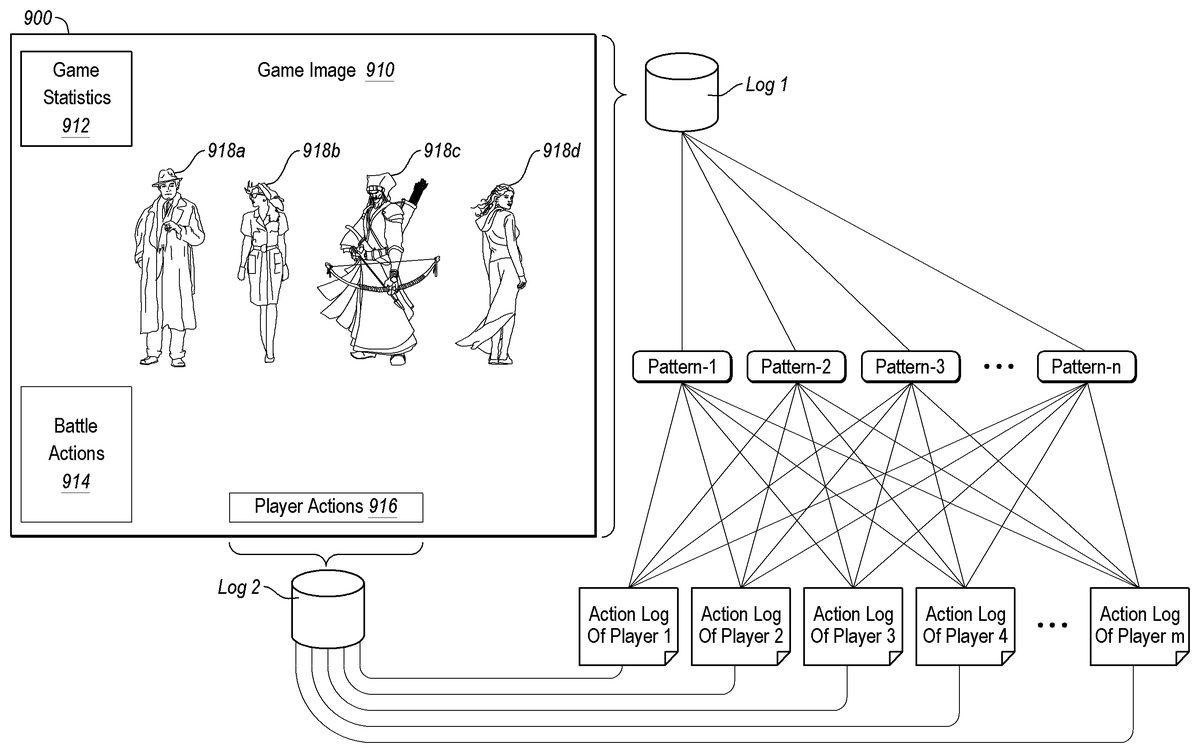
FIG. 9includes a schematic representation of a graphical user interface of a game and a data analysis protocol for detecting convergent game play, arranged in accordance with at least some embodiments described herein.FIG. 9includes: a graphical user interface900; a game image910; game statistics912; battle actions914; player actions916; player avatars918a,918b,918c,918d; Log1; Log2; “Pattern-1” to “Pattern-n”; and “Action Log Of Player1” to “Action Log Of Player m.” With combined reference toFIGS. 1 and 9, the schematic representation includes the GUI900showing the game image910of game play, which may be configured generally or specifically for a particular one of the players118, for example. The GUI900can include various types of information about the game, game scenario, game tests, friendly game players, and enemy game players, or other aspects of the game. The GUI900can include the game statistics912, the battle actions914of opponents, player actions916of current players118, and may show the player avatars918a,918b,918c,918das virtual characters. The game tests can be shown as monsters that battle the player avatars918a,918b,918c,918din the battle game scenarios. The game statistics912, battle actions914and player actions916are examples of game data. The game data shown on the GUI900or other game data can be processed to determine convergent game play.
The game data can be recorded for some, a portion, or all battles in a game and may be stored in, e.g., two types of logs: Log1(e.g., first log database132) that includes game action logs of some, a portion, or all battles in the game; and Log2(e.g., second log database134) that includes game action logs in response to the battles for some, a portion or all of the individual players118. Log1may include the game action log for battles (e.g., see Table 1), where the game action logs of the battles in the game can be analyzed. The analysis of Log1can include extraction of game action patterns with high game action co-occurrence probabilities. For example: “Pattern1” can include the following game action pattern: (Auxiliary magic for enhancing the power of magic attack)+(Fire-based whole attack magic); “Pattern2” can include the following game action pattern: (Direct attack at the compromise of agility)+(Auxiliary magic for enhancing agility)+(Auxiliary magic for reducing opponent's avoidance ability); . . . through to “Pattern n,” which can include the following game action pattern: (Action1)+(Action2)+ . . . (Action x). The game action patterns “Pattern1” through “Pattern n” can be stored and processed for convergent game play analysis. The gaming system110can record game action logs of players:1,2,3, . . . m, and compare the game actions logs with the patterns of “Pattern1” through “Pattern n.” The comparison can be performed to cross-correlate each of the battle action patterns with the action logs of the individual players118as shown.
For Log2, the game action logs of the battles of individual players118can be analyzed. Log2may include the action log of the players118(e.g., action logs of player1through player m) arranged to show the game actions in response to battles on a per player118basis (e.g., see Table 2). The analysis of Log2can include calculating the percentage of the battles including the extracted game action patterns. When the percentage of battles including the co-occurrent game actions in repeated game action patterns exceeds a threshold (e.g., 60%), it may be determined that game play convergence has occurred, and the process for game change can be performed. Thus, each of the game play patterns identified to be used frequently or repeatedly can be compared to some, a portion, or all of the game actions of the players118to see if the game action pattern is used across a number or defined subpopulation of players118. When the game action patterns are used across a subpopulation of players118, there may be convergent game play having the same game action patterns being repeated.
In some embodiments, the gaming system110can extract game action patterns with high co-occurrence probabilities from the first log database132. The game system110can process the extracted game action patterns by assuming that there are “n” types of game actions in the game system, and assuming that the average number of game actions during a game scenario or game test is “r.” The number of possible co-occurrent patterns of battle action can be expressed as “nHr,” which denotes the repeated combination of “r” actions from “n” types of action, allowing repetition. The “nHr” can be calculated according to the following Equation 1:
Hrn=Crn+r-1=(n+r-1r)=(n+r-1)!r!(n-1)!Equation1
The gaming system110can calculate the frequencies of occurrence of a portion or all combinations of co-occurrent game actions or game action patterns from the first log database132, and select certain co-occurrent game actions or game action patterns with frequencies of occurrence exceeding a predetermined threshold (e.g., 20%) as game action patterns with high game action co-occurrence probabilities.
In one embodiment, a method for determining convergence in game play actions of a game can include: providing a game simultaneously to a number of computing devices; identifying a game scenario type of the game that includes one or more game tests provided to the computing devices; obtaining one or more game actions from the computing devices in response to one or more game tests of the game scenario type; and determining a convergence of the one or more game actions across the computing devices that pass the one or more game tests. The determination of convergence in game play actions can trigger the game to be scheduled for a game change.
A method for detecting convergence in game play actions can also include: recording first log data of the one or more game actions for the one or more game tests received from the computing devices, where the first log data is independent of a specific computing device of the computing devices; recording second log data of the one or more game actions for the one or more game tests from the computing devices, where the second log data can be dependent on a specific computing device; extracting one or more game actions with high co-occurrence from the first log data; calculating frequency of occurrence of the extracted one or more co-occurrent game actions in the second log data; and comparing the calculated frequency of occurrence with a frequency of occurrence threshold, when the calculated frequency of occurrence is less than or equal to the frequency of occurrence threshold, then there may be convergence of the extracted one or more game actions.
In one embodiment, a method for detecting convergence in game play actions can include: recording first log to include game actions for one or more specific game tests from the multiple number of computing devices; recording the second log to include game actions for game tests from specific computing devices in response to the one or more specific game tests; calculating the frequency of occurrence of the combinations of co-occurrent game actions from the first log; selecting one or more game actions with co-occurrent game actions in repeated game action patterns that exceed the frequency of occurrence threshold, these selected one or more game actions being the extracted one or more game actions from the first log; and calculating frequency of occurrence in the second log of the extracted one or more game actions from the first log.
In one embodiment, the method for detecting convergence in game play can include calculating a percentage of the one or more game tests in the second log that includes the extracted one or more game actions from the first log with the one or more game tests of each computing system of the second log. When the percentage is above a predetermined percentage threshold, the convergence is determined. On the other hand, when the percentage is below the predetermined threshold, convergence is not detected.
After convergence of game actions is detected, a gaming system can implement a protocol for changing the game, such as providing a game update, so that the convergence can be overcome or inhibited. That is, the game can be changed in such a manner that the convergent game actions become less useful or useless in the game. Accordingly, the game actions involved in the convergence can become less desirable to use, and thereby the same game actions may not be used.
In one embodiment, changing a game can include creating a game change or game update that can be implemented in the gaming system or game. The convergent game action patterns can be modified by the computing system or game so that they have less effect or no effect. On the other hand, certain game scenarios or game tests can be modified by the gaming system or game so that the convergent game actions are no longer effective against the certain game scenarios or game tests.
In one embodiment, changing a game can include obtaining a game change and then testing it in the gaming system for the game to see if it changes the game in a manner to overcome or inhibit the convergence. That is, the game change can be processed through a simulation or test population of players to ensure that the convergence is overcome or inhibited before the game change is pushed out to the general population of players. As such, the protocol for changing a game can include checking that the change to the one or more game scenarios or game tests results in failure of the one or more game actions of the convergence to pass the one or more game scenarios or game tests.
The present disclosure is not to be limited in terms of the particular embodiments described in this application, which are intended as illustrations of various aspects. Many modifications and variations can be made without departing from its spirit and scope, as will be apparent to those skilled in the art. Functionally equivalent methods and apparatuses within the scope of the disclosure, in addition to those enumerated herein, will be apparent to those skilled in the art from the foregoing descriptions. Such modifications and variations are intended to fall within the scope of the appended claims. The present disclosure is to be limited only by the terms of the appended claims, along with the full scope of equivalents to which such claims are entitled. It is to be understood that this disclosure is not limited to particular methods or computing systems, which can, of course, vary. It is also to be understood that the terminology used herein is for the purpose of describing particular embodiments only, and is not intended to be limiting.
In one embodiment, the present methods can include aspects performed on a computing system. As such, the computing system can include a memory device that has the computer-executable instructions for performing the method. The computer-executable instructions can be part of a computer program product that includes one or more algorithms for performing any of the methods of any of the claims.
In one embodiment, any of the operations, processes, methods, or steps described herein can be implemented as computer-readable instructions stored on a computer-readable medium. The computer-readable instructions can be executed by a processor of a wide range of computing systems from desktop computing systems, portable computing systems, tablet computing systems, hand-held computing systems as well as network elements, and/or any other computing device.
There is little distinction left between hardware and software implementations of systems; the use of hardware or software is generally (but not always) a design choice representing cost vs. efficiency tradeoffs (in certain contexts the choice between hardware and software can become significant). There are various vehicles by which processes and/or systems and/or other technologies described herein can be effected (e.g., hardware, software, and/or firmware), and that the preferred vehicle will vary with the context in which the processes and/or systems and/or other technologies are deployed. For example, if an implementer determines that speed and accuracy are paramount, the implementer may opt for a mainly hardware and/or firmware vehicle; if flexibility is paramount, the implementer may opt for a mainly software implementation; or, yet again, alternatively, the implementer may opt for some combination of hardware, software, and/or firmware.
The foregoing detailed description has set forth various embodiments of the processes via the use of block diagrams, flowcharts, and/or examples. Insofar as such block diagrams, flowcharts, and/or examples contain one or more functions and/or operations, it will be understood by those within the art that each function and/or operation within such block diagrams, flowcharts, or examples can be implemented, individually and/or collectively, by a wide range of hardware, software, firmware, or virtually any combination thereof. In one embodiment, several portions of the subject matter described herein may be implemented via Application Specific Integrated Circuits (ASICs), Field Programmable Gate Arrays (FPGAs), digital signal processors (DSPs), or other integrated formats. However, those skilled in the art will recognize that some aspects of the embodiments disclosed herein, in whole or in part, can be equivalently implemented in integrated circuits, as one or more computer programs running on one or more computers (e.g., as one or more programs running on one or more computer systems), as one or more programs running on one or more processors (e.g., as one or more programs running on one or more microprocessors), as firmware, or as virtually any combination thereof, and that designing the circuitry and/or writing the code for the software and or firmware would be well within the skill of one of skill in the art in light of this disclosure. In addition, those skilled in the art will appreciate that the mechanisms of the subject matter described herein are capable of being distributed as a program product in a variety of forms, and that an illustrative embodiment of the subject matter described herein applies regardless of the particular type of signal bearing medium used to actually carry out the distribution. Examples of a signal bearing medium include, but are not limited to, the following: a recordable type medium such as a floppy disk, a hard disk drive, a CD, a DVD, a digital tape, a computer memory, etc.; and a transmission type medium such as a digital and/or an analog communication medium (e.g., a fiber optic cable, a waveguide, a wired communications link, a wireless communication link, etc.).
Those skilled in the art will recognize that it is common within the art to describe devices and/or processes in the fashion set forth herein, and thereafter use engineering practices to integrate such described devices and/or processes into data processing systems. That is, at least a portion of the devices and/or processes described herein can be integrated into a data processing system via a reasonable amount of experimentation. Those having skill in the art will recognize that a typical data processing system generally includes one or more of a system unit housing, a video display device, a memory such as volatile and non-volatile memory, processors such as microprocessors and digital signal processors, computational entities such as operating systems, drivers, graphical user interfaces, and applications programs, one or more interaction devices, such as a touch pad or screen, and/or control systems including feedback loops and control motors (e.g., feedback for sensing position and/or velocity; control motors for moving and/or adjusting components and/or quantities). A typical data processing system may be implemented utilizing any suitable commercially available components, such as those generally found in data computing/communication and/or network computing/communication systems.
The herein described subject matter sometimes illustrates different components contained within, or connected with, different other components. It is to be understood that such depicted architectures are merely exemplary, and that in fact many other architectures can be implemented which achieve the same functionality. In a conceptual sense, any arrangement of components to achieve the same functionality is effectively “associated” such that the desired functionality is achieved. Hence, any two components herein combined to achieve a particular functionality can be seen as “associated with” each other such that the desired functionality is achieved, irrespective of architectures or intermedial components. Likewise, any two components so associated can also be viewed as being “operably connected”, or “operably coupled”, to each other to achieve the desired functionality, and any two components capable of being so associated can also be viewed as being “operably couplable”, to each other to achieve the desired functionality. Specific examples of operably couplable include, but are not limited to, physically mateable and/or physically interacting components and/or wirelessly interactable and/or wirelessly interacting components and/or logically interacting and/or logically interactable components.
FIG. 10includes a schematic representation of an example computing device1000that may be used to implement convergent game play detection and game changing, arranged in accordance with at least some embodiments described herein. The computing device can be implemented as a computing device, computing system, gaming system, gaming system module, gaming device, gaming server, logging module, log database, pattern detection module, convergence analyzing module, game change module, scheduler module, game change schedule module, and which can be operated with a gaming network to facilitate game play. The computing device1000can be arranged to perform any of the computing methods described herein. In a very basic configuration1002, computing device1000generally includes one or more processors1004and a system memory1006. A memory bus1008may be used for communicating between processor1004and system memory1006.
Depending on the desired configuration, processor1004may be of any type including but not limited to a microprocessor (μP), a microcontroller (μC), a digital signal processor (DSP), or any combination thereof. Processor1004may include one more levels of caching, such as a level one cache1010and a level two cache1012, a processor core1014, and registers1016. An example processor core1014may include an arithmetic logic unit (ALU), a floating point unit (FPU), a digital signal processing core (DSP Core), or any combination thereof. An example memory controller1018may also be used with processor1004, or in some implementations memory controller1018may be an internal part of processor1004.
Depending on the desired configuration, system memory1006may be of any type including but not limited to volatile memory (such as RAM), non-volatile memory (such as ROM, flash memory, etc.) or any combination thereof. System memory1006may include an operating system1020, one or more applications1022, and program data1024. Application1022may include a determination application1026that is arranged to perform the functions as described herein including those described with respect to methods described herein. Program Data1024may include game data1028that may be useful for performing the methods and functions described herein. In some embodiments, application1022may be arranged to operate with program data1024on operating system1020to perform the methods and operations described herein.
Computing device1000may have additional features or functionality, and additional interfaces to facilitate communications between basic configuration1002and any required devices and interfaces. For example, a bus/interface controller1030may be used to facilitate communications between basic configuration1002and one or more data storage devices1032via a storage interface bus1034. Data storage devices1032may be removable storage devices1036, non-removable storage devices1038, or a combination thereof. Examples of removable storage and non-removable storage devices include magnetic disk devices such as flexible disk drives and hard-disk drives (HDD), optical disk drives such as compact disk (CD) drives or digital versatile disk (DVD) drives, solid state drives (SSD), and tape drives to name a few. Example computer storage media may include volatile and nonvolatile, removable and non-removable media implemented in any method or technology for storage of information, such as computer readable instructions, data structures, program modules, or other data.
System memory1006, removable storage devices1036and non-removable storage devices1038are examples of computer storage media. Computer storage media includes, but is not limited to, RAM, ROM, EEPROM, flash memory or other memory technology, CD-ROM, digital versatile disks (DVD) or other optical storage, magnetic cassettes, magnetic tape, magnetic disk storage or other magnetic storage devices, or any other medium which may be used to store the desired information and which may be accessed by computing device1000. Any such computer storage media may be part of computing device1000.
Computing device1000may also include an interface bus1040for facilitating communication from various interface devices (e.g., output devices1042, peripheral interfaces1044, and communication devices1046) to basic configuration1002via bus/interface controller1030. Example output devices1042include a graphics processing unit1048and an audio processing unit1050, which may be configured to communicate to various external devices such as a display or speakers via one or more A/V ports1052. Example peripheral interfaces1044include a serial interface controller1054or a parallel interface controller1056, which may be configured to communicate with external devices such as input devices (e.g., keyboard, mouse, pen, voice input device, touch input device, etc.) or other peripheral devices (e.g., printer, scanner, etc.) via one or more I/O ports1058. An example communication device1046includes a network controller1060, which may be arranged to facilitate communications with one or more other computing devices1062over a network communication link via one or more communication ports1064.
The network communication link may be one example of a communication media. Communication media may generally be embodied by computer readable instructions, data structures, program modules, or other data in a modulated data signal, such as a carrier wave or other transport mechanism, and may include any information delivery media. A “modulated data signal” may be a signal that has one or more of its characteristics set or changed in such a manner as to encode information in the signal. By way of example, and not limitation, communication media may include wired media such as a wired network or direct-wired connection, and wireless media such as acoustic, radio frequency (RF), microwave, infrared (IR) and other wireless media. The term computer readable media as used herein may include both storage media and communication media.
Computing device1000may be implemented as a portion of a small-form factor portable (or mobile) electronic device such as a cell phone, a personal data assistant (PDA), a personal media player device, a wireless web-watch device, a personal headset device, an application specific device, or a hybrid device that include any of the above functions. Computing device1000may also be implemented as a personal computer including both laptop computer and non-laptop computer configurations. The computing device1000can also be any type of network computing device. The computing device1000can also be an automated system as described herein.
With respect to the use of substantially any plural and/or singular terms herein, those having skill in the art can translate from the plural to the singular and/or from the singular to the plural as is appropriate to the context and/or application. The various singular/plural permutations may be expressly set forth herein for sake of clarity.
It will be understood by those within the art that, in general, terms used herein, and especially in the appended claims (e.g., bodies of the appended claims) are generally intended as “open” terms (e.g., the term “including” should be interpreted as “including but not limited to,” the term “having” should be interpreted as “having at least,” the term “includes” should be interpreted as “includes but is not limited to,” etc.). It will be further understood by those within the art that if a specific number of an introduced claim recitation is intended, such an intent will be explicitly recited in the claim, and in the absence of such recitation no such intent is present. For example, as an aid to understanding, the following appended claims may contain usage of the introductory phrases “at least one” and “one or more” to introduce claim recitations. However, the use of such phrases should not be construed to imply that the introduction of a claim recitation by the indefinite articles “a” or “an” limits any particular claim containing such introduced claim recitation to embodiments containing only one such recitation, even when the same claim includes the introductory phrases “one or more” or “at least one” and indefinite articles such as “a” or “an” (e.g., “a” and/or “an” should be interpreted to mean “at least one” or “one or more”); the same holds true for the use of definite articles used to introduce claim recitations. In addition, even if a specific number of an introduced claim recitation is explicitly recited, those skilled in the art will recognize that such recitation should be interpreted to mean at least the recited number (e.g., the bare recitation of “two recitations,” without other modifiers, means at least two recitations, or two or more recitations). Furthermore, in those instances where a convention analogous to “at least one of A, B, and C, etc.” is used, in general such a construction is intended in the sense one having skill in the art would understand the convention (e.g., “a system having at least one of A, B, and C” would include but not be limited to systems that have A alone, B alone, C alone, A and B together, A and C together, B and C together, and/or A, B, and C together, etc.). In those instances where a convention analogous to “at least one of A, B, or C, etc.” is used, in general such a construction is intended in the sense one having skill in the art would understand the convention (e.g., “a system having at least one of A, B, or C” would include but not be limited to systems that have A alone, B alone, C alone, A and B together, A and C together, B and C together, and/or A, B, and C together, etc.). It will be further understood by those within the art that virtually any disjunctive word and/or phrase presenting two or more alternative terms, whether in the description, claims, or drawings, should be understood to contemplate the possibilities of including one of the terms, either of the terms, or both terms. For example, the phrase “A or B” will be understood to include the possibilities of “A” or “B” or “A and B.”
In addition, where features or aspects of the disclosure are described in terms of Markush groups, those skilled in the art will recognize that the disclosure is also thereby described in terms of any individual member or subgroup of members of the Markush group.
As will be understood by one skilled in the art, for any and all purposes, such as in terms of providing a written description, all ranges disclosed herein also encompass any and all possible subranges and combinations of subranges thereof. Any listed range can be easily recognized as sufficiently describing and enabling the same range being broken down into at least equal halves, thirds, quarters, fifths, tenths, etc. As a non-limiting example, each range discussed herein can be readily broken down into a lower third, middle third and upper third, etc. As will also be understood by one skilled in the art all language such as “up to,” “at least,” and the like include the number recited and refer to ranges which can be subsequently broken down into subranges as discussed above. Finally, as will be understood by one skilled in the art, a range includes each individual member. Thus, for example, a group having 1-3 cells refers to groups having 1, 2, or 3 cells. Similarly, a group having 1-5 cells refers to groups having 1, 2, 3, 4, or 5 cells, and so forth.
From the foregoing, it will be appreciated that various embodiments of the present disclosure have been described herein for purposes of illustration, and that various modifications may be made without departing from the scope and spirit of the present disclosure. Accordingly, the various embodiments disclosed herein are not intended to be limiting, with the true scope and spirit being indicated by the following claims.
All references recited herein are incorporated herein by specific reference in their entirety.
Claims
- A method to change a game, the method comprising: providing, by a processor, a game simultaneously to a plurality of computing devices;identifying, by the processor, a game scenario type of the game that includes one or more game tests provided to the plurality of computing devices;obtaining, by the processor, one or more game actions from the plurality of computing devices in response to the one or more game tests of the game scenario type;determining, by the processor, a convergence of the one or more game actions across the plurality of computing devices that pass the one or more game tests, wherein determining the convergence with respect to the one or more game tests across the plurality of computing devices that pass the one or more game tests includes analyzing the one or more game actions to identify co-occurrent game actions from each of two or more of the plurality of computing devices in response to a common one of the one or more game tests, and wherein the co-occurrent game actions are co-occurrent at each of the two or more of the plurality of computing devices individually;changing, by the processor, the common one of the one or more game tests of the game scenario type such that the one or more game actions of the convergence fail the changed common one of the one or more game tests;recording a first log of the one or more game actions, wherein first log data of the first log is independent of any specific computing device of the plurality of computing devices;recording a second log of the one or more game actions, wherein second log data of the second log is dependent on a specific computing device of the plurality of computing devices;extracting one or more game actions with at least a preselected co-occurrence from the one or more game actions of the first log;calculating a frequency of occurrence of the extracted one or more game actions in the second log;and comparing the calculated frequency of occurrence with a frequency of occurrence threshold, wherein, the extracted one or more game actions are determined to converge in response to the calculated frequency of occurrence being greater than or equal to the frequency of occurrence threshold.
- The method of claim 1 , further comprising: calculating a percentage of the one or more game tests of the second log that include the extracted one or more game actions of the first log, wherein: in response to the percentage being above a particular percentage threshold, the convergence is determined;and in response to the convergence being determined, at least one of the one or more game tests of the game scenario type are changed.
- The method of claim 1 , further comprising: determining that there are “n” types of game actions from among the one or more game actions provided in response to the one or more game tests;determining an average number of game actions from among the one or more game actions provided in response to the one or more game tests to be “r”;calculating a number of possible game action patterns with co-occurrence to be nHr according to an equation: n H r = ( n + r - 1 ) ! r ! ( n - 1 ) !; and calculating a frequency of occurrence of all combinations of game actions from among the one or more game actions provided in response to the one or more game tests from nHr.
- The method of claim 1 , further comprising: prior to changing the common one of the one or more game tests, creating a change to the common one of the one or more game tests;and checking that the change to the common one of the one or more game tests results in failure of the one or more game actions of the convergence to pass the common one of the one or more game tests.
- The method of claim 1 , further comprising scheduling an update to the game to implement the change to the common one of the one or more game tests of the game scenario type.
- The method of claim 1 , wherein: the game comprises a massive multiplayer online role playing game (MMORPG) played on the plurality of computing devices and hosted by a computing network;the game scenario comprises a battle;the one or more game tests comprise opponents in the battle;the one or more game actions comprise battle actions;the battle actions comprise actions from the plurality of computing devices in response to the opponents in the battle;and the convergence is determined by identification of game action patterns that defeat one or more of the opponents in the battle.
- The method of claim 6 , further comprising: recording a first log of battle actions of a plurality of battles that include the battle in the MMORPG for the plurality of computing devices;recording a second log of battle actions of the plurality of battles for individual computing devices included in the plurality of computing devices;extracting battle action patterns with co-occurrence probabilities over a co-occurrence probability threshold from the first log;calculating a percentage of the plurality of battles of the second log that include the extracted battle action patterns with the co-occurrence probabilities from the first log;and changing at least one of the one or more tests in response to the percentage being above a percentage threshold.
- The method of claim 1 , wherein changing the common one of the one or more game tests of the game scenario type such that the one or more game actions of the convergence fail the common one of the one or more game tests comprises changing an effectiveness of the one or more game actions of the convergence as a response by the plurality of computing devices to the common one of the one or more game tests.
- A system to change a game, the system comprising: a game server that includes a processor and that is configured to be operably coupled to and provide a game simultaneously to a plurality of computing devices, the game server including a game scenario type of the game, the game scenario type including one or more game tests;a game action log module operably coupled to the game server;a memory configured to store: a first log database operably coupled to the game action log module and including one or more game actions for the one or more game tests, wherein the one or more game actions for the one or more game tests comprise one or more game actions received by the game action log module from the plurality of computing devices in response to the one or more game tests;and a second log database operably coupled to the game action log module and including the one or more game actions for the one or more game tests, wherein the one or more game actions for the one or more game tests are associated in the second log database with computing devices of the plurality of computing devices;a game action pattern detection module operably coupled to the first log database;a game action convergence analysis module operably coupled to the second log database and to the game action pattern detection module, and configured to determine a convergence of the one or more game actions across the plurality of computing devices that pass one or more game tests of the game, wherein the game action convergence analysis module is configured to determine the convergence by analysis of the one or more game actions to identify co-occurrent game actions from each of two or more of the plurality of computing devices in response to a common one of the one or game more tests, and wherein the co-occurrent game actions are co-occurrent at each of the two or more of the plurality of computing devices individually;and a game change module operably coupled to the game action convergence analysis module and to the game server, the game change module configured to change the common one of the one or more game tests of the game scenario type such that the one or more game actions of the convergence fail the changed common one of the one or more game tests, wherein: the game action pattern detection module is configured to calculate a frequency of occurrence of game action patterns from the first log database and is configured to select co-occurrent game actions of the game action patterns that include frequencies of occurrence that exceed a frequency of occurrence threshold;and the game action convergence analysis module is configured to calculate a frequency of occurrence of the one or more game actions of the second log database for each of the selected co-occurrent game actions from the game action pattern detection module to determine the convergence.
- The system of claim 9 , wherein the game change module is configured to change the common one of the one or more game tests of the game scenario type in response to the convergence being determined.
- The system of claim 9 , wherein: the first log database includes a first log of the one or more game actions for the one or more game tests of the plurality of computing devices, wherein first log data of the first log is independent of any specific computing device of the plurality of computing devices;the second log database includes a second log of the one or more game actions for the one or more game tests of the plurality of computing devices, wherein second log data of the second log is dependent on a specific computing device of the plurality of computing devices;the game action pattern detection module includes one or more game actions with at least a preselected co-occurrence extracted from the one or more game actions of the first log;and the game action convergence analysis module includes frequency of occurrence values of the extracted one or more game actions in the second log, the frequency of occurrence values being calculated in relation to a frequency of occurrence threshold.
- The system of claim 11 , wherein: the game action convergence analysis module includes a calculated percentage of the one or more game tests in the second log that result in the extracted one or more game actions from the first log;in response to the percentage being above a particular percentage threshold, the convergence is determined;and in response to the convergence being determined, the game change module includes one or more changed game tests for the game scenario type, the one or more changed game tests including the changed common one of the one or more game tests.
- The system of claim 12 , wherein the game change module includes instructions to schedule an update to the game to implement the changed common one of the one or more game tests of the game scenario type.
- The system of claim 9 , wherein: the game comprises a massive multiplayer online role playing game (MMORPG) played on the plurality of computing devices and hosted by a computing network that includes the game server;the game scenario comprises a battle;the one or more game tests comprise opponents in the battle;the one or more game actions comprise battle actions;the battle actions comprise actions from the plurality of computing devices in response to the opponents in the battle;and the convergence is determined by identification of game action patterns that defeat one or more of the opponents in the battle.
- The system of claim 14 , wherein: the first log database includes a first log of battle actions of a plurality of battles that include the battle in the MMORPG for the plurality of computing devices;the second log database includes a second log of battle actions of the plurality of battles for individual computing devices of the plurality of computing devices;the game action pattern detection module includes extracted battle action patterns with co-occurrence probabilities over a co-occurrence probability threshold from the first log database;the game action convergence analysis module includes a calculated percentage of the plurality of battles in the second log database that include the extracted battle action patterns with the co-occurrence probabilities from the first log database;and the game change module includes instructions to change at least one of the one or more game tests in response to the percentage being above a percentage threshold.
- The system of claim 9 , wherein to change the common one of the one or more game tests of the game scenario type such that the one or more game actions of the convergence fail the common one of the one or more game tests, the game change module is configured to change an effectiveness of the one or more game actions of the convergence as a response by the plurality of computing devices to the common one of the one or more game tests.
- A method to change a game on a game system, the method comprising: providing, by a processor, a game simultaneously to a plurality of computing devices, the game including a game scenario type and the game scenario type including one or more game tests;obtaining, by the processor, a plurality of game actions from the plurality of computing devices in response to the one or more game tests of the game scenario type;recording, by the processor, the plurality of game actions for the one or more game tests into a first log database;recording, by the processor, the plurality of game actions for the one or more game tests associated with computing devices of the plurality of computing devices into a second log database;calculating, by the processor, a frequency of occurrence of game action patterns that each include co-occurrent game actions from the first log and selecting co-occurrent game actions of the game action patterns that include frequencies of occurrence that exceed a frequency of occurrence threshold, wherein the selected co-occurrent game actions include at least two of the plurality of game actions that are co-occurrent at each of at least two of the plurality of computing devices individually;calculating, by the processor, a frequency of occurrence of each of the plurality of game actions of the second log database for each of the selected co-occurrent patterns to determine convergence of one or more game actions included in the plurality of game actions in response to the one or more game tests;determining, by the processor, that the game is to change the one or more game tests of the game scenario type in response to the convergence of the one or more game actions being determined;and changing, by the processor, the one or more game tests such that the one or more game actions fail the changed one or more game tests.
- The method of claim 17 , wherein: the game comprises a massive multiplayer online role playing game (MMORPG) played on the plurality of computing devices and hosted by a computing network;the game scenario comprises a battle;the one or more game tests comprise opponents in the battle;the plurality of game actions comprise battle actions;the battle actions comprise actions from the plurality of computing devices in response to the opponents in the battle;and the convergence is determined by identification of game action patterns that defeat one or more of the opponents in the battle.
- The method of claim 18 , further comprising: recording a first log of battle actions of a plurality of battles that include the battle in the MMORPG for the plurality of computing devices;recording a second log of battle actions of the plurality of battles for individual computing devices of the plurality of computing devices;extracting battle action patterns with co-occurrence probabilities over a co-occurrence probability threshold from the first log;calculating a percentage of the plurality of battles of the second log that include the extracted battle action patterns with the co-occurrence probabilities from the first log;and changing one or more of the plurality of game tests in response to the percentage being above a percentage threshold.
Disclaimer: Data collected from the USPTO and may be malformed, incomplete, and/or otherwise inaccurate.