U.S. Pat. No. 8,903,104
VIDEO GAMING SYSTEM WITH ULTRASONIC SPEAKERS
AssigneeTurtle Beach Corporation
Issue DateApril 16, 2013
Illustrative Figure
Abstract
A three-dimensional (3D) sound gaming application can include an ultrasonic sound system, one or more gamers, a gaming console and a throat microphone set. The ultrasonic sound system can include a digital signal processing (DSP) that can adjust the phase, delay, reverb, echo, gain, magnitude or other audio signal component of an audio signal or audio signal components received from the gaming console; an amplifier which can amplify the processed audio signal; and a pair of emitters which can emit ultrasonic signals to each of the gamer's ears to produce a 3D sound effect. The throat microphone set can include a throat microphone which can integrate a low pass filter to attenuate any picked up, ultrasonic carrier frequency signals from the emitted ultrasonic waves. In addition, the throat microphone set can also include an ear speaker piece with one or more apertures for allowing sound produced by ultrasonic waves to enter the gamer's ear canal.
Description
DETAILED DESCRIPTION In the following detailed description, reference is made to the accompanying drawings, which form a part hereof. In the drawings, which are not to scale or to proportion, similar symbols typically identify similar components, unless context dictates otherwise. The illustrative embodiments described in the detailed description, drawings and claims, are not meant to be limiting. Other embodiments may be used and/or and other changes may be made without departing from the spirit or scope of the present disclosure. DEFINITION OF TERMS As used herein, “emitter” can refer to a device capable of emitting ultrasonic signals. As used herein, “throat microphone” can refer to a device capable of picking up a gamer's speech during a 3D sound gaming session. As used herein, “ultrasonic sound system” can refer to a system that can include a digital signal processing (DSP), an amplifier, and a pair of emitters capable of generating and emitting ultrasonic signals for the production of a 3D sound effect around a gamer. As used herein, “gamer” can refer to a person that plays multi-player video games using a throat microphone and an ultrasonic sound system or a conventional sound system. As used herein, “apertures” can refer to one or more vents, channels or openings that can be formed in or through the rubber or plastic pad, housing, or frame of an ear speaker piece to allow ultrasonic signals to enter the gamer's ear canal. DESCRIPTION OF EMBODIMENTS OF THE INVENTION FIG. 1illustrates a simplified block diagram of a 3D sound gaming application100, where an ultrasonic sound system102can produce and direct ultrasonic waves104to one or more gamers106in order to create a 3D sound effect, according to an embodiment. This ultrasonic sound system102can include two or more ultrasonic emitters108, an amplifier110, and a digital signal processing (DSP) module112. A gaming ...
DETAILED DESCRIPTION
In the following detailed description, reference is made to the accompanying drawings, which form a part hereof. In the drawings, which are not to scale or to proportion, similar symbols typically identify similar components, unless context dictates otherwise. The illustrative embodiments described in the detailed description, drawings and claims, are not meant to be limiting. Other embodiments may be used and/or and other changes may be made without departing from the spirit or scope of the present disclosure.
DEFINITION OF TERMS
As used herein, “emitter” can refer to a device capable of emitting ultrasonic signals.
As used herein, “throat microphone” can refer to a device capable of picking up a gamer's speech during a 3D sound gaming session.
As used herein, “ultrasonic sound system” can refer to a system that can include a digital signal processing (DSP), an amplifier, and a pair of emitters capable of generating and emitting ultrasonic signals for the production of a 3D sound effect around a gamer.
As used herein, “gamer” can refer to a person that plays multi-player video games using a throat microphone and an ultrasonic sound system or a conventional sound system.
As used herein, “apertures” can refer to one or more vents, channels or openings that can be formed in or through the rubber or plastic pad, housing, or frame of an ear speaker piece to allow ultrasonic signals to enter the gamer's ear canal.
DESCRIPTION OF EMBODIMENTS OF THE INVENTION
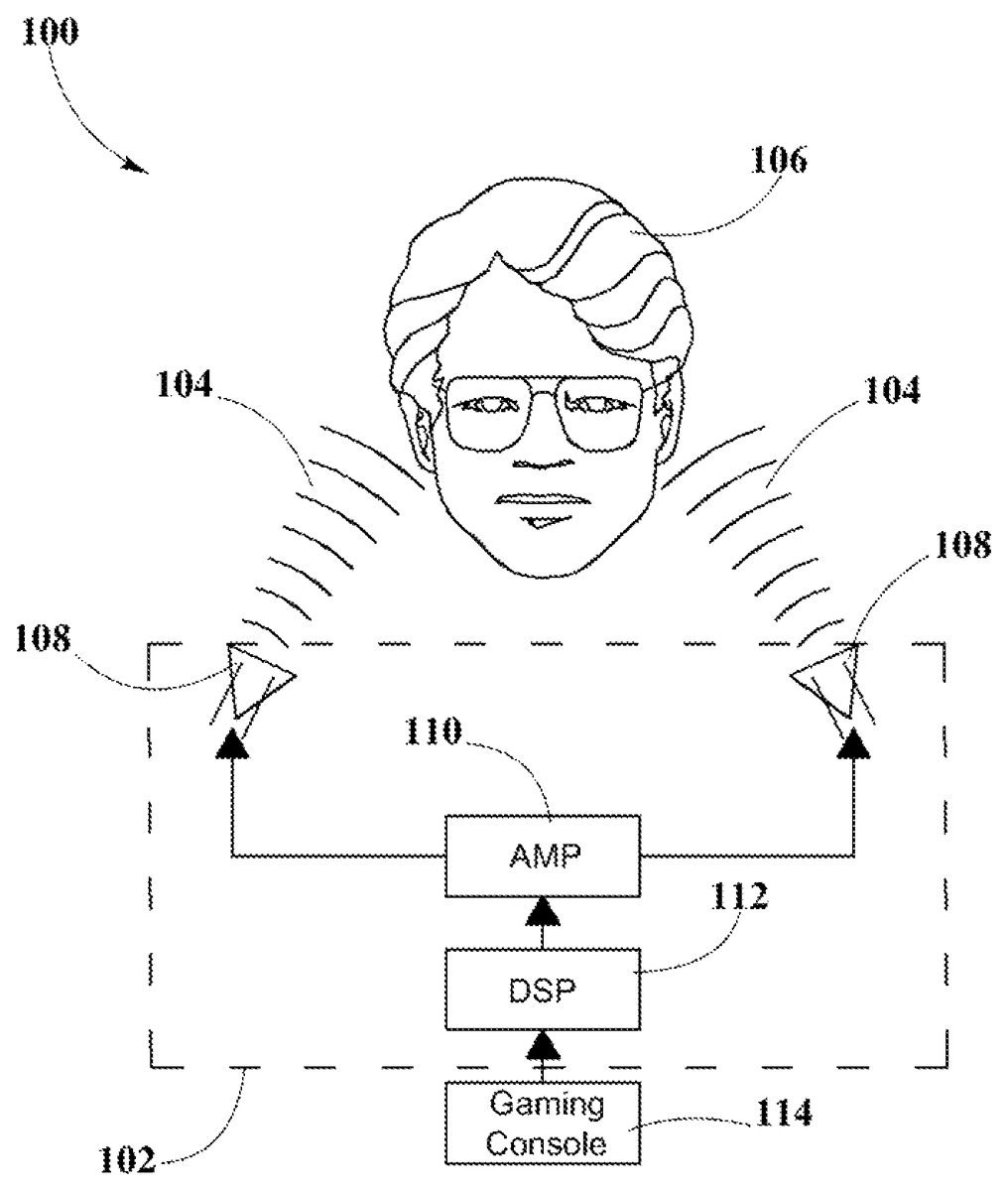
FIG. 1illustrates a simplified block diagram of a 3D sound gaming application100, where an ultrasonic sound system102can produce and direct ultrasonic waves104to one or more gamers106in order to create a 3D sound effect, according to an embodiment. This ultrasonic sound system102can include two or more ultrasonic emitters108, an amplifier110, and a digital signal processing (DSP) module112.
A gaming console114can generate an audio signal which can be received by DSP module112in the ultrasonic sound system102. Gaming console114can include computer hardware platforms such as PS3, Xbox, Nintendo Wii, Nintendo Wii U, and PCs among others. DSP module112can process various components of the audio signal from gaming console114. Specifically, DSP module112can adjust the phase, delay, reverb, echo, gain, magnitude or other audio signal component of the audio signal or audio signal components on one of the two channels relative to the other channel, allowing the audio reproduction of that audio signal or audio signal components to appear to be positioned in space relative to gamer106. For example, computer-generated audio components can be created with or modified to have signal characteristics to allow placement of various components and their desired respective positions in the listening environment around gamer106.
The processed audio signal can be combined with a carrier signal generated by an oscillator integrated in DSP module112. Amplifier110can then be used to amplify the modulated and processed audio signal, resulting in an amplified ultrasonic signal with a carrier frequency.
The modulated ultrasonic signal is then provided to ultrasonic emitters108, which can emit and direct ultrasonic waves104into each of the gainer's106ears. In some embodiments, ultrasonic wave104can be a parametric ultrasonic wave. As shown inFIG. 1, these ultrasonic emitters108can be aimed at gamer's106ears. When played back through ultrasonic emitters108at a sufficiently high sound pressure level, due to the nonlinear behavior of the air through which it is “played” or transmitted, the carrier signal in the ultrasonic waves104can mix with the sideband (s) to demodulate the signal and reproduce the audio content.
By adding phase, delay, reverb, echo, gain, magnitude or effects to each of the audio signal components in DSP module112, and then playing the audio content to gamer106using parametric sound through directional ultrasonic emitters108, the gamer106can be immersed in a 3D audio experience using only two ultrasonic emitters108. For example, increasing the gain of an audio component, such as a gun fire derived from a game being played in gaming console114, on the left channel relative to the right, and at the same time adding phase changes or delay (or echo, reverb, etc.) on that audio component for the right channel relative to the left, can make that audio component to the positioned to the left of gamer106.
In addition, different levels of this audio processing can be applied to different audio components to place each audio component properly around gamer106. For example, when a game character in the game is approaching the user, each footstep of that character can be encoded differently to reflect that footstep's position relative to the prior or subsequent footsteps of that character. Thus applying different processing to each subsequent footstep audio component, the footsteps can be made to sound like they are moving toward the gamer106from a predetermined location or moving away from the gamer106to a predetermined position. Additionally, the volume of the footstep sound components can be likewise adjusted to reflect the relative distance of the footsteps as they approach or move away from the gamer.
Referring now toFIG. 2, a throat microphone set200can be used by a gamer106(FIG. 1) during a conventional sound gaming application to communicate with other gamer(s) at different locations. This throat microphone set200can include a throat microphone202, a flexible frame204, a connection cord206, and an ear speaker piece208. Throat microphone202can pick up voice signals via vibrations generated by gamers106through a transducer or sensor positioned on of the gamer's throat. The transducer integrated in throat microphone202can pick up speech even in loud environments, whereas other types of microphones do not function well under those conditions because of high levels of background sounds.
Flexible frame204can be used to hold the throat microphone set200around gamer's106neck, and can be adjustable according to gamer's106neck size. Note that, while connection cord206is shown connecting ear speaker piece to the frame, the ear speaker can be wirelessly integrated within the system.
InFIG. 2, zoom-in view210shows front and side views of ear speaker piece208which can include a plastic or rubber pad, housing, or frame212to secure the ear speaker piece208into one of gamer's106ear canals. Pad, housing, or frame212can include other suitable materials such as silicone or foam, among others, and may be configured in a variety of shapes and dimensions. Ear speaker piece208can include a small speaker214which can reproduce voice sounds coming from one or more gamers at another physical location. That is, in spite of the sound coming out of a standard sound system, speaker214in ear speaker piece208can establish a private communication channel where a gamer106can listen to others gamers at different physical locations.
Although throat microphone set200is shown inFIG. 2with respective shape and components, other geometric shapes and components can be contemplated. That is, features of throat microphone set200can vary depending on the manufacturer model. Commercially available manufacturers of throat microphone set200can include Gioteck, CTA digital, Mad Catz, and AGPtek, among others.
FIG. 3shows a gamer106that is wearing the throat microphone set200during a conventional gaming application. When using standard or conventional surround sound systems such as Dolby 5.1 or 7.1, gamer106can also wear throat microphone set200without affecting communication with other gamers or without blocking the surround sound effect. However, wearing throat microphone set200as shown inFIG. 3can have a negative impact during the production of a 3D sound gaming application100.
As explained inFIG. 1, a gamer106can be positioned in front of ultrasonic emitters108in order to experience a 3D sound game experience. Simultaneously to receiving the audible sound created by the ultrasonic waves104at each ear, gamer106can talk and listen to other gamer (s) at different locations using throat microphone202and ear speaker piece208. Given the intensity level of the ultrasonic waves104, some models of throat microphone202can pick up this carrier signal, thus masking the voice of gamer106. Voice masking can be produced by the higher frequency range exhibited by the carrier signal in comparison with gamer's106voice frequency range. That is, carrier signal in ultrasonic waves104can exhibit a high frequency range from about 40 kHz to about 60 kHz, while typical frequency ranges of gamer's106voice can be significantly lower, typically in the range between about 100 Hz and 4 kHz. This voice masking can negatively impact the communication of gamer106with other gamer (s) when playing a multi-player game.
Another problem or limitation can arise when wearing the throat microphone set200as shown inFIG. 3. As explained inFIG. 1, ultrasonic emitters108are required to emit two separate columns of ultrasonic waves104to reproduce sound into each of gamer's106ears and generate a 3D sound effect. When gamer106is wearing throat microphone set200, pad, housing, or frame212which may be comprised of plastic or rubber in ear speaker piece208can partially or completely block one of the ear canals of gamer106, thereby eliminating or at least attenuating the 3D sound experience produced by ultrasonic sound system102.
The following embodiments herein described aim at solving the problems of carrier frequency pick up and sound obstruction in order to provide a suitable 3D sound gaming application100capable of incorporating a throat microphone set200for communication between two or more gamers106.
Referring now toFIG. 4, a conventional low pass filter circuit400can be integrated into throat microphone202to filter or attenuate high frequency carrier signals that might be picked up during 3D sound gaming application114, according to an embodiment. This low pass filter circuit400can be included in models throat microphone sets200susceptible or sensitive to the frequency carrier signals in ultrasonic waves104.
The Low pass filter circuit400can include a resistor configured in series with a capacitor (neither shown in detail). The input of this low pass filter circuit400can be the voice of gamer106along with any high frequency carrier signal picked up by throat microphone202. The output of low pass filter circuit400can be a filtered or attenuated high frequency carrier signal along with the voice of gamer106operatively coupled to a corresponding gaming console114.
The filter circuit can include a variety of components (most not shown in detail). For example, the resistor can exhibit resistance values of about 4.7 kΩ, while capacitance values of the capacitor can range from about 0.22 mF to about 10 nF, where these resistance and capacitance values can vary depending on the impedances of throat microphone202and gaming console114, as well as the desired filter characteristics. In one embodiment, values for the resistor and the capacitor can be set to sufficiently eliminate or attenuate any ultrasonic frequency signals that may reach the throat microphone202. The low pass filter circuit can provide a rate of frequency roll-off of about 6 dB per octave.
In another embodiment, an active version of low pass RC filter circuit400can include an operational amplifier circuit or any other solid-state circuit added to the output or capacitor to increase the voltage gain above 1, if necessary. Yet in another embodiment, an active version of low pass filter circuit can be implemented using commercially available integrated circuit (IC) chips with different configurations and features, where in such case, this active version of low pass RC filter circuit400can be isolated from the impedances of throat microphone202and gaming console114.
FIG. 5shows an example of an ear speaker piece208which can include one or more apertures502formed in or through the rounded plastic or rubber pad, housing, or frame212to prevent the ear speaker from blocking the ultrasonic waves104from entering the gamer's106ear canal, according to an embodiment. Apertures502in pad, housing, or frame212can allow sound produced by ultrasonic waves104to sufficiently enter the corresponding gamer's106ear canal, facilitating the establishment of a suitable 3-D sound gaming application100.
FIG. 5A illustrates a front view of ear speaker piece208, where apertures502can be formed in the rounded plastic or rubber pad, housing, or frame212around speaker214. These apertures502can exhibit suitable dimensions, length L and width W, for allowing sound from ultrasonic waves104to enter gamer's106ear canal and produce a 3D sound effect. Although ear speaker piece208and apertures502are shown in respective shapes and geometric relationships, other geometric relationships and shapes may be contemplated. For example, apertures502can exhibit a circular shape (not shown inFIG. 5), while ear speaker piece208can exhibit a variety of configurations depending on the model of throat microphone set200.
Compared to an open ear canal, the use of ear speaker piece208with apertures502may slightly decrease the amplitude of ultrasonic waves104, specifically in the range of about 2 dB to 3 dB. In such case, output levels in ultrasonic emitters108can be balanced to compensate for the amplitude loss in the gamer's106ear that is using the ear speaker piece208. For the example, as shown inFIG. 1andFIG. 3, if gamer106is wearing the ear speaker piece208in his/her left ear, then output level of ultrasonic emitter108aimed to the left of gamer106can be increased to compensate for the sound amplitude loss at his/her left ear. Similarly, if gamer106is wearing the ear speaker piece208in his/her right ear, then output level of ultrasonic emitter108aimed to the right of gamer106can be increased to compensate for the sound amplitude loss at his/her right ear. In addition, this ear speaker piece208with apertures502does not have any effect in the range of audible frequencies of gamer106, in other words, gamer106should be able to listen to all frequency levels according to his/her natural hearing capabilities.
Sectional view of ear speaker piece208inFIG. 5Bshows how apertures502can be formed through the rubber or plastic pad, housing, or frame212to create one or more channels, openings, conduits, etc. that can allow audible sound created by ultrasonic devices108to enter gamer's106ear canal; thereby producing a suitable 3D sound gaming application100capable of integrating a throat microphone set200for communication between one or more gamers106.
The present 3D sound system has proven superior to conventional surround sound systems in numerous ways. While conventional surround sound systems may provide a number of speakers surrounding a listener, each of these speakers is still limited to producing conventional audio. This conventional audio produced by each speaker is still “flat.” In contrast, the audio produced by the present emitters is capable of generating directional sound—the listener can detect variances in distance of sounds heard, relative to the listener, even if such sound is produced by only one, or most advantageously two emitters. The unique design of the ear speaker pieces of the present invention allow the use of both ultrasonic emitters and a regular earpiece speaker: without allowing the ultrasonic waves to pass through the openings in the earpiece speaker, the gamer's experience of 3D sound might otherwise be greatly diminished.
While various aspects and embodiments have been disclosed herein, other aspects and embodiments can be contemplated. The various aspects and embodiments disclosed herein are for purposes of illustration and are not intended to be limiting, with the true scope and spirit being indicated by the following claims.
Claims
- A method of providing a three-dimensional gaming experience to a user, comprising: providing a gaming system having a digital signal processor (“DSP”), an amplifier, and a plurality of ultrasonic emitters, wherein each of a user's ears receives a directional ultrasonic wave column from at least one independent ultrasonic emitter;providing an interface to interact with at least one other game user, the interface including an ear speaker piece placed in or around the user's ear and at least one microphone;configuring the microphone to receive voice input from the user;and configuring the ear speaker piece to relay voice input from the at least one other game user into the user's ear;and adjusting the amplitude of the directional ultrasonic wave column directed toward the user's ear having the ear speaker piece to compensate for any sound loss due to the presence of the ear speaker piece.
- The method of claim 1 , further comprising: providing a plurality of holes through a frame of the ear speaker piece and configuring the holes to allow ultrasonic waves generated by the ultrasonic emitters to pass through the ear speaker piece.
- The method of claim 1 , wherein the microphone includes a throat microphone.
- The method of claim 3 , further comprising: providing a flexible frame;and configuring the flexible frame to position the throat microphone against the user's throat.
- The method of claim 1 , further comprising: providing a low pass filter integrated into the microphone, the low pass filter configured to optimize the voice input by the user and to filter unwanted high frequency signals which may inhibit clear voice transmission to other users.
- The method of claim 1 , further comprising independently adjusting the phase, delay, reverb, echo, gain or magnitude of each of the ultrasonic emitters to reflect the relative virtual location of a sound's origin in relation to a character within a game controlled by the user.
- A method of providing a user with a three-dimensional gaming experience comprising: providing a plurality of ultrasonic emitters operably connected to a sound output of a gaming system;independently directing each ultrasonic emitter toward one of a user's ears, the ultrasonic emitters being operable to direct a plurality of directional sound columns to the user's ears based on a virtual sound direction relating to a virtual origin from which a plurality of virtual sounds are generated;and relaying to the ultrasonic emitters a signal relating to a plurality of virtual sounds such that the ultrasonic emitters project sound toward a user's ears so as to reproduce the virtual sounds to create a realistic three-dimensional sound environment;providing a multi-player communication interface including a user microphone and an ear speaker piece placed in or about the user's ear, wherein the microphone is configured to relay a voice input from the user to at least one other user;and configuring the ear speaker piece to relay sound to the user relating to voice input from the at least one other user;wherein a frame of the ear speaker piece includes a plurality of openings formed therein or therethrough, the openings being operable to allow directional sound to pass through the ear speaker piece into the user's ear.
- The method of claim 7 , further comprising: adjusting the phase, delay, reverb, echo, gain or magnitude of the modulated ultrasonic wave column directed toward the user's ear having the ear speaker piece fitted therein to compensate for sound loss due to the presence of the ear speaker piece in or about the user's ear.
- The method of claim 7 , further comprising: a low pass filter integrated into the microphone wiring configured to filter high frequency interference signals.
- The method of claim 7 , wherein the microphone includes a throat microphone.
- The method of claim 10 , further comprising: providing a flexible frame;and configuring the flexible frame to position the throat microphone against the user's throat.
- A method of providing a three-dimensional gaming experience to a user, comprising: providing a gaming system having a digital signal processor (“DSP”), an amplifier, and a plurality of ultrasonic emitters, wherein each of a user's ears receives a directional ultrasonic wave column from at least one independent ultrasonic emitter;providing an interface to interact with at least one other game user, the interface including an ear speaker piece placed in or around the user's ear and at least one microphone;configuring the microphone to receive voice input from the user;configuring the ear speaker piece to relay voice input from the at least one other game user into the user's ear;and providing a plurality of holes through a frame of the ear speaker piece and configuring the holes to allow ultrasonic waves generated by the ultrasonic emitters to pass through the ear speaker piece.
- The method of claim 12 , further comprising: adjusting the amplitude of the directional ultrasonic wave column directed toward the user's ear having the ear speaker piece to compensate for any sound loss due to the presence of the ear speaker piece.
- The method of claim 12 , wherein the microphone includes a throat microphone.
- The method of claim 14 , further comprising: providing a flexible frame;and configuring the flexible frame to position the throat microphone against the user's throat.
- The method of claim 12 , further comprising: providing a low pass filter integrated into the microphone, the low pass filter configured to optimize the voice input by the user and to filter unwanted high frequency signals which may inhibit clear voice transmission to other users.
- The method of claim 12 , further comprising independently adjusting the phase, delay, reverb, echo, gain or magnitude of each of the ultrasonic emitters to reflect the relative virtual location of a sound's origin in relation to a character within a game controlled by the user.
- A method of providing a user with a three-dimensional gaming experience comprising: providing a plurality of ultrasonic emitters operably connected to a sound output of a gaming system;independently directing each ultrasonic emitter toward one of a user's ears, the ultrasonic emitters being operable to direct a plurality of directional sound columns to the user's ears based on a virtual sound direction relating to a virtual origin from which a plurality of virtual sounds are generated;relaying to the ultrasonic emitters a signal relating to a plurality of virtual sounds such that the ultrasonic emitters project sound toward a user's ears so as to reproduce the virtual sounds to create a realistic three-dimensional sound environment;providing a multi-player communication interface including a user microphone and an ear speaker piece placed in or about the user's ear, wherein the microphone is configured to relay a voice input from the user to at least one other user;configuring the ear speaker piece to relay sound to the user relating to voice input from the at least one other user;and adjusting the phase, delay, reverb, echo, gain or magnitude of the modulated ultrasonic wave column directed toward the user's ear having the ear speaker piece fitted therein to compensate for sound loss due to the presence of the ear speaker piece in or about the user's ear.
- The method of claim 18 , wherein a frame of the ear speaker piece includes a plurality of openings formed therein or therethrough, the openings being operable to allow directional sound to pass through the ear speaker piece into the user's ear.
- The method of claim 18 , further comprising: a low pass filter integrated into the microphone wiring configured to filter high frequency interference signals.
- The method of claim 18 , wherein the microphone includes a throat microphone.
- The method of claim 21 , further comprising: providing a flexible frame;and configuring the flexible frame to position the throat microphone against the user's throat.
- The method of claim 18 , further comprising: providing a low pass filter integrated into the microphone, the low pass filter configured to optimize the voice input by the user and to filter unwanted high frequency signals which may inhibit clear voice transmission to other users.
- The method of claim 18 , further comprising independently adjusting the phase, delay, reverb, echo, gain or magnitude of each of the ultrasonic emitters to reflect the relative virtual location a sound's origin in relation to a character within a game controlled by the user.
Disclaimer: Data collected from the USPTO and may be malformed, incomplete, and/or otherwise inaccurate.