U.S. Pat. No. 8,900,044
GAME SYSTEM FOR PROVIDING VIDEO GAMES
AssigneeDeNA Co., Ltd.
Issue DateMay 28, 2013
Illustrative Figure
Abstract
One object is to provide a server device that enables accurate expectation of cost required to acquire a desired game content. In accordance with one aspect, a server device according to an embodiment of the present invention provides a game to one or more players via a network. This server device includes a won game content selecting unit configured to select one or more game contents as first won game contents from the game contents contained in a first deck allocated to a first player of the one or more players, an owned game content information storage unit configured to store the one or more won game contents in association with the first player identification information, and an updating unit configured to update the first deck by clearing the one or more first won game contents from the first deck.
Description
DESCRIPTION OF EXAMPLE EMBODIMENTS Various embodiments of the present invention will be described hereinafter with reference to the appended drawings. In the drawings, the same components are denoted by the same reference numerals. FIG. 1is a block diagram schematically illustrating a game system according to an embodiment of the present invention. As illustrated inFIG. 1, in the embodiment of the present invention, an online game server device10(hereinafter also referred to simply as the “server device10”) may be communicatively connected to a plurality of terminal devices30-1,30-2, . . . , and30-N (hereinafter also collectively referred to as the “terminal devices30”), each having a communication function, via a communication network20such as the Internet. The server device10is an example of a device implementing part or all of a game system according to an embodiment of the present invention. As illustrated inFIG. 1, the server device10may include a central processing unit (CPU)11, a main memory12, a user interface (I/F)13, a communication I/F14, an external memory15, and a disk drive16, and these components may be electrically connected to one another via a bus17. The CPU11may load an operating system and various programs for controlling the progress of an online game into the main memory12from the external memory15, and may execute commands included in the loaded programs. The main memory12may be used to store a program to be executed by the CPU11, and may be formed of, for example, a dynamic random access memory (DRAM). The user I/F13may include, for example, an information input device such as a keyboard or a mouse for accepting an input from an operator, and an information output device such as a liquid crystal display for outputting calculation results of the CPU11. The communication I/F14may be implemented as hardware, firmware, or communication software such as a transmission control protocol/Internet protocol (TCP/IP) ...
DESCRIPTION OF EXAMPLE EMBODIMENTS
Various embodiments of the present invention will be described hereinafter with reference to the appended drawings. In the drawings, the same components are denoted by the same reference numerals.
FIG. 1is a block diagram schematically illustrating a game system according to an embodiment of the present invention. As illustrated inFIG. 1, in the embodiment of the present invention, an online game server device10(hereinafter also referred to simply as the “server device10”) may be communicatively connected to a plurality of terminal devices30-1,30-2, . . . , and30-N (hereinafter also collectively referred to as the “terminal devices30”), each having a communication function, via a communication network20such as the Internet. The server device10is an example of a device implementing part or all of a game system according to an embodiment of the present invention.
As illustrated inFIG. 1, the server device10may include a central processing unit (CPU)11, a main memory12, a user interface (I/F)13, a communication I/F14, an external memory15, and a disk drive16, and these components may be electrically connected to one another via a bus17. The CPU11may load an operating system and various programs for controlling the progress of an online game into the main memory12from the external memory15, and may execute commands included in the loaded programs. The main memory12may be used to store a program to be executed by the CPU11, and may be formed of, for example, a dynamic random access memory (DRAM).
The user I/F13may include, for example, an information input device such as a keyboard or a mouse for accepting an input from an operator, and an information output device such as a liquid crystal display for outputting calculation results of the CPU11. The communication I/F14may be implemented as hardware, firmware, or communication software such as a transmission control protocol/Internet protocol (TCP/IP) driver or a point-to-point protocol (PPP) driver, or a combination thereof, and may be configured to be able to communicate with the terminal devices30via the communication network20.
The external memory15may be formed of, for example, a magnetic disk drive and store various programs such as a control program for controlling the progress of an online game. The external memory15may also store various data used in the game. The external memory may store, for example, a deck identification information management table, an owned game content management table, and a contained game content information management table that contains various data in accordance with the progression of the game (these tables will be described later). Also, these tables may be stored on a database server communicatably connected to the server device10and physically separate from the server device10.
The disk drive16may read data stored in a storage medium such as a compact disc read only memory (CD-ROM), digital versatile disc read only memory (DVD-ROM), or DVD Recordable (DVD-R) disc, or write data to such a storage medium. For example, a game application and data such as game data stored in a storage medium may be read by the disk drive16, and may be installed into the external memory15.
In an embodiment, the server device10may be a web server for managing a web site including a plurality of hierarchical web pages and may be capable of providing the terminal devices30with game services. The terminal devices30may be provided with browser software that fetches and analyzes HTML data for rendering a web page to present the web page to a user (a player of the game) of the terminal devices30. A game provided through a web page rendered by such browser software is sometimes called a browser game. The HTML data for rendering the web page may also be stored on the external memory15. HTML data may comprise HTML documents written in markup languages such as HTML; the HTML documents can be associated with various images by using tags. Additionally, the HTML documents can include programs written in script languages such as ActionScript™ and JavaScript™
The external memory15may store game applications to be executed on execution environments of the terminal device30other than browser software. This game application may include game programs for performing game functions and various data such as image data to be referred to for executing the game programs. The game programs may be created in, for example, object oriented languages such as Objective-C™ and Java™. The created game programs may be stored on the external memory15in the form of application software along with various data. The application software stored on the external memory15may be delivered to a terminal device30in response to a delivery request. The application software delivered from the server device10may be received by the terminal device30through a communication I/F34in accordance with the control of CPU31; the received game programs may be sent to an external memory35and stored thereon. The application software may be launched in accordance with the player's operation on the terminal device30and may be executed on a platform implemented on the terminal device30such as NgCore™ or Android™. The server device10may provide the game applications executed on the terminal devices30with various data required for progression of the games. Additionally, the server device10can store various data sent from the terminal device30for each player, thereby managing the progression of the game for each player.
Thus, the server device10may manage the web site for providing game services and deliver web pages constituting the web site in response to a request from the terminal device30, thereby progressing the game. Also, the server device10can progress a game by communicating various data to and from a game application performed on the terminal device30in place of, or in addition to, such a browser game. Whichever mode may be taken to provide the game, the server device10can store data required to progress the game for each identification identifying a player (described later). The games provided by the server device10may include desired games such as action games, roll playing games, interactive baseball games, and card games. The types of the games implemented by the web site or game applications of the server device10are not limited to those explicitly described herein.
In an embodiment, the terminal device30may be a desired information processing device capable of rendering, on a web browser, web pages of a game web site fetched from the server device10; for example, the terminal device30may be a mobile phone, smart phone, game console, personal computer, touch pad, or electronic book reader, but is not limited thereto. In another embodiment, the terminal device30may be a desired information processing device including an application execution environment for executing a game application.
The architecture of the terminal device30will be described with reference toFIG. 2.FIG. 2is a block diagram schematically illustrating the architecture of a terminal device30. As illustrated inFIG. 2, the terminal device30may include a central processing unit (CPU)31, a main memory32, a user interface (I/F)33, a communication I/F34, and an external memory35, and these components may be electrically connected to one another via a bus36.
The CPU31may load various programs such as an operating system into the main memory32from the external memory35, and may execute commands included in the loaded programs. The main memory32may store a program to be executed by the CPU31, and may be formed of, for example, a dynamic random access memory (DRAM).
The user I/F33may include, for example, an information input device such as a touch panel, a keyboard, a button, and a mouse for accepting an input from a player (user), and an information output device such as a liquid crystal display for outputting calculation results of the CPU31. The communication I/F34may be implemented as hardware, firmware, or communication software such as a transmission control protocol/Internet protocol (TCP/IP) driver or a point-to-point protocol (PPP) driver, or a combination thereof, and may be configured to be able to communicate with the server device10via the communication network20.
The external memory35may comprise, for example, a magnetic disk drive or a flash memory and store various programs such as an operating system. When receiving a game application from the server device10via the communication I/F34, the external memory35may store the received game application.
A terminal device30having such an architecture may include browser software for interpreting and rendering an HTML file (HTML data) for example; this browser software may enable the terminal device30to interpret the HTML data fetched from the server device10and render web pages corresponding to the received HTML data. Further, the terminal device30may include plug-in software (e.g., Flash Player distributed by Adobe Systems Incorporated) (FLASH is a trademark) embedded into browser software; therefore, the client device30can fetch from the server device10a SWF file embedded in HTML data and execute the SWF file by using the browser software and the plug-in software.
When a game is executed, for example, animation or an operation icon designated by the program may be displayed on a screen of the terminal device30. The player may enter an instruction for causing the game to progress using an input interface (e.g., a touch screen or a button) of the terminal device30. The instruction entered by the player may be transmitted to the server device10through the browser of the terminal device30or a platform function such as NgCore™.
Next, the functionality of the server device10implemented by the components shown inFIG. 1will be described with reference toFIG. 3.FIG. 3is a block diagram illustrating the functionality of a server device10according to an embodiment of the present invention. As shown inFIG. 3, the server device10according to this embodiment may have a game progression control unit51, a deck identification information storage unit52, a contained game content information storage unit53, a won game content selecting unit54, an updating unit55, an owned game content information storage unit56, an initializing unit57, and a contained game content information providing unit58. The server device10may also include a charging unit configured to authenticate a player at start of the game and perform charging process in accordance with progression of the game. These functions may be implemented by the CPU11controlling the loading of a certain program onto a main memory12and performing operations based on the instructions in the program.
The game progression control unit51may send and receive various data required for the progression of the game to and from the terminal device30and manage such data for each player, thereby controlling the progression of the game for each player. For example, the game progression control unit51can sequentially display, on the terminal device30, web pages constituting a web site for providing game services in response to a request from the terminal device30. When a hyperlink on the displayed web page is selected by the player, the game progression control unit51may send new HTML data corresponding to the hyperlink to the terminal device30. The terminal device30displays a web page based on the new HTML data. Thus, the game progression control unit51may control the game such that web pages stored on the server device10are sequentially provided to the terminal device30in accordance with the operation by the player; and the player can progress the game by operating the terminal device30.
When the terminal device30executes the game application, the game progression control unit51can send various data used in the game to the game application. For example, when receiving from a game application on the terminal device30a control signal indicating that a certain mission has been fulfilled, the game progression control unit51may provide the game application with various parameters related to a mission subsequent to the fulfilled mission. The game application may load the data provided by the server device10and progress the game.
The terminal device30can appropriately send to the server device10various information on progression of the game such as information indicating various parameter values used in the game (information on earned game points and earned items) and information indicating a status (information specifying a fulfilled mission), through the function of browser software or the game application. The game progression control unit51may store, for each player, information on the progression of the game received from a plurality of terminal devices30, thereby controlling the progression of the game for each player. Thus, when the player logs in the server device10using his own ID, the game may be resumed from the scene corresponding to the progression of the player (e.g., the scene where the game was interrupted) based on the information on the progression of the game associated with the player stored in the server device10. As will be described later, the information required for the progression of the game may be managed by various functions of the server device10other than the game progression control unit51.
Various game functions may be performed on the terminal device30. The game functions performed on the terminal device30use various game contents such as electronic cards, items, and/or virtual currency used in the games. The term “game contents” may refer to electronic data used by players to progress the games and including, but not limited to, cards, items, characters, and avatars. In an embodiment of the present invention, the game contents may be obtained, owned, used, managed, exchanged, fused, reinforced, sold, discarded, and/or presented by players in the games in accordance with progression of the games. It should be noted that the use of the game contents is not limited to those explicitly described herein. In selling of a card in a game, a player may be paid in virtual currency used in the game, not in real currency, for the card sold. The game contents may have, for example, attribute information assigned thereto (e.g., “rarity,” “level,” “offensive power,” “defensive power,” and “the name of the game content”) to be referred to in the progression of the game as required. At least part of these attribute information may be updated in accordance with the game. A player can progress the game using the game contents having updated attribute information. For example, in the card game, a player can use one or more his own cards to fulfill a mission or combat other players or non-player characters, thereby progressing the game. The Applicant provides various card games on Mobage™ platform.
Game contents used in the embodiments of the present invention may be managed in the server device10in the units of game content-containing decks (herein also referred to simply as “decks”). Each player can obtain a game content contained in a deck allocated to the player via the terminal device30, and progress the game by using the obtained game content. A deck may contain a limited number of game contents. Each player of the game may be individually allocated a deck. The game contents contained in decks may be different for each player; or decks containing common game contents may be allocated to the players.
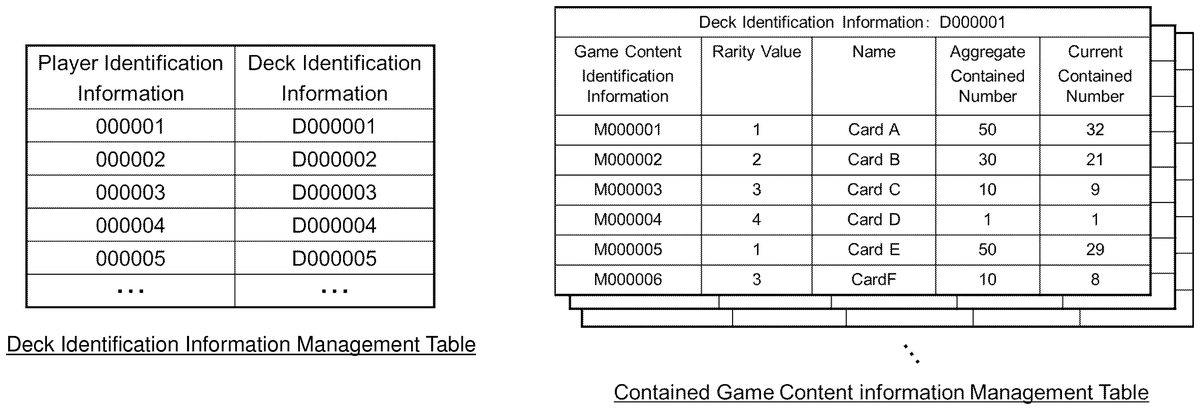
The deck identification information storage unit52may store deck identification information that identifies a deck allocated to each player in association with player identification information that identifies the player. The deck identification information storage unit52is implemented by a deck identification information management table provided on, for example, an external memory15or an external database server.FIG. 4shows an example of the deck identification information management table. As shown, the deck identification information management table may store deck identification information that identifies decks allocated to players in association with player identification information that identifies players. In the example shown inFIG. 4, deck identification information “D000001” is stored in association with player identification information “000001.”
“Player identification information”, as used herein, may consist of an identification code that identifies a player of a game and may be composed of, for example, a six-digit number. The code system of the player identification information is not limited to those explicitly described herein and may be configured desirably. For example, the player identification information may include an alphabetic character. Ordinarily, the player identification information may be assigned to a player, for example, when the player first logs in or sign up for a game, and may be reused for later logins of the player. Thus, the player identification information may be unique to a player and identifies the player in a game. “Deck identification information” may be an identification code that identifies a deck used in the game, and may consist of, for example, an alphabetic character and a six-digit number. The code system of the deck identification information is not limited to those explicitly described herein and may be configured desirably.
Information on game contents contained in each deck (hereinafter also referred to as “contained game content information”) may be stored in the contained game content information storage unit53. The contained game content information storage unit53is implemented by a contained game content information management table provided on, for example, an external memory15or an external database server.FIG. 5shows an example of the contained game content information management table. As shown, the contained game content information management table may store, in association with deck identification information, contained game content information on one or more game contents contained in the deck identified by the deck identification information. The contained game content information may include game content identification information that identifies game contents (or types of game contents) contained in the deck and “rarity value,” “aggregate contained number,” and “current contained number” of the game contents.
“Game content identification information” consists of an identification code that identifies a game content (or the type of a game content) owned by a player and is composed of, for example, an alphabetic character and a six-digit number. The code system of the game content identification information is not limited to those explicitly described herein and may be configured desirably.
The “rarity value” of a game content is an indicator that may indicate how frequently the game content can be obtained. This indicator may have a value ranging from “1” to “4” in the example shown inFIG. 5. In this example, it is supposed that a game content having a lower rarity value can be more frequently obtained by players, while a game content having a higher rarity value can be obtained with less frequency. The rarity value may also be set conversely such that a game content having a higher rarity value can be obtained more frequently.
Various techniques can be used to reduce the frequency that a game content having a higher rarity value can be obtained. For example, in the example shown inFIG. 5, a smaller number of game contents are contained in the deck as the rarity value of the game contents is higher. In this embodiment, if game contents to be provided to players are randomly selected from the game contents contained in the deck, game contents having a higher rarity value is less frequently selected. Also, in selecting a game content to be provided to a player from the game contents contained in the deck, winning probabilities may be weighted such that game contents having a higher rarity value is assigned a lower probability of being selected. In this embodiment, game contents having a higher rarity value are less likely to be selected. Even if rarity values of game contents are not assigned, low winning probabilities may be assigned to game contents that provide special effects in the game or game contents having a same or different type of game content attached thereto (also called a “prize-including” game content in actual games), such that these game contents are less likely to be selected.
The “aggregate contained number” (also referred to as “initial contained number”) of a game content inFIG. 5represents the number of the game contents contained in a deck in an initialized state. As described above, the “aggregate contained number” of each game content may be determined such that, as the rarity value of the game content is higher, a smaller number of the game contents are contained in the deck. In the example shown inFIG. 5, the aggregate contained numbers are set to “50” for both the game content identified by the game content identification information “M000001” (hereinafter also referred to as “game content1”) and the game content identified by the game content identification information “M000005” (game content5), both having the lowest rarity value “1.” In contrast, the aggregate contained number is set to “1” for the game content identified by the game content identification information “M000004” (game content4) having the highest rarity value “4.” Accordingly, if game contents are randomly selected from game contents contained in this deck, the probability that game content4is selected is one fiftieth of the probability that game content1is selected (the same applies to comparison with game content5).
The “current contained number” of a game content inFIG. 5represents the number of the game contents remaining in the deck after won game contents (described later) are provided to a player. As will be described later, game contents selected as won game contents from game contents contained in the deck identified by the deck identification information “D000001” (hereinafter also referred to as “deck1”) may be provided to the player identified by the player identification information “000001” (hereinafter also referred to as “player1”). The “current contained number” of the game content is calculated by subtracting the number of the game contents provided to the player from the “aggregate contained number” of the game content. The number of remaining game contents in the deck thus calculated is stored in a region of “current contained number” in the contained game content information management table.
The “name” of a game content inFIG. 5represents a name assigned to the game content. “Name” is an example of game content attribute information representing an attribute of a game content. Although omitted fromFIG. 5, various game content attribute information other than “name” may be stored in the contained game content information management table. Game content attribute information may include, for example, images of game contents, attribute values assigned to the game contents such as offensive power and defensive power, and experience points obtained by using the game contents in the game. These various information may be stored in the contained game content information management table.
FIG. 5shows contained game content information stored in association with deck identification information “D000001.” Likewise, other deck identification information may be associated with contained game content information. The types of the contained game content information associated with other decks may be either the same as or different from that of deck1.
The won game content selecting unit54selects, in response to a game content acquisition request from a player, one or more won game contents from the game contents contained in the deck allocated to the player in accordance with a predetermined lottery algorithm. For example, when the server device10receives from the terminal device30of player1a game content acquisition request inputted into the terminal device30by player1, the deck identification information management table shown inFIG. 4may be used to specify the deck identification number “D000001” associated with the player identification number “000001” of player1; and then a won game content may be selected from the game contents contained in the deck identified by the deck identification number “D000001”. In the example shown inFIG. 4, deck1is allocated exclusively to player1. Therefore, even if a game content acquisition request is received from a player other than player1, no won game content is selected from the game contents contained in deck1.
In an embodiment, a won game content may be randomly selected from the game contents contained in the deck by using, for example, pseudorandom numbers. In the example embodiment shown inFIG. 5, the total number of contained game contents is 100 (there are 32 game contents1,21game contents2,9game contents3,1game content4,29game contents5, and8game contents6; the total number of these game contents is 100). Therefore, the winning probability of each game content is one hundredth. In this case, game contents in a larger current contained number are more likely to be selected as won game contents. For example, game content1and game content5, having a low rarity value, are more likely to be selected due to large current contained numbers; conversely, game content4, having a high rarity value, are less likely to be selected due to a small current contained number. Thus, in the example shown inFIG. 5, game contents having a higher rarity value are in a smaller current contained number; therefore, game contents having a higher rarity value are less likely to be selected as won game contents. An example of game contents having a high rarity value as game content4is a “rare card.”
In another embodiment, winning probabilities may be assigned in accordance with rarity values of the game contents such that the probability of being selected is lower for a higher rarity value. The won game content selecting unit54selects won game contents based on the assigned winning probabilities. Thus, game contents having a higher rarity value are assigned a lower probability of being selected; therefore, game contents having a higher rarity value are less likely to be selected as won game contents.
In response to a game content acquisition request for one game content from a player, the won game content selecting unit54may either select one won game content or select, simultaneously or sequentially, a desired plural number of won game contents. To implement such a function, in an embodiment of the present invention, a game content acquisition request may include the number of game contents wanted by the player. In this case, the number of wanted game contents may be set to a desired natural number equal to or smaller than the total of current contained numbers of all the game contents contained in the deck. In an embodiment, a web page for generating a game content acquisition request (seeFIG. 8) may contain an input area for inputting the number of wanted game contents. A player can input a desired number into the input area through operation of the terminal device30. The game content acquisition request may include the number inputted in the input area as the number of wanted game contents. In another embodiment, acquisition of all the game contents contained in the deck may be requested, if selected by the player. In this case, the server device10may send to the terminal device30a web page for generating and sending an all-game content acquisition request for acquiring all the game contents contained in the deck. The web page may contain an operation button for generating an all-game content acquisition request and when the player operates the terminal device30to select the operation button, a game content acquisition request including an all-game content acquisition request is generated.
The updating unit55may clear the deck of won game contents selected from the game contents in the deck by the won game content selecting unit54. For example, in the example shown inFIG. 5, when one game content1is selected by the won game content selecting unit54, the “current contained number” stored in association with “M000001” is reduced from “32” to “31.” Thus, one game content1may be cleared from the deck. As described above, clearing a won game content from the deck herein may involve reducing the current contained number of the won game content. When a plurality of won game contents are selected, the current contained number of the won game content in the deck may be reduced by the number of selected game contents. For example, when three game contents1are selected as won game contents by the won game content selecting unit54, the “current contained number” stored in association with “M000001” may be reduced from “32” to “29.” Thus, the updating unit55may clear the deck of the won game contents selected by the won game content selecting unit54, so as to update at least part of the contained game content information associated with the deck.
The owned game content information storage unit56may store one or more game contents owned by players in the game, in association with player identification information that identifies the players. For example, the owned game content information storage unit56may be implemented by an owned game content management table provided on, for example, an external memory15or an external database server.FIG. 6shows an example of the owned game content management table. As shown, the owned game content management table may store game content identification information that identifies five game contents owned by each player and the owned number of each of the game contents in association with player identification information that identifies the player. InFIG. 6, “N/A” represents that no game content is owned.
When, in response to a game content acquisition request from a player, the won game content selecting unit54selects a won game content, the owned game content information storage unit56stores the won game content as an game content owned by the player. For example, in the example shown inFIG. 6, when game content1is selected as a won game content in response to a game content acquisition request from player1, the number of game contents1associated with the player identification information “000001” in the owned game content management table is updated from “8” to “9.” Thus, when the same game contents as one or more game contents already owned are selected as won game contents, the owned number of the game content is increased by the number of game contents selected as won game contents. For example, when one game content1is selected as a won game content, the owned number of game content1in the owned game content management table is increased by “1.” Further, when three game contents1are selected as won game contents, the owned number of game content1in the owned game content management table is increased by “3.” When a game content not owned by player1is selected as a won game content, game content identification information that identifies the won game content is stored in association with the player identification information “000001” of player1. For example, in the example shown inFIG. 6, when game content4is selected as a won game content in response to a game content acquisition request from player1, the region of “owned item5” associated with the player identification information “000001” may store the game content identification information “M000004” that identifies game content4and the owned number thereof “1.”
The owned game content management table may also be updated in accordance with progression of the game in cases other than the case where a won game content is selected by the won game content selecting unit54. For example, when the player acquires a game content such as a weapon item in a game, the game content is stored in the owned game content management table in association with the player identification information of the player who has acquired the game content. When the player newly acquires a game content such as a weapon item, the owned game content information storage unit56causes the owned game content management table to store the game content identification information that identifies the newly acquired game content, in association with player identification information of the player who has acquired the game content. Further, when a player exchanges game contents with another player, the owned game content management table is updated so as to reflect the exchange.
The initializing unit57may perform an initializing process for initializing the deck when a predetermined initializing condition is satisfied. The initializing conditions may include, for example, the following: (a) a game content having the highest rarity value in the deck is selected as a won game content (initializing condition (a)), (b) the total of current contained numbers of all the game contents contained in the deck becomes smaller than a predetermined number (initializing condition (b)), (c) a predetermined amount of time elapses from predetermined points of time such as a point when the player started using the deck, a point when the player signed up for the game, or a fixed point (e.g., 0 o'clock) (initializing condition (c)), (d) the server device10received game content acquisition requests a predetermined times from the player to which the deck is allocated (initializing condition (d)), and (e) a predetermined number of won game contents are selected (initializing condition (e)). The initializing conditions applicable to the present invention are not limited to the above examples.
When any of these initializing conditions is satisfied, the initializing unit57initializes the deck. Initializing the deck involves setting or updating the deck such that the current contained numbers of the game contents contained in the deck are equal to the respective aggregate contained numbers of the game contents. As described above, the deck in the embodiments of the present invention is configured such that, when won game contents are selected in response to a game content acquisition request from a player, the won game contents are cleared from the deck; and simultaneously, the current contained number of the game content is reduced by the number corresponding to the number of the won game contents. Accordingly, the deck may be initialized by replenishing the deck, which has been cleared of the won game contents, with the cleared game contents. The deck may be initialized by various methods. Particularly, the initialization of the deck in the present invention is not limited to replenishment of the deck with cleared won game contents. For example, the initializing unit57may replenish the deck with game contents having a low rarity value instead of game contents having the highest rarity value (e.g., game contents4). Thus, the number of distributed game contents having the highest rarity value can be restricted. In an embodiment of the present invention, when any of the initializing conditions (a) to (e) is satisfied, a web page for generating and submitting an initialization request is sent to the terminal device30; and when an initialization request generated based on the operation of the web page by the player is received, the deck may be initialized.
When a game content having the highest rarity value in the deck is selected as a won game content as stated in the initializing condition (a), the possibility of acquiring a card having a further higher rarity value from the deck is significantly low (in the example shown inFIG. 5, when a game content4is selected, the deck becomes free of game contents4; and there is no possibility of acquiring an additional game content4). Therefore, the deck may be initialized in such a case. The initialized deck contains the maximum containable number of game contents having a high rarity value. The initializing process increases the probability of selecting game contents having a high rarity value as compared to that before the initializing process. Thus, the player may be continuously attracted even after game contents having a high rarity value is selected.
Further, when any of the initializing conditions (b) to (e) is satisfied, many game contents have already been cleared from the deck, and game contents may unevenly remain in the deck. Therefore, the initializing unit57initializes the deck when any of the initializing conditions (b) to (e) is satisfied in the deck. This can solve the unevenness of the game contents contained in the deck.
The initializing unit57may allocate an initialized deck to a player who plays the game for the first time. As described above, the initialization of a deck may cause the current contained numbers of the game contents contained in the deck to be equal to the respective aggregate contained numbers of the game contents. For example, the server device10can store a plurality of types of decks, of which one contains different game contents than another. The initializing unit57may randomly allocate the plurality of types of deck to players. Further, the initializing unit57can put a deck that is either the same as or different from a deck being used into a used state, in addition to the deck being used When an additional deck is put into a used state for a player, the won game content selecting unit54selects won game contents from the game contents contained in the originally used deck or in the added deck. Thus, by adding a deck to another deck being used, the total number of game contents that can be selected by the won game content selecting unit54can be increased. Additionally, by adjusting the total number of the game contents contained in the deck to be added, the probability that game contents having a high rarity value is selected can be kept constant.
The contained game content information providing unit58may provide at least part of contained game content information stored in the deck identification information storage unit52to the terminal device30of the player. For example, the contained game content information providing unit58may generate a web page including part or all of “rarity value,” “name,” “aggregate contained number,” and “current contained number” of game contents stored in the contained game content information management table, and provide the generated web page to the terminal device30for display on the terminal device30.FIG. 10shows an example of such display, which will be described later.
Next, an example of process of selecting won game contents in an embodiment of the present invention will be described below with reference toFIG. 7.FIG. 7is a flow diagram schematically showing a process from the start of a game provided by the server device10until the deck has been updated in accordance with the selection of won game contents and the deck is initialized as required. The following description is based on the case where won game contents are selected from the game contents contained in deck1in accordance with a game content acquisition request from player1.
First, when the game is started in step702, the player operates a terminal device30to access the server device10and acquires a desired web page from among a plurality of web pages constituting the game site. When the player selects a link to a web page for submitting a game content acquisition request to acquire a game content, for example, a display screen as shown inFIG. 8is displayed on the terminal device30.FIG. 8shows an example of the display screen for prompting the player of the game to generate a game content acquisition request and send it to the server device10. The terminal device30may acquire from the server device10HTML data corresponding to the web page for submitting a game content acquisition request, from among the web pages constituting the game site, and parse the HTML data. The terminal device30may thereby display a game content acquisition request screen shown inFIG. 8.
When the player operates the terminal device30to select an operation button captioned “Request Acquisition” in the game content acquisition request screen, the terminal device30generates a game content acquisition request and sends it to the server device10. The game content acquisition request may include, for example, player identification information of player1. Subsequently, in step704, the server device10receives a game content acquisition request sent from the terminal device30of player1. Next, in step706, the won game content selecting unit54refers to the deck identification information management table in accordance with the received game content acquisition request to specify deck1allocated to player1. A won game content is selected from among the game contents contained in deck1in accordance with the above described lottery algorithm. For example, when one game content1is selected as a won game content, a web page corresponding to the display screen of a won game content shown inFIG. 9is generated, and the generated web page is sent to the terminal device30of player1. The terminal device30of player1may analyze the received web page and display a display screen containing the won game content as shown inFIG. 9. Player1may see the display screen shown inFIG. 9to confirm which game content has been selected as a won game content by lottery.
The server device10may store game points earned in the game by players and points that can be used in a plurality of games purchased from a game provider, in association with player identification information of the players. The server device10may update points such as game points stored in association with player identification information of player1based on game content acquisition request received from player1. For example, the example shown inFIG. 8represents that one game content acquisition request consumes 100 game points. When a game content acquisition request generated from the web page shown inFIG. 8is received, the game points owned by player1may be reduced by 100 points.
Next, in step708, game content1selected as won game content may be added to the game contents owned by player1. More specifically, the owned game content information storage unit56updates the owned number for player1stored in the owned game content management table shown inFIG. 6such that it increases by “1.” As shown inFIG. 6, when player1owns eight game contents1before sending the game content acquisition request, the owned game content management table is updated such that the owned number of the game contents1becomes nine.
Next, in step710, game contents1selected by the won game content selecting unit54may be cleared from deck1by the updating unit55. When one game content1is selected by the won game content selecting unit54, the updating unit55decreases the “current contained number” of game content1from “32” to “31,” the “current contained number” being stored in the contained game content information management table in association with deck1and the game content identification information “M000001” of game content1.
The contained game content information providing unit58may generate a web page including contained game content information stored in the updated contained game content information management table, and send the generated web page to the terminal device30of player1.FIG. 10shows an example of a display screen on the terminal device30corresponding to the web page including the updated contained game content information. As shown, the display screen shown inFIG. 10contains the names and the current contained numbers of game contents in association with each other, among updated contained game content information of the game contents. In the display screen, game content1is represented by the name “Card A,” along with the current contained number “32” before the update and the current contained number “31” after the update, in association with each other. Game contents other than game content1are represented by the names such as “Card B,” along with the current contained numbers associated therewith. This web page may include the aggregate contained numbers in addition to the current contained numbers; the current contained numbers and the aggregate contained numbers may be displayed along in the display screen ofFIG. 10. Thus, the current contained number and the aggregate contained number may be displayed in association with each other, so as to understandably present to the player what proportion of game contents among all the game contents contained in the deck have already been selected as won game contents (or cleared from the deck).
Next, in step712, it is determined whether any of the initializing conditions stored on the server device10has been satisfied. Concrete examples of the initializing conditions have been described above. When none of the initializing conditions is satisfied, the process proceeds to step716. In contrast, when any of these initializing conditions is satisfied, the process proceeds to step714, where the initializing unit57initializes deck1. For example, deck1may be initialized by updating the contained game content information such that the current contained numbers of game contents1to6are equal to respective aggregate contained numbers. In step714, when any of the above initializing conditions is satisfied, a web page for generating and submitting an initialization request is sent to the terminal device30; and when an initialization request generated based on the operation of the web page by the player is received from the terminal device30, the deck1may be initialized.
Next, in step716, if player1does not terminate the game, the process returns to step704, and waits until another game content acquisition request is received from the terminal device30of player1. When another game content acquisition request is received, the above processes706to716are performed again. If player1terminates the game, the game is terminated with respect to player1.
As described above, in an embodiment of the present invention, each player is individually allocated a deck that can contain a limited number of game contents. A won game content may be selected from game contents contained in the deck allocated to the player based on a game content acquisition request from each player. The won game contents selected may be provided to the player and is cleared from the deck allocated to the player. Accordingly, each player sequentially acquires won game contents from a predetermined limited number of game contents; therefore, the player can grasp the types and the number of game contents remaining in his own deck by, for example, referring to the history of won game contents heretofore acquired. For example, if the player has acquired a number of game contents having a low rarity, it is understood that the deck contains a large proportion of game contents having a high rarity. Further, as shown inFIG. 10, the current contained numbers of game contents may be displayed on the terminal device of the player, thereby to directly inform the player of the type and the number of the game contents remaining in the deck.
Thus, each player may be individually allocated a deck that can contain a limited number of game contents, and a game contents provided to the player may be cleared from the deck, such that the player can grasp the types and the number of game contents remaining in the deck. Accordingly, the player can accurately expect the number of times of game content acquisition requests required to acquire a desired game content remaining in the deck such as a game content having a high rarity. Further, based on the expected number of times of game content acquisition request, the player can accurately expect the costs, such as consumed points, that increase with the number of times of game content acquisition requests. For example, as shown in the contained game content information management table inFIG. 5, the deck contains a total of a hundred game contents, of which only one is game content4having the highest rarity value. It is understood that, in this case, the game content having the highest rarity value can be acquired by a maximum of a hundred times of game content acquisition requests.
Next, a server device according to another embodiment of the present invention will be described with reference toFIGS. 11 and 13. In the embodiment, each player may be allocated a plurality of different decks. In the embodiment, the deck identification information management table shown inFIG. 4is replaced with a deck identification information management table shown inFIG. 11; and the contained game content information management table shown inFIG. 5is replaced with a contained game content information management table shown inFIG. 12. Except the deck identification information management table and the contained game content information management table, the server device according to this embodiment is configured in substantially the same manner as in the embodiment shown inFIGS. 1 to 10; and except the processing using these tables, the server device according to this embodiment performs substantially the same processing as in the embodiment shown inFIGS. 1 to 10. Therefore, detailed descriptions shared with the embodiment shown inFIGS. 1 to 10will be omitted.
FIG. 11shows an example of a deck identification information management table provided in the server device10according to this embodiment or a database communicatively connected to the server device10; andFIG. 12shows an example of a contained game content information management table provided in the server device10according to this embodiment or a database communicatively connected to the server device10.FIG. 13is a flow diagram schematically showing a process provided by the server device according to this embodiment.
As shown inFIG. 11, the deck identification information management table according to this embodiment may store deck identification information that identifies one or more decks allocated to each player in association with player identification information that identifies the player. For example, in the deck identification information management table shown inFIG. 11, player identification information “000001” is associated with two decks identified by deck identification information “D000001-1” and “D000001-2.” For example, the deck identified by the deck identification information “D000001-2” (deck1-2) is configured to have a larger aggregate contained number of a game content having a high rarity than the deck identified by the deck identification information “D000001-1” (deck1-1). For example, in deck1-2shown inFIG. 12b, the aggregate contained number of game content4having the highest rarity is ten. Accordingly, when deck1-2is used to select a won game content, game content4is ten times as likely to be selected as with deck1-1, in which the aggregate contained number of game content4is one (seeFIG. 12a). The expected rarity value of the game contents contained in deck1-2may be either the same as or different from the rarity value of the game contents contained in deck1-1. As described above with reference toFIG. 12, the expected rarity value is higher when deck1-2is used than when deck1-1is used (i.e., deck1-2contains a larger proportion of game contents having a high rarity value). Alternatively, game contents to be contained in deck1-2may be determined such that the expected rarity values for deck1-1and deck1-2are equal.
In accordance with the flow diagram shown inFIG. 13, player1starts the game in step702, when the server device10may cause a web page for generating a game content acquisition request as shown inFIG. 14to be displayed on the terminal device30.FIG. 14shows an example of a display screen of a web page for prompting a player of the game to generate a game content acquisition request and submit it to the server device10. This display screen contains two display areas for “normal lottery” and “premium lottery,” unlike the example shown inFIG. 8. For example, when player1operates the terminal device30to select the operation button1402captioned “Request Acquisition” displayed in relation to the heading “Normal Lottery,” the terminal device30may generate a game content acquisition request including the deck selection information indicating use of deck1-1and send the generated game content acquisition request to the server device10. On the other hand, when player1operates the terminal device30to select the operation button1404captioned “Request Acquisition” displayed in relation to the heading “Premium Lottery,” the terminal device30may generate a game content acquisition request including the deck selection information indicating use of deck1-2and send the generated game content acquisition request to the server device10. Thus, in this embodiment, a game content acquisition request sent from the terminal device30of player1may include deck selection information indicating which of deck1-1and deck1-2is to be used
Further, the game content acquisition request may include the number of points such as game points to be consumed when a game content is acquired based on the game content acquisition request. For example, when the operation button1402is selected, a game content acquisition request including the number of consumed points100; and when the operation button1404is selected, a game content acquisition request including the number of consumed points300is generated. For example, “normal lottery” may require in-game points that are provided in accordance with progression of the game, while “premium lottery” may require virtual currency.
When the server device10receives a game content acquisition request including deck selection information from the terminal device30of player1, the processing proceeds to step1302. In step1302, the won game content selecting unit54specifies the deck to be used for selecting won game contents, based on the deck selection information included in the received game content acquisition request. For example, when the deck selection information includes deck identification information that identifies deck1-1, deck1-1is specified as the deck to be used. Subsequently, in step706, a won game content is selected from the game contents contained in the deck specified in step1302, in accordance with a predetermined algorithm. After the won game content is selected, the same processing as inFIG. 7is performed.
Thus, in this embodiment, each player may be allocated a plurality of decks of which one contains different types and number of game contents than another. Thus, each player can select desired decks based on the types and the number of contained game contents.
Next, a server device according to another embodiment of the present invention will be described with reference toFIG. 15. In this embodiment, a single deck may be shared by a plurality of players. Based on game content acquisition requests received from two or more players, won game contents are selected from the game contents contained in a deck shared by the players. In this embodiment, the deck identification information management table shown inFIG. 4is replaced with a deck identification information management table shown inFIG. 15. Except the deck identification information management table, the server device according to this embodiment is configured in substantially the same manner as in the embodiment shown inFIGS. 1 to 10; and except the processing using the deck identification information management table, the server device according to this embodiment performs substantially the same processing as in the embodiment shown inFIGS. 1 to 10. Therefore, detailed descriptions shared with the embodiment shown inFIGS. 1 to 10will be omitted.
As shown inFIG. 15, the deck identification information management table according to this embodiment may store deck identification information that identifies decks each allocated to one or more players in association with player identification information that identifies the players. For example, in the example shown inFIG. 15, deck identification information “D000001” is stored in association with player identification information “000001,” “000021,” and “000022.” Accordingly, when receiving a game content acquisition request from any of player1, player21, and player22, the won game content selecting unit54may select a won game content from the game contents contained in deck1identified by deck identification information “D000001.”
Thus, in this embodiment, one deck may be shared by a plurality of players; and a plurality of players can cooperate with each other to acquire a game content having a high rarity value.
Next, a server device according to another embodiment of the present invention will be described with reference toFIG. 16. In this embodiment, after a predetermined condition assigned to each deck is satisfied, won game contents are selected by using a new deck including a larger number of types of game contents than a deck that has been used Herein, a new deck including a larger number of types of game contents than an old deck may also be referred to as “an extension deck.”Further, the above “predetermined condition” assigned to determine whether to use an extension deck may also be referred to as “an extension condition.”
In this embodiment, the contained game content information management table shown inFIG. 5is replaced with a contained game content information management table shown inFIG. 16. Except the contained game content information management table, the server device according to this embodiment is configured in substantially the same manner as in the embodiment shown inFIGS. 1 to 10; and except the processing using the contained game content information management table, the server device according to this embodiment performs substantially the same processing as in the embodiment shown inFIGS. 1 to 10. Therefore, detailed descriptions shared with the embodiment shown inFIGS. 1 to 10will be omitted.
FIG. 16shows an example of a contained game content information management table for storing contained game content information on the game contents contained in an extension deck (extension deck1) used instead of deck1when the extension condition is satisfied for deck1shown inFIG. 5. The extension conditions may be various; for example, an extension condition may be the same as any of the initializing conditions described above. For example, when the extension condition is the same as the initializing condition (a), upon selecting a game content having the highest rarity value in deck1as a won game content, extension deck1is assigned as a servicing deck instead of deck1.FIG. 16shows an example of extension deck1that is assigned as a servicing deck when the initializing condition (a) is satisfied InFIG. 16, the current contained number of game content4included in deck1is0; therefore, game content4having the highest rarity value in deck1has been selected as a won game content, and thus the initializing condition (a) has been satisfied. After extension deck1is assigned as a servicing deck, the won game content selecting unit54selects a won game content from the game contents contained in extension deck1.
As shown inFIG. 16, extension deck1contains two types of game contents that are not included in deck1(game content7identified by game content identification information “M000007” and game content8identified by game content identification information “M000008”). The rarity values and the aggregate contained numbers of game contents added to extension deck1are not limited to those shown inFIG. 16. Further, the number of types of game contents added is not limited to two as inFIG. 16, but may be 1, 3, or larger. In accordance with an aspect of this embodiment, when an extension condition is satisfied, a web page for generating and sending an assignment request for assigning an extension deck as a servicing deck may be sent from the server device10to a terminal device30. When an assignment request generated based on operations on the web page is received from the terminal device30, the extension deck may be assigned as a servicing deck.
Thus, when an extension condition is satisfied, the extension deck is assigned as a servicing deck; and after extension deck1is assigned as a servicing deck, a won game content is selected from the game contents contained in extension deck1; therefore, a player is continuously attracted even after a game content having a high rarity value (e.g., a rare card) is selected or the current contained number of a game content has become small.
The invention has been explained based on the aspects deemed to be the most practical and desirable at the moment, but these explanations are directed only to explanation of the present invention and are not intended to limit the present invention to the disclosed embodiments. The explanations made herein are intended to include modifications within the purport and scope of the claims made to any feature of the above described embodiments and equivalents thereof. For example, combinations of a feature of any of the above described embodiments with one or more features of another embodiment are included in the scope of the present invention as far as possible.
An example of modification to the above embodiments will now be described. In accordance with an aspect of the present invention, when each player is allocated one deck as shown inFIG. 4, a web page for generating a game content acquisition request may be sent to the terminal device30of the player, the web page being able to generate two types of game content acquisition request as shown inFIG. 14. The game content acquisition request generated from this web page may include lottery type information indicating the type of lottery (that is, the type of lottery algorithm used by the won game content selecting unit54). For example, the game content acquisition request generated when the operation button1402is operated by the player may include lottery identification information indicating “normal lottery” while the game content acquisition request generated when the operation button1404is operated by the player includes lottery identification information indicating “premium lottery.” When the server device10receives a game content acquisition request from the terminal device30, the won game content selecting unit54refers to the lottery type information included in the received game content acquisition request to specify the type of lottery requested. When the game content acquisition request includes lottery type information indicating “normal lottery” the same processing as in the embodiment shown inFIGS. 1 to 10is performed. That is, a won game content may be selected from the deck allocated to the player. In contrast, when the game content acquisition request includes lottery type information indicating “premium lottery” a won game content may be selected in a method by which a game content having a high rarity value is more likely to be selected. For example, a won game content may be randomly selected from game contents having a rarity value of two or higher in a deck allocated to the player.
Thus, a game content acquisition request received from the terminal device30of the player may include lottery type information indicating different lottery methods; therefore, two or more types of different algorithms can be selectively used to select won game contents even if a single deck is used In the above example, the expected rarity values of won game contents to be selected may be different for the lottery algorithm corresponding to “normal lottery” and the lottery algorithm corresponding to “premium lottery.” This difference corresponds to the difference in costs such as game points consumed by the player in the above lottery methods (see the statements regarding the points to be consumed inFIG. 14).
The processes and procedures described and illustrated herein may be implemented by software, hardware, or any combination thereof including those explicitly stated in the embodiments. More specifically, the processes and procedures described and illustrated herein may be implemented by the installation of the logic corresponding to the processes into a medium such as an integrated circuit, a volatile memory, a non-volatile memory, a magnetic disk, or an optical storage. The processes and procedures described and illustrated herein may also be installed in the form of a computer program, and executed by various computers.
Even if processes and procedures are described and illustrated herein to be executed by a single device, software piece, component, or module, such processes and procedures may also be executed by a plurality of devices, software pieces, components, and/or modules. Also, even if data, table, or database are described and illustrated herein to be stored in a single memory, such data, table, or database may also be distributed to and stored in a plurality of memories included in a single device or a plurality of memories located in a plurality of devices in a distributed manner. Furthermore, the elements of the software and hardware elements described and illustrated herein may also be integrated into a smaller number of constituent elements or separated into a larger number of constituent elements.
If it is herein described that the invention comprises either one element or a plurality of elements, the invention may comprise either one element or a plurality of elements.
Claims
- A server device for providing a game to be played using game contents to a plurality of players via a network, the server device comprising: one or more processors;and at least one memory device configured to store instructions which when executed by the processor, causes the one or more processors to: at an initial point of time, allocate a plurality of game contents to a plurality of players such that each player is allocated a deck of game contents with a plurality of different kinds of game contents;for each of the plurality of different kinds of game contents associated with each deck, store in a database an aggregate contained number, and a current contained number, wherein the aggregate contained number indicates the total number of game contents for a corresponding kind of game contents that were initially allocated to the deck at the initial point of time, and the current contained number indicates the remaining number of game contents for that corresponding kind of game contents that are currently contained in the deck after the initial point of time;after the initial point of time, receive a request from a terminal device of a first player to acquire game content from a first deck allocated to the first player;in response to the request, randomly select a first number of game content from the first deck allocated to the first player and provide the selected game content to the first player;cause the terminal device of the first player to display information indicating said current contained number and said aggregate contained number for each of the plurality of the different kinds of game contents within the first deck allocated to the first player;store in the database the selected game content in association with first player identification information identifying the first player;and update the first deck allocated to the first player by clearing the selected game content from the database.
- The server device of claim 1 , updating the first deck allocated to the first player further includes updating a first current contained number corresponding to the selected game content by subtracting the first number from the first current contained number.
- The server device of claim 1 , wherein the instructions stored in the at least one memory device, when executed, further causes the one or more processors to initialize the first deck for the first player, if an initializing request is received from the terminal device of the first player after an initializing condition for initializing the first deck for the first player is satisfied.
- The server device of claim 1 wherein the game content request received from the terminal device indicates one of a first lottery algorithm and a second lottery algorithm to be used for the selection of the first number of game content, wherein the first lottery algorithm has a higher chance of selecting one of the plurality of different kinds of game contents than the second lottery algorithm.
- The server device of claim 4 , wherein the first player is allocated a second deck of the game contents, the second deck of the game contents being different from the first deck of the game contents, and wherein selecting the first number of game content in response to the game content acquisition request includes selecting the first number of game content from the first deck and not from the second deck.
- The server device of claim 4 , wherein a rarity value is assigned to individual ones of the plurality of game contents contained in the first deck allocated to the first player, and wherein the first lottery algorithm and the second lottery algorithm are configured such that an expected rarity value of the first won game content selected by using the first lottery algorithm is different from an expected rarity value of the first won game content selected by using the second lottery algorithm.
- The server device of claim 6 , wherein cost consumed by the first player using the first lottery algorithm is different from cost consumed by the first player using the second lottery algorithm.
- The server device of claim 1 , wherein the one or more processors are further configured to: allocate the a deck to a second player;after the initial point of time, receive a second request from a terminal device of the second player to acquire game content from the first deck allocated to the second player;in response to the second request, randomly select a second number of game content from the first deck allocated to the second player and provide the selected game content to the second player;and store in the database the selected second number of game content in association with second player identification information identifying the second player.
- A method using a computer for providing a game using game contents to a plurality of players via a network, the method being implemented in a processor configured to execute computer programs, the method comprising: at an initial point of time, allocating by the processor a plurality of game contents to a plurality of players such that each player is allocated a deck of game contents with a plurality of different kinds of game contents;for each of the plurality of different kinds of game contents associated with each deck, storing in a database an aggregate contained number, and a current contained number, wherein the aggregate contained number indicates the total number of game content for a corresponding kind of game contents that were initially allocated to the deck at the initial point of time, and the current contained number indicates the remaining number of game content for that corresponding kind of game contents that are currently contained in the deck after the initial point of time;after the initial point of time, receiving a request from a terminal device of a first player to acquire game content from a first deck allocated to the first player;in response to the request, randomly selecting a first number of game content from the deck allocated to the first player and provide the selected game contents to the first player;causing the terminal device of the first player to display information indicating said contained number and said aggregate contained number for each of the plurality of the different kinds of game content within the first deck allocated to the first player;storing in the database the selected game content in association with first player identification information identifying the first player;and updating the first deck allocated to the first player by clearing the selected game content from the database.
- A server device for providing a game using a game content to a plurality of players via a network, the server device comprising: one or more processors;and at least one memory device configured to store instructions which when executed by the processor, causes the one or more processors to: at an initial point of time, allocating a plurality of game contents to a plurality of players such that each player is allocated a first deck of game contents with a plurality of different kinds of game contents;for each of the plurality of different kinds of game contents associated with each deck, storing in a database contained game content information including an aggregate contained number, and a current contained number, wherein the aggregate contained number indicates the total number of game content for a corresponding kind of game contents that were initially allocated to the deck at the initial point of time, and the current contained number indicates the remaining number of game content for that corresponding kind of game contents that are currently contained in the deck after the initial point of time;after the initial point of time, receiving a first request from a terminal device of a first player to acquire game content from a first deck allocated to the first player;in response to the first request, randomly selecting a first number of game content from the first deck allocated to the first player and provide the selected first number of game content to the first player;after the initial point of time, receiving a second request from a terminal device of the first player to acquire game content from the first deck allocated to the first player;in response to the second request, randomly selecting a second number of game content from the first deck allocated to the first player and provide the selected game second number of game content to the first player;store in the database the selected game content in association with first player identification information identifying the first player;and updating the contained game content information such that a first current contained number is updated by subtracting the first number from the first current contained number, and a second current contained number is updated by subtracting the second number from the second current contained number;and providing, to a terminal device of the first player, information indicating the a current contained number and an aggregate contained number for each of the plurality of different kinds of game contents associated with the first deck.
- A server device for providing a video game to terminal devices of a plurality of players via a network, the server device comprising: one or more processors;and at least one memory device configured to store instructions which when executed by the processor, causes the one or more processors to: at an initial point of time, allocate a plurality of game contents to a plurality of players such that each player is allocated a deck of game contents with a plurality of different kinds of game contents;for each of the plurality of different kinds of game contents associated with each deck, manage contained game content information, the contained game content information including a current contained number that indicates a number of game content for a corresponding kind of game contents that are currently contained in the deck after the initial point of time after the initial point of time, receive a request from a terminal device of a first player to acquire game content from a first deck allocated to the first player;in response to the request, randomly select a first number of game content from the first deck allocated to the first player and provide the selected game content to the first player;store in the database the selected game content in association with first player identification information identifying the first player;and update the contained game content information for the first deck by subtracting the first number from a first contained content number corresponding to the selected game content;provide the contained game content information for the first deck to the terminal device of the first player;and initialize the first deck for the first player, if an initializing request is received from the terminal device of the player after an initializing condition for initializing the first deck for the first player is satisfied.
- The server device of claim 11 , wherein the contained game content information includes rarity information of the game contents in the decks, and wherein the at least a part of the contained game content information that is provided to the terminal device of the first player includes the rarity information of obtainable game contents in the decks.
- The server device of claim 11 , wherein storing the selected game content includes updating the selected game contents of the first player so as to reflect an exchange of game contents between the first player and a player other than the first player, the exchange being performed in the video game.
- The server device of claim 11 , wherein the instructions stored in the at least one memory device, when executed, further causes the one or more processors to progress the video game based on information on progression of the game stored in association with the individual ones of the plurality of players.
- A server device for providing a video game to terminal devices of a plurality of players via a network, the server device comprising: one or more processors;and at least one memory device configured to store instructions which when executed by the processor, causes the one or more processors to: at an initial point of time, allocating a plurality of game contents to a plurality of players such that each player is allocated a deck of game contents with a plurality of different kinds of game contents;for each of the plurality of different kinds of game contents associated with each deck, managing contained game content information, the contained game content information including a current contained number that indicates a number of game content for a corresponding kind of game contents that are currently contained in the deck after the initial point of time storing points owned by the individual ones of the plurality of players, in association with the individual ones of the plurality of the players;after the initial point of time, receiving a request from a terminal device of a first player to acquire game content from a first deck allocated to the first player;in response to the request, randomly selecting a first number of game content from the first deck allocated to the first player and provide the selected game content to the first player;storing in a database the selected game content in association with the first player as owned game contents of the first player;updating the contained game content information for the first deck by subtracting the first number from a first contained content number corresponding to the selected first number of game content;providing, to the terminal device of the first player, at least a part of the contained game content information;and initializing the first deck for the first player, if an initializing request is received from the terminal device of the player after an initializing condition for initializing the first deck for the first player is satisfied, wherein storing the selected game content includes updating the owned game contents of the first player so as to reflect an exchange of game contents between the first player and a player other than the first player, the exchange being performed in the video game.
- A method using a computer for providing a video game to terminal devices of a plurality of players via a network, the method being implemented in one or more processors configured to execute computer programs, the method comprising: at an initial point of time, allocating by the processor a plurality of game contents to a plurality of players such that each player is allocated a deck of game contents with a plurality of different kinds of game contents;for each of the plurality of different kinds of game contents associated with each deck, managing contained game content information, the contained game content information including a current contained number that indicates a number of game content for a corresponding kind of game contents that are currently contained in the deck after the initial point of time after the initial point of time, receiving a request from a terminal device of a first player to acquire game content from a first deck allocated to the first player;in response to the request, randomly selecting a first number of game content from the first deck allocated to the first player and provide the selected game content to the first player;storing in a database the selected game content in association with the first player as owned game contents of the first player;and updating the contained game content information for the first deck by subtracting the first number from a first contained content number corresponding to the selected first number of game content;providing at least a part of the contained game content information for the first deck to the terminal device of the first player;and initializing the first deck for the first player, if an initializing request is received from the terminal device of the player after an initializing condition for initializing the first deck for the first player is satisfied.
Disclaimer: Data collected from the USPTO and may be malformed, incomplete, and/or otherwise inaccurate.