U.S. Pat. No. 8,881,030
System and method for enhancing socialization in virtual worlds
AssigneeDisney Enterprises Inc
Issue DateAugust 24, 2009
Illustrative Figure
Abstract
There is provided a system and method for inducing a reply from a first client connected to a virtual world to facilitate a social interaction using a second client connected to the virtual world. There is provided a method for inducing a reply from a first client connected to a virtual world to facilitate a social interaction using a second client connected to the virtual world, the method comprising locating, in the virtual world, an avatar of the second client in a proximity of an avatar of the first client, executing a social action using the avatar of the second client such that the social action is observable by the first client but not observable by the second client, receiving the reply from the first client in response to the social action, and rendering the reply from first client using the avatar of the first client.
Description
DETAILED DESCRIPTION OF THE INVENTION The present application is directed to a system and method for inducing a reply from a first client connected to a virtual world to facilitate a social interaction using a second client connected to the virtual world. The following description contains specific information pertaining to the implementation of the present invention. One skilled in the art will recognize that the present invention may be implemented in a manner different from that specifically discussed in the present application. Moreover, some of the specific details of the invention are not discussed in order not to obscure the invention. The specific details not described in the present application are within the knowledge of a person of ordinary skill in the art. The drawings in the present application and their accompanying detailed description are directed to merely exemplary embodiments of the invention. To maintain brevity, other embodiments of the invention, which use the principles of the present invention, are not specifically described in the present application and are not specifically illustrated by the present drawings. FIG. 1presents a diagram of a network supporting a virtual world, according to one embodiment of the present invention. Diagram100ofFIG. 1includes server110, network130, clients140a-140c, and displays150a-150c. Server110includes processor111, virtual world service115, and virtual world120. Virtual world120includes avatars125a-125cbeing under the control of clients140a-140c, respectively. FIG. 1presents an overview of an exemplary network for supporting an online application, or virtual world service115. As shown inFIG. 1, clients140a-140ceach connect to server110via network130. Network130may comprise a publicly accessible network such as the Internet. Processor111of server110may execute virtual world service115to provide access to virtual world120. As shown inFIG. 1, virtual world120contains avatars125a-125c, which correspond to virtual representations of clients140a-140c, respectively. Clients140a-140cmay each comprise, for example, a desktop or laptop computer, a game console, a mobile phone, a portable media ...
DETAILED DESCRIPTION OF THE INVENTION
The present application is directed to a system and method for inducing a reply from a first client connected to a virtual world to facilitate a social interaction using a second client connected to the virtual world. The following description contains specific information pertaining to the implementation of the present invention. One skilled in the art will recognize that the present invention may be implemented in a manner different from that specifically discussed in the present application. Moreover, some of the specific details of the invention are not discussed in order not to obscure the invention. The specific details not described in the present application are within the knowledge of a person of ordinary skill in the art. The drawings in the present application and their accompanying detailed description are directed to merely exemplary embodiments of the invention. To maintain brevity, other embodiments of the invention, which use the principles of the present invention, are not specifically described in the present application and are not specifically illustrated by the present drawings.
FIG. 1presents a diagram of a network supporting a virtual world, according to one embodiment of the present invention. Diagram100ofFIG. 1includes server110, network130, clients140a-140c, and displays150a-150c. Server110includes processor111, virtual world service115, and virtual world120. Virtual world120includes avatars125a-125cbeing under the control of clients140a-140c, respectively.
FIG. 1presents an overview of an exemplary network for supporting an online application, or virtual world service115. As shown inFIG. 1, clients140a-140ceach connect to server110via network130. Network130may comprise a publicly accessible network such as the Internet. Processor111of server110may execute virtual world service115to provide access to virtual world120. As shown inFIG. 1, virtual world120contains avatars125a-125c, which correspond to virtual representations of clients140a-140c, respectively. Clients140a-140cmay each comprise, for example, a desktop or laptop computer, a game console, a mobile phone, a portable media player, or any other device capable of connecting to server110via network130and outputting video to displays150a-150c, respectively. For example, each of clients140a-140cmay be executing a client virtual world program or a web browser that accesses and interfaces with virtual world service115running on server110. The client virtual world programs or web browsers may then render virtual world120on displays150a-150cfor observing by the users of clients140a-140c.
Although only one server and three clients are depicted inFIG. 1, alternative embodiments may use several servers and support many more than three clients concurrently. Multiple servers may be provided for load balancing, optimum network locality, redundancy, and other reasons, whereas many clients may be connected concurrently to support massively multiplayer online (MMO) gameplay. However, for reasons of clarity and simplicity, the network configuration shown inFIG. 1shall be adopted for explanatory purposes.
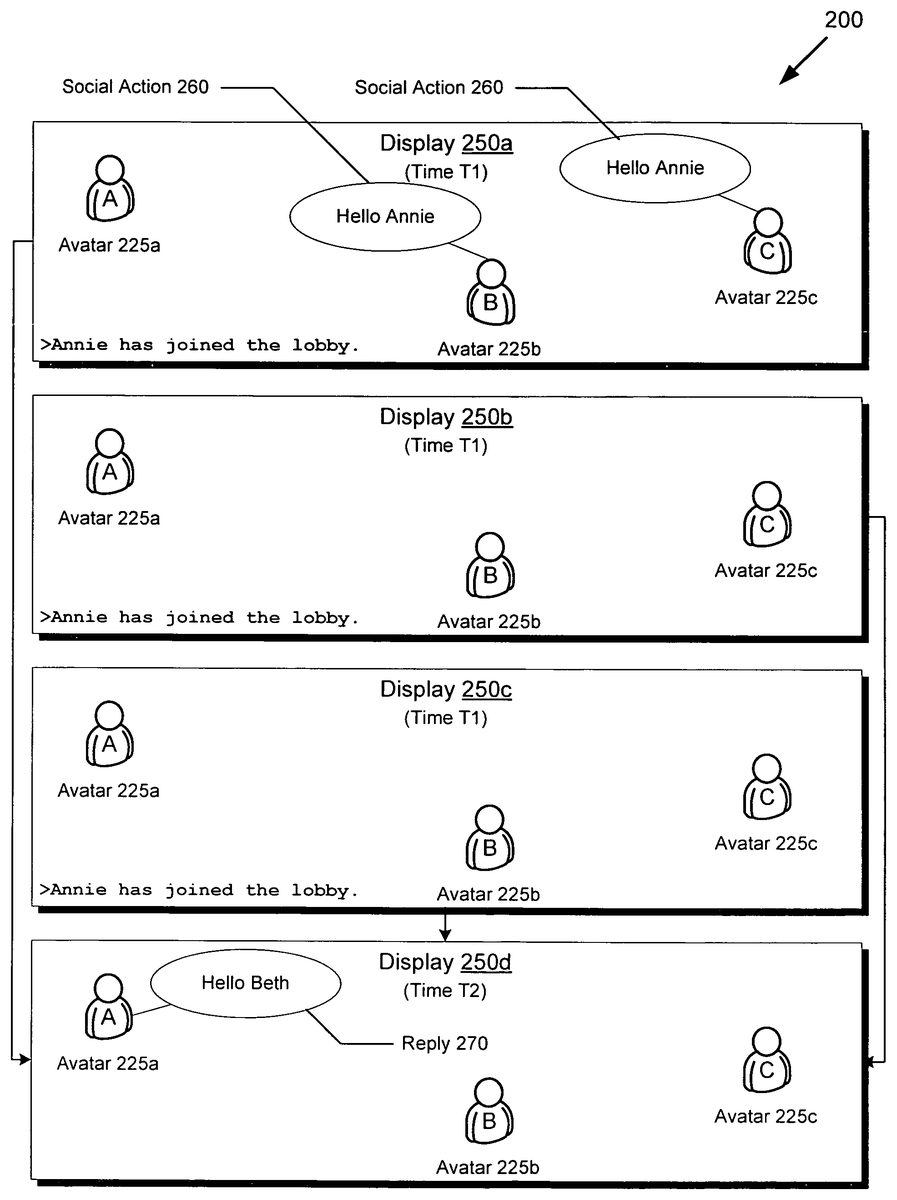
Moving toFIG. 2,FIG. 2presents a diagram showing the display of clients participating in the facilitation of a social interaction, according to one embodiment of the present invention. Diagram200ofFIG. 2includes display250a-250d. Display250aincludes avatars225a-225cand social action260. Display250bincludes avatars225a-225c. Display250cincludes avatars225a-225c. Display250dincludes avatars225a-225cand reply270. With respect toFIG. 2, it should be noted that display250acorresponds to display150afromFIG. 1, that display250bcorresponds to display150b, that display250ccorresponds to display150c, and that display250dcorresponds to display150a. Displays250a-250cshow the state of virtual world120fromFIG. 1at a time T1, whereas display250dshows the state of virtual world120at a time T2.
At time T1, the avatar Annie represented by avatar225ajoins a public lobby area, as shown by the join message at the bottom of displays250a-250c. However, the user controlling Annie, or the user of client140ainFIG. 1, may not be inclined towards making a first contact with other avatars due to a shy and introverted personality. Thus, to facilitate social interactivity, virtual world service115executing on processor111of server110inFIG. 1may temporarily control one or more avatars of other users within proximity of avatar225ato simulate a social action such as a personalized greeting, creating an impression of a friendly and outgoing community. This is shown inFIG. 2on display250aas social action260, where avatars225b-225cconvey the personalized text greeting, “Hello Annie.” Besides text communication, social action260might also comprise voice communication, avatar movements, and other actions, singly or in combination. For example, as shown on display250a, avatars225b-225cmay change orientation to face avatar225aduring social action260, and return to their original orientation after the completion of social action260. Other avatar movements might include gestures such as waving, bowing, beckoning, dancing, showing emotions via emoticons, and any other movements or actions permitted by virtual world service115. Furthermore, social action360might be invoked at staggered or random times for different controlled avatars, which may appear to look more like human behavior rather than simulated behavior.
Since social action260is merely simulated by processor111using virtual world service115and not actually initiated by corresponding clients140b-140c, the corresponding displays250b-250cfor clients140b-140cshow the public lobby as if nothing happened, as depicted inFIG. 2. In alternative embodiments, however, the execution of social action260by other controlled avatars might be shown as well. For example, display250bmight show avatar225csaying “Hello Annie” whereas display250cmight show avatar225bsaying “Hello Annie.” A decision to hide social action260from the display of all avatars except avatar225a, to hide only from a corresponding display of a controlled avatar, or to hide by some other criteria may be flexibly formulated as desired, as long as the simulation of social action260is kept protected from users' consciousness.
As shown by display250ainFIG. 2, clients140b-140cmay thus remain unaware that social action260has been simulated, whereas client140acan fully perceive social action260. In this manner, the user of Annie or avatar225amight feel more comfortable engaging in a conversation or another social activity with other avatars. Meanwhile, the users of avatars225b-225cdo not need to personally initiate a social interaction with avatar225a, since social action260is simulated for them by virtual world service115. As long as this simulation remains undetected by users, online community cohesiveness may be enhanced with little penalty and minimal effort. Even if users detect the simulation, the simulated social action may appear so innocuous that users might concede that their avatars have been used for the greater good of fostering a robust online community.
Before intervening in such a manner, processor111might first determine whether controlling the avatars is acceptable according to one or more factors. For example, virtual world service115might keep a behavior history for each avatar, allowing processor111to determine whether particular avatars have exhibited problematic social behavior in the past. Positive behaviors such as helping fellow avatars might add points to a behavior variable, whereas negative behaviors such as harassment might subtract points to the behavior variable. Processor111might then consider a behavior filter as a factor to remove from consideration any avatars having a low behavior variable, since they may not be ideal candidates for encouraging social interactions. This could apply both to avatars as candidates for simulated control, or avatars225b-225cinFIG. 2, and avatars as candidates for receiving a simulated social action, or avatar225ainFIG. 2.
Several other factors may also be considered besides avatar behavior. For example, to avoid excessive simulated actions that might make the user of avatar225asuspicious of system intervention, the frequency of simulated social actions might be moderated based on an upper limit, random chance, or other criteria. To help new users get up and running quickly in the virtual world, recently registered avatars without any established online friends might be targeted for simulated social actions more frequently than long established avatars with fully populated buddy lists. In this manner, simulated social actions can provide efficient returns in establishing a robust and friendly online community while minimizing the risk of users discovering the simulated nature of the social actions.
Assuming that processor111has determined that avatar225ais an appropriate target for receiving a simulated social action, processor111may then consult virtual world service115to determine avatars in proximity to avatar225ain virtual world120ofFIG. 1. One simple method of determining avatars in proximity to a particular avatar is to confirm that the avatars are visible on the display of a client associated with the particular avatar. Thus, since avatars225b-225care visible on display250a, it may be concluded that avatars225b-225care within proximity to avatar225a. As with avatar225a, one or more factors could be applied against avatars225b-225cto determine whether they are suitable candidates for simulating social action260. Assuming processor111determines that both avatar225b, or Beth, and avatar225c, or Carl, are acceptable candidates, then both avatars225b-225cmay be used to execute social action260, as shown in display250a. As shown inFIG. 2, social action260is observable by client140aof avatar225a, but not observable by clients140b-140cof avatars225b-225c. That is, whereas Annie sees avatars225b-225csending a personalized text greeting on display250a, Beth and Carl do not see any action occurring on displays250b-250c.
After the completion of social action260, which may for example display for a few seconds, the state of virtual world120may transition to the state shown in display250dat time T2. Since the simulation of social action260is complete at time T2, all users may observe the same display250das usual when no social actions are being simulated. Additionally and ideally, the user of client140amay also send a reply in response to social action260. Display250dshows one example reply270that might be received by processor111. Since the user of client140amight be more inclined to respond to avatar225bor Beth as she is closer than avatar225cor Carl, reply270comprises a return greeting to avatar225b, “Hello Beth.”
Recalling that the user controlling avatar225bor Beth did not observe the original social action260, as shown by display250bat time T1, reply270appears to be a first initiating communication from the perspective of the user controlling avatar225bor Beth. From the perspective of avatar225b, it appears that avatar225ais initiating the conversation when in reality it was the simulated social action260that prompted avatar225ato formulate reply270. Additionally, since the user of avatar225c, or Carl, was never aware of the existence of social action260in the first place, the lack of any specific reply from avatar225adoes not raise any concerns for the user of avatar225c. In this manner, users that are normally reticent to reach out and take the initiative in breaking the ice and acting socially confident and assertive may be assisted transparently with the help of a few simulated social actions.
For social action260to continue undetected as the real social interaction starter, reply270should appear to avatar225bto be a natural first initiating action even if social action260never occurred, since the user of avatar225bindeed never observed social action260. Thus, it may be helpful to formulate social action260to include a simple universal greeting so that reply270can also include the greeting as a response. As shown by social action260, the greeting “Hello” is used as such a simple universal greeting, as a typical reply to “Hello” may simply comprise repeating “Hello” back. However, just using the greeting in isolation may leave little impact, as it may be unclear whom the greeting is directed towards. Thus, adding personalization when formulating social action260may provide a stronger impact for avatar225a. InFIG. 2, personalization is accomplished by including the specific name of avatar225a, or “Annie,” but other methods of personalization could be used as well. This in turn may help shape reply270such that it is directed towards a particular avatar that was used for social action260.
As shown in reply270ofFIG. 2, the name of avatar225b, or “Beth,” is specifically included within the return greeting of “Hello,” making it clear that avatar225ais responding to avatar225b. This is particularly helpful since the user of avatar225bis unaware of the previous context of social action260, further helping to keep the role of social action260in the social interaction well hidden. Hopefully, avatar225bmay then naturally continue the flow of the conversation, replying with, for example, “How are you doing?” or “What's up?” In this manner, a casual conversation starter might lead to a lasting online friendship, which may have never otherwise occurred without the initial help of social action260.
While the example shown inFIG. 2is such that the avatars that are already in the public lobby are controlled to greet the joining avatar225a, a reverse scenario could also be used as well. For example, as soon as avatar225aenters the public lobby, virtual world service115might control avatar225asuch that it says “Hello everybody” or “Hello Beth” upon entering, without the user of client140aever observing or made aware that avatar225ais greeting anyone. As a result of the simulated greeting, avatar225bor avatar225cmight reply with “Hello Annie” and the conversation may proceed as described above.
Moving toFIG. 3,FIG. 3presents a diagram showing the display of clients participating in the facilitation of a social interaction, according to another embodiment of the present invention. Diagram300ofFIG. 3includes displays350a-350c. Display350aincludes avatars325a-325dand social action360. Display350bincludes avatars325a-325dand social action360. Display350cincludes avatars325a-325dand social action360. With regards toFIG. 3, it should be noted that display350acorresponds to display150afromFIG. 1, that display350bcorresponds to display150b, and that display350ccorresponds to display150c. Displays350a-350cshow the state of virtual world120fromFIG. 1at a time T1.
WhileFIG. 2focused on an example of starting a conversation between specifically selected avatars,FIG. 3demonstrates an example where the focus is more aimed towards general community enhancement directed towards a specific context or event. In the case ofFIG. 3, the specific context or event is the entrance of a well-known celebrity avatar “Dawn” who might be known for her good fashion sense. To emphasize this point and to generate buzz and excitement for a user, virtual world service115might control avatars of other users to reinforce Dawn's celebrity image.
For example, as shown inFIG. 3, virtual world service115ofFIG. 1may simulate a social action360such that each user observes other avatars talking about avatar325, or Dawn, that just entered the public lobby. Client140aviewing corresponding display350asees avatar325band avatar325cexecuting social action360, whereas client140bviewing corresponding display350bsees avatar325aand avatar325cexecuting social action360, and client140cviewing corresponding display350csees avatar325aand avatar325bexecuting social action360. Social action360may comprise a phrase for drawing attention to Dawn, which might be selected from a list of previously prepared phrases, including “Oh my gosh, it's Dawn!” and “Dawn! I love your fashion sense!” as shown inFIG. 3.
As a result, for example, the user of client140acontrolling avatar325amay wonder what the buzz surrounding Dawn is all about and decide to reply by, for example, communicating her own comment to the chorus, striking up a conversation with avatar325d, or asking avatar325bor avatar325cfor more information about Dawn. Similarly, the user of clients140band140ccontrolling avatars325band325cmay come up with their own responses to the apparent commotion that seems to be surrounding Dawn, which of course was only simulated by virtual world service115inFIG. 1. If users are generating comments on their own initiative, then it may not be necessary for virtual world service115to invoke social action360as shown inFIG. 3, or social action360may only be selectively applied to particular avatars that have not yet responded to the entrance of avatar325dto the public lobby.
In this manner, specific events or contexts may be controlled to enhance the user experience. For example, there might be a festival or party occurring in virtual world120ofFIG. 1, but avatars125a-125cmight be too shy to participate in the festive spirit and might just idly stand there. As a result, if virtual world service115detects that the party is going a bit dull, then it might control the behavior of some avatars to jumpstart the party. For example, avatar125amight see avatar125bsaying “Let's dance!” and avatar125cstarting to dance, when in actuality virtual world service115is simulating avatar125bsaying “Let's dance” and avatar125cdancing. Virtual world service115may provide a similar illusion for avatar125band avatar125c, so that users might begin to feel the festive spirit and begin participating in a more context or event appropriate manner, which enhances the experience for everyone. Once the festival or party goes into full swing then virtual world service115may stop simulating, as the objective of lifting everyone's mood and jumpstarting the party is already complete.
Moving toFIG. 4,FIG. 4shows a flowchart describing the steps, according to one embodiment of the present invention, by which a reply may be induced from a first client connected to a virtual world to facilitate a social interaction using a second client connected to the virtual world. Certain details and features have been left out of flowchart400that are apparent to a person of ordinary skill in the art. For example, a step may comprise one or more substeps or may involve specialized equipment or materials, as known in the art. While steps410through450indicated in flowchart400are sufficient to describe one embodiment of the present invention, other embodiments of the invention may utilize steps different from those shown in flowchart400.
Referring to step410of flowchart400inFIG. 5, diagram100ofFIG. 1, and diagram200ofFIG. 2, step410of flowchart400comprises processor111determining that social action260is acceptable using one or more factors. As previously discussed, these factors might include avatar behavioral histories, simulation frequency, user registration dates, buddy lists, and other data. Furthermore, these factors may be weighed against both the avatars executing social action260and the avatars receiving the effects of social action260.
Referring to step420of flowchart400inFIG. 5and diagram100ofFIG. 1, step420of flowchart400comprises processor111locating in virtual world120an avatar125bof client140bin proximity of an avatar125aof client140a. As previously discussed, one method of determining proximity is whether an avatar is visible on a corresponding client display. Turning toFIG. 2, both avatar225band avatar225care in proximity to avatar225asince they are both visible on display250a. Thus, step420may select avatar225bor avatar225c, or both as depicted inFIG. 2. For the purposes of the present example, it might be assumed that only avatar225bis selected.
Referring to step430of flowchart400inFIG. 5, diagram100ofFIG. 1, and diagram200ofFIG. 2, step430of flowchart400comprises processor111executing social action260using avatar225bsuch that social action260is observable by client140abut not observable by client140b. As shown inFIG. 2, step430may be accomplished by changing what is shown on each client's corresponding display. Thus, display250acorresponding to client140ashows avatar225bexecuting social action260, whereas display250bcorresponding to client140bdoes not show avatar225bexecuting social action260. As a result, the user of client140acan perceive social action260, or the communication of “Hello Annie,” whereas the user of client140bcannot perceive social action260. In one embodiment, prior to executing social action260using avatar225bat step430, processor111may wait for a pre-determined period of time, such as 10-15 seconds, to determine if any social action is initiated by one of the clients and, if so, flowchart400may be terminated.
Referring to step440of flowchart400inFIG. 5, diagram100ofFIG. 1, and diagram200ofFIG. 2, step440of flowchart400comprises processor111receiving reply270from client140ain response to social action260executed in step430. As a result of receiving a personalized greeting, the user of client140amay feel induced to send a return greeting, shown inFIG. 2as reply270, or “Hello Beth.” As previously discussed, step430may be formulated so that reply270may be interpreted by avatar225bor client140bas an initial conversation starter, rather than as a response to social action260. Including a general greeting that can be repeated as a response such as “hello” may create the desired effect. Additionally, adding personalization, such as the specific name of “Annie,” may also help elicit reply270from client140acontrolling avatar225a.
Referring to step450of flowchart400inFIG. 5, diagram100ofFIG. 1, and diagram200ofFIG. 2, step450of flowchart400comprises processor111rendering reply270received from step440using avatar225a. As shown in display250d, this may be accomplished by having avatar225aspeak reply270, which may then be viewed by all other avatars in proximity, including avatar225band avatar225c. Ideally as a result, avatars225aand225bmay then naturally continue the social interaction by continuing the flow of the conversation. In one embodiment, if client140bwants to provide a response to reply270that can be odd or confusing, e.g. “Hello” in response to “Hello Beth,” processor111may suppress the response such that it is not perceivable by client140a. Thus, normally shy and withdrawn users may be encouraged to communicate with others and gain greater enjoyment from their online experiences, which enriches the online community as a whole.
From the above description of the invention it is manifest that various techniques can be used for implementing the concepts of the present invention without departing from its scope. Moreover, while the invention has been described with specific reference to certain embodiments, a person of ordinary skills in the art would recognize that changes can be made in form and detail without departing from the spirit and the scope of the invention. As such, the described embodiments are to be considered in all respects as illustrative and not restrictive. It should also be understood that the invention is not limited to the particular embodiments described herein, but is capable of many rearrangements, modifications, and substitutions without departing from the scope of the invention.
Claims
- A method for inducing a reply from a first client connected to a virtual world to facilitate a social interaction using a second client connected to the virtual world, the method comprising: locating, in the virtual world, an avatar of the second client in a proximity of an avatar of the first client;executing, in response to the locating, a social action using the avatar of the second client such that the social action is observable by the first client, wherein the social action is neither observable nor initiated by the second client while the avatar of the second client is being controlled by the second client and is observable by the second client;receiving the reply from the first client in response to the social action;rendering the reply from the first client using the avatar of the first client;receiving a response from the second client in response to the reply;and rendering the response from the second client using the avatar of the second client.
- The method of claim 1 , wherein the avatar of the second client is located in the proximity of the avatar of the first client when the avatar of the second client is visible on a display of the first client.
- The method of claim 1 , wherein the social action is observable by the first client using a display of the first client showing the virtual world.
- The method of claim 1 , wherein the social action includes communication by text or voice.
- The method of claim 4 , wherein the communication is regarding an event occurring in the virtual world.
- The method of claim 4 , wherein the communication is personalized for the first client.
- The method of claim 4 , wherein the communication includes a greeting that may be repeated in response to the communication, and wherein the reply includes the greeting.
- The method of claim 7 , wherein the greeting is hello.
- The method of claim 1 , wherein the social action includes a movement.
- The method of claim 9 , wherein the movement comprises a gesture.
- The method of claim 9 , wherein the movement comprises changing orientation.
- The method of claim 1 further comprising prior to the locating: determining that the social action is acceptable using one or more factors.
- The method of claim 12 , wherein the one or more factors include a behavioral history of the second client.
- The method of claim 12 , wherein the one or more factors include a behavioral history of the first client.
- The method of claim 1 further comprising prior to the receiving: locating, in the virtual world, an avatar of a third client in a proximity of an avatar of the first client;and executing the social action using the avatar of the third client such that the social action is observable by the first client but not observable by the third client.
- The method of claim 15 , wherein executing the social action using the avatar of the second client is not observable by the third client, and wherein executing the social action using the avatar of the third client is not observable by the second client.
- A server for inducing a from a first client connected to a virtual world to facilitate a social interaction using a second client connected to the virtual world, the server comprising a processor configured to: locate, in the virtual world, an avatar of the second client in a proximity of an avatar of the first client;execute, in response to the locating, a social action using the avatar of the second client such that the social action is observable by the first client, wherein the social action is neither observable nor initiated by the second client while the avatar of the second client is being controlled by the second client and is observable by the second client;receive the reply from the first client in response to the social action;and render the reply from the first client using the avatar of the first client;receive a response from the second client in response to the reply;and render the response from the second client using the avatar of the second client.
- The server of claim 17 , wherein the social action includes communication by text or voice.
- The server of claim 18 , wherein the communication includes a greeting that may be repeated in response to the communication, and wherein the reply includes the greeting.
- The server of claim 17 , wherein prior to receiving the reply the processor is configured to: locate, in the virtual world, an avatar of a third client in a proximity of an avatar of the first client;and execute the social action using the avatar of the third client such that the social action is observable by the first client but not observable by the third client.
Disclaimer: Data collected from the USPTO and may be malformed, incomplete, and/or otherwise inaccurate.