U.S. Pat. No. 8,876,594
CASHLESS COMPUTERIZED VIDEO GAME SYSTEM AND METHOD
AssigneeOneida Indian Nation
Issue DateAugust 3, 2007
Illustrative Figure
Abstract
A cashless wagering game system is described herein. In some embodiments, the wagering game system includes a control network. The control network can include an account server configured to receive player activity information and demographic information over a network, wherein the player activity information includes a financial transaction associated with a player account, and where the demographic information is associated with a player. The control network can also include a player terminal configured to present a wagering game and to report the player activity information to the account server.
Description
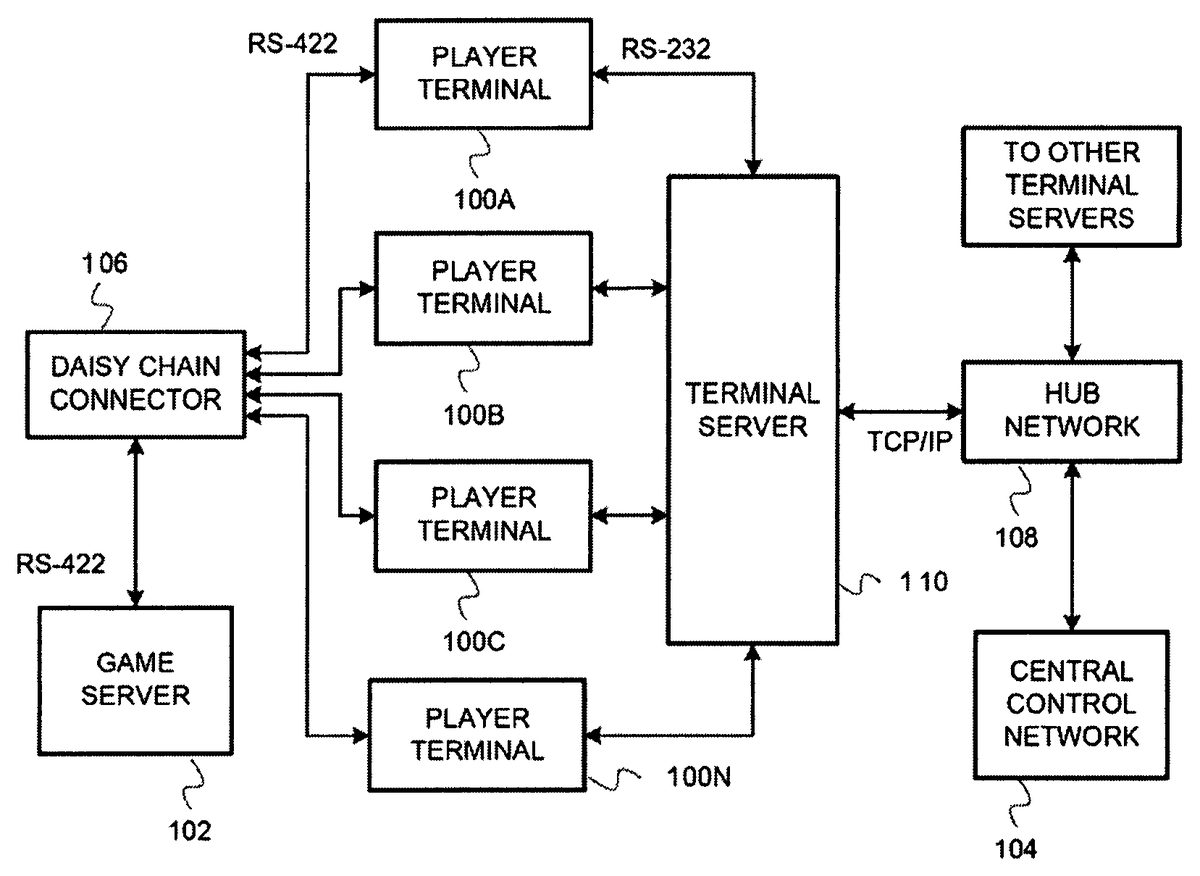
DETAILED DESCRIPTION OF THE INVENTION Reference will now be made in detail to the construction and operation of preferred implementations of the present invention illustrated in the accompanying drawings. In those drawings, like elements and operations are designated with the same reference numbers when possible. The following description of the preferred implementation of the present invention is only exemplary of the invention. The present invention is not limited to these implementations, but may be realized by other implementations. FIG. 1shows a block diagram of a coinless video game system in accordance with a preferred embodiment of the present invention. As shown, the system generally comprises a plurality of player terminals100a-100n, a game server102connected to each of the player terminals100a-100n, and a central control network104connected to each player terminal for administering and controlling the player terminals100and for maintaining player accounts. Game server102preferably connects to the player terminals100via a daisy-chain connection106and communicate via the RS-422 protocol. The central control network104connects to each player terminal100via a hub network108and a terminal server110. In a preferred embodiment, the system also includes a terminal server110connected to each player terminal100and communicates via the RS-232 protocol. Terminal server110converts information from the player terminals100to the TCP-IP protocol and communicates the converted messages to the central control network104via the hub network108. Hub network108preferably comprises an Ethernet network. As shown inFIG. 1, a group of player terminals100a-100nare serviced by a single game server102and a single terminal server110. In a preferred embodiment, a single game server102and single terminal server110service up to thirty-two player terminals. Additional groups of player terminals (not shown) are connected to the central control network104via the hub network108. As with the group of player terminals100a-100n, any additional groups of player terminals are also preferably serviced by a single game server and are connected to the hub network via a ...
DETAILED DESCRIPTION OF THE INVENTION
Reference will now be made in detail to the construction and operation of preferred implementations of the present invention illustrated in the accompanying drawings. In those drawings, like elements and operations are designated with the same reference numbers when possible.
The following description of the preferred implementation of the present invention is only exemplary of the invention. The present invention is not limited to these implementations, but may be realized by other implementations.
FIG. 1shows a block diagram of a coinless video game system in accordance with a preferred embodiment of the present invention. As shown, the system generally comprises a plurality of player terminals100a-100n, a game server102connected to each of the player terminals100a-100n, and a central control network104connected to each player terminal for administering and controlling the player terminals100and for maintaining player accounts. Game server102preferably connects to the player terminals100via a daisy-chain connection106and communicate via the RS-422 protocol. The central control network104connects to each player terminal100via a hub network108and a terminal server110.
In a preferred embodiment, the system also includes a terminal server110connected to each player terminal100and communicates via the RS-232 protocol. Terminal server110converts information from the player terminals100to the TCP-IP protocol and communicates the converted messages to the central control network104via the hub network108. Hub network108preferably comprises an Ethernet network.
As shown inFIG. 1, a group of player terminals100a-100nare serviced by a single game server102and a single terminal server110. In a preferred embodiment, a single game server102and single terminal server110service up to thirty-two player terminals. Additional groups of player terminals (not shown) are connected to the central control network104via the hub network108. As with the group of player terminals100a-100n, any additional groups of player terminals are also preferably serviced by a single game server and are connected to the hub network via a single terminal server. Thus, in accordance with the present invention, a gaming system may comprise hundreds or thousands of player terminals. A single game server and a single terminal server service a group of player terminals, and central control network104controls all the groups of player terminals.
FIG. 2illustrates a block diagram of a player terminal100in accordance with one embodiment of the present invention. Player terminals100differ from conventional electronic slot machine-type video game terminals because they do not receive coins and do not pay off winners with coins. Rather, in accordance with a preferred embodiment of the present invention, player terminals100accept a magnetic card or key (referred to generically as magnetic card), and communicate with the central control network104to debit and credit a player's account based on amounts wagered by the player for each game.
Referring toFIG. 2, player terminal100comprises a controller200, player interface202, game player204, magnetic card reader206, keypad208, counter210, and video display212. Player interface202preferably comprises a software application for displaying attract mode graphics to attract a player to the player terminal. Game player204preferably comprises software applications running electronic games of chance, such as lotto, keno, bingo, etc. These games are preferably conventional video games of chance except that, as described below, they receive a random number from the external game server102and base a win/lose result on that random number and the player's selection. In accordance with the invention, each player terminal100plays any one of several games independently of the others. Thus, within a group of player terminals such as player terminals100a-100n, several players may be playing keno while others play lotto and still others play video poker. Regardless of the game, the player terminals100look to the game server102for the random number to determine a result.
Magnetic card reader206preferably comprises a conventional magnetic card reader capable of reading a credit card—or smart card-type player identification card. The type of card will dictate the type of card reader.
Keypad208preferably comprises a conventional alphanumeric or numeric key entry device. Keypad208permits a player to enter a personal identification number (“PIN”) to verify the player at the player terminal100.
Video display212preferably comprises a conventional touch screen video monitor for displaying video graphics and receiving player inputs. A touch screen is not necessary, however, since player inputs can be made through keypad208.
The counter210preferably comprises a conventional digital counting device for counting a predetermined interval between game plays. The counter210helps synchronize operation.
As described above, electronic games of chance rely on randomly generated numbers to determine wins and losses. Although the video games are preferably played by game player204at the player terminals, the random number from which the games player204determines wins and loses at each player terminal is generated by the game server102servicing those player terminals100.
Thus, as shown inFIG. 3, game server102preferably comprises a random number generator300and a counter302. Game server102preferably generates random numbers once during a predetermined period, e.g., every few seconds, as determined by counter302. During a given predetermined period, if a players at player terminal100enters a wager and presses the “Play” button, the player must await the display of the next set of winning numbers. In the meantime, as soon as the “Play” button is selected, player terminal100notifies game server102and game server102enrolls that player terminal100in the next game.
Upon expiration of the predetermined period, game server102generates a set of random numbers for each type of game offered at player terminals100that it services. Game server102then sends the set of random numbers corresponding to the selected game at enrolled player terminal100. Player terminal100receives the corresponding set of random numbers and determines the win or loss of that game. This eliminates the duplicative need for each player terminal100to convert the random number for the particular game being played, and simplifies die programming necessary at player terminal100.
Each number in the generated set of random number may represent the winning number. For example, if keno is selected at player terminal100that is enrolled for the next game, game server102generates a set of twenty winning numbers. If the result of the game depends on a graphical figure, for example, Lucky Gem where three consecutive diamonds result in a winning jackpot, a predetermined number represents a certain shape of gem. To ensure proper randomization, however, game server102changes randomly or periodically the number corresponding to a certain graphical figure.
In another embodiment consistent with the present invention, game server102may generate a single set of random numbers and transmit them to player terminals100. Player terminals100would then convert the single set of random numbers to game-specific numbers corresponding to the selected game at that terminal. This simplifies the tasks at game server102by generating only a single set of random numbers regardless of what games are selected at player terminals100. Additionally, this embodiment alleviates the need for game server102to maintain enrollment information of player terminals100. Player terminals100would, however, need to perform additional computation in converting the set of random numbers to game-specific numbers. In any event, the centralization of the random number generation provides an efficient and effective means for controlling the games, increases the average number of games played, and helps reduce fraud.
Because of the predetermined interval between generations of random numbers, a player who makes a “play” during that interval, must wait until that interval expires before the player terminal100receives the random number and determines a win or loss for that “play.” The interval can, of course, be selected to be any predetermined interval to accommodate players and a provider of the system and games.
In accordance with the present invention, central controller network104provides a centralized control means for monitoring and administering all video games and player accounts. Central controller network104tracks each player activity, preferably on a per-game basis, to maintain current and comprehensive information about the players at any time during the player's session at player terminals100.FIG. 4provides a block diagram of the central control network104in accordance with a preferred embodiment of the invention.
Central control network104preferably comprises an account server400running control applications402to provide the administrative and service functions described in this application. Account server400stores players' account information in an account files database404, stores player card information in a player card information database406, and stores game result information in a game information database408. In addition, account server400preferably controls a cashier station410and a customer service station412.
Cashier station410preferably comprises an operator terminal414, connected to the account server via an Ethernet connection, a magnetic card reader416, and a keypad418. Customer service station412preferably comprises an operator terminal420, connected to account server400via an RS-232 connection, a magnetic card issue system422, and a keypad424. Magnetic card reader416and issue system422preferably comprise conventional devices for reading and generating credit card-type magnetic cards. Likewise, keypads418and424preferably comprise conventional alphanumeric or numeric keypads, and terminals414and420preferably comprise conventional PC or networked data entry terminals.
Although the account server400is shown as a single element of the central control to network104, in a preferred embodiment account server400comprises a fault tolerant configured paired STRATUS R55 computer.
In addition to administering games and customer accounts, central control network104also provides reports on both using a report server426. Account server400preferably trickles information from its transaction log file in its databases404,406, and408to the report server426, which in turn generates customized or standardized reports in accordance with a service providers' requirements. Report server426may comprise, for example, a RS-6000 computer and/or an A/S400. Each entry of the transaction log file preferably contains header information such as message type, transmission number, transaction code, and player account number to identify the type of message and transaction.
The transfer of information from account server400to report server426preferably occurs in real-time. Although only one physical connection may exist between account server400and report server426, account server400may transfer the information in multiple logical units in parallel. This approach is desirable during peak times when transaction volume is high.
At service station412, a player wishing to use a player terminal100can establish an account and receive a magnetic I.D. card to operate the player terminal100. Preferably, a player provides an operator with some identifying information, and the operator uses terminal420to transmit this information to account server400. Account server400establishes an account file for the player in account files database404and assigns a corresponding account number to that player. In addition, the operator may ask the customer to select a PIN via keypad424. The player identifier information, the account number, and an encrypted version of the PIN is then stored on a magnetic strip on a magnetic I.D. card issued by the magnetic card issue system422. Although not shown, customer service station412may also include a scanning device for scanning and storing a player's signature or photograph. Likewise, customer service station412may include a camera for photographing the player and including a picture on the players I.D. card. Account server400stores the player's identification information in the player card information database406. Such information may include the player's name, address, gender, birthday, and phone number. Any scanned information may be stored in a separate file server. Finally, the customer server status412may include a printer device to print, for example, customer receipts.
After receiving an I.D. card, the player proceeds to a cashier station410to deposit money into his or her account. An operator swipes the card through the magnetic card reader416to credit the account via the keypad418after receiving payment from the player. Account server400stores the player's account information in the account files database404, preferably including the time, date, and amount of deposit as well as the resulting account balance.
Cashier station410also serves to pay players having positive account balances at the end of their play sessions. To receive money, a player provides an operator at cashier station410with his/her I.D. card. The operator swipes the I.D. card to retrieve the account balance information verifies the player by requesting the player to input his/her PIN via keypad418, and pays the player any positive account balance. Account server400stores the player's account information in the account files database404, preferably including the time, date, and amount of withdrawal as well as the resulting account balance. Although shown as two separate stations, cashier station410and customer service station414may be combined as a single customer service/cashier station.
To help illustrate the operation of the cashless video game system of the present invention a preferred method of operation and system process will now be explained with reference to the system elements in block diagrams inFIGS. 1-4and the process flow diagram shown inFIGS. 5aand5b.
Referring toFIG. 5a, after opening a player account and obtaining a player I.D. card, a player logs onto a player terminal100by inserting the I.D. card into the magnetic card reader206(step500). Alternatively, the system does not require player I.D. cards, so the player simply enters his/her assigned player account number using keypad208.
The player terminal100, which has been executing attract mode graphics, reads the information from the I.D. card, displays the player's name (step502) sends the player account number to the account server400, and requests the account server400to verify the player's account number. Account server400receives the account number and, referring to the account file database404, determines whether the player account number is valid (step504). If not, player terminal100informs the player and either requests the player to reenter the account number or terminates the session (step506).
If account server400determines that the account number is valid, player terminal100requests the player to enter his/her PIN (step508). Player terminal100preferably encrypts the PIN and forwards the encrypted PIN to the account server400(step510). Account server400receives the PIN and determines whether the PIN is valid and corresponds to the player's account number (step512). If the PIN is not valid or does not correspond to player's account number, player terminal100either requests the player reenter the PIN, or terminates the session (step514). If the PIN is valid, player terminal100displays a graphical selection of video games on video display212(step516). As described, the video games may include keno, lotto, bingo, etc.
Using the touch screen video display212or keypad208, the player then selects a desired game (step518). The player terminal100displays the corresponding game graphics and requests the player to enter game choices corresponding to that game (step520). For a particular game, a player may have to make certain selections required by the rules of each game including a selection of predetermined numbers, colors, and/or symbols. For example, if the player selects keno, video display212may display eighty numbers from which the player selects up to twenty numbers via the video display screen212. Player terminal100also displays the account balance during a player session.
The player then enters his/her game choices and a wager amount (step522). In a preferred embodiment, video display212also displays the wager amount during each game. Player terminal100responds to the waged amount by requesting the account sever400to verify that the player has a sufficient balance in his/her account to cover the wager.
When the account server400receives this request from the player terminals it makes the requested determination (step524). If the player has insufficient funds to cover the wager, the player terminal100so informs die player and either requests the player to enter a new wager consistent with the player's account balance or terminates the session (step526). If account server100determines that the account balance is sufficient to cover the wager, player terminal400informs the player that he/she is authorized to play and requests the player to select a “play” button on the video display212or keypad208(step528). Once the player selects the “play” button, player terminal100passes control to counter210(step530) and waits to receive a random number from the corresponding game server102.
Again, as explained above, because game server102is generating a random number at a predefined interval, the player who has selected the “play” button during the interval must wait until the player terminal100receives the random number to determine the results of the play. Counter210in player terminal100keeps track of this interval and, in one embodiment, may display the time remaining between the player's selection of the “play” button and the determination of a win or loss (step532).
As explained above, at the end of the interval, game server102generates a set of random numbers corresponding to each of the plurality of games at player terminals100. Game server102transmits to each corresponding player terminal100the set of random numbers corresponding to the game being played at player terminal100. Player terminal100receives the random number from the game server (step534) and determines whether the player has won or lost that game (step536). If the player has lost, player terminal100displays preselected loss graphics explaining the losing results (step538). If the player wins, player terminal100displays preselected win graphics explaining the winning results (step540).
Win or lose, player terminal100sends the game result and game information to account server400(step542). Such information may include, for example, the player terminal number, game type code, game number, time, date, wager amount and resulting account balance. In accordance with certain requirements, some or all of this information may be encrypted in accordance with conventional encrypting techniques. As described below, player terminal100also maintains the player's account balance during a player session.
The account server400responds to the data from the player terminal100by recording the game information in the game information database408(step544) and crediting or debiting the players account the waged amount (step546). Account server400then preferably returns the updated account balance to the player terminal100(step548). Player terminal100determines whether the returned account balance matches the account balance being tracked by the player terminal100(step550). This additional monitoring of the player's account balance helps protect the game service provider and the player by reducing fraud and detecting balance inconsistencies as early as possible, ideally on a per-game basis. If the account balances do not match, the player terminal100may prevent the player from continuing, and request service assistance (step552). If the account balances match, player terminal100preferably prompts the player to choose whether to play again (step554).
When a player has finished playing, he/she exits the player terminal using an appropriate touch screen command on video display212or key on the keypad208and returns to the cashier station410to settle his/her account. As described, using cashier terminal414, a cashier (not shown) requests the player account information from the account server400and redeems the balance of the player's account to the player.
In the preferred embodiment consistent with the present invention, player terminals100transmit real-time to account server400all player activity information input by the player. This information may include, for example, the player's account number, information on the game played, and the game choices selected by the player, the wager amount, the winning numbers provided by the game server102, and a credit or debit request for crediting or debiting the player's account the wager amount. Account server400stores player activity information at account files database404and player card information database406. The player card information includes player demographics data such as age, gender, and geographic location. Accordingly, central controller network104maintains a current and comprehensive player activity information and demographics of each player, which may be accessed at any time by authorized personnel.
Report server426may provide a report of varying specificity including a detailed listing of an individual player's activity for a specified time period, a summary of a player's activity over a period of time, actual number of games played by each player, and a summary of all players' activity on a particular day or over a period of time. Report server426generates these reports periodically, for example, once every two minutes. Server426may then generate a player activity report outlining player gambling habits such as frequency of plays, favorite games, nomination of player terminals, and average amount of wagers. Such player tracking report is valuable to casinos and players. Based on such reports, for example, casinos may tailor the types, number, and wager amount of games offered at player terminals100to accommodate player demand. Player terminals100may be modified periodically or interactively based on current player demand.
Additionally, casinos may use the reports as a tool to identify players with certain characteristics for marketing purposes. One marketing tool may be to offer “free play” cards, which are unique player cards with non-redeemable, playable credits. Such cards may be used as an incentive to attract players to the casino. Casinos may also offer complimentary “free play” cards to players who spend a certain weekly amount playing games. Player's account number along with expiration date and time of the free play cards may be printed on the card. Upon expiration such date and time, player terminals100will not recognize the free play card. Additionally, casinos may program cashier stations410to restrict withdrawals on the free play cards to only amounts greater than the face value of the card. The redemption period may also be restricted, for example, as a predetermined number of days after the expiration date.
Central tracking of all player activity on a per-game basis helps better tailor player terminals100based on player use and demand, reduce fraud, and target marketing efforts to players with certain attributes. Additionally, instantaneous information provides greater flexibility for managing gaming establishments. For example, such information may enable gaming establishment to access information whether player habits qualify for special awards during the play. It also helps detect fraud while it is occurring, for example, by detecting wins that far exceed average statistical odds or a single player playing at multiple player terminals100simultaneously. Moreover, real-time maintenance of player activity enables accurate system recovery in emergency situations such as power outage.
This description describes the presently preferred embodiments and methods of the present invention, but those skilled in the art would recognize that various changes and modifications may be made, and equivalents may be substituted without departing from the scope of the invention.
For example, the figures and description include a game server as a separate device for generating random numbers for the player terminals associated with that game server. Each player terminal could also maintain its own random number generator. In this embodiment, the random number generators in each player terminal would preferably be synchronized to provide a random number at a predetermined interval, just as described above for the separated random number generator in a game server. A random number generator could also be provided in the central control network104rather than in a separate game server.
In addition, many modifications may be made to adapt a particular element, technique or implementation to the teachings of the present invention without departing from the scope of the invention. Therefore, this invention should not be limited to the particular embodiments and methods disclosed herein, but that the invention include all embodiments falling within the scope of the appended claims.
Claims
- A wagering game system comprising: an account server configured to receive, from player terminals, player activity information over a network, wherein the player activity information indicates player selections made during wagering games and financial transactions associated with player accounts;determine, based on the player activity information, verification balances for verifying local account balances at the player terminals;transmit, to the player terminals, the verification balances;the player terminals configured to present wagering games of a first type;report the player activity information to the account server;receive the verification balances;and compare the verification balances to the local account balances to verify the local account balances;a report server configured to determine, based in part on the player activity information, that demand for the first wagering game type has changed;control applications configured to select a second wagering game type based on information from the report server;and a game server configured to generate random numbers for wagering games of the first and second wagering game types, and to transmit the random numbers to the player terminals.
- The wagering game system of claim 1 , wherein the account server is further configured to determine, before presentation of the wagering games, that the player accounts include funds sufficient to complete the financial transactions.
- The wagering game system of claim 1 , wherein the account server is further configured to determine, before presentation of the wagering games, that the player accounts include funds sufficient to pay wagers associated with the wagering games.
- The wagering game system of claim 1 , wherein the account server is further configured to credit the player accounts after winning results of the wagering games, and to debit the player accounts after losing results of the wagering games.
- The wagering game system of claim 1 , wherein the player terminals report the player activity information to the account server in real-time.
- The wagering game system of claim 1 , wherein the player activity information further includes one or more of an account number, information about one or more of the wagering games, wager amounts, and player choices made during the wagering game.
- The wagering game system of claim 1 , wherein the system further includes: an account files database configured to record the financial transactions.
- A method comprising: receiving, over a network at an account server, player activity information, wherein the player activity information indicates player selections made during wagering games and financial transactions associated with player accounts;determining, at the account server based on the player activity information, verification balances for verifying local account balances at the player terminals;transmitting, to the player terminals, the verification balances;presenting, on the player terminals, wagering games of a first type;reporting, by the player terminals, player activity information to the account server;receiving, at the player terminals, the verification balances;comparing, at the player terminals, the verification balances to the local account balances to verify the local account balances;determining, at a report server based in part on the player activity information, that demand for the first wagering game type has changed;selecting, by control applications, a second wagering game type based on the information from the report server;generating, at a game server, random numbers for wagering games of the first and second wagering game types;and transmitting, to the player terminals, the random numbers.
- The method of claim 8 further including: determining, at the account server before presentation of the wagering games, that the player accounts include funds sufficient to complete the financial transactions.
- The method of claim 8 , wherein the player activity information further indicates one or more of player account numbers, information about the plurality of wagering games, and amounts wagered on the player terminals.
- The method of claim 8 , wherein the player activity information is received as a result of real-time transmission over the network.
Disclaimer: Data collected from the USPTO and may be malformed, incomplete, and/or otherwise inaccurate.