U.S. Pat. No. 8,858,341
Multi Video Game Changer
Issue DateAugust 18, 2009
Illustrative Figure
Abstract
A multi video game changer is presented. A video game changer can comprise a magazine for holding multiple video game media. The changer receives instructions, possibly including software instructions, from a game console on how to access video game data on the game media. In response, the changer streams the game data to the game console while buffering small portions of the game data.
Description
DETAILED DESCRIPTION The following discussion relates to a video game changer for a game console. One should appreciate that a game console is not a personal computer, but rather a computing device having a dedicated purpose of reading game data from a game media (e.g., disc, cartridge, ROM, etc.), interpreting the game data, and presenting the game to a player. InFIG. 1, game system100can comprise game console120, possibly connected to display110, and game changer130. Game console120represents a video gaming platform configured to accept one of game media145, interpret the game data on game media145, and provide a gaming experience to a game player based on the game data. Game console120can comprise hand-held game device or a non-hand-held device. Example, non-hand-held gaming devices include the Sony PlayStation™, Sony PlayStation 2™ (PS2), Sony PlayStation 3™ (PS3), Nintendo Wii™, Microsoft XBOX™, Microsoft XBOX 360™, or other gaming platforms known or yet to be developed. Example hand-held gaming devices that could operate as console120include the Sony PlayStation Portable™ (PSP), Nintendo Gameboy™, Nintendo DS™, Tiger Gizmondo™, or other hand-held gaming platforms. The names of actual companies and products mentioned herein may be the trademarks of their respective owners. In a preferred embodiment, console120comprises non-hand-held console. In some embodiments, game console120connects to display110, which presents gaming content to a game player. Display110can include any suitable display device including a television, a monitor, an LCD display, a plasma display, or other device capable of rendering an image under the control of console120. Display110can also include audio output, possibly speakers (not shown) for playing audio data under control of console120. Separate audio outputs are also contemplated. Console120can connect to display110via a wired or wireless connection using known techniques. For example, a wired connection could employ using an HDMI cable, an S-Video cable, audio cables, or other cables. It ...
DETAILED DESCRIPTION
The following discussion relates to a video game changer for a game console. One should appreciate that a game console is not a personal computer, but rather a computing device having a dedicated purpose of reading game data from a game media (e.g., disc, cartridge, ROM, etc.), interpreting the game data, and presenting the game to a player.
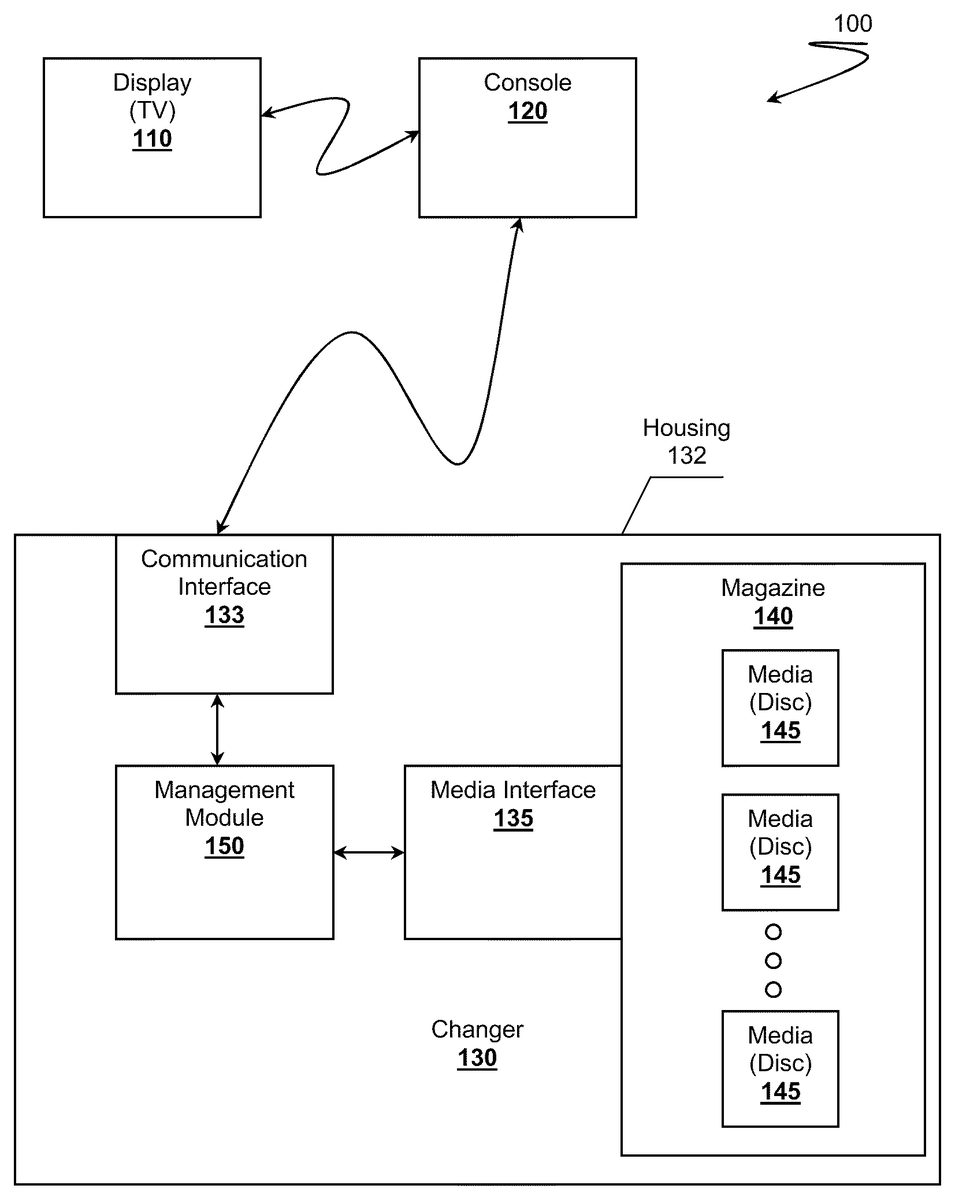
InFIG. 1, game system100can comprise game console120, possibly connected to display110, and game changer130. Game console120represents a video gaming platform configured to accept one of game media145, interpret the game data on game media145, and provide a gaming experience to a game player based on the game data. Game console120can comprise hand-held game device or a non-hand-held device. Example, non-hand-held gaming devices include the Sony PlayStation™, Sony PlayStation 2™ (PS2), Sony PlayStation 3™ (PS3), Nintendo Wii™, Microsoft XBOX™, Microsoft XBOX 360™, or other gaming platforms known or yet to be developed. Example hand-held gaming devices that could operate as console120include the Sony PlayStation Portable™ (PSP), Nintendo Gameboy™, Nintendo DS™, Tiger Gizmondo™, or other hand-held gaming platforms. The names of actual companies and products mentioned herein may be the trademarks of their respective owners. In a preferred embodiment, console120comprises non-hand-held console.
In some embodiments, game console120connects to display110, which presents gaming content to a game player. Display110can include any suitable display device including a television, a monitor, an LCD display, a plasma display, or other device capable of rendering an image under the control of console120. Display110can also include audio output, possibly speakers (not shown) for playing audio data under control of console120. Separate audio outputs are also contemplated.
Console120can connect to display110via a wired or wireless connection using known techniques. For example, a wired connection could employ using an HDMI cable, an S-Video cable, audio cables, or other cables. It is also contemplated a wired connection can comprise Ethernet cables, possibly as part of a packet switched network operating as a media network among various media components. A wireless connection could comprises 802.11, wireless USB, wireless 5.8 GHz A/V transmitter-receiver, or other wireless technology capable of exchanging A/V data among media components.
Although display110is shown external to console120, it is contemplated that display110, or audio output, can be internal to console120. In embodiments where console120comprises a hand-held gaming device (e.g., PSP, Nintendo DS, etc.), the hand-held device can include display110, for example.
Changer130preferably comprises console communication interface133, media management module150, and media interface135. Changer130can also include media magazine140configured to hold a plurality of video game media145. In a preferred embodiment, changer130comprises an external device relative to console120where the components of changer130are commonly disposed within housing132. However, it is also contemplated that changer130could be integrated within console120, possibly as a removable component.
Housing132can be an enclosure in which the various components of changer130are disposed. In some embodiments, housing132can be configured to allow removal or replacement of the various components including communication interface133, media interface135, magazine140, or module150. It is also contemplated that housing132could comprise one or more removable faceplates or bezels to allow consumers to customize changer130.
Communication interface133preferably comprises a wired or wireless interface compatible with a corresponding interface on console120. Communication interface133provides for a communication connection between changer130, preferably via management module150, and console120to exchange game data from media145or to exchange information regarding how to gain access to the game data. Example wired interfaces can comprise support for Ethernet, USB, Firewire, optic-fiber, or other wired-based communication interface. Example wireless interfaces can comprise support for Bluetooth, wireless USB, 802.11, UWB, Wi-Max, or other wireless communication interface. Especially preferred interfaces include USB or Ethernet. However, Bluetooth could also be employed. It is contemplated that changer130could include more that one of communication interface133including a heterogeneous mix of interface types to provide for compatibility across multiple gaming platforms.
Changer130also preferably includes one or more of media interface135, which is configured to engage with magazine140to at least read game data from game media145under instruction from management module150. Media interface135can employ various suitable approaches for reading media145. In some embodiments, media interface135includes read-heads adapted to read rotating media145. Read-heads can include optical read heads for reading optical media (e.g., CD, DVD, Blu-Ray, HD-DVD, Holographic Versatile Disc, etc.), or magnetic read-heads (e.g., HDD, tape, etc.). It is also contemplated that media interface135can include a bus interface that can connect to a solid state media (e.g., SSD, SD card, memory stick, flash, etc.). In some embodiments, possibly when changer130supports different types of gaming consoles120, changer130can include a heterogeneous mix of media interfaces135. Acceptable interfaces include those commonly employed in existing media players or gaming consoles120.
Media interface135can also be removable or replaceable from housing132. It is also contemplated that media interface135could be integrated into magazine140to allow changer130to operate with a wider range of game console platforms.
Magazine140can also take on many different forms depending on the target media145. In some embodiments magazine140comprises a rotating platter having receptacles for a plurality of media discs. In other, more preferred embodiments, magazine140comprises a cartridge having multiple media slots and that is capable of storing multiple game media145. In a preferred embodiment, magazine140comprises a cartridge capable of holding at least six, ten, twelve, or more discs. Media145can be loaded directly into magazine140, which is then inserted into changer130. In other more preferred embodiments, media145can be individually loaded into a loading slot in the housing of changer130, which then places media145into magazine140. It is specifically contemplated that magazine140could support holding a heterogeneous mix of media145including combinations of CDs, DVDs, Blu-Ray, solid state disks (e.g., SSD), flash cards, or other types of media.
One should appreciate that magazine140could be removable. Such an approach allows a gamer to create a library of magazines140. When desired, a complete magazine can be inserted into changer130. This approach also provides benefits to game developers. As games grow ever larger, possibly at a faster pace than the capacity of media145, game developers can package a game with multiple media145together, possibly packaged in magazine140, as a single game. The advantage is that a game would not be required to swap game media as they complete a game that bridges across multiple media.
A preferred magazine140comprises an internal magazine. Changer130can include a slot through which discs can be interested. Charger130can include a loading mechanism as is known in the art to load the discs into internal magazine140.
Preferred changers130include media management module150. Module150can be configured to take on roles, responsibilities, or functions to access game data on media145according to requirements, protocols, policies, or other criteria dictated by console120. Module150is discussed more fully below with respect toFIG. 2.
Changer130can also include additional features. One contemplated feature includes a network interface, through which changer130can exchange data with other devices on a local area network, the Internet, or other networks. In some embodiments, changer130can communicate with Internet-based severs to obtain firmware updates, programming information, authorizations, or other data. Another possible feature includes one or more additional A/V interfaces to allow changer130to operate as a media player. Changer130can be connected directly with A/V equipment (e.g., display110) and can play audio or video data on media145directly on the A/V equipment.
InFIG. 2, a possible embodiment of management module250is presented. Media management module250preferably includes processor255communicatively coupled to memory257. Processor255is configured to execute software instructions265stored in computer readable memory257. Software instructions265represent instructions that allow module250to fulfill its roles, responsibilities, or functions described below. In more preferred embodiments, module250also comprises communication interface connector233and media interface connector235. Both connectors233and235provide connectivity to the changer's respective interfaces.
Although module250is presented as a single component, it should be appreciated that module250could comprise physically discreet parts aggregated together physically on the same PCB, different PCBs, or in other configurations. In a preferred embodiment, module250comprises a single PCB, on which the various discreet parts are integrated. In some embodiments, module250exists on single PCB that serves as a main motherboard for a game changer. In other embodiments, module250can be a separate daughter or mezzanine board that interfaces to a main motherboard of the game changer. Such an approach provides for physically removing module250from a changer to replace, upgrade, repair, or otherwise change module250.
Module250can include communication connector233that provides a communication connection to a changer's console interface. Connector233ensures that module250can exchange various data with a console. In some embodiments, connector233is the changer's communication interface. In other embodiments, connector233could a bus connector, plug, socket, or other means for connecting to a bus external to module250.
In a similar vein media interface connector235can also be the changer's media interface. Connector235could also be a bus connector, plug, socket or other similar connector means to provide a communication path to external components.
Processor255can include any suitable processor capable of supporting the describe functionality, including those produced by Intel™, AMD™, FreeScale™, Motorola™, IBM™, or other processor manufactures. A preferred processor255provides support for communication interface connector233or media interface connector235. Processor255can access memory257using known bus architectures.
Memory257can be a combination of conventional non-volatile memory (NVM)260or volatile memory270. Examples of non-volatile memory260include flash, ROM, MRAM, or other types of computer readable media capable of persistently storing data across power cycles. It is also contemplated that non-volatile memory260could include a drive (e.g., HDD, SSD, CD, DVD, etc.) etc. Volatile memory270preferably includes RAM that can have its stored data removed easily, especially across the changer's power cycles. It is also contemplated that at least a portion of memory257could be configured to comply with one or more security standards including FIPS-140 to protect stored information.
In a preferred embodiment NVM260stores module software instructions265that guide the roles, responsibilities, or functionality of module250. In some embodiments, NVM260stores one or more identifiers, possibly secret keys, which can be used to establish secured communication channels with devices external to module250.
Volatile memory270preferably transiently stores console instructions275and one or more of buffer280as further discussed below.
Module software instructions265preferably provide three main features.
First, instructions265allow module to accept, receive, or otherwise establish a communication connection between module250and a remote console. The connection can be established as an application layer protocol possibly implemented on a networking layer API of a communication stack. For example, in an embodiment employing a TCP/IP stack for communication with a console, instructions265can create a TCP/IP socket that listens for connections from the console. One should appreciate that other types of connections can also be supported. It is also contemplated that the connection can be secured via one or more secret keys, possibly by establishing a secured connection using one or more protocols (e.g., SSL, SSH, HTTPS, etc.) or algorithms (e.g., AES, DES, 3DES, etc.).
Establishing a communication connection with the console can include exchanging keys, authenticating the changer with respect to the console, securing the connection is intimated above, or authorizing the changer to access information on the console. For example, the changer can utilize a stored identifier to perform one or more of the previous actions, where the identifier indicates the changer is produced under license of the console producer. The console can cooperate with module250to authenticate the changer as a viable source of game data based on the changer's identifier.
Second, instructions265allow module250to exchange data with the remote console over the established connection. Preferably the exchanged data includes console instructions275that comprise information relating how to access game data on the game media via a media interface. One should note that console instructions275can represent the proprietary technology or protocols of the console producer and are to be protected, where console instructions275define how to read game data from the game media using the media interface of the changer. Thus, in preferred embodiment, console instructions are transiently stored in volatile memory270, possibly in a secured portion of memory270. Console instructions275can easily be wiped from memory270as necessary to ensure that the proprietary instructions are not compromised.
In some embodiments, a console is a prior configured with console instructions275. When the console detects the presence of the changer, the console can initiate a connection to the changer. Once module250receives the connection, the console can upload console instructions275to memory270. Module250can accept the additional instructions from the game console through the connection. Uploading console instructions275can include providing media interface drivers, instantiating a secured virtual machine under (SVM) control of the console where the SVM controls the media interface, sending compiled module code, or other forms of presenting instructions to module250.
Naturally, the order of which device initiates the connection can be changed to suit a particular application. In more preferred approaches, the changer can be packaged with a media (e.g., software disc, CD, DVD, etc.), that store drivers, software, or console instructions275. The media can be inserted into the console after purchase, and data on the media can be used to configure the console to operate with the changer by interfacing with module250. One should note that console instructions275can, at all times, remain under control of the console as opposed to being a prior available to the changer. Such an approach reduces barriers of acceptance for a game changer by console producers because the console producer retains control of how their proprietary technology is used.
Third, module software instructions265allow module250to stream game data to the game console over the connection. In a preferred embodiment, software instruction265provide for establishing one or more of buffers280. Furthermore, the amount of game data that is buffered in a buffer280is restricted to ensure that the game data itself remains protected. In a preferred embodiment, module instructions265or console instructions275restricts the amount of data buffered from exceeding no more than ten percent of a capacity of the game media. For a DVD storing about 4.7 GB, the amount buffer would be less than 470 MB. This ensures that buffer280, or memory270, will store much less data than the entire game. In more preferred embodiments, the amount of data buffered in buffer280is restricted from exceeding no more than five percent (e.g., about 235 MB for a DVD), a more preferably no more than one percent (e.g., about 47 MB for a DVD), and yet more preferably no more than 0.02 percent (e.g., about 1 MB for a DVD). Buffers280are preferably restricted by instantiating buffer280with a reduced amount of memory. In more preferred embodiments, buffer280can be secured so that only the console is authorized to request data form the buffer.
One should appreciate that the smaller the buffer size relative to the size of the game is considered to be more advantageous to reduce a risk of exposing proprietary data and to provide increased DRM capabilities. This approach is counter to traditional approaches where lager buffers are considered more advantageous.
In some embodiments, module250supports multiple buffers280. Such an approach allows for instantiating a buffer280for each of the games currently in the changer. Having a buffer280for each game provides for a gamer to seamlessly switch between one game media and another by having reduced load times. For example, upon loading a changer with a magazine, module250could pre-load buffers280with game data from each game media. When a game switches games via the console, the changer begins auto streaming the game data from the corresponding buffer without having to wait until media interface engages with the game media.
Buffers280can be instantiate remotely by the console. One aspect of the inventive subject matter is considered to include the concept of a console remotely making a memory allocation request from module250(e.g., a remotemalloc( )call). Module instructions265can be configured to accept such a request, assuming any required authentication or authorization actions have been taken.
Module instructions265, console instructions275, or other configuration information can be used to provide additional features to aid in protecting third-party intellectual property rights. One feature includes automatically erasing one or more of buffer280, or possibly console instructions275upon detection of an event. For example, removing a game media or the changer's magazine can trigger erasure of portions of memory270. Other triggering events could include detection of a loss of connection with the console, detection of loss of power to the console, or detection of tampering with the changer's housing or other components. Erasing portions of memory270can include powering the memory down, or writing non-game data to all memory locations, possibly writing NULL values to the memory locations.
Yet another feature can include reading portions of the game data on a plurality of the media stored in the changer's magazine. In a preferred embodiment portions include descriptive information about the games that can be displayed. Along similar lines, module instructions265can be configured to provide information associated with the changer, which can be displayed via the console as an on-screen menu. Players or other users can interact with the changer to via the menu. A selected menu option can be passed to module250via the console, where module250properly handles the requested option.
It is also contemplated that memory257as a whole can have a smaller capacity relative the game media. In a preferred embodiment, memory257preferably has a capacity of no more than one GB, preferably where no more than half is dedicated to volatile memory270.
FIG. 3illustrates a product brochure for game changer that can be suitably adapted to employ one or more of the disclosed techniques. The product illustrated is Extreme Gamer™ multi video game changer for the PlayStation® 2 platform and is produced by Digital Extreme Technologies™ of Irvine, Calif. (http://www.dxtinc.com).
One should appreciate that the disclosed subject matter is considered to include many different inventive concepts. One concept includes providing a changer lacking instructions on how to access a media interface or game media. Such instructions are provided by and remain under direction of a game console. Another concept includes configuring a game changer to operate with different types of consoles. For example, a changer can be configured to operate with a PS2 as well as a PS3, or possibly a Wii. Still another concept includes methods of changing games that includes a changer downloading instructions from a console to properly interface with a media interface to access game data on a game media, and possibly including restricting an amount of game data that can be buffered.
It should be apparent to those skilled in the art that many more modifications besides those already described are possible without departing from the inventive concepts herein. The inventive subject matter, therefore, is not to be restricted except in the spirit of the appended claims. Moreover, in interpreting both the specification and the claims, all terms should be interpreted in the broadest possible manner consistent with the context. In particular, the terms “comprises” and “comprising” should be interpreted as referring to elements, components, or steps in a non-exclusive manner, indicating that the referenced elements, components, or steps may be present, or utilized, or combined with other elements, components, or steps that are not expressly referenced. Where the specification claims refers to at least one of something selected from the group consisting of A, B, C . . . and N, the text should be interpreted as requiring only one element from the group, not A plus N, or B plus N, etc.
Claims
- A multi video game changer, comprising: a magazine configured to hold a plurality of video game media;a communication interface compatible with a game console;a media interface adapted to access game data on the plurality of video game media from the magazine;a management module having a memory and a processor configured to execute software instructions stored in the memory, the software instructions configured to: (a) receive a connection over the communication interface from the game console, (b) accept proprietary instructions from the game console through the connection defining how to locally read game data from one or more of the plurality of video game media using the media interface;(c) instantiate, according to the proprietary instructions, a secured buffer within the memory where only the game console is authorized to access the secured buffer, the secured buffer restricted to have a capacity less than an entire game stored on at least one of the plurality of video game media;and (d) read the game data from one or more of the plurality of video game media according to the proprietary instructions and stream the game data to the game console over the connection while buffering in the console specific instantiated secured buffer an amount of the game data, where the amount is restricted from exceeding no more than ten percent of a capacity of at least one of the plurality of video game media;and wherein the memory comprises no more than one gigabyte of storage space.
- The changer of claim 1 , wherein the software instructions are further configured to authenticate the changer as a viable source of any game data.
- The changer of claim 1 , wherein the software instructions are further configured to provide information associated with the changer for display on an on-screen menu through the game console.
- The changer of claim 1 further comprising a common housing in which is disposed the module, the media interface, the communication interface, and the magazine.
- The changer of claim 4 , wherein the media interface is removable from the common housing.
- The changer of claim 4 , wherein the magazine is removable from the common housing.
- The changer of claim 4 , wherein the common housing comprises removable faceplates.
- The changer of claim 1 , wherein the module is configured to restrict the amount to no more than one percent of the capacity of the at least one of the plurality of video game media.
- The changer of claim 8 , wherein the module is configured to restrict the amount to no more than 0.02 percent of the capacity of the at least one of the plurality of video game media.
- The changer of claim 1 , wherein the memory stores an identifier indicating that the changer is produced under license of a producer of the game console.
- The changer of claim 1 , wherein the communication interface comprises a wired interface.
- The changer of claim 11 , wherein the wired interface is selected from the group consisting of: an Ethernet interface, a USB interface, and a Firewire interface.
- The changer of claim 1 , wherein the communication interface comprises a wireless interface.
- The changer of claim 13 , wherein the wireless interface is selected from the group consisting of: an 802.15 interface, a wireless USB interface, and an 802.11 interface.
- The changer of claim 1 , wherein at least one of the plurality of video game media comprises an optical disc.
- The changer of claim 1 , wherein at least one of the plurality of video game media comprise a cartridge.
- The changer of claim 1 , wherein the magazine is configured to hold a heterogeneous mix of game media.
- The changer of claim 1 wherein the magazine holds at least 6 game media.
- The changer of claim 18 , wherein the magazine holds at least 12 game media.
- The changer of claim 1 , wherein the magazine comprises a carousel.
- The changer of claim 1 , wherein the software instructions are further configured to erase buffered game data upon removal of the magazine.
Disclaimer: Data collected from the USPTO and may be malformed, incomplete, and/or otherwise inaccurate.