U.S. Pat. No. 8,858,317
METHODS FOR PROCESSING ONLINE GAMING USING ELECTRONIC DEVICES
AssigneeZynga Inc
Issue DateJune 17, 2013
Illustrative Figure
Abstract
Methods for processing online gaming operations. One method includes determining that a player has completed a game of chance. The game is accessible from a plurality of devices having online access. Completing the game includes a requirement that a player of the game must play from more than one of the devices. The requirement that the player must play from more than one of the devices includes a requirement that the player must present an identifier at each of the more than one of the devices during completion of the game. A requirement is provided that the player needs to collect specific outcomes when playing from the devices. The method further includes providing a reward to the player in response to determining that the player has completed the game. The method is executable by a processor.
Description
DETAILED DESCRIPTION OF THE INVENTION By directing slot players to specific slot machines or types of slot machines, casino operators can more effectively utilize the valuable floor space of a casino. By encouraging players to move to higher profit machines or encouraging an idle player to play any machine, casinos can achieve a higher profit per machine. Directing slot players to particular machines also benefits players by enhancing or expanding their gaming experiences. Many players are unfamiliar with certain machines or don't normally frequent areas of a casino housing particular slot machines. Encouraging a player to play a slot machine offering secondary rewards makes the player's experience more exciting. The present invention is directed to a method and apparatus for registering and conducting a secondary game of chance on multiple client slot machines of a slot machine network. The preferred embodiment will be described with reference to secondary games of chance that are modeled after a scavenger hunt game. It should be understood that the present invention will function equally well with many other types of secondary games of chance, and that the use of scavenger hunt games is merely one exemplary embodiment. Definitions As used herein, the following terms will have the corresponding definitions:Slot Machine: Any electronic amusement or gaming device typically installed in a gambling establishment, including slot machines, video poker machines and video blackjack machines.Outcome: A set of one or more game elements, such as slot reel symbols or playing cards, used to determine a single game result.Completion Parameter: A parameter or rule defining a completion condition, such as a set of game requirements defining successful completion of a game or a time limit defining unsuccessful completion of a game.Session: A single instance of a secondary game of chance.Client Identifier An identifier representing a specific client slot ...
DETAILED DESCRIPTION OF THE INVENTION
By directing slot players to specific slot machines or types of slot machines, casino operators can more effectively utilize the valuable floor space of a casino. By encouraging players to move to higher profit machines or encouraging an idle player to play any machine, casinos can achieve a higher profit per machine. Directing slot players to particular machines also benefits players by enhancing or expanding their gaming experiences. Many players are unfamiliar with certain machines or don't normally frequent areas of a casino housing particular slot machines. Encouraging a player to play a slot machine offering secondary rewards makes the player's experience more exciting.
The present invention is directed to a method and apparatus for registering and conducting a secondary game of chance on multiple client slot machines of a slot machine network. The preferred embodiment will be described with reference to secondary games of chance that are modeled after a scavenger hunt game. It should be understood that the present invention will function equally well with many other types of secondary games of chance, and that the use of scavenger hunt games is merely one exemplary embodiment.
Definitions
As used herein, the following terms will have the corresponding definitions:Slot Machine: Any electronic amusement or gaming device typically installed in a gambling establishment, including slot machines, video poker machines and video blackjack machines.Outcome: A set of one or more game elements, such as slot reel symbols or playing cards, used to determine a single game result.Completion Parameter: A parameter or rule defining a completion condition, such as a set of game requirements defining successful completion of a game or a time limit defining unsuccessful completion of a game.Session: A single instance of a secondary game of chance.Client Identifier An identifier representing a specific client slot machine or a family of client slot machines.
Apparatus Architecture
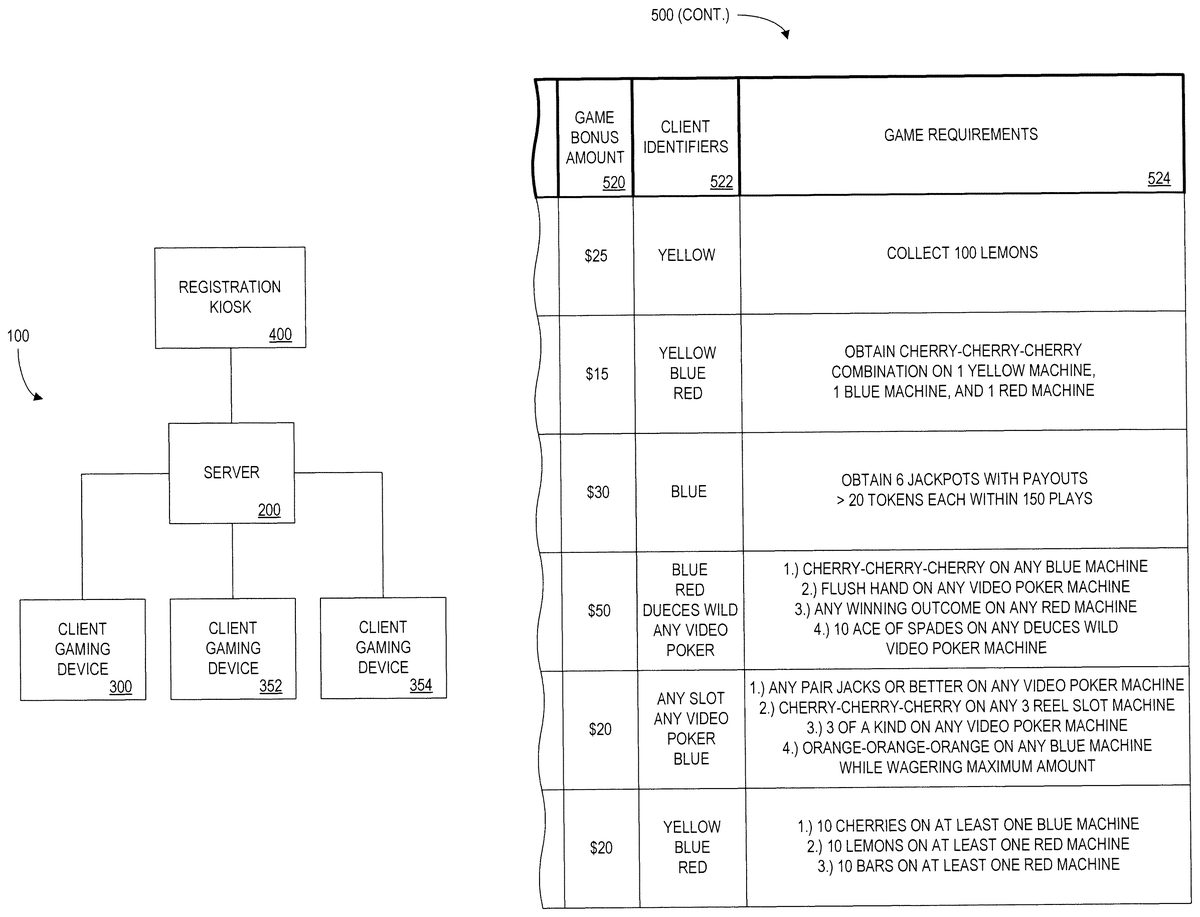
The apparatus architecture of an exemplary embodiment of the present invention will now be discussed with reference toFIGS. 1-4. Referring toFIG. 1, there is shown a block diagram of a slot network100. Network100includes a slot machine server200(hereinafter referred to as server) that is linked to and communicates with registration kiosk400and client gaming devices or slot machines300,352and354. Although three client gaming devices300,352and354are shown, a person of ordinary skill in the art will appreciate that any number of client gaming devices could be linked to and in communication with server200.
In the exemplary embodiment, a player utilizes kiosk400to register to play a secondary game of chance, such as a scavenger hunt game. Preferably, upon receiving a request from the player, kiosk400provides the player with a list of available secondary games for which the player may register. Kiosk400retrieves data regarding available games from server200and presents the data to the player. The available game data may be presented in any conventional manner including via a menu on a touchscreen. If a player wishes to register for an available game, kiosk400collects registration information supplied by the player and provides the player with a game identifier and directions to at least one client gaming device on which the player may play the secondary game of chance. Registration information might include a player tracking card with a corresponding player identifier, or it may include player-specified information such as his name, address, and credit card number. Kiosk400may collect registration information from the player in a number of ways, including via a player-tracking card, keyboard interface, scanner or pointing device.
The player utilizes a client gaming device, such as client gaming device300,352or354, to play a primary game of chance offered by the client gaming device as well as the secondary game of chance for which the player is registered. Slot server200communicates with kiosk400and client gaming devices300,352and354to manage the secondary game of chance.
Referring now toFIG. 2, the architecture of slot server200is illustrated. In addition to conventional server components, such as random access memory (not shown) and read only memory (not shown), slot server200includes a processor210linked to a clock212, a storage device214and a communication port220. Communication port220enables server200to communicate with registration kiosk400and client gaming devices300,352and354. Storage device214comprises an appropriate combination of magnetic and optical memory, such as disk drive memory, and semiconductor memory such as random access memory and read only memory, and contains program216for controlling server200in accordance with the present invention. Among other functions, program216includes instructions for registering a player for a secondary game of chance via kiosk400, instructions for managing and controlling a secondary game of chance played at a client gaming device, and instructions for dispensing an award for successfully completing a secondary game of chance. Storage device214further includes relevant data, including player table218, secondary game table500, registration table600and game outcome table700. The data stored by storage device214are described in more detail with reference toFIGS. 5-7. Although the data of the exemplary embodiment is stored at server200, in alternate embodiments, the data may be distributed among server200, kiosk400and client gaming devices300,352and354.
Referring now toFIG. 3, the architecture of slot machine or client machine300is illustrated. Slot machine300, which is substantially similar to slot machines352and354, is controlled by processor302and communicates with slot server200via communication port348. Processor302is connected to storage device304which stores program instructions and data for operating slot machine300in accordance with the present invention, including program306, payout table310and probability table312. Program306includes instructions for conducting the primary game of chance and instructions for conducting the secondary game of chance. Further connected to processor302are a player card tracking device338, a random number generator322, a reel controller324, three reels326,328and330, a hopper controller332and associated hopper334and a currency acceptor320.
As illustrated, slot machine300generally comprises conventional components, with the exception of the program instructions and data stored in storage device304. For purposes of better illustrating the invention, standard components, well known to those skilled in the art, are described only briefly. Although the present embodiment of the invention is described as implemented with physical components, the invention applies equally well to and includes software embodiments such as would be implemented on the Internet and other computer data networks.
Referring again to processor302, the slot machine300comprises one of many well known processing units, for example a Pentium class processor manufactured by Intel Corp. Data storage device304comprises an appropriate combination of magnetic and optical memory, such as disk drive memory, and semiconductor memory such as random access memory and read only memory. In addition to the program instructions and data shown inFIG. 3, storage device304stores appropriate operating system and control software (not shown), functional to operate gaming device300in the manner described below. Random number generator322comprises one of many well known random or pseudo-random number generators suitable for use in a gaming device.
Currency acceptor320is operative to receive one or more coins or bills, and to transmit an appropriate value signal to processor302. Hopper controller332, and hopper334connected thereto, are operative under the control of processor302to dispense coins to a player. Starting controller350comprises a player-operated device such as a handle or button for initiating the play of a game.
Player card tracking device338comprises a player tracking interface including a card reader346for receiving a player tracking card, a display344for communicating messages to the player, and a keypad342for receiving player input such as a player identifier. In addition to storing the player identifier, the player tracking card could be configured to store outcomes generated by slot machine300and other play related data, therefore obviating the need for registration table600and outcome table700.
Referring now toFIG. 4, the architecture of registration kiosk400is illustrated. Kiosk400enables a player to register for a secondary game of chance and, in one embodiment, redeem winnings accumulated during the secondary game of chance. Kiosk400is controlled by processor410and communicates with slot server200via communication port412. Processor410is connected to storage device428that stores, among other things, program430. Program430includes instructions enabling a player to register for a secondary game and instructions enabling a player to redeem bonus amounts awarded for successful completion of a secondary game.
Kiosk400includes input devices, such as currency acceptor414for receiving currency from the player, card reader418for reading a player tracking card, and input device420for receiving input from the player. Currency acceptor414enables kiosk400to accept a registration fee for the secondary game of chance, or pre-payment for the primary game of chance, in accordance with alternate embodiments of the present invention.
Kiosk400further includes output devices, including display416for displaying messages to the player, printer422and hopper controller424for dispensing currency via associated hopper426. Printer422enables kiosk400to print receipts, reports, game instructions and coupons redeemable for free games, dinner, merchandise or cash. Hopper controller424enables kiosk400to dispense payment for awards earned for successful completion of the secondary game of chance.
Data Tables
Referring now toFIG. 5, there are illustrated six representative records of an exemplary secondary game table500. Each record of secondary game table500defines the parameters of a secondary game that may be played, in addition to a primary game, at a client gaming device. Each record of secondary game table500includes a game identifier510that uniquely identifies the record and corresponds to the secondary game of chance that the record represents.
Each record of secondary game table500further includes field512that stores data representing the number of players required to play the associated secondary game. Game type field514stores data representing the type of secondary game. For example, record550, having a game type of “SOLO,” represents a single player game in which a single player must fulfill game requirements524to achieve a bonus. Record560, having a game type of “COMBINATION,” represents a multiple-player game in which the players cooperate as a team to collect outcomes which fulfill game requirements524to achieve a bonus. Record570, having a game type of “COMPETITION,” represents a multiple-player game in which the players compete to be the first to collect outcomes which fulfill the game requirements to achieve a bonus. Secondary games may be defined so that game requiring multiple players have more requirements than single player games, and the greater the number of required players, the longer or more complex the list of requirements.
Each record of secondary game table500further includes a number of parameters which define a secondary game, including a game time limit field516, game play limit field518, game bonus amount field520and client identifiers field522. Game time limit field516stores a time value that represents the maximum amount of time within which a player must collect the required game elements or outcomes to qualify for an award. Game play limit field518stores a value representing the maximum number of plays within which a player must collect the required slot symbols to qualify for an award. A single play might represent the pull of a traditional slot machine handle, completion of a final hand in video poker or completion of one hand of blackjack. Game bonus amount field520stores a monetary value that a player is awarded for completing the game requirements. Of course the bonus could be paid to a single player, divided among a group of players, or provided in full to each of a group of players. In addition to a bonus, a player successfully completing a secondary game of chance could win the right to play another game. This would enable tournament play among secondary game players.
Client identifiers field522stores the client identifiers of the client gaming devices on which the secondary game may be played. In the preferred embodiment, each client identifier stored in field522represents a family or type of slot machine, however, embodiments in which each client identifier stored in field522represents a specific slot machine are also envisioned. Of course, client identifier field522may store data representing a rule for identifying one or more client gaming devices. For example, in an embodiment in which descriptive client identifiers are assigned to client gaming devices (e.g. slot machine identifiers begin with “SM” and video poker identifiers begin with “VP”), client identifier field522may store a rule limiting eligible client gaming devices to those beginning with “SM.”
In addition, each record of secondary game table500includes at least one field defining the requirements of the corresponding secondary game. As illustrated, game requirements field524stores a definition of the requirements of each secondary game. Of course, one of ordinary skill will realize that game requirements field524is merely exemplary, and in practice, the requirements of each secondary game may be defined by multiple fields containing defining parameters. Alternatively, the requirements of each secondary game may be implemented through program instructions.
As illustrated, the game requirements require the player to collect specific outcomes from designated machines. The game requirements could easily require an order in which the player must collect the outcomes. For example, the player might have to complete requirements on lower denomination machines before progressing to higher denominations. An order of individual machines could also be specified, allowing the casino to distribute play over a fixed number of machines by specifying a different starting machine for each secondary game registered for that particular set of client machines.
Game requirements could also specify a minimum number of client machines on which a player must play in order to successfully complete the secondary game. By specifying a time window for play, the casino could encourage more play during off-peak times. For example, secondary games might only be available for play Monday through Thursday from 10:00 AM to 2:00 PM.
It is also envisioned that the outcomes designated by the secondary game requirements may consist entirely of game elements or outcomes that do not constitute winning outcomes in the primary game. In other words, in order to achieve an outcome required by the secondary game, a player must forego a winning outcome in the primary game of chance, and vice versa.
Much of the information stored in secondary game table500is presented to a player at kiosk400during a registration process. Kiosk400receives a request to register the player for a secondary game, and displays the available games, as defined in secondary game table500, to the player for selection. Upon receiving a game selection from the player, kiosk400may direct the player to the associated client gaming devices by displaying, printing or otherwise providing the player with a map of the casino floor, with the associated machines explicitly identified on the map. For ease of explanation, the present invention is disclosed with respect to an embodiment in which the casino color-codes certain types of machines in order to make them easy to recognize. This could be done by placing a placard or other visible sign on each associated machine, clearly marking its color code designation. In embodiments in which a particular order of client machines is required in order to satisfy the secondary game requirements, the map might indicate a preferred or required route, perhaps through the use of arrows or shading. In this embodiment, a player that is required to receive a cherry-cherry-cherry outcome on a blue machine simply has to look around for a machine with the blue placard on it. Server200recognizes an eligible client based on a client identifier received from the client machine. Server200may use the client identifier directly to determine whether a player may use the client device to play the secondary game. Alternatively, server200may use the client identifier to reference a client eligibility table (not shown) to indirectly determine whether a player may use the client device to play the secondary game.
In addition to the type of games illustrated, many other types of games could be implemented. For example, the player may be required to receive three cherry-cherry-cherry outcomes before he receives five lemon-lemon-lemon outcomes. As described with reference toFIGS. 6A-6C, server200would keep track of the player's cherry-cherry-cherry outcomes and lemon-lemon-lemon outcomes. If the player collects three cherry-cherry-cherry outcomes before he collects five lemon-lemon-lemon outcomes, the player is successful and is eligible to receive the bonus associated with the game. If, however, the player receives five lemon-lemon-lemon outcomes before receiving three cherry-cherry-cherry outcomes, the player is unsuccessful, and is not eligible to receive the associated bonus.
Although the records of secondary game table500are preferably populated by experienced casino personnel who understand the subtleties of maximizing the efficient use of the casino floor, server200may be programmed to automatically generate records for secondary game table500based on historical data collected from client devices300,352and354. For example, as one of ordinary skill will appreciate, historical coin-in data may be collected from client devices300,352and354. Server200could be programmed to analyze the coin-in data and to rank the client devices. In order to promote play on the lower ranked client devices, server200might be programmed to generate a record in secondary game table500to provide a secondary game directed to the lower ranked client devices.
Referring now toFIG. 6A, an exemplary record650from registration table600and two corresponding records750and752from game outcome table700are shown. Each record of registration table600represents a session of a secondary game for which a player is registered. Registration table600includes a session identifier610uniquely identifying the registration record. In the preferred embodiment, session identifier610is generated for the session by the server based on the date and time of registration. Registration table600further includes a game identifier612and a player identifier614for identifying the secondary game and the player associated with the session. Game identifier612is populated with the data from game identifier field510of the appropriate record from secondary game table500, and player identifier614is populated with the player identifier of the registered player. Player identifier614is preferably generated and assigned by the casino, but could take the form of a personal identification number (PIN) selected by player. Player identifier614is captured at kiosk400during a registration process. Player identifier614may be read from a player tracking card inserted into card reader418, or may be provided via input device420.
Registration table600further includes fields for tracking the progress of the player toward completion of the game requirements. Time remaining field616stores a time value representing the amount of time available for the player to complete the game requirements. The time available could be tracked individually for each player, or for a team of players. In such a team embodiment, the time remaining for each team member begins counting down with the first player inserting his player tracking card. For an individual player, the amount of time remaining could be frozen each time the player ended a particular series of plays by removing his player tracking card, with the time starting to count down only after the card was again inserted. Alternatively, time remaining field616could begin to count down immediately following registration by the player, encouraging the player to immediately begin playing the secondary game. Plays remaining field618stores a value representing the number of plays available for the player to complete the game requirements. Initially, time remaining field616and plays remaining field618are populated with data from game time limit field516and game play limit field518of the appropriate record from secondary game table500, respectively.
Session status field620stores a code representing a status of the corresponding session. Examples of valid session status codes are listed in Table I, below. In the preferred embodiment, a session is successfully completed when the player satisfies the corresponding game requirements. A session is unsuccessfully completed when the player has not satisfied the game requirements and there is no time or plays remaining. Of course, various other session completion parameters are possible. Bonus due field622stores a monetary value representing a bonus due to the player for successfully completing the session. Although an unsuccessfully completed session will result in a bonus due amount of zero, it should be understood that varying degrees of success may be defined by the game requirements, resulting in varying bonus due amounts.
TABLE ISessionStatus CodeSession Status DefinitionREADYA player has been registered to play a session of a game.ACTIVEA session of a game is in progress.SUCCESSA player successfully fulfilled the game requirements forthe session.FAILA player failed to successfully fulfill the game requirementsfor the session.PAIDA bonus for successfully completing the game requirementshas been paid to the player.
Each record of game outcome table700represents a game outcome that contributes to the successful completion of the session. Game outcome table700includes a session identifier710that identifies the session corresponding to the game outcome, Game outcome table700also includes player identifier711, outcome714and client identifier712for respectively documenting a player, an outcome fulfilling a game requirement (e.g. a reel symbol, set of reel symbols or card values) and the client gaming device that generated the outcome. Game outcome table700preferably includes a timestamp field716for storing the date and time the associated outcome was generated. Timestamp field716may be used to audit winning games. In alternate embodiments, timestamp field716may be used to cause outcomes to expire after a pre-specified period of time or number of plays.
The records shown inFIG. 6Adescribe a session of game ABC being played by a player having player identifier 24681012. To successfully complete game ABC, the player must receive 100 lemons during the session of up to 225 plays as defined by record550of secondary game table500, previously described with reference toFIG. 5. According to session status field618of record650, the session is “ACTIVE,” or in progress. Although the player was initially allotted 225 plays to complete the game requirements of game ABC, plays remaining field624indicates that the player has completed 120 plays and has 105 plays remaining to complete the game requirements. As shown by records750and752of game outcome table700, player 24681012 has received two lemons while playing slot machines having client identifiers SM-1002003 and SM 1001098.
The records shown inFIG. 6Bdescribe a session of game DEF being played by two players having player identifiers 36917154 and 48129003. To successfully complete game DEF, the players must cooperate to achieve the game requirements defined by record560of secondary game table500, previously described with reference toFIG. 5. According to session status field620of record652, the session has been registered, but play has not begun. The initial allotment of sixty minutes is stored in time remaining field616of records652and654. Because the secondary game has not started, there are no relevant records in game outcome table700relating to session 0327981148.
The records shown inFIG. 6Cdescribe a completed session of game EFG, a competitive game between two players having player identifiers 35791130 and 24483696. To successfully complete game EFG, a player must be the first to collect four outcomes: (i) a pair of jacks or better on any video poker machine, (ii) a cherry-cherry-cherry outcome on any three reel slot machine, (iii) three-of-a-kind on any video poker machine, and (iv) orange-orange-orange on any blue machine while wagering the maximum amount, as illustrated by record570ofFIG. 5. As shown by records754,756,758and760, the player having player identifier 35791130 successfully completed the game requirements.
Description of the Operation
Having thus described the architecture and components of the slot network of the present embodiment, the operation of the apparatus will now be described in greater detail with reference toFIGS. 7-9.FIG. 7is a flowchart illustrating an exemplary registration process;FIGS. 8A-8Gtogether comprise a flowchart illustrating an exemplary secondary game control process; andFIG. 9is a flowchart illustrating an exemplary redemption process. These flowcharts describe a preferred embodiment in which server200facilitates registration and redemption processes via kiosk400, and game play via client gaming device300. It should be understood, however, that the processes do not strictly require the described client-server architecture. For example, a gaming device providing a single player secondary game of chance could conduct registration, game play and redemption processes at a single unit.
Referring now toFIG. 7, an exemplary registration process is illustrated in the form of a flowchart. The registration process enables a player to select a secondary game in which to participate. The registration process preferably interfaces with the player on the casino floor via kiosk400, but may be accomplished by a client gaming device300.
At block701, processor410receives a request to register a player for a secondary game of chance and forwards the request to slot server200via communication port412. At block702, slot server200retrieves data describing the available games from secondary game table500and transmits the data to kiosk400where processor410causes the data to be communicated to the player via display416.
Kiosk400receives the game selection of the player at block714. The player may indicate a game selection using a touch screen or by providing a game identifier from a list of games provided at block702. At block704, processor410determines at least one player identifier, and at block705processor410determines a session identifier. The number of player identifiers determined at block704is based on the number of players required to play the selected game. The player identifiers may be determined in a number of ways including receiving a player identifier from a player tracking card inserted into card reader418, receiving a player-selected PIN, or generating a unique player identifier at the time of registration.
If the selected game requires multiple player identifiers, the registration process instructions of program430will enable multiple identifiers to be collected and verified. If the appropriate number of player identifiers are not received, kiosk400may display a message indicating that the identifiers were not received or were invalid.
For example, if the player requests to register for a three player game, he must provide two player identifiers in addition to his own. If the player fails to provide the correct number of player identifiers, his request to register for the secondary game will be rejected. In an alternate embodiment, players who do not have player tracking cards (or previously assigned player identifiers) but still wish to participate in a secondary game of chance may be provided with a PIN that will serve as their identifier for the duration of the game. The PIN may be either player-selected or generated by the system. Each player registered for a game will receive a unique PIN which may be input by the player via keypad342prior to playing a secondary game.
At block706, processor410transmits registration data including the session identifier, game identifier and player identifier(s) to server200which creates a new record in registration table600and stores the registration data in the new record. At block722, server processor202sets session status field620to “READY.” The requirements of the selected game are output to the player at block708. An illustration of such output is described with reference toFIG. 10. The output could alternatively take the form of a map showing the player the locations of various client gaming machines associated with the particular secondary game, printed in real-time or developed in advance as a brochure with casino promotional materials.
Instead of providing detail regarding the identity of each client machine, the registration process could identify a first client machine with subsequent client machines identified during play of the secondary game. Thus, the player does not know where he is heading in advance, receiving the identification of his next client machine from display344of client machine300. The player might also not be informed of the exact requirements of the secondary game until it was underway. For example, the player might achieve a required outcome of lemon-lemon-lemon and then receive identification of the next game requirement from display344such as bell-bell-bell.
Referring now toFIGS. 8A-8G, an exemplary secondary game control process is illustrated in the form of a flowchart. The illustrated secondary control process is performed by slot server200, for every outcome generated by a client gaming device, in accordance with program216.
Generally, if the player operating the client gaming device is registered for a game, server200will determine the type of game based on the game identifier, and direct the gaming device to execute the appropriate game play steps. If the player is not registered for a game, server200will not execute any steps to control a secondary game of chance. Once server200determines that the player is registered for a secondary game, it will update the time remaining and/or plays remaining while the player's player tracking card is in the gaming device, and store any of the player's outcomes that satisfy a game requirement. Server200will further store the client identifier of the client gaming device on which the outcome was generated, as well as the player identifier of the player playing the game. The record of the game outcome table is linked to the player's record of the registration table through a session identifier and the player's player identifier. In an alternate embodiment, server200could be programmed to continue to update the time remaining field of secondary games in progress so that if a player moves from one machine to another, the time remaining will continue to decrease. In the alternate embodiment, server200would continually update the time remaining from the time the player begins playing the secondary game until the completion of the game, regardless of whether the player removes the player tracking card from the gaming device.
In a multi-player team embodiment (either combined or competitive), the server keeps track of each player's results in the manner described above. In the competitive multi-player team embodiment, server200monitors each player's outcomes in substantially real time, and terminates the game once a player fulfills all of the game requirements. In an alternate embodiment, server200could track the time each player's outcome was obtained, in order to determine which player was the first to fulfill all of the requirements of the game.
At block810, processor210receives a player identifier, client identifier and outcome from client gaming device300. The player identifier, client identifier and outcome are transmitted by client gaming device300after a play of the machine. The transmission is performed in accordance with program306.
At block812, processor210determines whether a record corresponding to the received player identifier is registered for a secondary game of chance and whether the client identifier is among the eligible client identifiers associated with the secondary game. If a corresponding record does not exist, no further processing is required to control a secondary game of chance because the player associated with the received player identifier is not registered for a secondary game of chance that may be played at client gaming device300. If registration record corresponding to the received player identifier and client identifier exists, secondary game processing continues.
At block814, processor210retrieves registration data from the identified record of registration table600. Processor210retrieves game data from an appropriate record of secondary game table500, as shown by block816. The appropriate secondary game table record is determined based on the contents of game identifier field612retrieved at block814. At decision block818, processor210determines whether the retrieved session status field620contains “READY” or “ACTIVE.” If the retrieved registration record does not have a session status of either “READY” or “ACTIVE,” the registered game is complete, and processing terminates. Otherwise, at block820ofFIG. 8Bprocessor210determines whether the session status field contains “READY.” If it does, the session status is set to “ACTIVE” at block822to indicate that the session is in progress. At blocks824and826, process flow is directed based on whether the secondary game is a single player game, a multi-player competitive game or a multi-player combination game.
If the secondary game is a single player game or a multi-player cooperative game, process flow is directed to block828ofFIG. 8C. At block828, processor210determines whether the outcome, or any portion of the outcome, matches a game requirement. If the outcome fulfills a game requirement, the outcome is recorded in game outcome table700, as shown by block830. At block832, the time remaining and plays remaining fields of registration table600are updated. Processor210then determines whether all of the game requirements have been met at decision block834. If all of the game requirements have been satisfied, processing is directed to block838ofFIG. 8D, enabling the player to be informed of his success in substantially real time. Otherwise, processor210determines whether the game should be terminated due to the lack of remaining time or remaining plays. According to decision block836, if the game should be terminated, processing is directed to block850. Otherwise, the secondary game control process terminates. It should be noted that the process flow may be altered to enable the player to be informed of his success or failure at the end of the allotted time/plays without deviating from the spirit and scope of the present invention.
Referring now toFIG. 8D, there are illustrated the steps processor210executes if a player wins a single player game or cooperative multi-player game. At block838, processor210is directed to set the session status field620of the corresponding record of registration table600to “SUCCESS.” Processor210then retrieves game bonus amount520from the appropriate record of secondary game table500and stores the retrieved amount in the bonus due field622of the corresponding record of registration table600, as shown by blocks844and846. In an alternate embodiment, instead of analyzing whether a player has satisfied the game requirement in real time, server200may be programmed to determine success or failure of a player only after expiration of the time remaining or number of plays remaining.
At block848, processor210causes a signal to be transmitted to all client gaming devices on which a player associated with the session identifier is playing. The signal directs the client gaming devices to display a message indicating that the player has successfully completed the game requirements. In a multi-player game, all players are to be notified of the successful completion of the game requirements. If server200is unable to direct a message to a player because the player is not presently operating a gaming device, the message may be queued for delivery as soon as the player resumes operation of a client gaming device.
Referring now toFIG. 8E, there are illustrated the steps processor210executes if a player fails to complete the game requirements within the allotted time or number of plays. At block850, processor210sets session status field620of the corresponding record of registration table600to “FAIL” At block854, processor210causes a signal to be transmitted to every client gaming device on which a player associated with the session identifier is playing. The signal directs the client gaming devices to display a message indicating that the player secondary game has ended unsuccessfully.
Referring now toFIGS. 8F and 8G, there are illustrated the steps processor210executes if the corresponding session identifier is associated with a competitive multi-player game. At decision block860, processor210determines whether the outcome, or any portion of the outcome, matches a game requirement. If the outcome fulfills a game requirement, the outcome is recorded in game outcome table700, as shown by block862. At block863, the time remaining and plays remaining fields of registration table600are updated. Processor210then determines whether all of the game requirements have been met at decision block864. If all of the game requirements have been satisfied, processing is directed to block870ofFIG. 8G. Otherwise, processor210determines whether the game should be terminated due to the lack of remaining time or remaining plays. According to decision block866, if the game should be terminated, processing is directed to block868. Otherwise, the secondary game control process terminates.
At block868, processor210determines which players most successfully completed the game requirements. Pursuant to blocks870and872, respectively, session status field620of the corresponding record of registration table600is updated to “SUCCESS” for all winning players and “FAIL” for all other players. Although not shown by secondary game table500, multi-player games may be defined in which a bonus may be awarded for multiple levels of achievement, such as first place, second place and third place. Processor210then retrieves game bonus amount520from the appropriate record of secondary game table500and stores the retrieved amount in the bonus due field622of the corresponding records of registration table600, as shown by blocks874and876. At block878, processor210causes a signal to be transmitted to all client gaming devices on which a winning player associated with the session identifier is playing. The signal directs the client gaming devices to display a message indicating that the player has successfully completed the game requirements. At block880, processor210causes a signal to be transmitted to all client gaming devices on which a losing player associated with the session identifier is playing. The signal directs the client gaming devices to display a message indicating that the player has failed to successfully complete the game requirements.
FIGS. 8F and 8Gassume that the secondary game incorporates a time/plays limit, and that if the time/plays limit is reached the player having met the most game requirements is deemed to be the winner. Of course, the secondary game process could be easily modified to require a winner to complete all of the game requirements by eliminating block868from the process ofFIG. 8Fand setting session status field620of all of the participating players to “Fail” at block872ofFIG. 8G.
Referring now toFIG. 9, there are illustrated the steps of an exemplary redemption process. The redemption process is typically initiated by a player who has registered for and successfully completed the game requirements of a secondary game of chance. The redemption process is typically performed by server200operating in conjunction with kiosk400.
At block910, server200receives a request to provide a game bonus amount to a player. The request is received via kiosk400and includes a player identifier identifying the requesting player and a session identifier identifying the session during which the player achieved a game bonus. Server200retrieves the record from registration table600which corresponds to the received session identifier and player identifier, as shown by block912.
Server200determines whether the player successfully completed the session by comparing session status field620to “SUCCESS” at block914. If the identified session does not have an associated status of “SUCCESS,” server200prompts kiosk400to display a message indicating that the request is invalid, as shown by block916, and the redemption process terminates. If the player successfully completed the session, server200causes the appropriate payout to be provided based on the contents of bonus due field622, as shown at block918. At blocks920and922, respectively, bonus due field622is zeroed and session status field620is updated to “PAID” to reflect payment of the bonus. The game bonus may be automatically dispensed by kiosk400, or manually dispensed by a casino attendant. In an alternate embodiment, the redemption process could be executed by the gaming device at which the final game requirement is completed, or executed by any client slot machine. It should be noted that a bonus award earned by a team may be dispensed in a number of ways in accordance with the present invention. For example, each team member may receive the entire bonus amount, each team member may receive an equal share of the bonus amount, or each player may receive a share of the bonus amount proportional to the game requirements achieved by the player.
Bonus payout amounts could be adjusted based on the time to successful completion, with shorter completion times associated with relatively larger bonus payout amounts. Bonus payout amounts could also be supplemented in order to encourage play at off-peak hours, such as during early morning hours. In order to encourage a faster rate of play, the casino could offer higher bonus payout amounts to those players maintaining a high average rate of play. For example, a player completing a secondary game with a seven hundred handle pull-per-hour average rate of play might receive 10% more than a player maintaining a rate of only five hundred handle pulls-per-hour for the same secondary game structure.
Referring now toFIG. 10, there is illustrated an exemplary game receipt1000that may be provided to a registered player. Game receipt1000acts as proof of registration for a secondary game session and provides a convenient reminder to the player of the game requirements, time limit and bonus amount associated with the secondary game. Game receipt1000further directs the player to the appropriate gaming devices, and may provide instructions regarding redemption of an earned bonus. As shown, game receipt also includes check boxes enabling the player to track his progress toward successful completion of the game requirements.
While the best mode for carrying out the invention has been described in detail, those familiar with the art to which the invention relates will recognize various alternative designs and embodiments for practicing the invention. These alternative embodiments are within the scope of the present invention. Accordingly, the scope of the present invention embodies the scope of the claims appended hereto.
Claims
- A method, comprising: determining that a player has completed a game of chance, the game being accessible from a plurality of devices having online access;wherein completing the game includes a first requirement that a player of the game must play from more than one of the devices, and further, wherein the requirement that the player must play from more than one of the devices comprises a second requirement that the player must present an identifier at each of the more than one of the devices during completion of the game, and a third requirement that the player needs to collect specific outcomes when playing from the devices;and providing a reward to the player in response to determining that the first, second and third requirements have been satisfied, such that the player is identified as having completed the game, wherein the method is executable by a processor.
- The method of claim 1 , further comprising determining that the player has registered for the game before completing the game.
- The method of claim 2 , wherein determining that the player has completed the game includes determining whether the player has received a favorable outcome in the game;and wherein the reward is only provided to the player if the player has received a favorable outcome in the game.
- The method of claim 2 , wherein completing the game includes a fourth requirement that a player of the game must not exceed a maximum number of plays to complete the game.
- The method of claim 2 , wherein completing the game includes a fourth requirement that a player of the game must not exceed a maximum duration of time to complete the game.
- The method of claim 2 , wherein completing the game includes a fourth requirement that a player of the game must not play on more than a maximum number of devices.
- The method of claim 2 , wherein completing the game includes a fourth requirement of a minimum number of occurrences of a symbol output to the player via at least one device that accesses the game.
- The method of claim 2 , wherein completing the game includes a fourth requirement that the player collect a minimum number of outputs of a specified symbol along a respective payline of the devices associated with the game.
- Non-transitory computer readable media having program instructions, comprising: program instructions for determining that a player has completed a game of chance, the game being accessible from a plurality of devices having online access;wherein completing the game includes a first requirement that a player of the game must play from more than one of the devices, and further, wherein the requirement that the player must play from more than one of the devices comprises a second requirement that the player must present an identifier at each of the more than one of the devices during completion of the game, and a third requirement that the player needs to collect specific outcomes when playing from the devices;and program instructions for providing a reward to the player in response to determining that the first, second and third requirements have been satisfied, such that the player is identified as having completed the game.
- The computer readable media of claim 9 , further comprising determining that the player has registered for the game before completing the game.
- The method of claim 10 , wherein determining that the player has completed the game includes determining whether the player has received a favorable outcome in the game;and wherein the reward is only provided to the player if the player has received a favorable outcome in the game.
- The method of claim 10 , wherein completing the game includes a fourth requirement that a player of the game must not exceed a maximum number of plays to complete the game.
- The method of claim 10 , wherein completing the game includes a fourth requirement that a player of the game must not exceed a maximum duration of time to complete the game.
- The method of claim 10 , wherein completing the game includes a fourth requirement that a player of the game must not play on more than a maximum number of devices.
- The method of claim 10 , wherein completing the game includes a fourth requirement of a minimum number of occurrences of a symbol output to the player via at least one device that accesses the game.
- The method of claim 10 , wherein completing the game includes a fourth requirement that the player collect a minimum number of outputs of a specified symbol along a respective payline of the devices associated with the game.
Disclaimer: Data collected from the USPTO and may be malformed, incomplete, and/or otherwise inaccurate.