U.S. Pat. No. 8,858,313
Methods, Systems, and Devices for Synchronized Parallel Gameplay
AssigneeTopspin Networks Inc
Issue DateJuly 9, 2012
Illustrative Figure
Abstract
In one embodiment, the invention relates to a network-based quiz game and related methods that is playable in parallel relative to and synchronized with an event of interest such as a sports event. This embodiment can be a massively multiplayer game in one embodiment. The players of the game include various participant using electronic devices. The game and relates methods can be implemented using a client server architecture and various hardware and software components.
Description
DETAILED DESCRIPTION The use of headings and sections in the application is not meant to limit the invention; each section can apply to any embodiment or feature of the invention. Throughout the application, where compositions are described as having, including, or comprising specific components, or where processes are described as having, including or comprising specific process steps, it is contemplated that compositions of the present teachings also consist essentially of, or consist of, the recited components, and that the processes of the present teachings also consist essentially of, or consist of, the recited process steps. In the application, where an element or component is said to be included in and/or selected from a list of recited elements or components, it should be understood that the element or component can be any one of the recited elements or components and can be selected from a group consisting of two or more of the recited elements or components. Further, it should be understood that elements and/or features of a composition, an apparatus, or a method described herein can be combined in a variety of ways without departing from the spirit and scope of the present teachings, whether explicit or implicit herein. The use of the terms “include,” “includes,” “including,” “have,” “has,” or “having” should be generally understood as open-ended and non-limiting unless specifically stated otherwise. The use of the singular herein includes the plural (and vice versa) unless specifically stated otherwise. Moreover, the singular forms “a,” “an,” and “the” include plural forms unless the context clearly dictates otherwise. In addition, where the use of the term “about” is before a quantitative value, the present teachings also include the specific quantitative value itself, unless specifically stated otherwise. It should be understood that the order of steps or order for performing certain actions is ...
DETAILED DESCRIPTION
The use of headings and sections in the application is not meant to limit the invention; each section can apply to any embodiment or feature of the invention.
Throughout the application, where compositions are described as having, including, or comprising specific components, or where processes are described as having, including or comprising specific process steps, it is contemplated that compositions of the present teachings also consist essentially of, or consist of, the recited components, and that the processes of the present teachings also consist essentially of, or consist of, the recited process steps.
In the application, where an element or component is said to be included in and/or selected from a list of recited elements or components, it should be understood that the element or component can be any one of the recited elements or components and can be selected from a group consisting of two or more of the recited elements or components. Further, it should be understood that elements and/or features of a composition, an apparatus, or a method described herein can be combined in a variety of ways without departing from the spirit and scope of the present teachings, whether explicit or implicit herein.
The use of the terms “include,” “includes,” “including,” “have,” “has,” or “having” should be generally understood as open-ended and non-limiting unless specifically stated otherwise.
The use of the singular herein includes the plural (and vice versa) unless specifically stated otherwise. Moreover, the singular forms “a,” “an,” and “the” include plural forms unless the context clearly dictates otherwise. In addition, where the use of the term “about” is before a quantitative value, the present teachings also include the specific quantitative value itself, unless specifically stated otherwise.
It should be understood that the order of steps or order for performing certain actions is immaterial so long as the present teachings remain operable. Moreover, two or more steps or actions may be conducted simultaneously.
The aspects, embodiments, features, and examples of the invention are to be considered illustrative in all respects and are not intended to limit the invention, the scope of which is defined only by the claims. Other embodiments, modifications, and usages will be apparent to those skilled in the art without departing from the spirit and scope of the claimed invention.
Sports events and other events of interest have entertainment value for various reasons. One reason is the unpredictability and excitement that arises from guessing what may happen next or strategizing what a given coach, player, team or other participant in the event will do. For example, a basketball player picks ups 2 fouls in the first 28 seconds of an NCAA basketball game. The audience immediately begins to guess: will the player pick up a 3rdfoul quickly? Will he play the remainder of the first half? Will he end up fouling out of the game? Such conjecture is a common form of fan involvement in the live action. The uncertainty arising from the virtually endless number of game-specific situations is a fundamental part of the excitement surrounding live sports events.
As a result, during various arbitrary moments during a live video broadcast of a sports event fans often guess the outcome of impending plays unique to specific situations within an event (e.g. I think this base runner will attempt to steal second base). Fans are also inclined to guess the type of decision to be made by a player or coach (e.g. I think the manager will pull the home team pitcher before the 3rdinning), scoring levels at various and arbitrary upcoming time points during an event (e.g. I think the home team will close to within 5 points with 5:00 minutes to play), player statistics at various and arbitrary upcoming time points during an event (e.g. I think the center will foul out with more than 10 minutes left in the game), team statistics at various and arbitrary upcoming time points during an event (e.g. number of pitches thrown by a struggling pitcher prior to the 5thinning), and overall event statistics at various and arbitrary upcoming time points in an event (e.g. total points scored by both teams times prior to the next timeout), and other outcomes collectively: “impending play outcomes”. Thus, in part, embodiments of the invention relate to games, systems, and methods for a massive broadcast audience separated geographically, to compete simultaneously individual-against-individual and individual-against-entire-broadcast audience in a quiz game based on the accuracy of their guesses related to impending play outcomes.
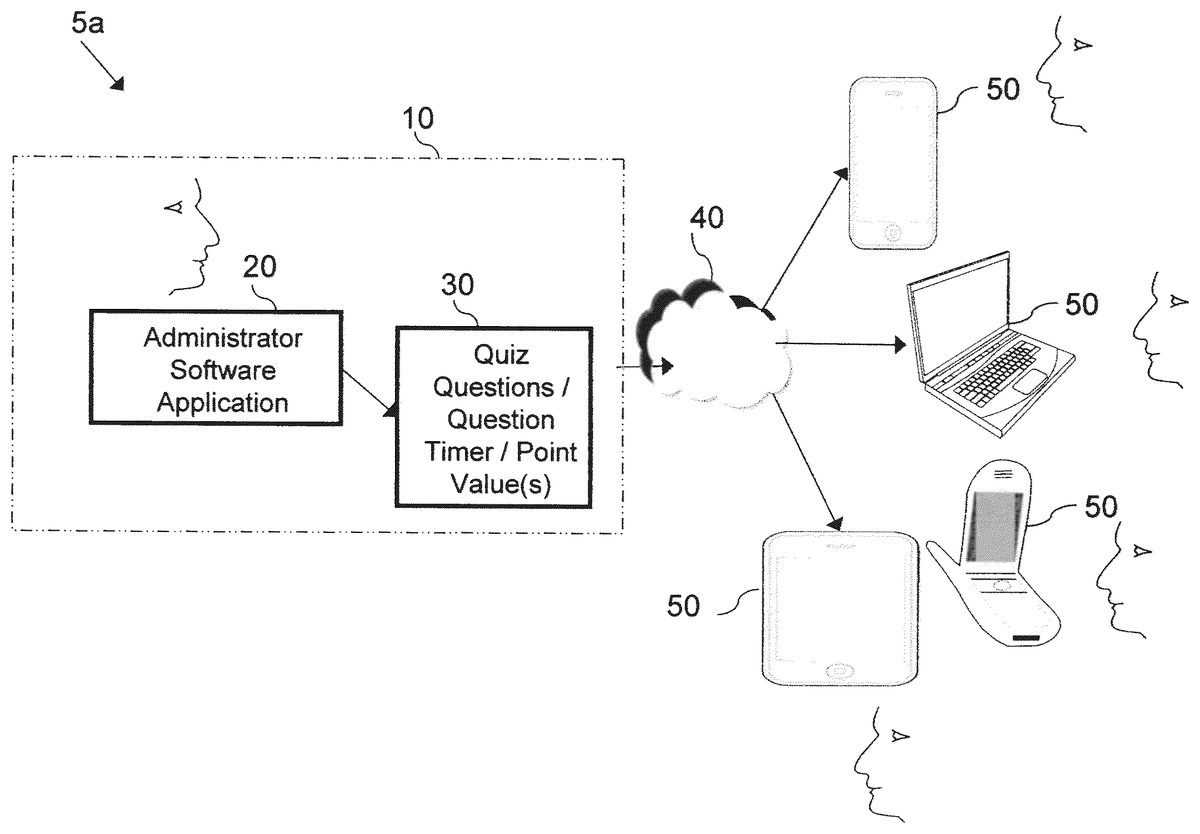
FIG. 1shows a system5asuitable for implementing a quiz game that allows participants to respond to questions that are generated in real time or substantially in real time while a sports event or other event of interest is being played or otherwise occurring. A data center10is shown that includes one or more computers to administer the game. In one embodiment, the data center includes a server running an administrator software application20. The administrator software application20allows for the game to be managed relative to a sports event or other event of interest that is occurring while the quiz game is being played by various participants. The data center can also include a database and various other components. Additional details relating to specific data center embodiments are described in more detail herein. The application20can incorporate message oriented middleware and various graphic user interfaces in one embodiment configured to support or enable programming, executing and monitoring ongoing events, content and games. In one embodiment, an indicator on the administrators interface indicates the time since the last question was posed. Administrators may strive to pose a certain number of questions per hour, per event, or according to some other metric to maintain user interest during the contest.
A question generation module (not shown) can be used to generate quiz questions. This module can be part of the administrator application20or be a standalone module. It can access a database of sports trivia and game specific scenarios that interface with an artificial intelligence system or rules engine to generate questions that are synchronized relative to a sports event or other event of interest. The quiz questions30can be generated based on historic data and automatically presented to the participants by routing through a network to a participant device50.
In one embodiment, the quiz questions are generated by sports enthusiasts, authors and experts in the area and entered into the systems5afor delivery or presentation to the participants. As an example, a given quiz generated and delivered as described herein can include one or a series of questions relating to a specific broadcast sports event. These questions are published periodically during the broadcast sports event to participants connected to the game network40by electronic participant devices50. The author of a given question that is created in real time based on a simultaneous occurring sports event or other scenario enters the questions into a graphic user interface. Once entered, the question is processed using the administrator software application20or another software module and routed over the network40to various participant devices50. This presentation of the question on the devices50occurs on a real time or substantially real time basis. Responses from the devices50are likewise transmitted over the network to the data center10.
The invention also includes quiz game applications that run on electronic participant devices50and enable quiz participation, interactivity and bi-directional communication with the game network and data center. This application can be distributed via an application store or otherwise made available to end users that want to participate in future games as described herein. In one embodiment, a browser-based application or the use of browser to access a remote game portal is used in lieu of a stand-alone quiz application.
FIG. 2shows a system5bthat includes substantially the same features of the system ofFIG. 1. This system embodiment also includes additional details relating to participant responses60and a question cutoff timestamp70. Once a sporting event or other event of interest is under way and a participant has logged into a server at or in communication with the datacenter10questions are generated and presented to the user as shown inFIG. 1. Typically, a number of participants are competing against each to answer a question that relates to a particular impending outcome in the sports event or other event of interest. Accordingly, there is a temporal component that dictates when a participant needs to respond. The question cutoff timestamp is set using a graphic user interface component of the administrator software application20. In one embodiment, this cutoff70sets a window by which participants in the quiz game to need to respond to have their response to the questions considered.
FIG. 3shows a system5cthat includes substantially the same features of the systems ofFIGS. 1 and 2and some additional details relating to scoring and ranking. In this system embodiment5c, a quiz score and ranking software modules is shown. Once a given question is answered the first correct responder can be notified and a score can be ascribed to that participant. In other embodiments, tiers of responding participants can be scored and ranked according to various criteria. The quiz scores and rankings can be updated over time on a per sports event basis or in the aggregate. This scoring and ranking allows friends and subgroups to track their progress and compete with each other. Subgroups can also have collective scores in one embodiment.
FIG. 4shows another system embodiment100suitable for playing a quiz game with a plurality of participants over a network40using participant devices50while a sports event is being played in parallel. The participant devices include any type of device that support the TCP protocol or other communication protocols, including smart phones, certain TVs, PCs, eReaders, and tablets (iPad) etc. and additional devices as described herein. This design feature can be advantageous relative to web protocols such as HTTP since the amount of overhead per message is minimal, whereas HTTP often has more header information than payload. In one embodiment, with a TCP connection, the game system or data center components transmit a minimum of information when TCP connections are made.
The system embodiment100shown is a multi-tier software and hardware architecture that includes clients, application servers, analysis servers, analytic servers, administrative software applications, database servers, and storage tiers. In one embodiment, the various tiers shown constitute a data center embodiment105. However, the individual tiers or their constituent hardware components need not be located at a common location in one embodiment. In one embodiment, the term data center refers to the hardware and software required to operate, maintain, administer a given quiz game and all related data.
The first tier of this system100includes an application tier that includes a plurality of application server nodes110. This collection of nodes form an application server cluster120. Each application server node110provides scale out capability on low cost hardware. In turn, connections to the application server nodes are load balanced by a first network switch112or other suitable device. The switch112provides a load-balanced connection between network40and the application server cluster120. A second network switch112provides connectivity to a shared disk database cluster135that includes a plurality of database nodes130. In one embodiment, only one switch112is used. The database cluster is the second tier of this system embodiment100. The third tier depicted is a storage area network (SAN) storage tier that is in communication with the shared disk database cluster135through a SAN storage switch or switches140. In turn, the SAN switch140is in communication with one or more shared disks150. One or more shared disks150provide persistent storage for all game data, metadata, and participant data and appear to the database nodes130as locally attached to the operating system of the nodes130. In one embodiment, the shared disk150is a solid-state drive, which increases the random I/O performance of the system100.
The application server cluster120can include one or more topics (i.e. a specific quiz is a type of topic for a specific sporting event, such as a baseball specific quiz for a given live baseball game); publication/subscription (i.e. pub/sub) services and connects to a database shared disk cluster135and performs write requests for quiz questions and quiz question responses. The application server cluster120also performs read requests for scores and rankings as requested by electronic participant devices50. The shared disk database cluster135monitors communications channels for requests from the application server cluster120and automatically routes requests to the least busy database node130for processing. In turn, in one embodiment, the database nodes130handle all read and write operations and data reduction for scoring and ranking.
The shared-disk cluster design shown inFIG. 4has significant advantages over traditional shared-nothing clusters. In the shared-disk architecture, scale-out is achieved by simply adding nodes. No software changes or data partitioning is required. In other words, the application software and database structures and overall system logic do not need to be modified to scale-out. They scale-out transparently. When additional capacity is needed (more participants subscribe to the game), additional, identical nodes are simply added to the network and capacity increases. In fact, capacity can be added to any tier independently. Adding nodes to the application tier increases connection capacity; adding nodes to the database cluster130augments the read/write throughput; and adding more disk capacity increases storage capacity.
In contrast, shared-nothing architectures require data locality in order to scale-out, which means that the application is required to be cluster aware. As a result, in a shared-nothing architecture application rework is necessitated when changes are made to the cluster. This causes risk, downtime, and cost increases. Therefore, in the face of unknown or rapidly increasing capacity requirements, the system ofFIG. 4and others described herein allows the system to scale and meet the growing demand for a massively multiplayer quiz game.
FIG. 5Ais a schematic diagram that shows a system200that includes a data center205for operating a quiz game embodiment while an event of interest is happening. An application server cluster209is shown with a plurality of application server nodes. As shown one or more of the nodes, includes message oriented middleware216that performs the publication and subscription embodiments of the question generation and distribution model. As shown, in one embodiment, questions are published to one or more topics hosted by the application server cluster. As shown, the questions themselves212,214, and215are stored in a database. This messaging technology can be used to integrate applications in a loosely coupled fashion. The design leverages the ability to publish to a clustered topic, which enables high numbers of users to receive the same message (quiz question) nearly simultaneously. Accordingly, this system embodiment is a scalable and fault tolerant approach for broadcasting messages to electronic participant devices.
FIG. 5Bis a schematic diagram that shows a system250that includes a data center205for operating a quiz game embodiment while an event of interest is happening. This embodiment can also be implemented using a form of message oriented middleware. This messaging technology is used to integrate applications in a loosely coupled fashion. The system250demonstrates a message queue response receipt model. As shown, in one embodiment, quiz question responses are published to message queues hosted by the application server cluster. The clustered response queue251enables a high numbers of users to respond to the same message (quiz question) simultaneously. The design leverages the ability to publish to a clustered message queue which is processed in parallel across the application server cluster, thus enabling high throughput write requests to the database cluster. This method is a highly scalable, fault tolerant method to maintain persistent client connections and to receive messages from massive numbers of participant devices.
In one embodiment, the system ofFIG. 6is an n-tier software and hardware architecture that includes clients, application servers, analysis servers, analytic servers, administrative software applications, database servers, and storage tiers. A data center is connected to the game network such as the internet or any other suitable network. In one embodiment, the datacenter includes a plurality of electronically networked computers, software components, hardware components, network infrastructure, software servers, software services, and software applications that function collectively to operate, administer, control, manage, monitor, and secure the quiz game and related data.
The switch/firewall/load balancer (potentially a Cisco Catalyst 6500 with ACE module) provides security and ensures that client connections are made in a scalable, robust fashion to a cluster of message processing/business logic servers. These message processing/business logic servers are examples of engines that can be used with the MOM server cluster or other servers described herein. In one embodiment, a given engine can include one or more Java-based TCP servers performing parallel processing-based message handling and business logic and persistence writes to a clustered database which holds all persistent data in memory for real-time retrieval. The engines are configured to monitor incoming message-based requests on a cluster of MOM servers. A cluster of servers does not require message replication to servers in a cluster for all messages but may use replication for certain message classes such as user answer messages.
In one embodiment, incoming requests initiate on a log-in MOM server where a log-in request message is pushed by the mobile device to the MOM server and then processed by a login engine server. When authenticated, the user of the mobile device is redirected to a game MOM server cluster where the user awaits question messages. Question answers transmitted by a given mobile device are processed in reverse, meaning answers are device-sent messages dropped on message queues on the game MOM server cluster and then processed by the game engine servers.
As described herein, various engines can be used that persistently monitor the servers described herein such as MOM server clusters and then perform specific tasks or functions relating to maintaining the backend components that support a game and controlling various game play mechanics or other features associated with administering or interacting with the software features described herein. Exemplary engines can include a garbage collection engine (clean old record, remove old answers,), administrator engine (publish schedule, start game), rank engine, game engine, and log-in engine. In operation, as an example, mobile devices running a software application configured to provide the live event related gameplay features described herein connect to one or more MOM servers through the application. Once connected to the MOM servers, messages initiated by user actions with respect to the mobile device can be sent to a MOM server and similarly received from a MOM server. As a result, by having various engines monitoring the message traffic between the mobile devices and the MOM server various software routines and functions can be performed by a given engine. The entire system is load balanced, either in hardware, software or both, so that connections, reads, and writes utilize resources in a manner that maximizes data throughput and minimizes latency and response times. In one embodiment the load balancing in message processing is configured based on a stateless architecture using a plurality of engines to process load. For example, in one embodiment a stateless log-in engine listens to multiple login message queues simultaneously and the first engine to read a log-in request message is by definition the least loaded engine. In one embodiment, such an engine takes ownership to process and handle the message request. A stateless design allows the application to add game capacity by scaling-out using low-cost machines to perform identical functions (e.g. add more game engines to process more user answers).
The quiz game applications that run on electronic participant devices (client in n-tier) may be implemented as web applications (web browser based) or native applications (e.g. native iPhone application). In the case of native applications on the clients, low latency, low overhead TCP connections are made to and from clients (electronic participant devices) to the application server cluster. In the case of web browser-based client implementation, bi-directional communication is enabled via efficient HTML5 web sockets which in turn connect to the MOM servers. The client side applications enable registered users to browse channels for quizzes. By selecting an event from the channel listings, the user (participant) joins quiz game and is immediately in direct competition with other users who have entered the same quiz.
The MOM server cluster manages persistent client sessions and hosts message oriented middleware (MOM). MOM provides a highly scalable, clustered, asynchronous, multi-protocol messaging subsystem according to a publication-subscription (“pub-sub”) methodology. The MOM system enables game administrators to broadcast quiz questions from the administrator applications to a massive audience of quiz participants. MOM can be implemented in conjunction with a service-oriented architecture (SOA) to implement various communication features. This is a preferred design since quiz questions are naturally described in text form (i.e. in message form).
Implementing the quiz game system described herein is based on real-time, bi-directional digital communication on a massive scale. However, network latency due to inefficient web protocols must also be managed. The use of a message oriented middleware and efficient TCP connections overcome many of these problems. Thus, in one embodiment a message oriented middleware is used to enable real-time or nearly real-time communications with a massive broadcast audience, separated by geography, to compete concurrently individual-against-individual and individual-against-entire-audience in a quiz game based on the accuracy of their guesses related to impending play outcomes. In addition, the exchange of data between game participants and the data center are decoupled from the game broadcast in one embodiment.
Electronic participant devices (clients) attach to MOM servers and listen for messages (quiz questions) published by game administrators to MOM topics (queues) each of which correspond to a specific broadcast sports event. Participants who have entered the same quiz are subscribed to the same MOM topic (event). Therefore all subscribers to a topic receive the same questions. In this pub-sub model, questions are pushed from the application servers to electronic participant devices without participants having to request quiz questions and thereby minimize latency between the time a question is published and the time it is received on the electronic participant devices.
In one embodiment, a database within the data center stores all data and meta data (e.g. registered users, user names, unique user id, encrypted passwords, events, channels, channel listings, quizzes, quiz questions, cutoff timestamps, sponsors, subgroups, participant responses, participant quiz scores, quiz rankings, participant ratings).
In one embodiment, the database is a RDBMS system. The RDBMS is configured in a shared-disk architecture for rapid, low cost, transparent scale out. The shared-disk database cluster architecture enables scaling by adding additional database server nodes as needed. This design is advantageous because it does not require costly and risky system changes to scale such as application code, database design, or system logic. In other embodiment, the RDMBS is an in-memory database shared-nothing cluster with replication for durability that provides high speed data access by avoiding spindle I/O bottlenecks of traditional disk-based databases.
When a participant responds to a quiz question by choosing a response from the graphic user interface on a participant device (client), the application server (clustered application servers) software timestamps the received question response, confirms authenticity of the response source, and writes the response (quiz question answer) along with validation metadata, and other metadata to the database via JDBC connectivity.
To eliminate traditional I/O bottlenecks related to reading and writing, the storage system can include a SSD storage system configured to present itself to the database cluster nodes as a locally attached drive. In one embodiment, the SSD storage system also incorporates board level RAID and is connected via high speed fiber channel interconnects to the database server cluster via SAN switches.
Periodically or upon command from the game administrators, the game analysis services software queries the database, calculates participant quiz scores and rankings, and writes those data to database tables or other high speed data store. The quiz game application that runs on electronic participant devices (clients) are programmed to make requests to via messages sent to MOM queues that are persistently monitored by engines which then query the database tables periodically or data store in order to update score and ranking information displayed on the individual user's electronic participant devices. By integrating with readily available social networking website APIs, the quiz game application is able to publish to social networking sites quiz scores and rankings, and channel rankings for individuals and subgroups.
The analytics services run periodically or on command and are generally for non-time-sensitive data such as broadcast ad rankings and ratings (broadcast ad ratings system), statistics related to quizzes, statistics related to quiz question responses, and channel ratings. The analytics services system uses database connectivity methods such as such as JDBC to connect to the database cluster, collect the appropriate data into the analytics services and generate results which are stored back to the database cluster persistently.
Administrator software applications enable the administrator to author quiz questions and submit them to the MOM system from the administrator engine for publishing to quiz participants. The application also writes the questions to the database for persistent storage. The administrator software applications require user authentication in order to prevent question publication and game administration by unauthorized users. In one embodiment, questions authored are stored with complete metadata required to track information such as which game administrator authored which questions thereby enabling a game producer performance measurement system i.e. which game producer has the lowest quiz dropout rate. Additional metadata associated with the questions includes, but is not limited to, question type, question value, cutoff type, game ID, channel ID, partner ID, Ad ID, Ad Category, Subcategory, timestamp, and other data suitable for enabling analytics and ratings as described herein. The game administrator applications run with high priority on the game network in order to minimize latency in publishing quiz questions.
Administrator software applications are connected to the database and have visibility into which upcoming broadcast ads have sponsors. Broadcast ads having sponsors are loaded into the quiz authoring system so that the administrator can pre-define skill-ad-type questions. The administrative applications also notify the administrator when the ad was actually broadcast, based on timestamps, thereby prompting the administrator to author and publish a skill-ad-type question related to such broadcast ads. Similarly if there is a sponsor for a quiz, then the administrator software applications can be configured to load the sponsor's logo and/or a message into the quiz game so that when users log in and select a quiz, it is readily apparent who sponsored the quiz (e.g. this quiz is sponsored by IBM).
Administrator software applications are also responsible for setting cutoff timestamps for quiz questions or question timer values, question type, question response choices, question response point values and for saving to the database correct response to quiz questions. The administrative software applications also enable data input of channel listings, sponsor information, billing information and other data required to operate the quiz game system and the underlying business processes.
Administrative software applications are responsible for monitoring system health, network health, backup and recovery as well as database replication, pruning and archiving as needed for long term storage on media with lower cost relative to the SSD storage system. In one embodiment, the subsystems in the data center utilize high speed networking technologies.
To begin using an electronic participant device such as a mobile device or computer to play one of the game embodiments described herein, fans simply open their electronic participant device and start the quiz game application or open a browser and go to a game portal. The participant will be challenged for log-in credentials and upon supplying credentials such as user id and password, the participant is presented with a start page having a greeting message, sponsor logo, and a list of channels. The participant browses channels and then chooses a specific event (quiz) and is then ready to receive quiz questions on his or her network connected electronic participant device. The participant then proceeds to submit responses to quiz questions thereby competing against a massively multiplayer audience comprised of participants who are watching the same live broadcast sports event. Quiz scores and rankings for the quiz game appear clearly on the participant device and are updated throughout the course of the broadcast sports event. In this way, participants can see their relative ability at guessing the results of impeding play outcomes. The application also displays the user's current channel ranking and rating which helps to maintain user interest in the quiz game.
FIGS. 7A-7Care screenshots of graphic user interfaces displayed on a mobile participant device suitable for playing a network-based quiz game and exchanging data with a data center. The top level of the interface can include information relating to an Event, such as any event of interest. In addition, the System Name for the branded name of the quiz game itself any logos or brands of interest can be displayed using the graphic user interfaces shown. The interfaces can run within a browser or be implemented as standalone participant device applications.
InFIG. 7A, the interface presents a series of interface buttons that enable a participant to join a quiz that is specific to a particular type of sports event that has started or is about to commence, or is already underway. In this way, a participant can select quizzes based on their game or event preference. Once selected, various questions can be presented and participant responses can be received and transmitted using the mobile device.
FIG. 7Bshows a user interface screen in which a question is being presented to a participant. Typically, this question is generated using a question generation module which can include an interface by which event experts watching the event of interest can type questions relative to an impending game event (such as whether a baseball player will hit a foul ball or swing and miss) and transmit their questions to all of the participants playing the game or otherwise watching the event of interest. The question shown inFIG. 7Bshows a multiple choice question with four answers choice and an associated point value. For example, a more specific question would be, “What will Arod do at bat?” The answer choices are as follows: a single (1B), walk (BB), strikeout looking or other. The response to the question is sent from the mobile device to the data center for timestamp application, validation, processing, and scoring.
The questions presented can be subject to different rules and constraints set using an administrator software application in communication with the data center. One question constraint is a “cutoff type” question constraint. This constraint can be set using the game administrator interface. It sets the cutoff timestamp with respect to which a given question will be evaluated. For example, questions answered after an impending outcome occurs in a live game are rejected. The cutoff can also be automated by using a timer having duration set by administrator. The duration of the cutoff timer begins when the question appears on participant device and ends after cutoff timer reads 0 seconds remaining. In one embodiment, the cutoff timer uses the clock mechanism built into electronic participant devices. When responses are received by data center they can be validated against cutoff timestamp or by a timer duration violation check performed within the data center after the response is submitted.
FIG. 7Cshows a screenshot of a graphic user interface displaying an advertising specific question. Given the enthusiasm for sports events, people are often more likely to watch advertisements when watching a live event on TV or through another communication medium. Questions that are directed to advertisements can be used to illicit responses that are of value to advertisers. In addition, participant activity on their mobile device can also be monitored using a monitoring module integrated with a quiz game application used to display the questions and transmit answers. This data can be sent back to the data center and analyzed. The result can be filtered and rendered anonymous as necessary and offered as a report or other product to advertisers or entities interested in demographic data. The data can serve as the basis for calculations and determinations of which ads are effective across varying demographics, location, sport, aired time, product, product category, and brand, for example.
In the following discussion of illustrative embodiments, a “mobile device” or a given “participant device” includes, without limitation, mobile phones, remote control devices, personal digital assistants, hand-held computers, ultra-mobile personal computers, and the like. Mobile device preferably includes a processing unit or processor, a system memory, a disk storage, a communication interface, an input device, an output device, and a system bus. System bus couples system components including, but not limited to, system memory to processing unit. The processing unit can be any of various available processors. A game application can also be resident in the system memory. This game application can be used to receive questions and display and interface for responding to the questions as shown inFIGS. 7A-7C. The game application can include various data elements and programs suitable for playing a quiz game during a live event of interest.
Exemplary Question Synchronizing and Related Gameplay Embodiments.
One embodiment of the invention relates to systems and methods configured to synchronize a question and answer activity across various network types, elements and network conditions.FIG. 8depicts one embodiment in which a question timer is synchronized across a large number of participant devices50. These devices are typically mobile devices as described above having a software application installed thereon. This gameplay related software application represents the client side of the data exchange of questions and answers with one or more networks and servers as described herein.
A recurring impediment to parallel gameplay across mobile or other networks relates to the objective of synchronizing activities across wireless carriers and Internet Service Providers (ISPs). Carriers and ISPs implement a variety of different technologies, backbones, routers, switches, routes, protocols, hardware, software, and policies. The networks have varying system load, customer count, latency characteristics, traffic volume, and usage patterns. All of which contribute to unpredictable network latency that can vary by time of day, geography, and the carrier involved. Therefore, it is difficult to operate a fair quiz game with time-limited questions sent to a massive audience of player devices by simply starting a timer when the question arrives on the device. Such an implementation is undesirable because it is impossible to have a deterministic question arrival time across devices when the goals of the game including answering first and answering correctly. With respect to players being given different amount of time to answer, it is clear that even a small difference of two seconds between players, in a fast paced real time or substantially real time game, can result in unfair outcomes and unhappy players.
Even during parallel gameplay within the same carrier network (e.g., AT&T, Comcast (ISP), Verizon), it is difficult to guarantee simultaneity of question arrival. The reasons are complicated but certainly no two messages take the exact same Internet route to the devices. Therefore, to ensure that no player has a detectable time advantage, one embodiment of the invention uses a timer synchronization method based on server synchronization coupled with an “ultra-light transaction” or request called getservertime( ) in order to determine the in-transit elapsed time for each question message to arrive on each device in a massive device population. The in-transit elapsed time plus a factor is subtracted from the question timer running as part of the gameplay software application on each device and thereby no player is given more time to respond than any other player. The devices are, in effect, synchronized. Also, according to one embodiment, at any given moment in time, the timer on different devices always displays the same “TIME REMAINING” for answering a particular question.
In one embodiment, the decision as whether or not to display a particular question as pop up through the software application is determined using the following value:
(a timer value)−[(a second server timestamp−a first server timestamp)plus(a factor)]
As a result, if the value generated above is zero or negative, no question will be displayed to the user of the mobile device. This follows because if the user will have no time to answer based on network or other data transmission conditions then there is no reason to display a question and frustrate the user. In contrast, if the time remaining is non-zero and positive then the software application can display the question message to the user. In one embodiment, this determination is performed on each device mobile device for each question to thereby synchronize all devices on time remaining so that the game is fair for all users.
Embodiments of the invention implement the above-described synchronization, as depicted inFIG. 8, as a non-limiting example, by synchronizing the backend servers60via a network time protocol (NTP) against a trusted clock source. This use of a trusted clock source ensures that all servers in the set of backend servers60can be used to provide consistent server timestamps when each device50in a massive audience makes a getservertime( ) request. The trusted clock source can be supplied by time servers62. In one embodiment, one or more backend servers synchronize with the time server62(over NTP). Accordingly, the backend servers60can then synchronize with each other in one embodiment.
The system may then dispatch questions70from the Administration App (web app) over a network40to the devices50. The dispatched questions contain a timer that limits the amount of time that a player has to respond. The question message metadata also contains the server time at which the question was transmitted from a backend server60or server cluster(s). Before displaying the question as a pop-up on the device50, the device makes a request to obtain the current server time of a backend server as a reference point. This request can be made by an ultra-light transaction via a getservertime( ) request to one or more backend servers60in one embodiment.
In this way, synchronization is initiated as a client side request from the game application running on the applicable device50. A back end server60responds to the request with the current server timestamp. The gameplay application running on the device50subtracts the original question transmittal server timestamp from the current server timestamp received to obtain a close estimate of the in-transit time for the question message. A latency factor is added to the in-transit time (where the latency factor is a constant in one embodiment). In one embodiment, the factor is determined as an estimate of the time to complete an average getservertime( ) transaction (20-100 ms). Additionally, the sum of the factor and the in-transit time is subtracted from the question timer that was originally defined by the game administrator. getservertime( ) is a low overhead transaction (low CPU, and bandwidth required) that is configured to be executed over a low-latency persistent TCP socket connection. Other server time request transactions can be used that reduce overhead and latency in other embodiments of the invention.
The synchronization methods and system components used to implement the same are fundamentally different from the standard web transactions which are based on high latency polling or other half-duplex techniques, and verbose protocols such as HTTP. For example, in the case of HTTP where the actual transaction payload is often many times smaller than total data transmitted for the transaction (i.e. verbose) efficient time synchronization can be precluded if the use of such a protocol is selected.
As an example of the time synchronization features described above, a player on a slow network may receive a 10 second question, but when it is displayed on the device, the question timer may start from 8 seconds (not 10 seconds) which reflects a 2 second downward clock adjustment based on the method above. The time decrement is determined on a participant by participant basis using each individual's mobile device in conjunction with a cluster of backend servers60that are synchronized with a trusted clock source62. Such a method eliminates the potential unfair advantage that would otherwise be caused by variability in various networks, network congestion, differences in equipment, programming, routing, etc.
The time synchronization, according to one embodiment, is an efficient ultra-light transaction-based method that is configured to be effective in synchronizing player devices, even when the number of devices is extremely large (e.g. millions). The illustrative method of one embodiment also handles the problematic minimized app scenario. When applications are minimized, the application often terminates or sleeps. Standard messaging systems would simply deliver the question when the user maximized (bring app to foreground) the application. This would give a player an opportunity to cheat. One embodiment of the invention employs the same method described above to this problem. In additions the application will kill the question so that the user never sees the question if the calculation described above results in a negative time value (i.e. if the synchronized timer has no time remaining).
With respect toFIG. 8, each question timer's adjustment is unique to each device. In this way, each device is used to diagnosis the latency it will encounter during gameplay and determining a factor to shift the relative device time used for answering a question such it can be synchronized with other devices during gameplay. In addition, to scale the games described herein in one embodiment server can refer to a server or a cluster of servers. Finally, at any given moment, each device is connected to one server in the cluster(s) as shown inFIG. 8.
Another embodiment of the present invention includes a player game entry method suitable for defining how the players in parallel gaming enter a quiz contest, referred to herein as a Shootout. Various interface screens can be configured to perform such an activity. Various examples are described herein and depicted in the figures. One skilled in the art will recognize that the term Shootout is not limiting and other naming conventions for such gameplay may be used within the scope and spirit of the described embodiments.
An inherent problem with gaming on mobile platforms is the limited screen space with which to list broadcast events and indicate which events are open for Shootouts. According to one embodiment of the invention, an event status indicator displayed on player's device notifies players that a Shootout has started or finished. LIVE or FINISHED indicators are embedded in a broadcast TV schedule and displayed for users to participating in using the software application described herein and their device of choice. Illustrative displays of a mobile device listing available events, shootouts and schedules are depicted inFIG. 9A-9C.FIG. 9Adepicts a schedule of featured events listing a start date and time as well as a status indicator indicating if a listed event is upcoming, live, or ended (Final).FIG. 9Bdepicts a representative screen capture with the specific details described in connection withFIG. 9Awhere the schedule of events grouped according to the different sports (e.g., pro basketball, golf, baseball, etc.). The illustrative display ofFIG. 9Cdepicts a schedule of featured events that may include a subset of all available events but featured by the administrator due to a sponsorship or other factor that may increase or prioritize the visibility of certain events. These exemplary interface screens can be used to participate in the advertised event such as a given Shootout.
To join a Shootout, the player simply pushes any listing with a LIVE indicator. According to one embodiment, when he does so, an automated Friends detection feature prompts the user that friends are available and offers to place the user into the Shootout that contains the most friends. One embodiment of the invention may include a display listing of friends or other participants currently involved in the Shootout. If none of the user's friends are currently playing in the Shootout, the player, in one embodiment may play alone, however data reflecting rankings as discussed below, is still collected and analyzed. The application also provides a screen that shows all Shootouts (games being watched by all of that user's friends). This is a visual method to announce to a user's friends what game he's watching. Such a feature provides a distinct and new way to see what live events are being watched by the user's friends. Another feature includes the ability to notify manually or automatically that a user has left the Shootout and/or joined another.
Gameplay during a shootout, according to one embodiment of the invention, is implemented through a message overlay implementation, as depicted inFIGS. 10A-10D. The background display of the Shootout includes a title bar describing the event during which the Shootout is taking place, such as Team A vs. Team B as shown inFIG. 10A. The administrator may send pop-up messages that have a customizable header that indicate whether the message pop up is a comment (i.e. from a celebrity, from a writers, from the administrators, or from an advertiser e.g. Header=Coke, Message=That was a tough inning. I need to open some happiness!). Types of messages included during gameplay may include, but are not limited to, questions, polls, celebrity messages, advertisements, administrative messages, status updates, upcoming events, or any other information an administrator deems appropriate for such a messaging environment. One embodiment of the invention may enable filtering so that when an overlay is an ad, it will be displayed only to those users that have appropriate filters.
For example, a pop-up for Bob's Furniture (a northeast chain of stores), would only be visible if the user is located in CT, MA, or NY. When a message is transmitted from the game play administrator, a pop-op overlay message appears showing a message header and the text of the message. The message header may include a descriptor for the type of message included in the message text.FIG. 10Bdepicts a message overlay example in which the administrator publishes a comment from a celebrity involved with the Shootout. Celebrity interaction provides one of many stickiness factors that keep active players engaged and attentive to the game play experience.FIG. 10Cdepicts a message overlay including an advertisement, whileFIG. 10Ddepicts an administrative message notifying players of an upcoming event.
The message overlay implementation provides a unique gaming experience in which many players can simultaneously participate in a quiz-like atmosphere enhancing the experience of viewing or monitoring a sporting event. One embodiment of the present invention includes quiz-like questions relating to the action of an ongoing event in which multi-point per answer questions are posed. Questions in which each answer is worth a different number of points enables handicapping of the Shootout and makes for a more enjoyable gaming experience. For example, during a baseball game if a baseball player is up at bat, assume he has a 70% likelihood of making an out and 30% likelihood of getting a hit. It would not make sense to have each response be listed as: a) out; or b) hit and have the same point value because players would simply go with well-established odds. By handicapping point value, the application encourages players to take risks in their responses. Without such a handicapping feature, the gameplay would suffer because, for example, all users would guess that a player will make an out over a hit given that the best players make an out ˜70% of the time.FIG. 11Adepicts a user interface in which a question with multiple choice answers of ranging point values is published to the audience. Each answer is worth a different number of points, leading to a user's increased thought and risk-assessment as to what may actually happen.FIG. 11Bdepicts another exemplary display of such handicapping technique in accordance with an embodiment of the invention.
During a shootout, a question is posed to the users; in the case ofFIG. 11B, asking how fast the current pitchers fastest pitch will be. Different point values are assigned to different ranges of speeds to accommodate for the probabilities of the correct answer. According to the question depicted inFIG. 11B, guessing 90-91 miles per hour (MPH) as the answer will only yield 5 points, if correct. This accounts for the probability statistics that the pitcher normally throws in the 90-91 MPH range and is the safest answer. Users are rewarded with higher point values for answering with less-likely outcomes; here a guess of over 95 MPH is worth of 20 points due to the rarity of the given pitcher throwing a pitch that fast. Embodiments of the invention include several other ways to handicap a score or maintain user interest. For example, this can be performed by posing questions with multiple correct responses.
Other embodiments of the invention implement features designed to keep a user's interest in the Shootout and in the parallel gaming environment in general. For example, the application may display correct answers on the device once the time has expired, display a friend's responses on the device (making the experience more social), and display audience statistics, such as the percentage of the audience that chose a particular response for each question (giving insight to the user as to whether it was a difficult question). Other features include zero point value questions in which a poll is taken within the Shootout. For example, a questions like “Did you like Joe Girardi's decision to pull the pitcher?” may be presented to the audience. While no points are given for responding, increased interactivity expands the stickiness of the application and maintains the user's interest and attention.
Another feature of one embodiment of the invention includes an In-Shootout chat.FIGS. 12A-Cdepict various embodiments of chat sessions available during game play.FIG. 12Adepicts a one-to-one chat environment in which the two players' conversation stream on the display. While chat and messaging protocols exist outside of the application, the ability to communicate in-Shootout is advantageous because it provides a single place to compete and communicate, without having to leave the application and risk missing a question, poll or other activity.
Another embodiment includes a method for one-to-one player messaging by simply pushing on their friend's name within the Shootout screen (to enable socializing during events). A method for players to chat with one-to-group messaging (to enable socializing among a group of friends competing in a Shootout) may also be implemented as depicted inFIG. 12B.FIG. 12Cdepicts a screen capture of one embodiment in which a group chat is occurring. Other features supporting the one-on-one and group chat on the back end include support for hiding or listing a user as offline to maintain privacy, encryption of chat messages, and a visually appealing interface in which it is easier to differentiate users in a group chat, for example. According to one embodiment, a player may use a voice over IP (VOIP) feature to enable and participate in the chat feature. The chat feature may be invoked from any number of displays and menus within the application, including but not limited to, scoring pages, ranking pages, user profile pages or main event menus.
Another feature of the application includes listing various ranking metrics of players and friends. According to one embodiment, a player may select a friend's profile to view those friends' current answers during the shootout.FIGS. 13Aand B depict illustrative displays of a player viewing such a friend's statistics.FIG. 13Adepicts a display in which a player is viewing “Friend F's Responses. Indicators of the friends answer, the correct answer and other metrics, such as the percentage of players selecting each answer, may also be shown on the display.FIG. 13Bdepicts a player's screen when viewing a serialized listing of a friend's answers. Answers displayed may include poll answers, including audience percentages, as well as point-value questions and answers, again with percentages for the entire audience's responses. A player may also engage in a chat session with the Friend-in-view from this page.
In addition to viewing a single friend's activity, embodiments of the invention include categorized and grouped rankingsFIGS. 14A-14Gdepicts several embodiments in which various rankings are displayed on a user device.FIG. 14Adepicts a ranking of top players according to the current event (i.e. current Shootout). Metrics displayed may include, but are not limited to, percentage rankings among the group, total number of players, and total points accumulated.FIG. 14Bdepicts rankings categorized and accumulated over the relevant season within a sport i.e. “channel”. Similarly,FIG. 14Cdepicts a screen display for the channel categorized as “Pro Basketball,” in which the top players in Pro Basketball Shootouts are ranked according to an accumulation of earned points over the relevant sports season.
A player may select any of the offered channels from a drop down menu at the top of the display. The player may also filter results based upon any number of sub-categories, such as worldwide, country, state, city, current location (i.e. bar, club, arena, etc.).FIG. 14Ddepicts a player's longitudinal statistics within channels (i.e, individual sports or other activities) categorized as against certain demographic groups, such as players in the same state, gender, and age group. The ranking engine allows for users to filter statistics and rankings based on any recognizable metric recorded by the application.FIG. 14Edepicts a ranking list of a player's friend within the same Shootout. Other information, such as worldwide rankings and other statistics may be displayed under each individual players name and score.FIG. 14Fdepicts a ranking categorization defined by a player within a given channel in which the individual player's rankings are broken down into sub-categories or groups.
According to the illustrative display, Player F's rankings across three subgroups of the entire audience for a given sport are displayed. The players ranking or success may be displayed as an average, a point total, or a numbered rank, or a percentile rank for example. Rankings may extend the competition for an entire season, thus minimizing the element of luck. Shootout rankings among friends within a Shootout may be implemented in real-time (after the answer is set by the Administrator) since answers are transmitted to each device immediately and the device is able to rank a limited set of friends quickly. Shootout worldwide rank (either percentile or actual rank) can take more time since an aggregation of data is required to make the worldwide rank calculation. This calculation time lag presents a display problem since the worldwide rank for each player could be out of synch with the friend's shootout rankings, which are real-time.
In order to resolve this problem, one embodiment of the invention uses an asynchronous method so that the shootout worldwide ranking is not displayed unless it is 100% consistent with the current scores being displayed the device, in other words when a friends ranking and Shootout Worldwide Ranking reflect the same point in time (same question ID). When a Rank Engine (the statistical engine that calculates and determines the rankings) catches up, then the shootout worldwide rank is shown. If a new question is asked then the application will go to a null display state on the device when the Administrator sets the answer for the next question. If this method is not selected, then users would not see a consistent presentation of both rank among friends and rank over a massive audience (unless rank among friends is delayed until the wider audience calculation finishes which is undesirable from the user perspective), given that real-time friend's rank can be accomplished in real-time by the device for a limited user population (i.e. friends) and audience-wide ranking (massive user population rank) requires the substantially greater computing power of the backend servers. Another feature of the application includes a rating method that computes a player's relative skill at predicting outcomes. Rating, according to one embodiment, is based on a standard deviation (i.e. distribution) of quiz results calculated nightly and presented nightly over a sports season. Ratings, as shown inFIG. 14Gmay take on human readable names (unrated, Elite Pro, Pro, Rookie, Hopeful).
Another feature of an embodiment of the invention includes a question authoring tool. The application provides a distributed, collaborative, networked authoring tool that is roles-based, meaning that a distributed population of writers have limited abilities in the system and can only act on events (start, stop, publish questions) to which they are assigned. The authorized capabilities are defined in the system as roles assigned to users. An advantage of a distributed authoring is that the distributed authoring environment may enable geographically dispersed game producers to cover a wider variety of events that if the authoring was centralized in one location. Another feature of the authoring tool is that is can that can start and stop an event. Stopping the event triggers follow up analysis such as event rank and channel rating. The authoring tool also enables a writer to set for each question the following illustrative attributes: question type (T/F, A/B, A/B/C, OVER/UNDER etc.), timer, point value overall, point value per response, and question-type which can drive other business logic e.g. poll-type auto-populates point value to 0 (or blank) and triggers other delayed analyses of audience responses.
Input device may be a keyboard, thumbboard, or touchscreen that are used to receive answers and other data from a user. In addition, input device can also include a plurality of other inputs or controls for adjusting and configuring a mobile device for playing the quiz game embodiments described herein. Output device may be a display device, such as an LCD or LED display screen, that can display one or more display quiz game or feeds from the sporting event or other event of interest such as configurable icons, buttons, input boxes, menus, tabs, key labels and so forth having multiple configurable dimensions, shapes, colors, text, data and sounds to facilitate operations with mobile device.
Storage may include removable or fixed, volatile or non-volatile or permanent or re-writable computer storage media. The computer readable medium can be any available medium that can be accessed by a general purpose or special purpose mobile device. By way of example, and not limitation, such a computer readable medium can comprise flash memory, RAM, ROM, electrically erasable programmable read only memory (EEPROM), optical disk storage, magnetic disk storage or other magnetic storage devices, or any other medium that can be used to store digital information on a mobile device.
The device, software, methods, and systems described herein can incorporate various network-based technologies and use any suitable network. In various embodiments, suitable network-based technologies for transmitting and receiving questions, answers, participant data, ads, and other data of interest and processed versions thereof include, but are not limited to cellular, TCP/IP, infrared (IR), satellite, Bluetooth, wide area network (WAN) and WLAN, Wireless Fidelity (Wi-Fi) such as 802.x standardized systems and are to be used generically when referring of any type of 802.11 network, whether IEEE 802.11b, 802.11a, 802.11g, 802.11n, 802.16, 802.20 dual-band, GPRS, CDMA, EDGE, WCDMA, CDMA2000, TD-SCDMA network, UWB/W-USB, ZigBee, NFC, LTE and WiMax.
Embodiments may operate over current mobile communication networks based on either Code Division Multiple Access (CDMA) or Global Systems Mobile (GSM) standards, or other systems. The game network can include and can be accessed using various protocols and auxiliary networks, including the suitable network-based technologies discussed above.
In addition to an administrative application and a participant device application resident on a given device50, an overall service including certain hardware components, such as servers that route questions, answers, and ads can also be established to facilitate the transfer and processing of answers and the deliver or publication of ads while a sports event of other event simultaneously occurs relative to the quiz game. Servers suitable for performing the processing, routing, transmission, and archiving of quiz game data and participant identifiers can use a Windows-based operating system, a Mac based, a Linux-based operating system, a Unix-based operating system, or any other suitable open source or proprietary operating system.
It is to be appreciated that the mobile device includes software that acts as an intermediary between users and the basic resources described in mobile device. Such software preferably includes an operating system. The operating system, which can be resident in storage, acts to control and allocate resources of mobile device. System applications, such as the administrator software application or mobile device game application embodiments, take advantage of the management of resources by the operating system through program modules and program data stored either in system memory or on disk storage. Furthermore, it is to be appreciated that the present invention can be implemented with various operating systems or combinations of operating systems.
The computer readable medium tangibly embodies a program, functions, and/or instructions that cause the computer system to operate in a specific and predefined manner as described herein. Those skilled in the art will appreciate, however, that the process described below relating to question generation, response processing, scoring, and ranking in general as well as other features recited herein, may be implemented at any level, ranging from hardware to application software. For example, the administrator software application, software, modules, and other front-end and back-end components discussed herein may be implemented as software code to be executed by mobile device using any suitable computer language and may be stored on any of the storage media described above, or can be configured into the logic of mobile device. Such software code may be executed by mobile device using any suitable computer language such as, for example, Java, Javascript, C++, C, C#, Objective-C, Perl, database languages, APIs, various system-level SDKs, assembly, firmware, microcode, and/or other languages and tools.
These are representative components of a mobile device whose operation is well understood. Furthermore, those of ordinary skill in the art will appreciate that mobile devices shown and described herein are exemplary only and that the present invention can operate within a number of different mobile devices.
The present invention may be embodied in may different forms, including, but in no way limited to, computer program logic for use with a processor (e.g., a microprocessor, microcontroller, digital signal processor, or general purpose computer), programmable logic for use with a programmable logic device, (e.g., a Field Programmable Gate Array (FPGA) or other PLD), discrete components, integrated circuitry (e.g., an application Specific Integrated Circuit (ASIC)), or any other means including any combination thereof. In a typical embodiment of the present invention, some or all question generation, question transmission and response processing is implemented as a set of computer program instructions that is converted into a computer executable form, stored as such in a computer readable medium, and executed by a microprocessor under the control of an operating system. Thus, questions and response and input data are transformed into processor understandable instructions suitable for generating the desired rankings, advertising data, metadata, and other information of interest and other features and embodiments described herein.
Computer program logic implementing all or part of the functionality previously described herein may be embodied in various forms, including, but in no way limited to, a source code form, a computer executable form, and various intermediate forms (e.g., forms generated by an assembler, compiler, linker, or locator). Source code may include a series of computer program instructions implemented in any of various programming languages (e.g., an object code, an assembly language, or a high-level language such as Fortran, C, C++, Objective-C, JAVA, or HTML) for use with various operating systems or operating environments. The source code may define and use various data structures and communication messages. The source code may be in a computer executable form (e.g., via an interpreter), or the source code may be converted (e.g., via a translator, assembler, or compiler) into a computer executable form.
The computer program may be fixed in any form (e.g., source code form, computer executable form, or an intermediate form) either permanently or transitorily in a tangible storage medium, such as a semiconductor memory device (e.g., a RAM, ROM, PROM, EEPROM, or Flash-Programmable RAM), a magnetic memory device (e.g., a diskette or fixed disk), an optical memory device (e.g., a CD-ROM), a PC card (e.g., PCMCIA card), or other memory device. The computer program may be fixed in any form in a signal that is transmittable to a computer using any of various communication technologies, including, but in no way limited to, analog technologies, digital technologies, optical technologies, wireless technologies (e.g., Bluetooth), networking technologies, and internetworking technologies. The computer program may be distributed in any form as a removable storage medium with accompanying printed or electronic documentation (e.g., shrink-wrapped software), preloaded with a computer system (e.g., on system ROM or fixed disk), or distributed from a server or electronic bulletin board over the communication system (e.g., the Internet or World Wide Web).
Hardware logic (including programmable logic for use with a programmable logic device) implementing all or part of the functionality previously described herein may be designed using traditional manual methods, or may be designed, captured, simulated, or documented electronically using various tools, such as middleware and SDKs.
Programmable logic may be fixed either permanently or transitorily in a tangible storage medium, such as a semiconductor memory device (e.g., a RAM, ROM, PROM, EEPROM, or Flash-Programmable RAM), a magnetic memory device (e.g., a diskette or fixed disk), an optical memory device (e.g., a CD-ROM), or other memory device. The programmable logic may be fixed in a signal that is transmittable to a computer using any of various communication technologies, including, but in no way limited to, analog technologies, digital technologies, optical technologies, wireless technologies (e.g., Bluetooth), networking technologies, and internetworking technologies. The programmable logic may be distributed as a removable storage medium with accompanying printed or electronic documentation (e.g., shrink-wrapped software), preloaded with a computer system (e.g., on system ROM or fixed disk), or distributed from a server or electronic bulletin board over the communication system (e.g., the Internet or World Wide Web).
Various examples of suitable processing modules are discussed below in more detail. As used herein a module refers to software, hardware, or firmware suitable for performing a specific data processing or data transmission task relating to the quiz game embodiments or administration of the same as described herein. Typically, in a preferred embodiment a module refers to a software routine, program, or other memory resident application suitable for receiving, transforming, routing and processing instructions, or various types of data and other information of interest.
Computers and computer systems described herein may include operatively associated computer-readable media such as memory for storing software applications used in obtaining, processing, storing and/or communicating data. It can be appreciated that such memory can be internal, external, remote or local with respect to its operatively associated computer or computer system.
Memory may also include any means for storing software or other instructions including, for example and without limitation, a hard disk, an optical disk, floppy disk, DVD (digital versatile disc), CD (compact disc), memory stick, flash memory, ROM (read only memory), RAM (random access memory), DRAM (dynamic random access memory), PROM (programmable ROM), EEPROM (extended erasable PROM), and/or other like computer-readable media.
In general, computer-readable memory media applied in association with embodiments of the invention described herein may include any memory medium capable of storing instructions executed by a programmable apparatus. Where applicable, method steps described herein may be embodied or executed as instructions stored on a computer-readable memory medium or memory media. These instructions may be software embodied in various programming languages such as C++, C, Objective-C, Java, and/or a variety of other kinds of software programming languages that may be applied to create instructions in accordance with embodiments of the invention.
The embodiments, embodiments, features, and examples of the invention are to be considered illustrative in all respects and are not intended to limit the invention, the scope of which is defined only by the claims. Other embodiments, modifications, and usages will be apparent to those skilled in the art without departing from the spirit and scope of the claimed invention.
Claims
- A computer-based method of synchronizing activity across a network including mobile devices with a live event, the method comprising: synchronizing a plurality of backend servers to a trusted time source;transmitting, from the backend servers, a first electronic message to a plurality of mobile devices, the first electronic message comprising a first server timestamp, and a question timer;receiving a request for a second server timestamp from a mobile device;transmitting the second server timestamp to the mobile device in a second electronic message from one of the plurality of backend servers;a total in-transit time interval for the first electronic message calculated as: [(the second server timestamp−the first server timestamp)+(a factor)].
- The method of claim 1 wherein the first electronic message comprises a question and a plurality of possible answers.
- The method of claim 2 wherein the second electronic message comprises a mobile device generated answer to the question.
- The method of claim 3 further comprising awarding points to a mobile account if the mobile generated answer is correct.
- The method of claim 4 further comprising displaying a ranking of the mobile accounts according to awarded points.
- The method of claim 5 further comprising categorizing rankings based on at least one of the categories chosen from the group consisting of: nation, world, league, friends, sport, location and event.
- The method of claim 5 further comprising ranking users of the mobile device in real-time.
- The method of claim 2 wherein each of the plurality of possible answers is associated with a point value.
- The method of claim 8 wherein each of the point values is different, the different point values reflecting the probability associated with each possible answer.
- The method of claim 1 wherein the factor is an estimate of the time to complete sending the request from the mobile device and receiving the second server timestamp at the mobile device.
- The method of claim 1 further comprising grouping user accounts according to a user preference.
- The method of claim 11 wherein the user preference is chosen from the group consisting of: friend, nation, world, sport, league, location, and favorite team.
- The method of claim 1 further comprising providing a communication protocol between the mobile devices.
- The method of claim 1 further comprising transmitting a third electronic message to the plurality of mobile devices, the third electronic message comprising an overlay.
- The method of claim 14 wherein the overlay is a message selected from the group consisting of: an advertisement, celebrity message, administrative message, writer message, and filtered message.
- The method of claim 1 further comprising generating the first electronic message from a distributed authoring tool.
- The method of claim 16 wherein the authoring tool includes the capability to start and stop an event, an electronic message that initiates and an electronic message that ends the event.
- A system for implementing a computer-based quiz game comprising: a memory device;and a processor in communication with the memory device, wherein the memory device comprises instructions that when executed by the processor cause the processor to: store the game question and the expiration event in a database;route the game question using a data center to a population of mobile devices in a format suitable for display on a mobile device, the game question comprising a timer value and a first server timestamp;receive a request for a second server timestamp from a mobile device;transmit the second server timestamp to the mobile device;receive a plurality of responses to the game question from the mobile devices, each of the responses comprising an answer to the question;award a score to the response, if the response matches correct answer as defined in the in the system;transmit a fourth message comprising correct answer for the game question;rank users among friends by sorting total score using the device processor;rank users against a player group that include the friends using backend processors, and transmit global rank to devices via another message.
- The system of claim 18 wherein time remaining on each device is synchronized for each question by making a device by device adjustment of the question timer by subtracting: [(a second server timestamp−a first server timestamp)+(a factor)] from the question timer.
- A computer-based method of synchronizing activity across a network, the method comprising: selecting a live event displayed on a mobile device;receiving a question, response choices, a timer value and a first server timestamp relating to the live event;transmitting a request to the backend server for a second server timestamp;receiving an input from a user of the mobile device;and transmitting a response choice to the backend server within a period of time calculated as (the timer value)−[(a second server timestamp−a first server timestamp)+(a factor)].
- The method of claim 20 further comprising the step of displaying the question on the mobile device if the period of time is non-zero.
- The method of claim 20 wherein selecting the live event generates a backend message and transmits the backend message to a MOM server.
- The method of claim 22 wherein a plurality of engines monitors the MOM server and wherein one or more engines process the backend message to add the user of the mobile device to a trivia game relating to the live event.
Disclaimer: Data collected from the USPTO and may be malformed, incomplete, and/or otherwise inaccurate.