U.S. Pat. No. 8,851,993
GAME DEVICE, GAME METHOD, NON-TRANSITORY STORAGE MEDIUM ENCODED WITH COMPUTER READABLE PROGRAM FOR CONTROLLING GAME DEVICE, AND GAME SYSTEM, ALLOWING FOR FUN IN TACTICS AND ENHANCED ZEST OF GAME
AssigneeNintendo Co., Ltd.
Issue DateDecember 9, 2011
U.S. Patent No. 8,851,993: Game device, game method, non-transitory storage medium encoded with computer readable program for controlling game device, and game system, allowing for fun in tactics and enhanced zest of game
U.S. Patent No. 8,851,993: Game device, game method, non-transitory storage medium encoded with computer readable program for controlling game device, and game system, allowing for fun in tactics and enhanced zest of game
Issued October 7 2014, to Nintendo Co., Ltd.
Priority Date: June 3, 2011

Summary:
U.S. Patent No. 8,851,993 (the ‘993 Patent) describes a board game video game where all the players travel along the same path together. Normally, every player in a board game travels an independent route. Each player will roll a dice that determines how far an individual player travels. Depending on the game, the route may have forks in the road where a player can choose which direction to travel. The ‘993 Patent describes a board game where each player travels together. Each player will get to roll dice but the distance traveled will be applied to the group. If the group lands on a special square, then the player who rolled the dice will receive the benefit or determent of the square. Some squares will apply to the group as a whole. Nintendo has used the board game described in the ‘993 Patent in several Mario Party games.
Abstract:
An exemplary embodiment provides a game device. The game device includes an indication acceptance unit for accepting an indication for determining an amount of movement, a movement amount determination unit for determining an amount of movement on the prescribed route, a position updating unit for updating positions of all player characters on the route in accordance with the determined amount of movement, and an event processing unit for executing an event on the player character and the indication acceptance unit includes a normal indication acceptance unit for accepting a normal indication for determining a normal amount of movement and a special indication acceptance unit for accepting a special indication for determining an amount of movement different from normal, which is executed alternative to the normal indication and of which number of permitted times of issuance by the plurality of player characters is limited.
Illustrative Claim:
1. A device for playing a game in which a plurality of player characters move on a prescribed route in a game space displayed on a display, comprising: an information processing device including one or more processing units configured to perform functions and operates as: an indication acceptance unit that accepts a movement indication for determining an amount of player character movement on said prescribed route directed to a player character among said plurality of player characters; a movement amount determination unit that determines an amount of player character movement on said prescribed route when said indication acceptance unit accepts the movement indication; a position updating unit that updates positions of said player character for which the movement indication has been accepted and of all other player characters on said prescribed route in accordance with said amount of player character movement determined by said movement amount determination unit; an item acquirement/loss processing unit that performs processing by which player characters acquire or lose a prescribed item in accordance with an update of a position of said player character for which said movement indication has been accepted; an event processing unit that executes an event at least on said player character for which the movement indication has been accepted in accordance with the position to which said player character has been moved; and a win/loss processing unit that performs a win/loss determination in which winning and losing is determined for player characters based on an amount of said prescribed items acquired by each of said plurality of player characters; wherein said indication acceptance unit further operates as: a normal movement indication determiner that accepts a normal movement indication for determining an amount of player character movement of a type that is a normal movement for a player character in the game, wherein said normal movement indication corresponds to a value of a cast shown by using a normal die, and a special movement indication determiner that accepts a special movement indication for determining an amount of player character special movement which is of a type that is different from said type that is a normal movement for a player character in the game, the special movement indication being used as an alternative to said normal movement indication and for which a number of permitted times of usage by each of said plurality of player characters is limited, and wherein said special movement indication corresponds to a value of a cast shown by using a special die different from said normal die.
Illustrative Figure
Abstract
An exemplary embodiment provides a game device. The game device includes an indication acceptance unit for accepting an indication for determining an amount of movement, a movement amount determination unit for determining an amount of movement on the prescribed route, a position updating unit for updating positions of all player characters on the route in accordance with the determined amount of movement, and an event processing unit for executing an event on the player character and the indication acceptance unit includes a normal indication acceptance unit for accepting a normal indication for determining a normal amount of movement and a special indication acceptance unit for accepting a special indication for determining an amount of movement different from normal, which is executed alternative to the normal indication and of which number of permitted times of issuance by the plurality of player characters is limited.
Description
DETAILED DESCRIPTION OF NON-LIMITING EXAMPLE EMBODIMENTS An embodiment will be described in detail with reference to the drawings. The same or corresponding elements in the drawings have the same reference characters allotted and description thereof will not be repeated. Referring toFIG. 1, a video game system10according to an embodiment includes a game device12representing one type of an image processing apparatus and a controller22. Game device12according to the present embodiment is designed to be able to communicate with at least one controller22. In addition, game device12and each controller22are connected to each other through wireless communication. For example, wireless communication is implemented under Bluetooth® specifications, however, it may be implemented under other specifications such as infrared or wireless LAN. Alternatively, wire connection may be adopted. Game device12includes a housing14in a substantially parallelepiped shape, and a disc slot16is provided in a front surface of housing14. An optical disc18typically representative of a storage medium for storing a game program or the like is inserted in disc slot16and attached to a disc drive54(seeFIG. 2) within housing14. An LED and a light guide plate are arranged around disc slot16, and the LED can illuminate in response to various processes. In addition, in the front surface of housing14of game device12, a power button20aand a reset button20bare provided in an upper portion thereof and an eject button20cis provided in a lower portion thereof. Moreover, a connector cover28for an external memory card is provided between reset button20hand eject button20c, in the vicinity of disc slot16. An external memory card connector62(seeFIG. 2) is provided inside connector cover28for external memory card, in which a not-shown external memory card (hereinafter simply also referred to as a “memory card”) is inserted. The memory card is used for temporarily storing a game program or the like that is read from optical disc18and loaded, or ...
DETAILED DESCRIPTION OF NON-LIMITING EXAMPLE EMBODIMENTS
An embodiment will be described in detail with reference to the drawings. The same or corresponding elements in the drawings have the same reference characters allotted and description thereof will not be repeated.
Referring toFIG. 1, a video game system10according to an embodiment includes a game device12representing one type of an image processing apparatus and a controller22.
Game device12according to the present embodiment is designed to be able to communicate with at least one controller22. In addition, game device12and each controller22are connected to each other through wireless communication. For example, wireless communication is implemented under Bluetooth® specifications, however, it may be implemented under other specifications such as infrared or wireless LAN. Alternatively, wire connection may be adopted.
Game device12includes a housing14in a substantially parallelepiped shape, and a disc slot16is provided in a front surface of housing14. An optical disc18typically representative of a storage medium for storing a game program or the like is inserted in disc slot16and attached to a disc drive54(seeFIG. 2) within housing14. An LED and a light guide plate are arranged around disc slot16, and the LED can illuminate in response to various processes.
In addition, in the front surface of housing14of game device12, a power button20aand a reset button20bare provided in an upper portion thereof and an eject button20cis provided in a lower portion thereof. Moreover, a connector cover28for an external memory card is provided between reset button20hand eject button20c, in the vicinity of disc slot16.
An external memory card connector62(seeFIG. 2) is provided inside connector cover28for external memory card, in which a not-shown external memory card (hereinafter simply also referred to as a “memory card”) is inserted. The memory card is used for temporarily storing a game program or the like that is read from optical disc18and loaded, or it is used for storing (saving) game data of the game played with this video game system10(data of a game result or data while playing the game). The game data above, however, may be stored in an internal memory such as a flash memory44(seeFIG. 2) provided inside game device12, instead of the memory card. In addition, the memory card may be used as a back-up memory for the internal memory. Further, the game program or the like may be supplied (downloaded) to game device12from a server or the like connected to the network through a wire or wireless communication line. The game program or the like thus downloaded is stored in flash memory44(seeFIG. 2) or a memory card provided in game device12.
A general-purpose SD (Secured Digital) card may be employed as the memory card, however, other general-purpose memory cards such as a memory stick or a multimedia card (trademark) may also be employed.
An AV connector58(seeFIG. 2) is provided on a rear surface of housing14of game device12. An AV cable32ais connected to AV connector58, and game device12, a monitor (display)34and a speaker34aare connected to one another through this AV cable32a. Monitor34and speaker34aare typically implemented by a color television. AV cable32ainputs a video signal from game device12to a video input terminal of the color television and inputs an audio signal to an audio input terminal. Therefore, for example, a game image of a three-dimensional (3D) video game is displayed on a screen of monitor34and stereophonic game sound such as game music or sound effect is output from left and right speakers34a. In addition, a marker portion34bhaving two infrared LEDs (markers)340mand340nis provided around monitor34(in the example shown inFIG. 1, on the top of monitor34). Marker portion34bis connected to game device12through a power cable32b. Therefore, marker portion34his supplied with power from game device12. Thus, markers340mand340nemit light and output infrared rays from the front of monitor34.
Game device12is supplied with power by a general AC adapter (not shown). The AC adapter is inserted in an ordinary wall outlet at home and power supply for home (commercial power supply) is converted to a DC voltage signal suitable for driving game device12. In other implementations, a battery may be employed as the power supply.
When the user plays some kind of a game (or another application, without limited to the game) with this video game system10, the user initially turns on power of game device12, selects appropriate optical disc18recording a program of a video game (or another application the user desires to play), and loads optical disc18to disc drive54of game device12. Then, game device12starts execution of the video game or another application based on the program recorded on that optical disc18. Alternatively, game device12may start execution of the video game or another application based on a program downloaded in advance from the server and stored in flash memory44(seeFIG. 2) or the like.
The user operates controller22to provide an input to game device12. For example, by operating any input means26, the user starts the game or another application. Further, by moving controller22itself other than operating input means26, the user can move a motion picture object (a player object) in a different direction or change a point of view of the user (a camera position) in a 3D game world.
In addition, controller22is provided with input means (a plurality of buttons or switches)26. Specifically, a cross key26a, an A button26d, and the like are provided. Cross key26ais a four-directional push switch, and includes operation portions pointing to four directions shown with arrows, that is, front (or up), rear (or down), right, and left. As the user operates any one of these operation portions, a direction of movement of a character (a player character) (simply also referred to as a character) or an object (a player object) operable by the user can be indicated or a direction of movement of a cursor can be indicated.
A button26dis a push-button switch, and it is used for causing the player character or the player object to perform an operation other than indication of a direction, that is, any action including hitting (punching), throwing, catching (acquiring), riding, jumping, or the like. For example, in an action game, jumping, punching, actuating a weapon, or the like can be indicated. Alternatively, in a role-playing game (RPG) or simulation RPG, acquiring of an item, selection and determination of a weapon or a command, or the like can be indicated.
Moreover, controller22has an image pick-up information operating unit80(seeFIG. 3), and a light incident port of image pick-up information operating unit80is provided at the tip end surface of controller22, although not shown.
The shape of controller22and the shape, the number, the installation position, and the like of input means26are merely by way of example, and even variation as appropriate thereof is encompassed in the present embodiment.
Referring toFIG. 2, each component within housing14is mounted on a printed circuit hoard. Game device12is provided with a CPU40. This CPU40functions as a game processor. A system LSI42is connected to CPU40. An external main memory46, a ROM/RTC48, disc drive54, and an AV_IC56are connected to this system LSI42.
External main memory46stores a program of various applications or various types of data, and it is used as a work area or a buffer area of CPU40. ROM/RTC48is what is called a boot ROM, and a program for starting up game device12is incorporated therein and provided with a time counting circuit for counting time. Namely, CPU40obtains current time and day (year, month, day, and time) by referring to ROM/RTC48. Disc drive54reads program data, object data, texture data or the like from optical disc18, and writes such data in an internal main memory42eor external main memory46which will be described later under the control of CPU40.
System LSI42includes an input/output processor42a, a GPU (Graphics Processor Unit)42b, a DSP (Digital Signal Processor)42c, a VRAM42d, and internal main memory42e, and these components are connected to one another through an internal bus.
Input/output processor (I/O processor)42atransmits and receives data or downloads data. Transmission and reception and downloading of data will be described later in detail.
GPU42bforms a part of rendering means. Receiving a graphics command (an image creation instruction) from CPU40, GPU42bgenerates game image data in accordance with the command. It is noted that CPU40provides an image generation program necessary for generating game image data to GPU42b, in addition to the graphics command.
As described above, VRAM42dis connected to GPU42b. CPU42bobtains data necessary for CPU42bto execute the image creation command (image data: data such as polygon data or texture data) by accessing VRAM42d. It is noted that CPU40writes image data necessary for rendering in VRAM42d, by utilizing GPU42b. GPU42baccesses VRAM42dand creates the game image data for rendering.
In the present embodiment, an example where GPU42bgenerates game image data is described. On the other hand, when some kind of application other than the game application is executed, GPU42bgenerates image data for that application.
In addition, DSP42cfunctions as an audio processor and generates audio data corresponding to sound, voice or music to be output from speaker34a, by using sound data or sound waveform (tone) data stored in internal main memory42eor external main memory46.
The game image data and the audio data generated as described above are read by AV_IC56and output to monitor34and speaker34athrough AV connector58. Therefore, a game picture is displayed on monitor34and sound (music) necessary for the game is output from speaker34a.
In addition, flash memory44, a wireless communication module50and a wireless controller module52as well as an expansion connector60and external memory card connector62are connected to input/output processor42a. Moreover, an antenna50ais connected to wireless communication module50and an antenna52ais connected to wireless controller module52.
Input/output processor42acan communicate with another game device or various servers connected to the network through wireless communication module50. Input/output processor42a, however, can also communicate directly with another game device without communicating via the network.
In addition, input/output processor42areceives input data transmitted from controller22through antenna52aand wireless controller module52, and causes internal main memory42eor external main memory46to store (temporarily store) the input data in a buffer area thereof. After the input data is used in game processing by CPU40, it is erased from the buffer area.
In the present embodiment, as described above, wireless controller module52communicates with controller22under Bluetooth® specifications.
In addition, expansion connector60and external memory card connector62are connected to input/output processor42a. Expansion connector60is a connector for an interface such as a USB or an SCSI, and a medium such as an external storage medium or a peripheral device such as another controller can be connected. In addition, a wired LAN adapter may be connected to expansion connector60and wired LAN can be utilized instead of wireless communication module50. An external storage medium such as a memory card can be connected to external memory card connector62. Therefore, for example, input/output processor42acan access the external storage medium to store data therein or to read data therefrom, through expansion connector60or external memory card connector62.
As shown also inFIG. 1, game device12(housing14) is provided with power button20a, reset button20band eject button20c. Power button20ais connected to system LSI42. When power button20ais turned on, system LSI42supplies power to each component in game device12through a not-shown AC adapter and sets a mode in a normally powered state (referred to as a normal mode). On the other hand, when power button20ais turned off, system LSI42supplies power only to some components in game device12and sets a mode in which power consumption is minimized (hereinafter also referred to as a “stand-by mode”). In the present embodiment, when the stand-by mode is set, system LSI42indicates stop of power supply to components other than input/output processor42a, flash memory44, external main memory46, ROM/RTC48, wireless communication module50, and wireless controller module52. Therefore, the stand-by mode refers to a mode in which CPU40does not execute an application.
Though power is supplied to system LSI42even in the stand-by mode, power consumption is lowered by avoiding drive of GPU42b, DSP42cand VRAM42das a result of stop of supply of a clock thereto.
In addition, a fan for expelling heat of an IC such as CPU40or system LSI42is provided in housing14of game device12. In the stand-by mode, this fan is also stopped. If the user does not wish to use the stand-by mode, setting for not using the stand-by mode may be made so that power supply to all circuit components is completely stopped as power button20ais turned off.
Reset button20bis also connected to system LSI42. When reset button20bis pressed, system LSI42re-starts a start-up program of game device12. Eject button20cis connected to disc drive54. When eject button20cis pressed, optical disc18is ejected from disc drive54.
Referring toFIG. 3, controller22includes a processor70, to which an external expansion connector22b, input means26, a memory72, an acceleration sensor74, a wireless module76, image pick-up information operating unit80, an LED82(an indicator22c), a vibrator84, a speaker86, and a power supply circuit88are connected through an internal bus (not shown). In addition, an antenna78is connected to wireless module76.
Processor70is responsible for overall control of controller22, and it transmits (inputs) as input data, information input from input means26, acceleration sensor74and image pick-up information operating unit80(input information) to game device12through wireless module76and antenna78. Here, processor70uses memory72as a work area or a buffer area.
An operation signal (operation data) from input means26(26a,26d, and the like) described above is input to processor70, which once causes memory72to store the operation data.
In addition, acceleration sensor74detects each acceleration in three axes of a vertical direction (direction of y-axis), a horizontal direction (direction of x-axis) and a front-rear direction (direction of z-axis) of controller22. Acceleration sensor74is typically a capacitance-type acceleration sensor, however, a sensor of another type may be employed.
For example, acceleration sensor74detects acceleration for each of the x-axis, the y-axis and the z-axis (ax, ay, az) every first prescribed time, and inputs the detected acceleration data (acceleration data) to processor70. For example, acceleration sensor74detects acceleration in the direction of each axis in a range from −2.0 G to 2.0 G (G represents acceleration of gravity; to be understood similarly hereinafter). Processor70detects acceleration data provided from acceleration sensor74every second prescribed time, and causes memory72to once store the acceleration data. Processor70creates input data including at least one of operation data, acceleration data and marker coordinate data which will be described later, and transmits the created input data to game device12every third prescribed time (for example, 5 msec.).
Here, a person skilled in the art could readily understand from the description in the present specification that further information on controller22can be estimated or calculated (determined) as a result of processing by the processor of game device12(such as CPU40), the processor of controller22(such as processor70) or the like, based on the acceleration data output from acceleration sensor74.
For example, in an example where a computer side performs processing on the premise that the controller including a one-axis acceleration sensor is in a static state, that is, where it is assumed that acceleration detected by the acceleration sensor consists of only acceleration of gravity, if controller22is actually in a static state, whether an attitude of controller22is inclined with respect to the direction of gravity or how it is inclined can be determined based on the detected acceleration data. Specifically, if a state that an axis detected by the acceleration sensor is in the vertically downward direction is defined as the reference, inclination can be determined only based on whether 1 G (acceleration of gravity) is applied or not, and magnitude of inclination can be determined based on magnitude of acceleration of gravity.
Alternatively, in a case of a multi-axis acceleration sensor, acceleration data in each axis is further processed so that a degree of inclination with respect to the direction of gravity can be known in further detail. In such a case, processor70may perform processing for calculating data of an angle of inclination of controller22based on outputs from the acceleration sensor, however, processing may be such that approximate inclination can be estimated based on outputs from the acceleration sensor without processing for calculating inclination angle data. Thus, by combining the acceleration sensor with the processor, an inclination, an attitude or a position of controller22can be determined.
On the other hand, in an example where the acceleration sensor is premised on a dynamic state, acceleration in accordance with movement of the acceleration sensor is detected in addition to a component of acceleration of gravity. Therefore, by eliminating the component of acceleration of gravity with prescribed processing, a direction of movement or the like can be determined. Specifically, when controller22having the acceleration sensor is moved in a manner dynamically accelerated by a user's hand, the acceleration data generated by the acceleration sensor is processed so that various movements and/or positions of controller22can be calculated.
Even in an example where the acceleration sensor is premised on a dynamic state, inclination with respect to the direction of gravity can be determined by eliminating acceleration in accordance with movement of the acceleration sensor with prescribed processing. In another embodiment, the acceleration sensor may incorporate an embedded signal processing device or a dedicated processing device of another type for subjecting an acceleration signal (acceleration data) output from contained acceleration detection means to desired processing prior to output of acceleration data to processor70. For example, an embedded or dedicated processing device may convert sensed acceleration data into a corresponding inclination angle (or other preferred parameters) if the acceleration sensor serves to detect static acceleration (for example, acceleration of gravity).
Wireless module76modulates a carrier wave at a prescribed frequency with input data and emits the resultant weak radio signal from antenna78, using, for example, the Bluetooth® technique. Namely, input data is modulated by wireless module76into a weak radio signal and transmitted from antenna78(controller22). This weak radio signal is received by wireless controller module52provided in game device12described above. The received weak radio wave is subjected to demodulation and decoding processing, and consequently, game device12(CPU40) can obtain input data from controller22. Then, CPU40proceeds with game processing in accordance with the obtained input data and the program (game program).
In addition, as described above, controller22is provided with image pick-up information operating unit80. Image pick-up information operating unit80is constituted of an infrared filter80a, a lens80b, an image pick-up element80c, and an image processing circuit80d. Infrared filter80aallows passage of only infrared of light incident from the front of controller22. As described above, markers340mand340narranged in the vicinity of (around) a display screen of monitor34are infrared LEDs for outputting infrared rays from the front of monitor34. Therefore, an image of markers340mand340ncan more accurately be picked up by providing infrared filter80a. Lens80bcollects the infrared rays that have passed through infrared filter80aand directs the infrared rays toward image pick-up element80c. Image pick-up element80cis implemented by a solid-state image pick-up element such as a CMOS sensor or a CCD, and it picks up an image of the infrared rays collected by lens80b. Therefore, image pick-up element80cpicks up an image only of the infrared rays that have passed through infrared filter80ato generate image data. An image picked up by image pick-up element80cis hereinafter referred to as a picked-up image. The image data generated by image pick-up element80cis processed by image processing circuit80d. Image processing circuit80dcalculates a position of an image pick-up object (markers340mand340n) within the picked-up image and outputs each coordinate value indicating the position to processor70as the image pick-up data every fourth prescribed time. Using the image data of the picked-up image including the image pick-up object, image processing circuit80dcalculates a coordinate indicating a position of each marker340m,340nin the picked-up image (a marker coordinate). As the distance between target images in the picked-up image is varied depending on a distance between controller22and markers340m,340n, game device12can obtain the distance between controller22and markers340m,340nby calculating the distance between the two marker coordinates.
Referring toFIG. 4, a data storage area402includes a route/character image data area404, a possessed die data area406, a character possession star data area408, and a character position coordinate data area410.
Route/character image data area404is an area storing image data necessary for rendering a route as well as an object, a character and the like on the route in the game space.
In the present example, possessed die data area406is an area storing data on dice possessed by a plurality of characters among a plurality of types of dice that can be possessed and used. In the present example, a normal die shows any of 1 to 6. A cast shown by a special die is determined differently from a normal die. Here, by way of example, a case where data corresponding to each of special dice (1 to m) is stored is shown. Specifically, data on the number of times of use of a die is stored. A normal die can be used in an unlimited manner. On the other hand, a special die is restricted in terms of the number of times of use.
Character possession star data area408is an area storing data on the number of stars possessed by each character, although description will be given later. In the present example, by way of example, a case where an area storing the number of stars possessed by each of four characters A to D is provided is shown.
Character position coordinate data area410stores data on a character position on the route in the game space.
Referring toFIG. 5, a program storage area502includes a position setting program504, a movement program506, a movement determination program508, a die determination program510, a star acquirement/loss program511, and an event execution program512.
Position setting program504is a program for setting a display position of an object such as a character and a star on the route in the game space.
Movement program506is a program for moving a character in the game space.
Movement determination program508is a program for determining whether a character has moved to a prescribed position or not.
Die determination program510is a program for determining an amount of movement based on a die. In the present example, by way of example, a cell is exemplified.
Star acquirement/loss program511is a program for processing acquirement or loss of a star.
Event execution program512is a program for executing various events. For example, by way of example, event execution program512includes a die acquirement program for acquiring a special die as an event, a mini game execution program for executing a mini game, and a winning and losing determination execution program for performing winning and losing determination processing.
By executing data and a program inFIGS. 4 and 5, a game in accordance with the embodiment can be played.
Outlines of a game according to the embodiment will initially be described.
Referring toFIG. 6, here, a case where a plurality of (in the present example, four) characters602to608are shown and the four characters ride in one vehicle600and move together on the route is displayed. In the present example, a case where a movement route610is displayed and a plurality of cells612are arranged on movement route610is shown. In addition, a case where a star614is arranged between the cells through which movement is made is displayed.
In the present game, the plurality of characters do not move independently of one another but they all move together along the route (for example, in a party in one vehicle).
Referring toFIG. 7, here, a case where a route is provided on a spiral is shown.
On the route, a plurality of cells are provided, and the plurality of characters move in one party for each cell provided until they arrive at the goal, which is a final position, from a start position, which is an initial position.
A plurality of types of cells brought in correspondence with various events are provided. For example, a normal cell, an event cell and the like are provided. When movement to a normal cell is made, processing for acquiring any special die is performed. Alternatively, when movement to an event cell is made, a mini game is executed. Though a case where a mini game is executed when movement to an event cell is made will be described in the present example, an event is not particularly limited to a mini game and other events can also occur. For example, various events such as change in order of a plurality of characters operated or movement to another location are applicable.
A star or the like is arranged between cells as necessary, and the plurality of characters move to the goal while acquiring or losing a star. Then, winning and losing is determined based on the number of stars possessed by each character at the goal.
It is noted that the route is by way of example, and the route may be branched or various routes are applicable.
It is noted that, in the present example, since movement cell by cell is made, an amount of movement can readily be grasped. Namely, a cell is easily identified at the time of using tactics in connection with movement and zest of a game is enhanced.
Referring toFIG. 8(A), here, processing for acquiring a star will be described. For example, as movement through 6 cells is made, three stars614are passed. Therefore, it is assumed that three stars are acquired.
Referring toFIG. 8(B), here, processing for losing a star will be described. For example, as movement through6cells is made, three bad lucks615are passed. Therefore, it is assumed that three stars are lost.
It is noted here that it is any one character among the plurality of characters on vehicle600that acquires or loses a star. For example, in a case where character A acquires three stars or loses three stars, the number of possessed stars stored in an area of the character possession star data of character A is updated.
It is noted that arrangement of stars or bad lucks is not limited to the fashion above, and for example, a plurality of stars or bad lucks may be arranged at the same position, a star and a bad luck may be arranged at the same position, and various arrangements are applicable.
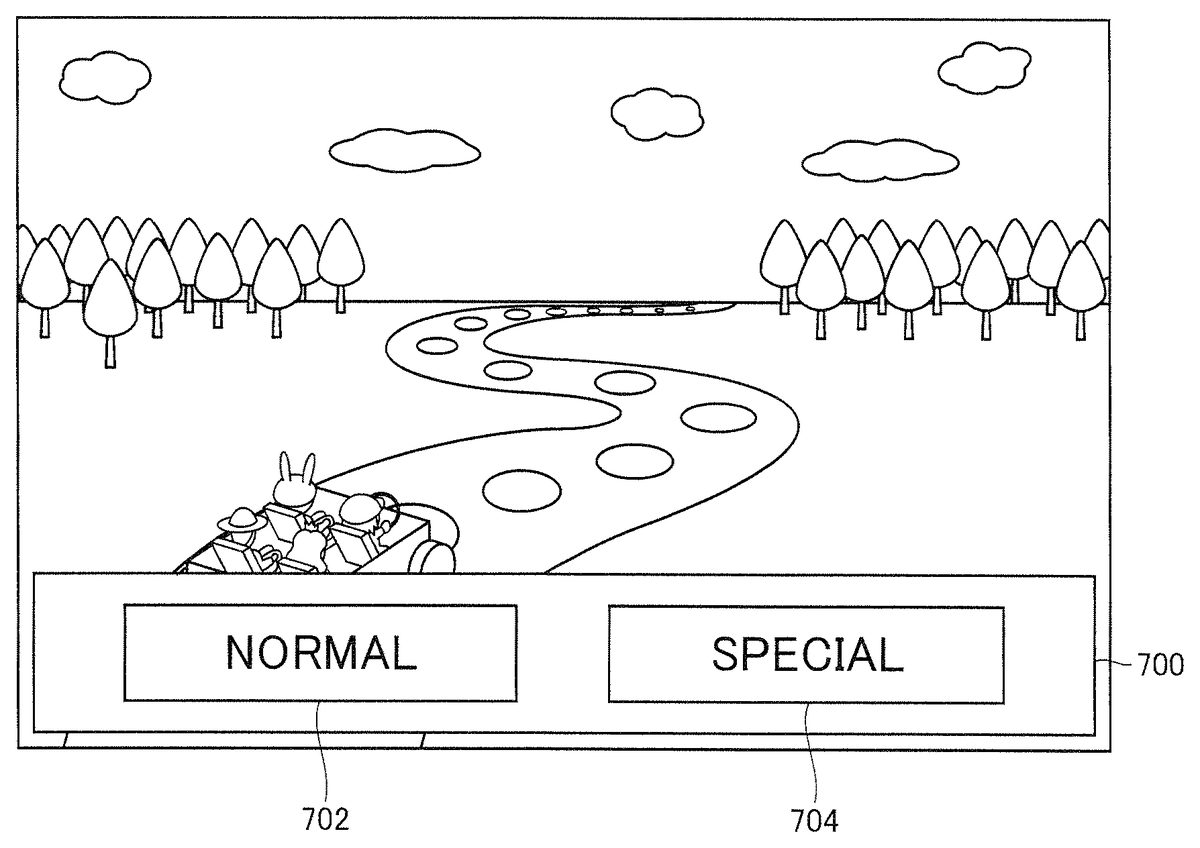
Referring toFIG. 9, for example, when a prescribed button (for example, A button26d) of controller22is selected in the screen inFIG. 8, a die selection screen700is displayed.
Here, a case where a “normal” button702for selecting a normal die and a “special” button704for selecting a special die are provided is shown. It is assumed that cross key22aof controller22is operated to allow selection of any button. Then, it is assumed, for example, that A button22dof controller22is operated to select a button.
For example, when a normal die is selected, movement processing based on a cast of the normal die is performed as movement processing.
Specifically, values of 1 to 6 are allocated to the normal die, and by selecting the normal die, the normal die is cast and movement in accordance with a cast shown is made.
Referring toFIG. 10, for example, a case where a normal die is selected and a normal die800shows “1” is shown.
Therefore, in this case, vehicle600carrying the plurality of characters602to608moves by one cell from the current cell position.
Referring toFIG. 11, for example, when “special” button704is selected in die selection screen700inFIG. 9, a special die selection screen900is displayed. Special die selection screen900is displayed in accordance with the possessed die data. The possessed die data is data on dice shared by all of the plurality of characters602to608.
Special die selection screen900shows special dice. Here, a “zero” die902, a “123” die904, a “456” die906, and a “slow” die908are shown. In addition, the number of permitted times of use is shown under each die displayed. Specifically, the number of permitted times of use of “zero” die902is shown as 1 (×1), the number of permitted times of use of “123” die904is shown as 0 (×0), the number of permitted times of use of “456” die906is shown as 1 (×1), and the number of permitted times of use of “slow” die908is shown as 0 (×0). Though not displayed, other special dice can also be displayed similarly by operating cross key22aof controller22. Then, it is assumed that operation of cross key22aof controller22allows selection of any die. Then, for example, it is assumed that, by operating A button22dof controller22, a special die is selected. It is noted that a special die of which number of permitted times of use is 0 cannot be selected.
For example, when “zero” die902is used, the number of permitted times of use is 0 (×0). When “zero” die902is used, such tactics that the operated character does not move but a character next in the order is moved is used and zest of a game can be enhanced.
It is noted that a normal die or a special die does not necessarily have to be selected first as shown inFIG. 9, and a die may be selected from among dice including both of the normal die and the special dice in the die selection screen as inFIG. 11. By doing so, the number of steps until a die is selected (cast) can be decreased.
Referring toFIG. 12,FIG. 12(A)shows the “zero” die showing a value of “0” as it is cast,FIG. 12(B)shows the “123” die showing any value of “1, 2, 3” as it is cast,FIG. 12(C)shows the “456” die showing any value of “4, 5, 6” as it is cast,FIG. 12(D)shows the “slow” die facilitating selection of a desired cast in response to an indication given at prescribed timing as a value of a cast is slowly displayed, andFIG. 12(E)shows a “10-face” die showing any value from “1 to 10” as it is cast.
Referring toFIG. 13, when a start-up operation is performed through controller22, CPU40initializes all data stored in data storage area402in external main memory46. As a result of this processing, for example, possessed die data area406in data storage area402inFIG. 4is initialized. When possessed die data area406is initialized, in the present example, the normal die can be used in an unlimited manner and any one of special dice is set to the number of permitted times of use of 1, with the number of permitted times of use of other special dice being set to 0. In addition, character possession star data area408and character position coordinate data410are also initialized. Namely, possessed star data indicates 0. Further, the character position is set to the start position representing an initial state.
Then, CPU40causes monitor34to display a movement route, an object such as a star, m (in the present example, 4) characters, and the like based on the route/character image data and the character coordinate data in data storage area402, in accordance with position setting program504and through GPU42b.
Then, CPU40selects a character to be operated, in the order designated in accordance with movement program506(step S5). For example, it is assumed that the order of selection is allotted to each of the plurality of characters602to608. Then, selection starting from the character in the first place is made.
Then, CPU40performs character movement processing in accordance with a selected character to be operated, in accordance with movement program506(step S6). The character movement processing will be described later.
Then, CPU40performs event processing in a cell to which movement has been made through the character movement processing, in accordance with event execution program512(step S8).
The process again returns to step S5, and a character to be operated next is selected and similar processing is repeated.
Referring toFIG. 14, initially, CPU40determines whether a die selection indication input has been provided or not (step S20).
For example, in the present example, in the game picture inFIG. 6, whether a prescribed input of controller22(for example, A button26d) has been provided or not is determined.
When CPU40determines in step S20that a die selection indication input has been provided (YES in step S20), it causes die selection screen700(FIG. 9) to be displayed (step S22).
Then, CPU40determines whether “normal” button702has been selected in die selection screen700or not (step S24).
When CPU40determines that “normal” button702has been selected (YES in step S24), it determines the number of cells through which movement should be made in accordance with the normal die (step S26). CPU40determines the number of cells in accordance with the die determination program in accordance with the selected die. In the case of the normal die, for example, the number of cells from 1 to 6 is determined by using random numbers.
Then, CPU40moves all player characters in accordance with the determined number of cells (step S28).
Then, CPU40performs star acquirement or loss processing (FIG. 8) in accordance with object(s) that has (have) been passed, based on star acquirement/loss program511(step S30). It is noted here that star acquirement or loss processing is performed on a selected character to be operated. For example, when character A acquired three stars, the number of possessed stars stored in the area of the character possession star data of character A is updated. The number of stars of other characters is also updated in a similar fashion.
Then, the process ends (return).
Therefore, in the present example, as described above, all characters move together as the selected character to be operated moves. Therefore, such movement directly affects other characters. In the conventional case, since each character has independently been moved, such movement has not directly affected other characters. Therefore, tactics in connection with movement has been less likely in the conventional case. In the case of the present example, however, tactics in connection with movement is used and zest of a game is enhanced.
For example, when a selected character to be operated is moved to come closer to bad luck, a character selected next in the order is more likely to lose a star due to bad luck and tactics against other characters in connection with movement is used.
In addition, since all characters move to the same position, a status on the route is readily grasped and zest of a game is enhanced.
Moreover, since movement of a character to be operated in its own order can be taken into consideration while movement of other selected characters to be operated is observed, speed of thinking increases and a speed of game progress also increases. Thus, zest of a game is enhanced.
On the other hand, when “normal” button702has not been selected in step S24(NO in step S24), that is, when “special” button704has been selected, CPU40causes display of special die selection screen900(FIG. 11) (step S32).
Then, CPU40determines whether a special die has been designated or not (step S34). Specifically, which special die has been designated in special die selection screen900by operating controller22is determined.
When CPU40determines that a special die has been designated (YES in step S34), it determines the number of cells through which movement is to be made in accordance with the special die (step S36). CPU40determines the number of cells in accordance with the die determination program in accordance with the selected special die. For example, when the “zero” die has been designated, the number of cells of 0 is determined.
Then, CPU40updates the number of permitted times of use of the special die (step S38). Namely, since the special die has been used, the corresponding number of permitted times of use of the special die in possessed die data area406is decremented.
Then, the process proceeds to step S28and CPU40moves all player characters in accordance with the determined number of cells (step S28). Subsequent processing is the same as described above.
As described above, the special dice in the present example are shared by the plurality of characters, and when a special die is used, the number of permitted times of use of the special die that was used is decremented (updated).
Therefore, a special die is not possessed independently by each character but it is shared, Therefore, in selecting a special die, tactics is used. Namely, use of an advantageous special die of which number of times of use is restricted results in restriction of the number of permitted times of use thereof by other characters, and tactics is used. Thus, zest of a game is enhanced. Then, not only the special dice can simply be used but also use thereof affects movement of the plurality of characters as a whole. Thus, a degree of tactics is further increased and zest of a game can be enhanced.
Referring toFIG. 15, CPU40determines to which cell movement has been made in accordance with the movement determination program. Then, various types of event processing are performed in accordance with the event execution program corresponding to the cell to which movement has been made.
CPU40determines whether movement to a normal cell has been made or not (step S40).
When CPU40determines in step S40that movement to a normal cell has been made (YES in step S40), it performs special die acquirement processing in accordance with the die acquirement program (step S42). Specifically, one of the special dice shown inFIG. 12is randomly acquired.
Then, CPU40updates the special die data (step S43). Namely, the number of times of use in the possessed die data is updated. Namely, the number of times increases by one.
Then, the process ends (return). Namely, the process returns to step S5inFIG. 13, a character to be operated next is selected, and similar character movement processing (step S6) and event execution processing (step S8) are performed. As a result of such processing, a character is selected sequentially and the game proceeds.
Then, when CPU40determines in step S40that movement to a normal cell has not been made (NO in step S40), it determines whether movement to an event cell has been made or not (step S44).
When CPU40determines in step S44that movement to an event cell has been made (YES in step S44), it performs mini game processing in accordance with the mini game execution program (step S46).
Then, CPU40updates the character possession star data in accordance with game results (step S48). Specifically, a star is added or subtracted in accordance with the results. It is noted that the mini game may be a mini game in which only selected characters to be operated participate or a mini game in which a plurality of characters together participate, and various forms are applicable.
Then, the process ends (return). Namely, the process returns to step S5inFIG. 13.
When CPU40determines in step S44that movement to an event cell has not been made (NO in step S44), it determines whether movement to a goal cell has been made or not (step S50).
When CPU40determines in step S50that movement to the goal cell has been made (YES in step S50), it performs winning and losing determination processing in accordance with the winning and losing determination execution program (step S52). The winning and losing determination processing is performed based on the possessed star data.
Then, the game ends (end).
On the other hand, when it is determined in step S50that movement to the goal cell has not been made (NO in step S50), the process ends (return).
Referring toFIG. 16, here, four operable characters are displayed and a mini race game in which each character runs to the goal is shown.
For example, by pressing a prescribed button of the controller corresponding to an operation of each character, the corresponding character moves. For example, it is assumed that a distance to move is different depending on the number of times of pressing the A button as the prescribed button.
In accordance with the number of times of pressing, each character runs on a race track620to the goal.
Then, a star is given in accordance with the order of arrival at the goal.
For example, the first place is given four stars, the second place is given two stars, the third place is given one star, and the fourth place is given zero star.
Though a mini game in which four operable characters compete against one another has been described in the present example, the game is not particularly limited to the mini game. Mini game processing by using one operable character may be performed, mini game processing in which a game is executed with a plurality of operable characters cooperating with each other may be performed, and various mini games can be executed.
Referring toFIG. 17, here, the number of stars acquired and the ranking based on the winning and losing determination processing based on the possessed star data are shown.
Specifically, a case where the number of stars acquired by character A is 20, the number of stars acquired by character B is 18, the number of stars acquired by character C is 10, and the number of stars acquired by character D is 2 is shown.
Then, a case where the ranking was determined based on the number of acquired stars is shown.
Though a case where a game proceeds with four characters participating in has been described in the present example, the number of characters is not particularly limited as such and any number of characters may be set.
Though a case where the number of cells through which a character moves is determined by using a die has been described in the present example, any means may be employed so long as it can determine the number of cells through which movement is made, without particularly limited to the die. For example, the number of cells through which movement is made may be determined based on a value set as roulette turns and stops. In addition, the number of dice is not limited to one either, and dice can also be used.
Though game device12has been exemplified as a representative example of an information processing apparatus in the embodiment described above, the information processing apparatus is not limited thereto. Namely, an application executable by a personal computer may be provided as a program. Here, the program may be incorporated as a partial function of various applications executed on the personal computer.
While certain example systems, methods, devices, and apparatuses have been described herein, it is to be understood that the appended claims are not to be limited to the systems, methods, devices, and apparatuses disclosed, but on the contrary, are intended to cover various modifications and equivalent arrangements included within the spirit and scope of the appended claims.
Claims
- A device for playing a game in which a plurality of player characters move on a prescribed route in a game space displayed on a display, comprising: an information processing device including one or more processing units configured to perform functions and operates as: an indication acceptance unit that accepts a movement indication for determining an amount of player character movement on said prescribed route directed to a player character among said plurality of player characters;a movement amount determination unit that determines an amount of player character movement on said prescribed route when said indication acceptance unit accepts the movement indication;a position updating unit that updates positions of said player character for which the movement indication has been accepted and of all other player characters on said prescribed route in accordance with said amount of player character movement determined by said movement amount determination unit;an item acquirement/loss processing unit that performs processing by which player characters acquire or lose a prescribed item in accordance with an update of a position of said player character for which said movement indication has been accepted;an event processing unit that executes an event at least on said player character for which the movement indication has been accepted in accordance with the position to which said player character has been moved;and a win/loss processing unit that performs a win/loss determination in which winning and losing is determined for player characters based on an amount of said prescribed items acquired by each of said plurality of player characters;wherein said indication acceptance unit further operates as: a normal movement indication determiner that accepts a normal movement indication for determining an amount of player character movement of a type that is a normal movement for a player character in the game, wherein said normal movement indication corresponds to a value of a cast shown by using a normal die, and a special movement indication determiner that accepts a special movement indication for determining an amount of player character special movement which is of a type that is different from said type that is a normal movement for a player character in the game, the special movement indication being used as an alternative to said normal movement indication and for which a number of permitted times of usage by each of said plurality of player characters is limited, and wherein said special movement indication corresponds to a value of a cast shown by using a special die different from said normal die.
- The device according to claim 1 , wherein said amount of player character movement is the number of cells provided successively on said prescribed route, through which movement is made.
- The device according to claim 1 , wherein said event processing unit includes a special indication acquirement processing unit that executes an event allowing use of said special movement indication of which number of permitted times of issuance is set as limited.
- The device according to claim 1 , wherein said special die is set to show only a value within a prescribed range narrower than a range of values determined by said normal die.
- The device according to claim 1 , wherein said special die is set to be able to show a value not included in the values determined by said normal die.
- The device according to claim 1 , wherein said special die is set to show only a value of zero.
- The device according to claim 1 , wherein said event processing unit further includes a mini game processing unit that executes a mini game in which said plurality of player characters compete against one another as they are operated.
- A computer implemented method using an information processing system having one or more processors for playing a game in which a plurality of player characters move on a prescribed route in a game space displayed on a display, the method comprising: using the processing system to accept a movement indication for determining an amount of player character movement on said prescribed route directed to a player character among said plurality of player characters;using the processing system to determine an amount of player character movement on said prescribed route when the movement indication is accepted;using the processing system to update positions of said player character for which the indication has been accepted and of all other player characters on said prescribed route in accordance with a determined amount of player character movement;using the processing system to perform item acquirement/loss processing by which player characters acquire or lose a prescribed item in accordance with an update of a position of said player character for which said movement indication has been accepted;using the processing system to execute an event at least on said player character for which the indication has been accepted in accordance with the position to which said player character has been moved;and using the processing system to perform a win/loss determination in which winning and losing is determined for player characters based on an amount of said prescribed items acquired by each of said plurality of player characters;wherein accepting a movement indication further includes: accepting a normal movement indication for determining an amount of player character movement of a type that is a normal movement for a player character in the game, wherein said normal movement indication corresponds to a value of a cast shown by using a normal die, and accepting a special movement indication for determining an amount of player character special movement which is of a type that is different from said type that is a normal movement for a player character in the game, the special indication being used as an alternative to said normal movement indication and for which a number of permitted times of usage by each of said plurality of player characters is limited, and wherein said special movement indication corresponds to a value of a cast shown by using a special die different from said normal die.
- A non-transitory storage medium encoded with a computer readable program instructions executable by one or more computer processor of an information processing system, the system being usable for playing a game in which a plurality of player characters move on a prescribed route in a game space displayed on a display, said program instructions comprising: instructions for accepting a movement indication for determining an amount of movement on said prescribed route directed to a player character among said plurality of player characters;instructions for determining an amount of player character movement on said prescribed route when the movement indication is accepted;instructions for updating positions of said player character for which the movement indication has been accepted and of all other player characters on said prescribed route in accordance with a determined amount of player character movement;instructions for performing item acquirement/loss processing by which player characters acquire or lose a prescribed item in accordance with an update of a position of said player character for which said movement indication has been accepted;instructions for executing an event at least on said player character for which the movement indication has been accepted in accordance with the position to which said player character has been moved;and instructions for performing a win/loss determination in which winning and losing is determined for player characters based on an amount of prescribed items acquired by each of said plurality of player characters;wherein instructions for accepting a movement indication further include: instructions for accepting a normal movement indication for determining an amount of player character movement of a type that is a normal movement for a player character in the game, wherein said normal movement indication corresponds to a value of a cast shown by using a normal die, and instructions for accepting a special movement indication for determining an amount of player character special movement which is of a type that is different from said type that is a normal movement for a player character in the game, the special indication being used as an alternative to said normal movement indication and for which a number of permitted times of usage by each of said plurality of player characters is limited, and wherein said special movement indication corresponds to a value of a cast shown by using a special die different from said normal die.
- A system which performs processing for playing a game in which a plurality of player characters move on a prescribed route in a game space displayed on a display, comprising: a game device;and a controller for operating the game device, said game device including one or more processing units configured to function or operate as: an indication acceptance unit that accepts a movement indication from said controller for determining an amount of player character movement on said prescribed route directed to a player character among said plurality of player characters, a movement amount determination unit that determines an amount of player character movement on said prescribed route when said indication acceptance unit accepts the indication, a position updating unit that updates positions of said player character for which the indication has been accepted and of all other player characters on said prescribed route in accordance with said amount of player character movement determined by said movement amount determination unit, an item acquirement/loss processing unit that performs processing by which player characters acquire or lose a prescribed item in accordance with an update of a position of said player character for which said movement indication has been accepted;an event processing unit that executes an event at least on said player character for which the movement indication has been accepted in accordance with the position to which said player character has been moved;and a win/loss processing unit that performs a win/loss determination in which winning and losing is determined for player characters based on an amount of prescribed items acquired by each of said plurality of player characters;wherein said indication acceptance unit further operates as: a normal movement indication determiner that accepts a normal movement indication for determining an amount of player character movement of a type that is a normal movement for a player character in the game, wherein said normal movement indication corresponds to a value of a cast shown by using a normal die, and a special movement indication determiner that accepts a special movement indication for determining an amount of player character special movement which is of a type that is different from said type that is a normal movement for a player character in the game, the special movement indication being used as an alternative to said normal movement indication and for which a number of permitted times of usage by each of said plurality of player characters is limited, and wherein said special movement indication corresponds to a value of a cast shown by using a special die different from said normal die.
Disclaimer: Data collected from the USPTO and may be malformed, incomplete, and/or otherwise inaccurate.