U.S. Pat. No. 8,851,992
MUSIC PLAYER FOR VIDEO GAME CONSOLES AND ELECTRONIC DEVICES OPERABLE IN SLEEP OR POWER-SAVING MODES
AssigneeDisney Enterprises, Inc.
Issue DateAugust 29, 2008
Illustrative Figure
Abstract
A game cartridge with a game program configured to cause a computer to implement a jukebox or music playing method. The method includes displaying a listing of game modules of the game program on a display screen including a jukebox module. A selection to activate or run the music player module is received. The music player module plays music by outputting to the audio output port an audio signal based on processing of the digital music files stored in the storage medium. The method includes receiving a sleep mode initiation signal such as may be transmitted in response a magnetic sensor sensing closing of a housing or lid. The method includes responding to the initiation signal by placing the game modules except for the music player module into a sleep state, whereby the music player module continues to play music after other modules are paused.
Description
DETAILED DESCRIPTION OF THE PREFERRED EMBODIMENTS Briefly, embodiments of the present invention are directed toward portable electronic devices that are adapted to run as music players or portable jukeboxes when the devices are otherwise in low-power consumption or sleep operating modes or states. The electronic devices may include nearly any device that enters a sleep mode, e.g., after a period of non-use, upon receipt of user selection of such mode, or, more typically, when a clamshell body is closed (e.g., a lid or upper portion is positioned against or near a base or lower portion of the body). The devices may include computers such as laptops, notebooks, and other portable computers and may include cell phones, personal digital assistants (PDAs), and other devices that are periodically placed in low-power consumption states. The following description is intended to cover such electronic devices while emphasizing use of the sleep-mode jukebox concept with video game consoles to provide a game system that can operate as a portable jukebox or music player. Specifically, the inventors were facing a challenge of increasing the functionality of a video game console while controlling its power consumption. It was believed that consumers would appreciate the ability to use their game consoles in a manner similar to a more typical music player such as a portable MP3 player or the like. To this end, the inventors determined that video games (e.g., game applications provided on the memory of a game cartridge or card or in a memory card that is inserted into a video game console) may be modified to include a music playing or jukebox module to allow the user of the game console to listen to music while they are playing the game. Most portable video game consoles are designed to have little or no memory for ...
DETAILED DESCRIPTION OF THE PREFERRED EMBODIMENTS
Briefly, embodiments of the present invention are directed toward portable electronic devices that are adapted to run as music players or portable jukeboxes when the devices are otherwise in low-power consumption or sleep operating modes or states. The electronic devices may include nearly any device that enters a sleep mode, e.g., after a period of non-use, upon receipt of user selection of such mode, or, more typically, when a clamshell body is closed (e.g., a lid or upper portion is positioned against or near a base or lower portion of the body). The devices may include computers such as laptops, notebooks, and other portable computers and may include cell phones, personal digital assistants (PDAs), and other devices that are periodically placed in low-power consumption states. The following description is intended to cover such electronic devices while emphasizing use of the sleep-mode jukebox concept with video game consoles to provide a game system that can operate as a portable jukebox or music player.
Specifically, the inventors were facing a challenge of increasing the functionality of a video game console while controlling its power consumption. It was believed that consumers would appreciate the ability to use their game consoles in a manner similar to a more typical music player such as a portable MP3 player or the like. To this end, the inventors determined that video games (e.g., game applications provided on the memory of a game cartridge or card or in a memory card that is inserted into a video game console) may be modified to include a music playing or jukebox module to allow the user of the game console to listen to music while they are playing the game.
Most portable video game consoles are designed to have little or no memory for use in storing game data. Hence, the game cartridge includes memory that is used in embodiments of the invention to not only include or store a game application with a jukebox module but also to store a plurality of songs (or digital music files such as MP3 files). The game application may be configured to provide all the music files to the user or game player or to provide a small list initially (e.g., in the user's cart) with other songs/music files being earned by game play. Typically, the user is also able to organize their music into folders and play lists and to navigate through the songs and control play similar to on other music playing devices, and these functions are provided through user interfaces/GUIs generated by the game application and/or with external user input buttons and/or switches (e.g., shoulder buttons may be used to navigate through a current play list, a volume switch on the console body may be used to set song playing volume, and so on).
Significantly, the inventors determined that it would be desirable to allow the user to listen to music even when the video game console is closed (or otherwise placed in a sleep or low-power consumption operating state). Typical video game consoles are designed to conserve battery life by entering a sleep mode whenever the console body is closed (e.g., lid placed against the base). In such sleep modes, the game applications are all paused and the screen becomes dark, with game data being stored prior to entering the sleep mode such that the game can resume at the same starting point when the video console is later opened. In contrast, the game applications of the present invention typically include a music player or jukebox module that is allowed to continue its operations when the video console body is closed (or the device is placed in a sleep mode). In some embodiments, this occurs automatically with the jukebox module acting to transmit an audio output signal only to the audio output port (or headphone/speaker port) when in such a sleep mode. In some embodiments, the screen is darkened (e.g., no user interface regarding the jukebox is displayed) in such a sleep mode while in other embodiments the screen may continue to display the same or a different interface with data or information on the currently played songs to facilitate use of the video game console as a music player.
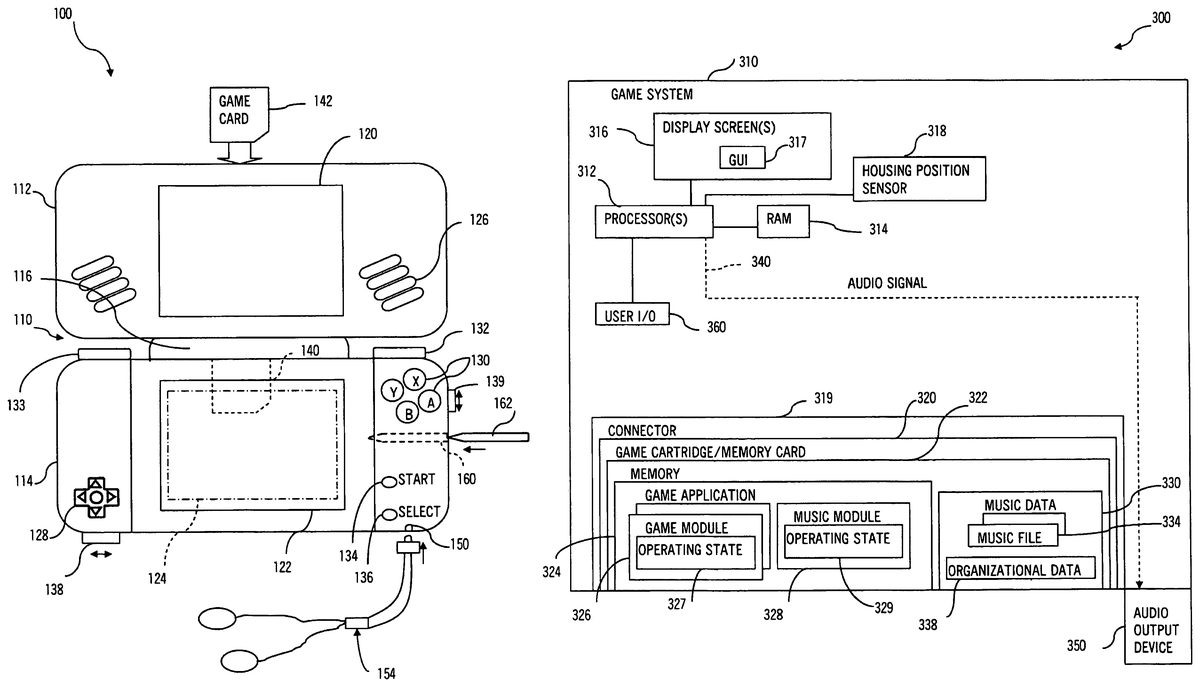
FIG. 1illustrates a game apparatus or system100of an embodiment of the invention that includes a game card142with a jukebox or music player module (not shown) in its memory that enables the game system100to be operated as a portable music player. As shown, the system100includes a video game console110, a game card142with a game application or main game processing program with a jukebox module, and an audio output device154(e.g., a pair of speakers or, as shown, a pair of earphones (or headphones)). During operation, the game card142is inserted by a user into the game loading slot or port140of the console110and the game application on the memory of the card142is loaded and run by the logic and hardware (not shown inFIG. 1) provided in the video game console110. To listen to music and operate the console110as a music player or jukebox, the user may insert the earphones154into the audio out port150(or use speakers126). In preferred embodiments, the jukebox or music player module of the game application is not paused when the console110is placed in sleep or low power mode (such as by closing the lid or upper housing/portion112) and an audio signal is transmitted whenever the jukebox module is selected and active in the game.
In this exemplary game system100, the game console110includes an upper housing or lid112connected by a hinge or pivotal member116to a lower housing114(e.g., a clamshell body design in which the lid112may be closed and opened by pivoting about hinge116to contact base114). The console110includes a first display or screen120in the lid112and a second display or screen122in the base114, and each of these may be liquid crystal displays (LCDs) or other display screens. Two or dual screens120,122are shown in system100, but more or fewer screens may be provided with some embodiments including only a single screen in some cases. During operation of the console, game information including information in user interfaces or graphical user interfaces (GUIs) related to the jukebox module, e.g., songs available in a player's cart, a current play list, the currently playing song, and so on, is displayed upon one or both of these displays120,122.
During operation to play a game application on game card142, the console110operates to emit sounds related to the game action. Further, as significant to the present invention, the game application provided in memory of card142includes a jukebox module or routine that may be activated or chosen to play songs (again stored, in most cases, in memory of card142). To this end, the console110includes speakers126(or sound emission holes/openings) shown in this example in the lid or upper housing portion112(but may be in the lower portion or base114). The game sounds and music may also be provided to a user via audible output devices connected to an audio output150, such as the earphones154plugged into console base114, speakers, headphones, or the like. For example, the speakers126may be used as output by the game application/music player until a device154is connected to audio output150, and in some embodiments, the jukebox or music player module of a game application provides audio output signals to port150when the game system100is operating in sleep or low power consumption modes (e.g., when the console110is closed).
Regarding entry of sleep mode, the console110includes an upper lid112and a base114that are rotatably or pivotally connected via hinge member116. Accordingly, when the game is not being played, the upper housing or lid112may be folded in clamshell fashion. When the closing occurs when the game application is running on console110, a sleep mode is set as described later in which an active or selected jukebox or music player module continues to operate (but, typically, without the screens120,122being used to display music data or navigation interfaces) while other game modules are paused to lower power consumption.FIG. 2illustrates the game system100with the console110in the closed position with the lid112folded upon the base114. In some embodiments, the user may not be able to adjust or change music playing when the console110is closed. In other embodiments, though, the user may be able to change at least some functions of the jukebox such as by adjusting volume of output music via earphones154such as by sliding a volume control lever or switch138provided on an external surface of the console110such as on a side of the base114as shown inFIGS. 1 and 2. Further, the user may be able to terminate operations completely by shutting down the device100by using power lever or switch139also provided on a side of the base114and accessible when the game console110is closed. Further, in some embodiments, a user is able to navigate (e.g., play the next song or play the last song or the like) within a current song play list by using shoulder buttons132,133provided on a side (or shoulders) of the base114and, again, accessible when the game console110is closed.
To allow a user to interact with the game application (e.g., play the game and use the music player), a number of operating switches or buttons are provided on the console110. In this example, the console110includes directional input pad or button128that may function as a digital joystick and is utilized by a player for providing user input to instruct a moving direction of a player character (or a player object) to be operated within a running game application by operating any one of four depression portions/directional arrow sections. Action switches/buttons130are provided to allow a user to cause particular actions within a running game (e.g., running, jumping, holding, and the like) by pressing one or more of the buttons130. Likewise, shoulder buttons132,133may be used to cause desired actions of a character or character object within a game and, in some cases, to navigate and select options (e.g., game play modes) a user interface or GUI displayed upon one or more of the screens/displays120,122. The console further includes a start switch or button134and a select button or switch136to provide input to a running game.
Further, in this embodiment, the display screen122includes a touch panel/screen124(e.g., a resistance film system, an optical system, an electrostatic capacitive coupling system, or the like). In operation of a game application on game card142, a GUI or game information is displayed upon the display122and the touch panel124operates to detect coordinates of where a user has touched the screen122to provide user input such as to select a displayed operating mode (e.g., activate the jukebox or music player, choose a music folder, play a song on a play list, and so on). User input may be provided with a stylus, pen, or stick162stored in base114in receptacle160or with a finger or the like used to depress, touch, or otherwise contact the screen122, and in response, the touch screen124outputs coordinate data corresponding to the detected touch location to the game application.
FIG. 3illustrates a portable music player system300in functional block form to provide further description on how game systems such as system100may be implemented to operate as portable jukeboxes or music players. As shown, system300includes a game system or apparatus310with one or more processors or CPUs312that control operation of the game system310. Memory314in the form of RAM or the like is provided in the system310for use by the processor312during running of a game application (temporary or transient data and the like) but not for storing game and music data and the like, which is stored in an inserted game card or memory cartridge320(e.g., the game system310is configured with little or no onboard memory but instead memory including game application logic and digital music files are provided on received memory cards and the like).
The game system310also includes one or more display screens316upon which game data may be provided and upon which user interfaces317are generated to allow a user to provide input via one or more user I/O devices360(e.g., touch screens, action buttons, joysticks, and the like). The game system310also includes a housing position sensor318(e.g., a magnetic sensor or the like) that operates to sense when a housing that may be a clamshell design is closed, which indicates the system310may enter a sleep or low power consumption operating state or mode. In other embodiments, a switch or other input device may be provided to allow a user to select a low power or sleep mode (e.g., in an electronic device that does not have a lid that closes such as many current cell phone and PDA designs) or logic may be provided to determine when a period of non-use has occurred and place the system310in sleep mode to save power (e.g., after 30 seconds, 1 minute, or some other time period, the game system310may enter a sleep mode including darkening a display screen, pausing game and other operating modules but continuing operation of an active jukebox or music player, and the like).
The game system310includes a connector or port/receptacle319connected to the processor312for receiving a game cartridge or memory card320. The game cartridge320includes logic and data (such as music files in MP3or another format) used by the game system310to allow a user of the system310to play a game and, in this embodiment, to use the system300as a portable music player. To this end, the game cartridge320includes memory322that stores a game application324, such as an interactive video game or the like. The game application324may include a plurality of game modules326, and the processor(s)312operates to run the modules326of the game application324to allow a user to play a game, and this typically includes displaying game data upon the display screens316that may include game menus and other GUIs317. The game modules326may also cause the processor312to output audio signals340to an audio output device350(e.g., speakers provided on a game console/body, earphones or the like plugged into an audio out port, or the like).
The game application324further includes a music player or jukebox module328that includes logic (e.g., coded software) that may be run by processor312to play music or songs by outputting audio signals340to audio output device350. To this end, the memory322also stores music data330that typically includes a plurality of songs in digital form or digital music files334. Any of a number of digital audio encoding formats may be used to practice the invention including, but not limited, to MP3 (or MPEG-1 Audio Layer 3), Dolby Digital, other MPEG formats, and the like. The memory322may also store other music-related data338such as organization data including play lists, user's music folders, and the like. In some embodiments, the music module328may be configured such that a player of the game application324is provided a smaller subset of the music files334at the beginning of the game play but can earn or find additional ones of the music files334that can be added to their play lists or to their cart for later access and playing to device350.
In some embodiments, the number/content of the music files334is fixed at the time of manufacture of the game cartridge320. The user may access, navigate, and organize the files334(or at least those currently added to their cart) via interfaces317generated by the music module328and/or by other game modules326. In other embodiments, a user may store additional music files in their music data330. For example, a user may be able to link to another device (e.g., a computer via a USB or other cable or via a wireless connection) to transfer music from the other device to the memory322(e.g., to fully or partially synchronize with another play list or the like), and, in some cases, the game application324and/or music player module328is adapted to allow the music files334(or those currently earned by the player) to be copied to the other device. In one embodiment, the manufacturer/distributor of the game cartridge320may operate a website on the Internet that may be used by a player or user of system310to update and add to the music files334(e.g., earn codes by playing the game application324to allow them to download additional music, interact with a website to earn or obtain new songs, purchase additional music related to or distinct from the game application324, and the like). In another embodiment, the user could use the program to create their own musical file, which could then be accessed by the jukebox application. As will be appreciated, there are many ways the music files334may be modified in embodiments in which the set of music files334is not fixed, which allows the system310to be operable more similarly to other digital audio playing devices (e.g., MP3 players and the like).
Another significant aspect of the music player system300is that the game cartridge320provides the logic for playing music with the music module328and also provides logic and/or functionality to play the music files334when the game system310is otherwise placed in sleep or low power consumption mode. To this end, the game application324may track the operating states327of the game modules326as well as the operating state329of the music player module328. For example, the operating states327may include inactive states (e.g., no power or not selected operational modes), active states (or high/standard power consumption modes) and sleep/pause states (or low power consumption modes). However, the operating states329of the music player module328may be limited to simply an active or selected state and an inactive or non-selected state because the module328is preferably adapted to continue its active state (or at least a subset of such active functions with some being paused or placed in sleep mode such as darkening of the screen316to stop display of a GUI317but such functionality may be provided in a game module326).
More particularly, operation of the music player system300may include a user inserting the game cartridge320into connector319and powering on the system310. The processor312may then load and run the game application324including one or more of the game modules326and the music module328. In some applications, the music module328will also run in the background of the game application324(e.g., always be active upon running the game application324) while in other applications the user may be able to selectively run or inactivate the music player module328(such as by selecting a button on a touch screen316and/or a portion of GUI317). When the processor312deteimines the game system310should enter sleep or low power mode such as in response to signal from sensor318indicative of a closed/closing lid, the processor312may transmit a sleep or pause signal that causes the game application324to change the operating states327of the game modules326to the sleep mode. Typically, this involves saving current game data in memory322to allow the game to be restarted at the point in the game where the lid was closed or sleep mode was initiated. In contrast, the operating state329of the music player module328is not altered such that it either continues in an inactive state or in an active state in which it plays music via audio signals340to audio output device350. In some embodiments, though, some functionality is altered upon a sensing of the lid closing via a signal from sensor318, and these alterations may include outputting the signal340only to a peripheral device350rather than an onboard speaker and terminating display of a GUI317providing music data338.
The specific components, electronic devices, and software modules that are used to implement the game systems of the invention such as those shown inFIGS. 1-3may be varied widely to practice the invention with many implementations being readily apparent to those in the video game industry and in the portable or handheld electronic device industry. However, it may be useful at this point to provide more detailed discussion of one useful implementation of a game apparatus or console400with reference toFIG. 4that may be used to provide a portable jukebox upon the insertion and use of a game card480configured according to the present invention.
FIG. 4is a block diagram showing an electric configuration of a game apparatus400. The game apparatus400includes an electronic circuit board440, and on the electronic circuit board440, a circuit component such as a CPU core442is mounted. The CPU core442is connected to a connector446via a bus444and is connected with a RAM448, a first graphics processing unit (GPU)450, a second GPU452, an input-output interface circuit or I/F circuit454, and an LCD controller460. The connector446is detachably connected to the memory or game card480. The game card480includes a ROM482and a RAM483, which may be connected with each other via a bus and also connected with the connector446such that the CPU core442gains access to the ROM482and the RAM483.
The ROM482stores in advance a game program for a game (e.g., a virtual or video game) to be executed by the game apparatus400image data (e.g., character image, background image, item image, icon (button) image, message image, and the like), data of the sound (music) necessary for the game (sound data), and the like. Specifically, the ROM482is shown to store the main game processing program with its game modules and game data as well as a jukebox engine486and digital music files (e.g., songs) and organizational data (as discussed above)488. The RAM (e.g., backup RAM)490stores or saves proceeding or current data of the game including result data and present settings of the game as shown at492. The RAM490may also store current music data494such as a selected music folder, a play list, a currently playing song, and the like. During operation of the apparatus400, audio signals are provided by the I/F circuit454to an onboard speaker432and/or an audio port434(e.g., a port or jack for earphones and the like) to output songs/audio output based on the music files488.
The RAM448is utilized as a buffer memory or a working memory. For example, the CPU442loads the game program484, game data, and music files/music organizational data488, and the like stored in the ROM482of the memory card480into the RAM448and executes the loaded game program. Furthermore, the CPU442executes a game process including the jukebox engine486while storing data (game data, flag data) temporarily generated in correspondence with a progress of the game in the RAM448.
The GPU50and the GPU52may form a part of a rendering mechanism and may be constructed with, for example, a single chip ASIC, and receive graphics commands from the CPU442to generate game image data according to the graphics commands. The CPU442applies an image generation program (included in the game program484) to generate the game image data including GUIs to the GPU450and GPU452in addition to the graphics commands. The GPU450is connected with a first video RAM or VRAM456, and the GPU452is connected with a second VRAM58. The GPU450and the GPU452respectively access the first VRAM456and the second VRAM458to obtain data (image data: character data, texture data, and the like) for executing the graphics commands. Also, the CPU442writes image data for rendering to the first VRAM456and the second VRAM458via the GPU450and the GPU452. The GPU450accesses the VRAM456to create game image data for rendering, and the GPU452accesses the VRAM458to create game image data for rendering.
The VRAM456and the VRAM458are connected to the LCD controller460. The LCD controller460includes a register462, and the register462may include, for example, one bit, and store a value of “0” or “1” (data value) according to an instruction from the CPU442. The LCD controller460outputs the game image data created by the GPU450to the LCD412and outputs the game image data created by the GPU452to the LCD414in a case that the data value of the register462is “0”. Also, the LCD controller460outputs the game image data created by the GPU450to the LCD414and outputs the game image data created by the GPU452to the LCD412when the data value of the register462is “1”. Additionally, the LCD controller460reads the game image data from the VRAM456and the VRAM458or reads the image data from the VRAM456and the VRAM458via the GPU450and the GPU452.
The I/F circuit454is connected to the operating switches420, the touch panel422, the speaker432, and audio out port432. For example, the operating switches420may be the user input devices, buttons, switches, and the like shown in the devices ofFIGS. 1-3. In response to an operation of one of the operating switches420, a corresponding operation signal (operation data) is input to the CPU442via the I/F circuit454. The coordinate data output from the touch panel422is input to the CPU442via the I/F circuit454. In addition, the CPU442reads from the RAM448the sound data and music files for the game program484and jukebox engine486, such as game-play music, a sound effect or voices of a game character (onomatopoeic sound), and songs488from a jukebox music list, and outputs it from the speaker432or audio port434via the I/F circuit454.
When the Hall element (e.g., a magnetic sensor)436detects magnetic flux of the magnet (e.g., a magnet around which a voice coil is wound in the speaker432or the like), the Hall element436outputs a voltage according to the magnetic flux. Numerical data according to the voltage is inputted to the CPU442. As described above, when the game apparatus400is closed by rotating the upper housing, the Hall element436can detect the magnetic flux of the magnet. That is, the CPU442detects that the game apparatus400is closed (e.g., in a closed state) when the numerical data is inputted from the Hall element436. On the other hand, the CPU442detects that the game apparatus400is opened (e.g., in an opened state) when the numerical data is not inputted from the Hall element436.
In some embodiments, an antenna438is connected to the game apparatus400, and the antenna438is connected to the wireless communication unit464. For example, the apparatus400may be adapted to communicate with other game devices in a wireless manner to exchange music files488or with a computer, a server, or the like to download music files488to ROM482(or to synchronize with a music play list stored in memory of a computer). In other embodiments, a port such as a USB port may be provided to allow wired connection to such devices to allow addition or management of music files488. The wireless communication unit464is connected to the CPU442through the bus444. When the CPU442provides game data, music data, or a command to the wireless communication unit464, the wireless communication unit464converts the data or commands into an analog signal, and the wireless communication unit464transmits or sends the analog signal in the form of a radio wave from the antenna438. When the wireless communication unit464receives a radio wave transmitted from another game apparatus or other electronic device through the antenna438, the wireless communication unit464separates the analog signal from the received radio wave to perform digital conversion to the analog signal, and the wireless communication unit464supplies the digital signal to the CPU442. Thus, the wireless communication is performed with other game apparatuses and/or electronic devices such as another device storing MP3 files or the like.
In simple terms, when the game apparatus400(e.g., a video game console or its housing) is closed during playing the communication game, a closed state of the game apparatus400is detected. That is, as described above, the Hall element436detects the magnetic flux of a magnet provided in the speaker32or otherwise, and the Hall element436supplies the numerical data of the voltage to the CPU core442according to the magnetic flux, which allows the CPU442to detect the closed state of the game apparatus400. When the CPU442detects the closed state, the CPU442determines that the game main processing program484or the majority of its game modules should be interrupted to set the game apparatus400to a sleep mode. The sleep mode is set, as discussed above, for the game modules but not for the jukebox engine, which continues to operate to provide music via I/F circuit454to audio port434.
Prior to the setting of the sleep mode, the parameters (e.g., game data) necessary to execute a game main processing program484are saved in RAM490to interrupt the execution of the game main processing program484. As described above, this enables the game to be resumed from the time point of the interruption, and this also enables the deletion of the game data due to the setting of the sleep mode to be prevented. Examples of the parameters (e.g., game data) include positional data of the player object, parameters (level, life, item, and the like) concerning the player object, and a flag concerning a game event, and so on. When the sleep mode is set, the LCD controller460acts to terminate or pause operation of the LCDs412,414. Optionally, in such sleep modes, other functions except for minimum circuit components may be turned off.
When the game apparatus400(e.g., its housing or console) is opened, because the Hall element436does not detect the magnetic flux of the magnet, the numerical data is not inputted to the CPU442from the Hall element436. When the CPU442detects the opened state, the CPU442cancels the sleep mode. Specifically the CPU442turns on LCD displays412,414, retrieves saved game data from RAM490, and initiates the game of game program484at the termination point. When the sleep mode is canceled, a selection screen or interface may be displayed on LCD412and/or LCD414for allowing a user to select the resumption of the game or the end of the game (or particular modules such as the jukebox module).
FIGS. 5 and 6illustrate screen shots of user interfaces that may be generated by a game program of the invention on LCDs or other screens of an electronic device. The user interface500provides a menu or listing of buttons510that may be chosen (e.g., pressing an action button or touching a touch screen) by a user to activate a particular game module. Button or menu item520is provided to allow a user to activate or select a jukebox engine or module as discussed above (and below with reference toFIGS. 6 and 7).
Upon selection of jukebox button520, a dual screen device600may operate to concurrently display the user interface610and the user interface620. The interface610may be displayed on an upper LCD or screen (e.g., a non-touch screen display) and may include music data612such as a current play list (or portion of such a list). In the play list, a currently playing song may be highlighted to the user (such as with a different colored display, a box placed around or under song title, with icons, or the like). The play list612may also include locked songs that are available in the game memory but not yet found/earned/unlocked by the user, and the user may be encouraged to play the game and even particular portions to unlock and then access these songs.
In user interface620, the user may be provided with information such as the current song selection in box628, art related to the music selection in area626, and time information related to the song in box629. The jukebox engine may also be adapted to allow the user to control music playing functions and to navigate through available music and back to game play. To this end, the user interface620may include navigation buttons622such as a back button, a top of play list button, a next page or portion of play list button, a next page or portion of play list button, and others such as to allow a different folder to be chosen and the like. The user interface620may further include play control inputs, buttons, switches, or the like624such as a play prior song button, a stop play button, a play button, a pause button, and a play next song button.
FIG. 7illustrates a method700of operating or providing a portable jukebox according to an embodiment of the invention. As shown, the method700starts at702such as with providing a video game console and a game cartridge with memory storing a jukebox module as part of a game application or program and storing music files that can be accessed by the jukebox module and played during operation of the console (e.g., during game play, as a separate operation with the game open or closed (e.g., in full or lower power/sleep modes). The method700continues at710with detection of a game card being inserted into a game port or connection with a connector of a game console. When a game is detected and the game console is powered on, the method700continues at714with determination of whether the game play is selected (e.g., the device may be operated for other functions until a game with a jukebox module is selected). If yes, the method700continues at718with the CPU loading the main game processing program718and running the game application.
At720, the method700continues with displaying one or more GUIs on one or more screens to provide game play options to the user (e.g., seeFIGS. 5 and 6) including game modules the user can choose, allow a user to set game or device parameters, and allow a user to select or activate the jukebox module/engine. At730, the method700includes the processor or CPU operating to sense or wait for selection of the jukebox mode. When the jukebox mode is chosen (such as by selection of a button on a touchscreen or the like), the method700continues at732with displaying a jukebox GUI(s) on one or more of the device screens (e.g., seeFIG. 6). At734, the processor may detect that user input is received and at736the jukebox engine may be run to respond to the user input such as by playing a selected song list, playing a song within a list, increasing volume, terminating or inactivating the jukebox module (with the method700then continuing at720), or the like. At780, a power off selection may be received, and the method700then would end at790. Although not shown, the jukebox mode may be active while other game modules are running so as to allow a user to play a game while listening to music via the jukebox or music player module.
At740, the game apparatus, such as with the processor, operates to wait for a signal from a lid closing/position sensor (e.g., a magnetic sensor as discussed above) indicating the lid has been closed. When received, the method700continues at744with a check or determination of whether the game program is running in jukebox mode (e.g., is the jukebox module in an active or running state of operation?). If not, the method700continues at750with placing all game modules in a sleep mode or state to conserve or consume less power. If in jukebox mode, the method700continues at760with placing all game modules except the jukebox module into sleep mode or state (e.g., pause all other game operations but continue to play music by providing a signal to the audio output port or earphone/headset/speaker jack). At770, the method700continues with the processor or game apparatus operating to sense when a lid open signal is received. When received from a magnetic or other sensor, the method700continues at776with resuming the game modules at saved points in their processes (e.g., by retrieving game data saved at750from memory). The method700may then continue at720,730,734,736,740, and/or780.
Although the invention has been described and illustrated with a certain degree of particularity, it is understood that the present disclosure has been made only by way of example, and that numerous changes in the combination and arrangement of parts can be resorted to by those skilled in the art without departing from the spirit and scope of the invention, as hereinafter claimed. For example, the above discussion provides the exemplary embodiment of a handheld or portable video game console or apparatus. The invention is not limited to video game devices but may be used with nearly any electronic device that is periodically placed in a sleep or low power consumption mode. These other electronic devices include cell phones, wireless PDAs, a number of MP3 and other audio file players, portable computers such as laptops and notebooks, and other devices that are adapted to play audio files such as MP3 files (e.g., music stored in a compressed digital form). In many cases, these devices will include a clamshell-type housing with a lid and base that are positionable in open and closed positions and a sensor is included for sensing when the housing is closed or open (such as a magnetic sensor or the like). In other cases, the device could be put into sleep mode through a button press or other mechanical device that is initiated by the user. In some cases, the device could enter low power mode after initiating a period of timeout or a specified length of time without user input.
Claims
- A game apparatus, comprising: a display apparatus with a computing device;user input devices;an audio output port;and non-transitory computer-readable storage medium having a game program stored therein, the game program causing the computing device of the game apparatus to implement a method comprising: displaying a listing of game modules of the game program on the display apparatus, wherein the game modules include a music player module;receiving a selection of the music player module from a user via the user input devices;with the music player module, playing music by outputting to the audio output port an audio signal based on digital music files stored in a memory and accessed by the music player module;receiving a sleep mode initiation signal;in response, placing the game modules except for the music player module in sleep states, whereby the playing music step continues after performance of the placing step by the music player module with the music player module having uninterrupted access to the digital music files in the memory;after the placing step, receiving user input via the user input devices providing music player control commands;and in response to the receiving of the user input, operating the music player module, which was operating prior to the receiving of the user input and without activating an additional program to control the music player module, to process the user input to modify the playing of the music based on the music player control commands.
- The game apparatus of claim 1 , wherein the sleep mode initiation signal is issued by the computer running the game program upon detecting a lid of a game apparatus that houses the computer and the storage medium being closed.
- The game apparatus of claim 1 , further comprising prior to the receiving of the sleep mode initiation signal receiving user input inactivating the music player module and then performing the placing step including maintaining the music player module in an inactive state.
- The game apparatus of claim 1 , wherein the music player control commands comprise navigation instructions selecting a prior or later song in a current play list of the digital music files.
- The game apparatus of claim 1 , further comprising prior to the receiving step, displaying a user interface on the display apparatus including a play list comprising names of each song in a set of the digital music files, receiving a selection of one of the names, and in response performing the playing music step by playing the selected song.
- The game apparatus of claim 1 , further comprising prior to the receiving step, displaying a user interface on the display apparatus including a list of accessible ones of the digital music files, receiving user input during operation of one of the game modules, and based on the received user input modifying the list of accessible ones to include additional ones of the digital music files.
- The game apparatus of claim 1 , further comprising communicatively linking the game apparatus to an electronic device with memory storing additional digital music files and transferring one or more of the additional digital music files to the computer-readable storage medium for use in the playing music step.
- A portable electronic device for playing music, comprising: a processor;an audio output;a memory storing a plurality of digital music files;a music player operable by the processor to provide an audio signal to the audio output based on processing of the digital music files;a clamshell housing with a lid and base pivotally connected for positioning in an open position with the lid and base spaced apart and in a closed position with the lid and base positioned proximate to each other, wherein the housing houses the processor, the memory, and the music player and wherein the music player provides the audio signal to the audio output with the clamshell housing in the open position;and a mechanism sensing the positioning of the clamshell housing in the closed position, wherein in response to the sensing of the closed position the processor continues operation of the music player to provide the audio signal without activating an additional program module to control the music player and places other program modules into a sleep mode and wherein the music player has uninterrupted access to the digital music files in the memory with the clamshell housing in the open and closed positions.
- The device of claim 8 , wherein the memory, the music player, and the other program modules are provided on a memory card, the device further comprising a connector for receiving the memory card in the housing and connecting the memory card to the processor.
- The device of claim 9 , wherein the device comprises a video game console and the other program modules comprise video game modules that are paused when in the sleep mode.
- The device of claim 8 , further comprising a display screen and the music player being operable to display a user interface including listings including identifiers for the digital music files, wherein the device includes user input devices operable by a user to provide music playing commands regarding the listings to navigate, organize, or affect the providing of the audio signal by the music player.
Disclaimer: Data collected from the USPTO and may be malformed, incomplete, and/or otherwise inaccurate.