U.S. Pat. No. 8,840,471
SYSTEM AND METHOD FOR USING A GAME CONTROLLER DEVICE FOR ELECTRONIC TRADING
AssigneeBGC Partners, Inc.
Issue DateApril 23, 2007
Illustrative Figure
Abstract
According to one embodiment, a system for electronic trading is provided. The system includes an interface application having an associated mapping module that defines a plurality of controller signal relationships. Each controller signal relationship associates a game controller signal with a trading system command associated with the electronic trading of financial instruments. The interface application is operable to receive a particular game controller signal, determine the trading system command associated with the particular game controller signal using the mapping module, and communicate the determined trading system command such that the trading system command is executed.
Description
DETAILED DESCRIPTION OF THE DRAWINGS Example embodiments of the present invention and their advantages are best understood by referring now toFIGS. 1 through 5of the drawings, in which like numerals refer to like parts. In general, a game controller device, such as a gamepad or joystick, is used to interface with a electronic trading system, such as to place orders to buy or sell financial instruments, for example. Configurations for various types and/or models of game controllers may be stored and managed such that different types and/or models of game controllers may be used interchangeably at a user terminal. In addition, a game controller may be configurable such that a user may configure the game controller as he or she desires. FIG. 1illustrates an example trading system10in which a user may engage in trading activity using a game controller device according to an embodiment of the present invention. As shown, system10includes a number of user terminals12coupled to a trading platform14by a communications network16. User terminals12provide users22access to engage in trading activity via trading platform14. A user22is any entity, such as an individual, group of individuals or firm, that engages in trading activity via trading system10. Trading platform14is a trading architecture that facilitates the electronic trading of financial instruments, such as stocks or other equity securities, bonds, mutual funds, options, futures, derivatives, and currencies, for example, or any other suitable instruments, goods or services between users22. Trading platform14may be a computer, a server, a management center, a single workstation, or a headquartering office for any person, business, or entity that seeks to manage trading between users22of system10. Accordingly, trading platform14may include any suitable hardware, software, personnel, devices, components, elements, or objects that may be utilized or implemented to achieve the operations and functions of an administrative body or a supervising entity ...
DETAILED DESCRIPTION OF THE DRAWINGS
Example embodiments of the present invention and their advantages are best understood by referring now toFIGS. 1 through 5of the drawings, in which like numerals refer to like parts.
In general, a game controller device, such as a gamepad or joystick, is used to interface with a electronic trading system, such as to place orders to buy or sell financial instruments, for example. Configurations for various types and/or models of game controllers may be stored and managed such that different types and/or models of game controllers may be used interchangeably at a user terminal. In addition, a game controller may be configurable such that a user may configure the game controller as he or she desires.
FIG. 1illustrates an example trading system10in which a user may engage in trading activity using a game controller device according to an embodiment of the present invention. As shown, system10includes a number of user terminals12coupled to a trading platform14by a communications network16. User terminals12provide users22access to engage in trading activity via trading platform14. A user22is any entity, such as an individual, group of individuals or firm, that engages in trading activity via trading system10.
Trading platform14is a trading architecture that facilitates the electronic trading of financial instruments, such as stocks or other equity securities, bonds, mutual funds, options, futures, derivatives, and currencies, for example, or any other suitable instruments, goods or services between users22. Trading platform14may be a computer, a server, a management center, a single workstation, or a headquartering office for any person, business, or entity that seeks to manage trading between users22of system10. Accordingly, trading platform14may include any suitable hardware, software, personnel, devices, components, elements, or objects that may be utilized or implemented to achieve the operations and functions of an administrative body or a supervising entity that manages or administers a trading environment.
Trading platform14may be operable to receive trading orders from users22and to manage or process those trading orders such that financial transactions between users22may be performed. Trading module may have a link or a connection to a market trading floor, or some other suitable coupling to any suitable element that allows for such transactions to be executed.
Communications network16is a communicative platform operable to exchange data or information between trading platform14and user terminals30. Communications network16represents an Internet architecture in a particular embodiment of the present invention, which provides users22with the ability to electronically execute trades or initiate transactions to be delivered to an authorized exchange trading floor. In other embodiments, communications system14could be any packet data network (PDN) offering a communications interface or exchange between trading platform14and user terminals30. Communications network16may alternatively be any local area network (LAN), metropolitan area network (MAN), wide area network (WAN), wireless local area network (WLAN), virtual private network (VPN), intranet, or any other appropriate architecture or system that facilitates communications in a network environment.
A user terminal12may include a computer system and appropriate software to allow user22to engage in trading activity via trading platform14. As used in this document, the term “computer” refers to any suitable device operable to accept input, process the input according to predefined rules, and produce output, for example, a personal computer, workstation, network computer, wireless data port, wireless telephone, personal digital assistant, one or more processors within these or other devices, or any other suitable processing device.
As shown inFIG. 1, a user terminal12may include a terminal body30, a display device32, and a game controller input device34. User terminal12may also include one or more additional input devices36, such as a keyboard38and a mouse40. Display device32may be any suitable device for displaying information to a user22, such as an internal notebook display, a CRT monitor, or a television, for example.
Terminal body30includes a processing unit46and a memory unit48that stores an interface application50, which is discussed below. Processing unit46may process data associated with system10, which may include executing coded instructions associated with interface application50. Memory unit46may be coupled to data processing unit46and may include one or more databases and other suitable memory devices, such as one or more random access memories (RAMs), read-only memories (ROMs), dynamic random access memories (DRAMs), fast cycle RAMs (FCRAMs), static RAM (SRAMs), field-programmable gate arrays (FPGAs), erasable programmable read-only memories (EPROMs), electrically erasable programmable read-only memories (EEPROMs), microcontrollers, or microprocessors.
Terminal body30also includes one or more input ports54, each of which provides an interface for coupling game controller input device34, one or more additional input devices36and/or other peripheral devices to interface application50. Input ports54may include various types of interfaces, such as USB type ports (such as USB type I or type II ports, for example), keyboard ports, mouse ports, serial ports, parallel ports, or Bluetooth™ or FireWire™ ports, for example. In the example embodiment shown inFIG. 1, terminal body30includes a mouse port56for mouse40, a keyboard port58for keyboard38, a serial port60, and a USB type port62. In this embodiment, game controller device34may be coupled to either serial port60or USB type port62, depending on the type of cable and/or plug provided by the game controller device34.
In addition, keyboard38may include one or more input ports64that allow other input devices to be plugged into keyboard38. Signals generated by an input device connected to an input port64provided by keyboard38are routed through keyboard38and keyboard port58to which keyboard38is coupled. In the embodiment shown inFIG. 1, keyboard38is a customized keyboard38designed for electronic trading applications, and includes a serial port68and a USB type port70. In some embodiments, a particular game controller device34may be able to be coupled directly to an input port54of terminal body30, or to an input port66of keyboard38, which is in turn connected to keyboard port58of terminal body30. In the embodiment shown inFIG. 1, game controller device34includes a USB cable72which may be plugged into USB type port70of keyboard38or directly into USB type port62of terminal body30(as shown by dotted line74). Alternatively, game controller device34may communicate with interface application50at least in part via wireless communications. For example, as shown inFIG. 1, game controller device34may include a wireless transceiver76that may communicate wirelessly with a wireless transceiver78associated with terminal body30. Such wireless communications may utilize any suitable wireless communications protocol or protocols.
Game controller input device34may be any of a variety of input devices used in connection with video or computer gaming, such as a handheld video game controller, a joystick or a gamepad, for example. Some game controller devices34include a number of buttons as well as one or more joysticks or directional pads (D-pads). The depression or manipulation of such buttons, joysticks and/or D-pads by a user22generates game controller signals which may be received and interpreted by interface application50in order to generate commands related to the functions of trading system10, as discussed below. Similarly, keyboard38and mouse40may generate keyboard signals and mouse signals, respectively, which may be received and interpreted by interface application50in order to generate commands related to the functions of trading system10.
Interface application50includes one or more applications and modules that provide interfaces that allow user22to communicate with trading platform14using various input devices34and display device32. For example, such applications and modules may include graphical user interface (GUI) applications that generate displays of information on display device32, receive and interpret commands from input devices34in order to cause changes to the active display on display device32and to generate and send messages to trading platform14, and receive and interpret messages from trading platform14in order to cause changes to the active display on display device32and/or to generate and send messages to input devices34. Interface application50may include any suitable software or coded instructions for providing at least the various functionality discussed herein with reference to interface application50.
In the embodiment shown inFIG. 1, interface application50includes a mapping module80and a configuration module81. Mapping module80defines various relationships for mapping signals received from various input devices34with various commands regarding trading system10. Mapping module80includes controller signal relationships82, keyboard signal relationships84, and mouse signal relationships86. Each controller signal relationship82associates a game controller signal generated by a game controller device34with a trading system command associated with trading system10. Each trading system command may be a control instruction to alter or manipulate the current display shown on display device32(such as an instruction to move a cursor across the display32, for example) and/or a trading instruction that may be communicated to or from trading platform14(such as an instruction to buy, sell, or increase a price, for example).
Mapping module80may include sets of such controller signal relationships82for various types or models of game controller devices34, as well as for various users22. Thus, if more than one type or model of game controller device34is used with a particular user terminal30, controller signal relationships82specific to each type or model of game controller device34may be stored in and retrieved from mapping module80. In addition, if more than one user22uses a particular user terminal30, controller signal relationships82specific to each such user may be stored in and retrieved from mapping module80. The controller signal relationships82for each type or model of game controller device34and/or for each user22may be configurable or reconfigurable such that each user22may create his or her own desired configuration. In addition, each type or model of game controller device34may have a default configuration of controller signal relationships82maintained by mapping module80.
Similar to controller signal relationships82, each keyboard signal relationship84associates a keyboard signal generated by a keyboard38with a trading system command associated with trading system10. Similarly, each mouse signal relationship86associates a mouse signal generated by a mouse40with a trading system command associated with trading system10.
Mapping module80may also include one or more sets of feedback signal relationships88, each associating a signal generated by trading platform14with a controller feedback command. Controller feedback commands are commands that may be used by game controller device34to provide feedback to a user22of game controller device34. For example, controller feedback commands may include commands which cause game controller device34to rumble (i.e., vibrate) or light up. In one embodiment, feedback signal relationships88for a particular game controller device34include a relationship between an “executed trade” signal generated by trading platform14and a “rumble” command for game controller device34. Thus, when trading platform14executes a trade involving a user22, trading platform14generates and communicates an “executed trade” signal to interface application50, which translates the signal into a “rumble” command and communicates the “rumble” command to game controller device34, thus causing the game controller device34to vibrate.
Configuration module81cooperates with mapping module80to allow users22to configure (or generate) and/or reconfigure various controller signal relationships82. In some embodiments, configuration module81provides a controller configuration GUI on display device32that allows a user22to configure, or generate, a set of controller signal relationships82associated with an unconfigured game controller device34, as well as to reconfigure the set of controller signal relationships82associated with a previously configured game controller device34. In a particular embodiment, the controller signal relationships82associated with a game controller device34may be reconfigured any number of times.
Mapping module80and configuration module81may include all or portions of the software or coded instructions associated with interface application50. Mapping module80and configuration module81may also be partially or completely integrated. In addition, multiple instances of mapping module80and/or configuration module81may be provided by application50.
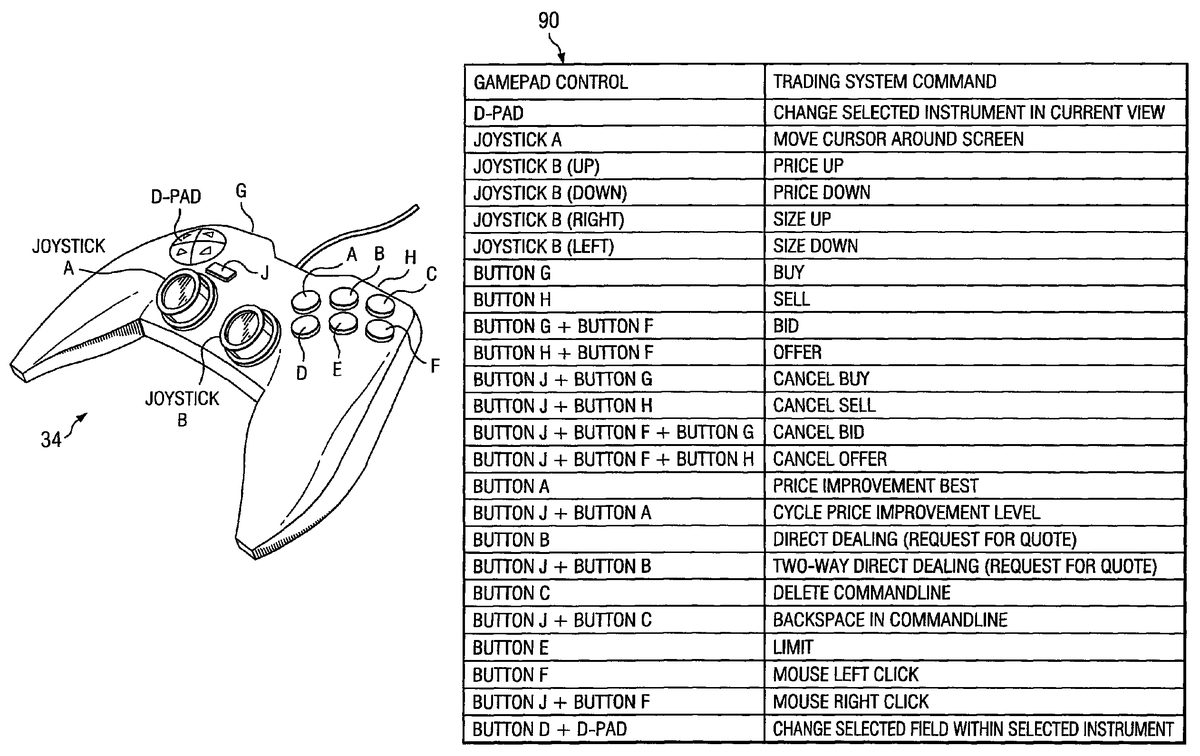
FIG. 2illustrates an example game controller device34for use in trading system10. Game controller device34is a gamepad that includes a D-pad, a pair of joysticks (Joystick A and Joystick B), and nine buttons (Button A through Button J).FIG. 3illustrates a table90that specifies example default controller signal relationships82for the game controller device34ofFIG. 2in accordance with one embodiment of the invention. As shown inFIG. 3, each controller signal relationship82is a relationship between the signal(s) produced by the manipulation of one or more gamepad controls and a trading system command.
FIG. 4illustrates an example method of a user22engaging in electronic trading via trading platform14using the game controller device34shown inFIG. 2and configured as described above according to an embodiment of the present invention. In this embodiment, the game controller device34is connected to a serial port68provided by a keyboard38at a user terminal12, which in turn is connected to a keyboard port58of the terminal body30of the user terminal12. Thus, game controller signals generated by game controller device34are routed to application50via keyboard38.
At step100, mapping module80of interface application50manages various sets of controller signal relationships82, keyboard relationships84, and mouse relationships86which map input signals with commands associated with trading activity within trading system10. The controller signal relationships82include the set of relationships shown inFIG. 3, which are the specific to the type and model of game controller device34. At step102, the appropriate set of controller signal relationships82for game controller device34are identified from mapping module80. This may involve any suitable steps or processes. For example, interface application50may automatically identify the type and/or model of game controller device34based on signals or messages received from game controller device34, such as a control message, for example. As another example, the user22may identify the type and/or model of game controller device34using a GUI displayed to the user22by interface application50, such as by selecting the appropriate type and/or model from a list of different game controller device types and/or models. In addition, if user22had previously reconfigured the controller signal relationships82for game controller device34, interface application50may identify the appropriate controller signal relationships82for user22and game controller device34. For example, interface application50may identify user22(such as from a user ID entered by user22, for example) and present to the user22a display listing one or more sets of controller signal relationships82that have been stored at mapping module80in association with user22. User22may then select from the list the desired set of controller signal relationships82.
At step104, user22initiates a game controller signal by moving the D-pad or joysticks and/or depressing one or more buttons of game controller device34. At step106, the game controller signal is communicated from game controller device34to application50via serial port68, keyboard38, and keyboard port58. At step108, interface application50determines the trading system command associated with the received game controller signal using the appropriate controller signal relationships82identified at step102, and acts accordingly. At step110, interface application50determines whether the determined trading system command is a control instruction to alter or manipulate the current display shown on display device32or a trading instruction to be communicated to trading platform14. If the trading system command is a control instruction, interface application50generates the control instruction at step112, which results in the appropriate change or manipulate the current display. For example, if the game controller signal was generated by user22moving Joystick A (which is associated with a “move cursor” command, as shown inFIG. 3), interface application50will cause the cursor to be moved around the screen.
Alternatively, if the trading system command is a trading instruction, interface application50generates and communicates the appropriate trading instruction to trading platform14at step114. The appropriate action is taken by trading platform14in response to the received trading instruction at step116. For example, if the game controller signal was generated by user22depressing both Button7and Button6(which is associated with a “bid” command, as shown inFIG. 3), interface application50will generate and communicate to trading platform14an instruction to place a particular bid for user22at step114, and trading platform14will receive the instruction and place the bid on trading platform14at step116. Steps104through116are repeated as user22continues to interact with interface application50using game controller device34in order to engage in trading activity with trading platform14.
At step118, trading platform14executes a trade between an buy order placed by user22and a sell order placed by another user22′ of system10. At step120, trading platform14generates and communicates to interface application50a signal indicating that the buy order was executed for user22. At step122, interface application50determines, using appropriate feedback signal relationships88, that the received signal is associated with a “rumble” controller feedback command. At step124, interface application50communicates the “rumble” command to game controller device34, which causes game controller device34to rumble, or vibrate.
FIG. 5illustrates an example method of configuring and reconfiguring the controller signal relationships82associated with a game controller device34according to one embodiment of the invention. At step150, interface application identifies that a game controller device34connected to terminal body30is not configured. At step152, configuration module81provides a controller configuration GUI on display device32that allows user22to configure, or generate, a set of controller signal relationships82for the unconfigured game controller device34. At step154, user22generates and communicates configuration instructions to configuration module81via the controller configuration GUI, such as by making selections using the game controller device34or another input device36, such as a keyboard38or mouse40. At step156, configuration module81generates controller signal relationships82, which are stored by mapping module80in association with the game controller device34and/or user22. At step158, user22engages in trading via trading platform14using the configured game controller device34.
At some subsequent time, user22wishes to reconfigure one or more of the controller signal relationships82for the game controller device34. At step160, user22submits a request to reconfigure controller signal relationships82for game controller device34. At step162, configuration module81provides a controller reconfiguration GUI on display device32that allows user22to reconfigure the existing set of controller signal relationships82for the game controller device34. The controller reconfiguration GUI may be similar or identical to the controller configuration GUI discussed above with reference to step152. At step164, user22generates and communicates reconfiguration instructions to configuration module81via the controller reconfiguration GUI, such as by making selections using the game controller device34or another input device36, such as a keyboard38or mouse40. At step166, configuration module81reconfigures, or changes, one or more controller signal relationships82, which changes are then stored by mapping module80. At step168, user22engages in trading via trading platform14using the reconfigured game controller device34.
Modifications, additions, or omissions may be made to the method without departing from the scope of the invention. Additionally, steps may be performed in any suitable order without departing from the scope of the invention.
Although an embodiment of the invention and its advantages are described in detail, a person skilled in the art could make various alterations, additions, and omissions without departing from the spirit and scope of the present invention as defined by the appended claims.
Claims
- A system for electronic trading, comprising: a memory having stored therein: a plurality of users associated with a game controller, the plurality of users comprising a first user and a second user;a first set of controller signal relationships associated in the memory with the game controller and the first user;and a second set of controller signal relationships different from the first set, the second set associated in the memory with the game controller and the second user;wherein each controller signal relationship associates one of a plurality of game controller signals with one of a plurality of transaction commands associated with electronic purchasing;and a processor communicatively coupled to the memory and operable to: determine that the first user is using the game controller;receive a particular game controller signal from the game controller;based on the acts of determining that the first user is using the game controller and the act of receiving a particular game controller signal from the game controller, access the first set of controller signal relationships;determine the transaction command associated with the particular game controller signal based at least in part on the first set of controller signal relationships;and communicate the determined transaction command, wherein a first joystick of the game controller is configured to move a cursor in a user interface, wherein a transaction can be entered at the user interface for entering transaction commands, and wherein a second joystick of the game controller is configured to input transaction commands in the user interface.
- The system of claim 1 , wherein the memory is further operable to store at least one set of keyboard signal relationships, each keyboard signal relationship associating one of a plurality of keyboard signals with one of the plurality of transaction commands, wherein the transaction commands comprise trading system commands associated with electronic trading of financial instruments.
- The system of claim 1 , further comprising an input port in communication with the processor, wherein the game controller is configured to interface with the input port such that any game controller signals produced by the game controller are communicated to the processor via the input port, wherein the input port is one of a USB type port and a serial port.
- The system of claim 1 , further comprising: a keyboard input port in communication with the processor;and a keyboard configured to interface with the keyboard input port such that any keyboard signals produced by the keyboard are communicated to the processor via the keyboard input port, the keyboard comprising a controller input port;and wherein the game controller is configured to interface with the controller input port of the keyboard such that any game controller signals produced by the game controller are communicated to the processor via the keyboard.
- The system of claim 4 , wherein the controller input port is one of a USB type port and a serial port.
- The system of claim 4 , wherein the memory is further operable to store at least one set of keyboard signal relationships, each keyboard signal relationship associating one of a plurality of keyboard signals produced by the keyboard with one of the plurality of transaction commands, wherein the transaction commands comprise trading system commands associated with electronic trading of financial instruments.
- The system of claim 1 , wherein the memory is further operable to store a plurality of feedback signal relationships, each feedback signal relationship associating a transacting platform signal with a controller feedback command;and wherein the processor is further operable to: receive a particular transacting platform signal from a transacting platform;determine the controller feedback command associated with the particular transacting platform signal using the plurality of feedback signal relationships;and communicate the determined controller feedback command toward the game controller.
- The system of claim 7 , wherein the determined controller feedback command comprises a command to vibrate the game controller.
- The system of claim 7 , wherein: the game controller comprises a light source that can be activated to generate light;and the determined controller feedback command is to activate the light source.
- The system of claim 7 , in which the act of receiving the particular transacting platform signal from the transacting platform comprises receiving an executed transaction signal indicating that a transaction has been executed;the act of determining the controller feedback command associated with the particular transacting platform signal comprises determining a command to vibrate the game controller;and the processor is further operable to cause the game controller to vibrate based on the act of receiving the executed transaction signal.
- The system of claim 1 , wherein the game controller generates game controller signals associated with transaction commands in response to each of: a depression of one button;a substantially simultaneous depression of a plurality of buttons;a movement of a joystick;a substantially simultaneous movement of a joystick and depression of one or more buttons;a movement of a D-pad;and a substantially simultaneous movement of a D-pad and depression of one or more buttons.
- The system of claim 1 , wherein the determined transaction command is a “Request for Quote” command.
- The system of claim 1 , wherein the determined transaction command is a command to cancel an order.
- The system of claim 1 , wherein the determined transaction command is a “Limit” command, wherein the transaction commands comprise trading system commands associated with electronic trading of financial instruments.
- The system of claim 1 , wherein the determined transaction command is one of a “Buy,” “Bid,” “Sell,” and “Offer” command, wherein the transaction commands comprise trading system commands associated with electronic trading of financial instruments.
- The system of claim 1 , wherein the determined transaction command is one of a “Size Up,” “Size Down,” “Price Up,” and “Price Down” command, wherein the transaction commands comprise trading system commands associated with electronic trading of financial instruments.
- The system of claim 1 , in which the game controller is a first type of game controller, in which the memory is further operable to store: a third set of controller signal relationships associated in the memory with the first user and a second type of game controller different from the first type of game controller.
- The system of claim 17 , in which the memory is further operable to store: a fourth set of controller signal relationships associated in the memory with the second user and the second type of game controller.
- The system of claim 1 , in which stored controller signal relationships associate at least a movement of the first joystick with cursor movement instructions, and wherein the first set of stored controller signal relationships associates at least a movement of the second joystick with a second trading command different from the cursor movement instructions, and at least an input of a d-pad with a third command different from the cursor movement instructions and second command.
- The system of claim 19 , in which: the first command comprises an instruction to move a cursor in a trading interface, the second command comprises an instruction to change at least one of a price and a quantity, and the third command comprises an instruction to change a selection.
- The system of claim 19 , in which the act of determining that the first user is using the game controller comprises: receiving identification indicia associated in the memory with the first user;authenticating the first user to use the game controller based on the identification indicia.
- A method for electronic trading, comprising: storing therein, by at least one processor in a memory, a plurality of users associated with a game controller, the plurality of users comprising a first user and a second user;storing therein, by the at least one processor in the memory, a first set of controller signal relationships associated in the memory with the game controller and the first user;and storing therein, by the at least one processor, a second set of controller signal relationships associated in the memory with the game controller and the second user, the second set being different from the first set;wherein at least one controller signal relationship associates one of a plurality of game controller signals with one of a plurality of transaction commands associated with electronic transacting;determining, by the at least one processor, that the first user is using the game controller;receiving, by the at least one processor, a particular game controller signal from the game controller;based on the acts of determining that the first user is using the game controller and the act of receiving a particular game controller signal from the game controller, accessing, by the at least one processor, the first stored set of controller signal relationships;determining, by the at least one processor, the transaction command associated with the particular game controller signal based at least in part on the first set of controller signal relationships;and communicating, by the at least one processor, the determined transaction command, wherein a first joystick of the game controller is configured to move a cursor in a user interface, wherein a transaction can be entered at the user interface for entering transaction commands, and wherein a second joystick of the game controller is configured to input transaction commands in the user interface.
- The method of claim 22 , further comprising: storing therein in the memory at least one set of keyboard signal relationships, each keyboard signal relationship associating one of a plurality of keyboard signals with one of the plurality of transaction commands;receiving a particular keyboard signal generated by a keyboard;determining the transaction command associated with the particular keyboard signal based on the at least one set of keyboard signal relationships;and communicating the determined transaction command.
- The method of claim 22 , further comprising: storing therein in the memory a plurality of feedback signal relationships, each feedback signal relationship associating a transacting platform signal with a controller feedback command;receiving a particular transacting platform signal associated with a transacting platform;determining the controller feedback command associated with the particular transacting platform signal based on the plurality of feedback signal relationships;and communicating the determined controller feedback command to the game controller, wherein the determined controller feedback command comprises a command to vibrate the particular game controller.
- The method of claim 22 , further comprising: providing to a user a controller configuration interface;receiving via the controller configuration interface one or more configuration instructions;and generating one or more of the plurality of sets of controller signal relationships based on the received configuration instructions.
- The method of claim 22 , further comprising: providing to a user a controller configuration interface;receiving via the controller configuration interface one or more reconfiguration instructions;and reconfiguring one or more of the plurality of sets of controller signal relationships based on the received reconfiguration instructions.
- A method for electronic trading, comprising: determining, by at least one processor, that a first user of a plurality of users is using a game controller;receiving, by at least one processor, a particular game controller signal from the game controller;based on the acts of determining that the first user is using the game controller and the act of receiving a particular game controller signal from the game controller, accessing a first of a plurality of stored sets of controller signal relationships, the first set of controller signal relationships being stored therein in a memory and associated in the memory with the first user, wherein: a first set of controller signal relationships is associated therein in the memory with a game controller and a first user;a second set of controller signal relationships is associated therein in the memory with the game controller and a second user;and at least one controller signal relationship associates therein in the memory one of a plurality of game controller signals with one of a plurality of transaction commands associated with electronic trading of financial instruments;determining, by the at least one processor, the transaction command associated with the particular game controller signal based at least in part on the at least one determined set of controller signal relationships;and communicating, by the at least one processor, the determined transaction command, wherein a first joystick of the game controller is configured to move a cursor in a user interface, wherein a transaction can be entered at the user interface for entering transaction commands, and wherein a second joystick of the game controller is configured to input transaction commands in the user interface.
- The method of claim 27 , further comprising: storing at least one set of keyboard signal relationships, each keyboard signal relationship associating one of a plurality of keyboard signals with one of the plurality of transaction commands;receiving a particular keyboard signal generated by a keyboard;determining the transaction command associated with the particular keyboard signal based on the at least one set of keyboard signal relationships;and communicating the determined transaction command, wherein the transaction commands comprise trading system commands associated with electronic trading of financial instruments.
- The method of claim 27 , further comprising: storing one or more feedback signal relationships, each feedback signal relationship associating a transacting platform signal with a controller feedback command;receiving a particular transacting platform signal associated with a transacting platform;determining the controller feedback command associated with the particular transacting platform signal using the one or more feedback signal relationships;and communicating the determined controller feedback command toward the game controller.
- The method of claim 29 , wherein the determined controller feedback command comprises a command to vibrate the particular game controller.
- The method of claim 27 , further comprising: providing to a user a controller configuration interface;receiving via the controller configuration interface one or more configuration instructions;and generating one or more of the plurality of sets of controller signal relationships based on the received configuration instructions.
- The method of claim 27 , further comprising: providing to a user a controller configuration interface;receiving via the controller configuration interface one or more reconfiguration instructions;and reconfiguring one or more of the plurality of sets of controller signal relationships based on the received reconfiguration instructions.
Disclaimer: Data collected from the USPTO and may be malformed, incomplete, and/or otherwise inaccurate.