U.S. Pat. No. 8,814,704
GAME SERVER THAT ALLOWS ONLINE GAME USER TO DESIGNATE PROXY TO EXERCISE AN AREA LIMITED ACQUISITION RIGHT, GAME CONTROLLING METHOD THEREOF, GAME SYSTEM, AND NON-TRANSITORY COMPUTER-READABLE MEDIUM
Assigneegloops, Inc.
Issue DateSeptember 25, 2013
Illustrative Figure
Abstract
A game server includes an acquisition right-granting section that grants an acquisition right for acquiring an item in a virtual space to a first virtual user, a proxy right-generating section that generates a proxy right to allow a second virtual user to exercise the acquisition right as a proxy, a proxy right-granting section that grants only the proxy right to the second virtual user, a positional information acquisition section that acquires a position of a second physical user's terminal, a proxy right-exercising section that exercises the proxy right by the second virtual user, an area-limited item-storing section that stores an area-limited item in association with a position in the physical space, an item information reading/loading section that reads/loads an area-limited item from the area-limited item storing section, and an item-providing section that provides only the first virtual user with the area-limited item read/loaded by the item information reading/loading section.
Description
DETAILED DESCRIPTION OF EMBODIMENTS Further features of the present disclosure will become apparent from the following detailed description of exemplary embodiments with reference to the accompanying drawings. As shown inFIG. 1, a game system G of the present embodiment is a computer network system comprising: a game server1; an Internet2; and terminals3a,3b,3c, . . . ,3n(hereinafter collectively referred to as the “terminal3”). The game server1is a computer (server computer) that provides various services relating to a social game embodied by the game system G, and the terminal3is a computer (client computer) that receives the services. (1) Definitions of Terms The definitions of terms used in the present embodiment are as follows. “Virtual space” means a virtual world that is created when the game server1executes a program stored on a non-transitory computer-readable medium for embodying the game system G. “Physical user” is an entity who operates the terminal3—in other words, a human living in the actual world. “Virtual user” is an object existing in a virtual space instead of the physical user and acts according to an instruction via the terminal3of the physical user. “Virtual user” may be a visual object—in other words, an object appearing as one image of a game character (monster, human, animal, etc.) in an image representing a virtual space. Also, “virtual user” may be a non-visual object that is not visually recognizable when existing as an entity acting in a virtual space. “Card” is one type of item (item object) existing in a virtual space. A card is supplied to a virtual user as an image representing a trading card of a game character. The card is displayed at the terminal3of the physical user who controls the virtual user having acquired the card. “Gacha right” is a right of a virtual user to request that the ...
DETAILED DESCRIPTION OF EMBODIMENTS
Further features of the present disclosure will become apparent from the following detailed description of exemplary embodiments with reference to the accompanying drawings.
As shown inFIG. 1, a game system G of the present embodiment is a computer network system comprising: a game server1; an Internet2; and terminals3a,3b,3c, . . . ,3n(hereinafter collectively referred to as the “terminal3”). The game server1is a computer (server computer) that provides various services relating to a social game embodied by the game system G, and the terminal3is a computer (client computer) that receives the services.
(1) Definitions of Terms
The definitions of terms used in the present embodiment are as follows.
“Virtual space” means a virtual world that is created when the game server1executes a program stored on a non-transitory computer-readable medium for embodying the game system G.
“Physical user” is an entity who operates the terminal3—in other words, a human living in the actual world.
“Virtual user” is an object existing in a virtual space instead of the physical user and acts according to an instruction via the terminal3of the physical user. “Virtual user” may be a visual object—in other words, an object appearing as one image of a game character (monster, human, animal, etc.) in an image representing a virtual space. Also, “virtual user” may be a non-visual object that is not visually recognizable when existing as an entity acting in a virtual space.
“Card” is one type of item (item object) existing in a virtual space. A card is supplied to a virtual user as an image representing a trading card of a game character. The card is displayed at the terminal3of the physical user who controls the virtual user having acquired the card.
“Gacha right” is a right of a virtual user to request that the system, which embodies a gacha part in the game, provide a card in order to acquire the card. Only the virtual user that first acquires the right is entitled to exercise the gacha right. There are three types of gacha rights: area-limited, time-limited, and non-limited (ordinary).
“Area-limited gacha right” is a gacha right to obtain an area-limited card according to the area of the globe where the terminal3, which is operated by a physical user of a virtual user having acquired the gacha right, exists.
“Time-limited gacha right” is a gacha right to acquire a card limited to the time period when the gacha right is exercised. Examples of the “time periods” of a day are morning, afternoon, and night, and examples of the “time periods” of a year are spring, summer, fall, and winter.
“Ordinary gacha right” is a gacha right unlike the aforementioned area-limited gacha right and time-limited gacha right. This right can be exercised to acquire a card without regard to any limitations such as area or time period.
“Proxy gacha right” is a gacha right which allows a virtual user (second virtual user) other than the virtual user that holds a gacha right (first virtual user) to exercise the gacha right as a proxy.
(2) Outline of Social Game
A social game of the present embodiment will be explained in reference toFIG. 2.
In a social game of the present embodiment, a physical user operates the terminal3to control a virtual user in a virtual space to create a set of a predetermined number of cards (hereinafter referred to as a card deck) that are selected from among cards of a hundred or more game characters (hereinafter referred to as a character). More specifically, the user strengthens and collects the cards by executing a battle against an enemy character appearing in the virtual space using the cards or by trading the cards with other virtual users, while upgrading a level and selecting an attribute of the card in the card deck. In a battle using the cards, damage to enemies and results of the battle are determined based on the level of offensive and defensive powers of each card constituting the card deck, a skill (corresponding to a “meld” as used in a card game or mahjong) with which a certain effect can be obtained by a predetermined combination of cards, and so on.
The social game is established as a whole with a plurality of parts being combined organically to constitute a game with a unique view of world and story. As shown inFIG. 2, a social game20of the present embodiment includes a quest part21, a combination part22, a battle part23, a gacha-part24and a trade part25, each part serving as a game element.
As represented by the term “quest”, the quest part21is a part constituting a game that progresses as a virtual user quests in a virtual space, battles against an enemy character that appears during the quest, and improves the level of the virtual user. In the quest part21, the virtual user is given predetermined quest points, and a movement of the virtual user and an improvement of the level are accomplished by consuming the quest points. In the quest part21, by consuming a battle point and using the cards in possession of the virtual user, a battle against an enemy character that has appeared is executed. A virtual user having defeated an enemy character is given items and quest points based on the level or type of the enemy character. The items include a card and a gacha right.
The combination part22is a part in which cards possessed by the virtual user are combined to increase the strength of the cards, so as to increase an offensive power for damaging an enemy character or the virtual user of an opponent (enemy object) or a defensive power for defending from an enemy object during a battle.
The battle part23is a part in which the cards possessed by the virtual user are used to launch a battle against another virtual user. A win or a loss is determined based on the offensive power and the defensive power of each of the cards described above.
The gacha part24is a part by which a virtual user exercises a gacha right. Gacha rights include those acquired by the quest part21and those obtained through a purchase. A virtual user can acquire at least one card every time the user exercises a gacha right. The occurrence rate of a card, in other words, a probability of acquiring a certain card by exercising a gacha right, is set differently for each card. By exercising a gacha right, a virtual user acquires a card randomly based on the occurrence rate thereof.
The trade part25is a part through which the virtual user exchanges the cards in its own possession with another virtual user. Each virtual user adds profitable cards obtained by using the trade part25into a card deck to strengthen the offensive power for damaging an enemy object or the defensive power for defending from an enemy object that is attacking during the battle.
The social game20including the plurality of parts described above is not independent from other game parts, and, as described above, each part is associated or combined with each other to become meaningful as an entire game. Therefore, with the social game20, a single game can be progressed as an entirety with the virtual user causing each game part to progress effectively.
(3) Basic Hardware Configuration
(3-1) Configuration of Terminal
Hereinafter, a hardware configuration for embodying a game system G will be described.
As shown inFIG. 1, the terminal3, which is a portable terminal with a web-browsing feature, comprises a wireless communication section31, a display section32, and an operation input section33. A specific example of the terminal3is smartphones that have rapidly spread all over the world in recent years.
Via the wireless communication section31, the terminal3is connected to the Internet2over a mobile telephone line or a wireless LAN circuit and communicates with the game server1by using the web browsing feature. The display section32uses this feature to display a game screen of images received from the game server1. The operation input section33comprises a touch panel disposed on the front surface of the display section32. Various operations can be performed by tapping the input entry area on the front surface of the display section32where the game screen is displayed.
The game server1performs an authentication process of the terminal3using a combination of a user ID and password registered in an unillustrated user management section. Upon completion of the authentication process, the game server1transmits, to the terminal3, image data of a game image and other types of data necessary for progression of a game and enables reception of operations via the terminal3.
The terminal3may be a mobile telephone or a personal computer as long as it is a communication device with a web-browsing feature. A touch panel is described as an example of the operation input section33, but operation input section33may be of a configuration in which various operations can be performed for playing the game by buttons and keys.
(3-2) General Configuration of Game Server
The game server1is embodied as a computer having a general-purpose hardware configuration as shown inFIG. 3. That is to say, as shown inFIG. 3, the game server1includes a communication interface section11that establishes communications with the terminal3via the Internet2, and an operation input unit12that accepts an operation input from a general input device, such as a keyboard or a mouse. Further, the game server1is provided with an arithmetic processing section13such as a CPU (central processing unit) that executes various arithmetic processing, a main memory14such as an SRAM or a DRAM that temporarily stores arithmetic processing data, a storage unit15such as a hard disk in which a non-transitory computer-readable medium and various data are stored, and a display16that displays an outcome of the arithmetic process.
In the game server1, by installing a program for offering the social game20to a user in the storage unit15and executing the program using the arithmetic processing section13, functional blocks as shown inFIG. 4are embodied. That is to say, the game server1acts as a game data processing section100that is comprised of a quest part processing section101, a combination part processing section102, a battle part processing section103, a gacha part processing section104, and a trade part processing section105. Also, the game server1acts as a game data storing section200that stores various types of data required for the social game20.
Here, the quest part processing section101is a functional block that executes data processing for embodying the quest part21. The combination part processing section102is a functional block that executes data processing for embodying the combination part22. The battle part processing section103is a functional block that executes data processing for embodying the battle part23. The gacha part processing section104is a functional block that executes data processing for embodying the gacha part24. The trade part processing section105is a functional block that executes data processing for embodying the trade part25.
(4-1) First Embodiment of Gacha Part24
Of the parts of the social game20, an embodiment for embodying the gacha part24will be explained in reference toFIG. 5. Hereinafter, the terminal3ais a terminal of a first physical user, and the terminal3bis a terminal of a second physical user. In this embodiment, examples of an area-limited gacha right and an ordinary gacha right that are granted to a virtual user will be explained.
(4-1-1) Configuration of Gacha Part Processing Section
The gacha part processing section104comprises a gacha right granting section (acquisition right granting section)111, a gacha right exercising section (acquisition right exercising section)112, a proxy gacha right generating section (proxy right generating section)113, a proxy gacha right granting section (proxy right granting section)114, a positional information acquisition section115, a proxy gacha right exercising section (proxy right exercising section)116, an area-limited card reading and loading section (item reading and loading section)117, an ordinary card reading and loading section118, and a card providing section (item providing section)119.
The game data storing section200comprises a card information storing section122and a holder information storing section123. The card information storing section122comprises an area-limited card storing section122A and an ordinary card storing section122B. The holder information storing section123comprises a gacha right holder storing section123A, a card holder storing section123B, and a proxy gacha right information storing section123C.
By using the web browsing feature of terminal3, the card information storing section122stores image data of various types of cards that can be displayed on a screen as part of a game. The area-limited card storing section122A stores image data of area-limited cards, and the ordinary card storing section122B stores image data of ordinary cards. The card information storing section122stores and manages image data of all cards in association with information for identifying each individual card (hereinafter referred to as “card identification information”) (seeFIG. 18).
The gacha right holder storing section123A is a functional block that stores the ID of a gacha right (gacha right ID) and the gacha right holder (first virtual user) in such a manner that the ID and the holder correspond to each other (seeFIG. 19A).
The card holder storing section123B is a functional block that stores the holder of a gacha right (first virtual user) and the card identification information in such a manner that the holder and the information correspond to each other (seeFIG. 19B).
The proxy gacha right information storing section123C is a functional block that stores the holder of a proxy gacha right (second virtual user), the ID of the proxy gacha right (proxy gacha right ID), and the gacha right ID are related to each other (seeFIG. 19C).
In the example ofFIG. 7, the URI (Uniform Resource Identifier) of the card is used among the card identification information, and the ID of the terminal3(terminal ID) for controlling the virtual user is used as information to identify a virtual user.
The gacha right granting section111is a functional block that performs processing for granting an area-limited or ordinary gacha right to the first virtual user.
The gacha right exercising section112is a functional block that performs processing for the first virtual user to exercise the gacha right in response to the operation of the terminal3aof the first physical user.
The proxy gacha right generating section113is a functional block that generates a proxy gacha right in response to a request via the terminal3aof the first physical user. The proxy gacha right generating section113comprises a proxy user displaying and showing section113A, a proxy user selecting section113B, and a proxy user section113C.
The proxy user displaying and showing section113A is a functional block that performs processing for displaying and showing, to the first virtual user, at least one virtual user that can be a virtual user that may exercise the proxy gacha right—in other words, the second virtual user. Specifically, on a game screen displayed at the terminal3aused for operating the first virtual user, the proxy user displaying and showing section113A displays images of candidates of virtual users that can be a second virtual user.FIG. 16shows an example proxy user selection screen. In this example, on a proxy user selection screen41, which is displayed as a game screen, pairs of an avatar as a candidate image42and a screen name of a candidate are listed. For instance, as a candidate of the second virtual user, a virtual user registered as a friend of the first virtual user in the social game is selected.
The proxy user selecting section113B is a functional block that performs processing for the first virtual user to select one virtual user from among at least one virtual user (at least one second virtual user candidate) displayed and shown by the proxy user displaying and showing section113A. Specifically, the proxy user selecting section113B performs processing for displaying and showing, on the game screen displayed at the terminal3aoperated by the first virtual user, an image of a select button for selecting a virtual user as a second virtual user. Also, the proxy user selecting section113B performs processing for enabling acceptance of an instruction via the select button. In the example ofFIG. 16, the select buttons43, the candidate images42, each of which represents an avatar, and screen names of candidates are displayed. The screen names are displayed on the right side of the candidate images42. The select buttons43, on each of which the word “Select” is indicated, are displayed on the right side of the screen names of the candidates.
The proxy user designating section113C is a functional block that performs processing for designating, as the second virtual user, the virtual user selected by the proxy user selecting section113B. Specifically, the proxy user designating section113C performs processing to store information on game data storing section200. The information is stored so that connections can be formed between pieces of data. The information is: the information which can identify the selected virtual user as the virtual user that may exercise the proxy gacha right (second virtual user) (e.g., the terminal ID of the terminal3bused to control the second virtual user); the proxy gacha right; and the gacha right which is exercised on a proxy basis by the exercise of the proxy gacha right.
The proxy gacha right granting section114is a functional block that performs processing for granting a proxy gacha right, which is generated by the proxy gacha right generating section113, to the virtual user designated as the second virtual user by the proxy user designating section113C. Specifically, the proxy gacha right granting section114performs processing for displaying an image of a select button44(seeFIG. 17) on the game screen displayed at the terminal3bof the second physical user in order to instruct exercise of the proxy gacha right. Also, the proxy gacha right granting section114performs processing for enabling acceptance of an instruction via the select button44.
The positional information acquisition section115is a functional block that performs processing for acquiring the position of the terminal3bof the second physical user. A method of acquiring the position of the terminal3bis not limited to any specific method. Examples of the method include a method of using positional information acquired by the GPS function equipped within the terminal3b, a method of using positional information on the base station (e.g., latitude and longitude) from which the terminal3breceives radio waves, and a method of using positional information that can be acquired from the IP address of the terminal3b.
The proxy gacha right exercising section116is a functional block that performs processing for the second virtual user to exercise the proxy gacha right when the position acquired by the positional information acquisition section115is in a specific area of physical space.
The area-limited card reading and loading section117is a functional block that performs processing for reading and loading an area-limited card from the area-limited card storing section122A based on the gacha right for which the proxy gacha right has been exercised by the second virtual user. In this context, “reading and loading an area-limited card” means, based on the occurrence rate set to each card, randomly extracting card identification information on one card, which corresponds to the position acquired by the positional information acquisition section115, from the card identification information on a plurality of cards stored in the area-limited card storing section122A. The “card identification information” is information that can be used for specifying a card or a location of the image data thereof such as the ID (Identification), file name, and URI of the card etc.
The ordinary card reading and loading section118is a functional block that performs processing for reading and loading an ordinary card from the ordinary card storing section122B based on the gacha right exercised by the first virtual user oneself. In this context, “reading and loading an ordinary card” means, based on the occurrence rate set to each card, randomly extracting the card identification information on one card from the card identification information on a plurality of cards stored in the ordinary card storing section122B.
The card providing section119comprises an area-limited card providing section119A and an ordinary card providing section119B.
The area-limited card providing section119A is a functional block that performs processing for providing the first virtual user with the area-limited card read and loaded by the area-limited card reading and loading section117based on the gacha right for which the proxy gacha right has been exercised by the proxy gacha right exercising section116.
The ordinary card providing section119B is a functional block that performs processing for providing the first virtual user with the ordinary card read and loaded by the ordinary card reading and loading section118based on the gacha right exercised by the gacha right exercising section112.
(4-2) Action of Gacha Part Processing Section
The action of the gacha part processing section104, whose configuration is described above, will be explained below in reference to the flowcharts shown inFIGS. 6 to 15.
(4-2-1) Gacha Part Processing
FIG. 6is a flowchart showing an example process (gacha part processing) of the gacha part processing section104. In gacha part processing, gacha right granting step S1and gacha execution step S2are performed in sequence.
Gacha right granting step S1is a step of performing processing for granting an area-limited or ordinary gacha right to the first virtual user. In step S1, the gacha right holder storing section123A stores the gacha right ID of the area-limited or ordinary gacha right and the terminal ID of the terminal3aused to control the first virtual user that has acquired the aforementioned gacha right so that aforementioned IDs correspond to each other (seeFIG. 19A). On the game screen displayed at the terminal3aof the first physical user, processing for displaying images of the select buttons45(seeFIGS. 20A and 20B) is performed for instructing exercise of the gacha right. Also, processing is performed for enabling of acceptance of an instruction via the select button45.
Gacha executing step S2is a step of performing processing for providing an area-limited or ordinary card, which is a card based on the gacha right, to the first virtual user having acquired the area-limited or ordinary gacha right.
(4-2-2) Gacha Execution Processing
FIG. 7is a flowchart showing an example process of gacha executing step S2.
Gacha executing step S2comprises gacha right determining step S110, ordinary gacha step S120, and area-limited gacha step S130.
Gacha right determining step S110is a step of performing processing for determining whether the gacha right granted to the first virtual user is area-limited or ordinary. Upon determination that the gacha right is ordinary (S110: No), the process proceeds to ordinary gacha step S120. When the gacha right is area-limited (S110: Yes), the process proceeds to area-limited gacha step S130.
(4-2-3) Ordinary Gacha Processing
FIG. 8is a flowchart showing an example process of ordinary gacha step S120.
Ordinary gacha step S120comprises gacha right exercise request determining step S121and ordinary gacha right exercising step S122.
Gacha right exercise request determining step S121is a step of performing processing for determining whether exercise of the gacha right has been requested via the terminal3aof the first physical user. Upon determination that exercise of the gacha right has been requested (S121: Yes), the process proceeds to ordinary gacha right exercising step S122.
FIG. 9is a flowchart showing an example process of ordinary gacha right exercising step S122.
Ordinary gacha right exercising step S122comprises ordinary card reading and loading step S131and ordinary card providing step132. Ordinary card reading and loading step S131is a step of performing processing for reading and loading an ordinary card from the ordinary card storing section122B based on the gacha right whose exercise has been requested. Ordinary card providing step S132is a step of performing processing for providing the read and loaded ordinary card to the first virtual user having requested exercise of the gacha right.
When ordinary gacha right exercising step S122is performed, the terminal ID of the terminal through which exercise of the ordinary gacha right is requested and the URI of the ordinary card read and loaded by exercise of the aforesaid gacha right are stored in the card holder storing section123B in such a manner that the terminal ID and the URI are associated with each other (seeFIG. 19B). Based on the information stored in the card holder storing section123B, the HTML data of a game image containing the URI is transmitted to the terminal3aof the first physical user identified by the terminal ID.
Upon completion of the foregoing process, the first virtual user having acquired the ordinary gacha right is registered as the holder of the ordinary card based on the ordinary gacha right. At the same time, the game image (seeFIG. 21) containing an image of the ordinary card can be displayed on the terminal3aof the first physical user.
(4-2-4) Area-Limited Gacha Processing
FIG. 10is a flowchart showing an example process of area-limited gacha step S130.
Area-limited gacha step S130comprises area-limited gacha right exercise request determining step S141, positional information acquisition step S142, terminal position determining step S143, area-limited gacha right exercising step S144, and proxy gacha step S145.
Area-limited gacha right exercise request determining step S141is a step in which processing for determining whether exercise of the gacha right has been requested via the terminal3aof the first physical user is performed. Upon determination that exercise of the gacha right has not been requested (S141: No), step S141is repeated. When exercise of the gacha right has been requested (S141: Yes), positional information acquisition step S142and terminal position determining step S143are performed in sequence.
In positional information acquisition step S142, processing is performed for acquiring the position of the terminal3aof the first physical user.
In terminal position determining step S143, processing is performed for determining whether the position acquired in positional information acquiring step S142is in the area in which the area-limited gacha right can be exercised. Upon determination that the position of the terminal3ais in the aforementioned area (S143: Yes), the process proceeds to area-limited gacha right exercising step S144.
FIG. 11is a flowchart showing an example process of area-limited gacha right exercising step S144.
Area-limited gacha right exercising step S144is a step for performing processing for the first virtual user having acquired the area-limited gacha right to exercise its own gacha right. In area-limited gacha right exercising step S144, area-limited card reading and loading step S151and area-limited card providing step S152are performed in sequence. Area-limited card reading and loading step S151is a step for performing processing for reading and loading an area-limited card from the area-limited card storing section122A based on the gacha right whose exercise has been requested. In area-limited card providing step S152, the read and loaded area-limited card is provided to the first virtual user having requested exercise of the gacha right.
When area-limited gacha right exercising step S144is performed, the terminal ID of the terminal through which exercise of the area-limited gacha right is requested and the URI of the area-limited card read and loaded by exercise of the aforesaid gacha right are stored in the card holder storing section123B in such a manner that the terminal ID and the URI are associated with each other (seeFIG. 19B). Based on the information stored in the card holder storing section123B, the HTML data of a game image containing the URI is transmitted to the terminal3aof the first physical user identified by the terminal ID.
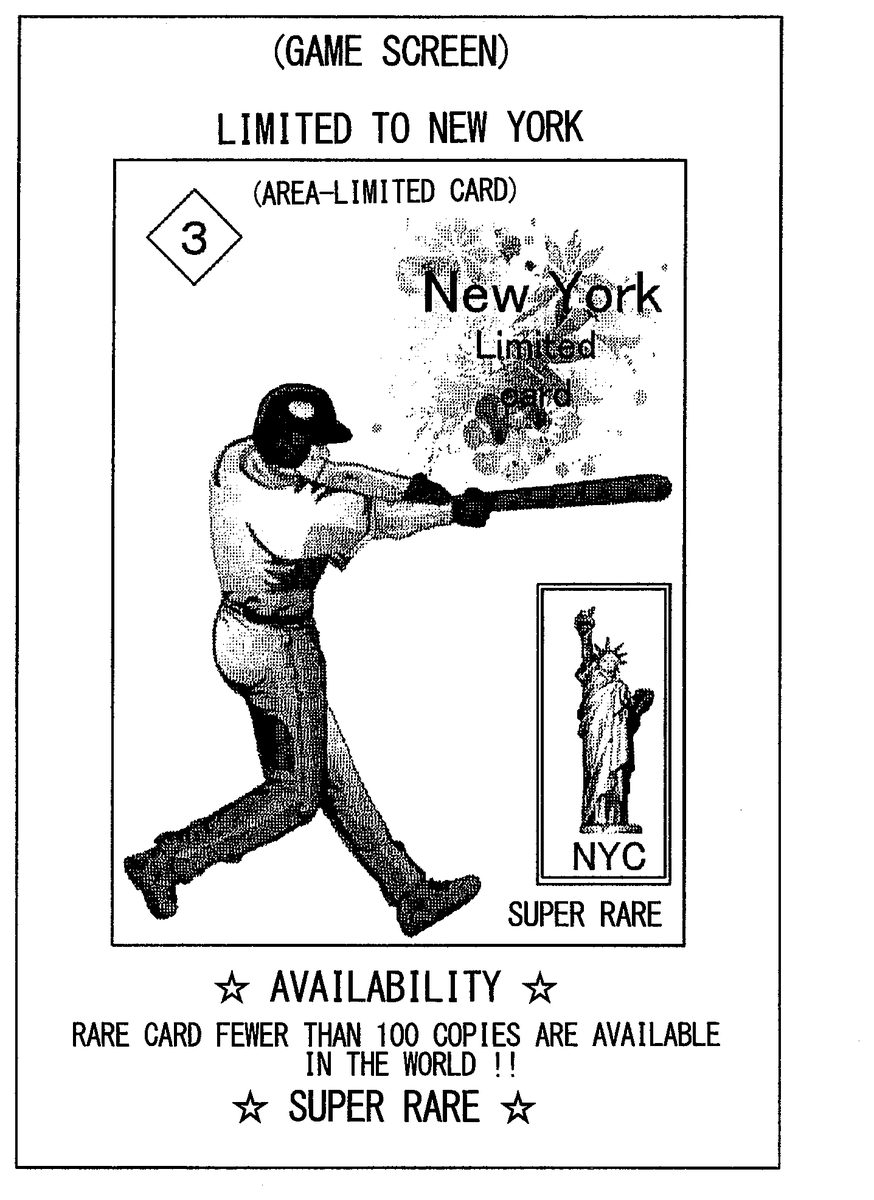
Upon completion of the foregoing process, the first virtual user having acquired the area-limited gacha right is registered as the holder of the ordinary card based on the area-limited gacha right. At the same time, the game image (seeFIG. 22) containing an image of the aforementioned area-limited card can be displayed at the terminal3aof the first physical user.
When the position of the terminal3ais not in the aforementioned area (S143: No), the process proceeds to proxy gacha step S145.
FIG. 12is a flowchart showing an example process of proxy gacha step S145. In proxy gacha step S145, proxy gacha right generating step S161, proxy gacha right granting step S162, and proxy gacha right exercising step S163are performed in sequence.
FIG. 13is a flowchart showing an example process of proxy gacha right generating step S161.
In proxy gacha right generating step S161, proxy user displaying and showing step S171, proxy user selecting step S172, and proxy user designating step S173are performed in sequence.
Proxy user displaying and showing step S171is a step of performing processing for displaying and showing, to the first virtual user, a virtual user that may exercise the proxy gacha right—in other words, at least one virtual user that can be the second virtual user. In step S171, the proxy user selection screen41, which contains images42of candidates selected from among the virtual users registered by the first virtual user as friends in the social game, is displayed at the terminal3aof the first physical user (seeFIG. 16).
Proxy user selecting step S172is a step of performing processing for the first virtual user to select one virtual user from among at least one virtual user (second virtual user candidate) displayed and shown in proxy user displaying and showing step S171. In step S172, the first physical user may select a virtual user to be designated as the second virtual user by operating the select button43displayed on the proxy user selection screen41(seeFIG. 16).
Proxy user designating step S173is a step of performing processing for designating, as the second virtual user, the virtual user selected in proxy user selecting step S172. In step S173, the virtual user selected by the first physical user is designated as the second virtual user. The terminal ID of the terminal3b, which is used to control the second virtual user, the ID of the proxy gacha right (proxy gacha right ID), and the ID of the gacha right (gacha right ID) that is exercised on a proxy basis by exercise of the proxy gacha right are stored in the proxy gacha right information storing section123C in such a manner that the three IDs are associated with each other (seeFIG. 19C).
In step S171and S173, the first physical user can select, from among the virtual users that are registered as its friends in the social game, one virtual user deemed to be the most appropriate for having the proxy gacha right granted. By designating the selected virtual user as the second virtual user, the proxy gacha right can be generated for the second virtual user to exercise, as a proxy, the gacha right acquired by the first virtual user.
Proxy gacha right granting step S162is a step of performing processing for granting the proxy gacha right to the virtual user designated as the second virtual user based on the information stored in the proxy gacha right information storing section123C. In step S162, the image of the select button44(seeFIG. 17), which is used for instructing exercise of the proxy gacha right, appears on the game screen displayed at the terminal3bof the second physical user. Also, processing is performed for enabling acceptance of an instruction via the select button44.
FIG. 14is a flowchart showing an example process of proxy gacha right exercising step S163.
Proxy gacha right exercising step S163is a step of performing processing for the second physical user to operate the terminal3bto exercise the proxy gacha right. In proxy gacha right exercising step S163, proxy gacha right exercise request determining step S181, positional information acquisition step S182, area determining step S183, and proxy gacha executing step S184are performed.
Proxy gacha right exercise request determining step S181is a step wherein processing for determining whether exercise of the proxy gacha right has been requested via the terminal3bof the second physical user is performed. Upon determination that exercise of the proxy gacha right has not been requested (S181: No), step S181is repeated. When exercise of the proxy gacha right has been requested (S181: Yes), positional information acquisition step S182and area determining step S183are performed in sequence.
In positional information acquisition step S182, processing is performed for acquiring the position of the terminal3bof the second physical user.
In area determining step S183, processing is performed for determining whether the position acquired in positional information acquisition step S182is in the area where the area-limited gacha right can be exercised. Upon determination that the position of the terminal3bis in the area (S183: Yes), the process proceeds to proxy gacha executing step S184. When the position of the terminal3bis not in the aforementioned area (S183: No), the process returns to positional information acquisition step S182.
FIG. 15is a flowchart showing an example process of proxy gacha executing step S184.
Proxy gacha executing step S184comprises area-limited card reading and loading step S191and area-limited card providing step S192.
Area-limited card reading and loading step S191is a step for performing processing for reading and loading an area-limited card from the area-limited card storing section122A based on the area-limited gacha right for which the proxy gacha right has been exercised. Area-limited card providing step S192is a step of performing processing for providing the read and loaded area-limited card to the first virtual user registered as the holder of the area-limited gacha right for which the proxy gacha right has been exercised.
When proxy gacha executing step S184is performed, the terminal ID of the terminal through which exercise of the area-limited gacha right is requested and the URI of the area-limited card read and loaded by exercise of the aforesaid area-limited gacha right are stored in the card holder storing section123B in such a manner that the terminal ID and the URI are associated with each other (seeFIG. 19B). Based on the information stored in the card holder storing section123B, the HTML data of a game image containing the URI is transmitted to the terminal3aof the first physical user identified by the terminal ID.
Upon completion of the foregoing process, the first virtual user having acquired the area-limited gacha right is registered as the holder of the area-limited card based on the area-limited gacha right. The game image (seeFIG. 22) containing an image of the aforementioned area-limited card can be displayed at the terminal3aof the first physical user.
(4-3) Effect of First Embodiment
In the game server1and game system G configured as described above, the proxy gacha right, whereby the area-limited gacha right granted to the first virtual user may be exercised on a proxy basis, is granted to the second virtual user. When the terminal3bof the second physical user is in a specific area and the proxy gacha right is exercised by the second virtual user, the area-limited gacha right is exercised on a proxy basis. An area-limited card that has been made acquirable by exercise of the area-limited gacha right on a proxy basis is not provided to the second virtual user having exercised the proxy right. Instead, the card is provided to the first virtual user that is the holder of the area-limited gacha right.
It can be difficult for the first physical user to visit a specific area where an area-limited card can be acquired and control the first virtual user via the terminal3athereof to exercise the acquisition right for acquiring the area-limited card. Even in the foregoing situation, by have the second virtual user exercise the proxy gacha right, the first physical user may indirectly exercise the area-limited gacha right to acquire the area-limited card.
As described above, instead of the virtual user (first virtual user) having acquired the area-limited gacha right, the area-limited gacha right can be exercised on a proxy basis by another virtual user (second virtual user). This proxy right creates a new relationship between the virtual user (first virtual user) having acquired the area-limited gacha right and the virtual user (second virtual user) that may exercise the aforesaid right as a proxy in a social game. Therefore, this novel relationship stimulates an interest in social games. For example, the present disclosure can be applied to a social game which provides a card of a professional athlete of an area-based team belonging to MLB (Major League Baseball), NFL (National Football League), NBA (National Basketball Association), or the like. By this application of the present disclosure, the card of a professional athlete is provided as an area-limited card in each of the areas where the teams are located. As a result, communications can increase between a user in the abovementioned area and a user who is unable to visit the area, but wishes to acquire the area-limited card.
(5-1) Second Embodiment of Gacha Part24
FIG. 23shows a second embodiment for embodying the gacha part24. In this embodiment, examples of granting the time-limited gacha right and the ordinary gacha right to a virtual user will be explained.
(5-1-1) Configuration of Gacha Part Processing Section
FIG. 23shows constituent elements of the gacha part processing section104and the game data storing section200. InFIG. 23, the positional information acquisition section115, the area-limited card reading and loading section117, the card providing section119A, and the area-limited card storing section122A ofFIG. 5are replaced, respectively, by a time detecting section131, a time-limited card reading and loading section132, a time-limited card providing section119C, and a time-limited card storing section122C.
Hereinbelow, the constituent elements ofFIG. 23that are common with those ofFIG. 5will not be explained, and only the functional blocks that are unique to the second embodiment will be explained.
The time detecting section131is a functional block that detects the current time. Specifically, the time detecting section131is embodied by an electronic time circuit in the arithmetic processing section13of the game server1.
The proxy acquisition right exercising section116is a functional block that performs processing for exercising the proxy gacha right by the second virtual user when the time detected by the time detecting section131is within a specific time period.
The time-limited card reading and loading section132is a functional block that performs processing for reading and loading a time-limited card from the time-limited card storing section122C based on the gacha right for which the proxy gacha right has been exercised by the second virtual user. In this context, “reading and loading a time-limited card” means, based on the occurrence rate set to each card, randomly extracting the card identification information on one card, which corresponds to the time period of the time detected by the time detecting section131, from the card identification information on a plurality of cards stored in the time-limited card storing section122C.
The time-limited card providing section119C is a functional block that performs processing for providing the first virtual user with a time-limited card read and loaded by the time-limited card reading and loading section132based on the gacha right for which the proxy gacha right has been exercised by the proxy acquisition right exercising section116.
The time-limited card storing section122C stores image data of a time-limited card.
(5-2) Action of Gacha Part Processing Section
Hereinbelow, the action of the gacha part processing section104of the second embodiment will be explained.
Of the flowcharts used in the explanation of the action in the first embodiment, those ofFIGS. 6,8,9,12, and13will be used again for the explanation below. The flowcharts ofFIGS. 24 to 29, which are not referred to above, will be used therefor as well.
(5-2-1) Gacha Part Processing
In the gacha part processing ofFIG. 6, gacha right granting step S1and gacha executing step S2are performed in sequence.
Gacha right granting step S1is a step for performing processing for granting the time-limited or ordinary gacha right to the first virtual user. In step S1, the gacha right holder storing section123A stores the gacha right ID of the time-limited or ordinary gacha right and the terminal ID of the terminal3aused to control the first virtual user having acquired the aforementioned gacha right in such a manner that the aforementioned IDs are associated with each other (seeFIG. 19A). On the game screen displayed at the terminal3aof the first physical user, processing is performed for displaying images of the select buttons45(seeFIGS. 20A and 20B) for instructing exercise of the gacha right. Also, processing is performed for enabling acceptance of an instruction via the select button45.
Gacha executing step S2is a step for performing processing for providing a card based on the gacha right—i.e., a time-limited or ordinary card—to the first virtual user having acquired the time-limited gacha right or the ordinary gacha right.
(5-2-2) Gacha Execution Processing
FIG. 24is a flowchart showing an example process of gacha executing step S2.
Gacha executing step S2comprises gacha right determining step S210, ordinary gacha step S220, and time-limited gacha step S230.
Gacha right determining step S210is a step of performing processing for determining whether the gacha right granted to the first virtual user is time-limited or ordinary. Upon determination that the gacha right thus granted is ordinary (S210: No), the process proceeds to ordinary gacha step S220. When the granted gacha right is time-limited (S210: Yes), the process proceeds to time-limited gacha step S230.
(5-2-3) Ordinary Gacha Processing
The contents of the process performed in ordinary gacha step S220are the same as those shown inFIGS. 8 and 9.
(5-2-4) Time-Limited Gacha Processing
FIG. 25is a flowchart showing an example process of time-limited gacha step S230.
Time-limited gacha step S230comprises time-limited gacha right exercise request determining step S241, current time detecting step S242, time period determining step S243, time-limited gacha right exercising step S244, and proxy gacha step S245.
Time-limited gacha right exercise request determining step S241is a step of performing processing for determining whether the first physical user has requested exercise of the gacha right via the terminal3athereof. Upon determination that exercise of the gacha right has not been requested (S241: No), step S241is repeated. When exercise of the gacha right has been requested (S241: Yes), current time detecting step S242and time period determining step S243are performed in sequence.
In current time detecting step S242, processing is performed for detecting the time when a request for exercising the gacha right is received.
In time period determining step S243, processing is performed for determining whether the time detected in current time detecting step S242is within a specific time period. When the detected time is in the specific time period (S243: Yes), the process proceeds to time-limited gacha right exercising step S244.
FIG. 26is a flowchart showing an example process of time-limited gacha right exercising step S244.
Time-limited gacha right exercising step S244is a step of performing processing for the first virtual user having acquired the time-limited gacha right to exercise the aforesaid gacha right oneself. In time-limited gacha right exercising step S244, time-limited card reading and loading step S251and time-limited card providing step S252are performed in sequence. Time-limited card reading and loading step S251is a step of performing processing for reading and loading a time-limited card from the time-limited card storing section122C based on the gacha right whose exercise has been requested. Time-limited card providing step S252is a step of providing the read and loaded time-limited card to the first virtual user having requested exercise of the gacha right.
When time-limited gacha right exercising step S244is performed, the terminal ID of the terminal through which exercise of the time-limited gacha right is requested and the URI of the time-limited card read and loaded by exercise of the aforesaid time-limited gacha right are stored in the card holder storing section123B in such a manner that the terminal ID and the URI are associated with each other (seeFIG. 19B). Based on the information stored in the card holder storing section123B, the HTML data of a game image containing the URI is transmitted to the terminal3aof the first physical user identified by the terminal ID.
Upon completion of the foregoing process, the first virtual user having acquired the time-limited gacha right is registered as the holder of the time-limited card based on the time-limited gacha right. The game image (seeFIG. 30) containing an image of the aforementioned time-limited card can be displayed at the terminal3aof the first physical user.
When the time detected in current time detecting step S242is not in the specific time period (S243: No), the process proceeds to proxy gacha step S245.
FIG. 27is a flowchart showing an example process of proxy gacha step S245.
In proxy gacha step S245, proxy gacha right generating step S261, proxy gacha right granting step S262, and proxy gacha right exercising step S263are performed in sequence.
The contents of the process performed in proxy gacha right generating step S261are the same as those shown inFIG. 13. When proxy gacha right generating step S261is performed, the first physical user may select, from among the virtual users that are registered as its friends in the social game, one virtual user deemed to be the most appropriate for having the proxy gacha right granted. By designating the selected virtual user as the second virtual user, the proxy gacha right can be generated for the second virtual user to exercise, as a proxy, the gacha right acquired by the first virtual user. In proxy gacha right granting step S262, the image of the select button44(seeFIG. 17), which is used for instructing exercise of the proxy gacha right, appears on the game screen displayed at the terminal3bof the second physical user. Also, processing is performed for enabling acceptance of an instruction via the select button44.
FIG. 28is a flowchart showing an example process of proxy gacha right exercising step S263.
In proxy gacha right exercising step S263, proxy gacha right exercise request determining step S281, current time detecting step S282, time period determining step S283, and proxy gacha executing step S284are performed.
Proxy gacha right exercise request determining step S281is a step of performing processing for determining whether exercise of the proxy gacha right has been requested via the terminal3bof the second physical user. Upon determination that exercise of the proxy gacha right has not been requested (S281: No), step S281is repeated. When exercise of the proxy gacha right has been requested (S281: Yes), current time detecting step S282and time period determining step S283are performed in sequence.
In current time detecting step S282, processing is performed for detecting the time of receiving a request for exercise of the proxy gacha right.
In time period determining step S283, processing is performed for determining whether the time detected in current time detecting step S282is within a specific time period. Upon determination that the detected time is in the specific time period (S283: Yes), the process proceeds to proxy gacha executing step S284. When the detected time is not in the specific time period (S283: No), the process returns to current time detecting step S282.
FIG. 29is a flowchart showing an example process of proxy gacha executing step S284.
Proxy gacha executing step S284comprises time-limited card reading and loading step S291and time-limited card providing step S292.
Time-limited card reading and loading step S291is a step for performing processing for reading and loading a time-limited card from the time-limited card storing section122C based on the time-limited gacha right for which the proxy gacha right has been exercised. Time-limited card providing step S292is a step for performing processing for providing the read and loaded time-limited card to the first virtual user registered as the holder of the time-limited gacha right for which the proxy gacha right has been exercised.
When proxy gacha right exercising step S284is performed, the terminal ID of the terminal through which exercise of the time-limited gacha right has been requested and the URI of the time-limited card read and loaded by exercise of the aforesaid time-limited gacha right are stored in the card holder storing section123B in such a manner that the terminal ID and the URI are associated with each other (seeFIG. 19B). Based on the information stored in the card holder storing section123B, the HTML data of a game image containing the URI is transmitted to the terminal3aof the first physical user identified by the terminal ID.
Upon completion of the foregoing process, the first virtual user having acquired the time-limited gacha right is registered as the holder of the time-limited card based on the time-limited gacha right. The game image (seeFIG. 30) containing an image of the aforementioned time-limited card can be displayed at the terminal3aof the first physical user.
(5-3) Effect of Second Embodiment
In the game server1and game system G configured as described above, the proxy gacha right, whereby the time-limited gacha right granted to the first virtual user may be exercised on a proxy basis, is granted to the second virtual user. When the proxy gacha right is exercised by the second virtual user within a specific time period, the time-limited gacha right is exercised on a proxy basis by the second virtual user. A time-limited card that has been made acquirable by exercise of the time-limited gacha right on a proxy basis is not provided to the second virtual user having exercised the proxy right. Instead, the card is provided to the first virtual user that is the holder of the time-limited gacha right.
It can be difficult for the first physical user to control the first virtual user via the terminal3athereof to exercise the time-limited gacha right within a specific time period. Even in the foregoing situation, by having the second virtual user exercise the proxy gacha right, the first physical user may indirectly exercise the time-limited gacha right to acquire the time-limited card.
For example, day can be separated into three time periods: morning, afternoon, and evening so as to define that “morning gacha”, “afternoon gacha”, and “evening gacha” refers to types of gacha that can be executed in the respective time periods, and that the time-limited gacha rights limited to the morning, afternoon, and evening periods can be granted. In such a game system, even when the first virtual user having acquired the time-limited gacha right for the “morning gacha” cannot exercise the right thus acquired, the first virtual user may acquire a morning-limited card by requesting that the second virtual user exercise the proxy gacha right.
As described above, instead of the virtual user (first virtual user) having acquired the time-limited gacha right, the time-limited gacha right can be exercised on a proxy basis by another virtual user (second virtual user). This proxy right creates a new relationship between the virtual user (first virtual user) having acquired the time-limited gacha right and the virtual user (second virtual user) that may exercise the aforesaid right as a proxy in a social game. Therefore, this novel relationship stimulates an interest in social games.
(6-1) Third Embodiment of Gacha Part24
The game server1of a combination of the first and second embodiments is within the technical scope of the present disclosure. Within the framework of the game server1, when the position of the terminal3bvia which exercise of the proxy gacha right is requested is in a specified area and the request is made within a specified time period, it is possible to exercise the gacha right (hereinafter referred to as the “area-limited and time-limited gacha right”) by the second virtual user on a proxy basis.
FIG. 31shows the third embodiment for embodying the gacha part24that can exercise the area-limited and time-limited gacha right as a proxy. In this embodiment, an example of granting the area-limited and time-limited gacha right and the ordinary gacha right to a virtual user will be explained.
(6-1-1) Configuration of Gacha Part Processing Section
FIG. 31shows constituent elements of the gacha part processing section104and the game data storing section200. The area-limited card reading and loading section117, the area-limited card providing section119A, and the area-limited card storing section122A ofFIG. 5are replaced, respectively, by an area-limited and time-limited card reading and loading section141, an area-limited and time-limited card providing section119D, and an area-limited and time-limited card storing section122D. Also, the time detecting section131ofFIG. 23is also comprised as an additional constituent element.
Hereinbelow, the constituent elements ofFIG. 31that are common with those ofFIGS. 5 and 23will not be explained, and only the functional blocks that are unique to the third embodiment will be explained.
The proxy gacha right exercising section116is a functional block that performs processing for exercising the proxy gacha right by the second virtual user when the position acquired by the positional information acquisition section115is in a specific area of the physical space and the time detected by the time detecting section131is within a specific time period.
The area-limited and time-limited card reading and loading section141is a functional block that performs processing for reading and loading an area-limited and time-limited card from the area-limited and time-limited card storing section122D based on the gacha right for which the proxy gacha right has been exercised by the second virtual user. In this context, “reading and loading an area-limited and time-limited card” means, based on the occurrence rate set to each card, randomly extracting the card identification information regarding one card from the card identification information regarding a plurality of cards stored in the area-limited and time-limited card storing section122D. The extracted information corresponds to the position acquired by the positional information acquisition section115and to the time period of the time detected by the time detecting section131.
The area-limited and time-limited card providing section119D is a functional block that performs processing for providing the first virtual user with an area-limited and time-limited card read and loaded by the area-limited and time-limited card reading and loading section141based on the gacha right for which the proxy gacha right has been exercised by the proxy gacha right exercising section116.
The area-limited and time-limited card storing section122D stores image data of an area-limited and time-limited card.
(6-2) Action of Gacha Part Processing Section
Hereinbelow, the action of the gacha part processing section104of the third embodiment will be explained.
Of the flowcharts used in explanation of the action in the first embodiment, those ofFIGS. 6,8,9,12, and13will be used again for the explanation below. The flowcharts ofFIGS. 32 to 37, which are not referred to above, will be used therefor as well.
(6-2-1) Gacha Part Processing
In the gacha part processing ofFIG. 6, gacha right granting step S1and gacha executing step S2are performed in sequence.
Gacha right granting step S1is a step for performing processing for providing the first virtual user with an area-limited and time-limited gacha right or an ordinary gacha right. In step S1, the gacha right ID of the area-limited and time-limited gacha right or the ordinary gacha right and the terminal ID of the terminal3aused to control the first virtual user having acquired the gacha right are stored in the gacha right holder storing section123A in such a manner that the IDs are associated with each other (seeFIG. 19A). Also, processing is performed for displaying images of the select buttons45(seeFIG. 20AandFIG. 20B), which are used for instructing exercise of the gacha right and appear on the game screen displayed at the terminal3aof the first physical user. Also, processing is performed for enabling acceptance of an instruction via the select button44.
Gacha executing step S2is a step wherein processing is performed for providing a card based on the gacha right—in other words, an area-limited and time-limited card or an ordinary card—to the first virtual user having acquired the area-limited and time-limited gacha right or the ordinary gacha right.
(6-2-2) Gacha Execution Processing
FIG. 32is a flowchart showing an example process of gacha executing step S2.
Gacha executing step S2comprises gacha right determining step S310, ordinary gacha step S320, and area-limited and time-limited gacha step S330.
Gacha right determining step S310is a step wherein it is determined whether the gacha right granted to the first virtual user is an area-limited and time-limited gacha right or an ordinary gacha right. Upon determination that the gacha right thus granted is an ordinary gacha right (S310: No), the process proceeds to ordinary gacha step S320. When the right is an area-limited and time-limited gacha right (S310: Yes), the process proceeds to area-limited and time-limited gacha step S330.
(6-2-3) Ordinary Gacha Processing
The contents of the process performed in ordinary gacha step S320are the same as those shown inFIGS. 8 and 9.
(6-2-4) Area-Limited and Time-Limited Gacha Processing
FIG. 33is a flowchart showing an example process of area-limited and time-limited gacha step S330.
Area-limited and time-limited gacha step S330comprises area-limited and time-limited gacha right exercise request determining step S341, positional information acquisition step S342, terminal position determining step S343, current time detecting step S344, time period determining step S345, area-limited and time-limited gacha right exercising step S346, and proxy gacha step S347.
Area-limited and time-limited gacha right exercise request determining step S341is a step for performing processing for determining whether exercise of the gacha right has been requested via the terminal3aof the first physical user. Upon determination that exercise of the gacha right has not been requested (S341: No), step S341is repeated. When exercise of the gacha right has been requested (S341: Yes), positional information acquisition step S342and area determining step S343are performed in sequence.
In positional information acquisition step S342, processing is performed for acquiring the position of the terminal3aof the first physical user.
In terminal position determining step S343, processing is performed for determining whether the position acquired in positional information acquisition step S342is in an area where the area-limited gacha right can be exercised. Upon determination that the position of the terminal3ais in the specific area (S343: Yes), current time detecting step S344and time period determining step S345are performed in sequence.
In current time detecting step S344, processing is performed for detecting the time of receiving a request for exercise of the gacha right.
In time period determining step S345, processing is performed for determining whether the time detected in current time detecting step S344is within a specific time period. Upon determination that the detected time is in the specific time period (S345: Yes), the process proceeds to area-limited and time-limited gacha right exercising step S346.
FIG. 34is a flowchart showing an example process of area-limited and time-limited gacha right exercising step S346.
Area-limited and time-limited gacha right exercising step S346is a step of performing processing for the first virtual user, which has acquired the area-limited and time-limited gacha right, to exercise the gacha right oneself. In area-limited and time-limited gacha right exercising step S346, area-limited and time-limited card reading and loading step S351and area-limited and time-limited card providing step S352are performed in sequence. In area-limited and time-limited card reading and loading step S351, based on the gacha right whose exercise has been requested, processing is performed for reading and loading an area-limited and time-limited card from the area-limited and time-limited card storing section122D. Area-limited and time-limited card providing step S352is a step of performing processing for providing the read and loaded area-limited and time-limited card to the first virtual user having requested exercise of the gacha right.
When area-limited and time-limited gacha right exercising step S346is performed, the terminal ID of the terminal through which exercise of the area-limited and time-limited gacha right is requested and the URI of the area-limited and time-limited card read and loaded by exercise of the aforesaid gacha right are stored in the card holder storing section123B in such a manner that the terminal ID and the URI are associated with each other (seeFIG. 19B). Based on the information stored in the card holder storing section123B, the HTML data of a game image containing the URI is transmitted to the terminal3aof the first physical user identified by the terminal ID.
Upon completion of the foregoing process, the first virtual user having acquired the area-limited and time-limited gacha right is registered as the holder of the time-limited card based on the area-limited and time-limited gacha right. The game image (seeFIG. 30) containing an image of the aforementioned area-limited and time-limited card can be displayed at the terminal3aof the first physical user.
When the position of the terminal3ais not in a specified area (S343: No) or the time detected in current time detecting step S344is not within a specified time period (S345: No), the process proceeds to proxy gacha step S347.
FIG. 35is a flowchart showing an example process of proxy gacha step S347.
In proxy gacha step S347, proxy gacha right generating step S361, proxy gacha right granting step S362, and proxy gacha right exercising step S363are performed in sequence.
The contents of the process performed in proxy gacha right generating step S361are the same as those shown inFIG. 13. When proxy gacha right generating step S361is performed, the first physical user may select, from among the virtual users that are registered as friends thereof in the social game, one virtual user deemed to be the most appropriate for having the proxy gacha right granted. By designating the selected virtual user as the second virtual user, the proxy gacha right can be generated for the second virtual user to exercise, as a proxy, the gacha right acquired by the first virtual user. In proxy gacha right granting step S362, the image of the select button44(seeFIG. 17), which is used for instructing exercise of the proxy gacha right, appears on the game screen displayed at the terminal3bof the second physical user. Also, processing is performed for enabling acceptance of an instruction via the select button44.
FIG. 36is a flowchart showing an example process of proxy gacha right exercising step S363.
In proxy gacha right exercising step S363, proxy gacha right exercise request determining step S371, positional information acquisition step S372, area determining step S373, current time detecting step S374, time period determining step S375, and proxy gacha executing step S376are performed.
Proxy gacha right exercise request determining step S371is a step for performing processing for determining whether exercise of the proxy gacha right has been requested via the terminal3bof the second physical user. Upon determination that exercise of the proxy gacha right has not been requested (S371: No), step S371is repeated. When exercise of the proxy gacha right has been requested (S371: Yes), positional information acquisition step S372and area determining step S373are performed in sequence.
In positional information acquisition step S372, processing is performed for acquiring the position of the terminal3bof the second physical user.
In area determining step S373, processing is performed for determining whether the position acquired in positional information acquisition step S372is in an area where the area-limited and time-limited gacha right can be exercised. Upon determination that the position of the terminal3bis in the area (S373: Yes), current time detecting step S374and time period determining step S375are performed in sequence. When the position of the terminal3bis not in the area (S373: No), the process returns to positional information acquisition step S372.
In current time detecting step S374, processing is performed for detecting the time of receiving a request for exercising the proxy gacha right.
In time period determining step S375, processing is performed for determining whether the time detected in current time detecting step S374is within a specific time period. Upon determination that the detected time is within the specific time period (S375: Yes), the process proceeds to proxy gacha executing step S376. When the detected time is not in the specific time period (S376: No), the process returns to positional information acquisition step S372.
When the detected time is not in the specified time period (S373: No), the process may be returned to positional information acquisition step S372instead of repeating time period determining step S375. Thereby, when the position is in an area where the area-limited and time-limited gacha right can be exercised and the position thereafter moves to outside the area, exercise of the proxy gacha right can be prevented even if the time is within the specified time period.
FIG. 37is a flowchart showing an example process of proxy gacha executing step S376.
Proxy gacha executing step S376comprises area-limited and time-limited card reading and loading step S381and area-limited and time-limited card providing step S382.
Area-limited and time-limited card reading and loading step S381is a step for performing processing for reading and loading an area-limited and time-limited card from the area-limited and time-limited card storing section122D based on the area-limited and time-limited gacha right for which the proxy gacha right has been exercised. Area-limited and time-limited card providing step S382is a step for performing processing for providing the read and loaded area-limited and time-limited card to the first virtual user registered as the holder of the area-limited and time-limited gacha right for which the proxy gacha right has been exercised.
When proxy gacha right exercising step S376is performed, the terminal ID of the terminal through which exercise of the area-limited and time-limited gacha right is requested and the URI of the area-limited and time-limited card read and loaded by exercise of the aforesaid gacha right are stored in the card holder storing section123B in such a manner that the terminal ID and the URI are associated with each other (seeFIG. 19B). Based on the information stored in the card holder storing section123B, the HTML data of a game image containing the URI is transmitted to the terminal3aof the first physical user identified by the terminal ID.
Upon completion of the foregoing process, the first virtual user having acquired the area-limited and time-limited gacha right is registered as the holder of the area-limited and time-limited card based on the area-limited and time-limited gacha right. A game image containing an image of the aforementioned card can be displayed at the terminal3aof the first physical user.
(6-3) Effect of Third Embodiment
In the game server1and game system G configured as described above, the proxy gacha right, whereby the area-limited and time-limited gacha right granted to the first virtual user may be exercised on a proxy basis, is granted to the second virtual user. When the terminal3bof the second physical user is in a specific area and the proxy gacha right is exercised by the second virtual user within a specific time period, the area-limited and time-limited gacha right is exercised on a proxy basis. An area-limited and time-limited card that has been made acquirable by exercise of the area-limited and time-limited gacha right is not provided to the second virtual user having exercised the proxy right. Instead, the card is provided to the first virtual user that is the holder of the area-limited and time-limited gacha right.
It can be difficult for the first physical user to visit a specific area where an area-limited and time-limited card can be acquired and control the first virtual user via the terminal3athereof within a specific time period to exercise the acquisition right for acquiring the area-limited and time-limited card. Even in the foregoing situation, by having the second virtual user exercise the proxy gacha right, the first physical user may indirectly exercise the area-limited and time-limited gacha right to acquire the area-limited and time-limited card.
As described above, instead of the virtual user (first virtual user) having acquired the area-limited and time-limited gacha right, the area-limited and time-limited gacha right can be exercised on a proxy basis by another virtual user (second virtual user). This proxy right creates a new relationship between the virtual user (first virtual user) having acquired the area-limited and time-limited gacha right and the virtual user (second virtual user) that may exercise the aforesaid right on a proxy basis in a social game. Therefore, this novel relationship stimulates an interest in social games. For example, a card featuring an area-specific festival is specified as an area-limited card, and the card is further specified as an area-limited and time-limited card for the period of the festival in the aforesaid area. By applying the present disclosure to the latter social game setting, communications can increase between a user existing in the abovementioned area during the specified time period and a non-local user unable to visit the area during the same period when the non-local wishes to acquire the area-limited and time-limited card.
(7) Other Embodiments
The game server1of the first embodiment is configured to allow the second virtual user to exercise the area-limited gacha right as a proxy (S184) when the terminal3bof the second physical user is in a specific area (S183: Yes) and exercise of the proxy gacha right is requested via the terminal3bof the second physical user (S181: Yes). However, the game server1may be configured to allow the second virtual user to exercise the area-limited gacha right without waiting for a request to exercise the proxy gacha right via the terminal3bof the second physical user upon recognition that the terminal3bof the second physical user is in a specific area. Specifically, step S181may be omitted.
The game server1of the second embodiment is configured to allow the second virtual user to exercise the time-limited gacha right as a proxy (S284) when exercise of the proxy gacha right is requested via the terminal3bof the second physical user (S281: Yes) and the current time is within a specific time period (S283: Yes). However, the game server1of the second embodiment may be configured to allow the second virtual user to exercise the time-limited gacha right as a proxy without waiting for a request to exercise the proxy gacha right via the terminal3bof the second physical user when the current time is within a specific time period. Specifically, step S281may be omitted.
The game server1of the third embodiment is configured to allow the second virtual user to exercise the area-limited and time-limited gacha right as a proxy (S376) when the terminal3bof the second physical user is in a specific area (S373: Yes); the current time is within a specific time period (S375: Yes); and exercise of the proxy gacha right is requested via the terminal3bof the second physical user (S371: Yes). However, the game server1may be configured to allow the second virtual user to exercise the area-limited and time-limited gacha right as a proxy without waiting for a request to exercise the proxy gacha right via the terminal3bof the second physical user when the terminal3bof the second physical user is in a specific area and the current time is within a specific time period. Specifically, step S281may be omitted.
Also, the game server1of the third embodiment may be configured to allow the second virtual user to exercise the area-limited and time-limited gacha right as a proxy upon determination that exercise of the proxy gacha right is requested via the terminal3bof the second physical user within a specific time period and that thereafter the terminal3bof the second physical user is in a specific area.
Claims
- A game server comprising: a processor;and a memory in communication with the processor, the memory having stored thereon instructions that upon execution by the processor: grant an acquisition right for acquiring an item in a virtual space, wherein the acquisition right is granted to a first virtual user in the virtual space that is controllable via a terminal of a first physical user connected to an Internet;in response to a request via the terminal of the first physical user, generate a proxy right for a second virtual user in the virtual space to exercise the acquisition right as a proxy, wherein the second virtual user is controllable via a terminal of a second physical user connected to the Internet;grant only the proxy right, which has been generated, to the second virtual user, while the acquisition right is reserved by the first virtual user;acquire a position of the terminal of the second physical user;exercise the proxy right by the second virtual user upon recognition that the position acquired is in a specific area of a physical space;store an area-limited item in association with a position in the physical space, wherein the area-limited item is made acquirable by exercising the acquisition right;read and load the stored area-limited item which corresponds to the position acquired;and based on the acquisition right for which the proxy right has been exercised, provide only the first virtual user with the area-limited item read and loaded.
- The game server according to claim 1 , wherein the instructions that upon execution by the processor further comprises instructions that generate the proxy right when the position of the terminal of the first physical user, through which exercise of the acquisition right on a proxy basis has been requested, is not in the specific area of the physical space.
- The game server according to claim 1 , wherein: the instructions that upon execution by the processor generate a proxy right comprise instructions that upon execution by the processor: display and show at least one virtual user to the first virtual user, wherein the at least one virtual user may be the second virtual user;allow the first virtual user to select one virtual user from among the at least one virtual user displayed and shown;and designate, as the second virtual user, the one virtual user.
- A game controlling method performed by a computer connected to an Internet, the method comprising: an acquisition right granting step of granting, by the computer, an acquisition right for acquiring an item in a virtual space, wherein the acquisition right is granted to a first virtual user in the virtual space that is controllable via a terminal of a first physical user connected to the Internet;a proxy right generating step of, in response to a request via the terminal of the first physical user, generating, by the computer, a proxy right for a second virtual user in the virtual space to exercise the acquisition right as a proxy, wherein the second virtual user is controllable via a terminal of a second physical user connected to the Internet;a proxy right granting step of granting, by the computer, only the proxy right to the second virtual user, while the acquisition right is reserved by the first virtual user;a positional information acquisition step of acquiring, by the computer, a position of the terminal of the second physical user;a proxy right exercising step of exercising, by the computer, the acquisition right on a proxy basis by the second virtual user based on the proxy right upon recognition that the position of the terminal of the second physical user is in a specific area of a physical space;an item information reading and loading step of reading and loading, by the computer, an area-limited item from an area-limited item storage, wherein the area-limited item storage stores the area-limited item, which has been made acquirable by exercise of the acquisition right, in association with a position in the physical space wherein the area-limited item corresponds to the position of the terminal of the second physical user;and an item providing step of, based on the acquisition right for which the proxy right has been exercised, providing, by the computer, only the first virtual user with the read and loaded area-limited item.
- A game system comprising a game server with a plurality of terminals, the game server and the plurality of terminals connected via an Internet, the game server comprising: a processor;and a memory in communication with the processor, the memory having stored thereon instructions that upon execution by the processor: grant an acquisition right for acquiring an item in a virtual space, wherein the acquisition right is granted to a first virtual user in the virtual space that is controllable via a terminal of a first physical user connected to the Internet;in response to a request via the terminal of the first physical user, generate a proxy right for a second virtual user in the virtual space to exercise the acquisition right as a proxy, wherein the second virtual user is controllable via a terminal of a second physical user connected to the Internet;grant only the proxy right, to the second virtual user, while the acquisition right is reserved by the first virtual user;acquire a position of the terminal of the second physical user;exercise the proxy right by the second virtual user upon recognition that the position acquired is in a specific area of a physical space;store an area-limited item in association with a position in the physical space, wherein the area-limited item is made acquirable by exercise of the acquisition right;read and load the stored area-limited item which corresponds to the position acquired;and based on the acquisition right for which the proxy right has been exercised, provide only the first virtual user with the area-limited item read and loaded;and the terminal comprising: a display section that displays a screen containing an image received from the game server;and an operation input section configured to receive an operation request for a virtual user that is controllable via the terminal is input through the operation input section.
- A non-transitory computer-readable medium storing a program executed by a computer connected to an Internet, the program comprising: an acquisition right granting step of granting an acquisition right for acquiring an item in a virtual space, wherein the acquisition right is granted to a first virtual user in the virtual space that is controllable via a terminal of a first physical user connected to the Internet;a proxy right generating step of, in response to a request via the terminal of the first physical user, generating a proxy right for a second virtual user in the virtual space to exercise the acquisition right on a proxy basis, wherein the second virtual user is controllable via a terminal of a second physical user connected to the Internet;a proxy right granting step of granting only the proxy right to the second virtual user, while the acquisition right is reserved by the first virtual user;a positional information acquisition step of acquiring a position of the terminal of the second physical user;a proxy right exercising step of exercising the proxy right by the second virtual user based on the proxy right upon recognition that the position of the terminal of the second physical user is in a specific area of a physical space;an item information reading and loading step of reading and loading an area-limited item from an area-limited item storage, wherein the area-limited item storage stores the area-limited item, which has been made acquired by exercise of the acquisition right, in association with a position in the physical space wherein the area-limited item corresponds to the position of the terminal of the second physical user;and an item providing step of, based on the acquisition right for which the proxy right has been exercised, providing only the first virtual user with the read and loaded area-limited item.
Disclaimer: Data collected from the USPTO and may be malformed, incomplete, and/or otherwise inaccurate.