U.S. Pat. No. 8,814,702
METHOD FOR INTRODUCING A PHYSICAL OBJECT IN A VIRTUAL WORLD
AssigneeVodafone IP Licensing Ltd
Issue DateMarch 5, 2013
Illustrative Figure
Abstract
A method for introducing an object with a unique identifier in a video game. A request to a server to introduce the object is made. An identity of a user of the video game is sent to the server. The server generates a token paired with the identity, embeds the token in a multimedia file, and sends the multimedia file to the video console. The video console reproduces the multimedia file and shows a message to the user so that the user executes an application in a smartphone. The application activates a reader to obtain the unique identifier of the object and activates a sensor element to be able to extract said token associated with the multimedia file. The smartphone sends the unique identifier of the object and the token to the server. The server pairs the unique identifier of the object with the identity of the user by means of the token and sends the unique identifier of the object to the video console to introduce it in the video game.
Description
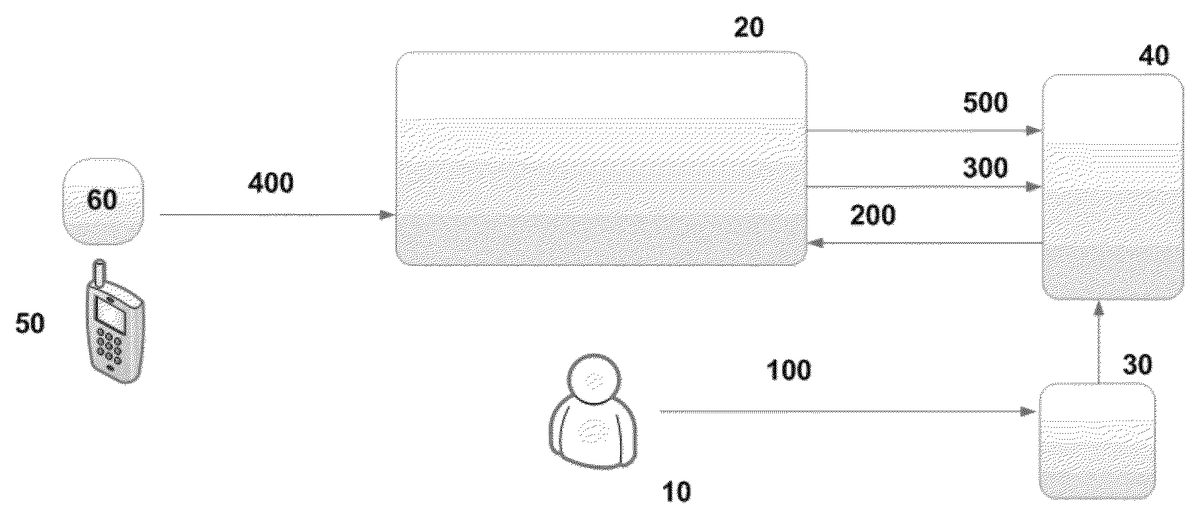
DESCRIPTION OF A PREFERRED EMBODIMENT OF THE INVENTION FIG. 1shows a user10with a video console40in which a video game30can be reproduced. This user10starts a procedure in the video game for adding or introducing an object (step shown by arrow100). The video game30sends an identity of the user (step200) to a server20through the video console40. The server20generates a token (or unique temporal code) which is paired with said identity of the user. This token, which can be a chain of alphanumeric characters, is unique and can only be generated once during a specific time period. When this time period runs out, the tokens are recycled. The server20incorporates this token in a tone or audio file by means of audio watermarking methods. The server20sends this audio file to the video console (step300) where the video game reproduces it, the tone being audible through the speakers of the video console. The video console also shows an on-screen message to the user indicating that he/she is to execute an application60previously installed in a smartphone50. This application60activates an NFC reader of said smartphone to thus obtain a unique identifier of the object to be introduced, which object in this case must be located in the proximity of the smartphone. This step of obtaining the unique identifier of the object can also be done by other methods, such as for example, by means of graphic codes, for example, BIDI. On the other hand, the application60also activates the microphone of the mobile telephone for hearing the ambient sound, such that the tone reproduced in the video console is detected and thus the token is extracted. This application60can be executed in any smartphone or intelligent mobile telephone belonging to any user. It must be noted that until now it has been unnecessary to enter any type of credentials ...
DESCRIPTION OF A PREFERRED EMBODIMENT OF THE INVENTION
FIG. 1shows a user10with a video console40in which a video game30can be reproduced.
This user10starts a procedure in the video game for adding or introducing an object (step shown by arrow100).
The video game30sends an identity of the user (step200) to a server20through the video console40.
The server20generates a token (or unique temporal code) which is paired with said identity of the user.
This token, which can be a chain of alphanumeric characters, is unique and can only be generated once during a specific time period. When this time period runs out, the tokens are recycled.
The server20incorporates this token in a tone or audio file by means of audio watermarking methods. The server20sends this audio file to the video console (step300) where the video game reproduces it, the tone being audible through the speakers of the video console.
The video console also shows an on-screen message to the user indicating that he/she is to execute an application60previously installed in a smartphone50.
This application60activates an NFC reader of said smartphone to thus obtain a unique identifier of the object to be introduced, which object in this case must be located in the proximity of the smartphone. This step of obtaining the unique identifier of the object can also be done by other methods, such as for example, by means of graphic codes, for example, BIDI.
On the other hand, the application60also activates the microphone of the mobile telephone for hearing the ambient sound, such that the tone reproduced in the video console is detected and thus the token is extracted.
This application60can be executed in any smartphone or intelligent mobile telephone belonging to any user.
It must be noted that until now it has been unnecessary to enter any type of credentials in the smartphone.
The smartphone50sends both the unique identifier of the object and the token (step400) to the server20.
The server20uses this token to establish the necessary pairing between the object and the identity of the player.
Finally, the server20sends the unique identifier of the object to the video console (step500) so that it is introduced and added in the virtual world of the video game.
One difference with respect to existing pairing methods (as in the case of PS Vita®) is that it is virtually transparent for the user, who does not have to enter any credential.
When the user starts the process of adding an object for the video game, the video game reproduces a melody with a watermark. That melody or sound is captured by means of the application of the smartphone and is sent to a server to complete the pairing process.
According to another possible embodiment, the server20incorporates this token in a multimedia file by means of embedded coding in the same file (for example, audio and image watermarking and steganography methods). The server also sends this multimedia file to the video console, where the video game reproduces it, being reproduced by the video game platform, for example, through the screen and/or speakers of the video game platform.
In this embodiment, the video console also shows an on-screen message to the user or player indicating that he/she is to execute the application60previously installed in the smartphone50.
The application60activates a reader of said smartphone to thus obtain the unique identifier of the object. This step of obtaining the unique identifier of the object can also be done by other methods, such as for example, by means of graphic codes.
According to this embodiment, the application activates a camera of the smartphone to extract the token from the multimedia file reproduced by the game platform.
According to another possible embodiment of the method of the invention, the multimedia file reproduced by the video console, for example, an image displayed on-screen, includes an instruction or series of instructions for the user to follow in the smartphone; for example, it may indicate making a series of strokes the touch-sensitive screen of the smartphone, or shaking the smartphone with a series of movements.
In this embodiment, the application activates the corresponding sensor of the corresponding smartphone, i.e., touch-sensitive screen or accelerometer/accelerometers, and after implementing that series of instructions with the corresponding activated sensor, the application maps out these instructions, thus obtaining the unique token.
The invention has been described according to preferred embodiments thereof, but for a person skilled in the art it will be evident that many variations can be introduced in said preferred embodiments without exceeding the object of the claimed invention.
Claims
- A method for introducing an object with a unique identifier in a video game, comprising the following steps: making a request to a server to introduce the object in said video game reproduced in a video console, sending an identity of a user of said video game to said server;said server generates a token paired with said identity and embeds said token in a multimedia file and sends said multimedia file to the video console;the video console reproduces said multimedia file and shows a message to the user so that the user executes an application in a smartphone;said application: activates a reader of said smartphone to obtain the unique identifier of said object;activates a sensor element of said smartphone to be able to extract said token associated with said multimedia file;the smartphone sends the unique identifier of said object and the token to said server;the server pairs the unique identifier of the object with the identity of the user by means of said token and sends said unique identifier of the object to the video console to introduce said object in the video game.
- Method according to claim 1 , wherein said reader of the smartphone is an NFC or RFID reader.
- Method according to claim 1 , wherein said reader of the smartphone is a reader of graphically represented codes.
- Method according to claim 1 , wherein said sensor element of the smartphone is a multimedia capture device and the application extracts the token from said multimedia file.
- Method according to claim 4 , wherein said multimedia capture device of the smartphone is a microphone and the multimedia file is an audio file.
- Method according to claim 4 , wherein said multimedia capture device of the smartphone is a camera and the multimedia file is an image file.
- Method according to claim 1 , wherein said multimedia file includes a series of instructions to carry out in the smartphone recognizable by the sensor element of the smartphone, and the application extracts the token by mapping out that series of instructions.
- Method according to claim 7 , wherein said sensor element is a touch sensitive interface.
- Method according to claim 7 , wherein said sensor element is an accelerometer.
- Method according to claim 1 , wherein said token is a chain of alphanumeric characters.
Disclaimer: Data collected from the USPTO and may be malformed, incomplete, and/or otherwise inaccurate.