DETAILED DESCRIPTION OF A PREFERRED EMBODIMENT In a preferred embodiment of the present invention, a player builds a virtual world comprised of game objects placed onto the topography of a digital game space. InFIG. 1, the game space100displays a virtual world that may contain any number or type of buildings, trees, flowers, paths, roads, decorations, and/or other objects. Further, some or all of the virtual world objects may be moved, rotated, adjusted, combined, removed, stored, or otherwise modified during the play of the game. The virtual world may also be populated by any number or type of creatures, animals, or other beings controlled by players and/or operated by a computer. The size of a virtual world, number of objects, and size of population may be limited by design but are otherwise infinitely expandable. The topography of game space100inFIG. 1is entirely flat. The flat topography may support building roads, buildings, and trees. A single building102is shown. In addition, the flat topography may also provide in-game benefits from planting crops (not shown) or drilling for oil (not shown). InFIG. 2a, the topography of the game space100has been modified by raising the elevation of a single segment112. The coloration and texture of the raised segment112may be altered to indicate elevation (not shown). InFIG. 2b, the raised segment112is raised again. The coloration and texture of the raised segment112may be altered again to indicate even greater elevation (not shown). InFIG. 2c, a segment114is raised that lies adjacent to the first raised segment112. The newly raised segment114is melded into the shape and contour of the first raised segment112. The two raised segments112and114become part of a mountain range. InFIG. 2d, segment114is raised again to the same height as segment112. The coloration and texture of these raised segments may indicate elevation and serve to meld the segments into ...
DETAILED DESCRIPTION OF A PREFERRED EMBODIMENT
In a preferred embodiment of the present invention, a player builds a virtual world comprised of game objects placed onto the topography of a digital game space.
InFIG. 1, the game space100displays a virtual world that may contain any number or type of buildings, trees, flowers, paths, roads, decorations, and/or other objects. Further, some or all of the virtual world objects may be moved, rotated, adjusted, combined, removed, stored, or otherwise modified during the play of the game. The virtual world may also be populated by any number or type of creatures, animals, or other beings controlled by players and/or operated by a computer. The size of a virtual world, number of objects, and size of population may be limited by design but are otherwise infinitely expandable.
The topography of game space100inFIG. 1is entirely flat. The flat topography may support building roads, buildings, and trees. A single building102is shown. In addition, the flat topography may also provide in-game benefits from planting crops (not shown) or drilling for oil (not shown).
InFIG. 2a, the topography of the game space100has been modified by raising the elevation of a single segment112. The coloration and texture of the raised segment112may be altered to indicate elevation (not shown). InFIG. 2b, the raised segment112is raised again. The coloration and texture of the raised segment112may be altered again to indicate even greater elevation (not shown).
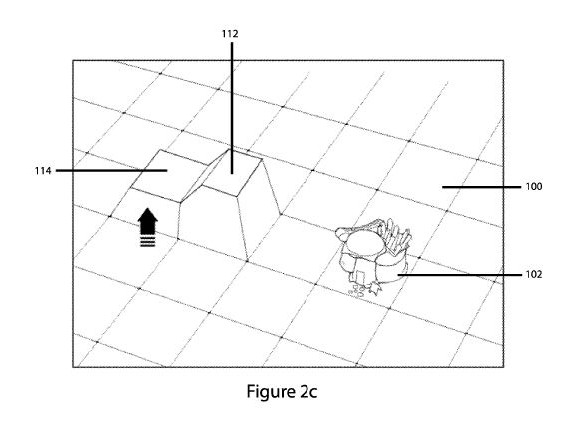
InFIG. 2c, a segment114is raised that lies adjacent to the first raised segment112. The newly raised segment114is melded into the shape and contour of the first raised segment112. The two raised segments112and114become part of a mountain range.
InFIG. 2d, segment114is raised again to the same height as segment112. The coloration and texture of these raised segments may indicate elevation and serve to meld the segments into a coherent and contiguous mountain range (not shown) or grassy plateau (not shown).
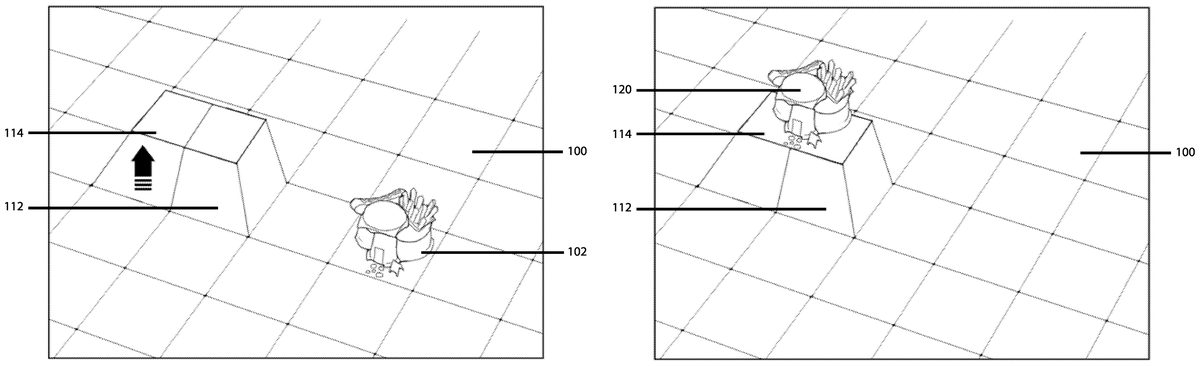
The mountainous topography created inFIGS. 2a-dprovides new in-game benefits: metal ores, such as gold, that can be mined; animals, such as mountain goats, that can be herded; or plants, such as pine trees, that can be harvested. Further, a house120may be placed on the mountains or plateaus to generate higher rents or other benefits, as shown inFIG. 2e.
InFIG. 3a, the topography of game space100is modified by lowering raised segment114to ground level. The coloration and texture of the segment114may be altered to indicate the change in elevation (not shown) to match other ground level segments at the same elevation. InFIG. 3b, segment112is also lowered to ground level to return to a flat topography.
InFIG. 3c, segment112is lowered below ground level to create a depression. A depression may be indicated as water, such as a lake (not shown). InFIG. 3d, segment114is also lowered below ground level. Since the segments112and114are contiguous, one large depression or body of water is formed. Non-contiguous segments would form their own independent depressions or bodies of water (not shown).
FIGS. 3a-dshow the topography of game space100being modified to replace a raised topography (i.e. mountain range) with a depression (i.e. lake). The in-game benefits associated with mountains have been removed and replaced with new in-game benefits specific to lakes: fish, such as trout, which can be caught; and water which can be used for drinking and irrigation. Further, houses placed at the water's edge may generate higher rents.
Network & Systems
The present invention may be implemented on computer-based networks using systems comprised of interconnected client and server devices. In a preferred embodiment, server and client devices operate across the Internet using one or more of the following networks: wired, wireless, satellite, and cellular communication. Client devices are connected to the networks via a network service provider or wireless carrier; servers are connected to the networks via modems, routers and/or networking switches.
Clients.
A client device is generally computer-based equipment such as a desktop computer, laptop computer, computer tablet, personal digital assistant, mobile phone, smart phone, mobile gaming device, and/or console game system that is managed and controlled by an operating system, such as LINUX, UNIX, Microsoft Windows, Apple Macintosh, and/or other proprietary or open source operating system.
To facilitate communication with a network, a client device includes a network interface, such as an Ethernet (IEEE 802.3), wi-fi (802.11), or wi-max (802.16). In addition, a client device may also include, but not be limited to, a central processing unit (CPU), system memory (DRAM), video memory, video display, hard drive, I/O ports, and/or keyboard.
A client device may execute one or more applications, such as a web browser (e.g., Microsoft Internet Explorer, Google Chrome, Mozilla Firefox, and Apple Safari) and plug-ins, languages, or other extensions (e.g., Flash Media Player, Unity 3D, AJAX, XML, HTML, Javascript), to perform game-related functions and/or access data from the servers available via one or more networks.
Servers.
Servers are computing devices that execute applications using languages such as PHP, ASP, C#, C, C++, CGI, PERL, XML, Java, JSP, SQL, PYTHON, and RUBY. Similar to client devices, servers must communicate with a network via a network interface, such as an Ethernet (IEEE 802.3), wi-fi (802.11), or wi-max (802.16). In addition, a server device may also include, but not be limited to, a central processing unit (CPU), system memory (DRAM), video memory, video display, hard drive, I/O ports, and/or keyboard.
Servers also store digital data as data files or records and, in many cases, organize the digital data into a variety of databases, such as relational and object-oriented databases. A database is logical framework that allows files and records to be created, accessed, edited, and/or deleted with maximum accuracy and speed. Digital data may take many forms, including: text, numbers, 2D and 3D images, graphics, animations, audio, video, and/or other media.
SCOPE & SPIRIT OF THE PRESENT INVENTION
The many features and advantages of the present invention are apparent from the foregoing descriptions of the preferred embodiments. The present invention, however, is not limited to these particular embodiments, as the invention is capable of being practiced and carried out in various ways. For example, new features may be added to an existing embodiment or features from two or more embodiments may be combined to produce a new embodiment. Further, features mentioned in any embodiment may be interchanged with similar features not mentioned that perform the same or similar functions. And, finally, the phraseology and terminology used to explain the embodiments are only descriptive and should not be regarded as limiting. The claims, therefore, seek to cover all features and advantages that fall within the true spirit and scope of the present invention.