U.S. Pat. No. 8,777,739
Gender and age based gameplay through face perception
AssigneeDisney Enterprises Inc
Issue DateFebruary 23, 2011
Illustrative Figure
Abstract
There is provided a system and method for determining a gender and age of a player of a game. There is a method comprising capturing an image of at least one player, and determining the gender and age of the player based on the image. In this manner, the game may be customized to be more relevant or attractive to the player's gender and/or age group.
Description
DETAILED DESCRIPTION OF THE INVENTION The present application is directed to a system and method for determining a gender and age of a player of a game using facial perception. The following description contains specific information pertaining to the implementation of the present invention. One skilled in the art will recognize that the present invention may be implemented in a manner different from that specifically discussed in the present application. Moreover, some of the specific details of the invention are not discussed in order not to obscure the invention. The specific details not described in the present application are within the knowledge of a person of ordinary skill in the art. The drawings in the present application and their accompanying detailed description are directed to merely exemplary embodiments of the invention. To maintain brevity, other embodiments of the invention, which use the principles of the present invention, are not specifically described in the present application and are not specifically illustrated by the present drawings. FIG. 1presents a system for determining a gender and age of a player of a game using facial perception, according to one embodiment of the present invention. Environment100ofFIG. 1includes device110, camera120, and player130. Device110includes game112, processor115, memory117, and display119. Camera120includes image data122. According to the embodiment shown inFIG. 1, player130may be characterized by gender132and age134. In one embodiment, device110may comprise any computing machine capable of presenting game112, as well as accept connections from other devices, such as a camera. For example, device110may comprise a Playstation 3™ console, an Xbox 360™ console, or a personal computer. These devices are often located in a room in a house, such as a living room. Alternatively, device110may comprise a hand-held computing device, such as a Nintendo DS™ or an Apple iPhone™. Display119may comprise any display capable of displaying output from ...
DETAILED DESCRIPTION OF THE INVENTION
The present application is directed to a system and method for determining a gender and age of a player of a game using facial perception. The following description contains specific information pertaining to the implementation of the present invention. One skilled in the art will recognize that the present invention may be implemented in a manner different from that specifically discussed in the present application. Moreover, some of the specific details of the invention are not discussed in order not to obscure the invention. The specific details not described in the present application are within the knowledge of a person of ordinary skill in the art. The drawings in the present application and their accompanying detailed description are directed to merely exemplary embodiments of the invention. To maintain brevity, other embodiments of the invention, which use the principles of the present invention, are not specifically described in the present application and are not specifically illustrated by the present drawings.
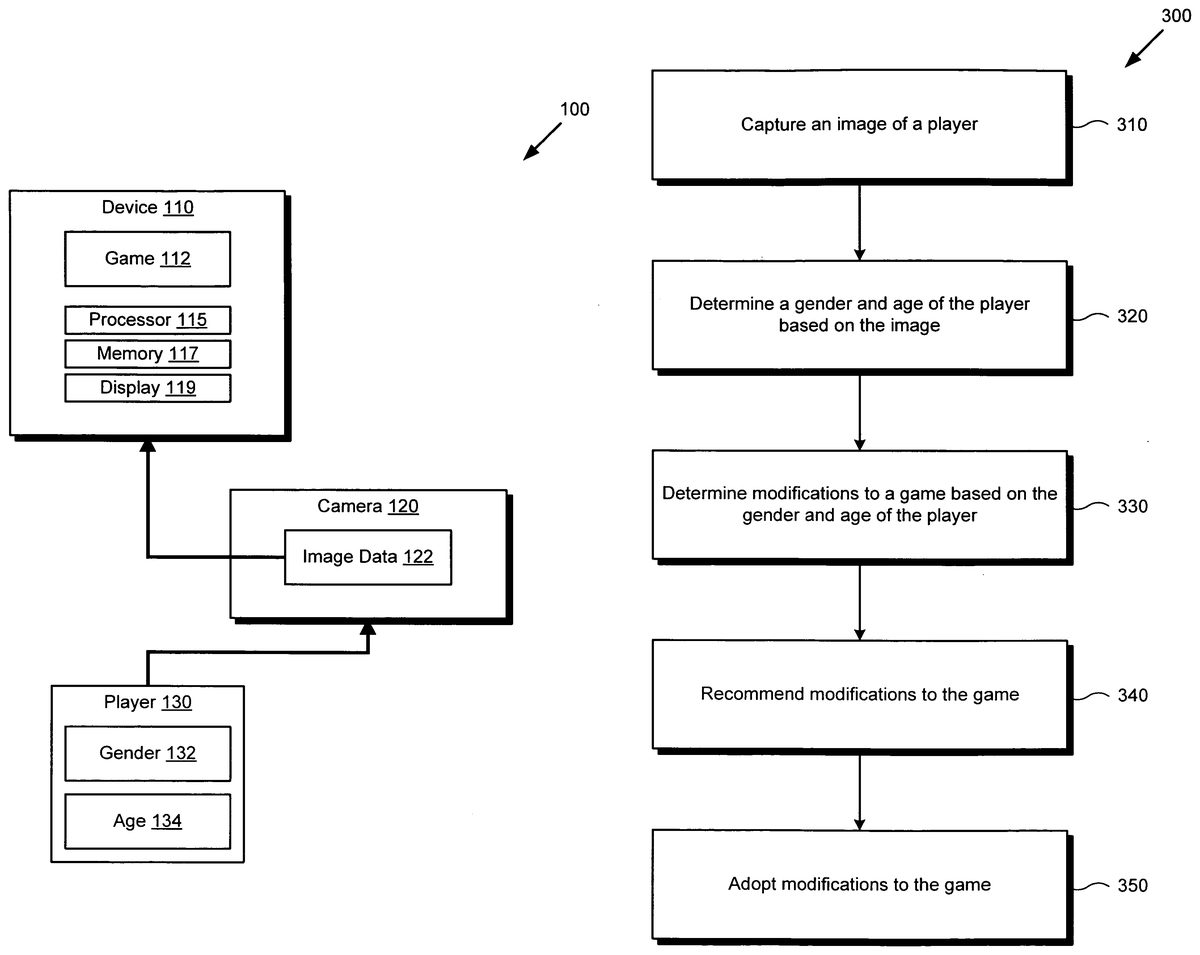
FIG. 1presents a system for determining a gender and age of a player of a game using facial perception, according to one embodiment of the present invention. Environment100ofFIG. 1includes device110, camera120, and player130. Device110includes game112, processor115, memory117, and display119. Camera120includes image data122. According to the embodiment shown inFIG. 1, player130may be characterized by gender132and age134.
In one embodiment, device110may comprise any computing machine capable of presenting game112, as well as accept connections from other devices, such as a camera. For example, device110may comprise a Playstation 3™ console, an Xbox 360™ console, or a personal computer. These devices are often located in a room in a house, such as a living room. Alternatively, device110may comprise a hand-held computing device, such as a Nintendo DS™ or an Apple iPhone™. Display119may comprise any display capable of displaying output from device110. Display119may be integrated with device110, such as the screen of an iPhone. In alternative embodiments, display119may comprise a separate component, externally connected to device110, such as a television. Processor115may comprise a processor capable of performing the tasks of device110described below. Memory117, which may be controlled by processor115, may comprise an area of memory, such as RAM, where software instructions and algorithms may reside. For example, game112may reside in memory117. Game112may comprise any interactive video based experience, such as a video game. Game112may present video shown on display119which a user or player may interact with through device110, often with specific objectives. Although in many embodiments game112may comprise a video game, the present invention is not limited to entertainment applications. For example, game112may instead comprise a vehicle simulation.
Camera120may comprise any camera or image capture device capable of connecting to device110. For example, the Playstation Eye™ may connect to a Playstation 3, whereas the Microsoft Kinect may connect to an Xbox 360, and a webcam may connect to a personal computer. Camera120is preferably located in the same room as device110, situated to capture at least player130. However, camera120may be in another location than device110, particularly if player130is located elsewhere. Although not shown inFIG. 1, camera120and device110may comprise a single integrated device. For example, the iPhone™ 4 has two built-in cameras. Camera120includes image data122. Image data122may comprise images captured by camera120. Image data122may be stored as a file or files on camera120and/or device110, or may alternatively comprise temporary data. In addition, image data122may comprise more than one image, or may comprise video data. Image data122may provide the raw data that may be used for facial perception, a technique known in the art. Accordingly, camera120and image data122are not limited to capturing only visual light.
Player130may comprise one or more persons actively playing game112on device110when camera120captures image data122. Alternatively, player130may comprise one or more persons who will play game112but are spectators at the time camera120captures image data122. Player130may be present with device110, or may be located elsewhere, able to view and/or interact with game112, and detectable by camera120. Gender132corresponds to the gender of player130. Likewise, age134corresponds to the age of player130. Age134may correspond a specific age, such as eighteen, or may correspond an age range, such as 25-35.
Before device110starts a video game, camera120may, at the request of device110, capture image data122of player130. Camera120may then send or otherwise make available image data122for analysis by device110. Device110may use facial recognition or facial perception techniques, which are known in the art, to analyze image data122. Alternatively, camera120may analyze image data122. Subsequently, device110may determine the genders and ages of player130in image data122, which corresponds to gender132and age134. Device110may then make gender132and age134available to game112. Game112may then be modified according to gender132and/or age134.
Moving toFIGS. 2A and 2B,FIG. 2Ashows a top-down view of an exemplary environment for determining a gender and age of a player of a game, according to one embodiment of the present invention.FIG. 2Bshows a side view of the exemplary environment ofFIG. 2A.FIGS. 2A and 2Binclude the same elements. Environment200includes console210, TV219, camera220, view225, and player230.
Environment200may comprise a living room in a typical house. Console210, which may correspond to device110ofFIG. 1, may comprise a video game console. Although not depicted inFIGS. 2A and 2B, console210may be connected to TV219and camera220. Console210may be capable of presenting video games, such as game112inFIG. 1, through TV219, which may correspond to display119inFIG. 1. TV219may comprise a television set. Camera220, which may correspond to camera120inFIG. 1, may comprise a camera peripheral that may connect to console210. View225corresponds to the range of vision of camera220. Player230, which may correspond to player130inFIG. 1, may comprise one or more persons in environment200who are currently playing game112on console210. Alternatively, player130may comprise one or more persons in environment200who are not playing game112.
As depicted inFIG. 2A, TV219may be centrally located in environment200to provide a good viewing angle for player230. Console210may be located near TV219, for example beside TV219, in order to be connected to TV219. In this embodiment, camera220may be located on top of TV219, as depicted inFIG. 2B, so that view225may capture player230. Once camera220captures an image of player230, console210may determine a gender and age of player230, a process described in further detail below with respect toFIG. 3.
Moving toFIG. 3,FIG. 3shows a flowchart describing the steps, according to one embodiment of the present invention, by which a gender and age of a player of a game may be determined using facial perception. Certain details and features have been left out of flowchart300that are apparent to a person of ordinary skill in the art. For example, a step may comprise one or more substeps or may involve specialized equipment or materials, as known in the art. While steps310to350indicated in flowchart300are sufficient to describe one embodiment of the present invention, other embodiments of the invention may utilize steps different from those shown in flowchart300.
Referring to step310of flowchart300inFIG. 3and environment100ofFIG. 1, step310of flowchart300comprises camera120capturing image data122of player130. Processor115, though device110, may request camera120to capture image data122before player130starts playing game112on device110. Possible times include but are not limited to the following: during a loading screen; during a demo screen; while a startup screen is displayed; or when a menu screen is displayed. Alternatively, camera120may capture image data122during actual gameplay. For example, camera120may capture image data122as part of its normal function within game112, or during downtime or loading screens during gameplay. Preferably, the time between capturing image data122and actual gameplay should be minimized, in order to obtain the most recent and accurate image of player130. In addition, camera120preferably captures a clear view of player130.
Referring to step320of flowchart300inFIG. 3and environment100ofFIG. 1, step320of flowchart300comprises determining a gender and age of the player of a game based on image data122. Device110may analyze image data122using facial recognition or facial perception techniques known in the art to determine gender132and age134. Alternatively, camera120may conduct parts or all of the analysis on image data122. Device110may make gender132and age134available to game112. Preferably, game112has not previously prompted player130for gender132and age134.
Referring to step330of flowchart300inFIG. 3and environment100ofFIG. 1, step330of flowchart300comprises determining modifications to game112based on gender132and age134. For example, a possible modification may be to change color schemes. Alternatively, device110may determine modifications to game112based on gender132only, or age134only. However, the modifications are not limited to tweaks to game112.
The modifications may alter the gameplay for player130. A possible modification may change the type of gameplay. Playtests and other market research may find that specific genders or age groups prefer certain types of gameplay. For example, the market research may suggest that males from ages 15-25 prefer first-person shooters, whereas females from ages 6-12 prefer click-and-collect games. If gender132corresponds to male, and age134corresponds to 15-25, a relevant modification would be to incorporate more first-person shooter elements into the gameplay. Similarly, if gender132corresponds to female, and age134corresponds to 6-12, a more relevant modification would be to incorporate more click-and-collect elements into the gameplay. In addition, one or more objectives of game112may be modified. For example, research may reveal that males prefer to eliminate a particular enemy in game112, whereas females prefer to sneak past the particular enemy. If gender132corresponds to male, an objective of game112may be modified to require player130to eliminate the particular enemy. Likewise, if gender132corresponds to female, the objective of game112may be modified to require player130to sneak past the particular enemy. A length of game112may also be modified. For example, research may reveal that persons from ages 3-7 are not able to concentrate on game112for extended periods of time. Accordingly, the length of game112may be shortened when age134corresponds to ages 3-7.
In embodiments where player130comprises a spectator, the modifications may provide audience participation, rather than alter the main gameplay. A possible modification may involve adding interesting background events and images which market research may reveal appeals to persons corresponding to gender132and/or age134. Such background images may further be based on image data122, for example using an image of a face of player130. A more elaborate modification may involve establishing a secondary game in the background. The secondary game may provide player130with objectives, appealing to persons corresponding to gender132and/or age134, which do not interfere with the main gameplay.
Referring to step340of flowchart300inFIG. 3and environment100ofFIG. 1, step340of flowchart300comprises recommending the modifications to game112. Game112, through device110, may present player130with options to apply the recommended modifications. Game112may alternatively ask player130to confirm the modifications. For example, game112may present player130with an alternative route which may appeal to persons corresponding to gender132and age134. In alternative embodiments, this step may be skipped for some or all modifications.
Referring to step350of flowchart300inFIG. 3and environment100ofFIG. 1, step350of flowchart300comprises adopting the modifications to game112. The modifications may have been explicitly accepted in the previous step, such as players130taking the alternative route mentioned in the previous example. Game112may then adopt the accepted modifications and alter its gameplay accordingly.
Other modifications may be automatically adopted, particularly if step340was skipped. For example, game112may automatically adopt interesting background scenery if player130comprises a spectator. In another example, game112may automatically alter its gameplay to appeal to persons corresponding to gender132and/or age134. Such alterations may be subtly or drastically alter game112.
From the above description of the invention it is manifest that various techniques can be used for implementing the concepts of the present invention without departing from its scope. Moreover, while the invention has been described with specific reference to certain embodiments, a person of ordinary skills in the art would recognize that changes can be made in form and detail without departing from the spirit and the scope of the invention. As such, the described embodiments are to be considered in all respects as illustrative and not restrictive. It should also be understood that the invention is not limited to the particular embodiments described herein, but is capable of many rearrangements, modifications, and substitutions without departing from the scope of the invention.
Claims
- A device for determining a gender and an age of a player and at least one spectator of a game, the device comprising a processor configured to: capture an image;determine the gender and age of the player and at least one spectator based on the image using at least one of facial recognition and facial perception;prompt the player for one or more modifications to the game, wherein the one or more modifications are based on the gender and age of the player;apply the one or more modifications to the game based on the gender and the age of the player if the player accepts the one or more modifications in response to the prompt;create a secondary game within the game based on the gender and the age of the at least one spectator;and present the game including the secondary game and the one or more modifications on a display.
- The device of claim 1 , wherein the device does not ask the player for the gender and age of the player.
- The device of claim 1 , wherein the game is modified without confirmation from the player.
- The device of claim 1 , wherein the processor is further configured to: determine, during loading screens, that the at least one spectator is present;and modify the secondary game in response to determining if the at least one spectator is present.
- The device of claim 1 , wherein a type of gameplay of the game is modified based on the gender and age of the player.
- The device of claim 1 , wherein an objective of the game is modified based on the gender and age of the player.
- The device of claim 1 , wherein a length of the game is modified based on the gender and age of the player.
- The device of claim 1 , wherein a background element of the game is modified based on the gender and age of the player.
- The device of claim 1 , wherein the device is further configured to modify the game based solely on the gender of the player.
- The device of claim 1 , wherein the device is further configured to modify the game based solely on the age of the player.
- A method for use by a device having a processor for determining a gender and an age of a player and at least one spectator of a game, the method comprising: capturing, by the processor, an image;determining the gender and age of the player and the at least one spectator based on the image using at least one of the facial recognition and facial perception;prompting the player for one or more modifications to the game, wherein the one or more modifications are based on the gender and the age of the player;applying the one or more modifications to the game based on the gender and the age of the player if the player accepts the one or more modifications in response to the prompt;creating a secondary game within the game based on the gender and the age of the at least one spectator;and presenting the game including the secondary game and the one or more modifications on a display.
- The method of claim 11 , wherein the player is not asked for the gender and age of the player.
- The method of claim 11 , wherein the game is modified without confirmation from the player.
- The method of claim 11 , further comprising: determining, during loading screens, that the at least one spectator is present;and modify the secondary game in response to determining if the at least one spectator is present.
- The method of claim 11 , wherein a type of gameplay of the game is modified based on the gender and age of the player.
- The method of claim 11 , wherein an objective of the game is modified based on the gender and age of the player.
- The method of claim 11 , wherein a length of the game is modified based on the gender and age of the player.
- The method of claim 11 , wherein a background element of the game is modified based on the gender and age of the player.
- The method of claim 11 , wherein the modifying the game is based solely on the gender of the player.
- The method of claim 11 , wherein the modifying the game is based solely on the age of the player.
Disclaimer: Data collected from the USPTO and may be malformed, incomplete, and/or otherwise inaccurate.