U.S. Pat. No. 8,734,215
POWER PLAY GAME MECHANICS
AssigneeDisney Enterprises Inc
Issue DateJanuary 3, 2013
Illustrative Figure
Abstract
Method, article and apparatus for executing computer games, and in particular, computer-based racing games. In a racing game, a player may be allowed to earn one or more game play options which may be exercised during the race. The game play options, when exercised, may modify the predefined race path to create an advantage for the player or a disadvantage to the competitors.
Description
DETAILED DESCRIPTION OF THE PREFERRED EMBODIMENTS Embodiments of the present invention are directed to computer games, and in particular to computer-based racing games. In a racing game, a player may be allowed to earn one or more game play options (also referred to herein as power play options) which may be exercised during the race. The power play options, when exercised, may modify the predefined race path to create an advantage for the player or a disadvantage to the competitors. In the following, reference is made to embodiments of the invention. However, it should be understood that the invention is not limited to specific described embodiments. Instead, any combination of the following features and elements, whether related to different embodiments or not, is contemplated to implement and practice the invention. Furthermore, although embodiments of the invention may achieve advantages over other possible solutions and/or over the prior art, whether or not a particular advantage is achieved by a given embodiment is not limiting of the invention. Thus, the following aspects, features, embodiments and advantages are merely illustrative and are not considered elements or limitations of the appended claims except where explicitly recited in a claim(s). Likewise, reference to “the invention” shall not be construed as a generalization of any inventive subject matter disclosed herein and shall not be considered to be an element or limitation of the appended claims except where explicitly recited in a claim(s). As will be appreciated by one skilled in the art, aspects of the present invention may be embodied as a system, method or computer program product. Accordingly, aspects of the present invention may take the form of an entirely hardware embodiment, an entirely software embodiment (including firmware, resident software, micro-code, etc.) or an embodiment combining software and hardware aspects that may all generally be ...
DETAILED DESCRIPTION OF THE PREFERRED EMBODIMENTS
Embodiments of the present invention are directed to computer games, and in particular to computer-based racing games. In a racing game, a player may be allowed to earn one or more game play options (also referred to herein as power play options) which may be exercised during the race. The power play options, when exercised, may modify the predefined race path to create an advantage for the player or a disadvantage to the competitors.
In the following, reference is made to embodiments of the invention. However, it should be understood that the invention is not limited to specific described embodiments. Instead, any combination of the following features and elements, whether related to different embodiments or not, is contemplated to implement and practice the invention. Furthermore, although embodiments of the invention may achieve advantages over other possible solutions and/or over the prior art, whether or not a particular advantage is achieved by a given embodiment is not limiting of the invention. Thus, the following aspects, features, embodiments and advantages are merely illustrative and are not considered elements or limitations of the appended claims except where explicitly recited in a claim(s). Likewise, reference to “the invention” shall not be construed as a generalization of any inventive subject matter disclosed herein and shall not be considered to be an element or limitation of the appended claims except where explicitly recited in a claim(s).
As will be appreciated by one skilled in the art, aspects of the present invention may be embodied as a system, method or computer program product. Accordingly, aspects of the present invention may take the form of an entirely hardware embodiment, an entirely software embodiment (including firmware, resident software, micro-code, etc.) or an embodiment combining software and hardware aspects that may all generally be referred to herein as a “circuit,” “module” or “system.” Furthermore, aspects of the present invention may take the form of a computer program product embodied in one or more computer readable medium(s) having computer readable program code embodied thereon.
Any combination of one or more computer readable medium(s) may be utilized. The computer readable medium may be a computer readable signal medium or a computer readable storage medium. A computer readable storage medium may be, for example, but not limited to, an electronic, magnetic, optical, electromagnetic, infrared, or semiconductor system, apparatus, or device, or any suitable combination of the foregoing. More specific examples (a non-exhaustive list) of the computer readable storage medium would include the following: an electrical connection having one or more wires, a portable computer diskette, a hard disk, a random access memory (RAM), a read-only memory (ROM), an erasable programmable read-only memory (EPROM or Flash memory), an optical fiber, a portable compact disc read-only memory (CD-ROM), an optical storage device, a magnetic storage device, or any suitable combination of the foregoing. In the context of this document, a computer readable storage medium may be any tangible medium that can contain, or store a program for use by or in connection with an instruction execution system, apparatus, or device.
A computer readable signal medium may include a propagated data signal with computer readable program code embodied therein, for example, in baseband or as part of a carrier wave. Such a propagated signal may take any of a variety of forms, including, but not limited to, electro-magnetic, optical, or any suitable combination thereof. A computer readable signal medium may be any computer readable medium that is not a computer readable storage medium and that can communicate, propagate, or transport a program for use by or in connection with an instruction execution system, apparatus, or device.
Program code embodied on a computer readable medium may be transmitted using any appropriate medium, including but not limited to wireless, wireline, optical fiber cable, RF, etc., or any suitable combination of the foregoing.
Computer program code for carrying out operations for aspects of the present invention may be written in any combination of one or more programming languages, including an object oriented programming language such as Java, Smalltalk, C++ or the like and conventional procedural programming languages, such as the “C” programming language or similar programming languages. The program code may execute entirely on the user's computer, partly on the user's computer, as a stand-alone software package, partly on the user's computer and partly on a remote computer or entirely on the remote computer or server. In the latter scenario, the remote computer may be connected to the user's computer through any type of network, including a local area network (LAN) or a wide area network (WAN), or the connection may be made to an external computer (for example, through the Internet using an Internet Service Provider).
Aspects of the present invention are described below with reference to flowchart illustrations and/or block diagrams of methods, apparatus (systems) and computer program products according to embodiments of the invention. It will be understood that each block of the flowchart illustrations and/or block diagrams, and combinations of blocks in the flowchart illustrations and/or block diagrams, can be implemented by computer program instructions. These computer program instructions may be provided to a processor of a general purpose computer, special purpose computer, or other programmable data processing apparatus to produce a machine, such that the instructions, which execute via the processor of the computer or other programmable data processing apparatus, create means for implementing the functions/acts specified in the flowchart and/or block diagram block or blocks.
These computer program instructions may also be stored in a computer readable medium that can direct a computer, other programmable data processing apparatus, or other devices to function in a particular manner, such that the instructions stored in the computer readable medium produce an article of manufacture including instructions which implement the function/act specified in the flowchart and/or block diagram block or blocks.
The computer program instructions may also be loaded onto a computer, other programmable data processing apparatus, or other devices to cause a series of operational steps to be performed on the computer, other programmable apparatus or other devices to produce a computer implemented process such that the instructions which execute on the computer or other programmable apparatus provide processes for implementing the functions/acts specified in the flowchart and/or block diagram block or blocks.
The flowchart and block diagrams in the Figures illustrate the architecture, functionality, and operation of possible implementations of systems, methods and computer program products according to various embodiments of the present invention. In this regard, each block in the flowchart or block diagrams may represent a module, segment, or portion of code, which comprises one or more executable instructions for implementing the specified logical function(s). It should also be noted that, in some alternative implementations, the functions noted in the block may occur out of the order noted in the figures. For example, two blocks shown in succession may, in fact, be executed substantially concurrently, or the blocks may sometimes be executed in the reverse order, depending upon the functionality involved. It will also be noted that each block of the block diagrams and/or flowchart illustration, and combinations of blocks in the block diagrams and/or flowchart illustration, can be implemented by special purpose hardware-based systems that perform the specified functions or acts, or combinations of special purpose hardware and computer instructions.
Referring now toFIG. 1, a block diagram illustrates a client-server view of a computing environment100, according to one embodiment of the invention. As shown, computing environment100includes client computers120, a network160, and a server system140. In one embodiment, the environment100may include existing computer systems, e.g., desktop computers, server computers, laptop computers, tablet computers, and the like. The computing environment100illustrated inFIG. 1, however, is merely an example of one computing environment. Embodiments of the present invention may be implemented differently, regardless of whether the computer systems are complex multi-user computing systems, such as a cluster of individual computers connected by a high-speed network, single-user workstations, or network appliances lacking non-volatile storage. Further, whileFIG. 1illustrates a client-server model, other models are contemplated such as a peer-to-peer model.
As shown, each client computer120includes a processing unit122, which obtains instructions and data via a bus121from a client memory130and client storage123. Processing unit122is a programmable logic device that performs instruction, logic, and mathematical processing, and may be representative of one or more CPUs and/or GPUs. Client storage123stores application programs and data for use by client computer120.
The memory130is any memory sufficiently large to hold the necessary programs and data structures. Memory130could be one or a combination of memory devices, including Random Access Memory, nonvolatile or backup memory (e.g., programmable or Flash memories, read-only memories, etc.). In addition, memory130and storage123may be considered to include memory physically located elsewhere; for example, on another computer coupled to the client computer120via bus121.
Client storage123includes hard-disk drives, flash memory devices, optical media and the like. Client computer120is operably connected to the network160. Client memory130includes an operating system (OS)131and a gaming program132. Operating system131is the software used for managing the operation of the client computer120. Examples of OS131include UNIX, a version of the Microsoft Windows® operating system, and distributions of the Linux® operating system. (Note: Linux is a trademark of Linus Torvalds in the United States and other countries.)
In one embodiment, each client is a dedicated gaming console, such as a Sony PS3®, Nintendo Wii®, or Xbox360®, capable of executing the gaming program132. In another embodiment, each client is a general purpose computer configured to run any variety of gaming and non-gaming software. The game may be viewed on a display device170, such as an LCD, LED or CRT monitor display, and controlled using input devices180which may be, e.g., a keyboard, mouse and/or a controller.
As shown, the server system140includes the same basic hardware elements as the client computers120. Specifically, the server system140includes a processing unit142(representative of one or more CPUs and/or GPUs), a memory144and storage143connected via a bus141. The server system140may be operably connected to the network160, which generally represents any kind of data communications network. Accordingly, the network160may represent both local and wide area networks, including the Internet. In one embodiment, the server system140hosts an on-line gaming environment to which one or more of the client computers120connect. In this case, server-side gaming software146may be located in memory144of the server system140and cooperates with client-side gaming software (e.g., game program132) located on the respective client computers120.
It is specifically contemplated that embodiments of the invention may be provided to end users through a cloud computing infrastructure. Cloud computing generally refers to the provision of scalable computing resources as a service over a network. More formally, cloud computing may be defined as a computing capability that provides an abstraction between the computing resource and its underlying technical architecture (e.g., servers, storage, networks), enabling convenient, on-demand network access to a shared pool of configurable computing resources that can be rapidly provisioned and released with minimal management effort or service provider interaction. Thus, cloud computing allows a user to access virtual computing resources (e.g., storage, data, applications, and even complete virtualized computing systems) in “the cloud,” without regard for the underlying physical systems (or locations of those systems) used to provide the computing resources.
Cloud computing resources may be provided to a user on a pay-per-use basis, where users are charged only for the computing resources actually used (e.g. an amount of storage space consumed by a user or a number of virtualized systems instantiated by the user). A user can access any of the resources that reside in the cloud at any time, and from anywhere across the Internet. In context of the present invention, a user may access applications (e.g., a game program) or related data available in the cloud. For example, the racing game described herein could execute on a computing system in the cloud, thereby allowing a user to access the game from any computing system attached to a network connected to the cloud (e.g., the Internet).
The following embodiments of the invention are described with reference to a vehicle racing game in which a plurality of game characters (also referred to herein as players) compete to win a race along a predefined path. The game characters may be user controlled and/or computer controlled. In one embodiment, the game software (e.g., game program132), wherever located, is a racing game which allows one or more or players to control a vehicle using a controller. The winner of the racing game may be determined based on the relative completion times of each of the players travelling the predefined path.
FIG. 2illustrates an exemplary predefined path200according to an embodiment of the invention. As illustrated inFIG. 2, the predefined path200may include one or more travelling lanes. While only two travelling lanes210and220are shown inFIG. 2, in alternative embodiments, the path200may include any number of lanes. The plurality of lanes of the path200may be arranged as two-way lanes or one-way lanes. In one embodiment, the path200may be a circuit. In other words, a start position230of the path may be the same as the finish position230. However, in alternative embodiments, the start position and the finish position may be at different locations.
In one embodiment, the path200may include a plurality of path features that may require a player to maneuver a vehicle along or around the features while navigating the path. For example, the path200inFIG. 2includes a plurality of curves240. In some embodiments, a plurality of obstacles250may be placed in the lanes210and220, as illustrated inFIG. 2. The obstacles250may include static obstacles such as traffic cones, parked vehicles, pot holes, road bumps, and the like. The obstacles may also include moving objects such as pedestrians, slow moving traffic, oncoming traffic, and the like.
A player may have to quickly and efficiently maneuver a vehicle along the features240and around obstacles250to improve his/her chances of winning the game. Crashing into an obstacle250or skidding off the lanes210and220while navigating a curve240, may stop or significantly slow down the player's vehicle, thereby allowing other players to gain an advantage. In one embodiment, the path200may include one or more hidden shortcuts260that may be made available by exercising a power play, as will be discussed in greater detail below.
Maneuvering a vehicle may involve using a game controller to control the movement of the vehicle while playing the racing game.FIG. 3Aillustrates an exemplary controller310according to an embodiment of the invention. The controller310is shown as a rectangular device inFIG. 3A. However, in alternative embodiments, the controller310may have any reasonable shape. For example, in some embodiments, the controller may be ergonomically shaped to facilitate gripping with human hands. The controller310may be a wired or a wireless controller configured to connect with a client computer120.
In general, the controller310may include one or more buttons, joysticks, switches, trackballs, and the like. For example, as illustrated inFIG. 3A, the controller310may include a direction pad311, one or more joysticks312, start button313, and one or more functional buttons314. The start button313may be configured to power the controller310. If the controller310is a wireless controller, pressing the start button313may cause the controller to establish a wireless connection with a respective client computer120.
The direction pad311may include a plurality directional buttons, e.g., up/forward (U), down/back (D), left (L), and right (R), as illustrated inFIG. 3A. In one embodiment, the direction pad311may be used to maneuver a vehicle in a racing game. For example, the forward button (U) may be used to accelerate a vehicle, the back button (D) may be used for braking, and the left (L) and right (R) buttons may be used to turn the vehicle in a desired direction. In one embodiment, a joystick312may also be used to maneuver a vehicle in a racing game. For example, a player may simply push a joystick in a direction in which movement of a vehicle is desired.
The functional buttons314may be used by players to exercise one or more specialized options. For example, in one embodiment, pressing a functional button314may allow a player to exercise a boost option that allows the player's vehicle to travel at greater than normal speeds for a predefined period of time. In some embodiments, a player's vehicle may be equipped with one or more guns. Accordingly, in such embodiments, a functional button314may be pressed to shoot at or blow up an opponent's vehicle, thereby giving the player an advantage in the game. In one embodiment, the functional buttons (or a combination thereof) may be used to exercise a power play option, as is described in greater detail below.
FIG. 3Billustrates another exemplary controller320, according to an embodiment of the invention. As illustrated inFIG. 3B, the controller320may be a shaped like a steering wheel. The controller320may include a direction pad321, start button323, and functional buttons324, which are similar to the direction pad311, start button313, and functional buttons314ofFIG. 3A. Because the controller is shaped like a steering wheel, a player may be allowed to maneuver a vehicle in the game by simply turning the wheel322in the same way the player would while driving an actual vehicle.
The controllers310and320are shown inFIGS. 3A-Bfor illustrative purposes only and are not limiting on the invention. Any reasonable type and shape of controller, for example, key pads, key boards, mouse, trackballs, and the like may be used in alternative embodiments to play the racing game, as disclosed herein. In some embodiments, the racing game may be played in a controller-free environment. In such embodiments, the gaming system, e.g., client120, may be configured to detect gestures of one or more players, wherein the gestures may be used to maneuver vehicles in the racing game.
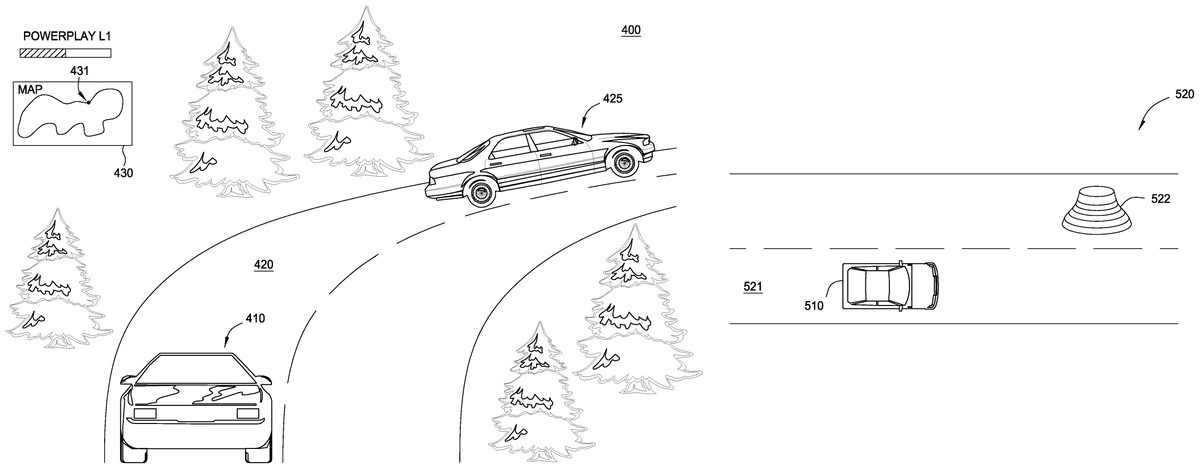
FIG. 4illustrates a view400of a racing game that may be displayed on a display device170according to an embodiment of the invention. The view400of the racing game may be displayed while executing a gaming program, e.g., gaming program132and146illustrated inFIG. 1. As illustrated inFIG. 4, a player's vehicle410(a car inFIG. 4) may be displayed in a bottom-center portion of the view400. A portion of a path420being traversed by the vehicle410is also visible in the view400. In one embodiment, the portion of the path420may correspond to a portion of the path200illustrated inFIG. 2. Also illustrated in the view400, is an environment around the path. For example, an environment comprising trees and a mountain is shown around the path420inFIG. 4.
During the car racing game, the vehicle420is presumed to be moving into the plane of the page. As a player accelerates and/or turns the vehicle410with a controller, path420and the environment around the path may be modified to simulate motion of the vehicle. As the player maneuvers his/her vehicle, one or more objects may become visible. For example, one of more competitors' vehicles425or obstacles, e.g., the obstacles250ofFIG. 2, may appear in the view400.
The view400also includes a map430of the path420, in one embodiment. The map430may indicate the shape of the path and a present location431of the player on the path. In one embodiment, the map430may also indicate locations of competitors on the path. Using the map430, a player may be able to make decisions on appropriate drive speed, gear-level, and the like, to successfully navigate his/her vehicle along or around path features such as curves, other players' vehicles, and the like.
In one embodiment, the racing game132may allow players to earn and exercise one or more power play options to gain an advantage in the game. In general, exercising a power play option may modify the predefined path of the game in such a way as to create an advantage for the player. A player may earn power play options by any one or more predefined methods. For example, in one embodiment, each player of the racing game may earn points for successfully navigating the predefined path of the game. E.g., predefined points may be assigned for navigating particular curves without going off course, navigating around obstacles without crashing, and the like. When a player accumulates a pre-set amount of points, a power play option may become available to the player.
While accumulating points to earn power play options are disclosed herein, any other reasonable methods, or combination of methods for earning power play options may be implemented. For example, in some embodiments, players may be allowed to collect power play options by driving his/her vehicle through or over power play objects that may be placed along the predefined path. In some embodiments, the power play objects may be placed at positions on the path that are difficult to navigate, e.g., on inside lanes of a sharply curved path.
In one embodiment, of the invention, the view400may provide an indication of how close a player is to earning a power play option. For example, a status bar or power bar440may be provided, as illustrated inFIG. 4. As a player gains points, the color of the power bar may change from a first color441to a second color442in a predefined direction. When the power bar completely changes to the second color, the power play may become available to the player. Alternatively, in some embodiments, an icon, a message, or any other reasonable graphical indication may be used to indicate to the player that a power play option is available to the player.
In general, exercising the power play option causes a modification to the predefined path. For example, a modification may be a structural change to the path itself. The structural change may or may not be permanent. Examples of permanent structural change include the introduction of a pothole or boulder to the path. Non-permanent structural changes include introducing or removing movable objects (such as a traffic cone) onto/from the path. Permanent structural changes are not removed from the path by interaction with the vehicles and, therefore, are experienced by all the players encountering the structural change. Non-permanent structural changes, on the other hand, may not be experienced by all the players because the object which introduced the structural change may be moved by one or more of the vehicles impacting the object. Another form of modification may be a route change where the route available to one or more of the vehicles is altered, such as where a previously available path segment is closed (i.e., rendered unnavigable) or a new path segment is opened.
It should be appreciated that the modifications described herein may be pre-scripted, according to some embodiments. Pre-scripted modifications are not subject to physics rules and are programmed to occur in precisely the same way each time they are invoked. For example, various power play options may be available at specific, predefined locations on a track and, when exercised, produce precisely the same event each time (such as a boulder rolling onto the track). In another embodiment, the modifications are subject to physics rules, in which case the manner in which those modifications occur will depend on the state of game.
In one embodiment, exercising the power play option may make it easier for the player to traverse the predefined path. For example, exercising the power play may clear one or more obstacles in the player's path.FIG. 5illustrates an example of exercising a power play option according to an embodiment of the invention. As illustrated inFIG. 5A, the player's vehicle510may be travelling at a high rate of speed in a first lane521of a straight portion of predefined path520. As shown inFIG. 5A, an obstacle, e.g., a traffic cone522may be present in the lane521. Maneuvering around the traffic cone522may slow the players' progress. Accordingly, in one embodiment, exercising a power play option may result in an obstacle being removed from the players' path.
Thus, upon seeing the traffic cone in his lane, the player may exercise the power play option, thereby resulting in the obstacle disappearing, or otherwise being removed from the lane521.FIG. 5Billustrates the predefined path after the player has exercised the power play option. As can be seen in theFIG. 5B, the traffic cone522is no longer present in the lane521, thereby allowing the player to continue moving his/her vehicle in a relatively straight direction at a high rate of speed. Specifically, inFIG. 5B, upon exercising the power play option, the obstacle522is moved from the lane521to the lane522.
In one embodiment, exercising the power play option may result in one or more obstacles being created in one or more opponents' path. For example,FIG. 6Aillustrates a player's vehicle610and an opponent's vehicle620travelling along a path630. Specifically, the player's vehicle610is shown travelling in a lane631and the opponent's vehicle620is shown moving in a lane632of the path630. As can be seen inFIG. 6A, the opponent's vehicle620is ahead of the player's vehicle. Accordingly, to gain an advantage in the race, the player may exercise a power play option that dynamically creates an obstacle in front of the opponent's vehicle620. For example, as illustrated inFIG. 6B, exercising the power play may create a pot hole640in front of the opponent's vehicle620. Because the obstacle may be created dynamically and suddenly, the opponent may not have sufficient time to maneuver around the obstacle, thereby causing the opponent's vehicle to crash or at least significantly slow down. By creating such obstacles dynamically in an opponent's path, the player may be able to gain an advantage in the race by using power plays, as illustrated inFIG. 5B.
In one embodiment of the invention, several different levels of power plays may be progressively attained by a player during the race. At each progressive level, the effects of the exercising the power play and the advantage to the player may become greater. For example, in one embodiment, three power play levels, e.g., level1, level2and level3may be achieved by a player. At the start of the game, the player may accumulate points to attain the level1power play. In one embodiment, level1power plays may generally slow down a competitor's vehicle. For example, the player may exercise the level1power play to create pot holes of bumps in front of an opponent's vehicle to slow the opponent's vehicle.
After achieving the level1power play, the player may continue to accumulate points to achieve a level2power play. In one embodiment, level2power plays may generally cause an opponent's vehicle to crash, thereby stopping the opponent's vehicle. For example, by exercising a level2power play, the player may create obstacles such as traffic drums in front of an opponent's vehicle, thereby causing the opponent to crash.
After achieving the level2power play, the player may continue to accumulate points to achieve a level3power play. In one embodiment, level3power plays may generally cause an opponent's vehicle to stop for a predefined period of time. For example, by exercising a level3power play, the player may cause rail road crossing gates in an opponent's path to close for a train to pass, thereby requiring the opponent's vehicle to stop until the train passes. In one embodiment, at each power play level, the power plays from lower level may also be available to the player. In other words, the power plays earned may be cumulative. For example, after achieving level3power plays, the player may be able to exercise any one of level1, level2, and level3power plays. Alternatively, at any given power play level, only the power plays associated with that level may be available to the player. While three power play levels are described hereinabove, in alternative embodiments, any number of power play levels may be implemented.
In one embodiment, a given power play may be exercised only once by the player during the game. Alternatively, in some embodiments, once a particular power play is exercised, the player may have to wait for a predefined period of time before exercising the same power play again. In other embodiments, once a power play is exercised, the player may have to earn the power play again, e.g., by accumulating points, to become eligible for the power play again.
Embodiments of the invention are not limited to the specific power plays described for exemplary purposes herein. In general, any power play that modifies the predefined path of the race falls within the purview of the invention. Modifying the predefined path may include moving, removing or creating obstacles in the path. Other examples of modifying the predefined path include blowing up bridges to block lanes of an underlying road, crashing airplanes into one or more lanes of the predefined path, creating construction lanes in the path, stalling vehicles in the path, and the like. Modifying the path may also include removing or moving any one of the above mentioned obstacles.
In some embodiments, modifying the path may include revealing hidden shortcuts of the predefined path. For example, referring back toFIG. 2, a shortcut260is disclosed. In some embodiments, exercising a power play may reveal the shortcut only to the player exercising the power play. Therefore, the player may gain an advantage by travelling a shorter distance to reach the finish as compared to other players.
FIG. 7Aillustrates another example of a short cut, according to an embodiment of the invention. As illustrated a player vehicle732and a competitor vehicle731may be travelling along a path700, which may include a portion710and a shortcut720. The shortcut may be hidden from the vehicles731and732. Now suppose the player vehicle732has a power play option available for revealing shortcuts. In one embodiment, as the player vehicle732approaches the curve711, one or more visual indications of an available shortcut may be presented on the player's display screen. For example, one or more icons721may be displayed to indicate the location of a short cut.
In response to seeing an available shortcut, the player may exercise the power play option to reveal the shortcut720in the path700. In one embodiment, the shortcut720may be visible only on a screen or a portion of a screen associated with the player controlling the vehicle732. Accordingly, only the vehicle732will be allowed to travel via the shortcut720. Alternatively, the shortcut720may be made visible to all the players of the game. Accordingly, in one embodiment, the player controller vehicle732may slow his/her vehicle and allow the competitor vehicle731to enter the portion710of path700before exercising the power play and revealing the shortcut720.
In some embodiments, the racing game may be configured to dynamically create shortcuts in the predefined path of a racing game. For example, when a player becomes eligible for exercising a power play for a shortcut, the player may be allowed to exercise the power play at any time, and at any location along the predefined path. In such embodiments, the racing game may be configured to dynamically generate an appropriate short cut in the path to give the player an advantage over competitors.
While shortcuts that shorten the distance of the predefined path are described hereinabove, in alternative embodiments, the predefined path may be altered in any reasonable manner to give the player an advantage or his/her competitors a disadvantage. For example, in some embodiments, exercising a power play may reveal a new path or alternative path which may have more favorable driving conditions, e.g., fewer obstacles, straight roads, and the like.
In some embodiments, modifying the predefined path may involve destroying at least a portion of an existing path and creating a new path around the destroyed portion of the existing path. The new path may be selected from one or more alternative, selectable path segments. The alternative path segments may be mutually exclusive, so that only one of the path segments is actually traversable. For example,FIG. 7Billustrates a predefined path790comprising a fork region791that branches into two or more path segments (three path segments792,793, and794shown in this example). By default, one of the path segments is active—that is, one of the path segments is currently available to be traversed by the players and defines a portion of the complete path of the racing game. Upon approaching the fork region791, a player may alter the path of the racing game by exercising a power play to select one of the other path segments as the segment to be traversed by one or more of the players of the game. For example, assume that segment794is the default traversable segment. By exercising a power play as the player approaches the fork region791, segment794becomes unavailable (e.g., obstructed) and one of the other two segments792or793become available/traversable.
In an alternative embodiment, all of the alternative path segments (e.g., the path segments792,793, and794ofFIG. 7B) may be available/traversable by default. In this case, exercising the power play results in one or more of the other segments being blocked, leaving less than all of the alternative path segments available. For example, if a player selects segment794by exercising a power play, segments792and793may be blocked, thereby requiring all players to travel the segment794. In some embodiments, players of the game may be required to travel the selected segment until the end of the power play, until another power play selecting a different segment, or like event occurs.
The visual dynamic a player experiences when a power play is exercised may vary according to different embodiments.FIGS. 7C and 7Dillustrate an exemplary scene780of a racing game, according to an embodiment of the invention in which exercising the power play closes one path segment and opens an alterative path segment. As illustrated in the scene780ofFIG. 7C, a first path781(which may correspond to one of the path segments792,793, and794shown inFIG. 7B) may pass near a ship782and under a gantry783. In one embodiment, a player may exercise a power play which may cause the gantry783to blow up and block the first path781. For example, in one embodiment, upon approaching the gantry783, a user may be provided a visual indication, e.g., an icon, a message, an arrow, or the like indicating that a power play option may be exercised to blow up the gantry. Accordingly, the user may exercise the power play option to gain an advantage in the game.
FIG. 7Dillustrates the scene after the gantry783has been blown up. As a result of the gantry783blowing up and collapsing, a second path784(which may correspond to one of the other path segments792,793, and794shown inFIG. 7B) may be created. As illustrated inFIG. 7D, the second path784may pass through the ship782and around the collapsed gantry783.
Exercising the power play option may involve pressing one or more functional buttons, e.g., the functional buttons314and324illustrated inFIGS. 3A and 3B, on the player's controller. Any combination of one or more of the functional buttons may be used to exercise the power play. In some embodiments, a different functional button, or combination of functional buttons, may be pressed to exercise different power plays. For example, the functional button A inFIG. 3Amay be used to create a pot hole in an opponent's lane, whereas the functional button B may be pressed to remove a pot hole from the player's lane.
While using functional buttons to exercise the power play option is disclosed herein, in alternative embodiments, any one of the controller buttons or other input devices may be used to exercise the power play. For example, in some embodiments, power plays may be exercised by using one or more of a joystick, direction pad, start button, hand gestures, and the like.
In some embodiments, one or more rules may be defined for exercising power plays. For example, in a particular embodiment, a power play that dynamically creates an obstacle in an opponent's path may only be created in front of an opponent vehicle that is ahead of the player's vehicle. In alternative embodiments, the player may have the option to create obstacles in portions of the path he has already traversed to slow down opponents that may be catching up to the player.
FIG. 8is a flow diagram of exemplary operations that may be performed by a gaming program, according to an embodiment of the invention. The operations may begin in step810by determining that a player is eligible to exercise a power play option. The eligibility may be determined, for example, based on skills points accumulated by the player. In step820, an indication may be provided to the player that a power play option is available. For example, the gaming program may indicate that the power play is available by means of a power play bar, an icon, a message, or any other graphical indication on a display screen. In step830, the gaming program may receive an input indicating that the power play is to be exercised. For example, the gaming program may receive input from a controller, the input comprising one or more button presses. In response to receiving the input, the gaming program may execute the power play by, e.g., modifying the predefined path of the racing game in step740.
While the foregoing is directed to embodiments of the present invention, other and further embodiments of the invention may be devised without departing from the basic scope thereof, and the scope thereof is determined by the claims that follow.
Claims
- A computer implemented method for executing a vehicle racing video game, comprising: during a race, generating an indication to a player participating in the race that a game play option earned by the player through a game play performance of the player and is available during the race, the game play option being selectable by the player to cause a modification in a predefined path traversable by vehicles participating in the race, the modification being selected from at least one of: a permanent structural change to the predefined path;and a route change to the predefined path that alters where at least one of the vehicles is able to traverse;receiving user input from the player indicating that the the game play option is to be exercised during the race;and in response to receiving the user input, modifying the predefined path of the race.
- The method of claim 1 , wherein the indication that the game play option is available is generated upon determining that the player has earned the game play option.
- The method of claim 2 , wherein the player earns the game play option by accumulating points, wherein the points are accumulated based on the player's driving skills.
- The method of claim 1 , wherein at a time prior to receiving the user input, the predefined path includes a first path segment traversable by the vehicles, and wherein the modification of the predefined path comprises making the first path segment untraversable by the vehicles and making a second path segment traversable by the vehicles.
- The method of claim 1 , wherein the modification of the predefined path comprises one of: (i) removing an obstacle from a portion of the path being traversed by the vehicle of the player;and (ii) dynamically creating an obstacle in a portion of the path being traversed by one or more vehicles of the opponents of the player.
- The method of claim 1 , wherein the modification of the predefined path comprises revealing a hidden short cut in the path to the player.
- The method of claim 1 , wherein modifying the predefined path of the race in response to exercising the game play option comprises executing a pre-scripted scene.
- A computer readable storage medium comprising a program product which, when executed, is configured to perform an operation to execute a vehicle racing video game, comprising: during a race, generating an indication to a player participating in the race that a game play option earned by the player through a game play performance of the player and is available during the race, the game play option being selectable by the player to cause a modification in a predefined path traversable by vehicles participating in the race, the modification being selected from at least one of: a permanent structural change to the predefined path;and a route change to the predefined path that alters where at least one of the vehicles is able to traverse;receiving user input indicating that the the game play option is to be exercised;and in response to receiving the input, modifying the predefined path of the race.
- The computer readable storage medium of claim 8 , wherein the indication that the game play option is available is generated upon determining that the player has earned the game play option, wherein the player earns the game play option by accumulating points, wherein the points are accumulated based on the player's driving skills.
- The computer readable storage medium of claim 8 , wherein at a time prior to receiving the user input, the predefined path includes a first path segment traversable by the vehicles, and wherein modifying the predefined path comprises making the first path segment untraversable by the vehicles and making a second path segment traversable by the vehicles.
- The computer readable storage medium of claim 8 , wherein modifying the predefined path comprises one of: (i) removing an obstacle from a portion of the path being traversed by the vehicle of the player;and (ii) dynamically creating an obstacle in a portion of the path being traversed by one or more vehicles of the opponents of the player.
- The computer readable storage medium of claim 8 , wherein modifying the predefined path comprises dynamically creating an obstacle in a portion of the path being traversed by one or more vehicles of the opponents of the player.
- The computer readable storage medium of claim 8 , wherein modifying the predefined path comprises revealing a hidden short cut in the path to the player.
- The computer readable storage medium of claim 8 , wherein modifying the predefined path of the race in response to exercising the game play option comprises executing a pre-scripted scene.
- A system, comprising: a memory device comprising a vehicle racing video game;and a processor which, when executing the vehicle racing video game is configured to: during a race, generate an indication to a player participating in the race that a game play option earned by the player through a game play performance of the player and is available during the race, the game play option being selectable by the player to cause a modification in a predefined path traversable by vehicles participating in the race, the modification being selected from at least one of: a permanent structural change to the predefined path;and a route change to the predefined path that alters where at least one of the vehicles is able to traverse;receive an input from the player indicating that the the game play option is to be exercised during the race;and in response to receiving the user input, modify the predefined path of the race.
- The system of claim 15 , wherein the indication that the game play option is available is generated by the processor upon determining that the player has earned the game play option, wherein the player earns the game play option by accumulating points, wherein the points are accumulated based on the player's driving skills.
- The system of claim 15 , wherein at a time prior to receiving the user input, the predefined path includes a first path segment traversable by the vehicles, and wherein the processor is configured to cause the modification of the predefined path by making the first path segment untraversable by the vehicles and making a second path segment traversable by the vehicles.
- The system of claim 15 , wherein the processor is configured to cause the modification of the predefined path by one of: (i) removing an obstacle from a portion of the path being traversed by the vehicle of the player;and (ii) dynamically creating an obstacle in a portion of the path being traversed by one or more vehicles of the opponents of the player.
- The system of claim 15 , wherein the processor is configured to cause the modification of the predefined path by revealing a hidden short cut in the path to the player.
- The system of claim 15 , wherein modifying the predefined path of the race in response to exercising the game play option comprises executing a pre-scripted scene.
Disclaimer: Data collected from the USPTO and may be malformed, incomplete, and/or otherwise inaccurate.