U.S. Pat. No. 8,721,413
COMPUTER GAME WITH A TARGET NUMBER OF FORMATIONS CREATED FROM FALLING PIECES IN A TRIANGULAR GRID
AssigneeSkyecandy Pty Ltd
Issue DateOctober 5, 2011
Illustrative Figure
Abstract
A puzzle game where the objective of the game is to create a target number of HEXA and DIA formations per level using a set of primary sub-formations. The game is further intensified by the introduction of secondary sub-formations and a set of Reward Buttons that are awarded for completing different formations. The present invention uses a novel way of scoring where points are calculated based on the formations created by a player and the time remaining in the level. Therefore, if a player finishes a level faster, the player gets additional points. There is also an Infinite game mode for PDA and mobile phone users that allows play until the battery in the device runs out or the device shuts off due to a low battery that has no set levels and set scoring based on various possible formations only.
Description
DETAILED DESCRIPTION OF THE INVENTION In the following are detailed descriptions of the invention of exemplary embodiments. These embodiments are described in sufficient detail to enable those skilled in the art to practice the invention, but other embodiments may be utilized and logical, mechanical, electrical, and other changes may be made without departing from the scope of the present invention. The following detailed description is, therefore, not to be taken in a limiting sense, and the scope of the present invention is defined only by the appended claims. In the following description, numerous specific details are set forth to provide a thorough understanding of the invention. However, it is understood that the invention may be practiced without these specific details. In other instances, well-known structures and techniques known to one of ordinary skill in the art have not been shown in detail in order not to obscure the invention. The basic concept of this game will be discussed first. In this game, a set of Primary pieces made up of one or a plurality of triangle pieces joined together, fall from the top of a Triangular Grid in random order, one after another, moving downwards within the bounds of the grid. Primary pieces are capable of rotation, which may follow one of many methods, within the bounds of the Triangular Grid. Primary pieces are also capable of horizontal movement both left and right into adjacent cells following one of many methods, within the bounds of the Triangular Grid. They can also be influenced in their state by certain Secondary pieces or Reward Buttons. The challenge for the player is to create different target formations, possible in different embodiments of the invention, by moving, rotating or influencing Primary pieces as they travel downward. Referring toFIGS. 1aand1b, the two-dimensional graphics of a ...
DETAILED DESCRIPTION OF THE INVENTION
In the following are detailed descriptions of the invention of exemplary embodiments. These embodiments are described in sufficient detail to enable those skilled in the art to practice the invention, but other embodiments may be utilized and logical, mechanical, electrical, and other changes may be made without departing from the scope of the present invention. The following detailed description is, therefore, not to be taken in a limiting sense, and the scope of the present invention is defined only by the appended claims.
In the following description, numerous specific details are set forth to provide a thorough understanding of the invention. However, it is understood that the invention may be practiced without these specific details. In other instances, well-known structures and techniques known to one of ordinary skill in the art have not been shown in detail in order not to obscure the invention.
The basic concept of this game will be discussed first. In this game, a set of Primary pieces made up of one or a plurality of triangle pieces joined together, fall from the top of a Triangular Grid in random order, one after another, moving downwards within the bounds of the grid. Primary pieces are capable of rotation, which may follow one of many methods, within the bounds of the Triangular Grid. Primary pieces are also capable of horizontal movement both left and right into adjacent cells following one of many methods, within the bounds of the Triangular Grid. They can also be influenced in their state by certain Secondary pieces or Reward Buttons. The challenge for the player is to create different target formations, possible in different embodiments of the invention, by moving, rotating or influencing Primary pieces as they travel downward.
Referring toFIGS. 1aand1b, the two-dimensional graphics of a game are shown.FIGS. 1aand1bare representative screen shots of the game as displayed on a PDA or mobile device.FIG. 1ashows an example single-colored HEXA (hexagon) formation100whileFIG. 1bshows an example single-colored DIA (diagonal) formation126on the top most rows where pieces have landed. The game is a general view of the computer game method according to one embodiment of the present invention. The game can easily be rendered on the display of a portable device, such as a mobile phone, PDA, or on the screen of a typical computer.
According to this embodiment, the objective of the game is to create a target number of formations of geometric shapes, forms and objects (which includes hexagons and diagonals) per level using a set of Primary pieces. Primary pieces are collectively referred to as Primaries (also known as primary sub-formations), which fall in random order from the top to the Triangular Grid moving towards the bottom of the grids. Primaries are made up of either one or a plurality of triangle pieces joined together.
The game is intensified by introducing a set of Secondary pieces. Secondary pieces are collectively referred to as Secondaries (also known as secondary sub-formations), which, like Primaries, fall in random order from the top to the Triangular Grid moving towards the bottom of the grid, but less frequently than Primary pieces. Secondaries are made up of either one or a plurality of triangle pieces joined together. Each Secondary piece has a different attribute to each other or to Primary pieces.
The game is further intensified by introducing a set of Rewards that are provided to the player using Reward Buttons. A Reward is awarded to a player when they complete a formation. Different formations completed can provide different capacity and types of Rewards. Reward Buttons allow the player to influence the state of a current falling game piece or to influence the state of the next falling game piece that is queued.
The present invention uses a novel way of scoring where points are calculated based on the formations created by a player and the time remaining in the level. Therefore, the faster a player finishes a level, the higher the points earned are.
The game includes a Triangular Grid of triangular cells defined by grid lines, which are rendered and aid understanding of the invention and ease playability. The grid is set into a frame that bounds the playing area of the game. The Triangular Grid can be bound within a rectangular area, or any regular or any irregular shaped area can bind it. The Triangular Grid can be completely filled with triangular cells, or it can be a combination of areas with triangular cells and areas where the regular triangular cells are missing. Areas with missing triangular cells provide added degree of difficulty in the game.
In the example screenshots ofFIGS. 1aand1b, the Triangular Grid102is made up of six columns and twenty-one rows of cells. Collectively the cells can hold a hundred and twenty six individual triangle pieces. The triangular cells are capable of holding one triangle piece of a Primary or a Secondary piece at a time. Triangle pieces held by cells can be of any color; however, the triangle pieces must be in the same orientation in order to fit into a cell. The triangle pieces are movable by a player as part of a whole unit of the Primary or Secondary piece they construct, through input means (example a Touchscreen gesture, keypad, joystick, Touch pad, or other) of the portable device or computer. The triangle pieces can be moved left, right, and down, as part of a whole unit of the Primary or Secondary piece they construct, within the bounds of the grid. Furthermore, the triangle pieces can be influenced to rotate them or be held to place it into a horizontal position, as part of a whole unit of the Primary or Secondary piece they construct.
FIG. 1aalso shows a Level indicator106, the Score108, the Target HEXA formations110for the level, the number of HEXA formations112the player has created so far in the level, the Target DIA formation114for the level, the number of DIA formations116created so far in the level, an upcoming Primary piece Preview118, the Speed Setting104, a Pause Button124, and a Count Down Clock122that shows the time remaining to reach the level target and Reward Buttons120.
Now referring toFIGS. 2a-2dillustrate the set of Primaries taught by one embodiment of the present invention. Primaries, the primary falling pieces in the game, include single triangle pieces of varying color, double triangle pieces where two triangles are oriented such that one side of each triangle is opposite and parallel to each other, and triple triangles that are arranged to form a trapezoidal shape wherein two triangles surround a middle triangle oriented opposite of the two end triangles. Singles triangles can be in any color. Double triangles can either be comprised of two similar colored triangles or two triangles of any two colors. Triple triangles can be comprised of three similar colored triangles or three triangles with any color from three different colors.
Primary Game pieces may be maneuvered by a player into a desired position before they reach either the bottom of the grid or another game piece that does not allow the falling game piece to continue its downward falling motion and it becomes fixed on the grid. A player may maneuver the piece to the left, right, or increase its rate of fall in the downward direction. A player cannot maneuver the piece up above any row past where the piece has fallen.
In one embodiment of the present invention, the set of Primaries is made of triangle pieces, each made of one or a plurality of colors. In this embodiment, formations include but are not limited to single colored or multi-colored two or higher dimensional geometric shapes, forms and objects such as diagonals, honeycombs, polygons, polyhedra, polytopes, and polydrafters.
A Triangular Grid offers more than one specific method to handle game piece rotations. Only some of these methods, stating specific degrees of rotation per piece, are described here.
A single triangle piece, whether they are a Primary or Secondary piece, can be tapped or influenced to rotate it 180 degrees. A double triangle, whether Primary or Secondary, and of two similar colored triangles or two different colored ones, can be tapped or influenced to rotate it 180 degrees or held down to rotate it to a horizontal orientation in the grid. A triple triangle, whether Primary or Secondary, can be tapped to rotate it 180 degrees.
In the game, if the player has not created the target number of formations in a level yet, but falling Primaries have stacked up from the bottom and reach the top of the Triangular Grid, the game ends. If the player has reached the target number of formations in a level before the falling Primaries has reached the top of the Triangular Grid, the level completes and the player moves onto the next level. In the event that the player was in the final level of the game when this happened, the game completes.
FIGS. 3a-3cshow the set of Secondaries taught by one embodiment of the present invention. In this example, Secondaries include but are not limited to: Bonus, Destroyer, and Block. The Bonus Secondary Piece substitutes any single Primary triangle so that it can represent any color. The player can move and rotate the Bonus Secondary Piece like any other single triangle Primary piece. The Destroyer Secondary Piece destroys everything as it falls in its path. The player can move and rotate the Destroyer Secondary Piece like any other single triangle primary piece. The Block Secondary Piece blocks the grid cells where it lands, disallowing the creation of any formation on those cells. The player can move and rotate the Block Secondary Piece like any other Double Primary piece.
Additional Game Reward buttons may be presented to the player, awarded on the creation of formations, in specific or all Game levels.FIG. 3dshows a Color Button that allows a player to change the color of a falling Primary piece by tapping or influencing the Color Button any number of times, in turn taking the falling Primary piece through all the possible colors, before the piece lands.
FIG. 3eshows an Explode Button allows a player to explode a falling piece before it lands by tapping or influencing the Explode Button. A Bonus button allows a player to change the next, previewed and queued, falling Primary piece to a Bonus Secondary Piece by tapping or influencing the Bonus button. A Destroyer button allows a player to change the next, previewed and queued, falling Primary piece to a Destroyer Secondary Piece by tapping or influencing the Destroyer button.
Independent of player input moving the falling pieces, a process is generally ongoing and is performed periodically upon the final position of each falling game piece in the grid. Upon a game piece reaching a fixed point in the grid, created formations or objects matching the desired game formations are deleted and upon such deletion any remaining objects in the grid that were above the deleted pieces then fall downward in the grid without the player having the ability or opportunity to manipulate them until the pieces reach a new fixed position in the grid. Upon this movement, the process is repeated again to check if any formations matching the desired game formations have been created. Upon the successful creation, detection, and deletion of a desired game formation, the player is awarded points.
FIGS. 4a-4oillustrate some methods of movement falling game pieces can take in a Triangular Grid according to the embodiment of the present invention.
FIG. 4ashows one method of moving a Single Primary piece right horizontally within the bounds of the Triangular Grid. The first horizontal shift moves the piece to Position1, which is a cell right and then, a cell below the original position. The second horizontal shift moves the piece to Position2, which is a cell right and then, a cell row above Position1. The third horizontal shift moves the piece to Position3, which is a cell right and then, a cell row below Position2. The fourth horizontal shift moves the piece to Position4, which is a cell right and then, a cell row above Position3. The movement continues in the same pattern and is also true for Secondary Pieces in the same shape and color arrangement. This movement method allows the pieces to maintain the same orientation as it moves horizontally across the Triangular Grid.
FIG. 4bshows another method of moving a Single Primary piece right horizontally within the bounds of the Triangular Grid. The first horizontal shift moves the piece to Position1, which is a cell directly to the immediate right of the original position. To achieve this, the piece has had to flip horizontally. The second horizontal shift moves the piece to Position2, which is a cell directly to the immediate right of Position1. To achieve this, the piece in Position1has had to flip horizontally. The third horizontal shift moves the piece to Position3, which is a cell directly to the immediate right of Position2. To achieve this, the piece in Position2has had to flip horizontally. The fourth horizontal shift moves the piece to Position4, which is a cell directly to the immediate right of Position3. To achieve this, the piece in Position3has had to flip horizontally. The movement continues in the same pattern and is also true for Secondary Pieces in the same shape and color arrangement. This movement method allows the piece to remain in the same cell row, without moving up or down cells. But to do this, the piece has to change its orientation as it moves horizontally across the Triangular Grid.
FIG. 4cshows one method of moving a Double Primary piece, made of two similar colored triangles, right horizontally within the bounds of the Triangular Grid. The first horizontal shift moves the top triangle of the piece to Position1, which is a cell right and then, a cell below the original position. The bottom piece follows, maintaining the shape and orientation. The second horizontal shift moves the top triangle piece to Position2, which is a cell right and then, a cell row above Position1. The bottom piece follows maintaining the shape and orientation. The third horizontal shift moves the piece to Position3, following the same method of the first horizontal shift. The movement continues in the same pattern and is also true for Secondary Pieces in the same shape and color arrangement. This movement method allows the pieces to maintain the same orientation as it moves horizontally across the Triangular Grid.
FIG. 4dshows another method of moving a Double Primary piece, made of two similar colored triangles, right horizontally within the bounds of the Triangular Grid. The first horizontal shift moves the top triangle of the piece to Position1, which is a cell directly to the immediate right of the original position. To achieve this, the piece has had to flip horizontally. The bottom piece follows maintaining the shape. The second horizontal shift moves the top triangle of the piece to Position2, which is a cell directly to the immediate right of Position1. To achieve this, the piece in Position1has had to flip horizontally. The bottom piece follows maintaining the shape. The third horizontal shift moves the piece to Position3, following the same method of the first horizontal shift. The movement continues in the same pattern and is also true for Secondary Pieces in the same shape and color arrangement. This movement method allows the piece to remain in the same cell rows, without moving up or down cells. But to do this, the piece has to change its orientation as it moves horizontally across the Triangular Grid.
FIG. 4eshows one method of moving a Double Primary piece, made of two different colored triangles, right horizontally within the bounds of the Triangular Grid. The horizontal shifts in Positions1to4follow the same method of movement as similar-colored Double Primary pieces explained underFIG. 4c. This movement method allows different colored Double Primary pieces to maintain the same orientation as it moves horizontally across the Triangular Grid.
FIG. 4fshows another method of moving a Double Primary piece, made of two different colored triangles, right horizontally within the bounds of the Triangular Grid. The horizontal shifts in Positions1to4follow the same method of movement as similar-colored Double Primary pieces explained underFIG. 4d. This movement method allows different colored Double Primary pieces to remain in the same cell rows, without moving up or down cells. But to do this, the piece has to change its orientation as it moves horizontally across the Triangular Grid.
FIG. 4gshows one method of moving a Triple Primary piece, made of three similar colored triangles, right horizontally within the bounds of the Triangular Grid. The first horizontal shift moves the top triangle of the piece to Position1, which is a cell right and then, a cell below the original position. The bottom pieces follow, maintaining the shape and orientation. The second horizontal shift moves the top triangle piece to Position2, which is a cell right and then, a cell row above Position1. The bottom pieces follow maintaining the shape and orientation. The third horizontal shift moves the piece to Position3, following the same method of the first horizontal shift. The movement continues in the same pattern and is also true for Secondary Pieces in the same shape and color arrangement. This movement method allows the pieces to maintain the same orientation as it moves horizontally across the Triangular Grid.
FIG. 4hshows another method of moving a Triple Primary piece, made of three similar colored triangles, right horizontally within the bounds of the Triangular Grid. The first horizontal shift moves the top triangle of the piece to Position1, which is a cell directly to the immediate right of the original position. To achieve this, the piece has had to flip horizontally. The bottom pieces follow maintaining the shape The second horizontal shift moves the top triangle of the piece to Position2, which is a cell directly to the immediate right of Position1. To achieve this, the piece in Position1has had to flip horizontally. The bottom pieces follow maintaining the shape. The third horizontal shift moves the piece to Position3, following the same method of the first horizontal shift. The movement continues in the same pattern and is also true for Secondary Pieces in the same shape and color arrangement. This movement method allows the piece to remain in the same cell rows, without moving up or down cells. But to do this, the piece has to change its orientation as it moves horizontally across the Triangular Grid.
FIG. 4ishows one method of rotating a Single Primary piece within the bounds of the Triangular Grid. When the piece is tapped once or influenced to rotate once, it moves to Position1, having rotated 180 degrees within the same column. To achieve this orientation, the piece has to move down one cell in the Triangular Grid.
FIG. 4jshows one method of rotating a Double Primary piece, made of two similar colored triangles within the bounds of the Triangular Grid. When the piece is tapped once or influenced once to rotate, the top triangle of the piece moves to Position1, having rotated 180 degrees within the same column. The bottom triangle moves to Position2. To achieve this orientation, the piece has to move down one cell in the Triangular Grid.
FIG. 4kshows one method of rotating a Double Primary piece made of two different colored triangles within the bounds of the Triangular Grid. When the piece is tapped once or influenced once to rotate, the top Green triangle of the piece moves to Position1, currently held by the blue piece, having rotated 180 degrees within the same column. The bottom blue piece moves to Position2. To achieve this orientation, the piece has to move down one cell in the Triangular Grid.
FIG. 4lshows one method of custom moving a Double Primary piece made of similar colored triangles to a horizontal orientation within the bounds of the Triangular Grid. Certain game pieces can be influenced in a special way to perform a custom movement. By way of an example, in the case of a mobile device with a touch screen, when a finger or pointing device is held down against the touch screen for a short duration to cause a special movement, the top triangle of the piece moves to Position1in another column. The bottom triangle remains as it is. To achieve this orientation, the piece has to move down one cell in the Triangular Grid.
FIG. 4mshows one method of custom moving a Double Primary piece made of two different colored triangles to a horizontal orientation within the bounds of the Triangular Grid. Certain game pieces can be influenced in a special way to perform a custom movement. By way of an example, in the case of a mobile device with a touch screen, when a finger or pointing device is held down against the touch screen for a short duration to cause a special movement, the top triangle of the piece moves to Position1in another (next) column. The bottom triangle remains as it is. To achieve this orientation, the piece has to move down one cell in the Triangular Grid.
FIG. 4nshows a method of interchanging the color between two triangles of a Double Primary piece made of two different colored triangles, once the piece is in a new horizontal orientation after a custom movement, which was discussed and illustrated usingFIG. 4m. When the piece is tapped once or influenced once, the right triangle (blue in diagram) takes the color of the left triangle (green in diagram) while the left triangle takes the color of the right. The piece can remain in the same cells in the Triangular Grid.
FIG. 4oshows one method of rotating a Triple Primary piece made of three same colored triangles within the bounds of the Triangular Grid. When the piece is tapped once or influenced once to rotate, the top triangle of the piece moves to Position1, having rotated 180 degrees within the same column. The middle triangle will move down a cell to Position2while the bottom triangle will move down a cell to Position3. To achieve this orientation, the piece has to move down one cell in the Triangular Grid.
FIG. 5is a chart illustrating game formations along with their points or calculation formula for different game modes in one embodiment of the present invention. In this example, the regular game mode (referred to as “JUPITER”) is to consist of levels in which the player has to create certain formations during a given time period in order to move to the next level.
In regular game play mode, the desired formations that must be created by a player for scoring are the hexagonal shape (also referred to as a HEXA) comprised of six individual triangles of the same color; a diagonal string of a plurality of triangles of the same color which in a preferred game embodiment is a diagonal string of eight triangles; a Di-Hexa shape which is comprised of 10 triangles of the same color, where the middle two triangles are shared by the outer four triangles to each side to create two hexagonal shapes; and a Hex-Tri shape which is comprised of a diagonal string of a plurality of triangles of the same color which in a preferred game embodiment is a diagonal string of eight triangles which also shares three triangles with three triangles immediately above or below the diagonal string to create a hexagonal shape.
Scoring in the regular mode, in one embodiment of the game is as follows and is illustrated inFIG. 5. For the HEXA shape, it is the time remaining for the player to clear the level divided by four. For the DIA shape it is the time remaining for the player to clear the level. For the DI-HEXA shape, it is two times the score for a HEXA shape. For the HEX-TRIA shape, it is three times the HEXA shape score plus the DIA shape score.
The present invention also includes an Infinite game mode executable on a PDA or mobile device that allows players to play until the battery in their device runs out or the device shuts off due to a low battery. Infinite game mode has no defined levels and set scores are awarded to various possible formations that can be made. To provide added degree of difficulty in this mode, the Triangular Grid can begin to lose some of its triangular cells for empty cells, providing a smaller grid area to create formations. In the Infinity game mode, scoring is based on the various formations created by a player during game play and is rewarded with a fixed score per formation as show inFIG. 5.
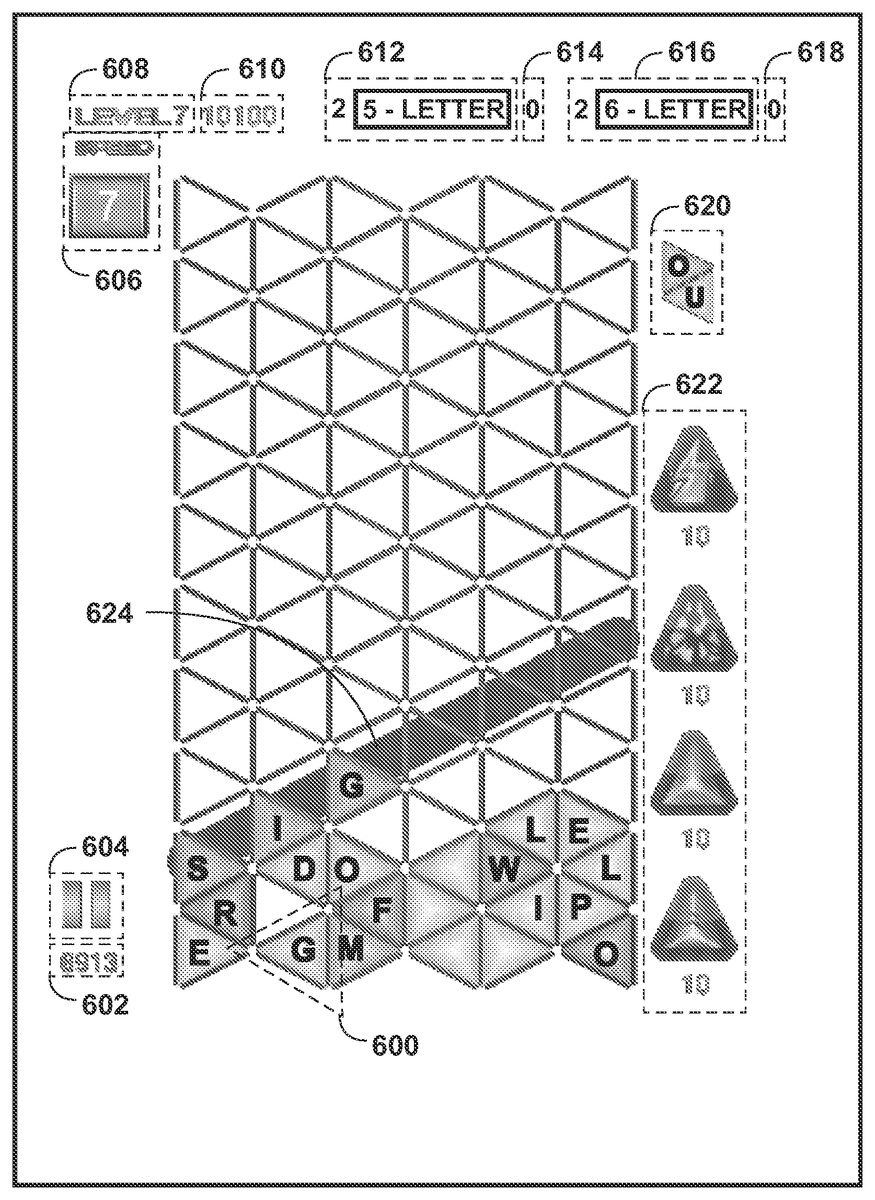
WhileFIGS. 1aand1bprovided a screenshot representation of one embodiment of the present invention,FIG. 6illustrates another embodiment of the present invention, where the set of Primaries is made of triangle pieces, each made of one or a plurality of colors, and each triangle piece of a Single Primary piece, Double Primary piece or a Triple Primary piece includes one or more Grapheme600. The challenge for the player is to move, rotate or influence the Primaries to create the target 5-Letter and 6-Letter Word formations for a level.
Again referring toFIG. 6, the diagonal line624is used to demonstrate the possibility of creating a 5-Letter Word (example “STING”) or a 6-Letter word (example “STINGY”) in the English language using a DIA (Diagonal) formation.
For this embodiment, formations include but are not limited to the construction of Words, Names, Phrases, Clauses and Sentences using Grapheme600in the arrangement of Geometric shapes, forms and objects.
For this embodiment, formations include but are not limited to the construction of Words, Names, Phrases, Clauses and Sentences using Grapheme600in the English language only.
The same exemplary set of Secondaries, the Bonus, Destroyer and Block still hold for this embodiment, with the Bonus Secondary Piece substituting any single Primary triangle so that it can represent any color or any Grapheme600.
The same exemplary set of Reward buttons, Explode, Bonus and Destroyer holds for this embodiment, apart from a slight variation of the Color Button to a Grapheme button. Similar in behavior to a Color Button, the Grapheme button allows a player to change one or more Grapheme600contained in a falling Primary piece by tapping or influencing the Grapheme button any number of times, in turn rotating the falling Primary piece through possible common or useful Grapheme sets before the piece lands. An example of a useful Grapheme set is the set of vowels when the Grapheme is alphabets from the English language.
FIG. 6also shows a Level Indicator608, the Score610, the Target 5-Letter Word formations612for the level, the number of 5-Letter Word formations614the player has created so far in the level, the Target 6-Letter Word formations616for the level, the number of 6-Letter Word formations618the player has created so far in the level, an upcoming Grapheme piece Preview620, the Speed Setting606, a Pause button604, and a Count Down Clock602that shows the time remaining to reach the level target and Reward Buttons622.
In another embodiment of the present invention, the set of Primaries is made of triangle pieces, each made of one or a plurality of colors, and each individual triangle piece also includes one or more Grapheme. For this embodiment, formations include but are not limited to the construction of Words, Names, Phrases, Clauses and Sentences using Grapheme in the arrangement of Geometric shapes, forms and objects.
In still another embodiment, formations include tessellations and tiling. Tiling formations allow for jigsaw puzzles where the entire set of Primaries, or a small set from it include part of a subject, theme, object or picture, and these can be influenced and interlocked to assemble the final picture.
Thus, it is appreciated that the optimum dimensional relationships for the parts of the invention, to include variation in size, materials, shape, form, function, and manner of operation, assembly and use, are deemed readily apparent and obvious to one of ordinary skill in the art, and all equivalent relationships to those illustrated in the drawings and described in the above description are intended to be encompassed by the present invention.
Furthermore, other areas of art may benefit from this method and adjustments to the design are anticipated. Thus, the scope of the invention should be determined by the appended claims and their legal equivalents, rather than by the examples given.
Claims
- A method for a computer game executable and rendered on the display of a portable device, the method comprising: providing on and executing by a computer;displaying a triangular playing grid comprising rows and columns of cells, each of the plurality of cells capable of holding an object, each object having a type;presenting an object for positioning in a grid;moving each object in the grid to a cell adjacent to and below the object unless that cell is occupied by another object or the object is in the bottom most row;identifying objects that result in a desired formation due to their position in the grid;deleting all objects when they create a desired formation;shifting any objects previously resting on the now deleted objects and their previously occupied cell down in the grid to a cell adjacent to and below the object unless that cell is occupied by another object or the object is in the bottommost row;providing an award for the creation of a desired formation;requiring the creation of certain formations during a given time period in order to move to the next level;wherein the desired formations that must be created by a player for scoring are as follows: the hexagonal shape comprised of six individual triangles of the same color;a diagonal string of a plurality of triangles of the same color which in a preferred game embodiment is a diagonal string of eight triangles;a Di-Hexa shape which is comprised of 10 triangles of the same color, where the middle two triangles are shared by the outer four triangles to each side to create two hexagonal shapes;and a Hex-Tri shape which is comprised of a diagonal string of a plurality of triangles of the same color which in a preferred game embodiment is a diagonal string of eight triangles which also shares three triangles with three triangles immediately above or below the diagonal string to create a hexagonal shape;scoring is as follows: for the HEXA shape, it is the time remaining for the player to clear the level divided by four;for the DIA shape it is the time remaining for the player to clear the level;for the DI-HEXA shape, it is two times the score for a HEXA shape;and for the HEX-TRIA shape, it is three times the HEXA shape score plus the DIA shape score.
- The method of claim 1 , wherein the primary falling pieces in the game include single triangle pieces of varying color;double triangle pieces where two triangles are oriented such that one side of each triangle is opposite and parallel to each other;and triple triangles that are arranged to form a trapezoidal shape wherein two triangles surround a middle triangle oriented opposite of the two end triangles.
- The method of claim 2 , further comprising the steps of providing a first movement option for moving a single primary or secondary piece in the same shape and color arrangement as the primary right horizontally within the bounds of the triangular grid comprising the steps of: moving a piece to a first position which is a cell right and then a cell below the original position;moving a piece to a second position which is a cell right and then a cell row above the first position;moving a piece to a third position which is a cell right and then a cell row below the second position;moving a piece to a fourth position is a cell right and then a cell row above the third position;repeating the movement in the same pattern;allowing the pieces to maintain the same orientation as it moves horizontally across the triangular grid;providing a second movement option moving a single primary piece right horizontally within the bounds of the triangular grid comprising the steps of: moving the piece to a first position, which is a cell directly to the immediate right of the original position by flipping the piece horizontally;moving the piece to a second position which is a cell directly to the immediate right of the first position by flipping the piece placed into the first position horizontally;moving the piece to a third position which is a cell directly to the immediate right of the second position by flipping the piece placed into the second position horizontally;moving the piece to a fourth position which is a cell directly to the immediate right of the third position by flipping the piece placed into the third position horizontally;repeating the movement in the same pattern;and allowing the pieces to maintain the same orientation as it moves horizontally across the triangular grid.
- The method of claim 2 , further comprising the steps of providing a movement option for moving a double primary piece or secondary pieces in the same shape and color arrangement, made of two similar colored triangles, right horizontally within the bounds of the triangular grid comprising the steps of: a first horizontal shift moving the top triangle of the piece to a first position, which is a cell right and then a cell below the original position, the bottom piece follows, maintaining the shape and orientation;a second horizontal shift moving the top triangle piece to a second position, which is a cell right and then a cell row above the first position, the bottom piece follows maintaining the shape and orientation;a third horizontal shift moving the top triangle of the piece to a first position, which is a cell right and then a cell below the original position, the bottom piece follows, maintaining the shape and orientation which allows the pieces to maintain the same orientation as it moves horizontally across the triangular grid;repeating the movement in the same pattern;allowing the pieces to maintain the same orientation as it moves horizontally across the triangular grid;providing a movement option for a double primary piece made of two similar colored triangles, right horizontally within the bounds of the triangular grid comprising the steps of: a first horizontal shift moving the top triangle of the piece to a first position, which is a cell directly to the immediate right of the original position by flipping the piece horizontally, and the bottom piece follows maintaining the shape;a second horizontal shift moving the top triangle of the piece to a second position, which is a cell directly to the immediate right of the first position by flipping the piece in the first position horizontally, and the bottom piece follows maintaining the shape;and a third horizontal shift moving the piece to a third position, following the same method of the first horizontal shift that allows the piece to remain in the same cell rows, without moving up or down cells;repeating the movement in the same pattern;and allowing the pieces to maintain the same orientation as it moves horizontally across the triangular grid.
- The method of claim 2 , further comprising the steps of providing a movement option for a double primary piece, made of two different colored triangles, right horizontally within the bounds of the triangular grid comprising the steps of: a first horizontal shift moving the top triangle of the piece to a first position, which is a cell right and then a cell below the original position, the bottom piece follows, maintaining the shape and orientation;a second horizontal shift moving the top triangle piece to a second position, which is a cell right and then a cell row above the first position, the bottom piece follows maintaining the shape and orientation;a third horizontal shift moving the top triangle of the piece to a first position, which is a cell right and then a cell below the original position, the bottom piece follows, maintaining the shape and orientation which allows the pieces to maintain the same orientation as it moves horizontally across the triangular grid;repeating the movement in the same pattern;allowing the pieces to maintain the same orientation as it moves horizontally across the triangular grid;providing a movement option for a Double Primary piece, made of two different colored triangles, right horizontally within the bounds of the Triangular Grid comprising the steps of a first horizontal shift moving the top triangle of the piece to a first position, which is a cell directly to the immediate right of the original position by flipping the piece horizontally, and the bottom piece follows maintaining the shape;a second horizontal shift moving the top triangle of the piece to a second position, which is a cell directly to the immediate right of the first position by flipping the piece in the first position horizontally, and the bottom piece follows maintaining the shape;and a third horizontal shift moving the piece to a third position, following the same method of the first horizontal shift that allows the piece to remain in the same cell rows, without moving up or down cells;repeating the movement in the same pattern;and allowing the pieces to maintain the same orientation as it moves horizontally across the triangular grid.
- The method of claim 2 , further comprising the steps of providing a movement option for a triple primary piece, made of three similar colored triangles, right horizontally within the bounds of the triangular grid;a first horizontal shift moving the top triangle of the piece to a first position which is a cell right and then a cell below the original position, the bottom pieces follow, maintaining the shape and orientation;a second horizontal shift moving the top triangle piece to a second position, which is a cell right and then, a cell row above the first position, the bottom pieces follow maintaining the shape and orientation;a third horizontal shift moving the piece to a third position, moving the top triangle of the piece to a first position which is a cell right and then a cell below the original position, the bottom pieces follow, maintaining the shape and orientation;repeating the movement in the same pattern;allowing the pieces to maintain the same orientation as it moves horizontally across the triangular grid;providing a movement option for a Triple Primary piece, made of three similar colored triangles, right horizontally within the bounds of the Triangular Grid;a first horizontal shift moving the top triangle of the piece to a first position, which is a cell directly to the immediate right of the original position by flipping the piece horizontally, the bottom pieces follow maintaining the shape;a second horizontal shift moving the top triangle of the piece to a second position, which is a cell directly to the immediate right of the first position by flipping the piece in the first position horizontally;the bottom pieces follow maintaining the shape;a third horizontal shift moving the piece to a third position, moving the top triangle of the piece to the third position, which is a cell directly to the immediate right of the second position by flipping the piece horizontally, the bottom pieces follow maintaining the shape;repeating the movement in the same pattern;and allowing the pieces to maintain the same orientation as it moves horizontally across the triangular grid.
- The method of claim 1 , further comprising the steps of creating a target number of formations of geometric shapes, forms, and objects per level using a set of primary sub-formations.
- The method of claim 7 , further comprising the steps of providing secondary sub-formations made up of one or more triangle pieces joined together;and assigning each secondary sub-formation a different attribute to each other or to Primary pieces.
- The method of claim 7 , further comprising the steps of providing a set of reward buttons, which are awarded for completing different formations;and influencing the state of a current falling piece or influencing the state of the next falling piece that is queued by the reward button.
- The method of claim 1 , further comprising the steps of scoring where points are calculated based on the formations created by a player and the time remaining in the level.
- The method of claim 1 , wherein the triangular grid of triangular cells is defined by grid lines, which are rendered and aid understanding of the invention and ease playability;the triangular grid is set into a frame that bounds the playing area of the game;the triangular grid can be bound within a rectangular area, or any regular or any irregular shaped area can bind it;the triangular grid can be completely filled with triangular cells, or it can be a combination of areas with triangular cells and areas where the regular triangular cells are missing;and areas with missing triangular cells provide added degree of difficulty in the game.
- The method of claim 1 , wherein the triangular cells are capable of holding one triangle piece of a primary or a secondary piece at a time;triangle pieces held by cells can be of any color, however, the triangle pieces must be in the same orientation in order to fit into a cell although they may even be differentiated by color;the triangle pieces are movable by a player through an input means of the portable device or computer;the triangle pieces can be moved left, right, and down within the bounds of the grid;and the triangular pieces can be influenced to rotate them or be held to place it into a horizontal position.
- The method of claim 1 , further comprising the steps of providing a level indicator;displaying one or more form the following group: the score;the HEXA shape goal for the level and corresponding number of HEXA formations created so far during play in the level;the DIA shape goal for the level and corresponding number of DIA formations created so far during play in the level;an upcoming Primary piece preview;the speed setting;a pause button;and a count down clock illustrating the time remaining to reach the level goal.
- The method of claim 11 , wherein single triangles can be in any color;double triangles can either be comprised of two similar colored triangles or two triangles of any two colors;and triple triangles can be comprised of three similar colored triangles or three triangles with any color from three different colors.
- The method of claim 1 , further comprising the steps of maneuvering primary game pieces into a desired position before they reach either the bottom of the grid or another game piece that does not allow the falling game piece to continue its downward, falling motion and it becomes fixed on the grid;and maneuvering a primary game pieces to the left, right, or increase its rate of fall in the downward direction.
- The method of claim 1 , wherein the grid is triangular;a single triangle piece can be tapped or influenced to rotate it 180 degrees;a double triangle, whether of two similar colored triangles or two different colored ones, can be tapped or influenced to rotate it 180 degrees or held down to rotate it to a horizontal orientation on the grid;and a triple triangle can be tapped to rotate it 180 degrees.
- The method of claim 16 , further comprising substitution of any single Primary triangle by a bonus secondary piece so that it can represent any color;providing a destroyer secondary piece that destroys everything as it falls in its path;providing a block secondary piece which blocks the grid cells where it lands, disallowing the creation of any formation on those cells;and providing a Color Button that allows changing the color of a falling primary piece any number of times, in turn rotating the falling primary piece through all the possible colors, before the piece lands;providing an Explode Button that allows a falling piece before it land;and providing a bonus button changes the next, previewed and queued, falling primary piece to a bonus secondary piece;and providing a destroyer button that changes the next, previewed and queued, falling primary piece to a destroyer secondary piece.
- The method of claim 1 , further comprising the steps of deleting created formations or objects matching the desired game formations upon a game piece reaching a fixed point in the grid;allowing, upon such deletion any remaining objects in the grid, the remaining pieces to fall down the grid without the player having the ability or opportunity to manipulate them until they reach a new fixed point in the grid;and repeating the steps again if a created formation matching the desired game formations is reached;and rewarding points upon the successful creation, detection, and deletion of a desired game formation.
- The method of claim 1 , wherein the set of primaries is made of triangle pieces, each made of one or a plurality of colors, and each triangle piece of a single primary piece, double primary piece or a triple primary piece includes one or more Grapheme;and formations include the construction of Words, Names, Phrases, Clauses and Sentences using Grapheme in the arrangement of Geometric shapes, forms and objects.
Disclaimer: Data collected from the USPTO and may be malformed, incomplete, and/or otherwise inaccurate.