U.S. Pat. No. 8,708,821
SYSTEMS AND METHODS FOR PROVIDING INTERACTIVE GAME PLAY
AssigneeMQ Gaming LLC
Issue DateDecember 13, 2010
Illustrative Figure
Abstract
A method of interactive game play is provided wherein a seemingly magical wand toy is provided for enabling a trained user to electronically send and receive information to and from other wand toys, a master system and/or to actuate various play effects within a play environment. The toy wand or other seemingly magical object is configured to use a send/received radio frequency communications protocol which provides a basic foundation for a complex, interactive entertainment system to create a seemingly magical interactive play experience.
Description
DETAILED DESCRIPTION OF THE PREFERRED EMBODIMENTS Basic System and Framework FIG. 1illustrates one preferred embodiment of an interactive play structure100having features and advantages in accordance with the present invention. The particular play structure illustrated takes on the theme of a “magic” training center for would-be wizards in accordance with the popular characters and storylines of the children's book series “Harry Potter” by J. K. Rowling. Within this play structure100, play participants105learn to use a “magic wand”200and/or other tracking/actuation device. The wand200allows play participants to electronically and “magically” interact with their surrounding play environment simply by pointing or using their wands in a particular manner to achieve desired goals or produce desired effects within the play environment. Various receivers or transceivers300are distributed throughout the play structure100to facilitate such interaction via wireless communications. Depending upon the degree of game complexity desired and the amount of information sharing required, the transceivers300may or may not be connected to a master system or central server (not shown). Preferably, most, if not all, of the receivers or transceivers300are stand-alone devices that do not require communications with an external server or network. In one particularly preferred embodiment this may be achieved by storing any information required to be shared on the wand200and/or on an associated radio frequency tracking card or badge worn or carried by the play participant (described later). The play structure itself comprises a multi-level structure constructed using any one of an number of materials and construction techniques well known to those skilled in the art. The structure100may be suitable for either outdoor or indoor use, as desired. Preferably, the structure100comprises a supporting framework102formed from a plurality of interconnected support members126, comprising columns, pylons, beams, connectors and the like. The support members126may be formed from any combination of convenient materials having sufficient strength and durability ...
DETAILED DESCRIPTION OF THE PREFERRED EMBODIMENTS
Basic System and Framework
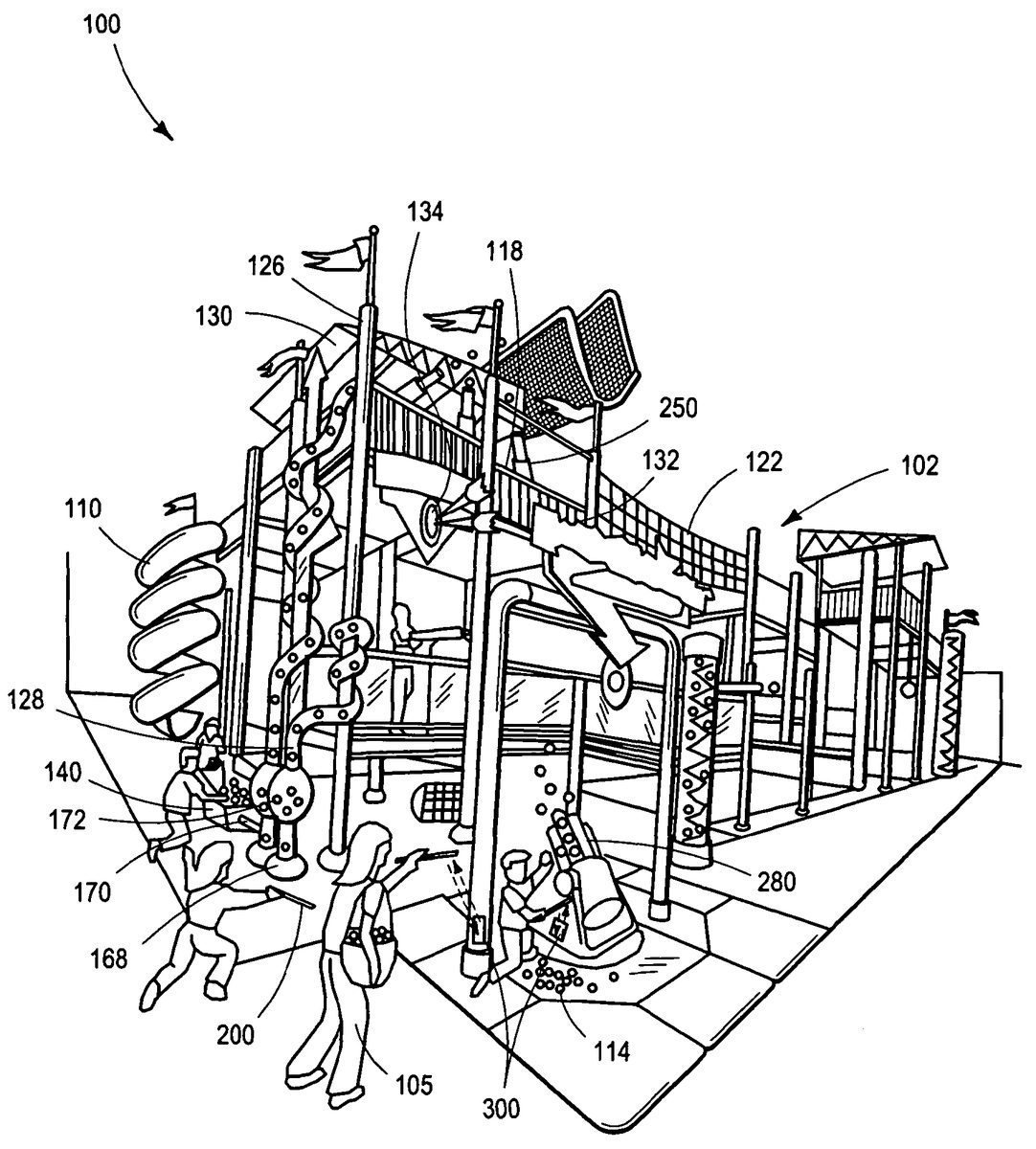
FIG. 1illustrates one preferred embodiment of an interactive play structure100having features and advantages in accordance with the present invention. The particular play structure illustrated takes on the theme of a “magic” training center for would-be wizards in accordance with the popular characters and storylines of the children's book series “Harry Potter” by J. K. Rowling. Within this play structure100, play participants105learn to use a “magic wand”200and/or other tracking/actuation device. The wand200allows play participants to electronically and “magically” interact with their surrounding play environment simply by pointing or using their wands in a particular manner to achieve desired goals or produce desired effects within the play environment. Various receivers or transceivers300are distributed throughout the play structure100to facilitate such interaction via wireless communications. Depending upon the degree of game complexity desired and the amount of information sharing required, the transceivers300may or may not be connected to a master system or central server (not shown). Preferably, most, if not all, of the receivers or transceivers300are stand-alone devices that do not require communications with an external server or network. In one particularly preferred embodiment this may be achieved by storing any information required to be shared on the wand200and/or on an associated radio frequency tracking card or badge worn or carried by the play participant (described later).
The play structure itself comprises a multi-level structure constructed using any one of an number of materials and construction techniques well known to those skilled in the art. The structure100may be suitable for either outdoor or indoor use, as desired. Preferably, the structure100comprises a supporting framework102formed from a plurality of interconnected support members126, comprising columns, pylons, beams, connectors and the like. The support members126may be formed from any combination of convenient materials having sufficient strength and durability for safely supporting multiple play participants105. For example, plastic or PVC pipes, steel pipes, I-beams or channel beams, reinforced concrete beams/columns, and the like may all be used to form the supporting framework102.
For visual appeal and added safety, optional decorative panels, railings132and/or roofing elements130may be provided, as desired, to shade play participants105from the sun (for outdoor play structures), to prevent play participants from falling off the structure100, or to complement a particular desired theme of the play structure100. For instance, in the preferred embodiment shown inFIG. 1, various roof elements130and railings132are provided for added safety and to complement the theme of HARRY POTTER'S “Hogwart School for Wizards.” Decorative panels may be formed of wood, fiberglass or other reinforced fiber, PVC, aluminum, steel or a variety of other suitable materials, as desired. Corrosion-resistant materials are preferred, particularly if the play structure100is to be used outdoors. Of course, those skilled in the art will readily appreciate that a wide variety of other decorative or thematic elements may be incorporated into the overall design of the play structure100in order to provide added safety and/or to help convey a particular desired play theme.
Preferably, a suitable play media, such as foam or rubber balls or similar objects, is provided for use throughout the structure to provide a tactile interactive play experience. A number of conduits128or other transport means are preferably provided throughout the framework102for transporting play media to and from the various play areas in the play structure100. The conduits128may be formed from plastic hosing or PVC pipes joined together using commercially available fittings, as is well known in the art. Conduits128may also be formed from a wide variety of other suitable materials such as steel pipe, ceramic/clay pipe, or they may be formed as open channels and/or runners, as desired. Clear or colored/transparent plastic pipes having an inner diameter of about 2⅛″-6½″, and more preferably about 3-4″, are particularly preferred for aesthetic appeal and added excitement. Alternatively, larger or smaller diameter conduits128or conduits128having different colors or shapes may be used, as desired, to accommodate various sizes and shapes of balls or other play media114. Play media114may be conveniently transported by use of pressurized air or other suitable means, as desired. Various participant-operated or “magically” actuated conveyors may also be employed to circulate balls or other play media114from one area of the structure100to another, as desired.
The particular play structure shown inFIG. 1utilizes thousands of soft foam balls as an interactive play medium114. These may be manipulated by play participants using various interactive play elements to create desired effects. Balls may range in size from approximately 1″ to 12″ in diameter or larger, as desired, and are preferable about 2½″ in diameter. Preferably, the balls are not so small as to present a choking hazard for young children. The majority of the balls may be the same size, or a mixture of ball sizes may be utilized, as desired. A few play elements, as described below, may utilize balls of a relatively large diameter (about 12″ or more). Certain play elements may use only certain sized balls, with filtering relays (not shown) in the conduits128permitting only certain sized balls to roll to certain play areas. A range of colors for the balls may also be used for visual appeal. Optionally, ball sizes and/or types may be color-coded as desired to indicate their use with particular play elements or in certain play zones and/or for facilitating their return to the proper areas when they are removed.
Other suitable play media114may include, without limitation, foam, plastic or rubber balls and similarly formed articles such as cubes, plates, discs, tubes, cones, rubber or foam bullets/arrows, the present invention not being limited to any particular preferred play media. These may be used alone or in combination with one another. For instance, flying discs, such as Frisbees™, may be flung from one location on the play structure100while other play participants shoot at the discs using foam balls or suction-cup arrows. Wet or semi-wet play mediums, such as slime-like materials, snow, mud, squirt guns and/or water balloons may also used, as desired, to cool and entertain play participants. Durable plastic or rubber play media are preferable in an outdoor play structure where environmental exposure may prematurely destroy or degrade the quality of certain play mediums such as foam balls. The particular play media used is not particularly important for purposes of carrying out the invention and, optionally, may be omitted altogether, if desired.
Various electronic interactive play elements are disposed in, on and/or around the play structure100to allow play participants105to create desired “magical” effects, as illustrated inFIG. 1. These may include interactive elements such as projectile accelerators, cannons, interactive targets, fountains, geysers, cranes, filter relays, and the like for amusing and entertaining play participants and/or for producing various desired visual, aural or tactile effects. These may be actuated manually by play participants or, more desirably, “magically” electronically by appropriately using the wand200in conjunction with one or more transceivers300. Some interactive play elements may have simple immediate effects, while others may have complex and/or delayed effects. Some play elements may produce local effects while others may produce remote effects. Each play participant105, or sometimes a group of play participants working together, preferably must experiment with the various play elements and using their magic wands in order to discover how to create the desired effect(s). Once one play participant figures it out, he or she can use the resulting play effect to surprise and entertain other play participants. Yet other play participants will observe the activity and will attempt to also figure it out in order to turn the tables on the next group. Repeated play on a particular play element can increase the participants' skills in accurately using the wand200to produce desired effects or increasing the size or range of such effects. Optionally, play participants can compete with one another using the various play elements to see which participant or group of participants can create bigger, longer, more accurate or more spectacular effects.
A spherical, preferably clear, plastic relay172acts as a trap and/or filter selectively feeding play media114into a holding tank. This tank, in turn, provides play media114to the flexible hose128. Dramatic visual effects are created as multi-colored balls and/or other play media114bounce around the interior of the relay172and are carried up through the spiraling conduit128. The relay172may also be used to collect and/or filter play media114for further transmission along the various conduits128or to other play elements or conveyors as desired.
Other interactive play elements may include, for example and without limitation, a wand activated overhead reservoir for dumping balls or other play media114onto other play participants, a tray or channel for allowing balls or other play media114to roll down onto a target or other play participants, a bucket conveyor for lifting balls or other play media114from a lower collection basin to an elevated container for supplying other play elements, and various interactive targets.
The play structure100also preferably incorporates a number of other conventional (passive) play elements, such as climbing nets, crawl tunnels, swinging bridges, slides110, and the like as shown inFIG. 1. These provide entertaining physical challenges and allow play participants to safely negotiate their way through the various areas of the play structure100. Slides110may be provided at the front, rear, and/or sides of the play structure100and may be straight, curved, or spiral-shaped, as desired. They may also be enclosed and tube-like or open and exposed to flying play media, as desired. Alternatively, those skilled in the art will readily appreciate that the size, number, and location of the various slides110can be varied, as desired, while still enjoying the benefits and advantages of the present invention.
Multiple ball pits and the like may also be provided at various locations throughout the play structure. Those skilled in the art will readily appreciate that a wide variety of other passive play elements, such as funny mirrors, rotating tunnels, trampolines, climbing bars, swings, etc. may all be used to create a desired play environment for carrying out the features and advantages as of the present invention as taught herein.
While a particular preferred play environment and play structure100has been described, it will be readily apparent to those skilled in the art that a wide variety of other possible play environments, play structures, entertainment centers and the like may be used to create an interactive play environment within which the invention may be carried out. For instance, a suitable play structure may be constructed substantially entirely of molded or contoured concrete, fiberglass or plastic, as desired. Alternatively, a suitable play structure may be constructed entirely or partially from conduits or pipes which also transport play media to and from various locations throughout the play structure. Alternatively, the play environment need not comprise a play structure at all, but may be simply a themed play area, or even a multi-purpose area such as a restaurant dining facility, family room, bedroom or the like.
Magic Wand
As indicated above, play participants105within the play structure100learn to use a “magic wand”200and/or other tracking/actuation device. The wand200allows play participants to electronically and “magically” interact with their surrounding play environment simply by pointing or using their wands in a particular manner to achieve desired goals or produce desired effects within the play environment. Use of the wand200may be as simple as touching it to a particular surface or “magical” item within the play structure100or it may be as complex as shaking or twisting the wand a predetermined number of times in a particular manner and/or pointing it accurately at a certain target desired to be “magically” transformed or otherwise affected. As play participants play and interact within the play structure100they learn more about the “magical” powers possessed by the wand200and become more adept at using the wand to achieve desired goals or desired play effects. Optionally, play participants may collect points or earn additional magic levels or ranks for each play effect or task they successfully achieve. In this manner, play participants105may compete with one another to see who can score more points and/or achieve the highest magic level.
FIG. 2illustrates the basic construction of one preferred embodiment of a “magic” wand200having features and advantages in accordance with one preferred embodiment of the invention. As illustrated inFIG. 2Athe wand200basically comprises an elongated hollow pipe or tube310having a proximal end or handle portion315and a distal end or transmitting portion320. If desired, an internal cavity may be provided to receive one or more batteries to power optional lighting, laser or sound effects and/or to power longer-range transmissions such as via an infrared LED transmitter device or RF transmitter device. An optional button325may also be provided, if desired, to enable particular desired functions, such as sound or lighting effects or longer-range transmissions.
FIG. 2Bis a partially exploded detail view of the proximal end315of the magic wand toy200ofFIG. 2A. As illustrated, the handle portion315is fitted with optional combination wheels having various symbols and/or images thereon. Preferably, certain wand functions may require that these wheels be rotated to produce a predetermined pattern of symbols such as three owls, or an owl, a broom and a moon symbol. Those skilled in the art will readily appreciate that the combination wheels may be configured to actuate electrical contacts and/or other circuitry within the wand200in order to provide the desired functionality. Alternatively, the combinations wheels may provide a simple security measure to prevent unauthorized users from actuating the wand.
FIG. 2Cis a partial cross-section detail view of the distal end of magic wand toy200ofFIG. 2A. As illustrated, the distal end320is fitted with an RFID (radio frequency identification device) transponder335that is operable to provide relatively short-range RF communications (<60 cm) with one or more of the receivers or transceivers300distributed throughout play structure100(FIG. 1). At its most basic level, RFID provides a wireless link to uniquely identify objects or people. It is sometimes called dedicated short range communication (DSRC). RFID systems include electronic devices called transponders or tags, and reader electronics to communicate with the tags. These systems communicate via radio signals that carry data either uni-directionally (read only) or, more preferably, bi-directionally (read/write). One suitable RFID transponder is the 134.2 kHz/123.2 kHz, 23 mm Glass Transponder available from Texas Instruments, Inc. (http://www.tiris.com, Product No. RI TRP WRHP). This transponder basically comprises a passive (non-battery-operated) RF transmitter/receiver chip340and an antenna345provided within an hermetically sealed vial350. A protective silicon sheathing355is preferably inserted around the sealed vial350between the vial and the inner wall of the tube310to insulate the transponder from shock and vibration.
FIG. 3is a simplified schematic diagram of one embodiment of an RF transceiver300(FIG. 1) and optional master control system375for use with the magic wand toy actuator ofFIG. 2A. As illustrated, the transceiver300basically comprises an RF Module380, a Control Module385and an antenna390. When the distal end of wand200comes within a predetermined range of antenna390(about 20-60 cm) the transponder antenna345(FIG. 2C) becomes excited and impresses a voltage upon the RF transmitter/receiver chip340disposed within transponder335at the distal end of the wand200. In response, the RF transmitter/receiver chip340causes transponder antenna345to broadcast certain information stored within the transponder335comprising 80 bits of read/write memory. This information typically includes the users unique ID number, magic level or rank and/or certain other information pertinent to the user or the user's play experiences.
This information is initially received by RF Module380, which can then transfer the information through standard interfaces to an optional Host Computer375, Control Module385, printer, or programmable logic controller for storage or action. If appropriate, Control Module385provides certain outputs to activate or control one or more associated play effects, such as lighting, sound, various mechanical or pneumatic actuators or the like. Optional Host Computer375processes the information and/or communicates it to other transceivers300, as may be required by the game. If suitably configured, RF Module380may also broadcast or “write” certain information back to the transponder335to change or update one of more of the 80 read/write bits in its memory. This exchange of communications occurs very rapidly (about 70 ms) and so from the user's perspective it appears to be instantaneous. Thus, the wand200may be used in this “short range” or “passive” mode to actuate various “magical” effects throughout the play structure100by simply touching or bringing the tip of the wand200into relatively close proximity with a particular transceiver300. To provide added mystery and fun, certain transceivers300may be hidden within the play structure100so that they must be discovered by continually probing around the structure using the wand200. The locations of the hidden transceivers may be changed from time to time to keep the game fresh and exciting.
If desired, the wand200may also be configured for long range communications with one or more of the transceivers300(or other receivers) disposed within the play structure100. For example, one or more transceivers300may be located on a roof or ceiling surface, on an inaccessible theming element, or other area out of reach of play participants. Such long-rage wand operation may be readily achieved using an auxiliary battery powered RF transponder, such as available from Axcess, Inc., Dallas, Tex. If line of sight or directional actuation is desired, a battery-operated infrared LED transmitter and receiver of the type employed in television remote control may be used, as those skilled in the art will readily appreciate. Of course, a wide variety of other wireless communications devices, as well as various sound and lighting effects may also be provided, as desired. Any one or more of these may be actuated via button325, as desirable or convenient.
Additional optional circuitry and/or position sensors may be added, if desired, to allow the “magic wand”200to be operated by waiving, shaking, stroking and/or tapping it in a particular manner. If provided, these operational aspects would need to be learned by play participants as they train in the various play environments. The ultimate goal, of course, is to become a “grand wizard” or master of the wand. This means that the play participant has learned and mastered every aspect of operating the wand to produce desired effects within each play environment. Of course, additional effects and operational nuances can (and preferably are) always added in order to keep the interactive experience fresh continually changing. Optionally, the wand200may be configured such that it is able to display 50 or more characters on a LTD or LCD screen. The wand may also be configured to respond to other signals, such as light, sound, or voice commands as will be readily apparent to those skilled in the art.
RFID Tracking Card/Badge
FIGS. 4A and 4Bare front and rear views, respectively, of an optional or alternative RFID tracking badge or card400for use within the interactive play structure ofFIG. 1. This may be used instead of or in addition to the wand200, described above. The particular badge400illustrated is intended to be affixed or adhered to the front of a shirt or blouse worn by a play participant during their visit to suitably equipped play or entertainment facilities. The badge preferably comprises a paper, cardboard or plastic substrate having a front side404and a back side410. The front405of each card/badge400may be imprinted with graphics, photos, or any other information desired. In the particular embodiment illustrated, the front405contains an image of HARRY POTTER in keeping with the overall theme of the play structure100. In addition, the front405of the badge400may include any number of other designs or information pertinent to its application. For example, the guest's name430, and group435may be indicated for convenient reference. A unique tag ID Number440may also be displayed for convenient reference and is particularly preferred where the badge400is to be reused by other play participants.
The obverse side410of the badge400contains the badge electronics comprising a radio frequency tag420pre-programmed with a unique person identifier number (“UPIN”). The tag420generally comprises a spiral wound antenna450, a radio frequency transmitter chip460and various electrical leads and terminals470connecting the chip460to the antenna. Advantageously, the UPIN may be used to identify and track individual play participants within the play facility. Optionally, each tag420may also include a unique group identifier number (“UGIN”) which may be used to match a defined group of individuals having a predetermined relationship—either preexisting or contrived for purposes of game play. If desired, the tag420may be covered with an adhesive paper label (not shown) or, alternatively, may be molded directly into a plastic sheet substrate comprising the card400.
Various readers distributed throughout a park or entertainment facility are able to read the RFID tags420. Thus, the UPIN and UGIN information can be conveniently read and provided to an associated master control system, display system or other tracking, recording or display device for purposes of creating a record of each play participant's experience within the play facility. This information may be used for purposes of calculating individual or team scores, tracking and/or locating lost children, verifying whether or not a child is inside a facility, photo capture & retrieval, and many other useful purposes as will be readily obvious and apparent to those skilled in the art.
Preferably, the tag420is passive (requires no batteries) so that it is inexpensive to purchase and maintain. Such tags and various associated readers and other accessories are commercially available in a wide variety of configurations, sizes and read ranges. RFID tags having a read range of between about 10 cm to about 100 cm are particularly preferred, although shorter or longer read ranges may also be acceptable. The particular tag illustrated is the 13.56 mHz tag sold under the brand name Taggit™. available from Texas Instruments, Inc. (http://www.tiris.com, Product No. RI-103-110A). The tag420has a useful read/write range of about 25 cm and contains 256-bits of on-board memory arranged in 8.times.32-bit blocks which may be programmed (written) and read by a suitably configured read/write device. Such tag device is useful for storing and retrieving desired user-specific information such as UPIN, UGIN, first and/or last name, age, rank or level, total points accumulated, tasks completed, facilities visited, etc. If a longer read/write range and/or more memory is desired, optional battery-powered tags may be used instead, such as available from ACXESS, Inc. and/or various other vendors known to those skilled in the art.
FIGS. 5 and 6are simplified schematic illustrations of tag and reader operation. The tag420is initially activated by a radio frequency signal broadcast by an antenna510of an adjacent reader or activation device500. The signal impresses a voltage upon the antenna450by inductive coupling which is then used to power the chip460(see, e.g.,FIG. 5A). When activated, the chip460transmits via radio frequency a unique identification number preferably corresponding to the UPIN and/or UGIN described above (see, e.g.,FIG. 5B). The signal may be transmitted either by inductive coupling or, more preferably, by propagation coupling over a distance “d” determined by the range of the tag/reader combination. This signal is then received and processed by the associated reader500as described above. If desired, the RFID card or badge400may also be configured for read/write communications with an associated reader/writer. Thus, the unique tag identifier number (UPIN or UGIN) can be changed or other information may be added.
As indicated above, communication of data between a tag and a reader is by wireless communication. As a result, transmitting such data is always subject to the vagaries and influences of the media or channels through which the data has to pass, including the air interface. Noise, interference and distortion are the primary sources of data corruption that may arise. Thus, those skilled in the art will recognize that a certain degree of care should be taken in the placement and orientation of readers500so as to minimize the probability of such data transmission errors. Preferably, the readers are placed at least 30-60 cm away from any metal objects, power lines or other potential interference sources. Those skilled in the art will also recognize that the write range of the tag/reader combination is typically somewhat less (about 10-15% less) than the read range “d” and, thus, this should also be taken into account in determining optimal placement and positioning of each reader device500.
Typical RFID data communication is asynchronous or unsynchronized in nature and, thus, particular attention should be given in considering the form in which the data is to be communicated. Structuring the bit stream to accommodate these needs, such as via a channel encoding scheme, is preferred in order to provide reliable system performance. Various suitable channel encoding schemes, such as amplitude shift keying (ASK), frequency shift keying (FSK), phase shift keying (PSK) and spread spectrum modulation (SSM), are well know to those skilled in the art and will not be further discussed herein. The choice of carrier wave frequency is also important in determining data transfer rates. Generally speaking the higher the frequency the higher the data transfer or throughput rates that can be achieved. This is intimately linked to bandwidth or range available within the frequency spectrum for the communication process. Preferably, the channel bandwidth is selected to be at least twice the bit rate required for the particular game application.
FIG. 7is a simplified block diagram illustrating the basic organization and function of the electronic circuitry comprising the radio frequency transmitter chip460of the RFID tag device420ofFIG. 4B. The chip460basically comprises a central processor530, Analogue Circuitry535, Digital Circuitry540and on-board memory545. On-board memory545is divided into read-only memory (ROM)550, random access memory (RAM)555and non-volatile programmable memory560, which is available for data storage. The ROM-based memory550is used to accommodate security data and the tag operating system instructions which, in conjunction with the processor530and processing logic deals with the internal “house-keeping” functions such as response delay timing, data flow control and power supply switching. The RAM-based memory555is used to facilitate temporary data storage during transponder interrogation and response. The non-volatile programmable memory560may take various forms, electrically erasable programmable read only memory (EEPROM) being typical. It is used to store the transponder data and is preferably non-volatile to ensure that the data is retained when the device is in its quiescent or power-saving “sleep” state.
Various data buffers or further memory components (not shown), may be provided to temporarily hold incoming data following demodulation and outgoing data for modulation and interface with the transponder antenna450. Analog Circuitry535provides the facility to direct and accommodate the interrogation field energy for powering purposes in passive transponders and triggering of the transponder response. Analog Circuitry also provides the facility to accept the programming or “write” data modulated signal and to perform the necessary demodulation and data transfer processes. Digital Circuitry540provides certain control logic, security logic and internal microprocessor logic required to operate central processor530.
Role Play Character Cards
The RFID card400illustrated and described above is used, in accordance with the afore-mentioned preferred embodiment, to identify and track individual play participants and/or groups of play participants within a play facility. However, in another preferred embodiment, the same card400and/or a similarly configured RFID or a magnetic “swipe” card or the like may be used to store certain powers or abilities of an imaginary role-play character that the card400represents. For example, card400may represent the HARRY POTTER character. As each play participant uses his or her favorite character card in various HARRY POTTER play facilities the HARRY POTTER character represented by the card400gains (or loses) certain attributes, such as magic skill level, magic strength, flight ability, various spell-casting abilities, etc. All of this information is preferably stored on the card400so that the character attributes may be easily and conveniently transported to other similarly-equipped play facilities, computer games, video games, home game consoles, hand-held game units, and the like. In this manner, an imaginary role-play character is created and stored on a card that is able to seamlessly transcend from one play medium to the next.
For example, character attributes developed during a play a participant's visit to a local HARRY POTTER/Hogwart magic facility are stored on the card400. When the play participant then revisits the same or another HARRY POTTER play facility, all of the attributes of his character are “remembered” on the card so that the play participant is able to continue playing with and developing the same role-play character. Similarly, various video games, home game consoles, and/or hand-held game units can be and preferably are configured to communicate with the card400in a similar manner as described above and/or using other well-known information storage and communication techniques. In this manner, a play participant can use the character card400and the role play character he or she has developed with specific associated attributes in a favorite video action game, role-play computer game or the like.
FIGS. 8A-8Dare front views of various alternative embodiments of possible role-play character cards for use within a HARRY POTTER/Hogwart interactive play structure such as illustrated inFIG. 1. Role play cards600are preferably constructed substantially the same as the card400illustrated and described above in connection withFIGS. 4B,4B, except with different character illustrations and/or graphics. For example, each card600may include a different character from a HARRY POTTER storyline representing a role-play character desired to be imagined by a play participant. The obverse side (not shown) includes an RFID tag, such as illustrated and described above in connection withFIG. 4B. Alternatively, a magnetic “swipe” strip and/or other well-known information storage means may be used with efficacy, so long as it is relatively compact, durable and inexpensive.
The particular size, shape and theme of the cards600are relatively unimportant. In the particular embodiment illustrated, the cards600are shaped and themed so as to be used as bookmarks for HARRY POTTER series books. These may be packaged and sold together with each HARRY POTTER book, or they may be sold separately as novelty items or the like. If desired, a hole or eyelet610may be provided at the top of each card600so as to facilitate wearing the card600as a pendant on a necklace620or as key-chain trinket. Smaller, pocket-sized cards and/or other similar RFID or magnetic transponder devices may also be used where convenience and market demand dictates. Such transponder devices are commercially available, such as from Texas Instruments, Inc. (http://www.tiris.com, e.g., Prod. Nos. RI-TRP-W9WK, RI-TRP-R9QL, RI-TRP-WFOB).
Master Control System
Depending upon the degree of game complexity desired and the amount of information sharing required, the transceivers300may or may not be connected to a master control system or central server375(FIG. 3). If a master system is utilized, preferably each wand200and/or RFID card400,600is configured to electronically send and receive information to and from various receivers or transceivers300distributed throughout the play facility100using a send receive radio frequency (“SRRF”) communication protocol. This communications protocol provides the basic foundation for a complex, interactive entertainment system which creates a seemingly magic interactive play experience for play participants who possess and learn to use the magical wand. In its most refined embodiments, a user may electronically send and receive information to and from other wands and/or to and from a master control system located within and/or associated with any of a number of play environments, such as a family entertainment facility, restaurant play structure, television/video/radio programs, computer software program, game console, web site, etc. This newly created network of SRRF-compatible play and entertainment environments provides a complex, interactive play and entertainment system that creates a seamless magical interactive play experience that transcends conventional physical and temporal boundaries.
SRRF may generally be described as an RF-based communications technology and protocol that allows pertinent information and messages to be sent and received to and from two or more SRRF compatible devices or systems. While the specific embodiments described herein are specific to RF-based communication systems, those skilled in the art will readily appreciate that the broader interactive play concepts taught herein may be realized using any number of commercially available 2-way and/or 1-way medium range wireless communication devices and communication protocols such as, without limitation, infrared-, digital-, analog, AM/FM-, laser-, visual-, audio-, and/or ultrasonic-based systems, as desired or expedient.
The SRRF system can preferably send and receive signals (up to 40 feet) between tokens and fixed transceivers. The system is preferably able to associate a token with a particular zone as defined by a token activation area approximately 10-15 feet in diameter. Different transceiver and antenna configurations can be utilized depending on the SRRF requirements for each play station. The SRRF facility tokens and transceivers are networked throughout the facility. These devices can be hidden in or integrated into the facility's infrastructure, such as walls, floors, ceilings and play station equipment. Therefore, the size and packaging of these transceivers is not particularly critical.
In a preferred embodiment, an entire entertainment facility may be configured with SRRF technology to provide a master control system for an interactive entertainment play environment using SRRF-compatible magic wands and/or tracking devices. A typical entertainment facility provided with SRRF technology may allow 300-400 or more users to more-or-less simultaneously send and receive electronic transmissions to and from the master control system using a magic wand or other SRRF-compatible tracking device.
In particular, the SRRF system uses a software program and data-base that can track the locations and activities of up to a hundred more users. This information is then used to adjust the play experience for the user based on “knowing” where the user/player has been, what objectives that player has accomplished and how many points or levels have been reached. The system can then send messages to the user throughout the play experience. For example, the system can allow or deny access to a user into a new play area based on how many points or levels reached by that user and/or based on what objectives that user has accomplished or helped accomplish. It can also indicate, via sending a message to the user the amount of points or specific play objectives necessary to complete a “mission” or enter the next level of play. The master control system can also send messages to the user from other users.
The system is preferably sophisticated enough that it can allow multiple users to interact with each other adjusting the game instantly. The master system can also preferably interface with digital imaging and/or video capture so that the users activities can be visually tracked. Any user can locate another user either through the video capturing system or by sending a message to another device. At the end of a visit, users are informed of their activities and the system interfaces with printout capabilities. The SRRF system is preferably capable of sending and receiving signals up to 100 feet. Transmitter devices can also be hidden in walls or other structures in order to provide additional interactivity and excitement for play participants.
Suitable embodiments of the SRRF technology described above may be obtained from a number of suitable sources, such as AXCESS, Inc. and, in particular, the AXCESS active RFID network system for asset and people tacking applications. In another preferred embodiment the system comprises a network of transceivers300installed at specific points throughout a facility. Players are outfitted or provided with a reusable “token”—a standard AXCESS personnel tag clipped to their clothing in the upper chest area. As each player enters a specific interactive play area or “game zone” within the facility, the player's token receives a low frequency activation signal containing a zone identification number (ZID). The token then responds to this signal by transmitting both its unique token identification number (TID) along with the ZID, thus identifying and associating the player with a particular zone.
The token's transmitted signal is received by a transceiver300attached to a data network built into the facility. Using the data network, the transceiver forwards the TID/ZID data to a host computer system. The host system uses the SRRF information to log/track the guest's progress through the facility while interfacing with other interactive systems within the venue. For example, upon receipt of a TID/ZID message received from Zone1, the host system may trigger a digital camera focused on that area, thus capturing a digital image of the player which can now be associated with both their TID and the ZID at a specific time. In this manner the SRRF technology allows the master control system to uniquely identify and track people as they interact with various games and activities in a semi-controlled play environment. Optionally, the system may be configured for two-way messaging to enable more complex interactive gaming concepts.
In another embodiment, the SRRF technology can be used in the home. For enabling Magic at the home, a small SRRF module is preferably incorporated into one or more portable toys or objects that may be as small as a beeper. The SRRF module supports two-way communications with a small home transceiver, as well as with other SRRF objects. For example, a Magic wand200can communicate with another Magic wand200.
The toy or object may also include the ability to produce light, vibration or other sound effects based on signals received through the SRRF module. In a more advanced implementation, the magical object may be configured such that it is able to display preprogrammed messages of up to 50 characters on a LCD screen when triggered by user action (e.g. button) or via signals received through the SRRF module. This device is also preferably capable of displaying short text messages transmitted over the SRRF wireless link from another SRRF-compatible device.
Preferably, the SRRF transceiver300is capable of supporting medium-to-long range (10-40 feet) two-way communications between SRRF objects and a host system, such as a PC running SRRF-compatible software. This transceiver300has an integral antenna and interfaces to the host computer through a dedicated communication port using industry standard RS232 serial communications. It is also desirable that the SRRF transmission method be flexible such that it can be embedded in television or radio signals, videotapes, DVDs, video games and other programs media, stripped out and re-transmitted using low cost components. The exact method for transposing these signals, as well as the explicit interface between the home transceiver and common consumer electronics (i.e. TVs, radios, VCRs, DVD players, NV receivers, etc.) is not particularly important, so long as the basic functionality as described above is achieved. The various components needed to assemble such an SRRF system suitable for use with the present invention are commercially available and their assembly to achieve the desired functionality described above can be readily determined by persons of ordinary skill in the art. If desired, each SRRF transceiver may also incorporate a global positioning (“GPS”) device to track the exact location of each play participant within one or more play environments.
Most desirably, a SRRF module can be provided in “chip” form to be incorporated with other electronics, or designed as a packaged module suitable for the consumer market. If desired, the antenna can be embedded in the module, or integrated into the toy and attached to the module. Different modules and antennas may be required depending on the function, intelligence and interfaces required for different devices. A consumer grade rechargeable or user replaceable battery may also be used to power both the SRRF module and associated toy electronics.
Interactive Game Play
The present invention may be carried out using a wide variety of suitable game play environments, storylines and characters, as will be readily apparent to those skilled in the art. The following specific game play examples are provided for purposes of illustration and for better understanding of the invention and should not be taken as limiting the invention in any way:
Example 1
An overall interactive gaming experience and entertainment system is provided (called the “Magic” experience), which tells a fantastic story that engages children and families in a never-ending adventure based on a mysterious treasure box filled with magical objects. Through a number of entertainment venues such as entertainment facilities, computer games, television, publications, web sites, and the like, children learn about and/or are trained to use these magical objects to become powerful “wizards” within one or more defined “Magic” play environments. The play environments may be physically represented, such as via an actual existing play structure or family entertainment center, and/or it may be visually/aurally represented via computer animation, television radio and/or other entertainment venue or source.
The magical objects use the SRRF communications system allowing for messages and information to be received and sent to and from any other object or system. Optionally, these may be programmed and linked to the master SRRF system. Most preferably, the “magic wand”200is configured to receive messages from any computer software, game console, web site, and entertainment facility, television program that carries the SRRF system. In addition, the magic wand can also preferably send messages to any SRRF compatible system thus allowing for the “wand” to be tracked and used within each play environment where the wand is presented. The toy or wand200also preferably enables the user to interact with either a Master system located within a Magic entertainment facility and/or a home-based system using common consumer electronic devices such as a personal computer, VCR or video game system.
The master control system for a Magic entertainment facility generally comprises: (1) a “Icken” (gag, toy, wand200or other device) carried by the user105, (2) a plurality of receivers or transceivers300installed throughout the facility, (3) a standard LAN communications system (optional), and (4) a master computer system interfaced to the transceiver network (optional). If a Master computer system is used, preferably the software program running on the Master computer is capable of tracking the total experience for hundreds of users substantially in real time. The information is used to adjust the play for each user based on knowing the age of the user, where the user has played or is playing, points accumulated, levels reached and specific objectives accomplished. Based on real-time information obtained from the network, the system can also send messages to the user as they interact throughout the Magic experience.
The Master system can quickly authorize user access to a new play station area or “zone” based on points or levels reached. It can also preferably indicate, via sending a message to the user, the points needed or play activities necessary to complete a “mission.” The Master system can also send messages to the user from other users. The system is preferably sophisticated enough to allow multiple users to interact with each other while enjoying the game in real-time.
Optionally, the Master system can interface with digital imaging and video capture so that the users' activities can be visually tracked. Any user can then locate another user either through the video capturing system or by sending a message to another device. At the end of a visit, users are informed of their activities and other attributes related to the Magic experience via display or printout.
For relatively simple interactive games, the Master system may be omitted in order to save costs. In that case, any game-related information required to be shared with other receivers or transceivers may be communicated via an RS-232 hub network, Ethernet, or wireless network, or such information may be stored on the want itself and/or an associated RFID card or badge carried by the play participant (discussed later). For retrofit applications, it is strongly preferred to provide substantially all stand-alone receivers or transceivers that do not communicate to a master system or network. This is to avoid the expense of re-wiring existing infrastructure. For these applications, any information required to be shared by the game system is preferably stored on the wand or other RFID device(s) carried by the play participants. Alternatively, if a more complex game experience is demanded, any number of commercially available wireless networks may be provided without requiring rewiring or existing infrastructure.
Example 2
A computer adventure game is provided in which one or more play participants assume the role of an imaginary character “Pajama Sam” from the popular series of computer games published by Humongous Entertainment, Inc. of Woodinville, Wash. A Pajama Sam adventure character card700, such as illustrated inFIGS. 9A,9B, is provided to each play participant. The card may be packaged and sold together with the game software, and/or it may be sold separately, as convenience and market demands dictate.
The card700may be constructed substantially the same as the cards400,600illustrated and described above in connection withFIGS. 4 and 8, except with different character illustrations and/or graphics. For example, each card700may include a different character from the Pajama Sam computer game series representing a role-play character desired to be imagined by a play participant. The obverse side (FIG. 9B) includes an RFID tag720, such as illustrated and described above in connection withFIG. 4B. Preferably, the tag720is covered with an adhesive paper label725. Alternatively, the tag720may be molded directly into a plastic sheet substrate from which the card700is then formed. Alternatively, a magnetic “swipe” strip and/or other well-known information storage means may be used with efficacy, so long as it is relatively compact, durable and inexpensive.
The particular size, shape and theme of the card700is relatively unimportant. In the particular embodiment illustrated, the card700is shaped and themed similar to a baseball trading card so that they may be collected and stored conveniently in any baseball card album or the like. If desired, a hole or eyelet (not shown) may be provided at the top of the card700so as to facilitate wearing the card700as a pendant on a necklace or as key-chain trinket. Of course, smaller, pocket-sized cards and/or other similar RFID or magnetic transponder devices may also be used where convenience and market demand dictates. Such alternative suitable transponder devices are commercially available, such as from Texas Instruments, Inc. (http://www.tiris.com, e.g., Prod. Nos. RI-TRP-W9WK, RI-TRP-R9QL, RI-TRP-WFOB).
A specially configured computer, video game, home game console, hand-held gaming device or similar gaming device is provided with a reader, and more preferably a reader/writer such as described above, that is able to communicate with the tag720or other information storage means associated with the card700. As each play participant plays his or her favorite Pajama Sam game the Pajama Sam character represented by the card700gains (or loses) certain attributes, such as speed, dexterity, and/or the possession of certain tools or objects associated with the game play. All of this information is preferably stored on the card700so that the character attributes may be easily and conveniently transported to other similarly-equipped computer games, video games, home game consoles, hand-held game units, play facilities, and the like. In this manner, an imaginary role-play character is created and stored on a card that is able to seamlessly transcend from one play medium to the next.
For example, in the course of playing a typical Pajama Sam game, players must “find” certain objects or tools that they will use to solve certain puzzles or tasks presented by the game. Players “pick up” these objects or tools by clicking their mouse on the desired object. The computer game software then keeps a record of which objects have been collected and displays those objects on the computer screen when requested by the player. This is illustrated byFIG. 10A, which is a screen shot from the computer game, “Pajama Sam, in No Need to Hide When It's Dark Outside,” published by Humongous Entertainment, Inc. © 1996. The game begins in Pajama Sam's bedroom, and the player is asked to find and click on certain objects810that Pajama Sam needs to begin his adventure—namely his flashlight, PajamaMan lunch box and PajamaMan mask. As these objects are located and collected, they are displayed on the bottom of the computer screen, as illustrated inFIG. 10A.
FIG. 10Bis a screen shot from the same game where the player faces his first challenge or puzzle to solve. He or she must somehow make Pajama Sam operate the elevator815to take Pajama Sam up into the tree house820where his archenemy “Darkness” resides. To solve the puzzle the player explores the scene with his mouse and clicks on objects that might be useful to solve the puzzle. Eventually, the player will discover a pile of rocks825which Pajama Sam picks up and tosses into the basket830to operate the elevator. In the next scene (FIG. 10C) Pajama Sam is inside the tree house and the player must decide which of three possible paths to take representing doors840,845and850. Doorway850leads to the scene illustrated inFIG. 10Din which Pajama Sam (and the player) is challenged to a trivia game by a pair of talking doors. The player chooses from different categories of questions and attempts to choose correct answers from a multiple choice list provided by the game (seeFIG. 10E). Ultimately, the player is challenged with a question specific to the game (seeFIG. 10F) and which requires the player to have visited a particular location within the game where the information is contained. If the player has not completed that portion of the computer game, he or she cannot answer the question posed and Pajama Sam cannot advance in the adventure game (seeFIG. 10G).
If the player were to quit the game at this point, he or she could save the game on the host computer and return to the same computer later to complete the adventure. But the Pajama Sam character itself, its attributes, experiences and accomplishments are not portable and cannot presently be transferred from one game or gaming environment to another. However, the Pajama Sam adventure card700in accordance with the present invention enables a play participant to continue the adventure somewhere else (e.g. at a friends house, or a video arcade facility) without having to restart the game and repeat the steps that the player has already accomplished. With the Pajama Sam adventure card700, relevant details of the game experience and the Pajama Sam character are stored on the card700so that the player can take the card to another computer, game console, hand-held game device or a designated Pajama Sam play facility, to continue the adventure in a new and exciting play environment.
For example, the Pajama Sam play facility could be configured as a physical play space similar to that described above in connection withFIG. 1, except having theming and game play that parallels that of one or more of the Pajama Same computer adventure games. Now our computer game player who has a Pajama Same adventure card700can visit this play facility and the facility would be able to read the information on the card and determine that this particular player has already completed the first puzzle in the first Pajama Sam computer adventure game. If the player desires, he or she will be allowed to advance automatically in the game play within the Pajama Sam play facility so that the player can work on a new puzzle. If the player successfully solves a new puzzle at the play facility, this information will be recorded on the Pajama Sam adventure card700. The next time he or she plays the computer game the card can be automatically read and the computer experience can be modified or updated in accordance with the new information recorded on the card. In this manner, the character role-play experience becomes portable, personal and long-term. This, in turn, facilitates the development of even more sophisticated and complex role-play characters and longer, more enjoyable role play experiences as players are able to continue playing with and developing the same role-play character(s) over long periods of time and in different and varied play environments.
Similarly, various other video games, home game consoles, and/or hand-held game units can be and preferably are configured to communicate with the Pajama Sam adventure card700in a similar manner as described above and/or using other well-known information storage and communication techniques. In this manner, a play participant can use the Pajama Sam adventure card700and the role play character he or she has developed with specific associated attributes in a favorite video action game, role-play computer game, internet adventure game or the like.
Example 3
A trading card game is provided wherein a plurality of cards depicting various real or imaginary persons, characters and/or objects are provided and wherein each card has recorded or stored thereon in an electronically readable format certain selected information pertaining to the particular person, character or object, such as performance statistics, traits/powers, or special abilities. The information is preferably stored on an RFID tracking tag associated with each card and which can be read electronically and wirelessly over a predetermined range preferably greater than about 1 cm when placed in the proximity of a suitably configured RF reader. Optionally, the RFID tag may be read/write capable such that it the information stored thereon may be changed or updated in any manner desired. Alternatively, a magnetic strip, bar code or similar information storage means may be used to store relevant information on the card.
FIGS. 11A and 11Bdepict one preferred embodiment of a trading card900having features and advantages in accordance with the present invention. The particular trading card illustrated inFIG. 11Ais provided in the theme of the popular Pokemon characters and, in particular, the character Pikachu.FIGS. 11C and 11Dillustrate several other possible Pokemon themed trading cards which may be provided in accordance with the present invention. Each card preferably comprises a paper, cardboard or plastic substrate having a front side905and a back side910. The front905of the card900may be imprinted with graphics, photos, or any other information as desired. In the particular embodiment illustrated, the front905contains an image of the Pikachu character925in keeping with the Pokemon theme. In addition, the front905of the card900may include any number of other designs or information930pertinent to its application. For example, the character's type, size and evolution may be indicated, along with any special powers or traits the character may possess.
The obverse side910of the card900preferably contains the card electronics comprising a radio frequency tag920pre-programmed with the pertinent information for the particular person, character or object portrayed on the front of the card. The tag920generally comprises a spiral wound antenna950, a radio frequency transmitter chip960and various electrical leads and terminals970connecting the chip960to the antenna. If desired, the tag920may be covered with an adhesive paper label (not shown) or, alternatively, the tag may be molded directly into a plastic sheet substrate from which the card900is formed.
Preferably, the tag920is passive (requires no batteries) so that it is inexpensive to purchase and maintain. Such tags and various associated readers and other accessories are commercially available in a wide variety of configurations, sizes and read ranges. RFID tags having a read range of between about 10 cm to about 100 cm are particularly preferred, although shorter or longer read ranges may also be acceptable. The particular tag illustrated is the 13.56 mHz tag sold under the brand name Taggit™ available from Texas Instruments, Inc. (http://www.tiris.com, Product No. RI-103-110A). The tag920has a useful read/write range of about 25 cm and contains 256-bits of on-board memory arranged in 8*32-bit blocks which may be programmed (written) and read by a suitably configured read/write device. If a longer read/write range and/or more memory is desired, optional battery-powered tags may be used instead, such as available from ACXESS, Inc. and/or various other vendors known to those skilled in the art.
Cards900may be collected or traded and/or they may be used to play various games, such as a Pokemon arena competition using an electronic interface capable of reading the card information. Such games may be carried out using a specially configured gaming device or, alternatively, using a conventional computer gaming platform, home game console, arcade game console, hand-held game device, internet gaming device or other gaming device that has been modified to include an RF reader or magnetic “swipe” reader device as illustrated and described above. Advantageously, play participants can use the trading cards900to transport a information pertinent to a particular depicted person, character or object to a favorite computer action game, adventure game, interactive play structure or the like. For example, a suitably configured video game console and video game may be provided which reads the card information and recreates the appearance and/or traits of particular depicted person, character of object within the game. If desired, the game console may further be configured to write information to the card in order to change or update certain characteristics or traits of the character, person or object depicted by the card900in accordance with a predetermined game play progression.
Of course, those skilled in the art will readily appreciate that the underlying concept of an RIFD trading card900and card game is not limited to cards depicting fantasy characters or objects, but may be implemented in a wide variety of alternative embodiments, including sporting cards, baseball, football and hockey cards, movie character cards, dinosaur cards, educational cards and the like. If desired, any number of other suitable collectible/tradable tokens or trinkets may also be provided with a similar RFID tag device in accordance with the teachings of the present invention as dictated by consumer tastes and market demand.
Although this invention has been disclosed in the context of certain preferred embodiments and examples, it will be understood by those skilled in the art that the present invention extends beyond the specifically disclosed embodiments to other alternative embodiments and/or uses of the invention and obvious modifications and equivalents thereof. Thus, it is intended that the scope of the present invention herein disclosed should not be limited by the particular disclosed embodiments described above, but should be determined only by a fair reading of the claims that follow.
Claims
- A wireless gaming system including physically collectible or tradable items for entertaining one or more game participants playing a game using one or more of a wireless-compatible game console, hand-held game unit, personal computer or play facility, said gaming system comprising: one or more collectible or tradable items depicting or representing persons, characters or objects relevant to said game, each of said one or more collectible or tradable items having associated therewith a passive RFID tag, each said RFID tag comprising: a unique tag ID for identifying or tracking each said corresponding collectible or tradable item;non-volatile, programmable memory configured to selectively store, retrieve and update selected information pertaining to certain relevant attributes, experiences or accomplishments of a person, character or object depicted or represented by each said corresponding collectible or tradable item;a tag antenna sized and configured to be selectively activated or energized by an externally produced radio frequency signal for powering said RFID tag;and a tag transceiver circuit electrically coupled to said tag antenna and powered by said externally produced radio frequency signal configured to wirelessly send and receive information relevant to each said corresponding collectible or tradable item, including at least said unique tag ID and said selected information;an intermediary gaming device for wirelessly communicating with said one or more collectible or tradable items and a wireless-compatible game console, hand-held game unit, personal computer or play facility, said intermediary gaming device comprising: i) an RFID reader configured to wirelessly power and communicate with each said RFID tag when placed in proximity to said intermediary gaming device and to thereby send and receive information relevant to each said collectible or tradable item, including at least said unique tag ID and said selected information;and ii) a wireless transceiver configured to wirelessly communicate with said game console, hand-held game unit, personal computer or play facility, and to thereby send and receive information relevant to each said collectible or tradable item, including at least said unique tag ID and said selected information;whereby game participants can affect the play of said game by selectively placing said one or more collectible or tradable items in proximity to said intermediary gaming device and whereby said selected information associated with said selectively placed collectible or tradable items can be stored, retrieved and updated according to the play of said game.
- The wireless gaming system of claim 1 , wherein at least one of said collectible or tradable items comprises a token depicting or representing a person, character or object relevant to said game.
- The wireless gaming system of claim 1 , wherein at least one of said corresponding RFID tags comprises programmable memory further configured to selectively store, retrieve or update information uniquely identifying at least one of said one or more game participants, whereby said identifying information can be communicated to said game console, hand-held game unit, personal computer or play facility and used thereby for purposes of scoring or creating a performance record for said at least one game participant.
- The wireless gaming system of claim 1 , wherein at least one of said corresponding RFID tags comprises programmable memory further configured to selectively store, retrieve or update said unique tag ID, whereby said unique tag ID can be selectively changed or updated.
- The wireless gaming system of claim 1 , wherein said wireless-compatible game console, hand-held game unit, personal computer or play facility is configured to produce one or more computer-animated visual, aural or tactile effects in accordance with said game and wherein at least one of said corresponding RFID tags comprises programmable memory further configured to selectively store, retrieve or update selected information describing the appearance, traits, attributes, game objects or tools possessed by an associated particular person, character or object depicted or represented by said corresponding collectible or tradable item, whereby said depicted or represented particular person, character or object can be recreated in the computer animation of said game in accordance with the described appearance, traits, attributes, game objects or tools.
- The wireless gaming system of claim 1 , wherein said game comprises a computer-animated role-play game carried out in accordance with a magic theme and wherein at least one of said corresponding RFID tags comprises programmable memory further configured to selectively store, retrieve or update selected information describing the magic skill level, magic strength, flight ability or spell-casting ability possessed by an associated particular person, character or object depicted or represented by each said corresponding collectible or tradable item, whereby said depicted or represented particular person, character or object can be recreated in the computer animation of said game in accordance with the described magic skill level, magic strength, flight ability or spell-casting ability.
- The wireless gaming system of claim 1 , wherein said RFID tag comprises a passive, batteryless 13.56 MHz RFID tag and wherein said tag antenna comprises a substantially flat spiral wound antenna.
- The wireless gaming system of claim 1 , wherein at least one of said one or more collectible or tradable items is further configured to produce light, vibration or sound effects.
- The wireless gaming system of claim 1 , further comprising a second intermediary gaming device configured to wirelessly communicate with said one or more collectible or tradable items and a separate and different game console, hand-held game unit, personal computer or play facility, whereby said one or more collectible or tradable items representing particular persons, characters or objects relevant to a first user-selectable game and having stored attributes, experiences or accomplishments may be physically collected, transported and played in a second user-selectable game using said separate and different game console, hand-held game unit, personal computer or play facility.
- The wireless gaming system of claim 1 , further comprising one or more handheld devices configured to be held and used by said one or more game participants to wirelessly communicate with said intermediary gaming device or said wireless-compatible game console, hand-held game unit, personal computer or play facility while playing said game, at least one of said handheld devices comprising motion- or position-sensitive circuitry operatively associated with said at least one handheld device and configured to enable said handheld device to be operated by moving the entire body of said at least one handheld device in free space to activate or control one or more visual effects associated with said game.
- A portable gaming device for playing a user-selectable interactive game using one or more of a wireless-compatible game console, hand-held game unit, personal computer or play facility and one or more RFID-tagged items depicting or representing persons, characters or objects relevant to said game, each of said one or more RFID-tagged items having associated therewith a passive read/write RFID tag each having a unique tag ID and selected stored information representing certain relevant attributes, experiences or accomplishments of a corresponding person, character or object depicted or represented by each said corresponding RFID-tagged item, said portable gaming device comprising: an RFID reader configured to wirelessly power and provide short-range two-way wireless communications with each said RFID-tagged item when placed within a limited communication range of less than 60 cm from said RFID reader and to send and receive to and from each said associated RFID tag certain information relevant to each said RFID-tagged item, including at least said unique tag ID and said selected stored information;a first transceiver electrically coupled to said RFID reader and configured to provide medium-range two-way wireless communication over a communication range greater than 10 feet;and wherein said first transceiver is further configured to wirelessly communicate with a second transceiver comprising a wireless communication interface of a wireless-compatible game console, hand-held game unit, personal computer or play facility to thereby send and receive information relevant to each said RFID-tagged item, including at least said unique tag ID and said selected stored information;whereby game participants can affect the play of said game by selectively placing said one or more RFID-tagged items in short-range proximity to said RFID reader, and whereby said selected stored information associated with said selectively placed RFID-tagged items can be stored, retrieved and updating according to the play of said game.
- The portable gaming device of claim 11 , wherein said portable gaming device is further configured to produce light, vibration or sound effects based at least in part on information received from said second transceiver.
- The portable gaming device of claim 11 , in combination with a second gaming device configured to wirelessly communicate with said one or more RFID-tagged items and a separate and different game console, hand-held game unit, personal computer or play facility, whereby said one or more RFID-tagged items depicting or representing persons, characters or objects relevant to a first user-selectable game and having stored attributes, experiences or accomplishments may be physically collected, transported and played in a second user-selectable game using said separate and different game console, hand-held game unit, personal computer or play facility.
- The portable gaming device of claim 11 , further comprising one or more wireless handheld input devices configured to be held and used by one or more game participants to wirelessly communicate with said wireless-compatible game console, hand-held game unit, personal computer or play facility while playing said game, at least one of said wireless handheld input devices comprising an elongated body and motion- or position-sensitive circuitry operatively associated with the elongated body for enabling said wireless handheld input device to be operated at least in part by moving the elongated body in a particular manner to activate or control one or more visual effects associated with said game.
- A wireless interactive entertainment system for communicatively interfacing with one or more portable wireless toys and a wireless-compatible video game system, personal computer or entertainment facility for amusing or entertaining one or more game participants playing a game in which a computer-generated play environment is represented through one or more computer-animated effects, said wireless interactive entertainment system comprising: an intermediary gaming device comprising a first wireless RF transceiver configured to provide two-way short-range wireless communication with one or more portable wireless toys;at least one motion-sensitive handheld controller comprising a second wireless RF transceiver configured to provide two-way medium-range wireless communication with said wireless-compatible video game system, personal computer or entertainment facility, and further comprising motion- or position-sensitive circuitry for enabling said handheld controller to be operated at least in part by moving the entire body of said handheld controller in one or more motions to activate or control said one or more computer-animated effects in accordance with said game;and at least one portable wireless toy comprising a collectible or tradable item depicting or representing a particular person, character or object relevant to said game, and further comprising a third wireless RF transceiver configured to provide two-way short-range wireless communication with at least said intermediary gaming device, and wherein said at least one portable wireless toy is further configured to wirelessly send and receive game-relevant information to and from at least said intermediary gaming device, and wherein said intermediary gaming device is further configured to communicate said game-relevant information to and from at least said wireless-compatible video game system, personal computer or entertainment facility;whereby said wireless-compatible video game system, personal computer or entertainment facility can use said game-relevant information to adjust the game experience for said one or more game participants and whereby said one or more game participants can use said motion-sensitive handheld controller and said at least one portable wireless toy to wirelessly interact with said wireless-compatible video game system, personal computer or entertainment facility.
- The wireless interactive entertainment system of claim 15 , wherein said at least one portable wireless toy is further configured to produce light, vibration or sound effects based on information wirelessly transmitted by said wireless-compatible video game system, personal computer or entertainment facility.
- The wireless interactive entertainment system of claim 15 , wherein said at least one portable wireless toy comprises a toy wand controller configured to be held and used by said one or more game participants to wirelessly communicate with said intermediary gaming device, said wireless-compatible video game system, personal computer or entertainment facility.
- The wireless interactive entertainment system of claim 17 , wherein said toy wand controller is further configured to be operated by waving or shaking it in a particular manner to thereby actuate a particular desired effect within said game.
- The wireless interactive entertainment system of claim 15 , wherein said first and third wireless RF transceivers are configured to provide two-way wireless communication at least in part by inductive coupling.
- The wireless interactive entertainment system of claim 15 , wherein said third wireless RF transceiver comprises an RFID tag having a non-volatile, programmable memory configured to selectively store, retrieve and update selected information relevant to said game, and wherein said first wireless RF transceiver comprises an RFID reader configured to wirelessly power and communicate with said RFID tag and to send and receive to and from said RFID tag said selected information relevant to said game.
- The wireless interactive entertainment system of claim 15 , wherein said at least one portable wireless toy comprises a passive RFID tag, said RFID tag further comprising: a tag ID for identifying or tracking said at least one portable wireless toy;non-volatile, programmable memory configured to selectively store, retrieve and update selected information pertaining to certain relevant attributes, experiences or accomplishments of said depicted or represented person, character or object;a tag antenna sized and configured to be selectively activated or energized by an externally produced radio frequency signal for powering said RFID tag;and a tag transceiver circuit electrically coupled to said tag antenna and powered by said externally produced radio frequency signal for wirelessly sending and receiving said tag ID and said selected information relevant to said depicted or represented person, character or object.
- The wireless interactive entertainment system of claim 21 , wherein said intermediary gaming device comprises an RFID reader configured to wirelessly power and communicate with said RFID tag over a limited communication range of less than 60 cm when said RFID tag is placed in proximity with said RFID reader and to thereby send and receive said tag ID and said selected information relevant to said depicted or represented person, character or object.
- The wireless interactive entertainment system of claim 21 , wherein said collectible or tradable item comprises a token depicting or representing a person, character or object relevant to said game.
- The wireless interactive entertainment system of claim 21 , wherein said programmable memory is further configured to selectively store, retrieve or update information uniquely identifying at least one of said one or more game participants, whereby said stored identifying information can be communicated to said video game system, personal computer or entertainment facility and used for purposes of scoring or creating a performance record for said at least one game participant.
- The wireless interactive entertainment system of claim 15 , wherein said at least one portable wireless toy comprises a global positioning system (GPS) device.
- The wireless interactive entertainment system of claim 15 , wherein said at least one portable wireless toy comprises a display screen configured to display game scoring, game play objectives and/or text messages.
- A motion-sensitive wireless interactive gaming system including physically collectible or tradable items for entertaining one or more game participants playing a game in which a computer-generated play environment is represented through one or more computer-animated effects, said gaming system comprising: a host system comprising a game console, hand-held game unit, personal computer or play facility configured to host said game;at least one wireless motion-sensitive handheld device configured to be held and used by said one or more game participants to wirelessly communicate with said host system at least in part by moving the entire body of said handheld device in free space to thereby activate or control said one or more computer-animated effects;one or more collectible or tradable items each depicting or representing a person, character or object relevant to said game, at least one of said one or more collectible or tradable items having associated therewith an RFID tag, said RFID tag further comprising: a tag ID for identifying or tracking each said collectible or tradable item;non-volatile memory configured to facilitate storage and retrieval of selected information pertaining to certain relevant attributes, experiences or accomplishments of said depicted or represented person, character or object;a tag antenna sized and configured to be selectively activated or energized by an externally produced radio frequency signal for powering said RFID tag;and a tag transmitter circuit electrically coupled to said tag antenna and powered by said externally produced radio frequency signal for wirelessly transmitting at least said tag ID and said selected information;and an RFID reader communicatively associated with said host system and configured to wirelessly power and communicate with said RFID tag when said corresponding at least one collectible or tradable item is placed in proximity to said RFID reader and to thereby receive at least said tag ID and said selected information, said RFID reader being further configured to communicate said received tag ID and said selected information to said host system;whereby an interactive entertainment experience is provided wherein said one or more game participants are able to affect the play of said game by moving said at least one wireless motion-sensitive handheld device in free space and/or by selectively placing said at least one collectible or tradable item in readable proximity to said RFID reader.
- The gaming system of claim 27 , wherein at least one of said collectible or tradable items comprises a card, trinket, token or pendant depicting or representing a person, character or object relevant to said game.
- The gaming system of claim 27 , wherein said memory is programmable and wherein said RFID reader is further configured to selectively store, retrieve and update said selected information stored in said memory when said corresponding at least one collectible or tradable item is placed in proximity to said RFID reader, whereby said selected information can be stored, retrieved and updating according to the play of said game.
- The gaming system of claim 29 , wherein said memory is further configured to store, retrieve or update information uniquely identifying at least one of said one or more game participants, and wherein said stored identifying information can be selectively communicated to said host system and used to score or create a performance record for said at least one game participant.
- The gaming system of claim 27 , wherein said memory is further configured to selectively store selected information describing the appearance, traits, attributes, game objects or tools possessed by said person, character or object depicted or represented by said corresponding at least one collectable or tradable item, and wherein said host system is further configured to recreate said depicted or represented person, character or object in the computer animation of said game in accordance with said described appearance, traits, attributes, game objects or tools.
- The gaming system of claim 27 , wherein said RFID tag comprises a passive, batteryless 13.56 MHz RFID tag and wherein said tag antenna comprises a substantially flat spiral wound antenna.
- A handheld wireless gaming device for amusing or entertaining one or more game participants playing a game using a wireless-compatible gaming platform in which a computer-generated play environment is visually and aurally represented through one or more computer-animated effects, said handheld wireless gaming device comprising: a portable body configured to be held and moved in free space and operated by a game participant to selectively activate or control said one or more computer-animated effects;a first radio frequency (RF) transceiver configured to provide short-range two-way wireless communication with a wireless-compatible device over a limited communication range of less than 60 cm and wherein said short-range two-way wireless communication is facilitated at least in part through inductive coupling;a second RF transceiver configured to provide medium-range two-way wireless communication with said wireless-compatible gaming platform over a communication range greater than 10 feet;motion-sensitive circuitry configured to enable said handheld wireless gaming device to be operated at least in part by moving said portable body in free space to activate or control said one or more computer-animated effects associated with said game;a display screen configured to display game scoring, objectives and/or messages based at least in part on information wirelessly communicated to said handheld wireless gaming device by said wireless-compatible gaming platform;and an effects generator configured to produce one or more vibration or sound effects based on information wirelessly communicated to said handheld wireless gaming device by said wireless-compatible gaming platform.
- The handheld wireless gaming device of claim 33 , wherein said wireless-compatible gaming platform comprises a game console, handheld game unit, personal computer or live-action play facility.
- The handheld wireless gaming device of claim 33 , wherein said motion-sensitive circuitry is configured to sense and distinguish one or more waving or shaking motions of said portable body.
- The handheld wireless gaming device of claim 33 , wherein said first RF transceiver is configured to operate at a carrier wave frequency of 13.56 MHz.
- The handheld wireless gaming device of claim 36 , wherein said first RF transceiver uses an amplitude frequency shift keying (FSK) channel encoding scheme.
- The handheld wireless gaming device of claim 33 , further comprising a global positioning system (GPS) device configured to determine the geographical location of said handheld wireless gaming device.
- The handheld wireless gaming device of claim 33 , further comprising programmable memory configured to store a unique identification number for uniquely identifying said handheld wireless gaming device within said game and for distinguishing said handheld wireless gaming device from one or more other wireless devices that may be operated by other game participants.
- The handheld wireless gaming device of claim 33 , further comprising at least one user-actuable button configured to selectively activate or control at least one associated function of said handheld wireless gaming device.
- The handheld wireless gaming device of claim 33 , in combination with a wireless-compatible gaming platform comprising a home game console configured to produce one or more computer-animated effects in accordance with said game.
- The combination of claim 41 , in further combination with game software configured to be executed by said home game console to carry out said game, said game software including program instructions for causing said home game console to conduct an interactive game in which a virtual play environment is represented through one or more computer animations, to track the game progress or performance of said one or more game participants playing said interactive game, to wirelessly transmit selected messages or other game-relevant information to be displayed on said display screen, and to adjust the play experience for said one or more game participants based at least in part on said tracked game progress or performance.
- The handheld wireless gaming device of claim 33 , in combination with a wireless motion-sensitive input device sized and configured to be held and moved freely in the air and to be operated by a game participant using a single hand to play said game at least in part by moving the entire body of said input device in one or more motions, and wherein said input device is further configured to wirelessly communicate with said handheld wireless gaming device or said wireless-compatible gaming platform.
- The handheld wireless gaming device of claim 33 , in combination with an image capture system configured to be triggered at least in part by said handheld wireless gaming device and further configured to capture one or more digital images of said one or more game participants playing said game.
- The handheld wireless gaming device of claim 33 , wherein said first RF transceiver is configured to provide short-range two-way wireless communications with said wireless-compatible device over a limited communication range between 1 cm and 25 cm.
- The handheld wireless gaming device of claim 33 , wherein said portable body is sized and configured to be held and operated by said game participant using a single hand to wirelessly activate or control said one or more computer-animated effects.
Disclaimer: Data collected from the USPTO and may be malformed, incomplete, and/or otherwise inaccurate.