U.S. Pat. No. 8,702,510
METHOD AND APPARATUS FOR USER-SELECTED MANIPULATION OF GAMEPLAY MECHANICS
AssigneeDisney Enterprises Inc
Issue DateJuly 18, 2008
Illustrative Figure
Abstract
One particular implementation of the present invention may take the form of a method and system for a user of a video game to alter game scenes, objects and models in real-time by drawing shapes within the video game environment during game play. The method may include artificial intelligent reactions by the gameplay mechanics to the user-selected alterations to the video game as the alterations are made. More particularly, one method for manipulating a video game may allow the user to alter the environment of the video game by using a drawing tool to draw shapes within the video game environment. The video game may recognize the shape drawn within the game and generate a rendered shape corresponding to the drawn shape. The user may also alter character models or sprites within the video game to stretch or shrink the model. Further, the above methods may occur within a two-dimensional or three-dimensional video game environment. The user may use a video game controller including a tablet-type device to facilitate the user drawing a shape within the video game environment.
Description
DETAILED DESCRIPTION One particular implementation of the present invention may take the form of a method for allowing a user of a video game to alter game scenes, objects and models in real-time by drawing shapes within the video game environment during game play. The method may include programmatic reactions by the gameplay mechanics to the user-selected alterations to the video game as the alterations are made. Further, the method may include game space, background, coloring, shading, pace or other alterations to the video game environment in response to the alteration of the game space. More particularly, one method for manipulating a video game may allow the user to alter the game space by using a drawing tool to draw shapes within the video game environment. The video game may recognize the shape drawn within the game and generate a rendered shape corresponding to the drawn shape. The video game and characters within the video game may also react to the rendered shape in real time. In this manner, the user or player may manipulate the environment of the video game by drawing shapes within the game space, thereby changing the video game environment and the reactions of the characters of the game. A second method may allow the player to alter character models or sprites within the video game to stretch or shrink the model. Programmatic characteristics of the video game characters may react accordingly. A third method may allow the player to create new action options within the video game by drawing shapes within the video game environment and on the video game characters. The characters and sprites of the video game may react to the new actions accordingly. The above methods may occur within a two-dimensional or three-dimensional video game environment. FIG. 1is a block diagram illustrating ...
DETAILED DESCRIPTION
One particular implementation of the present invention may take the form of a method for allowing a user of a video game to alter game scenes, objects and models in real-time by drawing shapes within the video game environment during game play. The method may include programmatic reactions by the gameplay mechanics to the user-selected alterations to the video game as the alterations are made. Further, the method may include game space, background, coloring, shading, pace or other alterations to the video game environment in response to the alteration of the game space.
More particularly, one method for manipulating a video game may allow the user to alter the game space by using a drawing tool to draw shapes within the video game environment. The video game may recognize the shape drawn within the game and generate a rendered shape corresponding to the drawn shape. The video game and characters within the video game may also react to the rendered shape in real time. In this manner, the user or player may manipulate the environment of the video game by drawing shapes within the game space, thereby changing the video game environment and the reactions of the characters of the game. A second method may allow the player to alter character models or sprites within the video game to stretch or shrink the model. Programmatic characteristics of the video game characters may react accordingly. A third method may allow the player to create new action options within the video game by drawing shapes within the video game environment and on the video game characters. The characters and sprites of the video game may react to the new actions accordingly. The above methods may occur within a two-dimensional or three-dimensional video game environment.
FIG. 1is a block diagram illustrating a video game system configured in accordance with aspects of the present disclosure. The video game system100may include a controller110, a console120, a storage device130, and a display device140. It should be noted that the video game system depicted inFIG. 1is illustrative only. Alternative embodiments of a video game system may add components, omit components, or may change the configuration of the in which the components are connected.
Video game system100is one example of a platform for running a video game configured in accordance with the present disclosure. Such a video game system100, however, may be played on any platform that provides a user-interaction with a video game, including in-home video game consoles that attach to a television, personal computers, handheld video game consoles, mobile phones, personal digital assistants, music or audio players, and so on. Accordingly, a “video game system” as used herein, encompasses all such devices and any other device that allows a user to interact and play a video game, configured as set forth herein.
A video game system may include a controller device110or several controller devices. A controller110of a video game system may allow a user or player to provide inputs to the video game system to control the various characters and features of the video game. The controller may connect to a video game console120by plugging the controller110directly into the console120or the controller110may connect wirelessly. Further, in video game systems that are handheld, the controller may be built directly into the console device. The controller device100to the video game system may include, but is not limited to, a controller containing a directional pad and a series of buttons, a joystick, a tablet device, a mouse, a keyboard, a device taking the shape of a separate input device with a series of buttons (i.e. a drum, a guitar, a dance pad), a stylus, and so on. Accordingly, a “controller” as used herein, encompasses all such devices that allows a user to provide an input to the video game system so that the user may interact with the video game. Several embodiments of controllers are described in more detail below with respect toFIGS. 11-16.
The video game console120may provide many functions for the video game system. The console120may accept and interpret the inputs being provided by the user through the video game controller110. The console120may also provide the display output to a display device140. Further, the console120may accept and interpret the video game code from a storage device130in which the code may be stored. In this manner, the console120may be similar in design and functionality as a typical home computing system. Accordingly, a “console” as used herein, encompasses all such devices that may provide a platform through which a user of the video game system may interact and play a video game.
The video game code may be written in any computer-readable medium and stored on any computer-readable storage device130, including optical disks, flash media, floppy disks, hard drives and so on. The video game code may be read by the console from the storage device130during game play to provide the computer-generated environment in which the players interact. Further, many varied types of video games may support the present embodiment. Such games include first-person games, side-scrolling games, sports-related games, role-playing games, action games, strategy games, casino games, and so on. Accordingly, a “video game” as used herein, encompasses all such games and any other video games that may be played on a video game system.
The video game system100may also include a display device140. For in-home video game systems, the display device140is typically a television, including CRT, plasma, and LCD televisions. For handheld video game systems, the display device140is typically embodied within the handheld device and may include plasma and LCD-type screens. For video game systems embodied in a personal computer, the display device140is typically a monitor connected to the personal computer. Accordingly, a “display device” as used herein, encompasses all such display devices that provides a visual representation of the video game.
FIG. 2is one example of a video game environment with the capabilities of a first embodiment. The video game200may include one or more characters. For example, the video game200depicted inFIG. 2includes a cat character210and a dog character220. One or both of the characters may be controlled by the video game user through a video game controller. Further, one or both of the characters may move independent of the user's input, normally through the video games programmatic characteristics of the characters. Those skilled in the art will appreciate the many ways a video game may control the characters embodied in the video game environment, either through programmed characteristics of the characters or through a user input.
FIG. 3is an example of a video game with the capabilities of the first embodiment illustrating using a drawing device to alter the game space by drawing a shape within the video game environment.FIG. 3depicts a similar example of a video game as that depicted inFIG. 2and includes the same characters and video game environment. However,FIG. 3further depicts a user of the video game altering the game environment by drawing a shape within the video game and, hence, adding a new feature to the video game environment to interact with the characters.
As shown inFIG. 3, the video game300may include a user-controlled icon or drawing device330that may be used for drawing shapes and lines within the video game environment. The drawing device330may be used by the player to draw shapes within the video game environment to ultimately create rendered shapes that the video game characters may then interact with. InFIG. 3, the drawing device330icon is a pencil. However, the drawing device330icon may take any shape. For example, the drawing device330icon may take the shape of an arrow, similar to the pointer of a typical computer mouse.
The drawing device330may be controlled by the user through a video game controller. For example, the user may move a mouse controller of a typical computer system to move the drawing device330around the video game environment. The user may then depress and hold a button located on the mouse to activate the drawing feature of the video game. The video game system may interpret the button pushing and movement of the mouse controller as an indication that the user is drawing in the video game environment. Thus, a line may be drawn within the video game as the mouse moves while the button on the mouse is being pressed. In this manner, the user may draw a shape within the environment of the video game.
An alternative operation to control the drawing device330within the video game environment may include the user maneuvering the drawing device icon using a directional pad of a video game controller. The controller may also include buttons that may be pressed by the user to indicate that drawing is to begin. Through the directional pad and buttons of the controller, the user may draw a variety of shapes within the video game environment.
Another operation to control the drawing device330within a video game environment may be accomplished through a tablet input to the video game system. The tablet may include a stylus-type device that interfaces with a flat panel of the device. The user may use the stylus to draw shapes on the flat panel of the device. The tablet may then interpret the shape drawn on the flat panel and draw a corresponding shape within the video game environment. Thus, the tablet may provide the user with the feeling of drawing with the stylus directly within the video game environment. Several embodiments of a tablet-type video game controller are described in more detail below with respect toFIGS. 11-16.
While several examples of methods to manipulate a drawing icon within a video game are presented, any input device recognized by the video game system may be used to draw shapes within the video game.
The user may draw a circular shape within the environment of the video game using the drawing device330. In the example ofFIG. 3, a user may draw a circle340under the cat character310in the video game environment. As explained above, the video game may draw a line that follows the drawing device330as the user draws within the video game using the video game controller. In this manner, the user may draw the shape of a circle340under the cat character310. Once the user of the video game completes the shape, the drawn shape may then be used by the video game to manipulate the video game environment and gameplay in reaction to the drawn shape as depicted inFIG. 4.
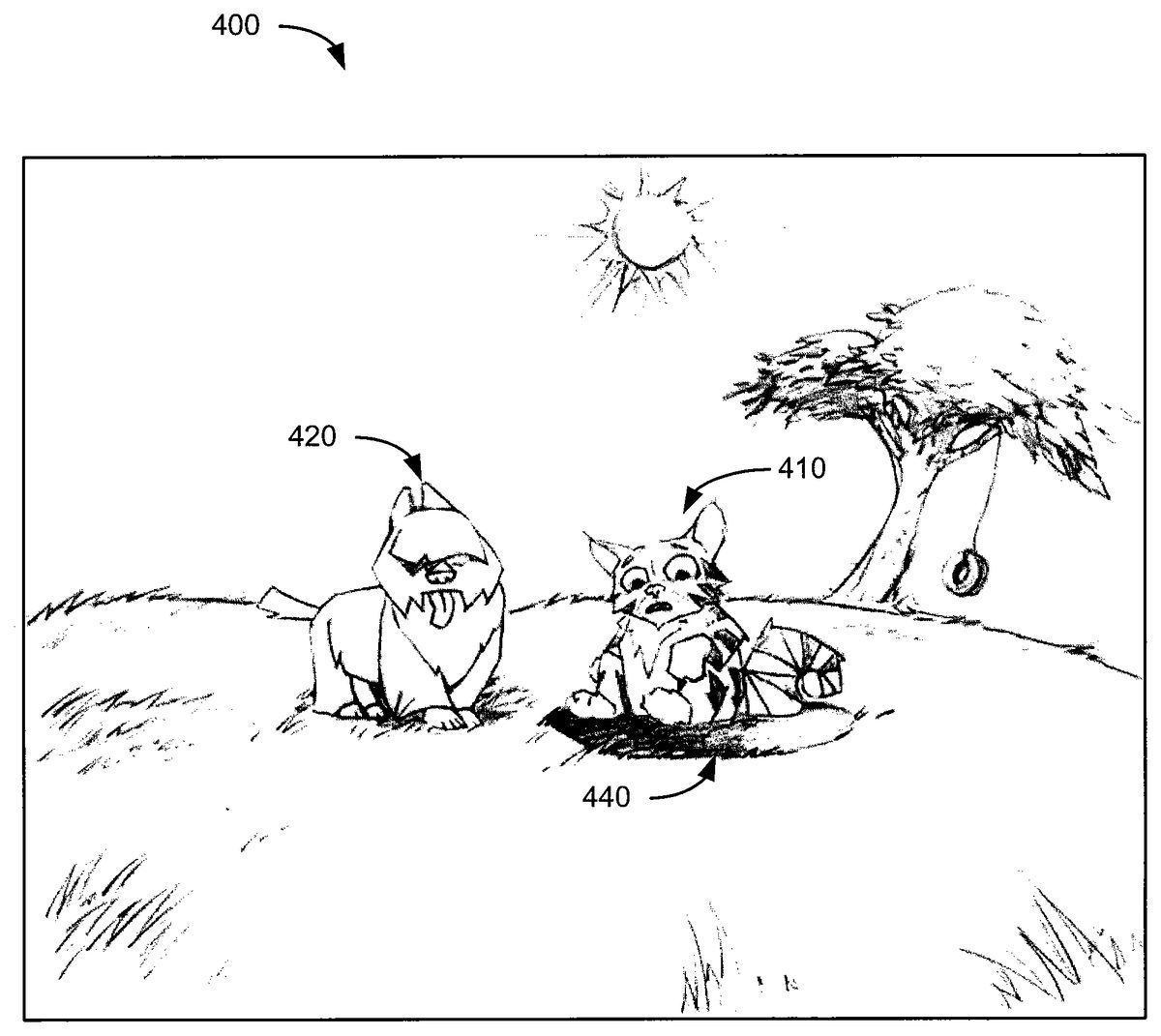
FIG. 4is an example of a video game with the capabilities of the first embodiment illustrating the video game substituting a rendered shape in place of a drawn shape within the video game environment.FIG. 4depicts a similar example of a video game as that depicted inFIGS. 2 and 3and includes the same characters and video game environment. However,FIG. 4further depicts the addition of a rendered object within the video game environment replacing a shape drawn by the video game user.
As discussed above with reference toFIG. 3, a user of a video game300may draw a shape within the video game environment using a drawing device330within the game. After the user draws a shape within the video game environment, the video game400may interpret the drawn shape and provide the user with a rendered shape more closely matching the detailed computer-rendered environment of the game, as shown inFIG. 4. For example, the video game400may recognize the circle drawn under the cat character410in the video game as a hole in the ground. The video game may then replace the drawn shape with a rendered hole in the ground440below the cat character410in the video game environment. The operation of replacing a drawn shape with a rendered shape is described in more detail below with respect toFIG. 10. Further, as described below with reference toFIG. 5, once the rendered shape is inserted within the video game environment, the characters of the video game may interact with the newly rendered shape.
FIG. 5is an example of a video game with the capabilities of the first embodiment illustrating the characters of a video game interacting with a computer-rendered shape that replaces a drawn shape within the video game environment.FIG. 5depicts a similar example of a video game as depicted inFIGS. 2-4and includes the same characters and video game environment. However,FIG. 5further depicts the characters of the video game interacting with the newly drawn and rendered shape within the video game environment.
As depicted inFIGS. 2-4, a user may draw a shape within a video game environment that the video game may then interpret replace with a computer-rendered shape that more closely matches the detailed environment of the video game. As depicted inFIG. 5, once the rendered shape is inserted into the video game environment, the characters may interact with the rendered shape. For example, once the hole under the cat character is drawn into the video game500and rendered as a hole in the ground540, the cat may then fall into the hole. Further, the dog character520may react to the cat falling into the hole540by looking at the hole540. In other examples, the character's programmatic behaviors may cause the character of the video game to act differently in response to the newly rendered object. For example, a wall may be drawn within a video game to stop the oncoming rush of a villain. Once the drawn shape is recognized by the video game and a rendered wall is inserted into the video game environment to replace the drawn shape, the villain character may stop and study the wall. The villain character may then attempt to climb over the wall or attempt to find a an alternate way around the wall to continue the pursuit. Alternatively, if the wall is never drawn into the environment by the user, the villain may continue in his pursuit, unabated. In this manner, the characters of a video game may interact with a newly rendered shape within the video game environment. Further, a character's programmatic behavior within the video game may also cause the character to conduct a series of movements in reaction to the newly rendered shape. These series of movements may be different from the movements of the character if the rendered shape is not drawn in the video game environment. Those skilled in the art will appreciate all of the varied ways in which a video game character may respond to a newly rendered shape within the video game environment, and the example interactions set out herein are merely a discrete sample of the myriad possible shapes and associated interactions.
FIG. 6is an example of a video game with the capabilities of a second embodiment illustrating altering the game space through the removal of rendered shapes or objects within a video game environment.FIG. 6depicts a similar example as that depicted inFIGS. 2-5and includes similar characters and video game environment. However,FIG. 6further depicts the capability of the user to erase or remove a shape that has been drawn into the video game environment by the user. It is also possible for the user to erase or remove a rendered shape that has replaced the drawn shape.
As shown inFIGS. 2-5, a circular shape may be drawn within a video game environment and replaced with a rendered shape the characters within the video game may react and interact with. As shown inFIG. 6, the user may also remove or erase an existing or rendered shape. For example, the user may use a drawing device630within the video game to draw over the rendered shape. The drawing device630of may be similar to the drawing device330described inFIG. 3. Alternatively, the user may select an erase function from a menu rather than a drawing function. Then, by moving the drawing device630over the rendered object640, the object may be erased from the environment. Similarly, the user may press a button on the video game controller while moving the drawing device630over a rendered object to erase the object. Those skilled in the art will recognize the many various ways in which a user of a video game may interact with the drawing device to erase rendered objects within the video game.
Similar to the drawing function described above, the characters within the video game may also react to the erasing function. For example, the dog character620inFIG. 6may turn towards the erasing function as the rendered shape is removed from the environment. Also similar to the drawing function, the programmatic behavior of the characters may also recognize the erased object and act accordingly. For example, after the hole640is removed, the dog character620may know that it is capable of walking over the spot where the hole was without falling in. Similarly, a villain character may recognize that a wall previously blocking the villain's path may have been erased. The villain character may then walk down the previously blocked path.
While the above descriptions demonstrate the drawing and erasing function in relation to the environment of the video game, the same functions may also be applied to the characters themselves. For example, a user may use the remove function as described above to erase the arm of a character within the video game. The characters of the video game may also react accordingly in response to the erased arm. Thus, a character with an erased arm may search for an object located in the video game environment to replace the erased arm. Further, the video game user may draw a replacement shape on the arm of the character after erasing the arm. For example, the user may draw a feather duster on the character of the video game. Once the drawn shape is recognized and rendered in a similar manner as described above, the character may then react accordingly and begin using the feather duster arm. As described below with reference toFIG. 10, the number of possible shapes and objects that may be recognized by the video game is limited only by the imagination of the video game designer and the available memory space of the video game system.
The drawing and removing functions described above may also occur on the background environment of the video game, independent of the characters.FIG. 7is an example of a video game with the capabilities of a third embodiment illustrating altering the game space by removing an existing feature from the background of a video game environment.FIG. 7depicts a similar example as that depicted inFIGS. 2-6. However,FIG. 7further depicts the capability of the user to erase or remove a object that is part of the video game background environment.
A drawing device730may be used to allow the user to interact with the video game background environment. More specifically, the drawing device730may allow the user to add and remove objects within the video game background environment. For example, the drawing device730may be utilized by the user to erase a sun object740located in the sky of the video game environment. The erase function may be performed in a similar manner as described with respect toFIG. 6. While the video game may be designed to allow the user to erase any object associated with the background environment of the video game, it is likely that some background objects will be static and cannot be erased by the user. The types and numbers of background objects that may be erased by the user may be decided by the video game designer.
The erasing of an object of the background environment in the video game700may cause the overall environment of the video game to change. For example, a user of a video game may erase a window of a room in the background of the video game environment. After erasing the window, the video game may alter the background of the environment to change the temperature of the room, i.e. by providing icicles on the window ledge. Further, the characters may react to the erasing of the object in the background environment of the video game. Environment and character interaction with the erased object may be similar to the reactions as described above.
Similar to the erase function of the background objects, a user may also draw objects into the background environment of the video game.FIG. 8is an example of a video game with the capabilities of a fourth embodiment illustrating altering the game space by drawing an object within a video game background environment.FIG. 8depicts a similar example as that depicted inFIGS. 2-7.
As shown inFIG. 8, a user of a video game800may use a drawing device830to draw a shape within the background environment of a video game. For example, the user may use the drawing device830to draw a crescent moon shape840in the sky of the video game environment. The user may draw a shape within the background environment of a video game in a similar manner as described above with reference toFIG. 3, namely by utilizing a drawing device830and manipulating a video game controller.
Similar toFIG. 4above, the shape drawn inFIG. 8may be interpreted by the video game800and compared to a list of available rendered objects. The operation of replacing a drawn shape with a rendered shape is described in more detail below with respect toFIG. 10.
FIG. 9is an example of a video game with the capabilities of the fourth embodiment illustrating the video game inserting a rendered shape in place of the drawn object within the background environment of a video game, and altering the game space environment based on a characteristic of the rendered shape.FIG. 9depicts a similar example as that depicted inFIGS. 2-8and includes the same character and video game environment. However,FIG. 9further depicts the addition of a rendered object to the video game background environment through the drawn shape.
The video game900inFIG. 9may recognize the shape drawn by the user in the background of the video game environment and replace the drawn shape with a rendered shape that more closely matches the computer-rendered details of the video game environment. For example, the video game may recognize the crescent moon shape940drawn inFIG. 9and insert a rendered moon940into the sky of the video game environment. The process of replacing a drawn shape with a rendered shape is described in more detail below with respect toFIG. 10.
The video game may interpret the insertion of the rendered shape into the video game environment and adjust the environment accordingly. For example, the video game may replace the drawn crescent moon940with a rendered crescent moon940. Further, the video game may recognize that the crescent moon shape940symbolizes night and may alter the environment of the video game to represent night. Thus, the video game may perform a shading950of the video game environment to darken the background, creating the sense of night time within the video game. Therefore, not only may the characters interact and react to the newly drawn and rendered shape in the background environment, the entire video game environment may also be adjusted accordingly.
Another embodiment may allow the user to stretch or otherwise manipulate the characters within the video game through the use of push/pull points on the character sprite or model. For example, the characters of the video game may include a series of push/pull points indicated on the character, such as flashing stars or glowing dots. These push/pull points may be manipulated by the video game user to alter the character model. Thus, a user may utilize the video game controller to move the drawing device to select one of the push/pull points on the video game character. The user may then use the video game controller to move the push/pull point to stretch, compact, or otherwise manipulate the character's shape. Examples of possible character manipulation include, but are not limited to, stretching or shortening the limbs of the character, making the character wider or thinner, and increasing the width of any limb of the character to represent additional strength.
Further, the manipulation of the character models may cause the characters to react accordingly. For example, the user may contract the legs of a villain within the video game. The video game may recognize the alteration in the character's model and programmatically alter the behavior of the character. Thus, the villain may recognize that his legs are shorter and may begin to use his arms to propel himself forward. Another example may allow the video game to recognize the increase in strength of a character to allow the character to break a wall that was previously impenetrable. Those skilled in the art will recognize the various ways that the video game may recognize and react programmatically to the altered character models.
Similarly, an embodiment may allow the user to stretch or otherwise manipulate the various features of the environment of the video game. This alteration of the video game environment may be accomplished through push/pull points located within the environment in a similar manner as described above for the alteration of the video game characters. For example, a push/pull point may be indicated on a hill of the video game environment. The user may use the video game controller and the drawing device to select the push/pull point to stretch or extend the hill, thereby making the hill taller or steeper. Similar push/pull points may be used to make a valley deeper and/or wider, a lake larger, a cave or tree taller. The alteration of the environment through the use of a push/pull point may include any feature of the video game environment. Further, the characters of the video game may recognize and react to the altered environment in a similar manner as described above.
In another embodiment, the video game may provide a series of environmental tools that may be selected to replace the drawing tool and allow the user to alter the environment of the video game. The user of the video game may select one of the environmental tools from the set of tools for a specific alteration to the environment. For example, a depression tool may be selected by the user to temporarily replace the drawing device. The depression tool may allow the user to create a depression in the ground of the video game environment by selecting or otherwise indicating the placement of the depression within the video game environment. Once the location of the depression within the video game environment is indicated, a depression may appear. Similarly, an erosion environmental tool may be selected for use by the user. The erosion tool may allow the user to thin or erode aspects of the video game environment. For example, a rock may be located on a hill within the video game environment. The user may use the erosion tool to select or otherwise indicate the area below the rock for erosion. The video game may respond to the selection of the area below the rock by thinning or eroding that aspect of the video game environment. Further, the characters and environment of the video may recognize and react to the altered environment. For example, the rock within the video game may recognize and react to the erosion of the ground below the rock by rolling down the hill in response to the video game gravity. Those skilled in the art will recognize the various environmental tools that may be included in the video game to alter the video game environment.
FIG. 10ais a flow chart illustrating a method for a video game to recognize a shape drawn within the video game environment, replace the drawn shape with a rendered shape, and allow interaction with the rendered shape. Beginning in operation1010, the user may draw a shape within the video game environment using the video game controller. The user may draw the shape within the video game in a similar manner as described above with reference toFIGS. 3 and 8.
In operation1020, the video game may then compare the drawn shape against a list of possible rendered shapes. Software code may be written to create a real-time 3D rendering while the drawings are being made, or the code may interpret a drawing created by a user within a defined margin of error. Each rendered shape in the list of possible rendered shapes may contain a collection of points that define the rendered shape. For example, a user may draw a circle in the video game environment. The code may recognize the circle shape by comparing several points along the drawn shape. These points may be compared to the collection of points of each rendered shape in the list. The code may then recognize that the points of the drawn circle match or closely approximate the collection of points for a rendered hole. Thus, the video game may recognize that the user has drawn a hole in the ground of the video game environment.
If the drawn shape matches or is similar to one of the rendered shapes included in the list of rendered shapes, the video game may replace the drawn shape with the rendered shape in the video game environment in operation1030. Similar to handwriting software, the code of the video game may compare the drawn shape against a collection of points that define the rendered shape. As long as the rendered shapes are pre-defined with thresholds for margins of error, the drawn shapes ma y be recognized if the they fall within the margins of error. For example, the game software may interpret any shape with three angles within a maximum and minimum threshold (margin of error) as a triangle no matter how imperfect the triangle might be. The triangle shape may hen be coded to create a 3D pyramid object in the video game environment, and the triangle object may be created. In this manner, the drawn shape may be replaced by a rendered shape and the rendered shape may become part of the video game environment so that the video game characters may interact with the newly rendered shape in operation1040.
The list of computer-rendered shapes available to compare with drawn shapes within the video game environment may contain any number of rendered shapes. For example, the list may include a rendered ball, a collection of balloons, a boxing glove, a ladder, a wall, etc. Any number of items or shapes may be included in the list of rendered shapes that may replace the drawn shapes. Further, the list of rendered shapes may be tailored to the type of video game being played. For example, the list may include oil slicks, speed bumps, and different tire types for a car racing game. Typically, the imagination of the video game designer and the available memory space of the video game system are the only limits to the number and types of rendered shapes available to the video game user.
In the event that the drawn shape does not match or is not similar to a shape in the list of rendered shapes, the video game may disregard the drawn shape or present the user with a message that the shape does not match one of the rendered shapes in the rendered shapes list.
FIG. 10bis a block diagram of a system that provides for a video game to recognize a shape drawn within the video game environment, replace the drawn shape with a rendered shape, and allow interaction with the rendered shape. The system may include an input device1050. The input device1050may be any type of video game controller that allows the user to provide an input to the video game system. Some examples given above include a mouse device or a directional pad. Other types of input devices1050are described in more detail below with reference toFIGS. 11-16
The system ofFIG. 10bmay also include a collection of modules. These modules may be included in a video game system including a processor. The processor of the video game system may be configured to perform the methods of each module of the system as described in more detail below. Alternatively, a computer readable medium may be configured to perform the methods of each module of the system. Such computer-readable media can be any available media that can be accessed by a general purpose or special purpose computer. By way of example, and not limitation, such computer-readable media can comprise RAM, ROM, EEPROM, DVD, CD ROM or other optical disk storage, magnetic disk storage or other magnetic storage devices, or any other medium which can be used to carry or store desired program code means in the form of computer-executable instructions or data structures and which can be accessed by a general purpose or special purpose computer. When information is transferred or provided over a network or another communications link or connection (either hardwired, wireless, or a combination of hardwired or wireless) to a computer, the source of the information can be properly viewed as a computer-readable medium, such as a server, a storage medium, a processor, and the like.
Combinations of the above should also be included within the scope of computer-readable media. Computer-executable instructions comprise, for example, instructions and data which cause a general purpose computer, special purpose computer, or special purpose processing device to perform a certain function or group of functions.
The system ofFIG. 10bmay include a matching module1055configured to match a drawn shape within the video game environment against a list of possible rendered shapes to find a rendered shape that matches with the drawn shape. The matching module1055may utilize a comparing module1060that compares a collection of data points along the drawn shape to a collection of data points for each rendered shape in the list. A data store1065may also be included in the system to store the list of possible rendered shapes. The comparing module1060may access the data store1065to compare the drawn shape to the list of possible rendered shapes to provide a rendered match to the drawn shape. Each rendered shape in the list of possible rendered shapes may contain a collection of points that define the rendered shape. For example, a user may draw a circle in the video game environment. The code may recognize the circle shape by comparing several points along the drawn shape. These points may be compared to the collection of points of each rendered shape in the list stored in the data store. The code may then recognize that the points of the drawn circle match or closely approximate the collection of points for a rendered hole. Thus, the video game may recognize that the user has drawn a hole in the ground of the video game environment.
If the drawn shape matches or is similar to one of the rendered shapes included in the list of rendered shapes, a insertion or replacing module1070may insert the rendered shape in the video game environment. The insertion module or replacing module1070may insert the rendered shape into the environment or may replace the drawn shape with the rendered shape. In the event that the drawn shape does not match or is not similar to a shape in the list of rendered shapes, the insertion or replacing module1070may disregard the drawn shape or present the user with a message that the shape does not match one of the rendered shapes in the rendered shapes list.
If the rendered shape is inserted into the video game environment or replaces the drawn shape, an associating module1075may be configured to associate the rendered shape with the background of the video game environment. Once associated with the background, the characters of the video game may interact with the newly rendered shape. In a similar manner, the associating module1075may associate the rendered shape with a character of the video game. Upon association with the character, the characters of the video game may interact with the rendered shape. Thus, through the described system, a user of a video game may draw a shape within the video game environment, the drawn shape may be replaced with a rendered shape and the video game and video game characters may interact with the rendered shape.
Described above are several methods for allowing a user of a video game to alter game scenes, objects and models in real-time by drawing shapes within the video game environment during game play. The user of the video game system may draw a shape within the video game environment by manipulating a video game controller. Some examples of controllers that the user may use to draw within the video game environment include a mouse device or a directional pad. Another example of a controller that may be used to draw a shape within a video game is a tablet-type controller. Several embodiments of a tablet-type video game controller are described below.
FIG. 11is a top view of a first embodiment of a video game controller utilizing multiple input devices. The controller1100may allow a user or player of a video game system to provide multiple inputs to the video game system to control the various characters and features of the video game.
The controller1100depicted inFIG. 11may be rectangular in shape and constructed from a molded plastic. The controller1100may also be large enough to be held with two hands of a video game player. While the controller1100depicted is rectangular in shape, the controller1100may take any shape suitable for video game use. Also, the controller1100may vary in size depending on the capabilities of the various video game systems the controller1100may be used with. The controller1100may also be molded on the bottom to form fit into the lap of a video game user. Further, the controller1100may include handles molded into the sides of the controller for ease in moving and tilting the controller1100.
The controller1100may include a flat surface, or tablet1102, on the top of the controller1100. The tablet1102may be used by the user to provide pressure inputs to the controller1100by drawing in the tablet1102area. For example, as explained in more detail below, the user may draw along the tablet1102with a stylus device. The controller1100may be capable of detecting the pressure applied by the user at multiple points upon the tablet1102area as the stylus is moved across the tablet1102. Thus, the user may supply a pressure input to the controller1100through the tablet1102. Although the tablet1102is rectangular-shaped as depicted inFIG. 11, the tablet1102may be any shape. Further, the tablet1102may encompass the entire surface of the controller, or may be limited to a particular area of the controller. Accordingly, a “tablet” as used herein, encompasses any area of the controller that may recognize and interpret pressure applied to the area.
As discussed above, the pressure may be applied to the tablet1102through a specifically manufactured device or stylus1104. The pressure may also be provided by the fingers or hands of the video game system user. Although the stylus1104is pen-shaped as depicted inFIG. 11, the stylus1104may be any shape and size. Thus, a stylus may be any manufactured device that may be used to apply pressure to the tablet1102such that the controller1100may recognize and register the pressure input.
The controller1100may register the location of the pressure being applied on the tablet1102and provide an X/Y coordinate of the pressure point to the video game system. The controller1100may also provide a value to the video game system indicating the amount of pressure applied by the user. Thus, through the tablet1102input, the controller1100may then recognize and react to varying degrees of pressure from the stylus1104or hands of the user across multiple points in the tablet1102area. These inputs may then be applied to a video game such that the user may interact with the video game by drawing or pressing on the tablet1102area of the controller1100. The interaction between the pressure inputs provided by the user and the video game system is described in more detail below with respect toFIG. 13.
The controller1100may also include a set of buttons1106that may be pressed by the user during gameplay to further interact with the video game. The controller1100may include any number of buttons1106that may be located anywhere on the controller1100. A user of the controller1100may press the buttons1106during gameplay to interact with the video game. For example, one button may function as an “undo” feature, while a second button may function as a “save” feature. Further, the same button may perform separate functions based on the video game being played. For example, a button may cause a character of the video game to jump in a role-playing game while the same button may accelerate a racecar in a driving simulation game. The function of each button1106included on the controller1100may be configured by the video game designer to interact with the particular video game being designed.
The buttons of the controller1100may also function as a directional pad or scrolling device. For example, button1108may be a four-direction control pad with a button at each of the four points. Thus, a user of the controller1100may press the directional pad to move a character of a video game. Alternatively, button1108may spin allowing the user to scroll through a list of possible game actions. In another embodiment, button1108may contain a hole in the center of the button. A user of the controller1100may insert the stylus1104or other device into the hole of the button1108to create a joystick-type device. The stylus1104or other device may then by manipulated by the user to control the video game. Through these configurations, the buttons (1106,1108) of the controller1100may provide to the user of the video game system a variety of input interfaces.
The controller1100may also include a cable1112to transmit and receive electronic signals to and from the video game console. The cable1112may be wired directly to the controller1100or may connect to the controller1100through an I/O port1110. The I/O port1110of the controller1100may be any device or construct capable of receiving electrical signals from a cable1112. Exemplary I/O ports include USB ports, RCA-type ports, VGA ports, DB25 ports, S-Video ports, SDI ports, BNC ports and so on. An alternative embodiment may transmit electronic signals from the controller1100to the video game console wirelessly. Thus, the controller1100may include an RF-device to broadcast and receive electronic signals to and from a video game console. Through the I/O port1110, the cable1112, or the wireless device, the controller1100may transmit electronic signals representing the inputs provided by the video game user through the controller1100to a video game console such that the user may interact with a video game.
FIG. 12is block diagram illustrating the components of a first embodiment of a video game controller utilizing multiple input devices. WhileFIG. 12illustrates some of the components of the controller, it should be appreciated that other embodiments may omit some components or may add additional components.
The embodiment depicted inFIG. 12may include a microprocessor1200. The microprocessor1200may receive electrical signals from the multiple inputs of the controller, as well as communicate those inputs to a video game console for interpretation by the video game system. Further, the microprocessor1200may provide output signals to control various output devices of the controller.
As discussed above with reference toFIG. 11, the controller may include several input devices through which a video game user may interact with the video game system. These inputs may include a tablet1102that may interpret pressure applied to the tablet1102by the user and a series of buttons1106that may be pressed by the user. The tablet1102and buttons1106are also represented inFIG. 12as inputs to the microprocessor1200. Other inputs1202may also be included in the controller as inputs to the microprocessor1200. For example, the controller may include a track-wheel device, such as found in a mouse controller for a personal computer. The controller may also include a series of knobs or switches accessible by the user. The other input devices1202may also include peripheral devices that may plug into the controller. For example, a standard mouse device may plug into the controller for use by the user. Similarly, a set of drum sticks may also plug into the controller for use during a drumming game, or a steering wheel for use during a driving simulator. It should be appreciated that the embodiment is not limited to the above examples of possible input devices. Accordingly, “input devices” as used herein, encompasses all such devices that allow a user to interact with the controller and to provide and/or receive an input to the video game system.
The controller ofFIG. 12may also include an internal tilt sensor1204that may communicate the orientation and acceleration of the controller in three-dimensional space as an input to the microprocessor1200. The tilt sensor1204may include a series of accelerometers located within the controller that measure the movement, acceleration and orientation of the controller. The accelerometers may then provide the measurements to the microprocessor1200of the controller, which may in turn transmit those measurements to the video game console through a series of electronic signals. For example, the tilt sensor1204may recognize when the user tilts the controller from front to back. The tilt sensor1204may measure the motions of the controller and provide those signals to the video game console. Through this, the user of the video game system may tilt, turn, or shake the controller to interact with a video game.
The microprocessor1200may also provide an output signal to various output devices associated with the controller. For example, the microprocessor1200may transmit an electrical signal to a vibration device1206located within the controller. The vibration device1206may cause the controller to vibrate to provide a more interactive experience for the video game user. For example, the microprocessor1200may send a signal to the vibration device during specific game events, such as a when a car crashes into a wall in the video game. Thus, the user may feel the controller vibrate when the car hits the wall in the game. A signal to vibrate the controller may be received by the microprocessor1200from the video game console through the I/O port1208, as described in more detail below.
The microprocessor may also provide an output signal to an LED display1210located on the video game console or the controller itself. The LED display1210may communicate to the video game user a status of the video game system. For example, the microprocessor1200may send a signal to the LED display1210to indicate to the user that the controller is effectively communicating with the video game console. It should be appreciated that the embodiment ofFIG. 12is not limited to the above examples of possible output devices that may receive a signal from the microprocessor.
Other components of the controller may both provide an input to the microprocessor1200as well as receive an output from the microprocessor1200. For example, the controller may include a speaker/microphone device1212. The speaker portion of the speaker/microphone device1212may allow the user to input sound into the controller. The microprocessor1200may then convert the inputted sound into electronic signals to send to the video game console such that the user may utilize the microphone to interact with a video game or with other users in the case of a video game played over a network. The microprocessor1200may also transmit signals received from the video game console to the speaker portion of the speaker/microphone device1212to provide the user with a more interactive gaming experience.
As described above, the microprocessor1200may communicate with a video game console of a video game system through an I/O port1208located on the controller. Through the I/O port1208, the controller may transmit the various input signals provided by the user through the input devices to the video game console. The video game console may then interpret the input signals and change the video game environment in response to the inputs. For example, a user may press a button on the controller and a character of the video game may jump. Similarly, the microprocessor1200may receive signals from the video game console through the I/O port1208of the controller. For example, the video game may include instructions to vibrate the controller whenever a character is runs into an object. The video game console may then transmit a signal to the controller through the I/O port1208. The microprocessor1200may receive the transmitted signal and send it onto the vibration device to initiate vibration of the controller. Thus, the microprocessor1200of the controller may both transmit and receive electronic signals from the video game console through the I/O port1208.
FIG. 13is a block diagram illustrating the capability of a first embodiment of a video game controller to translate a shape drawn on the tablet device into a video game environment. As described above, the user of a video game may use a controller1300to provide inputs to a video game system to control the action of a video game. The controller may include a tablet1302and stylus13013to provide the user with the capability to draw a shape or otherwise provide a pressure input to tablet1302to communicate with the video game system.
As mentioned above, a video game user may provide inputs to a video game system through the controller by drawing a shape within the tablet1302area. For example, the user may use a stylus device1304to draw a shape on the tablet1302area. The controller1300may register each location of the pressures being applied on the tablet1302and provide a map of the X/Y coordinates of the pressure points to the video game system as the user applies the pressure to the tablet1302. The controller1300may also provide a value to the video game system indicating the amount of pressure applied at each point. The controller1300may then transmit the information received through the tablet1302to a video game console1306to allow the user to interact with a video game. The transmission of the coordinates and pressure value may take place through a cable1308connected between the controller1300and a console1306. Alternatively, the controller1300may broadcast the signals to the console1306through a wireless connection1310.
The console1306may receive the transmitted signals from the controller1300and interpret the signals to interact with the video game being displayed. The console1306may then send the incorporate the input signals into a video game environment and display the video game on a display device1312. As shown inFIG. 13, the video game system may take the input shape drawn by the video game user on the tablet1302and display the same shape on the video game display device1312, allowing the user of the video game system to interact with a video game. This interaction may be used when the video game includes a drawing or handwriting exercise.
WhileFIG. 13illustrates the reproduction on the display device1312of the shape drawn on the tablet1302, it is not necessary that the shape drawn on the tablet1302be reproduced. The tablet1302input may also allow the user to alter the characters of a video game or the video game environment as described above. For example, the user may use the stylus1304to draw on the tablet1302to select a point on a character of the video game. The user may then move the stylus1304across the tablet1302. The console1306may receive the input of the stylus1304moving across the tablet1302and interpret the movement as a movement of the character. Thus, the video game console1306may then move the character in the direction of the stylus1304movement in response to the user's input on the tablet1302. The user may also increase the size of the video game character by selecting the character and expanding the character through the movement of the stylus1304.
The user of a video game system may also use his fingers or hands to apply pressure to the tablet1302as an input to the video game system. The controller1300may interpret the pressure applied by the user's fingers in the same manner as if the user were using the stylus1304. Thus, the user may use their finger to draw a shape that may be reproduced on the display device1312. Further, the user may use multiple fingers at once to move objects within a video game. For example, the user may use a forefinger and a thumb simultaneously to open a door within a video game. By moving the thumb and forefinger apart while pressing on the tablet1302, the video game console1306may interpret the movement as a desire to open a door within the video game. Similarly, the user may perform the same movements with his fingers to expand the size of a character. Typically, the imagination of the video game designer and the available memory space of the video game system are the only limits to the number and types of movements the video game system may recognize through the tablet1302of the controller1300.
The user may also use the stylus1304or the user's fingers to tap within the tablet1302area. The tapping within the tablet1302area may be interpreted by the video game console1306in a similar manner as described above when drawing on the tablet1302. For example, the controller1300may detect the tap on the tablet1302area, provide an X/Y coordinate for the tap, and provide a value indicating the amount of pressure applied during the tap. The user may utilize the tapping input to select an object within the video game environment. Alternatively, the tapping may be interpreted as an action input by the console1306. For example, the user may tap on the tablet1302to select a rock for the video game character to pick up. The user may then tap a second time to make the character throw the rock. Typically, the imagination of the video game designer is the only limit to the types of movements within the video game that may correlate to the user tapping on tablet1302.
As explained above with reference toFIG. 12, the controller1300may also include a tilt sensor. The tilt sensor may be utilized by the user of the controller1300to interact with a video game. For example, the user may tip the controller1300forward to accelerate or tip the controller backward to slow a car within a racing simulator. Similarly, the user may tip the controller from side to side to steer the car. The tilt sensor of the controller1300may recognize the movements, acceleration and orientation of the controller1300. The controller1300may then send electrical signals to the console1306indicating the changes in movement of the controller1300. The console1306may interpret the received signals and incorporate those signals into the video game being displayed. Thus, the video game user may use the tilt sensor within the controller1300to control the action of the video game. Again, the only limit to the types of tilt sensor movements that correspond as an input to a video game is the imagination of the video game designer.
FIG. 14is a top view of a second embodiment of a video game controller illustrating a piano overlay covering a tablet area of the video game controller. The controller1400illustrated inFIG. 14is similar to the embodiment depicted inFIG. 11. However, this embodiment may include a overlay1402that covers the controller1400such that the user of the controller may interact with a particular video game that corresponds to the overlay1402device.
As described inFIG. 11, a video game controller1100may include a tablet1102that may detect pressure at multiple points along the tablet1102surface. This pressure may be applied by a stylus1104device or by the user's fingers or hands. The user may use the tablet1102to interact with a video game by providing inputs through the tablet1102. To further assist the user's interaction with the video game, a overlay may be provided that covers the tablet1102area and provides the user with an interface for using the tablet1102on the controller1100.
InFIG. 14, a overlay1402depicting piano keys may cover the tablet area of the controller1400. Such an overlay1402may be used for a video game requiring the user to play a piano, either as a learning device or as part of a puzzle solving game. Once the overlay1402is in place over the tablet area, the user may then use a stylus or their fingers to press on the appropriate keys of the overlay1402. In this manner, the overlay1402may provide the user of the controller1400an interface to properly interact with the video game. The tablet may detect the pressure applied by the user to the overlay1402and interpret the signals accordingly. For example, the controller1400may detect a pressure point on the tablet directly under the A key of the piano overlay1402. Thus, the controller1400and the video game console may interpret the pressure point as the user pressing the A key. The video game may then depress the A key in a video game and make the sound of the A key of a piano being pressed. Without the overlay1402in place, the user may find it difficult to determine which area of the tablet corresponds to which key of the piano. Thus, the overlay1402provides an interface to the video game user such that the user may use the tablet and controller1400to interact with a video game.
The overlay1402may be composed of various materials. For example, the overlay1402may be composed of a clear, reusable plastic with the piano keys painted or pressed onto the plastic. Generally, the overlay may be composed of any material that allows the overlay to cover the tablet area of the controller1400and allows the transfer of the pressure applied by the user on top of the overlay1402through the overlay1402and onto the tablet, such that the tablet detects the pressure being applied by the user.
Further, the overlay1402may attach the controller1400in many varied ways. For example, the overlay1402may include a sticky substance on the bottom so that the overlay may attach to the tablet area of the controller1400. Similarly, the overlay1402may be composed of such a material that it may stick to the controller1400through static electricity. The overlay1402may also connect to the controller1400by attaching to the sides or by sliding a sleeve including the overlay1402around the controller1400. It should be noted that the method by which the overlay1402attaches to the controller1400is not limited to the above examples. Any method to attach the overlay1402to the controller1400such that the overlay1402covers the tablet area of the controller1400is imagined without taking away from the spirit and scope of the invention.
The various types of overlays that may provide an interface to a video game is only limited by the imagination of the video game designer. For example,FIG. 15is a top view of a third embodiment of a video game controller illustrating a racing game interface overlay covering a tablet area of the video game controller. The racing overlay1502may include a depiction of a gear shift. During game play of a driving or racing simulator, the user may use a stylus device or his fingers to press on the numbered circles within the overlay1502. The numbered circles may correspond to a gear for the racecar depicted in the video game. Thus, by pressing on the numbered circles, the user may change the gears of the racecar within the video game. The controller1500may detect pressure applied to the area under the numbered circles and change the gear of the racecar of the video game to correspond to the area pressed. In this manner, the racing overlay1502may provide an interface for a user of a racing video game.
Further examples of overlays include an overlay depicting a keyboard that may be utilized by the user to use the controller for typing a message. Also, the overlay may include a stencil that a user may utilize to draw shapes within the video game.
Another example of an overlay is depicted inFIG. 16.FIG. 16is a top view of a fourth embodiment of a video game controller illustrating a overlay covering a tablet area of the video game controller that allows the embodiment to be used with a pre-existing video game console. In this embodiment, the overlay1602provides an interface to the user that closely resembles a video game controller for a pre-existing video game system. For example, a pre-existing video game system may include a controller with four buttons (A, B, X and Y) and a directional pad. The controller1600depicted inFIG. 16may also be used with the pre-existing video game system in place of the controllers that are part of the game system. The overlay1602depicted may assist in the user of the video game system to utilize the controller1600to provide inputs to the video game system. The user may use an overlay1602that includes four buttons, labeled A, B, X and Y, and a directional pad. Like the examples above, the user may use a stylus device or fingers to press the overlay in the appropriate area. For example, if the user wishes to press the X button, the user may use a stylus or his fingers to press the circle marked X on the overlay1602. The controller1600may detect the pressure applied to the tablet under the X button of the overlay1602and interpret the pressure as if the user pressed the X-button on the standard controller. In this manner, the overlay1602may assist the user in interfacing the controller1600with a pre-existing video game system, effectively replacing the controller that was included with the pre-existing system with the embodied controller1600. Thus, the controller1600may be used with any video game system by utilizing the correct overlay to cover the tablet area of the controller1600.
The foregoing merely illustrates the principles of the invention. Various modifications and alterations to the described embodiments will be apparent to those skilled in the art in view of the teachings herein. It will thus be appreciated that those skilled in the art will be able to devise numerous systems, arrangements and methods which, although not explicitly shown or described herein, embody the principles of the invention and are thus within the spirit and scope of the present invention. From the above description and drawings, it will be understood by those of ordinary skill in the art that the particular embodiments shown and described are for purposes of illustrations only and are not intended to limit the scope of the present invention. References to details of particular embodiments are not intended to limit the scope of the invention.
Claims
- A method for altering gameplay mechanics of a video game in real time, the method comprising: providing for the manipulation of a video game controller to draw a feature within the video game environment;matching the drawn feature with at least one rendered object;inserting the at least one rendered object in the video game environment;and effectuating programmatic reaction by gameplay mechanics to the at least one rendered object wherein the programmatic reaction comprises at least one element of the video game environment interacting with the at least one rendered object.
- The method of claim 1 , further comprising: accessing a data store of a plurality of rendered objects including the at least one rendered object;comparing the drawn feature with the plurality of rendered objects to match the at least one rendered object having at least one characteristic of the drawn feature;and in the video game environment, replacing the drawn feature with the at least one rendered object.
- The method of claim 2 , wherein the comparing operation further comprising: comparing a plurality of points of the drawn feature to a plurality of points of the at least one rendered object;wherein the inserting operation further comprises: in the event that the drawn shape is similar to the at least one rendered object, replacing the drawn shape in the video game environment with the rendered object;and in the event that the drawn shape is not similar to the at least one rendered object, removing the drawn shape from the video game environment.
- The method of claim 1 , further comprising: providing for manipulation of the video game controller to remove an object from the video game environment.
- The method of claim 1 , further comprising: operably associating the at least one rendered object with a character in the video game environment.
- The method of claim 1 , further comprising: operably associating the at least one rendered object with a background feature in the video game environment.
- The method of claim 4 , further comprising: providing for manipulation of the video game controller to remove a feature of a character in the video game environment.
- The method of claim 4 , further comprising: providing for manipulation of the video game controller to remove an feature of a background environment aspect in the video game environment.
- The method of claim 1 , further comprising: providing for manipulation of the video game controller to alter the shape of a character in the video game environment.
- The method of claim 1 , further comprising: providing for manipulation of the video game controller to alter the shape of the video game environment.
- The method of claim 1 , wherein the operation of inserting the at least one object in the video game includes replacing the drawn feature with the at least one rendered object, the method further comprising: providing for interaction of the at least one character of the video game with the rendered object.
- The method of claim 1 , wherein the operation of inserting the at least one object in the video game includes replacing the drawn feature with the at least one rendered object, the method further comprising: providing for alteration of the background environment aspect of the video game environment in response to the rendered object.
- The method of claim 1 , wherein the programmatic reaction is effectuated as the rendered object is inserted in the video game environment.
- A system for altering gameplay mechanics of a video game in real time, the system comprising: an input device configured to allow a user of the system to draw a shape within a video game environment;a matching module configured to match the drawn feature with at least one rendered object;and an insertion module configured to insert the at least one rendered object in the video game environment, wherein the system is configured to generate a programmatic reaction in response to insertion of the at least one rendered object wherein the programmatic reaction comprises at least one element of the video game environment interacting with the at least one rendered object.
- The system of claim 14 , further comprising: a data store, the data store configured to store a plurality of rendered objects including the at least one rendered object;a comparing module configured to compare the drawn feature with the plurality of rendered objects to match the at least one rendered object having at least one characteristic of the drawn feature;and a replacing module configured to replace, in the video game environment, the drawn feature with the at least one rendered object.
- The system of claim 15 , wherein the comparing module is further configured to: compare a plurality of points of the drawn feature to a plurality of points of the at least one rendered object;wherein the inserting module is further configured to: in the event that the drawn shape is similar to the at least one rendered object, replace the drawn shape in the video game environment with the rendered object;and in the event that the drawn shape is not similar to the at least one rendered object, remove the drawn shape from the video game environment.
- The system of claim 14 , wherein the input device is further configured to remove an object from the video game environment.
- The system of claim 14 , further comprising: an associating module configured to operably associate the at least one rendered object with a character in the video game environment.
- The system of claim 14 further comprising: an associating module configured to operably associate the at least one rendered object with a background feature in the video game environment.
- The system of claim 17 , wherein the input device is further configured to remove a feature of a character in the video game environment.
- The system of claim 17 , wherein the input device is further configured to remove a feature of a background environment aspect in the video game environment.
- The system of claim 14 , wherein the input device is further configured to alter the shape of a character in the video game environment.
- The system of claim 14 , wherein the insertion module is further configured to replace the drawn feature with the at least one rendered object, the system further comprising: a module configured to provide for interaction of the at least one character of the video game with the rendered object.
- The system of claim 14 , wherein the insertion module is further configured to replace the drawn feature with the at least one rendered object, the system further comprising: a module configured to provide for alteration of the background environment aspect of the video game environment in response to the rendered object.
- A method for altering gameplay mechanics of a video game in real time, the method comprising: providing for the manipulation of an input device to draw within the video game environment;interpreting the manipulation;and adapting the video game environment in real time in response to the manipulation, wherein adapting the video game environment comprises inserting at least one rendered obiect into the video game environment, wherein gameplay mechanics cause a programmatic reaction in response to insertion of the at least one rendered obiect, and wherein the programmatic reaction comprises at least one element of the video game environment interacting with at least one rendered object inserted into the video game environment.
Disclaimer: Data collected from the USPTO and may be malformed, incomplete, and/or otherwise inaccurate.