U.S. Pat. No. 8,684,844
GAME SYSTEM, GAME PROCESSING METHOD, COMPUTER-READABLE STORAGE MEDIUM HAVING STORED THEREIN GAME PROGRAM, AND GAME APPARATUS
AssigneeNintendo Co., Ltd.
Issue DateSeptember 10, 2012
Illustrative Figure
Abstract
A plurality of players operate player characters using controllers. The player characters form a friend team to attack enemy characters. The player characters make attacks on the enemy characters by firing bullets into a game space using guns, in accordance with the operations of the respective players. If one of the player characters attacks another one of the player characters, a life of the attacked player character decreases, and a life item for restoring a life also appears in the game space. The attacked player character can restore a life by acquiring the life item.
Description
DETAILED DESCRIPTION OF NON-LIMITING EXAMPLE EMBODIMENTS (Example of Configuration of Game System) With reference to the drawings, a game system1according to an exemplary embodiment is described below.FIG. 1is a block diagram showing an example of the configuration of the game system1. As shown inFIG. 1, the game system1includes a game apparatus10, controllers20(20A,20B,20C, and the like), a display section30, and an external storage medium40. Further, the game apparatus10includes an input/output control section11and an information processing section12. The game apparatus10is connected to the plurality of controllers20using a wireless or wired connection. Each controller20is operated by a player, and transmits operation data based on the operation of the player to the game apparatus10. The controller20includes an operation section. The operation section of the controller20includes an operation button for making an attack described later, a direction indication section for indicating the moving direction of a player character, and the like. The controller20also functions as a pointing device for indicating a position on a screen of the display section30. The pointing of the controller20to the screen may be performed using a known technique. For example, the controller20may receive infrared light from a light-emitting section placed around the display section30, thereby pointing to a position on the screen. The information processing section12includes a CPU that performs game processing described later, a memory, and a GPU that generates a game image to be output to the display section30. The information processing section12loads a game program stored in the external storage medium40(for example, a non-volatile memory) into the memory, and executes the program, thereby performing the game processing described later. For example, the information processing section12acquires operation data (data representing information of the operation performed on the operation button, data representing the position pointed to, and the like) from each controller20via the input/output control section11, and performs the ...
DETAILED DESCRIPTION OF NON-LIMITING EXAMPLE EMBODIMENTS
(Example of Configuration of Game System)
With reference to the drawings, a game system1according to an exemplary embodiment is described below.FIG. 1is a block diagram showing an example of the configuration of the game system1. As shown inFIG. 1, the game system1includes a game apparatus10, controllers20(20A,20B,20C, and the like), a display section30, and an external storage medium40. Further, the game apparatus10includes an input/output control section11and an information processing section12. The game apparatus10is connected to the plurality of controllers20using a wireless or wired connection.
Each controller20is operated by a player, and transmits operation data based on the operation of the player to the game apparatus10. The controller20includes an operation section. The operation section of the controller20includes an operation button for making an attack described later, a direction indication section for indicating the moving direction of a player character, and the like. The controller20also functions as a pointing device for indicating a position on a screen of the display section30. The pointing of the controller20to the screen may be performed using a known technique. For example, the controller20may receive infrared light from a light-emitting section placed around the display section30, thereby pointing to a position on the screen.
The information processing section12includes a CPU that performs game processing described later, a memory, and a GPU that generates a game image to be output to the display section30. The information processing section12loads a game program stored in the external storage medium40(for example, a non-volatile memory) into the memory, and executes the program, thereby performing the game processing described later. For example, the information processing section12acquires operation data (data representing information of the operation performed on the operation button, data representing the position pointed to, and the like) from each controller20via the input/output control section11, and performs the game processing on the basis of the acquired operation data. Then, the information processing section12outputs a game image and a game sound that result from the game processing to the display section30via the input/output control section11. The display section30may be, for example, a television receiver or a dedicated display apparatus.
It should be noted that the game system1shown inFIG. 1is merely illustrative, and the game processing described later may be performed by any apparatus.
(Overview of Game Processing)
Next, a description is given of an overview of the game processing performed by the game system1according to the exemplary embodiment. A game according to the exemplary embodiment is performed by a plurality of players. Specifically, the game apparatus10is connected to a plurality of controllers20, so that each player operates the corresponding controller20to control their player character (player object). It should be noted that, in the game according to the exemplary embodiment, up to four controllers20can be connected to the game apparatus10.
Hereinafter, the game according to the exemplary embodiment is described on the assumption that a player A operates a controller20A, a player B operates a controller20B, a player C operates a controller20C, and a player D operates a controller20D.
FIG. 2is a diagram showing an example of a game image displayed on the display section30. As shown inFIG. 2, the screen of the display section30is divided into four equal areas, so that an image70A, an image70B, an image70C, and an image70D are displayed in the respective divided areas. As shown inFIG. 2, on the display section30, a player character81A, a player character81B, a player character81C, and a player character81D are displayed. Further, on the display section30, a plurality of enemy characters95(95a,95b, and the like) are also displayed.
The player character81A is a virtual character placed in a game space (a three-dimensional (or two-dimensional) virtual world), and is operated by the player A using the controller20A. The player character81A makes an attack on the enemy characters95by shooting a bullet using a gun object82A. The player character81B is a virtual character placed in the game space, and is operated by the player B using the controller20B. The player character81C is a virtual character placed in the game space, and is operated by the player C using the controller20C. The player character81D is a virtual character placed in the game space, and is operated by the player D using the controller20D. The player character81B, the player character81C, and the player character81D make attacks on the enemy characters95by shooting bullets using gun objects82B through82D, respectively.
As shown inFIG. 2, in the upper left area of the screen of the display section30, the image70A including the player character81A is displayed, so that the player A operates the player character81A while viewing the image70A. In the image70A, an aim83A is displayed that is used when the player character81A attacks the enemy characters95. In the upper right area of the screen of the display section30, the image70B including the player character81B is displayed, so that the player B operates the player character81B while viewing the image70B. In the image70B, an aim83B is displayed that is used when the player character81B attacks the enemy characters95. In the lower left area of the screen of the display section30, the image70C including the player character81C is displayed, so that the player C operates the player character81C while viewing the image70C. In the image70C, an aim83C is displayed that is used when the player character81C attacks the enemy characters95. In the lower right area of the screen of the display section30, the image70D including the player character81D is displayed, so that the player D operates the player character81D while viewing the image70D. In the image70D, an aim83D is displayed that is used when the player character81D attacks the enemy characters95.
The enemy characters95are virtual characters controlled by the game apparatus10, and make attacks on the player characters81by firing bullets at them while moving in the game space. The object of the game according to the exemplary embodiment is for the players A through D to cooperate to defeat the enemy characters95.FIG. 3is a diagram illustrating an overview of the game according to the exemplary embodiment. As shown inFIG. 3, in the game according to the exemplary embodiment, the players A through D form a friend team and cooperate with each other to defeat the enemy characters95. In the exemplary embodiment, each player character81initially has three lives, so that one life decreases if the player character81is hit by a bullet from any one of the enemy characters95. The lives are a parameter that allows the attack of the player character81. If the number of the lives of the player character81becomes 0, the player character81cannot make an attack, and therefore cannot participate in the game in the sense of attacking the enemy characters95(the player character81is ejected from the game). If the numbers of the lives of all the members of the friend team become 0, the friend team loses, and the game ends. If the friend team defeats all the enemy characters95before the numbers of the lives of all the members of the friend team become 0, the friend team wins. It should be noted that, as shown inFIG. 2, the number of the remaining lives of each player character81may be displayed on the display section30. For example, in the lower right region of the image70A, an image representing the number of remaining lives is displayed. In the example shown inFIG. 2, the number of the remaining lives of the player character81A is one. Further, as shown inFIG. 2, the numbers of the remaining lives of the player character81B and the player character81D are three, and the number of the remaining lives of the player character81C is two.
FIG. 4Ais a diagram showing an example of an image displayed on the display section30immediately before the player character81A attacks the enemy character95b.FIG. 4Bis a diagram showing an example of an image displayed on the display section30after the player character81A has attacked the enemy character95b. As shown inFIG. 4A, the player A directs the controller20A toward the screen so as to point to a position on the screen, thereby placing the aim83A on the enemy character95b, and then presses the operation button of the controller20A for firing a bullet. As a result, a bullet is fired at the position, in the game space, indicated by the aim83A from the position of the player character81A (the gun object82A). As shown inFIG. 4B, if the bullet fired into the game space hits the enemy character95b, the enemy character95bis damaged. If bullets hit the enemy character95bpredetermined times, the enemy character95bfalls down.
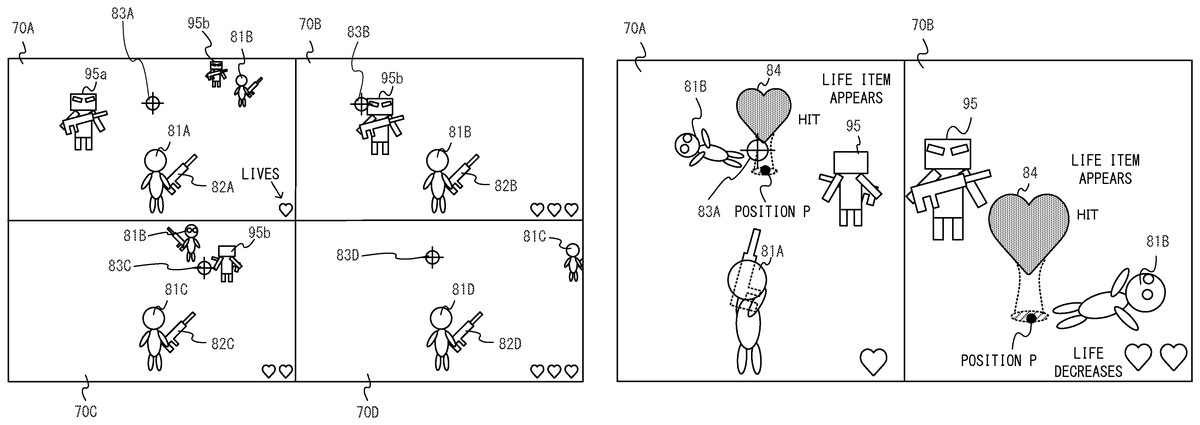
Here, a description is given of the case where a bullet fired by one of the player characters81has hit another one of the player characters81that is a member of the friend team.FIG. 5Ais a diagram showing an example of an image displayed on the display section30immediately before the player character81A attacks the player character81B.FIG. 5Bis a diagram showing an example of an image displayed on the display section30after the player character81A has attacked the player character81B. It should be noted thatFIGS. 5A and 5Bshow only the image70A displayed in the upper left of the screen and the image70B displayed in the upper right of the screen, and the other images (70C and70D) are omitted. Further, inFIGS. 5A and 5B, only central regions of the image70A and the image70B are displayed, and the end regions of the image70A and the image70B are not displayed.
As shown inFIG. 5A, the aim83A indicating the position on which the player character81A is to make an attack is located in the display region of the player character81B (the image70A), and the number of the remaining lives of the player character81B is three at this time (the image70B). In this case, if the player A accidentally (or intentionally) presses the operation button for making an attack, a bullet is fired at the aim83A (the player character81B) from the gun object82A held by the player character81A. Then, as shown inFIG. 5B, if the bullet fired by the player character81A hits the player character81B, the number of the lives of the player character81B decreases by one (the number of the remaining lives of the player character81B becomes two), and a life item84also appears in the game space. The life item84is a virtual object for restoring a life of each player character81. If one of the player characters81is attacked by another one of the player characters81on the friend team, the life item84appears at a position determined on the basis of a position P (in a predetermined range including the position P) of the player character81when attacked. For example, the life item84appears at the position P of the player character81when attacked. It should be noted that, if the attack of the player character81A further hits the player character81B, the number of the lives of the player character81B further decreases by one (the number of the remaining lives of the player character81B becomes one), and another life item84also appears in the game space.
As shown inFIG. 5B, even if a bullet hits the player character81B and the number of their lives decreases, the number of their remaining lives is two. This allows the player character81B to continuously perform the game (make an attack on the enemies). That is, the attacked player character81B stands up again after a predetermined time elapses since it was attacked, and then becomes capable of moving in the game space and also capable of making an attack on the enemy characters95.
The player character81B attacked by another one of the player characters on the friend team can restore a life by acquiring the life item84having appeared in the game space.FIG. 6Ais a diagram showing the state where the player character81B attacked by another one of the player characters on the friend team moves toward the life item84.FIG. 6Bis a diagram showing an image immediately before the player character81B attacked by the other player character on the friend team acquires the life item84.FIG. 6Cis a diagram showing the state after the player character81B attacked by the other player character on the friend team has acquired the life item84. As shown inFIGS. 6A and 6B, the number of the remaining lives of the player character81B is two before the player character81B acquires the life item84. As shown inFIG. 6C, if the player character81B moves to the position of the life item84(the display region of the life item84), the player character81B acquires the life item84. As a result, the lives of the player character81B increase from two to three. As described above, the player character81B whose lives have decreased because it has been attacked by the other player character on the friend team can restore a life by acquiring the life item84.
It should be noted that the life item84disappears after a certain time elapses since its appearance.FIG. 7is a diagram showing the state where the life item84disappears after a certain time has elapsed. As shown inFIG. 7, the life item84having appeared in the game space disappears after a certain time elapses since the appearance.
The player characters81other than the player character81attacked by the other player character on the friend team can also acquire the life item84.FIG. 8Ais a diagram showing the state where the player character81A has accidentally (or intentionally) attacked the player character81B and the life item84appears.FIG. 8Bis a diagram showing the state where the player character81A having made the attack moves toward the life item84having appeared.FIG. 8Cis a diagram showing the state after the player character81A having made the attack has acquired the life item84.
As shown inFIG. 8A, if the player character81A attacks the player character81B, the life item84appears. As shown inFIGS. 8A and 8B, the number of the lives of the player character81A having made the attack is one before the player character81A acquires the life item84. In this case, if the player character81A acquires the life item84having appeared as a result of the player character81A attacking the player character81B, the number of the lives of the player character81A increases by one. That is, a life of each player character81is restored not only when the player character81has acquired the life item84having appeared as a result of the player character81itself being attacked by another one of the player characters81on the friend team, but also when the player character81has acquired the life item84having appeared as a result of the player character81itself attacking another one of the player characters81on the friend team. It should be noted that the maximum value of the lives of each player character81is set to three. Thus, even if one of the player characters81whose lives are the maximum value acquires the life item84, the number of their lives does not increase although the life item84disappears.
As described above, any one of the player characters81different from another one of the player characters81having been attacked can restore a life by acquiring the life item84. This enables, for example, one of the player characters81to intentionally allow another one of the player characters81on the friend team to shoot the player character81itself, thereby causing the life item84to appear, and then allow the other player character81having made the attack to restore a life by acquiring the life item84. Alternatively, the player character81A can attack the player character81B, thereby causing the life item84to appear, so that the player character81C can acquire the life item84. This makes it possible to cooperate with other players to compete against enemy characters, while giving lives to other player characters.
It should be noted that, if the number of the lives of one of the player characters81becomes 0, the player character81enters the state of being capable of moving in the game space but incapable of making an attack (an incapable-of-attack state). The player character81in the incapable-of-attack state can, instead of being capable of firing a bullet, generate an object (a predetermined object visible to the players) that does not affect any lives, regardless of whether it is the enemies or the friends. For example, the player character81in the incapable-of-attack state can generate an object representing an electrical wave. By generating an electrical wave, the player character81in the incapable-of-attack state can inform the other player characters81of the position of the player character81itself, and inform the other player characters81of the positions of the enemy characters.
FIG. 9Ais a diagram showing an example of a game image when the number of the lives of the player character81B has become 0 and the player character81B has entered the incapable-of-attack state.FIG. 9Bis a diagram showing an example of a game image when the player character81B in the incapable-of-attack state has generated an electrical wave. As shown inFIG. 9A, the player character81B in the incapable-of-attack state is displayed in a form that enables the players to recognize the incapable-of-attack state of the player character81B at a glance. For example, the player character81B in the incapable-of-attack state does not hold the gun object82B, and is also displayed in a display form different from that of the state of being capable of making an attack (the state where the number of the lives is one or greater). If the player B presses the operation button of the controller20B (the operation button for making an attack), an image85B is displayed that represents, as shown inFIG. 9B, that the player character81B has generated an electrical wave. The image85B is an image having a wave-like shape so as to represent the state of a wave propagating from the player character81B toward the aim83B. The players operating the other player characters can know, from the image85B, in which direction the player character81in the incapable-of-attack state is present. This enables the other player characters to move to the position of the player character81in the incapable-of-attack state, and give a life to the player character81in the incapable-of-attack state. Further, by generating an electrical wave, the player character81in the incapable-of-attack state can also inform the players operating the other player characters of the positions of the enemy characters.
It should be noted that the condition under which each player character81enters the incapable-of-attack state is not limited to the number of their lives being 0. The player character81may enter the incapable-of-attack state if the number of their lives becomes a predetermined value or less.
As described above, in the exemplary embodiment, if one of the player characters81is attacked by another one of the player characters81on the friend team, the life item84appears. If the player character81acquires the life item84, a life of the player character81is restored. Consequently, even if one of the player characters has accidentally attacked another one of the player characters on the friend team, the attacked player character can restore a life. Thus, in a game that a plurality of players cooperate to perform, it is possible to enjoy the game while cooperating with each other by various methods.
That is, in a game where a plurality of players cooperate to defeat enemies, if a player character has accidentally attacked another player character on the friend team, it is possible to either treat the attack of a player character on the friend team in a similar manner to that of an enemy by simply reducing the lives of the attacked player character, or neglect the attack of a player character on the friend team without reducing the lives of the attacked player character. For example, if a player character has been attacked by another player character on the friend team and the lives of the attacked player character simply decrease, the player operating the attacked player character has a feeling of discomfort, and the player operating the player character having made the attack may be too considerate to the player operating the attacked player character to enjoy the game. In the game according to the exemplary embodiment, however, if one of the player characters81is attacked by another one of the player characters81on the friend team, the life item84appears. Thus, the player character81attacked by the other player character on the friend team can restore a life by acquiring the life item84. Consequently, the player operating the attacked player character does not have a feeling of discomfort, and the player operating the player character having made the attack does not need to be considerate to the player operating the attacked player character either because the attacked player character can restore a life. Further, a player intentionally allows another player character on the friend team to shoot their player character, and thereby can give a life to the other player character on the friend team. It is possible to give a life to another player character on the friend team having a small number of lives, which makes it possible to enjoy the game while cooperating with other players by helping each other.
In a game where a plurality of players cooperate to defeat enemies, an attack for defeating the enemies may hit another player character on the friend team. Thus, if the lives of the attacked player character are simply reduced by treating the attack of a player character on the friend team in a similar manner to that of an enemy, it may not be possible to enjoy the game as described above. Further, if the attack of a player character on the friend team is neglected so as not to affect any lives, each player may concentrate only on attacking the enemies, which may make the game monotonous. In the game according to the above embodiment, however, if a player character is attacked by another player character on the friend team, the lives of the attacked player character are reduced, and the life item84for restoring a life is also caused to appear. This makes it possible to provide an environment that facilitates the cooperation of the players. This enables the players not only to attack the enemies, but also to advance the game while considering a strategy for the friend team to win, taking into account an attack on the other player characters on the friend team as well. By giving the players more options, it is possible to allow a latitude in the advancement of a game that a plurality of players cooperate to perform.
In addition, in the above embodiment, if one of the player players81is attacked by another one of the player players81on the friend team, the life item84appears, and the attacked player character81can itself move to acquire the life item84. This enables the attacked player character to itself restore a life. Further, in the above embodiment, the life item84is caused to appear at the position where the player character81has been attacked, which enables the attacked player character81to immediately restore a life. Further, the other player characters81can continuously perform the game in order to defeat the enemy characters95.
In addition, in the above embodiment, any one of the player characters81whose lives have become 0 and which has entered the incapable-of-attack state is not only simply ejected from the game of defeating the enemies, but also capable of generating an electrical wave. This makes it possible to inform the players operating the other player characters of the positions of the enemy characters95, and inform the other players of the position of the player character81itself. Further, it may be possible to inform the other players of the positions of predetermined items. For example, items for attacking the enemy characters95may be placed in the game space. Then, the player character81in the incapable-of-attack state may inform the other players of the positions of the items by generating electrical waves, and thereby can cooperate with the other players so that the friend team can win.
It should be noted that the above embodiment is merely illustrative, and, for example, may be modified in various manners as described below.
For example, in the above embodiment, the assumed game is where the player characters operated by the respective players form the friend team, and the friend team attempts to defeat the enemy characters (CPU characters) controlled by the game apparatus10. Alternatively, in another embodiment, the game may be where a team formed of a plurality of player characters competes against a team formed of a plurality of other player characters. In this case, three or more teams may be formed, so that one may compete against another.
FIG. 10is a diagram showing a versus game performed by a friend team formed of a plurality of player characters and an enemy team formed of a plurality of other player characters. As shown inFIG. 10, for example, a team (a friend team) is formed of the player character81A operated by the player A and the player character81B operated by the player B. Further, another team (an enemy team) is formed of the player character81C operated by the player C and the player character81D operated by the player D. Then, these teams perform a versus game. In this case, for example, if the player character81A shoots the player character81B, a life of the player character81B decreases, and the life item84described above also appears in the game space. Similarly, if the player character81C shoots the player character81D, a life of the player character81D decreases, and the life item84described above also appears in the game space. On the other hand, if, for example, the player character81A shoots the player character81C on the enemy team, a life of the player character81C decreases, but the life item84does not appear.
In addition, in the above embodiment, the life item84can be acquired by all the player characters81on the friend team, and a life of the player character81having acquired the life item84is restored. Alternatively, in another embodiment, when only some of the player characters81on the friend team have acquired the life item84, a life of the player character81having acquired the life item84may be restored. For example, only one of the player characters81attacked by another one of the player characters81on the friend team may be able to acquire the life item84, and a life of the attacked player character81may be restored in accordance with the acquisition of the life item84.
In addition, in the above embodiment, the lives of each player character81are represented by three steps, so that, if the player character81is attacked by one of the enemy characters95or another one of the player characters81on the friend team, the lives of the player character81are reduced by one. Alternatively, in another embodiment, the initial lives of each player character81may not only be represented by three steps, but also have any value. Further, a life that decreases in accordance with the attack of the enemy character95may have any value. For example, a predetermined life point (a hit point; a value ranging from 0 to 100, for example) may be set as the lives of each player character81, and the value of the life point that decreases may vary depending on the type of the attack of the enemy character95. Further, the value of the lives restored in accordance with the acquisition of the life item84may not necessarily be the same as the value of the lives that decreases when the player character has been attacked.
In addition, in the above embodiment, the lives of each player character81are represented by a plurality of steps. Alternatively, in another embodiment, the life of each player character81may be either 0 or 1. In this case, the life of the player character81is initially set to 1. For example, if the player character81A is attacked by one of the enemy characters95, the life of the player character81A becomes 0, and the player character81A enters the incapable-of-attack state. Meanwhile, the lives of other player characters, namely the player characters81B and81C, are 1, and therefore, the player characters81B and81C are in the state of being capable of making an attack. In this case, if the player character81C attacks the player character81B on the friend team, the life of the player character81B becomes 0, the player character81B enters the incapable-of-attack state, and the life item84also appears. Then, the player character81A in the incapable-of-attack state acquires the life item84, whereby the life of the player character81A becomes 1, and the player character81A enters the state of being capable of making an attack. For example, if the player character81A and the player character81B are capable of making different types of attacks, it is possible to perform a game that places more importance on teamwork. That is, a player character thus gives one life to another player character, whereby the player C can cause the player A, instead of the player B, to make an attack that can be made only by the player A. Thus, the team can select a more effective attack to attack the enemy characters.
In addition, in the above embodiment, if the lives of all the members of the friend team become 0, the friend team loses. Alternatively, in another embodiment, the condition under which the friend team loses may be any condition. For example, the friend team may lose under the condition that the lives of any one of the player characters81on the friend team being 1 have become 0. Alternatively, the friend team may lose under the condition that the number of the player characters81whose lives are 0 have become a predetermined number. Yet alternatively, for example, the friend team may lose under the condition that the lives of a particular character on the friend team have become 0. Yet alternatively, a time limit may be set in advance, so that victory or defeat may be determined on the basis of the numbers of the lives of the player characters81on the friend team when the time limit is reached.
In addition, in the above embodiment, if one of the player characters81is attacked by another one of the player characters81on the friend team, the life item84for restoring a life is caused to appear in the game space. Alternatively, in another embodiment, if one of the player characters81is subjected to a predetermined operation of another one of the player characters on the friend team, not only the above lives but also a predetermined parameter may be reduced (or increased), and an item for restoring the parameter (making a change opposite to that made when the player character81has been subjected to the predetermined operation) may be caused to appear in the game space. For example, a game may be performed where each player character has a predetermined parameter (for example, a parameter for making a special attack), and the progression of the game depends on the predetermined parameter. For example, when the predetermined parameter has become a certain value or greater (or less), the special attack can be made. If one of the player characters is subjected to a predetermined operation of one of the enemy characters, the predetermined parameter decreases (or increases). If one of the player characters is subjected to a predetermined operation of another one of the player characters on the friend team, the predetermined parameter of the player character is reduced (or increased), and an item for restoring the parameter is also caused to appear in the game space. Then, if the player character acquires the item, the predetermined parameter is restored.
In addition, in the above embodiment, an attack is made on the enemy characters95by pointing to a position on the screen using each controller20. The pointing to a position on the screen may be performed by any other method. For example, an aim83may be moved in accordance with the direction indicated using a direction indication section (a directional pad, an analog stick, or the like) included in the controller20or another input apparatus, and then, an attack may be made on the position pointed to (indicated) using the aim83. Alternatively, a touch panel may be provided on the screen, a position on the screen may be indicated by a touch operation, and then, an attack may be made on a position, in the game space, based on the indicated position. Alternatively, a position on the screen may be pointed to with a pointing device such as a mouse, and then, an attack may be made on a position, in the game space, based on the position pointed to. Then, if any one of the enemy characters or any one of the player characters on the friend team is present at the position on which the attack has been made, the attack is successful.
In addition, in the above embodiment, an attack is made on the enemy characters by firing a bullet at the position pointed to. Alternatively, in another embodiment, the attack is not limited to firing a bullet, and may be any attack so long as it is an attack of launching a predetermined object to the position pointed to. For example, the attack may be made on a position away from the player character, using a ball, a bombshell, a boomerang, an arrow, or the like. Alternatively, in another embodiment, the attack to be made by the player character is not limited to an attack of launching a predetermined object to the position pointed to, and may be any other type of attack (for example, an attack using a sword).
(Details of Game Processing)
Next, a description is given of details of the game processing performed by the game system1according to the exemplary embodiment. First, a description is given of various data used in the game processing.FIG. 11is a diagram showing various data stored in the game apparatus10.
As shown inFIG. 11, a memory of the game apparatus10(the memory in the information processing section12) includes a game program100, player character data101, enemy character data102, and life item data103.
The game program100is a program for performing the game processing according to the exemplary embodiment. The game program100is loaded from the external storage medium40and stored in the memory.
The player character data101includes various information of each player character81(the position and the direction of the player character81in the game space, the number of the current lives of the player character81, the maximum number of the lives of the player character81, the position of the aim83, and the like). In the player character data101, the above information is stored for each player character.
The enemy character data102includes various information of each enemy character95(the position and the direction of the enemy character95, the number of the current lives of the enemy character95, the position of making an attack, and the like).
The life item data103includes the position of each life item84, the time elapsed since the appearance of the life item84, and the like. The position and the elapsed time are stored for each life item. If no life item84is present in the game space, data indicating the absence of life items is stored in the life item data103.
(Descriptions of Flow Charts)
Next, with reference toFIGS. 12 and 13, a description is given of details of the game processing performed by the game apparatus10.FIG. 12is a main flow chart showing the flow of the game processing performed by the game apparatus10.
The information processing section12performs an initial process (step S101). In the initial process, for example, the player characters81are placed at predetermined positions in the game space, and the enemy characters95are placed at predetermined positions in the game space. Further, the number of the lives of each player character81is set to the maximum value (for example, three).
Subsequently, the information processing section12performs a movement process (step S102). In the movement process, for example, the position of each player character81is updated on the basis of the operation data from the corresponding controller20, and the position of each enemy character95is updated in accordance with a predetermined algorithm.
Next, the information processing section12performs an attack process (step S103). In the attack process, if the operation button of each controller20for firing a bullet has been pressed, a bullet is fired into the game space. Here, the position of each aim83is calculated on the basis of the operation data from the corresponding controller20, and a bullet is fired at the calculated position, in the game space, indicated by the aim83. It should be noted that, even when the operation button of each controller20has been pressed, a bullet is not fired if the player character81operated by the controller20is set to the incapable-of-attack state. In this case, the information processing section12generates an electrical wave, instead of firing a bullet (seeFIG. 9B). Further, in the attack process, the enemy characters95also make attacks on the player characters81.
Next, the information processing section12performs a life update process (step S104). With reference toFIG. 13, details of the life update process are described below.FIG. 13is a flow chart showing a detailed flow of the life update process (step S104) shown inFIG. 12.
First, the information processing section12determines whether or not a bullet fired by any one of the player characters81has hit any one of the enemy characters95(step S110). If the determination result is positive, the information processing section12next performs the process of step S111. If the determination result is negative, the information processing section12next performs the process of step S112.
In step S111, the information processing section12reduces, by one, the lives of the enemy character95hit by the bullet. The information processing section12next performs the process of step S112. It should be noted that, if the enemy character95has fallen down (the lives of the enemy character95have become 0) and the number of the enemy characters95existing in the game space becomes 0 in step S111, the friend team (the team of the player characters81) wins, and the processing shown inFIGS. 12 and 13ends.
In step S112, the information processing section12determines whether or not a bullet has hit any one of the player characters81on the friend team. If the determination result is positive, the information processing section12next performs the process of step S113. If the determination result is negative, the information processing section12next performs the process of step S118.
In step S113, the information processing section12determines whether or not the player character81hit by the bullet has been shot by another one of the player characters81on the friend team. If the determination result is positive, the information processing section12next performs the process of step S114. If the determination result is negative, the information processing section12next performs the process of step S115.
In step S114, the information processing section12causes a life item84to appear in the game space. Specifically, the information processing section12causes the life item84to appear at the position of the player character81hit by the bullet. It should be noted that the information processing section12causes the life item84to appear, and also starts to measure the time elapsed since the appearance of the life item84. If the elapsed time becomes a predetermined time, the information processing section12causes the life item84to disappear. The information processing section12next performs the process of step S115.
In step S115, the information processing section12reduces the lives of the player character81hit by the bullet. At this time, the information processing section12causes an image, indicating that the bullet has hit the player character81(seeFIGS. 4B and 5B), to be displayed on the display section30. The information processing section12next performs the process of step S116.
In step S116, the information processing section12determines whether or not the number of the remaining lives of the player character81hit by the bullet is 0. If the determination result is positive, the information processing section12next performs the process of step S117. If the determination result is negative, the information processing section12ends the life update process.
In step S117, the information processing section12sets the player character81the number of whose lives is 0 to the incapable-of-attack state, and ends the life update process.
On the other hand, in step S118, the information processing section12determines whether or not any one of the player characters81has acquired a life item84. Specifically, if the position of any one of the player characters81and the position of a life item84are included in a predetermined range, the information processing section12determines that the player character81has acquired the life item84. If the determination result is positive, the information processing section12next performs the process of step S119. If the determination result is negative, the information processing section12ends the life update process.
In step S119, the information processing section12determines whether or not the number of the current lives of the player character81having acquired the life item84is the maximum value determined in advance (for example, three). If the determination result is positive, the information processing section12ends the life update process. If the determination result is negative, the information processing section12next performs the process of step S120.
In step S120, the information processing section12increases, by one, the lives of the player character81having acquired the life item84, and ends the life update process.
Referring back toFIG. 12, after the process of step S104, the information processing section12determines whether or not the lives of all the members of the friend team have become 0 (step S105). Specifically, with reference to the memory, the information processing section12determines whether or not the numbers of the lives of all the player characters81have become 0. If the determination result is positive, the information processing section12next performs the process of step S106. If the determination result is negative, the information processing section12performs the process of step S102again.
In step S106, the information processing section12performs a defeat process. The defeat process is the process of causing the friend team to lose because the numbers of the lives of all the members of the friend team (all the player characters81) have become 0. Specifically, the information processing section12causes an image, indicating that the friend team has lost, to be displayed on the display section30. This is the end of the game processing.
It should be noted that the processes of all the steps in the flow charts shown inFIGS. 12 and 13are merely illustrative. Thus, the processing order of the steps may be changed so long as similar results are obtained. Further, the values set in the game processing and the values used for the determinations are merely illustrative, and therefore, other values may be used.
In addition, the game program may be executed not only by the game apparatus10described above, but also by any other information processing apparatus, and the other information processing apparatus may function as the game system described above. Possible examples of the other information processing apparatus include mobile phones, smartphones, PDAs, personal computers, tablet computers, and the like.
Alternatively, in another embodiment, in a game system including a plurality of apparatuses capable of communicating with each other, the plurality of apparatuses may share the execution of the game processing performed by the game apparatus10as described above. For example, the game system as described above may include a plurality of information processing apparatuses connected to a network such as the Internet.
In addition, in the above embodiment, the processing indicated in the flow chart described above is performed as a result of the information processing section12of the game apparatus10executing the game program. Alternatively, in another embodiment, some or all of the processing described above may be performed by a dedicated circuit included in the game apparatus10, or may be performed by a general-purpose processor other than the dedicated circuit. At least one processor may operate as a “programmed logic circuit” for performing the processing described above.
While certain example systems, methods, devices and apparatuses have been described herein, it is to be understood that the appended claims are not to be limited to the systems, methods, devices and apparatuses disclosed, but on the contrary, are intended to cover various modifications and equivalent arrangements included within the spirit and scope of the appended claims.
Claims
- A game system for executing a game played by a plurality of players, the game system comprising: a player object setting unit for setting, for each player, a player object to be operated by the player;a friend setting unit for setting a friend team including a plurality of player objects among the player objects;an enemy setting unit for setting an enemy object that serves as an enemy of the friend team;a life setting unit for setting a life for each player object;and a game processing unit for performing game processing in a virtual space on the basis of operations of the players, the game processing unit including: a movement process unit for, in accordance with an operation of each player, causing the corresponding player object to move;an attack execution unit for, in accordance with an operation of the player, causing the player object to make an attack;a first damage process unit for damaging the enemy object in accordance with an attack made on the enemy object by the player object;a second damage process unit for performing subtraction on the life of the player object in accordance with an attack made on the player object by the enemy object;a friend attack process unit for, when a player object which is a member of the friend team and which is different than said player object operated by the player, said player object operated by the player also being a member of the friend team has attacked said player object, performing subtraction on the life of the attacked player object, and causing a restoration object for restoring the life to appear in the virtual space;and a restoration process unit for, when any one of the player objects on the friend team has acquired the restoration object in accordance with an operation of the player operating said any one of the player objects, restoring the life of the player object having acquired the restoration object.
- The game system according to claim 1 , wherein when the player object attacked by the other player object on the friend team has acquired the restoration object, the restoration process unit restores the life of the player object.
- The game system according to claim 1 , wherein the game processing unit further includes: a state change unit for, when the life of the player object has become a predetermined value or less, changing a state of the player object to an incapable-of-attack state where the movement process unit is capable of causing the player object to move, but the attack execution unit is incapable of causing the player object to make an attack;and a recovery process unit for, when the player object in the incapable-of-attack state has acquired the restoration object, restoring the life and recovering the player object to a state where the attack execution unit is capable of causing the player object to make an attack.
- The game system according to claim 3 , wherein the game processing unit further includes an object generation unit for, when the player object is in the incapable-of-attack state, generating a predetermined object from the player object.
- The game system according to claim 1 , wherein the friend attack process unit causes the restoration object to appear at a position, in the virtual space, determined on the basis of the attacked player object.
- The game system according to claim 1 , wherein the game processing unit further includes a defeat process unit for, when the lives of the player objects on the friend team have satisfied a predetermined condition, determining a defeat of the friend team.
- The game system according to claim 1 , wherein all the player objects belong to the friend team, and the enemy object is automatically controlled by the game system.
- The game system according to claim 1 , wherein the attack execution unit causes the player object to make an attack on a position pointed to in accordance with the operation of the player.
- The game system according to claim 1 , wherein the friend setting unit divides the player objects into a plurality of teams so as to set at least one friend team and at least one enemy team, and the player objects on the enemy team serve as the enemy object.
- A game processing method to be performed by a game system capable of executing a game played by a plurality of players, the game processing method comprising: player object setting for setting, for each player, a player object to be operated by the player;friend setting for setting a friend team including a plurality of player objects among the player objects;enemy setting for setting an enemy object that serves as an enemy of the friend team;life setting for setting a life for each player object;and performing game processing in a virtual space on the basis of operations of the players, the performing game processing including: a movement process for, in accordance with an operation of each player, causing the corresponding player object to move;an attack execution for, in accordance with an operation of the player, causing the player object to make an attack;a first damage process for damaging the enemy object in accordance with an attack made on the enemy object by the player object;a second damage process for performing subtraction on the life of the player object in accordance with an attack made on the player object by the enemy object;a friend attack process for, when a player object which is a member of the friend team and which is different than said player object operated by the player, said player object operated by the player also being a member of the friend team has attacked said player object, performing subtraction on the life of the attacked player object, and causing a restoration object for restoring the life to appear in the virtual space;and a restoration process for, when any one of the player objects on the friend team has acquired the restoration object in accordance with an operation of the player operating said any one of the player objects, restoring the life of the player object having acquired the restoration object.
- The game processing method according to claim 10 , wherein when the player object attacked by the other player object on the friend team has acquired the restoration object, the life of the player object is restored in the restoration process.
- The game processing method according to claim 10 , wherein the performing game processing further includes: a state change for, when the life of the player object has become a predetermined value or less, changing a state of the player object to an incapable-of-attack state where the player object is capable of being caused to move in the movement process, but is incapable of being caused to make an attack in the attack execution;and a recovery process for, when the player object in the incapable-of-attack state has acquired the restoration object, restoring the life and recovering the player object to a state where the player object is capable of being caused to make an attack in the attack execution.
- The game processing method according to claim 12 , wherein the performing game processing further includes an object generation for, when the player object is in the incapable-of-attack state, generating a predetermined object from the player object.
- The game processing method according to claim 10 , wherein in the friend attack process, the restoration object is caused to appear at a position, in the virtual space, determined on the basis of the attacked player object.
- The game processing method according to claim 10 , wherein the performing game processing further includes a defeat process for, when the lives of the player objects on the friend team have satisfied a predetermined condition, determining a defeat of the friend team.
- The game processing method according to claim 10 , wherein all the player objects belong to the friend team, and the enemy object is automatically controlled by the game processing method.
- The game processing method according to claim 10 , wherein in the attack execution, the player object is caused to make an attack on a position pointed to in accordance with the operation of the player.
- The game processing method according to claim 10 , wherein in the friend setting, the player objects are divided into a plurality of teams so as to set at least one friend team and at least one enemy team, and the player objects on the enemy team serve as the enemy object.
- A non-transitory computer-readable storage medium having stored therein a game program to be executed by at least one processor included in a game system for executing a game played by a plurality of players, the game program causing the processor to execute: setting, for each player, a player object to be operated by the player;setting a friend team including a plurality of player objects among the player objects;setting an enemy object that serves as an enemy of the friend team;setting a life for each player object;performing game processing in a virtual space on the basis of operations of the players, causing, in accordance with an operation of each player, the corresponding player object to move;causing, in accordance with an operation of the player, the player object to make an attack;damaging the enemy object in accordance with an attack made on the enemy object by the player object;performing subtraction on the life of the player object in accordance with an attack made on the player object by the enemy object;performing, when a player object which is a member of the friend team and which is different than said player object operated by the player, said player object operated by the player also being a member of the friend team has attacked said player object, subtraction on the life of the attacked player object, and causing a restoration object for restoring the life to appear in the virtual space;and restoring, when any one of the player objects on the friend team has acquired the restoration object in accordance with an operation of the player operating said any one of the player objects, the life of the player object having acquired the restoration object.
- A game apparatus for executing a game played by a plurality of players, the game apparatus comprising: a player object setting unit for setting, for each player, a player object to be operated by the player;a friend setting unit for setting a friend team including a plurality of player objects among the player objects;an enemy setting unit for setting an enemy object that serves as an enemy of the friend team;a life setting unit for setting a life for each player object;and a game processing unit for performing game processing in a virtual space on the basis of operations of the players, the game processing unit including: a movement process unit for, in accordance with an operation of each player, causing the corresponding player object to move;an attack execution unit for, in accordance with an operation of the player, causing the player object to make an attack;a first damage process unit for damaging the enemy object in accordance with an attack made on the enemy object by the player object;a second damage process unit for performing subtraction on the life of the player object in accordance with an attack made on the player object by the enemy object;a friend attack process unit for, when a player object which is a member of the friend team and which is different than said player object operated by the player, said player object operated by the player also being a member of the friend team has attacked said player object, performing subtraction on the life of the attacked player object, and causing a restoration object for restoring the life to appear in the virtual space;and a restoration process unit for, when any one of the player objects on the friend team has acquired the restoration object in accordance with an operation of the player operating said any one of the player objects, restoring the life of the player object having acquired the restoration object.
- A game system for executing a game played by a plurality of players, the game system comprising: a player object setting unit for setting, for each player, a player object to be operated by the player;a friend setting unit for setting a friend team including a plurality of player objects among the player objects;an enemy setting unit for setting an enemy object that serves as an enemy of the friend team;a parameter setting unit for setting a predetermined parameter for each player object;and a game processing unit for performing game processing in a virtual space on the basis of operations of the players, the game processing unit including: a movement process unit for, in accordance with an operation of each player, causing the corresponding player object to move;an action execution unit for, in accordance with an operation of the player, causing the player object to take a predetermined action;a determination unit for determining whether or not the predetermined action of the player object based on the action execution unit has been taken on the enemy object or another one of the player objects;a first parameter process unit for changing a predetermined parameter of the enemy object in accordance with the predetermined action of the player object taken on the enemy object;a second parameter process unit for changing the predetermined parameter of the player object in accordance with a predetermined action of the enemy object taken on the player object;a friend action process unit for, when a player object which is a member of the friend team and which is different than said player object operated by the player, said player object operated by the player also being a member of the friend team has taken said predetermined action on the player object, changing the predetermined parameter of the player object on which the predetermined action has been taken, and causing a restoration object for restoring the predetermined parameter to appear in the virtual space;and a restoration process unit for, when any one of the player objects on the friend team has acquired the restoration object in accordance with an operation of the player operating said any one of the player objects, restoring the predetermined parameter of the player object having acquired the restoration object.
Disclaimer: Data collected from the USPTO and may be malformed, incomplete, and/or otherwise inaccurate.