U.S. Pat. No. 8,651,960
System, Method and Computer Program for Enabling an Interactive Game
AssigneeAT&T Intellectual Property I LP
Issue DateOctober 24, 2012
Illustrative Figure
Abstract
A system, method and computer program enable an interactive game. A game server, in response to a user request, provides a unique identifier associated with an instance of the interactive game. The game server forwards one or more invitations to join the interactive game in accordance with the user request. Thereafter, the game server registers one or more wireless communication devices to be used as data controllers for use by participants that join the game.
Description
DETAILED DESCRIPTION Embodiments of the present system, method and computer program enable an interactive game. A game server, in response to a user request, provides a unique identifier associated with an instance of the interactive game. The game server forwards one or more invitations to join the interactive game in accordance with the user request. Thereafter, the game server registers one or more wireless communication devices to be used as data controllers by players who elect to join the game. The integration of available entertainment, communication and data networks is leveraged to provide select multimedia content to a specified viewing device. U.S. Pat. No. 5,818,438 (the '438 patent), the contents of which are incorporated by reference herein, discloses a system and method that provides an identifying code or interactive callback address along with information for directly invoking alternative multimedia content. A user of the system and method disclosed in the '438 patent can establish a session with a game server using the interactive callback address and other information and upon completion of the session, re-tune or select the original content for viewing. The game server associates this identifying code or interactive callback address with a location at which the presently viewed programming or application will be stored. The identifying code or interactive callback address may be a program-specific code that can be used by hosts or subscribers to invoke one or more programs to configure an interactive game. Alternatively, the identifying code may be a common identifying code or interactive callback address, used by all subscribing viewers to access a setup program, or an application-specific identifying code or interactive callback address, which is in turn used to invoke a setup program on the game server. Hosts or subscribers are provided with a set top box or similar device adapted to ...
DETAILED DESCRIPTION
Embodiments of the present system, method and computer program enable an interactive game. A game server, in response to a user request, provides a unique identifier associated with an instance of the interactive game. The game server forwards one or more invitations to join the interactive game in accordance with the user request. Thereafter, the game server registers one or more wireless communication devices to be used as data controllers by players who elect to join the game.
The integration of available entertainment, communication and data networks is leveraged to provide select multimedia content to a specified viewing device. U.S. Pat. No. 5,818,438 (the '438 patent), the contents of which are incorporated by reference herein, discloses a system and method that provides an identifying code or interactive callback address along with information for directly invoking alternative multimedia content. A user of the system and method disclosed in the '438 patent can establish a session with a game server using the interactive callback address and other information and upon completion of the session, re-tune or select the original content for viewing.
The game server associates this identifying code or interactive callback address with a location at which the presently viewed programming or application will be stored. The identifying code or interactive callback address may be a program-specific code that can be used by hosts or subscribers to invoke one or more programs to configure an interactive game. Alternatively, the identifying code may be a common identifying code or interactive callback address, used by all subscribing viewers to access a setup program, or an application-specific identifying code or interactive callback address, which is in turn used to invoke a setup program on the game server.
Hosts or subscribers are provided with a set top box or similar device adapted to be coupled to a multimedia-distribution network to which one or more service provider systems are also coupled and a suitable display device, such as a television monitor, a computer, etc. The set top box includes a receiving set capable of receiving broadband signals over the multimedia-distribution network. The set top box is configured to detect the presence and content of an identifying code or interactive callback address received by the receiving set either in a program signal (an in-band signal) or in an out-of-band signal. The set top box is also configured to store the identity of the source or channel on which the presently viewed programming is being received in one or more storage devices. The set top box is also configured to detect and store information accompanying the transmission of the identifying code or interactive callback address regarding an image to be displayed on the display device (such as a “key” or “icon”) or an audio message to be reproduced to indicate the availability of content, such as an interactive application, from the game server. Alternatively, such information regarding the image to be displayed or the message to be reproduced may be pre-stored in an appropriate storage device to which the set top box is coupled. The set top box is also coupled to a processor configured to generate a video image based on the received or pre-stored “key” or “icon” information, or alternatively, is programmed to generate the video signal and is coupled to the display device in such a manner as to provide such a signal to that device.
Furthermore, the set top box is adapted to establish communication over the multimedia distribution network with the game server, upon receiving a request from the host or subscribing viewer in response to seeing the “icon” or hearing the message. The processor may first store in the information storage device the identity of the channel on which the program then being viewed is being transmitted. A communication session over a network to the game server is then established by transmitting a message including the identifying code or interactive callback address. If the identification code or interactive callback address is a common identification code (for example, a “well-known callback address”) the game server returns the program- or application-specific identification code or interactive callback address, which the set top box then may use to invoke from the game server an appropriate setup or configuration program.
The game server transmits to the set top box the identity of a network service (i.e., a network address) or a channel on which the requested program and later game information will be provided, and the set top box initiates a session with the indicated network service and/or causes the receiving set to tune to the channel. The set top box then receives the program and later game information from the game server. During that session, communication between the set top box and the game server may be two-way.
A setup program directs the host in identifying the game and the participants or players. The setup program may be configured to prompt the host for information regarding each of the players and a respective wireless communication device that each player will use to communicate with the game server to play the game. Otherwise, the setup program will simply prompt the host for contact information associated with potential players. In turn, the game server generates a unique identifier that is associated with a particular instance of the game and contacts each of the players via a wireless communication device to confirm the potential player's desire to participate and to receive information regarding the wireless communication device that will be used to communicate with the game server during the game.
One or more communication sessions or channels remain open while the players interact with the game server to play the game. Players located within view of the host's display device may communicate with the game server via a short-range wireless network, the set top box and one or more links between the set top box and the game server. Alternatively, these local players can communicate with the game server via a wireless data network. Local players receive game content from the game server via the host's display device or via a display device integrated with their respective wireless communication device. Local players generate game commands using the user interface of their respective wireless communication devices. Players removed from the host (not within view of the host's display device) can be contacted and invited to join the game. Such a player forwards the unique identifier, a user name, and information identifying their wireless communication device to the game server. Game content is provided to remote players via a wireless data network. Similarly, game commands are generated using the user interface of the wireless communication device and communicated back to the game server via the wireless data network.
When the setup program is terminated and game play is not desired or when the host signals the set top box that interactive game is no longer desired, the communication session(s) with the game server associated with the particular instance of the game are terminated. The set top box then retrieves the identity of the first program from the information storage device, and causes the receiving set to re-tune to the first program to which the hosts viewing device had been tuned.
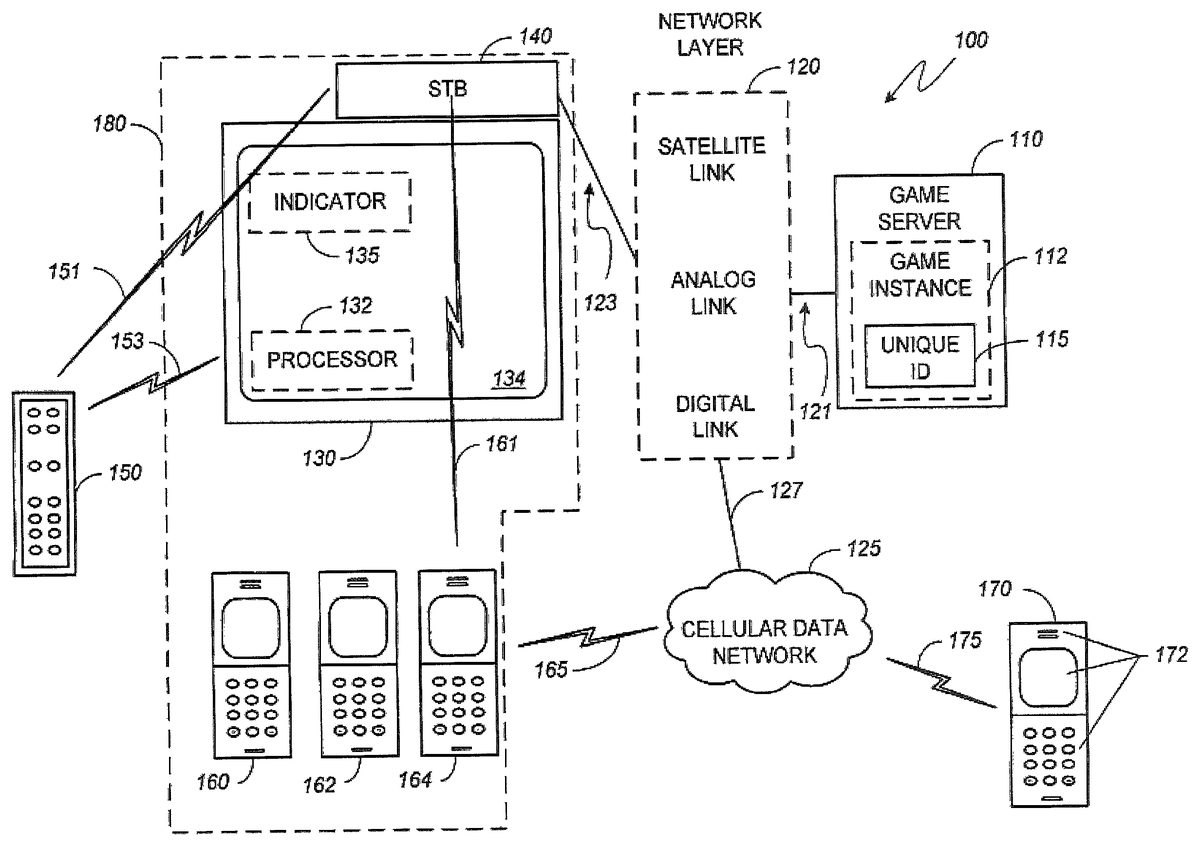
Having generally described the present system, method and computer program for enabling an interactive game, various additional embodiments will be described with respect toFIGS. 1-5. By way of example,FIG. 1is a block diagram illustrating an embodiment of a game environment100. Game environment100includes a short-range wireless or home network180that is communicatively coupled to game server110via a network layer120. The short-range wireless network180is configured to support network connectivity of portable devices and complies with one or more wireless network protocols, such as but not limited to the Institute of Electrical and Electronics Engineers 802.11 and 802.15 protocols and the Bluetooth protocol for home or local area wireless networks.
Short-range wireless network180includes set top box140and one or more wireless communication devices, such as wireless communication device160, wireless communication device162and wireless communication device164. Set top box140communicates with one or more network layer120content transfer mediums via communication link123. In addition, short-range wireless links communicatively couple set top box140with wireless communication devices, such as wireless link161, which couples set top box140and wireless communication device164. Moreover, set top box140is coupled to monitor130and processor132, which converts various signals received via communication link123and network layer120to present multimedia content to viewers in close proximity to display134. In the illustrated embodiment, set top box140is a separate device. The set top box140could be integrated or otherwise combined with monitor130or some other device such as a gaming console (not shown). For that matter, the gaming console could be combined or integrated with monitor130. As described above and in the '438 patent, one or more indicators, such as indicator135is integrated within the various signals communicated via set top box140to indicate that game server110is available to provide alternative content.
As indicated inFIG. 1, controller150is wirelessly coupled to set top box via communication link151and wirelessly coupled to monitor130via communication link153. A game host or subscriber of one or more multimedia services delivered via set top box140directs the operation of set top box140and monitor130via multiple function controller150.
Game server110communicates with one or more network layer120content transfer mediums via communication link121. Game server110is configured to provide one or more interactive games to local players within home network180. Game instance112stored within game server110includes information that supports the generation of game content, which is communicated via network layer120and set top box140on its way to monitor130. Game instance112further includes a unique identifier115, which is used to bind set top box140and each of the wireless communication devices, such as wireless communication device160, wireless communication device162, and wireless communication device164to the interactive game. Upon the completion of a setup procedure that is illustrated inFIG. 2and explained in detail below, game instance112includes information that maps select items of the user interface of each respective wireless communication device for use as a game input. In this way, multiple players can enjoy an interactive multi-player game without the need of specialized game controllers or being in close proximity to the host's home network.
In one alternative embodiment, one or more select items of the user interface of controller150are registered to enable the host or an additional player without a wireless communication device to join the game. In this mode of operation, other items of the user interface of controller150remain operable to communicate with set top box140and monitor130to control these devices.
As further illustrated inFIG. 1, a remote wireless communication device170(i.e., not within home network180) is communicatively coupled to network layer120via cellular data network125, communication link127and wireless data link175. User interface172associated with wireless communication device170can also be registered or bound to game instance112via unique identifier115. In this way, an operator of remote wireless communication device170can be contacted, invited to join and added to the game.
Alternatively, one or more of the local wireless communication devices can be coupled to cellular data network125via communication link165to directly or indirectly contact the operator of remote wireless communication device170. For example, one or more of a text message, a multimedia message, a voice message or a phone call can be communicated to invite the operator of remote wireless communication device170to join the game. These messages will include the unique identifier and perhaps additional information that can be used by the operator to communicate with game server110to join the game.
While the embodiment illustrated inFIG. 1includes wireless telephonic devices (i.e., cellular telephones), it should be understood that wireless communication devices with various user interfaces, such as personal digital assistants (PDAs), combination devices, wireless computing devices, etc. can be interchanged with one or more of the wireless communication devices to communicate with game server110.
FIG. 2is a schematic diagram illustrating game setup and operation in the environment ofFIG. 1. The schematic diagram includes a sequence of encircled numbers from1through11that are indicative of an example sequence of actions, events and information transfers that occur during the setup and operation of an interactive game. As described above and noted by the encircled number “1,” game server110and/or set top box140are configured to work in conjunction with monitor130to present indicator135on display134.
In response to the indicator135, a host or subscriber of a game service uses a wireless controller150configured to communicate with monitor130and set top box140to engage a setup menu. The setup menu can be software and/or firmware stored and operative on set top box140. Alternatively, the setup menu can be hosted in game server110. The host, via the setup menu, identifies a game, a number of proposed players and provides information about controller150, when it is desired to have controller150serve as both a host controller and as a game controller. In addition, the host may provide contact information associated with one or more remote players. A remote player communicates with game server110via wireless communication device170and a wireless data network different from the short-range wireless network used by the host and local players. Moreover, the host may provide additional information via the setup menu about a first local player, a respective wireless communication device160and a second local player with wireless communication device162. The above described activities of the host communicating with game server110via controller150are noted by the encircled number “2.”
The encircled number “3” indicates that game; player; contact; and controller information collected during execution of the setup menu are communicated from set top box140to game server110. Alternatively, the set top box140or game server110may have stored contact information associated with remote or local users that have been invited to previous games. Information associated with the previous invitation or previously game instances can be used to assist the setup menu in configuring a particular game instance.
As indicated by the encircled number “4,” game server110in turn initiates a game instance112, which includes unique identifier115. Unique identifier115is transmitted from game server110to display134via set top box140. As noted by the encircled number “5,” the host and local players can observe unique identifier115in the video information presented in display134and/or hear a message that includes the unique identifier. Encircled number “5” indicates that game server110forwards an invitation to join the game to a potential remote player via wireless communication device170. The invitation can be made via a short-message service (SMS) or multimedia-message service (MMS) message provided over a wireless data network. The invitation includes the unique identifier115. Alternatively, the wireless communications device170may also be able to initiate a request to join the game by entering a SMS, MMS, hypertext transfer protocol (HTTP), or other address associated with game instance112on game server110. In this way, a remote user can attempt to join a game in progress from anywhere where the remote user, through wireless communication device170can be communicatively coupled to game server110. In turn, game server110will communicate information about the remote user to set top box140, which may present a notice on monitor130introducing the remote user or a request for the host to allow the remote user to enter the game.
Thereafter, as indicated by the encircled number “6,” each of the potential local and remote players communicates the unique identifier115, a user name and information about their respective wireless communication devices to game server110. The encircled number “7” indicates that game server110stores player interface data200in game instance112. Player interface data200is derived from a description of the user interface on each respective player's wireless communication device and is used throughout the existence of game instance112to process command inputs from each of the players. Game server110forwards information on game operation and navigation via each specific wireless communication device registered with game instance112. Game server110communicates this information once the identity of each registered wireless communication device is determined. To assist users in configuring a particular game, game server110or set top box140is provided a database of popular wireless communication devices including photographs or graphical images representing different devices. In some embodiments, the setup menu presents images grouped by manufacturer for users to easily identify their respective wireless communication device. In return, game server110or set top box140provides one or more images describing how the various items on each user interface is used to enter specific game commands.
Having been provided with information from the setup menu as well as information about each of the respective devices that will be used to interact with game instance112, game server generates game information210as shown by the encircled number “8.” Game information210is used by game logic to coordinate the generation and transmission of game content220to set top box140for presentation on display134and presentation via the user interface (i.e., a separate display) on wireless communication device170, as indicated by the encircled number “9.” Thereafter, as indicated by the encircled number “10,” each of the respective players transmits various controller commands230in accordance with play of the interactive game, which are communicated back to and temporarily buffered within game instance112of game server110, as indicated by the encircled number “11.” Game server110or set top box140is further configured to pause and restart or otherwise continue an interrupted game. Game server110or set top box140has the ability to choose how each player is invited to connect to a game instance112that is about to be restarted or continued in accordance with a host controllable connectivity configuration. For example, game instance112may be paused while a remote player is in transit from a remote location to the host's local network. If the remote player was using a cellular telephone to connect with game server110and desires to switch from connectivity via a wireless data network to connectivity via the host's local network, game instance112retains a record of the remote player's username and cellular telephone number to enable the remote player to continue under the new connectivity situation within the stored game. In addition, game server110and set top box140have the ability to store information identifying a number of alternative controllers and connectivity configurations for a particular player should the information be needed to configure a continuation of an interrupted game or to configure a new game.
FIG. 3is a block diagram illustrating an embodiment of the game server110ofFIG. 1andFIG. 2. Generally, in terms of hardware architecture, game server110includes processor310, memory320, power supply330, input/output (I/O) interface340and network interface350. Processor310, memory320, power supply330, I/O interface340and network interface350are communicatively coupled via local interface360. Local interface360can be, for example but not limited to, one or more buses or other wired or wireless connections, as is known in the art. Local interface360may have additional elements, which are omitted for simplicity, such as controllers, buffers (caches), drivers, repeaters, and receivers, to enable communications. Further, local interface360may include address, control, and/or data connections to enable appropriate communications among the aforementioned components.
Power supply330provides power to each of the processor310, memory320, I/O interface340, network interface350and local interface360in a manner understood by one of ordinary skill in the art.
Processor310is a hardware device for executing software, particularly that stored in memory320. The processor310can be any custom made or commercially available processor, a central processing unit (CPU), an auxiliary processor among several processors associated with the game server110, a semiconductor based microprocessor (in the form of a microchip or chip set), or generally any device for executing software instructions.
The memory320can include any one or combination of volatile memory elements (e.g., random-access memory (RAM, such as dynamic random-access memory (DRAM), static random-access memory (SRAM), synchronous dynamic random-access memory (SDRAM), etc.) and nonvolatile memory elements (e.g., read-only memory (ROM), hard drive, tape, compact disc read-only memory (CDROM), etc.). Moreover, the memory320may incorporate electronic, magnetic, optical, and/or other types of storage media. Note that the memory320can have a distributed architecture, where various components are situated remote from one another, but can be accessed by the processor310.
The software in memory320may include one or more separate programs, each of which comprises an ordered listing of executable instructions for implementing logical functions in addition to identified locations for data storage. In the example ofFIG. 3, the software in the memory320includes operating system322, game engine323and registration engine324. The operating system322essentially controls the execution of other programs, such as game engine323and registration engine324and provides scheduling, input-output control, file and data management, memory management, and communication control and related services.
Registration engine324includes logic configured to complete the necessary steps to identify a desired game, initiate game instance112, generate, associate and communicate unique identifier115with the game instance112. In addition, registration engine324includes logic configured to generate one or more invitations, identify and associate players that communicate unique identifier115with game instance112and establish appropriate game content links. Moreover, registration engine324includes logic configured to work in conjunction with information in device interface store325to map and communicate the assignment of appropriate elements of a player's respective wireless communication device interface with game commands. Player information generated as a result of the execution of logic within registration engine324may be collected and stored within player interface data200.
Game engine323includes logic for receiving game commands (i.e., inputs) from one or more players as identified within player interface data200and applying the same in accordance with the rules of an identified game. In turn, game engine323generates game information210, which is stored within game instance112. Moreover, game engine323includes logic for generating game content in a format or formats suitable for local and remote players. In the case of local players, game content may be in the form of audio, video or both audio and video suitable for display and presentation via monitor130. In the case of remote players, game content will be formatted for display and presentation on the player's wireless communication device.
Game engine323and registration engine324are source programs, executable programs (object code), scripts, or any other entities comprising a set of instructions to be performed. When implemented as source programs, the programs are translated via a compiler, assembler, interpreter, or the like, which may or may not be included within the memory320, so as to operate properly in connection with the O/S322. Furthermore, game engine323and registration engine324can be written in one or more object-oriented programming languages, which have classes of data and methods, or procedure programming languages, which have routines, subroutines, and/or functions.
I/O interface340is a hardware device for communicatively coupling local input devices, for example but not limited to, a keyboard, mouse, scanner, microphone, etc. Furthermore, I/O interface340communicatively couples local output devices, for example but not limited to, a printer, display, etc. These local I/O devices may be provided to configure and maintain game server110as desired.
Network interface350is a hardware device for communicatively coupling set top box140and one or more wireless communication devices to game server110via various wired and wireless networks. In this regard, network interface350may include devices that communicate both inputs and outputs, for instance but not limited to, a modulator/demodulator (modem; for accessing another device, system, or network), a radio frequency (RF) or other transceiver, a telephonic interface, a bridge, a router, etc.
Network interface350exposes game server110to wired and wireless data networks, including but not limited to, community access television (CATV) distribution networks, satellite broadcast networks, public switched telephone network (PSTN) based communication services, DSL, and cellular data networks. Accordingly, network interface350is configured to perform the signal conditioning and format conversions to communicate data through network layer120(FIG. 1). Under some circumstances, signal conditioning and format conversions include the performance of a variety of functions including, for example: answering a phone line; hanging-up a phone line; dialing a phone number; sending data signals; receiving data signals; generating dual tone multi-frequency (DTMF) tones; detecting DTMF tones; receiving automatic number identification—the number from which a caller initiates a call (ANI) and dialed number identification service—the number dialed by the caller (DNIS) playing voice messages; and converting voice signals between analog and digital formats. Under some other circumstances, signal conditioning and format conversions include encoding and encapsulating data in packets under one or more protocols including transmission control protocol/Internet protocol (TCP/IP), among others.
When game server110is in operation, the processor310is configured to execute software stored within the memory320, to communicate data to and from the memory320, and to generally control operations of the game server110pursuant to the software and data elements. Game engine323, registration engine324and the O/S322, in whole or in part, but typically the latter, are read by the processor310, perhaps buffered within the processor310, and then executed.
When game engine323and registration engine324are implemented in software, as is shown inFIG. 3, it should be noted that these software elements can be stored on any computer-readable medium for use by or in connection with any computer related system or method. In an alternative embodiment, where one or more of the game engine323and registration engine324are implemented in hardware, the game engine323and registration engine324can implemented with any or a combination of the following technologies, which are each well known in the art: a discrete logic circuit(s) having logic gates for implementing logic functions upon data signals, an application-specific integrated circuit (ASIC) having appropriate combinational logic gates, a programmable gate array(s) (PGA), a field-programmable gate array (FPGA), etc.
FIG. 4is a flow diagram illustrating an embodiment of a method400for enabling an interactive game. In this regard, each block represents a specified step or function. When embodied in software and/or a hardware device, each block represents a module, segment, or portion of code, which comprises one or more executable instructions for implementing the specified function(s). Method400begins with block410where an interactive session is established. In block420, a unique identifier is provided. Thereafter, as shown in block430a wireless communication device is registered for use as a data controller in response to a communication from the wireless communication device that contains the unique identifier.
FIG. 5is a flow diagram illustrating an embodiment of a computer program that can be executed on the game server110ofFIG. 1. The flow diagram ofFIG. 5shows the architecture, functionality, and operation of a possible implementation via software and or firmware associated with the game server110introduced inFIG. 1. In this regard, each block represents a module, segment, or portion of code, which comprises one or more executable instructions for implementing the specified function(s). Computer program500begins with block510where an account is established. In block520, computer program500directs game server110to deliver an indication that alternative content is available to a device associated with the account. Thereafter, as shown in block530, computer program500receives a response to the indication indicating a desire to initiate an interactive game. In turn, computer program500provides a unique identifier, as indicated in block540. Next, as shown in block550, game server110under the direction of computer program500, registers a wireless communication device as an interface for the interactive game. As illustrated in block560, game server110uses an input entered via the user interface on the wireless communication device as a game input.
Operational software programs that may be used by game server110, as well as operational software that may be used in conjunction with controllers, browsers, monitors, computers, telephonic devices, among other devices that interface with system100, which comprise an ordered listing of executable instructions for implementing logical functions, can be embodied in any computer-readable medium for use by or in connection with an instruction execution system, apparatus, or device, such as a computer-based system, processor-containing system, or other system that can fetch the instructions from the instruction execution system, apparatus, or device and execute the instructions.
In the context of this document, a “computer-readable medium” can be any means that can contain, store, communicate, propagate, or transport the program for use by or in connection with the instruction execution system, apparatus, or device. The computer-readable medium can be, for example but not limited to, an electronic, magnetic, optical, electromagnetic, infrared, or semiconductor system, apparatus, device, or propagation medium. More specific examples (a non-exhaustive list) of the computer-readable medium would include the following: an electrical connection (electronic) having one or more wires, a portable computer diskette (magnetic), a RAM, a ROM, an erasable programmable read-only memory (EPROM or Flash memory) (magnetic), an optical fiber (optical), and a portable CDROM (optical). Note that the computer-readable medium could even be paper or another suitable medium upon which the program is printed and the program can be electronically captured, via for instance, optical scanning of the paper or other medium, then compiled, interpreted or otherwise processed in a suitable manner if necessary, and then stored in a computer memory.
While various embodiments of the system, method and computer program for enabling an interactive game have been described, it will be apparent to those of ordinary skill in the art that many more embodiments and implementations are possible that are within the scope of the accompanying claims. Accordingly, the system, method and computer program for enabling an interactive game are not to be restricted beyond the attached claims and their equivalents.
Claims
- An apparatus, comprising: a processor;and a memory storing instructions that are executable by the processor to perform operations comprising: sending content of a first channel to a display device;receiving a callback address from a game server;sending an image that corresponds to the callback address to the display device;storing information associated with the first channel when the image is sent to the display device;sending content associated with a game to the display device;and sending the content of the first channel to the display device based on the stored information associated with the first channel.
- The apparatus of claim 1 , wherein the content associated with the game includes a game setup menu, and wherein the operations further comprise sending the content of the first channel based on the stored information after the game setup menu terminates.
- The apparatus of claim 1 , wherein the operations further comprise sending content of a second channel associated with the game to the display device.
- The apparatus of claim 1 , wherein the operations further comprise sending an identifier and information regarding a controller useable to participate in the game to the game server.
- The apparatus of claim 4 , further comprising a network interface coupled to a first network, wherein the identifier enables a player to join the game via a second network that is different from the first network.
- The apparatus of claim 4 , wherein the operations further comprise receiving the identifier from each of a plurality of players, and sending commands associated with the game received from each of the plurality of players to the game server.
- The apparatus of claim 1 , wherein the operations further comprise receiving, from the game server, visual representation data associated with the game.
- The apparatus of claim 1 , further comprising a network interface configured to communicate with at least one controller via a short-range radio-frequency link.
- The apparatus of claim 1 , further comprising a network interface configured to receive game commands associated with play of a particular game from a wireless phone.
- A method comprising: receiving, at a game server, first commands from a set top box via a first network, wherein the set top box is located at a first location and wherein the first commands are associated with a game instance of a particular game;receiving, via a second network that is different from the first network, second commands associated with the game instance from a wireless device that is located at a second location that is remote from the first location;receiving a first request at the game server to pause the game instance;receiving a second request at the game server to resume the game instance when the wireless device has relocated from the second location to the first location;resuming the game instance at the game server;and after resuming the game instance, receiving the first commands from the set top box and third commands from the wireless device via the first network.
- The method of claim 10 , further comprising sending visual representation data associated with the game instance to the set top box.
- The method of claim 11 , wherein the set top box sends visual representations based on the visual representation data to a display device of the wireless device.
- The method of claim 10 , further comprising sending images of control features of the game instance to the wireless device.
- The method of claim 10 , further comprising sending image data corresponding to control features of the game instance to the set top box via the first network.
- The method of claim 10 , further comprising storing an identifier associated with the wireless device to enable the wireless device to continue sending commands associated with the game instance after the game instance is resumed.
- The method of claim 10 , wherein the second network comprises a radio frequency network.
- A computer-readable storage device storing instructions executable by a processor to perform operations comprising: receiving a request via a first network for a game instance, the request received from a set top box, wherein the request includes first identification information associated with a first player collocated with the set top box and second identification information of a wireless device associated with a second player remotely located from the set top box;starting the game instance;receiving commands associated with the game instance from a controller of the first player via the first network;receiving commands associated with the game instance from the wireless device via a second network that is different than the first network;detecting an interruption of the game instance;retrieving information identifying an alternative controller associated with a particular game player;and resuming the interrupted game instance based on the retrieved information.
- The computer-readable storage device of claim 17 , wherein the operations further comprise retrieving second information associated with an alternative connectivity configuration associated with the particular game player and resuming the interrupted game instance further based on the second information.
- The computer-readable storage device of claim 17 , the operations further comprising sending an identifier of the game instance to the set top box via the first network.
- The computer-readable storage device of claim 19 , the operations further comprising sending an invite to join the game instance to the wireless device associated with the second player, wherein the invite includes the identifier.
Disclaimer: Data collected from the USPTO and may be malformed, incomplete, and/or otherwise inaccurate.