U.S. Pat. No. 8,651,949
TOY AND ASSOCIATED COMPUTER GAME
AssigneeMattel, Inc.
Issue DateAugust 24, 2011
Illustrative Figure
Abstract
A series of co-packaged products, wherein each product includes a physical toy, action figure, or the like, along with an associated CD-ROM or other media encoded with software code or logic that includes a computer game that uses as a game character a rendering of the physical toy with which the CD-ROM is co-packaged. In an embodiment, each CD-ROM in the series includes all of the games that are associated with each respective game character in the series. Each CD-ROM is further configured, if it is a first such CD-ROM being installed on the computer, to generate and store a configuration file that indicates which ones of the game characters should be activated. Thus, once a first CD-ROM of the series is installed on the computer, a subsequent install of software encoded on another CD-ROM will result in, perhaps, only a modification of the configuration file, without having to install the entire computer game again.
Description
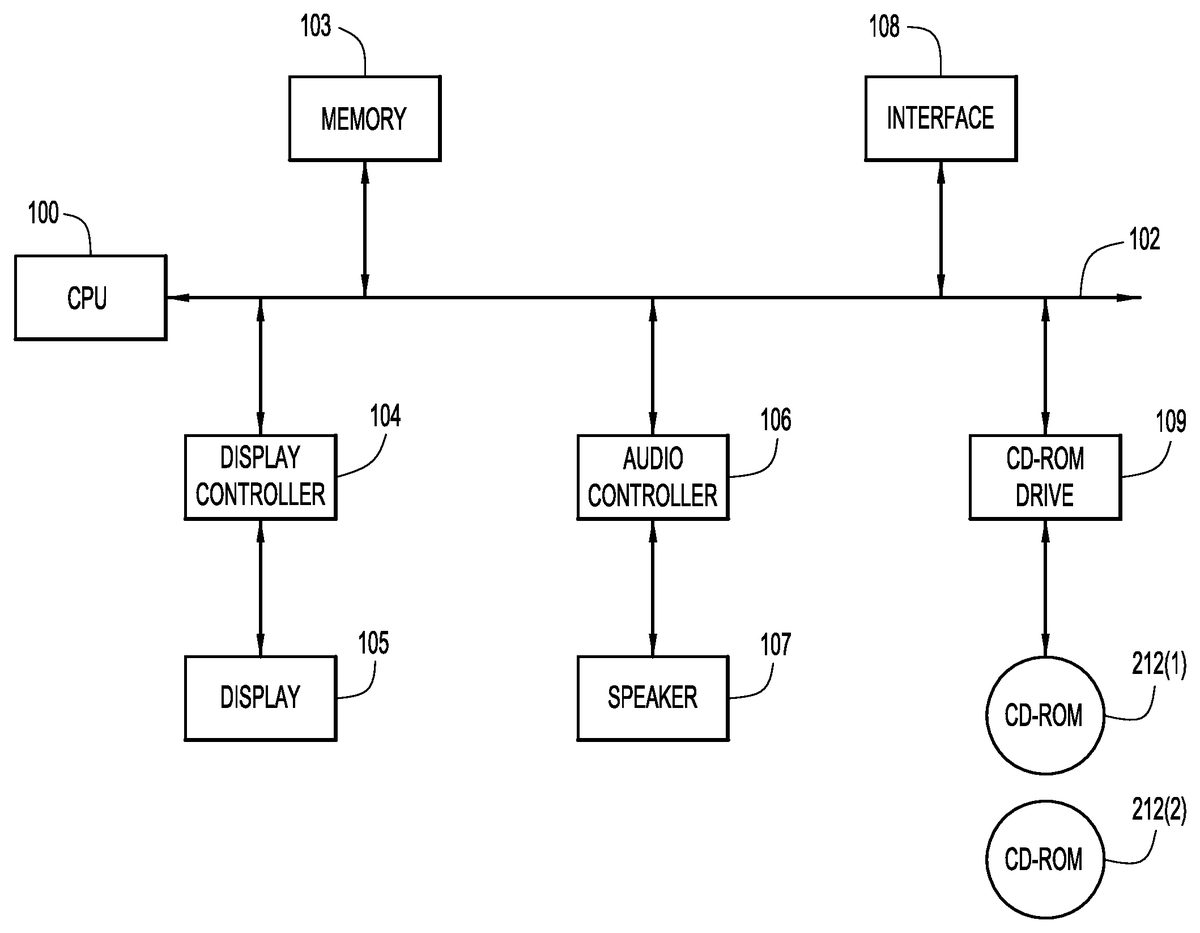
Like reference numerals have been used to identify like elements throughout this disclosure. DETAILED DESCRIPTION OF THE INVENTION FIG. 1depicts a computer system with which embodiments of the present may operate. The computer system includes a central processing unit (CPU)100connected to a bus102via which the CPU100can communicate with other components of the system. The computer system further includes memory103which may include read only memory (ROM), random access memory (RAM), combinations of the two, or other suitable memory including a hard drive or similar devices. A display controller104provides graphics signals to a display105for, in this case, rendering views of the computer game. Likewise, an audio controller106provides audio signals to a speaker107. As will be explained in more detail later herein, audio cues, output from speaker107, help a user to understand the status of game characters. Further, an interface module108is shown. Interfaces may include a keyboard, pointing device, such as a mouse, or any other like device that permits a user to provide instructions or input to the computer. Finally, a CD-ROM drive109is provided. The CD-ROM drive109successively accepts CD-ROMs212(1),212(2), . . .212(n), which, in the case of embodiments of the present invention, each includes a computer game that is loaded and run on the computer system. More particularly, and as will be explained more fully below, different CD-ROMs may be inserted and read by the computer system in order to gain access to, or unlock or activate, respective game characters. Although the use of CD-ROMs and a CD-ROM driver are described herein, there may be other media via which the computer game may be loaded onto the computer system, including USB memory “sticks,” USB drives, memory cards, or any other suitable media that can store program logic (i.e., software) for the computer game. In the context of the instant description, the “computer ...
Like reference numerals have been used to identify like elements throughout this disclosure.
DETAILED DESCRIPTION OF THE INVENTION
FIG. 1depicts a computer system with which embodiments of the present may operate. The computer system includes a central processing unit (CPU)100connected to a bus102via which the CPU100can communicate with other components of the system.
The computer system further includes memory103which may include read only memory (ROM), random access memory (RAM), combinations of the two, or other suitable memory including a hard drive or similar devices. A display controller104provides graphics signals to a display105for, in this case, rendering views of the computer game. Likewise, an audio controller106provides audio signals to a speaker107. As will be explained in more detail later herein, audio cues, output from speaker107, help a user to understand the status of game characters.
Further, an interface module108is shown. Interfaces may include a keyboard, pointing device, such as a mouse, or any other like device that permits a user to provide instructions or input to the computer.
Finally, a CD-ROM drive109is provided. The CD-ROM drive109successively accepts CD-ROMs212(1),212(2), . . .212(n), which, in the case of embodiments of the present invention, each includes a computer game that is loaded and run on the computer system. More particularly, and as will be explained more fully below, different CD-ROMs may be inserted and read by the computer system in order to gain access to, or unlock or activate, respective game characters. Although the use of CD-ROMs and a CD-ROM driver are described herein, there may be other media via which the computer game may be loaded onto the computer system, including USB memory “sticks,” USB drives, memory cards, or any other suitable media that can store program logic (i.e., software) for the computer game. In the context of the instant description, the “computer game” may include multiple sub-games where each sub-game is associated with an individual game character. A sub-game may be a game distinct from all other sub-games, or may instead be a game that interacts with other sub-games.
Reference is now made toFIG. 2, which shows a co-packaging configuration for a computer game and toy in accordance with an embodiment of the present invention. As shown, a package200includes a toy210and an associated CD-ROM212(1). The toy210may be, e.g., an action figure, made from, e.g., plastic or other suitable material. The toy210may also come with accessories (not shown) such as a jet pack, weapons, tools, or other accessories that might be suitable for the particular toy and that may enhance the enjoyment of a user, such as a child.
Combined with the toy, in the same package200, is CD-ROM212(1). CD-ROM212(1) inFIG. 2includes indicia214indicating that this particular CD-ROM is “#2” out of, perhaps, a total of six different toys and associated CD-ROMs combination sets. As is seen in the drawing, CD-ROM212(1) preferably includes graphics216that include a rendering of the toy with which the CD-ROM212(1) is packaged. That is, there is a clear correspondence or relationship between the CD-ROM212(1) and the toy210in a given package200. As will be explained, the CD-ROM212(1) will unlock or activate, with the computer game, a game character that looks substantially identical to or resembles the toy with which the CD-ROM212(1) was packaged. Indicia216on package200notify purchasers and potential purchasers of the package200that each action figure or toy comes with its own computer game, and that one can collect, in this particular implementation, all six of such toys and computer games.
FIG. 3is a screenshot of a game access screen300that, in one embodiment, is displayed once the computer game, stored on CD-ROM212(1), is, e.g., loaded, read, stored and launched on the computer system. As shown, six different game pieces or characters308-318are depicted. One of the game characters, namely character310, is indicated as being active (in the figure hash marks surround the character310). In a color rendering, character310may be displayed in full color, while the other characters308and312-318may be displayed in more simple gray scale. As a result, a user has an immediate visual indication as to which ones of the game characters are active or unlocked versus those that are inactive or locked. Those that are displayed in color are unlocked and active, and those that are locked or inactive are displayed in, e.g. gray scale.
Screenshot300ofFIG. 3is a screen that, in an embodiment, is shown after only one of, e.g., possibly six different CD-ROMs (each corresponding to a different game character) is loaded on the computer system. Consequently, the only game character available for use, i.e., active or unlocked, is the game character that corresponds to the particular toy with which the CD-ROM212(1) was packaged and sold.
In use, when a user manipulates a pointing device, such as a mouse, to hover over any one of the game characters shown in screenshot300, the character may be backlit to emphasize that the pointing device is pointing to that character, and an audible cue may be provided to announce the name, and perhaps the status, of that game character. Thus, for example, if a mouse were manipulated to place a pointer over unlocked character310, an audible announcement might be generated to play as follows: “Waves” (which is the character's name). The announcement might also say: “Waves is unlocked and ready for action.” If a user were to click on this character, a game character status screen (see screenshot400ofFIG. 4) may be displayed. This game character status screenshot400may act as a gateway to an actual interactive game, as will be explained later herein. Alternatively, in another possible embodiment, clicking on the active character310may immediately initiate an interactive game associated with the game character310.
Referring still toFIG. 3, when, on the other hand, a pointer is placed over an inactive or locked character such as character314, the audible cue might be: “G-Force” (which is the character's name). The announcement might also say: “G-Force is locked and unavailable for action.” If a user were to click on this character another game character status screen (see screenshot1100ofFIG. 11) may be displayed. A discussion ofFIG. 11is provided later herein.
As mentioned, in accordance with an embodiment, when a user clicks on an active game character such as character310, a screen like screenshot400shown inFIG. 4may be displayed. This screenshot400includes a window410that shows the game character, perhaps moving, twisting or revolving in slow motion as a graphical effect. When a user manipulates a pointing device to hover over window410, an audible notice might say: “Waves . . . Status active.” Thus, screenshot400is yet another possible place for a user to obtain status information regarding a game character. In this way, a user, perhaps a young child, can easily discern which characters are active or inactive. Button420, when clicked, launches an interactive game, shown inFIG. 5.
The screenshot500ofFIG. 5shows one possible game that involves the specific Waves character310that is active in the computer game. In this particular game, the character310can be moved around the screen using, e.g., a mouse in an effort to “capture” crystals502that are moving, in this case, along multiple vertical axes. The nature of the computer game is not at all critical. This particular game is discussed only as an example to show how an active character can be selected to play an interactive game involving that character.
FIG. 6shows two CD-ROMs212(1) and212(2). CD-ROM212(1) includes graphics matching game character310(Waves). As can be seen, CD-ROM212(1) is numbered with “#2” indicating that it is the second character/computer game out of an arbitrary number of possible toy/game characters/computer game combinations. CD-ROM212(2) includes graphics corresponding to a different game character, in this case, G-Force game character316. Significantly, however, while the graphics on each CD-ROM212might depict a different game character, all of the computer sub-games (each computer game for each game character) is resident on each CD-ROM212. Thus, as will be explained in more detail, all of the same games are included on each CD-ROM212(1),212(2),212(n), but each CD-ROM212is configured with software or code to unlock only a single one of the game characters and the game(s) associated with that game character.
FIG. 7is a screenshot700that shows the rendering on the display105of the computer system when a second CD-ROM212(2) is read by the computer system. It is assumed that software or code from a first CD-ROM212(1) has already been loaded on the computer system, and the entirety of all computer games associated with each game character has also been loaded, but not yet activated.
In the case of the screenshot700ofFIG. 7, a window710asks whether the software on the CD-ROM212(2) should be installed or whether the program should be exited. Assuming, a user clicks the “Install” button in window710, the CD-ROM212(2) is configured to start an install process including rendering a screen such as screenshot800ofFIG. 8. Screenshot800includes a window810that asks a user to launch a setup wizard. Assuming the user clicks “next” in window810, the software or code encoded on CD-ROM212(2) determines whether a prior CD-ROM212(e.g., CD-ROM212(1)) that includes the entire computer game also resident or encoded on the current CD-ROM212(2) has already been installed. If so, then a screen similar to screenshot900ofFIG. 9may be presented. Window910in screenshot900indicates “This Robot has been unlocked and activated.” In this specific implementation, “robot” is equivalent to game character. Thus, window910indicates to the user that the game character depicted on CD-ROM212(2) that has been input in CD-ROM driver109is now active or unlocked. Significantly, because a previously installed CD-ROM212already loaded all of the games for all of the game characters, the game(s) encoded on most recently installed CD-ROM212(2) need not be loaded onto the computer system. Rather, only a relatively simple configuration file change needs to occur to unlock or activate a game character associated with a newly-installed CD-ROM212(2). This substantially increases the speed of the install process.
FIG. 10shows an example configuration file that may be set up by software encoded on a first CD-ROM212and stored in a directory on the computer system, which configuration file can then be updated when a subsequent CD-ROM212is installed. As shown, once a second one of the CD-ROMs212is installed, two game characters, e.g., Waves310and G-Force314each have a bit set to one or flag set, while the remaining game characters bits or flags are not set. Thus, each time the computer game launches the software code checks the configuration file and determines which ones of the game characters to depict as being active or unlocked versus inactive or locked. Thus, again, when a subsequent CD-ROM is installed, the entire computer game need not be installed. Instead, only a configuration file, an example of which is shown inFIG. 10, needs to be updated, thereby unlocking the appropriate game character.
FIG. 11shows screenshot1100of a game access screen that, in one embodiment, is displayed once CD-ROM212(2), is loaded, read, stored and launched on the computer system. As shown, the six different game pieces or characters308-318are still depicted. Now, however, and in juxtaposition withFIG. 3, two of the game characters, namely characters310and314are indicated as being active (hash marks surround the game characters310and314). In a color rendering, both characters310and314may be displayed in full color, while the remaining characters308,312and316-318may be displayed in more simple gray scale. As a result, and in a similar fashion discussed with respect toFIG. 3, a user has an immediate visual indication as to which ones of the game characters are active or unlocked. Those game characters that are displayed in color are unlocked and active, and those that are locked or inactive are displayed in, e.g. gray scale.
A user now has a choice between selecting, or clicking on, either game character310(Waves) or game character314(G-Force). If game character314is selected, a screen similar to screenshot1200inFIG. 12may be shown. Like the screenshot400ofFIG. 4, screenshot1200may provide audible status information about the selected game character, here game character314(G-Force), when a pointing device is manipulated to hover over widow1210. The game character in window1210may move, twist or revolve to enhance the graphical presentation. Also, as before, this game character status screen may act as a gateway to an actual interactive game, by clicking on the “PLAY” button near the bottom of the screenshot1200. In another possible embodiment, clicking on the active character314in the screen depicted by screenshot1100may immediately initiate an interactive game associated with the character314.
Screenshot1300ofFIG. 13shows an interactive game that uses game character314in a game similar to the game depicted inFIG. 5. In this game, however, crystals502moving substantially along horizontal axes and the game character can be moved to capture the crystals502using a pointing device, such as a mouse. Once again, the nature of the interactive game is of no particular consequence.
FIG. 14shows an example series of steps for practicing aspects of an embodiment of the present invention. At step1402a CD-ROM is read. This CD-ROM (or other media) is preferably packaged and sold with a toy that resembles a game character in a game with which the CD-ROM is encoded. However, aspects of the present invention can be implemented without a co-packaged toy. At step1404, it is determined whether the software encoded on the CD-ROM that is currently being read has already been installed on the computer. If yes, then at step1406, and indication is provided to the user that the software is already installed and, e.g., that the CD-ROM may be removed.
If the software or code has not already been installed at step1404, then the process moves to step1408where it is determined whether a similar CD-ROM (i.e., another in the series) has already been installed. In other words, is the installation a first ever installation for the computer game. If yes, then the CD-ROM is considered a “first” CD-ROM and the process continues with step1410. At step1410, the computer game (including all sub-games) encoded on the first CD-ROM is loaded and stored on the computer system (e.g., a hard drive or other memory device). At step1412, in the course of loading the computer game, a configuration file is generated and stored. The configuration file is configured to provide an indication regarding whether to activate a given game character and sub-game associated with the given game character (in this case a first game character associated with the first CD-ROM).
After the installation process is complete, the game can be launched at step1414. This can be done automatically upon completion of installation, or by a user selecting an icon on the computer.
After launch, at step1416, the computer game is configured to show a status screen of the activated first game character along with un-activated (or locked) second and other game characters. The remainder of the game can played with the first game character.
When a second CD-ROM is read at step1402, the process again moves to step1404where it is determined whether that second CD-ROM has already been installed. If not the process moves to step1408. Here, since a first CD-ROM has already been installed, the second CD-ROM is not being used as a first installation CD-ROM. Accordingly, the process moves step1418. At step1418, because substantially all of the game software has already been loaded on the computer from a previously loaded CD-ROM (the first CD-ROM), the software or code encoded on the second CD-ROM updates the configuration file to indicate that a second sub-game or second game character associated with the second CD-ROM should be unlocked or activated. The computer game can then be launched at step1420.
Then, after launch at step1422, and in accordance with the configuration file, a status screen is shown that visually indicates that the first and second game characters are activated, along with any remaining locked or un-activated game characters.
A third and subsequent CD-ROMs can be read and loaded in this the same manner as the second CD-ROM to activate still more game characters and any associated games.
Thus, embodiments of the present invention provide a series of co-packaged products. Each product in the series includes a physical toy, action figure, or the like, along with an associated CD-ROM or other media capable of storing software code or logic that includes a computer game that uses as a game character a rendering of the physical toy with which the CD-ROM is co-packaged.
In an embodiment, each CD-ROM in the series includes all of the games that are associated with each game character in the series. Each CD-ROM is configured, if it is a first such CD-ROM being installed on the computer, to generate and store a configuration file that indicates which ones of the game characters should be activated. Thus, once a first CD-ROM of the series is installed on the computer, a subsequent install of another CD-ROM will result in a modification of the configuration file, without having to install the entire computer game again. This substantially speeds up the install process, thereby making the overall experience simpler and less stressful.
In an embodiment, an initial screen displayed by the computer game depicts all game characters in the series, visually indicating which ones of the game characters are active and inactive. This screen may thus entice a user to purchase additional co-packaged toy/computer games in a desire to unlock any or all of the inactive game characters and their associated games or sub-games.
Although the manufacture, apparatus, system or method are illustrated and described herein as embodied in one or more specific examples, they are nevertheless not intended to be limited to the details shown, since various modifications and structural changes may be made without departing from the scope of the manufacture, apparatus, system, and method and within the scope and range of equivalents of the claims. Accordingly, it is appropriate that the appended claims be construed broadly and in a manner consistent with the scope of the manufacture, apparatus, system, and method, as set forth in the following.
Claims
- A method, comprising: reading, by a computer, a first non-transitory computer readable storage medium, the first non-transitory computer readable storage medium having stored thereon a computer game that includes at least two game characters, the first non-transitory computer readable storage medium being configured to cause only a first one of the game characters to be unlocked once the computer game is loaded and launched on the computer;displaying a status screen that shows the at least two game characters, wherein the first one of the game characters is indicated as being unlocked as compared to a second one of the game characters, which is indicated as being locked;reading, by the computer, a second non-transitory computer readable storage medium, the second non-transitory computer readable storage medium having stored thereon the computer game that includes the at least two game characters, the second non-transitory computer readable storage medium being configured to cause only the second one of the game characters to be unlocked;and displaying, after the second non-transitory computer readable storage medium is read, the status screen, wherein the status screen indicates that both the first one and the second one of the at least two game characters are unlocked.
- The method of claim 1 , further comprising indicating that the first one of the game characters is unlocked by rendering the first one of the game characters in color;and indicating that the second one of the game characters is locked by showing a grayed-out rendering of the second one of the game characters.
- The method of claim 1 , further comprising receiving an indication that one of the at least two game characters has been selected, and launching a specific portion of the computer game associated with the selected game character.
- The method of claim 1 , further comprising receiving an indication that a pointing device is hovering over one of the at least two game characters;and in response, generating audible status information regarding whether the game character over which the pointing device is hovering is locked or unlocked.
- The method of claim 1 , further comprising: maintaining, on the computer, configuration information that identifies which ones of the at least two game characters are unlocked.
- The method of claim 5 , further comprising loading substantially all of the computer game using the first non-transitory computer readable storage medium, and updating the configuration information using the second non-transitory computer readable storage medium without loading the computer game.
- The method of claim 1 , wherein the first non-transitory computer readable storage medium and the second non-transitory computer readable storage medium are respective CD-ROMs.
- The method of claim 7 , wherein the respective CD-ROMs are sold with respective toys that resemble the first one of the game characters and the second one of the game characters.
- A method, comprising: co-packaging a first physical toy and associated first electronic media storing software code that includes a computer game that is configured to activate a first game character resembling the first the physical toy with which the first electronic media is co-packaged;and co-packaging a second physical toy and associated electronic media storing the software code and that is configured to activate a second game character resembling the second physical toy with which the second electronic media is co-packaged.
- The method of claim 9 , further comprising configuring the software code to indicate that the first game character is unlocked by rendering on a display the first game characters in color;and configuring the software code to indicate that the second game character is locked by rendering on the display a grayed-out rendering of the second game character.
- The method of claim 9 , further comprising configuring the software code to receive an indication that the first or second game character has been selected, and to launch a specific portion of the computer game associated with the selected first or second game character.
- The method of claim 9 , further comprising configuring the software code to receive an indication that a pointing device is hovering over one of the first or second game characters;and in response, to generate audible status information regarding whether the game character over which the pointing device is hovering is locked or unlocked.
- The method of claim 9 , further comprising configuring the software code to maintain configuration information on a computer that identifies which ones of the first and second game characters are activated and available for use in the computer game.
- The method of claim 13 , further comprising configuring the software code to load substantially all of the computer game using the first electronic media;and configuring the software code to update the configuration information using the second electronic media without loading the computer game on the computer.
- The method of claim 9 , wherein the first electronic media comprises a CD-ROM.
- A set of co-packaged items, comprising: a first co-packaged item comprising a first physical toy and associated first electronic media storing software code that includes a computer game that is configured to activate a first game character resembling the first the physical toy with which the first electronic media is co-packaged;and a second co-packaged item comprising a second physical toy and associated electronic media storing the software code and that is configured to activate a second game character resembling the second physical toy with which the second electronic media is co-packaged.
- The co-packaged items of claim 16 , wherein the software code is configured to indicate that the first game character is unlocked by rendering on a display the first game characters in color;and the software code is configured to indicate that the second game character is locked by rendering on the display a grayed-out rendering of the second game character.
- The co-packaged items of claim 16 , wherein the software code is configured to receive an indication that the first or second game character has been selected, and to launch a specific portion of the computer game associated with the selected first or second game character.
- The co-packaged items of claim 16 , wherein the software code is configured to receive an indication that a pointing device is hovering over one of the first or second game characters;and in response, to generate audible status information regarding whether the game character over which the pointing device is hovering is locked or unlocked.
- The co-packaged items of claim 16 , wherein the software code is configured to maintain configuration information on a computer that identifies which ones of the first and second game characters are activated and available for use in the computer game.
- The co-packaged items of claim 16 , wherein the software code is configured to load substantially all of the computer game using the first electronic media;and the software code is configured to update the configuration information using the second electronic media without loading the computer game on the computer.
- The co-packaged items of claim 16 , wherein the first electronic media comprises a CD-ROM.
Disclaimer: Data collected from the USPTO and may be malformed, incomplete, and/or otherwise inaccurate.