U.S. Pat. No. 8,641,530
SYSTEM AND METHOD FOR REAL TIME TRADING COMPUTER GAME
AssigneeTex Games LLC
Issue DateMarch 1, 2011
Illustrative Figure
Abstract
A computer game for dynamic real time trading where the rates of the tradeable objects (such as securities prices) are presented/displayed by using changes in properties of game objects (such as position, speed, shape, size, color or texture, etc.). The system employs player computer(s), real time data feeds from the investment objects to be traded and a game application that dynamically renders the data feed onto a gamer's visual display. The game application renders the data feed via a Conversion Engine Price To Game Model that depicts the price changes of the tradeable objects as the behavior of the game objects by changing the displayed properties. The player interacts with the game visual display to actually execute “buy” or “sell” actions or a reverse action (e.g., “short sell” then “buy”).
Description
DETAILED DESCRIPTION OF THE PREFERRED EMBODIMENTS Reference will now be made in detail to the preferred embodiments of the present invention, examples of which are illustrated in the accompanying drawings. According to the exemplary embodiment, a method for dynamic real time trading by using visual characteristics of the traded entities (such as position, speed, shape, size, color or texture, etc) is provided. The system employs player computer(s), real time data feeds from the tradeable objects (i.e., securities whose value is represented by game objects) to be traded provided by a broker server via a game server and a computer program that dynamically renders the data feed on a visual display or a computer monitor in a specific graphic form. FIG. 1illustrates a game system and functionality flow in accordance with the exemplary embodiment. A player PC (or a similar device with a CPU)20has a game application running on it. The player PC20is connected to a game provider server14which in turn is connected to a broker server16connected to trading exchange18(for example, any stock exchange like the NYSE or the NASDAQ). The player PC is connected to a visual display module such as a monitor (not shown) or a TV set and means of interacting with the display in order to execute game commands or actions, which are then transformed into trading commands “buy” or “sell.” Note that the interactive means enable one or more players to interact with the visual display to initiate the transactions. The game computer program running on the user PC20provides both a free game mode and a paid game mode. A drop-down menu or other type of game interface can provide the player with the selections such as whether to engage the free mode game or the paid mode game. The selection can be implemented as separate ...
DETAILED DESCRIPTION OF THE PREFERRED EMBODIMENTS
Reference will now be made in detail to the preferred embodiments of the present invention, examples of which are illustrated in the accompanying drawings.
According to the exemplary embodiment, a method for dynamic real time trading by using visual characteristics of the traded entities (such as position, speed, shape, size, color or texture, etc) is provided. The system employs player computer(s), real time data feeds from the tradeable objects (i.e., securities whose value is represented by game objects) to be traded provided by a broker server via a game server and a computer program that dynamically renders the data feed on a visual display or a computer monitor in a specific graphic form.
FIG. 1illustrates a game system and functionality flow in accordance with the exemplary embodiment. A player PC (or a similar device with a CPU)20has a game application running on it. The player PC20is connected to a game provider server14which in turn is connected to a broker server16connected to trading exchange18(for example, any stock exchange like the NYSE or the NASDAQ).
The player PC is connected to a visual display module such as a monitor (not shown) or a TV set and means of interacting with the display in order to execute game commands or actions, which are then transformed into trading commands “buy” or “sell.” Note that the interactive means enable one or more players to interact with the visual display to initiate the transactions. The game computer program running on the user PC20provides both a free game mode and a paid game mode. A drop-down menu or other type of game interface can provide the player with the selections such as whether to engage the free mode game or the paid mode game. The selection can be implemented as separate common GUI tools, such as buttons or as any other convenient mode select option.
Other player selections include the trading market for a particular session selected from a group of real time tradable objects (i.e., such as for example, stocks, bonds, commodities, currency exchange, etc., represented by game objects). Player can select a gaming model (types of game scenarios) in block120. The game model can be specially developed for this application, or can be traditional games, such as roulette, slot machine, wheel of fortune, etc., adapted to use in the system described herein. If, in step132, the player has selected the free mode (i.e., a simulation mode, if the game model supports it), the system provides a prompt to the video display via block122to consider the paid mode as an alternate option. An associated marketing “teaser” can be presented to the player in order to convince him to pursue the paid mode.
Assuming the player chooses in step132first to pursue the free game mode. The player is prompted to confirm that choice via another drop-down menu or other common GUI tools of functional block124. After the free mode is started in block124, a conversion engine126responds to the free mode election to enable a free game engine128to initiate and proceed with the game activity. The conversion engine126is fed real time pricing information from a real time price feed module130located on broker server16.
The real time price feed130includes prices of any stock, commodity, financial instrument, currency exchange rate, etc. traded on an exchange or an auction, through brokerages or other registered entities, so long as they support real time trading. The real time price feed130is provided to the free game engine128which transforms it into a game-like presentation for rendering on the visual display device of the player PC20.
The game-like presentation depicts the price change of the selected investment (i.e., game object) in a form that reflects changes of visual characteristics (such as position, speed, shape, size, color, texture, etc.). The game-like presentation does not necessarily reflect the context of interaction with the underlying real function, since the game actions in effect mask buy/sell commands. According to the exemplary embodiment, the game system renders the real time price information in a manner that allows for interaction means, for example: aim and shoot; catch and release; take and give; chase and catch; tag and grab; open and close, buy and sell, or other similar two-step actions that capture two separate moments in time.
If the player elects the paid mode from the menu132, whether initially or after participating in the free mode, the system requests appropriate identification information so as to verify the player and his association with the particular account through interface134on the user PC and block136on the game provider server14. If the account is insufficient based on the required minimum, assuming the player's identity has been confirmed, the player would be prompted to add funds to his account as well as (optionally) be reminded of the required fee for participating in this mode, for a predetermined time. Once the account credentials and balance are confirmed, the system authorizes the player to initiate the paid mode game via drop down menu or other common GUI tools prompted by system functional block138.
The conversion engine126now engages the paid game engine140, where the game activity is converted to buying and selling orders directed to a trade engine142for a subsequent execution through a trade execution module144associated with the exchange18on which the game object (i.e., investment) is traded. The underlying goal of the paid mode is for the trader (i.e., player) to make a related profit. In either of the two modes, visual characteristics and behavior of the object displayed on the game monitor are controlled by either the free game engine128or paid game engine140based on the real time data feed130received into the respective game engine.
In the free mode game, the player plays the game for entertainment only. However, the system is programmed to periodically remind the player of the paid mode so that if and when he desires to he can pursue his “success” in the free mode in the paid mode that can make him money if likewise successful. In reality, the player's actions in the paid mode result in buying and selling of securities or any investment instrument traded in real time environment with associated profit or loss. A summary of the player's transactions are maintained with periodic prompts, if necessary, to the player to advise him when his account balance falls below a predetermined minimum.
FIG. 2illustrates a game flow diagram in accordance with the exemplary embodiment. A player10requests an authorization for playing the game in block203. The player authorization is performed in authorization module205located on a game server14. After authorization is completed in block205, the player selects the game in block207. Then the game is loaded from the game server14(block211) or from the player PC cache in block209. Then, the game server14requests a connection with a broker server16(see block213). Connection is implemented by connection module215on the broker server side16. Once connected, the game starts in block217.
In block219the game interface is formed and the initial request for rate history (or values of corresponding selected securities) of game objects is generated in block221. The rate history over time period T is generated in block223on the broker server16. The generated history is provided to block227(on player PC20) where the graphic representation of history and movement of the game objects (i.e., changes in prices of the corresponding security) is generated and provided to the player for history analysis (block225).
According to the exemplary embodiment, the game generates cyclical requests for current rates of the tradable objects (i.e., game objects) within pre-set time intervals t in block229implemented on the player PC20. These requests are sent to the broker server16, where, in block231, the current rates at the moment of the request are recorded. Then, the game server14sets the additional value for the current rates in block233and provides the corrected rates to the player for analysis in block225via the graphics block227, which forms the rates into convenient graphic form for rendering to the player.
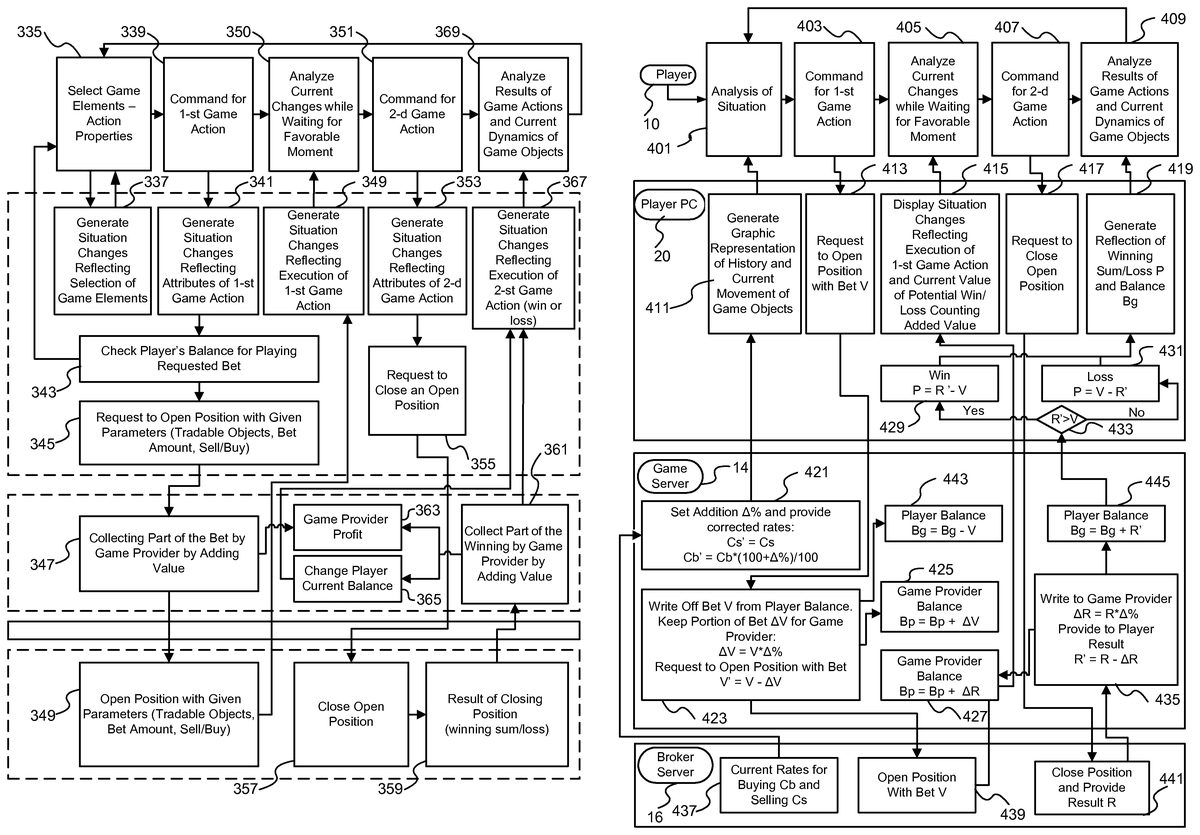
FIG. 3illustrates a detailed game flow in accordance with the exemplary embodiment. Player selects game elements (i.e., action properties) and the changes in the situation based on the selected game elements are generated by the game block337. Then, the player performs a first game action (see block339). Subsequent changes in game situation are generated in block341. The game checks player's balance for playing a requested (by first game action) bet in block343. A request for opening the position with the given game parameters is formed in block345. The game provider collects a portion of the bet in block347.
Then, the collected bet portion is added to game provider profit in block363. The position with given parameters is opened in block349. The game situation changes triggered by execution of the first game action are generated in block349. The player analyzes current changes while waiting for a favorable moment, in block350. Then, the player issues a command for a second game action in block351. The subsequent changes in the game situation bases on the attributes of the second game action are generated in block353. The game requests to close the opened position in block355and the opened position is closed in block357.
Results (win amount or loss) of closing of the position are generated in block359. A portion of the result of closing the position is collected by the game provider in block361. Subsequently, the game provider profit is increased by the collected amount in block363and player current balance is changed in block365. Then the changes of the game situation (win or loss) triggered by execution of the second game action are generated in block367and rendered to the user in block369for analyzing results of the game actions and the current dynamics of the game objects.
FIG. 4illustrates a diagram of the game including exemplary financial calculations. A player10begins the game by analyzing the situation in block401. A command for a first game action is issued in block403. In step405, player analyses current changes while waiting for a favorable moment. Then, in step407, player issues a command for a second game action. In step409the player10analyses results of the game actions and current dynamics of the game objects.
After the first game action is executed in step403, a request to open a position with bet V is generated in block413and the bet V is written off from player balance in block423. The portion of the bet V is kept by the game provider. Therefore the actual bet is:
V′=V−ΔV, where ΔV is the portion that goes to the game provider in step425, where the game provider balance is increased accordingly. The player balance is decreased in block443by the bet amount V. Position with bet V′ is opened in block439(on the broker server16) and the game provider balance is increased in block425.
The changes reflecting the execution of the first game action are provided by block415for analysis in block405. These changes also reflect the current value of the potential win or loss. After the player10executes a second game action in block407, a request to close opened position is generated in block417. This request is executed in block441, the position is closed and the result R is provided to block435. Then, in block435, a portion of the result ΔR is given to the game provider and the result R′=R−ΔR is used for player balance calculation performed in block445. Then the current player balance is:
Bg=Bg+R′
The game provider balance is increased by in block427by ΔR (the value charged by the game provider).
Then, in block433, the game checks if the player made profit in the current round. If the result of the game larger than the bet (R′>V), then the player has won the amount
P=R′−V(a difference between the game result and the bet).
If in block433a loss is determined (R′<V) the loss amount is calculated in block431as P=V−R′ (a difference between the bet and the game result). The P value calculated in either of the blocks429and431is provided to block419where reflection of win or loss is generated along with the player balance and provided to the player for analysis in block409.
The current rates for buying and selling (Cb and Cs) are provided by block437(located on the broker server16) to block421on the game provider server14. The addition to the rates is set in block421and the corrected rates are provide to block411(on the user PC20) where graphic representation of history and current movement of game objects is generated and rendered to the player in block401for analysis.
In other words, the game provider is interested in the player having maximum winnings, since the more the player wins, the greater the commission (and the more likely the player is to come back and play more)—unlike many games where the players plays “against the house.”
It should be appreciated by those skilled in the art, that the scheme of the real time trading game depicted in the above figures provides for a unique real time gaming experience, where the game advantageously provides a player with opportunities to analyze the real time market situation in a convenient graphical form and make decision for buying and selling that are independent of the game itself. The trade game only provides the gaming environment, but does not play against the user and does not control the game outcome, thereby giving a user unlimited winning opportunities for a small fraction of player's bets and additions to the rates that are charged by the game provider.
With reference toFIG. 5, an exemplary system for implementing the invention includes a general purpose computing device in the form of a computer (or a similar device with a CPU)20(or game server14or broker server16) or the like, including a processing unit21, a system memory22, and a system bus23that couples various system components including the system memory to the processing unit21.
The system bus23may be any of several types of bus structures including a memory bus or memory controller, a peripheral bus, and a local bus using any of a variety of bus architectures. The system memory includes read-only memory (ROM)24and random access memory (RAM)25. A basic input/output system26(BIOS), containing the basic routines that help transfer information between elements within the computer20, such as during start-up, is stored in ROM24.
The computer20may further include a hard disk drive27for reading from and writing to a hard disk, not shown, a magnetic disk drive28for reading from or writing to a removable magnetic disk29, and an optical disk drive30for reading from or writing to a removable optical disk31such as a CD-ROM, DVD-ROM or other optical media.
The hard disk drive27, magnetic disk drive28, and optical disk drive30are connected to the system bus23by a hard disk drive interface32, a magnetic disk drive interface33, and an optical drive interface34, respectively. The drives and their associated computer-readable media provide non-volatile storage of computer readable instructions, data structures, program modules and other data for the computer20.
Although the exemplary environment described herein employs a hard disk, a removable magnetic disk29and a removable optical disk31, it should be appreciated by those skilled in the art that other types of computer readable media that can store data that is accessible by a computer, such as magnetic cassettes, flash memory cards, digital video disks, Bernoulli cartridges, random access memories (RAMs), read-only memories (ROMs) and the like may also be used in the exemplary operating environment.
A number of program modules may be stored on the hard disk, magnetic disk29, optical disk31, ROM24or RAM25, including an operating system35. The computer20includes a file system36associated with or included within the operating system35, one or more application programs37, other program modules38and program data39. A user may enter commands and information into the computer20through input devices such as a keyboard40and pointing device42. Other input devices (not shown) may include a microphone, joystick, game pad, satellite dish, scanner or the like.
These and other input devices are often connected to the processing unit21through a serial port interface46that is coupled to the system bus, but may be connected by other interfaces, such as a parallel port, game port or universal serial bus (USB). A monitor47or other type of display device is also connected to the system bus23via an interface, such as a video adapter48. In addition to the monitor47, personal computers typically include other peripheral output devices (not shown), such as speakers and printers.
The computer20may operate in a networked environment using logical connections to one or more remote computers49. The remote computer (or computers)49may be another computer, a server, a router, a network PC, a peer device or other common network node, and typically includes many or all of the elements described above relative to the computer200, although only a memory storage device50has been illustrated. The logical connections include a local area network (LAN)51and a wide area network (WAN)52. Such networking environments are commonplace in offices, enterprise-wide computer networks, Intranets and the Internet.
When used in a LAN networking environment, the computer20is connected to the local network51through a network interface or adapter53. When used in a WAN networking environment, the computer20typically includes a modem54or other means for establishing communications over the wide area network52, such as the Internet.
The modem54, which may be internal or external, is connected to the system bus23via the serial port interface46. In a networked environment, program modules depicted relative to the computer20, or portions thereof, may be stored in the remote memory storage device. It will be appreciated that the network connections shown are exemplary and other means of establishing a communications link between the computers may be used.
Having thus described a preferred embodiment, it should be apparent to those skilled in the art that certain advantages of the described method and apparatus have been achieved. In particular, those skilled in the art would appreciate that the proposed system and method provide for a real time gaming environment, where the game provide does not affect the actual game process and its outcome.
It should also be appreciated that various modifications, adaptations and alternative embodiments thereof may be made within the scope and spirit of the present invention. The invention is further defined by the following claims.
Claims
- A computer-implemented system for real time trading game, the game comprising: a player computing device having a processor and a memory;a visualization device connected to the player computing device for displaying player interactions with the game;the player computing device is connected to a game provider service, which is in turn connected to an online securities exchange broker service for executing securities trading orders, wherein a relationship of a player's gaming activity and interaction between the game provider service and the broker service is hidden from the player, such that the player making securities markets transactions with the game objects is hidden from the player;a plurality of game objects reflecting a scenario of the game and whose behavior is based on information received from the broker service by the player computer;wherein behavior of the game objects represents behavior of tradeable objects in real time, based on data provided by the broker service such that the game scenario visually appears to the player as a game, including game characters, game actions and/or game graphics, and wherein the player does not know which securities market process controls the game objects under a guise of the game scenario;a visualization processing module for rendering history and behavior of the game objects;and a win and loss analysis module, wherein: wherein the player interacts with the game objects based on the game scenario such that actions of the player in the game scenario are interpreted by the game provider service as a command for the broker service to make a securities trading order;the game server receives real time rate feeds for the tradeable objects from the broker service and passes them to the player computing device;the player computing device converts tradeable objects' prices into the game model presentation using a conversion engine;the player's profit and loss depends on the securities trading orders corresponding to the player's actions;and the game server's profit is based on commissions from the player's securities market trading activity;and the game server maintains the game regardless of whether any player is participating at that moment, so long as the security market is functioning.
- The system of claim 1 , further comprising an authorization module for authorizing the player to use the game and to interface to the game server.
- The system of claim 1 , further comprising a game mode selection module that presents the player with a choice of game models for selection of one game model.
- The system of claim 3 , wherein the modules are provided to the player computer from the game server.
- The system of claim 3 , wherein the game models are selected are provided to the player computer from the game server.
- The system of claim 1 , further comprising a player credentials and balance verification game module.
- The system of claim 1 , wherein the game objects correspond to real time tradable objects comprising any of: stocks;bonds;securities;currencies;and commodities.
- The system of claim 1 , wherein the game server performs player authorization.
- The system of claim 1 , wherein the player makes the securities market transactions by executing game commands.
- The system of claim 9 , wherein amounts and volumes of the player's securities market transactions are checked against the player balance.
- The system of claim 9 , wherein the game server calculates and collects portions from the player's securities market transactions orders such as to open or to close positions as a service fee.
- The system of claim 1 , wherein the game provider server maintains the player's account and balance.
- The system of claim 1 , wherein current buying prices of the game objects are increased and current selling prices of the game objects are decreased by a game provider's service margin prior to being displayed on the visualization device.
- The system of the claim 1 , wherein, in case of a loss, the loss amount is taken out of the player's account.
- The system of claim 1 , wherein the player interacts with the game via the visual display using any of action modes: aim and shoot;catch and release;take and give;chase and catch;tag and grab;open and close;buy and sell.
- The system of claim 1 , further comprising a cyclical request module for acquiring current exchange rates to buy or sell tradeable objects for periodic representation of a behavior of the tradeable objects on the display.
- The system of claim 1 further comprising means for interfacing to a trade engine module on a broker side.
- A computer-implemented method for a real time trading game, the method comprising: (a) authorizing a player;(b) connecting a player's computing device to a game provider service, which is in turn connected to an online securities exchange broker service for executing securities trading orders, wherein a relationship of a player's gaming activity and interaction between the game provider service and the broker service is hidden from the player, such that the player's securities markets transactions with the game objects are hidden from the player;(c) generating a graphic representation of a history game objects;(d) rendering the graphic representation to the player;(e) acquiring real time current rates of the tradeable objects in order to display behavior of corresponding the game objects;(f) correcting adjusting the current rates by calculating service fees and collecting portions of the player securities market transactions and results of closing of player positions as the service fee;(g) displaying the rates in a game model;(h) generating a graphic representation of the current rates and object behavior and rendering it to the player;and (i) receiving a securities market transaction request from the player, subtracting a service fee from the securities market transaction and placing an order in a securities market for securities corresponding to the tradeable objects;wherein the player's profit and loss depends on the securities trading orders corresponding to the player's actions;the game server's profit is based on commissions from the player's securities market trading activity;the game objects reflect a scenario of the game and behavior of the game objects is based on information received from the broker service;the behavior of the game objects represents behavior of tradeable objects in real time, based on data provided by the broker service such that the game scenario visually appears to the player as a game, including game characters, game actions and/or game graphics, the player does not know which securities market process controls the game objects under a guise of the game scenario;the player interacts with the game objects based on the game scenario such that actions of the player in the game scenario are interpreted by the game provider service as a command for the broker service to make a securities trading order, and the game server maintains the game regardless of whether any player is participating at that moment, so long as the security market is functioning.
- The method of claim 18 , wherein the tradeable objects are any of: stocks;bonds;securities;currencies;and commodities.
Disclaimer: Data collected from the USPTO and may be malformed, incomplete, and/or otherwise inaccurate.