U.S. Pat. No. 8,632,412
VIDEO GAME TITLE PROFILE AWARDS
AssigneeMicrosoft Corporation
Issue DateJanuary 31, 2008
Illustrative Figure
Abstract
Techniques for recognizing the accomplishments of a game player are disclosed herein. In particular, a user identification profile is provided so that digital items awarded to the user for meeting specified performance criteria in a video game or some other event may be associated with such user identification profile. The digital item may be something that is usable within the current video game title, in a later version or the next generation of a particular video game title, or even in a different video game by the same developer. One technique involves receiving an identification representative of the digital item awarded to the user, associating the digital item with the user identification profile corresponding to the user, and storing an indication that the digital item is associated with the user identification profile. In this way, the indication may be utilized to display the digital item in the user identification profile.
Description
DETAILED DESCRIPTION The inventive subject matter is described with specificity to meet statutory requirements. However, the description itself is not intended to limit the scope of this patent. Rather, it is contemplated that the claimed subject matter might also be embodied in other ways, to include different steps or combinations of steps similar to the ones described in this document, in conjunction with other present or future technologies FIG. 1illustrates an example of a suitable computing system environment100in which the subject matter described above may be implemented. The computing system environment100is only one example of a suitable computing environment and is not intended to suggest any limitation as to the scope of use or functionality of the subject matter described above. Neither should the computing environment100be interpreted as having any dependency or requirement relating to any one or combination of components illustrated in the exemplary operating environment100. With reference toFIG. 1, computing system environment100includes a general purpose computing device in the form of a computer110. Components of computer110may include, but are not limited to, a processing unit120, a system memory130, and a system bus121that couples various system components including the system memory to the processing unit120. The system bus121may be any of several types of bus structures including a memory bus or memory controller, a peripheral bus, and a local bus using any of a variety of bus architectures. By way of example, and not limitation, such architectures include Industry Standard Architecture (ISA) bus, Micro Channel Architecture (MCA) bus, Enhanced ISA (EISA) bus, Video Electronics Standards Association (VESA) local bus, and Peripheral Component Interconnect (PCI) bus (also known as Mezzanine bus). Computer110typically includes a variety of computer readable media. Computer readable media can be any available media that can be accessed by computer110and includes both volatile and nonvolatile media, removable ...
DETAILED DESCRIPTION
The inventive subject matter is described with specificity to meet statutory requirements. However, the description itself is not intended to limit the scope of this patent. Rather, it is contemplated that the claimed subject matter might also be embodied in other ways, to include different steps or combinations of steps similar to the ones described in this document, in conjunction with other present or future technologies
FIG. 1illustrates an example of a suitable computing system environment100in which the subject matter described above may be implemented. The computing system environment100is only one example of a suitable computing environment and is not intended to suggest any limitation as to the scope of use or functionality of the subject matter described above. Neither should the computing environment100be interpreted as having any dependency or requirement relating to any one or combination of components illustrated in the exemplary operating environment100.
With reference toFIG. 1, computing system environment100includes a general purpose computing device in the form of a computer110. Components of computer110may include, but are not limited to, a processing unit120, a system memory130, and a system bus121that couples various system components including the system memory to the processing unit120. The system bus121may be any of several types of bus structures including a memory bus or memory controller, a peripheral bus, and a local bus using any of a variety of bus architectures. By way of example, and not limitation, such architectures include Industry Standard Architecture (ISA) bus, Micro Channel Architecture (MCA) bus, Enhanced ISA (EISA) bus, Video Electronics Standards Association (VESA) local bus, and Peripheral Component Interconnect (PCI) bus (also known as Mezzanine bus).
Computer110typically includes a variety of computer readable media. Computer readable media can be any available media that can be accessed by computer110and includes both volatile and nonvolatile media, removable and non-removable media. By way of example, and not limitation, computer readable media may comprise computer storage media and communication media. Computer storage media include both volatile and nonvolatile, removable and non-removable media implemented in any method or technology for storage of information such as computer readable instructions, data structures, program modules or other data. Computer storage media include, but are not limited to, RAM, ROM, EEPROM, flash memory or other memory technology, CDROM, digital versatile disks (DVD) or other optical disk storage, magnetic cassettes, magnetic tape, magnetic disk storage or other magnetic storage devices, or any other medium which can be used to store the desired information and which can be accessed by computer110. Communication media typically embody computer readable instructions, data structures, program modules or other data in a modulated data signal such as a carrier wave or other transport mechanism and include any information delivery media. The term “modulated data signal” means a signal that has one or more of its characteristics set or changed in such a manner as to encode information in the signal. By way of example, and not limitation, communication media include wired media such as a wired network or direct-wired connection, and wireless media such as acoustic, RF, infrared and other wireless media. Combinations of any of the above should also be included within the scope of computer readable media.
The system memory130includes computer storage media in the form of volatile and/or nonvolatile memory such as read only memory (ROM)131and random access memory (RAM)132. A basic input/output system133(BIOS), containing the basic routines that help to transfer information between elements within computer110, such as during start-up, is typically stored in ROM131. RAM132typically contains data and/or program modules that are immediately accessible to and/or presently being operated on by processing unit120. By way of example, and not limitation,FIG. 1illustrates operating system134, application programs135, other program modules136, and program data137.
The computer110may also include other removable/non-removable, volatile/nonvolatile computer storage media. By way of example only,FIG. 1illustrates a hard disk drive141that reads from or writes to non-removable, nonvolatile magnetic media, a magnetic disk drive151that reads from or writes to a removable, nonvolatile magnetic disk152, and an optical disk drive155that reads from or writes to a removable, nonvolatile optical disk156, such as a CD-RW, DVD-RW or other optical media. Other removable/non-removable, volatile/nonvolatile computer storage media that can be used in the exemplary operating environment include, but are not limited to, magnetic tape cassettes, flash memory cards, digital versatile disks, digital video tape, solid state RAM, solid state ROM and the like. The hard disk drive141is typically connected to the system bus121through a non-removable memory interface such as interface140, and magnetic disk drive151and optical disk drive155are typically connected to the system bus121by a removable memory interface, such as interface150.
The drives and their associated computer storage media discussed above and illustrated inFIG. 1provide storage of computer readable instructions, data structures, program modules and other data for the computer110. InFIG. 1, for example, hard disk drive141is illustrated as storing operating system144, application programs145, other program modules146and program data147. Note that these components can either be the same as or different from operating system134, application programs135, other program modules136and program data137. Operating system144, application programs145, other program modules146and program data147are given different numbers here to illustrate that, at a minimum, they are different copies. A user may enter commands and information into the computer110through input devices such as a keyboard162and pointing device161, such as a mouse, trackball or touch pad. Other input devices (not shown) may include a microphone, joystick, game pad, satellite dish, scanner, or the like. These and other input devices are often connected to the processing unit120through a user input interface160that is coupled to the system bus121, but may be connected by other interface and bus structures, such as a parallel port, game port or a universal serial bus (USB). A graphics interface182may also be connected to the system bus121. One or more graphics processing units (GPUs)184may communicate with graphics interface182. A monitor191or other type of display device is also connected to the system bus121via an interface, such as a video interface190, which may in turn communicate with video memory186. In addition to monitor191, computers may also include other peripheral output devices such as speakers197and printer196, which may be connected through an output peripheral interface195.
The computer110may operate in a networked or distributed environment using logical connections to one or more remote computers, such as a remote computer180. The remote computer180may be a personal computer, a server, a router, a network PC, a peer device or other common network node, and typically includes many or all of the elements described above relative to the computer110, although only a memory storage device181has been illustrated inFIG. 1. The logical connections depicted inFIG. 1include a local area network (LAN)171and a wide area network (WAN)173, but may also include other networks/buses. Such networking environments are commonplace in homes, offices, enterprise-wide computer networks, intranets and the Internet.
When used in a LAN networking environment, the computer110is connected to the LAN171through a network interface or adapter170. When used in a WAN networking environment, the computer110typically includes a modem172or other means for establishing communications over the WAN173, such as the Internet. The modem172, which may be internal or external, may be connected to the system bus121via the user input interface160, or other appropriate mechanism. In a networked environment, program modules depicted relative to the computer110, or portions thereof, may be stored in the remote memory storage device. By way of example, and not limitation,FIG. 1illustrates remote application programs185as residing on memory device181. It will be appreciated that the network connections shown are exemplary and other means of establishing a communications link between the computers may be used.
It will be appreciated that one particular application of computer110is in the form of a game console300(FIG. 3). As seen therein, game console300has a central processing unit (CPU)301having a level 1 (L1) cache302, a level 2 (L2) cache304, and a flash ROM (Read-only Memory)306. The level 1 cache302and level 2 cache304temporarily store data and hence reduce the number of memory access cycles, thereby improving processing speed and throughput. The flash ROM306can store executable code that is loaded during an initial phase of a boot process when the game console300is initially powered. Alternatively, the executable code that is loaded during the initial boot phase can be stored in a FLASH memory device (not shown). Further, ROM306can be located separate from CPU301. Game console300can, optionally, be a multi-processor system; for example, game console300can have three processors301,303, and305, where processors303and305have similar or identical components to processor301.
A graphics processing unit (GPU)308and a video encoder/video codec (coder/decoder)314form a video processing pipeline for high speed and high resolution graphics processing. Data is carried from the graphics processing unit308to the video encoder/video codec314via a bus. The video processing pipeline outputs data to an A/V (audio/video) port340for transmission to a television or other display device. A memory controller310is connected to the GPU308and CPU301to facilitate processor access to various types of memory312, such as, but not limited to, a RAM (Random Access Memory).
Game console300includes an I/O controller320, a system management controller322, an audio processing unit323, a network interface controller324, a first USB host controller326, a second USB controller328and a front panel I/O subassembly330that may be implemented on a module318. The USB controllers326and328serve as hosts for peripheral controllers342(1)-842(2), a wireless adapter348, and an external memory unit346(e.g., flash memory, external CD/DVD ROM drive, removable media, etc.). The network interface324and/or wireless adapter348provide access to a network (e.g., the Internet, home network, etc.) and may be any of a wide variety of various wired or wireless interface components including an Ethernet card, a modem, a Bluetooth module, a cable modem, and the like.
System memory343is provided to store application data that is loaded during the boot process. A media drive344is provided and may comprise a DVD/CD drive, hard drive, or other removable media drive, etc. The media drive344may be internal or external to the game console300. When media drive344is a drive or reader for removable media (such as removable optical disks, or flash cartridges), then media drive344is an example of an interface onto which (or into which) media are mountable for reading. Application data may be accessed via the media drive344for execution, playback, etc. by game console300. Media drive344is connected to the I/O controller320via a bus, such as a Serial ATA bus or other high speed connection (e.g., IEEE 3394). While media drive344may generally refer to various storage embodiments (e.g., hard disk, removable optical disk drive, etc.), game console300may specifically include a hard disk353, which can be used to store game data, application data, or other types of data, and on which the file systems depicted inFIGS. 3 and 4may be implemented.
The system management controller322provides a variety of service functions related to assuring availability of the game console300. The audio processing unit323and an audio codec332form a corresponding audio processing pipeline with high fidelity, 3D, surround, and stereo audio processing according to aspects of the present subject matter described herein. Audio data is carried between the audio processing unit323and the audio codec326via a communication link. The audio processing pipeline outputs data to the A/V port340for reproduction by an external audio player or device having audio capabilities.
The front panel I/O subassembly330supports the functionality of the power button350and the eject button352, as well as any LEDs (light emitting diodes) or other indicators exposed on the outer surface of the game console300. A system power supply module336provides power to the components of the game console300. A fan338cools the circuitry within the game console300.
The CPU301, GPU308, memory controller310, and various other components within the game console300are interconnected via one or more buses, including serial and parallel buses, a memory bus, a peripheral bus, and a processor or local bus using any of a variety of bus architectures.
When the game console300is powered on or rebooted, application data can be loaded from the system memory343into memory312and/or caches302,304and executed on the CPU301. The application can present a graphical user interface that provides a consistent user experience when navigating to different media types available on the game console300. In operation, applications and/or other media contained within the media drive344may be launched or played from the media drive344to provide additional functionalities to the game console300.
The game console300may be operated as a standalone system by simply connecting the system to a television or other display. In this standalone mode, the game console300may allow one or more users to interact with the system, watch movies, listen to music, and the like. However, with the integration of broadband connectivity made available through the network interface324or the wireless adapter348, the game console300may further be operated as a participant in a larger network community.
A gamer profile, also known as a user profile or user identification herein, may be stored within game console300, such as in hard disk353, or at any other suitable location on or accessible to game console300. This user identification may include general information, such as the user's name or gamertag, biography, geographical location, and the like. In addition, other pertinent information relating to the user's gamerscore, reputation, and gamer zone may also be stored in the user identification. Various achievements accomplished by the user may also be stored within the user identification.
It will be understood that a gamer is preferably able to be recognized as having achieved or accomplished various items offered up by the game's developer. Such achievements may include, for example: finishing the game; earning a 100% rating for finding all secrets and items; beating a level or the entire game within a set time limit; beating a player online ranked several levels higher; competing with or against someone from a different country; beating all the preset high scores; or, finishing a level in a stealth game without ever being spotted. Recognition for such achievements has heretofore been limited since it may persist in the user profile but is not transferable to another experience.
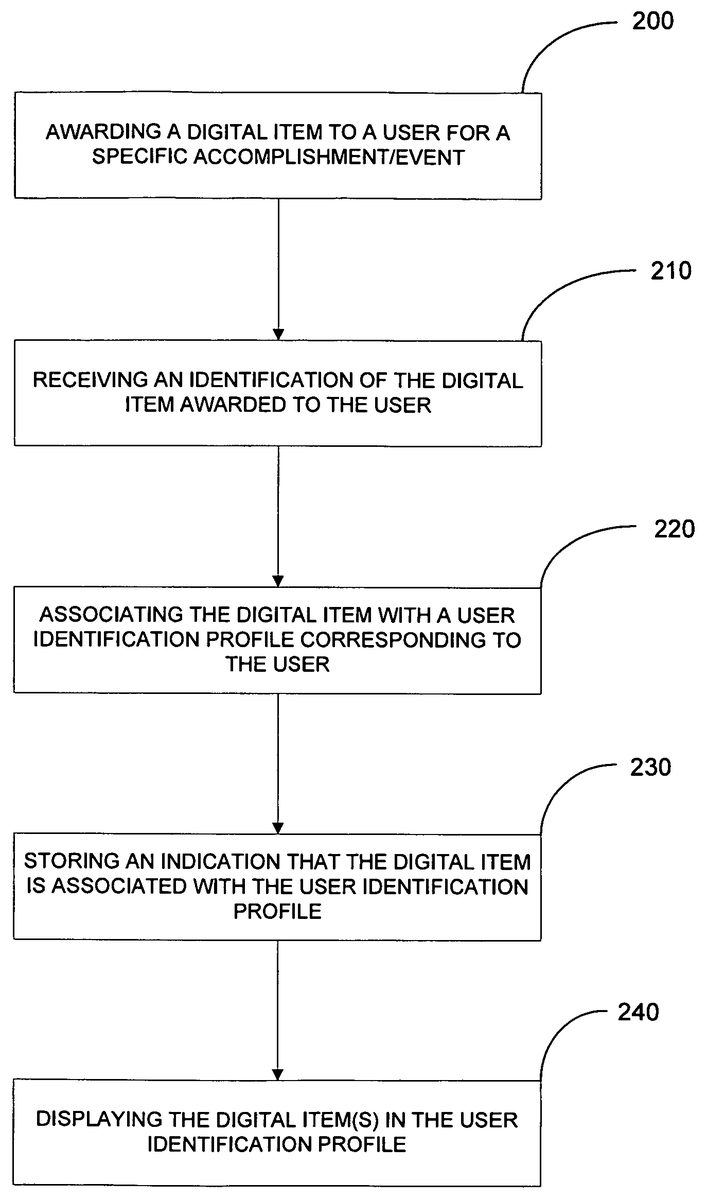
In order to reward users for continued investment in a game, a process is preferably performed by computer-executable instructions stored within game console300. More specifically, as seen inFIG. 2, an exemplary process includes the step of awarding a digital item to a user for a specific accomplishment in a video game (box200). The specific accomplishment may relate to meeting certain criteria performance set forth by a game developer, as indicated above, and the digital item may be automatically awarded to the user upon the occurrence of such accomplishment. In addition, the digital award may be based on something entirely outside of the gaming arena, such as attendance at a designated event (e.g., a concert, tournament, or sporting event) or the accumulation of loyalty points granted by a designated sponsor.
It will further be appreciated that the digital item may be something that is usable within the current video game title, in a later version or the next generation of a particular video game title, or even in a different video game by the same developer. The digital item may, for example, unlock a level in another game or provide access to certain advanced or desirable equipment, weapons, or the like. In another embodiment, the digital item may be an article of clothing (e.g., a football jersey for Madden NFL, a basketball jersey for NBA Live, armor, a helmet, etc.). In order to enhance the display of the digital item, an avatar and/or digital closet may be provided within the user identification which is able to wear the digital item.
According to the process, an identification representative of the digital item awarded to the user is received (box210). The digital item is then associated with the user identification corresponding to the user (box220). Upon completion of such association, an indication that the digital item is associated with the user identification is stored (box230). This indication may be utilized to permit displaying of the digital item in the user profile (box240).
Another process performed by computer-executable instructions stored within a computer-readable medium (e.g., gaming console300) involves the display of the user identification or profile. As seen inFIG. 4, an exemplary process first involves receiving a request to display the user profile corresponding to a first or specified user (box400). Upon receipt of such request, user profile information corresponding to the first user is retrieved from memory (box410). It will be appreciated that the user profile preferably includes at least one digital item which has been awarded to the user for the accomplishment of a specified goal or achievement within a video game or even outside of the gaming arena. The digital information contained within the user profile is then displayed (box420).
Although the subject matter has been described in language specific to the structural features and/or methodological acts, it is to be understood that the subject matter defined in the appended claims is not necessarily limited to the specific features or acts described above. Rather, the specific features or acts described above are disclosed as example forms of implementing the claims.
Claims
- A computer-readable storage device having stored thereon computer-executable instructions for performing a process comprising: receiving at a gaming system a gamer profile, the gamer profile is associated with a game player;performing on the gaming system a first video game, the first video game awards a digital item other than points;receiving an identification of the digital item, the digital item is awarded to the game player by the first video game, the digital item is usable as a gaming object by the game player in both the first video game and a second video game, the second video game is different from the first video game, the first video game is associated with a first video game title, the second video game is associated with a second video game title, the first video game title is different from the second video game title;updating the gamer profile to include the identification of the digital item;and performing on the gaming system the second video game, the digital item is utilized in the second video game.
- The computer-readable storage device of claim 1 , wherein the digital item is awarded to the game player for an accomplishment in the first video game;and the digital item is transferable to the second video game.
- The computer-readable storage device of claim 1 , wherein the digital item is awarded to the game player while the game player is playing the first video game, the digital item unlocks a level in the second video game.
- The computer-readable storage device of claim 1 , wherein the digital item provides access to a weapon in the second video game.
- The computer-readable storage device of claim 1 , wherein the digital item is an article of apparel.
- The computer-readable storage device of claim 1 , wherein the digital item is displayed on an avatar in the gamer profile.
- A method for transferring gaming awards, comprising: receiving at a gaming system a user identification profile, the user identification profile is associated with a game player;performing a first video game, the first video game awards a digital item other than points to the game player;receiving a representation of the digital item, the digital item is awarded to the game player by the first video game, the digital item is usable as a gaming object by the game player in both the first video game and a second video game, the second video game is different from the first video game, the first video game is associated with a first video game title, the second video game is associated with a second video game title, the first video game title is different from the second video game title;updating the user identification profile to include the representation of the digital item;and performing the second video game, the second video game utilizes the digital item.
- The method of claim 7 , wherein the method further comprises displaying the representation of the digital item in the gamer profile.
- The method of claim 7 , wherein the first video game is performed on the gaming system.
- The method of claim 7 , wherein the digital item is displayed on an avatar in the user identification profile.
- The method of claim 7 , wherein the digital item is awarded to the game player for an accomplishment in the first video game, the digital item is used by the game player in the second video game.
- The method of claim 7 , wherein the digital item is awarded to the game player while the game player is playing the first video game, the digital item unlocks a level in the second video game.
- The method of claim 7 , wherein the first video game is associated with a particular video game title and the second video game comprises a later version of the particular video game title than the first video game.
- The method of claim 7 , wherein the digital item provides access to a weapon in the second video game.
- The method of claim 7 , wherein the digital item provides access to a digital good.
- The method of claim 15 , wherein the digital good is a weapon.
- An electronic device for utilizing one or more gaming profiles, comprising: a communication interface, the communication interface receives a gamer profile;a storage device, the storage device stores a first set of program instructions associated with a first video game and a second set of program instructions associated with a second video game;and one or more processors in communication with the communication interface and the storage device, the one or more processors execute the first set of program instructions associated with the first video game to perform the first video game and award a digital item other than points to the gamer profile during the first video game, the digital item is usable as a gaming object by a game player in both the first video game and the second video game, the gamer profile is associated with the game player, the second video game is different from the first video game, the first video game is associated with a first video game title, the second video game is associated with a second video game title, the first video game title is different from the second video game title, the one or more processors execute the second set of program instructions associated with the second video game to perform the second video game, the digital item is utilized in the second video game.
Disclaimer: Data collected from the USPTO and may be malformed, incomplete, and/or otherwise inaccurate.