U.S. Pat. No. 8,628,424
INTERACTIVE SPECTATOR FEATURES FOR GAMING ENVIRONMENTS
AssigneeRed 5 Studios Inc
Issue DateJune 28, 2012
Illustrative Figure
Abstract
Systems and methods for exchanging virtual rewards for computing resources are provided herein. Exemplary methods may include receiving access to a portion of computing resources of an end user computing system and providing a virtual reward within a gaming environment to an end user in exchange for utilizing an amount of the portion of the computing resources of the end user computing system.
Description
DETAILED DESCRIPTION OF EXEMPLARY EMBODIMENTS While this technology is susceptible of embodiment in many different forms, there is shown in the drawings and will herein be described in detail several specific embodiments with the understanding that the present disclosure is to be considered as an exemplification of the principles of the technology and is not intended to limit the technology to the embodiments illustrated. According to some embodiments, the present technology may provide interactive spectator features within videogames, and specifically the gaming environment of the videogame. Broadly speaking, these interactive spectator features allow spectators to not only to passively view the gaming environment, but also control or affect a gaming experience of an active participant. The spectator may affect the gaming experience of the active participant in various ways. For example, the spectator may cheer, applaud, complain, or otherwise provide feedback to the gaming system that facilitates the gaming environment. Feedback may be received by way of an end user computing system operated by a spectator. Exemplary end user computing systems include, but are not limited to, personal computers, mobile devices, videogame consoles, and so forth. Furthermore, feedback may be received from input devices associated with the end user computing systems, such as a keyboard, a microphone, a Bluetooth headset, a mouse, a motion-based input device, a webcam, and so forth. This feedback may be provided to active participants within the gaming environment to augment or enhance the gaming experience of the active participants. In other embodiments, spectators may modify the gaming experience of an active participant by altering the gaming environment. For example, spectators may arrange competitions between active participants; allow the active participant to be killed/saved during a combat scenario; generate impediments (e.g., enemies, bosses, obstacles, etc.) for the active participant; present the active participant with a challenge; ...
DETAILED DESCRIPTION OF EXEMPLARY EMBODIMENTS
While this technology is susceptible of embodiment in many different forms, there is shown in the drawings and will herein be described in detail several specific embodiments with the understanding that the present disclosure is to be considered as an exemplification of the principles of the technology and is not intended to limit the technology to the embodiments illustrated.
According to some embodiments, the present technology may provide interactive spectator features within videogames, and specifically the gaming environment of the videogame. Broadly speaking, these interactive spectator features allow spectators to not only to passively view the gaming environment, but also control or affect a gaming experience of an active participant. The spectator may affect the gaming experience of the active participant in various ways. For example, the spectator may cheer, applaud, complain, or otherwise provide feedback to the gaming system that facilitates the gaming environment. Feedback may be received by way of an end user computing system operated by a spectator. Exemplary end user computing systems include, but are not limited to, personal computers, mobile devices, videogame consoles, and so forth. Furthermore, feedback may be received from input devices associated with the end user computing systems, such as a keyboard, a microphone, a Bluetooth headset, a mouse, a motion-based input device, a webcam, and so forth.
This feedback may be provided to active participants within the gaming environment to augment or enhance the gaming experience of the active participants. In other embodiments, spectators may modify the gaming experience of an active participant by altering the gaming environment. For example, spectators may arrange competitions between active participants; allow the active participant to be killed/saved during a combat scenario; generate impediments (e.g., enemies, bosses, obstacles, etc.) for the active participant; present the active participant with a challenge; or any combinations thereof.
Generally speaking, the term “spectator” may be understood to include a non-participating actor that is allowed to view and/or modify the gaming environment. While the spectator may interact with the gaming environment, these interactions only allow for indirect interaction with the gaming environment. Spectators may enter the gaming environment via a spectator mode. In some instances, an active participant may be placed into “spectator mode” and become a spectator when they are killed or otherwise prevented from being an active participant. Thus, an active participant is an actor that directly interacts with the gaming environment (e.g., a player).
In some instances, active participants may also provide responsive feedback reactively to feedback that is directed to the active participants from one or more spectators. These and other advantages of the present technology will be discussed in greater detail herein.
FIG. 1illustrates an exemplary architecture100for practicing aspects of the present technology. The architecture100is shown as including a networked gaming system105implemented within the context of a server110(shown within a plurality of web servers). The networked gaming system105may facilitate the operation of a videogame program125that generates a gaming environment.
An end user computing system115(shown within a plurality of end user computing systems) may be communicatively coupled to the server110via a network connection120. It will be understood that the network connection120may include any private or public network such as the Internet.
When the end user computing system115is communicatively coupled to the server110, spectators may interact with the gaming environment generated by a videogame program125using the end user computing system115. Likewise, active participants may interact with the gaming environment using the end user computing system115.
In some embodiments, the networked gaming system105may be implemented as a cloud-based computing environment. In general, a cloud-based computing environment is a resource that combines the computational power of a large grouping of processors and/or that combines the storage capacity of a large grouping of computer memories or storage devices. For example, systems that provide a cloud resource may be utilized exclusively by their owners. These systems may be accessible to outside users who deploy applications within the computing infrastructure to obtain the benefit of large computational or storage resources.
The cloud may be formed, for example, by a network of web servers, with each web server (or at least a plurality thereof) providing processor and/or storage resources. These servers may manage workloads provided by multiple users (e.g., cloud resource consumers or other users). Typically, each user places workload demands upon the cloud that vary in real-time, sometimes dramatically. The nature and extent of these variations typically depend on the type of business associated with the user.
According to some embodiments, the networked gaming system105may be generally described as a particular purpose computing environment that includes executable instructions stored in memory. These instructions, when executed by the processor provide interactive spectator features within the gaming environment. More specifically, the networked gaming system105may execute the videogame program125to generate a gaming environment (seeFIG. 4for an exemplary view of a gaming environment). The videogame program125may comprise one or more mechanisms for facilitating spectator interaction with the gaming environment. According to some embodiments, the networked gaming system105may receive spectator feedback relative to at least one active participant within the gaming environment. Additionally, the networked gaming system105may provide indication of the spectator feedback to the at least one active participant within the gaming environment. Thus, spectator feedback may be utilized to enhance and/or alter the gaming experience of the at least one active participant.
In accordance with the present technology, the networked gaming system105may facilitate spectator interaction with a gaming environment by first providing a spectator access to a view the gaming environment. Next, the networked gaming system105may provide the spectator with one or more options for interacting with the gaming environment. The networked gaming system105may then receive a selection of the one or more options from the spectator and finally effect a change within the gaming environment based upon the selection. The changed that is affected within the gaming environment may directly impact or alter the gaming experience of one or more active participants.
In some embodiments, the executable instructions such as a videogame program125that facilitates a gaming environment may reside on the server110. In some instances, the videogame program125may comprise a spectator module130, an interactivity module135, and an implementation module140. In other embodiments, the spectator module130, the interactivity module135, and the implementation module140may cooperate together as a standalone plug-in or module that is separate from the videogame program125.
It is noteworthy that the server110may include additional modules, engines, or components, and still fall within the scope of the present technology. As used herein, the term “module” may also refer to any of an application-specific integrated circuit (ASIC), an electronic circuit, a processor (shared, dedicated, or group) that executes one or more software or firmware programs, a combinational logic circuit, and/or other suitable components that provide the described functionalities.
According to some embodiments, the spectator module130may provide a spectator access to view the gaming environment, while the interactivity module135provides the spectator with one or more options for interacting with the gaming environment and receives a selection of the one or more options from the spectator. The implementation module140may then affect a change within the gaming environment based upon the selection received from the spectator.
With regard to the videogame program125, the videogame program125may comprise any type of videogame application/program/set of executable instructions, including but not limited to, a multiplayer networked videogame such as a MMORPG (massively multiplayer online role-playing game), a first-person shooter, a strategy game, role playing games, action games, arcade games, simulation games, and so forth. Other suitable types of videogames that would be known to one of ordinary skill in the art are also likewise contemplated for use in accordance with the present technology. Active participants (e.g., game players) may interact with the gaming environment that is generated by the videogame program125. With regard to conventional videogames, the gaming experience for active participants is largely, if not entirely, predetermined by game designers and encoded into the videogame. Therefore, other than actions performed within the gaming environment by other active participants, the gaming experience of an active participant is preconfigured into the executable instructions for the videogame.
Advantageously, the present technology allows for spectator interaction with the gaming environment. Spectator interaction may comprise positive and negative feedback of spectators such as applause, cheering, jeering, booing, or other audible feedback. In other instances, the feedback may be received from an end user computing system in the form of button click, mouse clicks, cursor movements, keystrokes, accelerometer sensed input, gesture-based input, motion sensing input, facial recognition, or any combinations thereof. Feedback may be received via a plurality of input devices associated with the end user computing system115. The end user computing system115may provide the feedback to the networked gaming system105.
According to some embodiments, the spectator module130may be executed to allow for spectator access to the gaming environment. This feature may be referred to as “spectator mode.” Spectators may gain access to views of the gaming environment from a graphical user interface that is generated by the videogame program125. The spectator environment may include a view of at least a portion of the gaming environment and/or a plurality of views of different portions of the gaming environment. In some instances, a spectator may be allowed to follow a selected or specified active participant. In other embodiments, the spectator may roam through the gaming environment in a free-form mode. Exemplary views of the gaming environment may comprise a first-person perspective view (relative to the spectator or an active participant, a top-down perspective view, and so forth. In other instances, the spectator module130may provide the spectator with a plurality of view features such as zoom, pan, replay, tilt, and so forth.
According to some embodiments, the spectator module130in combination with the implementation module140may add spectators to the gaming environment in an avatar form such that the spectators are visible to active participants and/or other spectators. The spectator module130may allow the spectator to specify the appearance attributes of their avatar such as height, weight, skin color, eye and hair color, clothing, and so forth. Alternatively, spectators may view the gaming environment transparently such that the spectators are unable to view the active participants and/or spectators.
In some embodiments, the videogame program125may track the position of one or more spectators within the gaming environment and determine active participants located proximate the spectators. Alternatively, if the spectator has chosen to follow a particular active participant, the videogame program125may track this information as well. Based upon the location information, the implementation module140may provide indication of feedback received from the spectator to one or more active participants. For example, if the spectator cheers for an active participant that the spectator is following, the cheers of the spectator may be played for the active participant such that the gaming experience of the active participant is enhanced.
In accordance with the present disclosure, the interactivity module135may be executed to facilitate spectator interaction with the gaming environment. Again, spectator interaction may include the receipt of feedback by the interactivity module135. In other embodiments, spectator interaction may comprise an alteration/modification of the gaming environment. For example, spectators may be allowed to alter the appearance of the gaming environment, such as the time of day, the weather, a location or scene, a background, a landscape, and so forth.
In other embodiments, the spectator may be allowed to affect a change in the gaming environment that directly/indirectly affects the gaming experience of one or more active participants. For example, the spectator may be allowed to determine whether the active participant may be killed/saved, generate impediments (e.g., enemies, bosses, obstacles, etc.) for the active participant, present the active participant with a challenge, and so forth.
These types of alterations of the gaming environment may be caused by the interaction or input of a single spectator. In some embodiments, the actions, feedback, and/or input of a plurality of spectators may be utilized in the aggregate. For example, before feedback such as applause is played within the gaming environment, the interactivity module135may specify that applause related feedback should be received from a threshold number of spectators. In other instances, the interactivity module135may specify that the feedback reach a threshold decibel level before the feedback is provided within the gaming environment and/or to an active participant. For example, before feedback is provided to an active participant, the aggregate sound input provided by a plurality of spectators must meet or exceed a decibel level of 90. In other embodiments, before feedback is provided to an active participant, an aggregate number of button clicks received from a plurality of spectators must meet or exceed 1,000 actions within a period of 30 seconds. Thus, feedback requirements may both comprise quantity and/or time constraints, as well as other constraints that would be known to one of ordinary skill in the art.
According to some embodiments, the interactivity module135may provide the spectator with one or more options for interacting with the gaming environment. Again, these options may be tailored to the type of interactivity that is allowed for the spectator. For example, the interactivity module135may provide the spectator with a list of options such as: (1) introduce an enemy, (2) award gift, (3) send message, (4) select an adversary, and so forth. Once selected, the interactivity module135may provide the spectator with a plurality of additional selections that allow the spectator to further specify the details of the interaction. For example, if the spectator chooses option (1), the interactivity module135may provide the spectator with a list of selectable enemy types, quantities, and enemy attributes (e.g., strength, experience, inventory, etc.).
With regard to the awarding of a gift, spectators may be allowed to award a player with gift such as an award, a game achievement, such as the unlocking of a game feature (e.g., a level, a skill, a gaming experience, etc.). Gifts may also include objects such as weapons, inventory items (appropriate for the particular video game), a redeemable coupon, health, experience, and so forth. In some instances, a value of the gift may be commensurate with the amount of feedback received from one or more spectators. For example, if several spectators vote to award the player with a game achievement or other gift, the value of the reward may be greater than a reward provided to a player that received fewer amounts of votes. Again, the feedback may be measured in decibels, aggregate clicks of buttons, votes, and so forth.
In some instances, the ability for spectators to provide feedback may be utilized with a coliseum type gaming environment where combat between active participants may be arranged by certain groups of spectators. Moreover, enemies or other impediments may be introduced into the gaming environment. Additionally, other groups of spectators may be allowed to decide whether active participants that have lost in combat are killed/saved. Again, collaborative feedback may be utilized in these types of scenarios. In some embodiments, the gaming environment may include an arena/coliseum type location where spectators may be located within a viewing gallery and combat/activities between active participants may take place with a ring or other suitable location.
The implementation module140may be executed to implement the spectator feedback/interactions within the gaming environment. For example, if the spectator feedback includes applause or cheering, the implementation module140may play the applause or cheering within the gaming environment. Again, these types of audio feedback may be received from end user computing systems and transmitted to the networked gaming system105. The playing of the applause or cheering may be directed to an active participant or may be played such that all active participants and other spectators may hear the applause/cheering. Similarly, boos or jeering may be played with the gaming environment. Therefore, both positive and negative feedback may be played within the gaming environment simultaneously to produce a realistic spectator environment (e.g., where some spectators boo and other cheer).
The implementation module140may generate and provide other indications of spectator feedback to complement the played feedback. These indications may comprise, but are not limited to an icon, a sound effect, a visual effect, or any combinations thereof. More specifically, an icon may comprise an image of a “thumbs-up” or “thumbs-down.” Likewise, a sound effect may comprise artificial/computer-generated applause, cheering, booing, stomping, and so forth. Exemplary visual effects may comprise fireworks, a video, a banner, and so forth. Again, each of these indications of feedback may be provided by the implementation module140upon the receipt of threshold levels of spectator feedback. Contrastingly, the implementation module140may provide indications of feedback as the feedback is received from spectators, without regard for threshold values for the feedback.
Similarly to spectator feedback, active participants may also provide feedback to spectators in response to a spectator affecting the gaming environment of the active participant. For example, the active participant may provide a “thank you” message for applause/cheers received from spectators. Likewise, active participants may incite, heckle, or otherwise taunt spectators that provide negative feedback. The feedback may be received from active participants by way of button clicks, mouse movements/clicks, motion-based input (e.g., received from accelerometer signals generated within a game controller), and other similar input mechanisms as those described with regard to spectators.
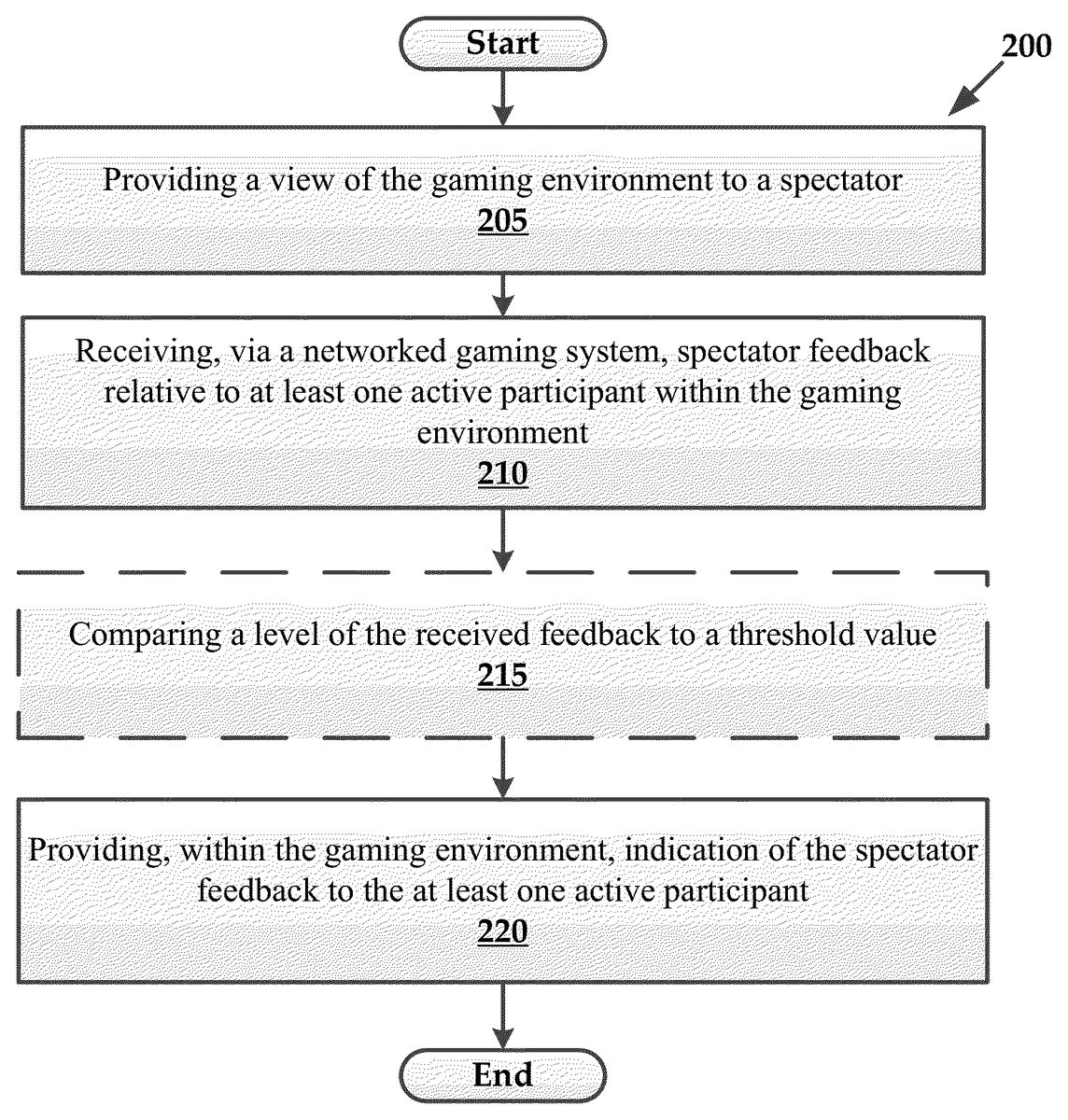
FIG. 2is a flowchart of an exemplary method200for providing spectator feedback within a gaming environment. According to some embodiments, the method200may comprise a step205of providing a view of the gaming environment to a spectator. Next, the method200may comprise a step210of receiving, via a networked gaming system, spectator feedback relative to at least one active participant within the gaming environment. As described in greater detail above, the spectator feedback may comprise content that affects the gaming experience of an active participant. Feedback may comprise applause, cheering, booing, and so forth. Additionally, feedback may include modifications or alterations of the gaming environment that directly and/or indirectly affect the gaming experience of an active participant.
Advantageously, spectator feedback may comprise any of keystrokes, mouse movements, mouse clicks, audio input, accelerometer sensed input, gesture input, motion sensing input, facial recognition, or any combinations thereof.
In some instances the method200may comprise an optional step215of comparing a level of the received feedback to a threshold value. For example, a decibel level of audio feedback from a spectator may be compared to a decibel level threshold value, such as 90 decibels. Only audio feedback that has a decibel level of greater than 90 decibels may trigger further action by the system, such as providing indication of feedback. In other instances, the level of spectator feedback may comprise an aggregate number of spectators providing feedback.
Additionally, the method200may comprise a step220of providing, within the gaming environment, indication of the spectator feedback to the at least one active participant. Again, in some instances, indication of the spectator feedback to the at least one active participant occurs upon a level of spectator feedback exceeding a threshold amount. As described above, indication of spectator feedback may comprise any of an icon, a sound effect, a visual effect, or any combinations thereof.
FIG. 3is a flowchart of an exemplary method300for facilitating spectator interaction with a gaming environment. In accordance with the present disclosure, the method300may comprise a step305of providing a spectator access to view the gaming environment. It will be understood that the spectator may comprise an entity that is not actively engaged with game play within the gaming environment.
Next, the method300may comprise a step310of providing the spectator with one or more options for interacting with the gaming environment. By way of a few non-limiting examples, the options for spectator interaction may comprise allowing the active participant to be killed, arranging combat between two active participants, generating impediments for the active participant, presenting the active participant with a challenge, or any combinations thereof.
In some embodiments, the method300may comprise a step315of receiving a selection of the one or more options from the spectator, as well as a step320of effecting a change within the gaming environment based upon the selection.
FIG. 4is an exemplary view400of a gaming environment405. The gaming environment is shown as comprising an active participant410and415as well as a landscape420. The gaming environment405is shown with enemies425and430. It will be understood that this view of the gaming environment that is shown inFIG. 4is an exemplary view that may be provided to a spectator. The view ofFIG. 4approximates the same view that the active participant views in a third-person view mode.
FIG. 5illustrates an exemplary computing system500that may be used to implement an embodiment of the present technology. Either of the end user computing system115and/or the server110may include one or more of the components of computing system500. The computing system500ofFIG. 5includes one or more processors510and main a memory store520. Main a memory store520stores, in part, instructions and data for execution by the one or more processors510. Main a memory store520can store the executable code when the computing system500is in operation. The computing system500ofFIG. 5may further include a mass storage device530, portable storage medium drive(s)540, output devices550, user input devices560, a graphics display570, and other peripheral device(s)580.
The components shown inFIG. 5are depicted as being connected via a single bus590. The components may be connected through one or more data transport means. The one or more processors510and main a memory store520may be connected via a local microprocessor bus, and the mass storage device530, peripheral device(s)580, portable storage medium drive(s)540, and graphics display570may be connected via one or more input/output (I/O) buses.
Mass storage device530, which may be implemented with a magnetic disk drive or an optical disk drive, is a non-volatile storage device for storing data and instructions for use by one or more processors510. Mass storage device530can store the system software for implementing embodiments of the present technology for purposes of loading that software into main a memory store520.
Portable storage medium drive(s)540operate in conjunction with a portable non-volatile storage medium, such as a floppy disk, compact disk or digital video disc, to input and output data and code to and from the computing system500ofFIG. 5. The system software for implementing embodiments of the present technology may be stored on such a portable medium and input to the computing system500via the portable storage medium drive(s)540.
Input devices560provide a portion of a user interface. Input devices560may include an alphanumeric keypad, such as a keyboard, for inputting alphanumeric and other information, or a pointing device, such as a mouse, a trackball, stylus, or cursor direction keys. Additionally, the computing system500as shown inFIG. 5includes output devices550. Suitable output devices include speakers, printers, network interfaces, and monitors.
Graphics display570may include a liquid crystal display (LCD) or other suitable display device. Graphics display570receives textual and graphical information, and processes the information for output to the display device.
Peripheral device(s)580may include any type of computer support device to add additional functionality to the computing system. Peripheral device(s)580may include a modem or a router.
The components contained in the computing system500ofFIG. 5are those typically found in computing systems that may be suitable for use with embodiments of the present technology and are intended to represent a broad category of such computer components that are well known in the art. Thus, the computing system500ofFIG. 5can be a personal computer, hand held computing system, telephone, mobile computing system, workstation, server, minicomputer, mainframe computer, or any other computing system. The computer can also include different bus configurations, networked platforms, multi-processor platforms, etc. Various operating systems can be used including UNIX, Linux, Windows, Macintosh OS, Palm OS, and other suitable operating systems.
Some of the above-described functions may be composed of instructions that are stored on storage media (e.g., computer-readable medium). The instructions may be retrieved and executed by the processor. Some examples of storage media are memory devices, tapes, disks, and the like. The instructions are operational when executed by the processor to direct the processor to operate in accord with the technology. Those skilled in the art are familiar with instructions, processor(s), and storage media.
It is noteworthy that any hardware platform suitable for performing the processing described herein is suitable for use with the technology. The terms “computer-readable storage medium” and “computer-readable storage media” as used herein refer to any medium or media that participate in providing instructions to a CPU for execution. Such media can take many forms, including, but not limited to, non-volatile media, volatile media and transmission media. Non-volatile media include, for example, optical or magnetic disks, such as a fixed disk. Volatile media include dynamic memory, such as system RAM. Transmission media include coaxial cables, copper wire and fiber optics, among others, including the wires that comprise one embodiment of a bus. Transmission media can also take the form of acoustic or light waves, such as those generated during radio frequency (RF) and infrared (IR) data communications. Common forms of computer-readable media include, for example, a floppy disk, a flexible disk, a hard disk, magnetic tape, any other magnetic medium, a CD-ROM disk, digital video disk (DVD), any other optical medium, any other physical medium with patterns of marks or holes, a RAM, a PROM, an EPROM, an EEPROM, a FLASHEPROM, any other memory chip or data exchange adapter, a carrier wave, or any other medium from which a computer can read.
Various forms of computer-readable media may be involved in carrying one or more sequences of one or more instructions to a CPU for execution. A bus carries the data to system RAM, from which a CPU retrieves and executes the instructions. The instructions received by system RAM can optionally be stored on a fixed disk either before or after execution by a CPU.
While various embodiments have been described above, it should be understood that they have been presented by way of example only, and not limitation. The descriptions are not intended to limit the scope of the technology to the particular forms set forth herein. Thus, the breadth and scope of a preferred embodiment should not be limited by any of the above-described exemplary embodiments. It should be understood that the above description is illustrative and not restrictive. To the contrary, the present descriptions are intended to cover such alternatives, modifications, and equivalents as may be included within the spirit and scope of the technology as defined by the appended claims and otherwise appreciated by one of ordinary skill in the art. The scope of the technology should, therefore, be determined not with reference to the above description, but instead should be determined with reference to the appended claims along with their full scope of equivalents.
Claims
- A method for providing spectator feedback within a gaming environment, the method comprising: adding one or more spectators to the gaming environment such that the one or more spectators are visible in the gaming environment to active participants and other spectators;receiving, via a networked gaming system, spectator feedback from the one or more added spectators relative to at least one active participant within the gaming environment;and providing, within the gaming environment, indication of the spectator feedback to the at least one active participant upon a level of spectator feedback exceeding a threshold amount.
- The method according to claim 1 , wherein the level of spectator feedback comprises a decibel level.
- The method according to claim 1 , wherein the level of spectator feedback comprises an aggregate number of spectators providing feedback.
- The method according to claim 1 , wherein the spectator feedback comprises any of keystrokes, mouse movements, mouse clicks, audio input, accelerometer sensed input, gesture input, motion sensing input, facial recognition, or any combinations thereof.
- The method according to claim 1 , wherein indication of the spectator feedback comprises any of an icon, a sound effect, a visual effect, or any combinations thereof.
- The method according to claim 1 , wherein when the spectator feedback comprises audio input, the indication of the spectator feedback comprises the audio input, which is played within the gaming environment.
- A method for facilitating spectator interaction within a gaming environment, the method comprising: placing an active participant into a spectator mode when the activate participant is killed in the gaming environment;providing the placed spectator access to view the gaming environment using a spectator module, the spectator comprising an entity that is not actively engaged with game play while roaming within the gaming environment;receiving, via the gaming environment, spectator feedback from the one or more placed spectators relative to at least one active participant within the gaming environment;and providing, within the gaming environment, indication of the spectator feedback to the at least one active participant upon a level of spectator feedback exceeding a threshold amount.
- The method according to claim 7 , wherein the spectator affects a gaming experience of an active participant by any of: allowing the active participant to be killed, arranging combat between two active participants, generating impediments for the active participant, presenting the active participant with a challenge, or any combinations thereof.
- A system that facilitates a gaming environment, the system comprising: at least one server that is selectively coupleable to an end user computing system, the at least one server comprising a processor configured to execute instructions that comprise: a videogame program that provides the gaming environment and tracks a position of one or more spectators within the gaming environment, the videogame program comprising: a spectator module that provides a spectator access to a first-person perspective view of the gaming environment while roaming through the gaming environment;an interactivity module that provides the spectator with one or more options for interacting with the gaming environment and receives a selection of the one or more options from the spectator;an implementation module that effects a change within the gaming environment based upon the selection;and a feedback module that: receives spectator feedback from the spectator relative to at least one active participant within the gaming environment;and provides an indication of the spectator feedback to the at least one active participant within the gaming environment upon a level of the spectator feedback exceeding a threshold amount.
- The system according to claim 9 , wherein the implementation module effects a change within the gaming environment by altering a gaming experience of an active participant.
- The system according to claim 9 , wherein the videogame program tracks a location of a spectator while the spectator follows an active participant through the gaming environment, and the implementation module effects a change within the gaming environment by providing spectator feedback to the followed active participant.
- The system according to claim 9 , wherein the implementation module effects a change within the gaming environment by provision of a virtual gift from a spectator to an active participant, the virtual gift being presented to the active participant within the gaming environment.
- The system according to claim 9 , wherein the spectator feedback is received from the spectator using an audio input device and comprises an audio feedback relative to the at least one active participant within the gaming environment.
- The system according to claim 9 , wherein the feedback module further receives a response from the at least one active participant and provides indication of the response to the spectator.
Disclaimer: Data collected from the USPTO and may be malformed, incomplete, and/or otherwise inaccurate.