U.S. Pat. No. 8,628,397
Multiplayer Competition Game Device, Game Machine and Game Program
AssigneeKonami Digital Entertainment Co., Ltd.
Issue DateMay 31, 2006
Illustrative Figure
Abstract
After the offensive selection element images are moved along the joining direction to the offensive selection image display area (70c) and displayed one after another in an alternating manner thereon, based on the control of the offensive selector (73), the images are halted and displayed in a matrix-wise arrangement. The character property (79) and physical strength value (72) are stored in association with the character, and the character corresponding to a physical strength value (72) equal to or lower than a predetermined final value is determined to be the loser, the physical strength value of the attacked character being calculated using the offensive value and a formula corresponding to the character property and the offensive type. Furthermore, the image of the character determined to be the loser by the winner/loser determinator (76) is varied.
Description
BEST MODES FOR CARRYING OUT THE INVENTION First Embodiment A game machine as a multiplayer competition game device according to the present invention is configured as a token game machine, that is, a slot machine employing a video reel system in which three reels are displayed on a video. By using the video reels, a multiplayer competition game, in which characters are made to compete with each other, is played. Each character is represented as a “monster” having its own character. A player can select any three monsters from among a plurality of monsters. A party is formed by the selected monsters and each monster is associated with each of the above-mentioned reels. Each reel uses a table in accordance with the associated monster. Due to this, a reel band having an arrangement of symbols corresponding to the monster is determined and the symbol specific to the monster is displayed in its varying or halted state. After the monsters are associated with all of the reels, a dividend list is created based on the data of the symbols included in the table. The dividend list data is displayed on the screen as a dividend list. The physical strength value, the favorite trick (fighting ability or defending ability), and the arrangement of symbols in the reel band differ from monster to monster, therefore, a plurality of monsters are combined to realize various sequences. For example, such characteristics are generated that “vulnerable to a fire offensive but well defended against a magic offensive” or “the offensive power is low but the physical strength is high and good at a fight of attrition”. Then, since the symbols to be arranged on one reel are fixed, it is not possible to set the character of a monster that is well defended against all kinds ...
BEST MODES FOR CARRYING OUT THE INVENTION
First Embodiment
A game machine as a multiplayer competition game device according to the present invention is configured as a token game machine, that is, a slot machine employing a video reel system in which three reels are displayed on a video. By using the video reels, a multiplayer competition game, in which characters are made to compete with each other, is played. Each character is represented as a “monster” having its own character.
A player can select any three monsters from among a plurality of monsters. A party is formed by the selected monsters and each monster is associated with each of the above-mentioned reels. Each reel uses a table in accordance with the associated monster. Due to this, a reel band having an arrangement of symbols corresponding to the monster is determined and the symbol specific to the monster is displayed in its varying or halted state. After the monsters are associated with all of the reels, a dividend list is created based on the data of the symbols included in the table. The dividend list data is displayed on the screen as a dividend list.
The physical strength value, the favorite trick (fighting ability or defending ability), and the arrangement of symbols in the reel band differ from monster to monster, therefore, a plurality of monsters are combined to realize various sequences. For example, such characteristics are generated that “vulnerable to a fire offensive but well defended against a magic offensive” or “the offensive power is low but the physical strength is high and good at a fight of attrition”. Then, since the symbols to be arranged on one reel are fixed, it is not possible to set the character of a monster that is well defended against all kinds of offensive and there is established a relationship of strength like that between stone, scissors, and paper in a finger flashing game.
In the present game machine, the symbol is displayed in its varying state on the video reel and after a lapse of a predetermined time, it is displayed in its halted state and when a particular prize-deserving sequence is realized, a dividend is paid and a rendering of carrying out an offensive against the opponent monster is performed. The attacked monster decreases its physical strength value. Two players carry out an offensive and protect against the offensive by rotating the reels by turns and when the physical strength value of a monster of one of the players is decreased to zero, the other player wins the game.
Further, there are two concepts of value, that is, “credit” and “magic point” in regard to the present game machine. “Credit” relates to insertion or payout of a token as in the general token game. “Magic point” is a concept of value specific to the present game machine. In other words, it has nothing to do directly with the credit and increases or decreases in a particular game, having a concept of its own BET and WIN (dividend).
The games played with the present game machine are divided into a Short play, an Original game, and a Jackpot game. A Short-play is ready when lines (1 to 5) are set by operating a bet button after inserting a token. In other words, this is a game that has obviated an entry card for reading and writing data via magnetism. A player competes with a computer (client device) using a predetermined monster. Because no entry card is required, a player can participate in a game readily. The object of the Short-play is to make a player understand the contents of the game and move to a “multiplayer competition game” to be described later. After preparations are made, when a start button is operated, the reels rotate and if a predetermined combination of symbols appears, damage is given to the monster of the opponent (computer, here) and a dividend is paid. Each time the opponent monster is defeated, the player gains a victory bonus (for example, ten tokens) and if the player wins three consecutive games, it is made possible for him/her to play a Jackpot game to be described later.
By the way, the Short-play is played based on the following supplementary rules. (1) A player takes the first action in all of the battles, that is, the player is first to realize a sequence when the reels rotate and stop and gain its dividend. (2) The level of the opponent monster becomes higher in order of “1→2→3”, therefore, the opponent becomes stronger each time the player wins. Here, the “level of a monster” is the offensive power that decreases the physical strength value of the opponent monster and the resistivity that prevents its own physical strength value from decreasing when attacked by the opponent, both the offensive power and the resistivity being expressed by a numeric value. For example, when the level of a monster becomes high, the resistivity increases and the reduction in physical strength value becomes less for the same offensive, or the offensive power increases and damage (reduction in physical strength value of the opponent) given to the opponent becomes greater by the same offensive (the same sequence), and the probability of the final victory becomes higher. (3) The physical strength value of the monster selected by the player is fully restored for each game. (4) When the monster selected by the player is defeated, the level of the opponent monster returns to 1 and the physical strength value is restored by half. (5) Immediately after a battle starts, the opponent monster does not carry out an offensive until the offensive of the player hits the monster. In other words, no prize-deserving sequence is realized on the opponent (computer) side until a particular prize-deserving sequence is realized on the player side. (6) When “the monster symbols (symbols representing predetermined monsters as described above)” align in a line during the battle, the monster of the player turns into a monster with a higher level. As a result, the probability of the victory of the player becomes higher. On the other hand, when defeated in the battle, the original situation returns. In other words, the probability of the victory of the player is returned to the state before it is raised. (7) When a Jackpot-game to be described later ends, the monster of the player turns into a monster with a higher level. As a result, the probability of the final victory of the player becomes higher. On the other hand, when defeated in the battle, the original situation returns. In other words, the probability of the victory of the player is returned to the state before it is raised.
The Jackpot game is a game in which a player competes with a computer (server device arranged in the center). The server device has a case formed into a monster called “Goddragon” and a monster selected by a player competes with “Goddragon”. When the offensive against Goddragon is effective, that is, when a particular sequence is realized, the player is given a hit dividend, that is, a dividend corresponding to the realized sequence and all of the dividends can be gained as a bonus. When Goddragon is defeated, the player can further gain a clear bonus. The Jackpot game is a free game and all of the gained dividends are turned into the credit. In the Jackpot-game, the time for a play is limited and after a lapse of a predetermined time, an offensive is carried out automatically.
The Original game is a game played over a long period of time using an entry card for reading and writing data via magnetism. A player inserts an entry card into a card insertion slot to participate in a game. The Original game is provided with the following five kinds of game aspect. That is, (1) Mission, (2) Tournament, (3) Blend, (4) Shop, and (5) Data.
Mission is a game in which, for example, a player clears 12 stages and hidden stages and is a game aspect the object of which is to collect a magic point, which is a point specific to the game, and a monster. It is a game in which a player competes with a computer (client device) and gains only a dividend of a token, that is, a credit during battle. When a player wins the battle, the player can gain a monster (three lives). In other words, data representing the monster and its life is input to the player side and written into a memory. Then, it is made possible to play a game again using the data representing the monster and its life. The life of a monster is a numeric value having the meaning of so-called life (the number of lives), indicative of the limit of the number of times (when the physical strength value is lost, it is regarded as one time) the monster can be used in the game. The life represents the remaining number of times available of the monster. On the other hand, when defeated, the life of the monster used is reduced by one. When a player wins and ends the game, the player gains the magic point as a bonus. The result of the game is recorded in the entry card.
The Tournament is a game in the form of a tournament in which a player competes with another player. In other words, players bet the magic points gained in the Mission and make their monsters to compete with each other. Only players having the magic point (10 to 30) specified for each tournament and monsters that meet the condition of participation can participate in the game. The condition of participation is that the number of remaining lives is equal to or greater than a value of criterion that the level is equal to or greater than a value of criterion, etc., which can be set in accordance with a game. A player pays a tournament fee (9 to 75 BETs), however, the magic point is used for the battle fee other than that. In other words, a player bets the magic point and gains the magic point as a dividend. A player gains a monster of the opponent each time the player wins, that is, data representing a monster corresponding to the opponent monster and its life is added. On the other hand, when defeated, the lives of all the monsters used in the battle are reduced by one, respectively. Therefore, when defeated in the battle, the number of times available of the monster is reduced. Here, a monster is represented on a card and displayed on the screen, therefore, to gain a monster means to gain a card of the monster on the screen. The card in hand can be used in a competition as a monster in hand. Thus, if a player continues to win to the last, the player wins the championship and can play the Jackpot-game in which to compete with Goddragon.
The Blend is a game aspect in which a plurality of monsters are combined to give birth to a new monster. In other words, by using data representing a plurality of monsters and their lives, data representing a new monster and its life is generated. When the same monsters are blended, the kind of monster remains the same and only their lives and scores are added. When different kinds of monster are blended, a new monster is generated and the life of the monster is half the total lives or half plus 0.5 and the score is initialized. When a Blend is performed, respective different credits in accordance with respective monsters are required. By the way, as a result of Blend, it is set that data representing a monster called “Goldmonster” is generated with a slight probability, which monster gives a large dividend although limited to only one battle.
The Shop is a game aspect in which a player purchases a monster for 10 credits. When a player operates to direct purchase, the credit possessed by the player is reduced by 10, data of any one of monsters is generated, and the player gains the card of the monster on the screen. By the way, although the probability is slight, it is set that data representing a monster called “Goldmonster” is generated as a result of purchase.
The Data is a game aspect in which the monsters possessed by a player or the score of the player is displayed. By specifying a particular monster, it is possible to display the score (the number of battles, the number of victories, the percentage of victories to the total number of battles, the total points gained in its life) of the monster alone.
FIG. 1is an appearance view of the game machine according to the present embodiment. A game machine1is provided with a server device2arranged in the center, having a case the appearance of which is formed into a shape of a monster, and a plurality of client devices3around the server device2. Each client device3comprises components required for the individual players to play a game, including a plurality of operation buttons and a display unit for displaying images. Each player plays a multiplayer competition game using the client device3and when a player wins the championship in the tournament, the player can participate in a free game in which the player competes with the server device2in the center. The case of the server device2having a shape of a monster enhances the effect of a rendering and provides the effect to raise the challenging spirit of a player.
FIG. 2is a block diagram conceptually showing the functions of the present game machine. A display unit70displays various images such as letters, figures, and symbols. The display unit70has a physical strength value display area70afor displaying the physical strength value of a character by a bar graph etc., a character image display area70bfor displaying the image of a character such as a monster with which a player competes, and an offensive selection image display area70cfor displaying the situation of selection of a offensive kind or selection of a offensive value by virtual reels that rotate and stop. A player manipulator71is one with which a player performs operation relating to a game, having various operation buttons, a bet button, a token insertion slot, a token payout slot, etc. An offensive selector73selects an offensive type and an offensive value of an offensive against a character and determines positions at which the virtual reels stop. A physical strength value calculator74calculates the change of the physical strength value of the attacked character based on the offensive selected by the offense selector73. A physical strength value display controller75displays the physical strength value calculated as above on the physical strength value display area70aof the display unit70. A winner or loser determinator76judges the winner and loser of a game. A character image display controller77displays the image of the above-mentioned character on the character image display area70bof the display unit70. An offensive selection image display controller78displays an offensive selection element image corresponding to the offensive selected by the offense selector73on the offensive selection image display area70cof the display unit70.
The offensive selection image display controller78has a storage78afor storing a plurality of sets of offensive selection element images for which at least the type of the offensive can be discriminated along with their arrangement and an offensive selection display controller78bfor displaying the predetermined number of virtual reels in their varying and halted states on the offensive selection image display area using predetermined sets among the plurality of sets of offensive selection element images stored in the storage. Then, the offensive selection display controller78bdisplays the virtual reels based on their halted state on the halt position determined by the offensive selector73.
The offensive selector73selects an offensive type and an offensive value and controls the offensive selection image display controller78to display the offensive selection element image corresponding to at least the offensive type in its halted state in the predetermined arrangement on the offensive selection image display area70c. The physical strength value calculator74has a character data storage80for storing a character property79and a physical strength value72after associating them with the character and calculates, works, and stores the physical strength value of the attacked character using a calculation expression corresponding to the character property79and the offensive type. For example, A, B, and C ranks are set in accordance with the matching degree between the character property and the offensive type and in the case of A, the offensive value is subtracted from the physical strength value and the result is stored again, in the case of B, two-thirds of the offensive value is subtracted from the physical strength value and the result is stored again, and in the case of C, one-third of the offensive value is subtracted from the physical strength value and the result is stored again. In other words, A means that the character is vulnerable to the offensive and C means that the character is well-defended against the offensive. The winner and loser determinator76judges whether or not the physical strength value72is equal to or lower than a predetermined final value, 0, for example, and judges that the character corresponding to the physical strength value72equal to or lower than the predetermined final value is the loser. The character image display controller77has a character image storage77afor storing the image of a character for each character property and changes the image displayed on the character image display area70bof the character judged to be the loser by the winner and loser determinator76by reducing its size or making it become extinct.
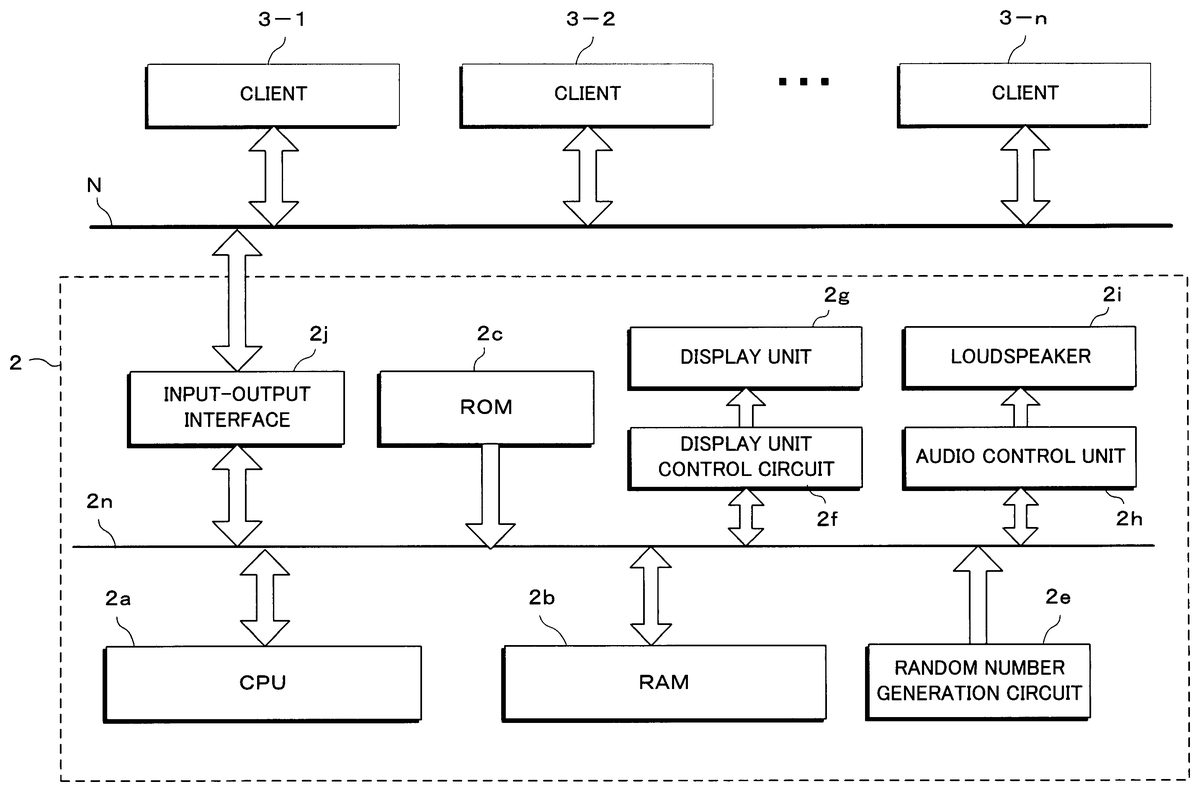
FIG. 3is a block diagram showing an electrical configuration of the server device2. In the server device2, a CPU2areads out data from a RAM2band a ROM2cor writes data into the RAM2b. Then, a control operation is performed in accordance with a program set in advance. In the ROM2c, in addition to a control program for controlling the action of the game machine1, data of the symbols that can be displayed on the reels, data representing each monster, and various kinds of tables (the arrangement of the symbols configuring the reel band as shown inFIG. 7) corresponding to the data representing each monster are stored as shown inFIG. 6andFIG. 7, and these are read out and used as the need arises. The data representing each monster is displayed as a card until it is selected by a player.
A random number generation circuit2egenerates fixed random numbers. Data relating to images is output to a display unit2gconsisting of, for example, a liquid crystal display device, via a display unit control circuit2fthat performs image processing etc. On the display unit2g, letters, still images, motion videos, etc., are displayed. It is not necessarily required for the server device2to have the display unit2g. Data relating to audios is output from the CPU2ato a loudspeaker2ivia an audio control unit2hthat performs audio processing, amplification, etc. The respective components perform transmission and reception of data to each other via a control bus2n. Then, the server device2performs transmission and reception with each of client devices3-1to3-nvia an input-output interface2jand a bus N.
FIG. 4is a block diagram showing an electrical configuration of the client device3. A token discrimination device3ajudges whether or not a token is proper and a payout token counter3bcounts the number of tokens to be paid. An operation unit3ccomprises a plurality of operation buttons, a start button, etc., and inputs a signal when a player operates these operation buttons and the start button. A token payout device3dperforms payout of tokens. Data relating to images is output to a display unit3fconsisting of, for example, a liquid crystal display device, via a display unit control circuit3ethat performs image processing etc. On the display unit3f, letters, still images, motion videos, etc., are displayed. For example, images as shown inFIG. 5are displayed. Data relating to audios is output to a loudspeaker3hvia an audio control unit3gthat performs audio processing, amplification, etc. The respective components perform transmission and reception of data to each other via a control bus3nwhile being controlled by a CPU3i. The CPU3ireads out data from a RAM3jand a ROM3kor writes data into the RAM3j. Then, a control operation is performed in accordance with a program set in advance. In the ROM3k, a program for controlling image display, a program for controlling audios, etc., are stored and these are read out and used as the need arises. A random number generation circuit3mgenerates fixed random numbers. The client device3performs transmission and reception of data with the server device2via an input-output interface3p.
The display unit2gand the display unit3fconfigure a display unit and the RAM2bor the ROM2cconfigures a character storage, a character image storage, and a storage. Further, the operation unit3cconfigures a player operation unit and the CPU2a, the RAM2b, and the ROM2cconfigure an offensive selector, a physical strength value calculator, a physical strength value display controller, a winner and loser determinator, a character image display controller, and an offensive selection image display controller.
FIG. 5is a diagram showing an example of a screen displayed on the display unit3fof the client device3. The center of a screen40is an offensive selection image display area and three reels41ato41cthat display a plurality of kinds of symbol in the varying or halted state are displayed. On the right end of the screen40, a sub screen42that displays the state of the reels of the opponent in a competition is displayed. With the present game machine, a player can select the card of a monster by operating the operation buttons on the operation unit3c. Then, the player associates the cards of a monster arbitrarily selected with each of the reels41ato41c. This operation may be performed by the player following guidance. For example, a message “which monster you select as a boss?” or a message “which monster you use for the first reel?” is displayed and at the same time, cards of a plurality of monsters are displayed on the screen. Then, the card of a monster can be determined in accordance with the operation using the operation buttons and when a “determination button (enter key)” is operated, the selected monster is associated with the reel.
An area43aon the left side of the screen40is a character image display area of a player and a monster43bassociated with the center reel41bis displayed thereon among the three monsters selected by the player. The name of the monster43bis displayed on a name display area43cprovided below the reels41ato41c. The physical strength value of the monster43bis displayed by a bar graph43don the physical strength value display area of the character of the player on the upper left side of the screen. On the other hand, an area44aon the right side of the screen40is a character image display area of the opponent in a competition and a monster44bassociated with the center reel on the opponent side is displayed thereon among the three monsters selected by another player, who will be the opponent in the competition, or the computer. The name of the monster44bis displayed on a name display area44cprovided below the sub screen42. The physical strength value of the monster44bis displayed by a bar graph44don the physical strength value display area of the opponent character in the competition on the upper right side of the screen.
In a dividend list45, a dividend to be paid to a player is displayed in accordance with a sequence realized by a combination of symbols displayed on the respective reels41ato41c. Normally, when the respective symbols are displayed in the halted state on the respective reels41ato41cafter displayed in the varying state, a rendering is performed by an animation in which the monster43band the monster44bfight with each other on the top portion of the screen40. For example, in the case of the offensive, an animation is displayed in which the monster hits, kicks, bites, etc., the opponent. An animation in which the monster blows a flame against the opponent etc. may be displayed. Further, the image of the monster may be changed in accordance with the property of the monster on the offensive side. For example, in the case of a two-footed monster, an animation in which the monster stamps, kicks the opponent, etc., is displayed. In the case of a monster with a motif of wild beasts, an animation in which the monster roars out, shows its teeth, etc., is displayed. In this manner, by changing the images of the scene of the offensive by the monster and the monster itself, it is made possible to make clear the offensive type, the property of the monster, etc. Further, the image display is prevented from becoming monotonous and it is made possible to perform an effective rendering. As a result, it is possible to impress a player with the scene of the offensive. Furthermore, when attacked by the opponent, the physical strength value of the monster decreases and at this time, it may also be possible to change the image of the monster. In other words, when the physical strength value of the attacked monster decreases, the scene in which the monster is injured and writhes in agony is displayed in an animation. Due to this, it is possible to make clear the offensive received and reduction in physical strength value. However, when a special offensive is carried out, a rendering by an effect animation using the entire screen40is displayed. For example, an animation in which a monster moves around on the entire screen40, the size of a monster is increased, etc., is displayed. At this time, it may also be possible to change the color, to display flashing, or to display the image of lighting.
As shown inFIG. 6, there exist many kinds of symbol to be displayed on the respective reels41ato41c. InFIG. 6, symbols51ato51care those for carrying out a physical offensive. When certain symbols align in a line (prize-deserving line), the monster43bselected by the player carries out a physical offensive against the opponent monster44b. By the way, the fighting power is that of a symbol with the lowest level. Symbols52ato52care those for carrying out a fire offensive. When certain symbols align in a line, the monster43bcarries out a fire offensive against the opponent monster44b. By the way, the fighting power is that of a symbol with the lowest level. Symbols53ato53care those for carrying out a magic offensive. When certain symbols align in a line, the monster43bcarries out a magic offensive against the opponent monster44b. By the way, the fighting power is that of a symbol with the lowest level.
A symbol54is one for carrying out a multiple offensive. When the symbols54align in a line, the monster43bcarries out a physical offensive, a fire offensive, and a magic offensive simultaneously against the opponent monster44b. At this time, each offensive is carried out with the fighting power supposed to be level 1. The level of the fighting power indicates the degree that the physical strength value of the opponent monster can be decreased and when the numeric value is large, it is possible to decrease the physical strength value of the opponent monster more. Further, it is possible for the symbol54to perform the same function as that of the symbol of a physical offensive, a fire offensive, or a magic offensive with level 1, that is, the symbol51a, the symbol52a, and the symbol53a. A symbol55is one for restoring the physical strength. When the symbols55align in a line the physical strength value of the monster43bis restored by a fixed numeric value. A symbol56is a wild symbol. The symbol56has a function of being replaced with any symbol except that of a monster. When the symbols align in a line, a free game starts, which can be started without betting. Symbols57to59are those representing the respective monsters. When one or more (three in total) monsters are revealed on the respective three reels41ato41c, the respective monsters' favorite tricks are displayed on the screen the player can put it into action by selecting one of the tricks according to the guidance on the screen. The favorite trick that can be put into action differs depending on the kind of a monster.
In the game machine according to the present embodiment, the level, favorite trick, reel property, and BET fee are determined for each monster. As shown inFIG. 7(A)toFIG. 7(C), these are displayed on cards60to62representing monsters. The level represents the degree of the ability of the monster. The physical strength value is a value that determines the initial physical strength of the monster. The favorite trick is an attribute of the offensive that the monster has and can be increased or decreased. The reel property is determined by the ratio between the numbers of symbols representing a physical offensive, those representing a fire offensive, and those representing a magic offensive in the reel band. The bet fee is the number of BETs required to use the monster in a game. The BET fee differs from monster to monster and a monster with a higher level has a higher probability that the player will win, therefore, the BET fee is higher.
In the game machine according to the present embodiment, monsters configuring a reel band differ depending on the kind of monster. In other words, a table used as a reel band includes data of a plurality of kinds of symbol and differs from monster to monster. For example, as shown inFIG. 7(A), on a table corresponding to a monster called “Geropy”, the symbols51arepresenting a physical offensive and the symbols52arepresenting a fire offensive are large in number, therefore, the offensive power is not high. In other words, even if the symbols align in a line, the degree that the physical strength value of the opponent monster can be decreased is low. On the other hand, the table is abundant in symbols55that restore the physical strength value by 30, therefore, the monster has many chances to recover even if attacked. As shown inFIG. 7(B), a table corresponding to a monster called “Demon” includes many symbols51aand51brepresenting a physical offensive and many symbols53ato53crepresenting a magic offensive, therefore, the offensive power is high. In other words, when the symbols align in a line, the degree that the physical strength value of the opponent monster can be decreased is high. As shown inFIG. 7(C), a table corresponding to a monster called “Bluedragon” includes many symbols52ato52crepresenting a fire offensive and also includes the two wild symbols56, therefore, the offensive power is high. In other words, when the symbols align in a line, the degree that the physical strength value of the opponent monster can be decreased is high. As described above, the tables specific to the respective monsters are stored in the ROM2cand function as reel bands when associated with respective reels by a player.
As described above, a table includes a monster or data relating to the action of the monster, therefore, the monster selected by a player or the symbol relating to the monster is displayed in the varying or halted state. When the monster selected by the player or the symbol relating to the monster is displayed in the halted state, the monster takes the action of the offensive relating to the symbol, therefore, it is possible to inform the player in advance of the action of the monster by means of the display of the above-mentioned symbol in the halted state. For example, when the monster selected as above is “Bluedragon”, the symbol representing Bluedragon and the symbol representing the favorite offensive of Bluedragon are included on the table, therefore, when a prize-deserving sequence due to the symbols is realized, it is possible to impress the player that a prize-deserving sequence specific to Bluedragon is realized by displaying an animation in which the offensive action specific to Bluedragon is taken.
Next, the operation of the game machine according to the present embodiment is explained. First, in the Short play, it is assumed that a party is composed of three of the same monsters. Therefore, the three reels display symbols based on the same table. Since the table includes only one kind of symbol for performing the favorite trick of the monster, it is possible for the monster to perform only one favorite trick. As a monster of a player, any one of monsters with the lowest level (for example, level 1) is selected. If the player loses a game, a monster is selected again by lottery. As a monster to be an opponent to the player, any one of monsters with a level slightly higher than the lowest level (for example, level 2) is selected in the first round. Then, in the second round, any one of monsters with, for example, level 3 is selected, and in the third round, any one of monsters with a still higher level, for example, level 4 is selected. After preparations are made, when a start button is operated, the reels rotate and if a predetermined combination of symbols appears, damage is given to the monster of the opponent (computer, here) and a dividend is paid. Each time the opponent monster is defeated, the player gains a victory bonus (for example, a credit of ten tokens) and if the player wins three consecutive games, it is made possible to play the Jackpot game. In the Jackpot game, the same monster appears at all times.
Next, the Mission is explained. In Mission 1, a player plays one battle game with an opponent. After paying a challenging fee (for example, three BETs), the player determines members configuring a party while observing the boss (monster) of the opponent. The boss is a monster associated with the center reel and plays the leading role of the party and its character determines the policy of strategy. “Members” are monsters to be associated with the right reel and the left reel and configure the party together with the boss (this applies to other positions). During the battle, a credit is bet and a game to gain (WIN) the credit is played. The player first initiates an offensive and if the player wins, it is possible to gain a monster. In other words, data representing the monster is output to the RAM2b. The monster the player gains is any one of the three opponent monsters. Further, the player gains one life and the magic point (5 MP). On the other hand, if defeated, the life of any one of the monsters in the party is decreased by one. The monster is selected at random.
In Mission 2, a player plays two battle games with an opponent. The order of the battle is the same as that in Mission 1 and two game are played with the same party. After paying a challenging fee (for example, four BETs), the player determines members configuring a party while observing the boss (monster) of the opponent. If the player wins the first game, the player gains any one of the three opponent monsters (two lives) and plays the second game. If the player loses the first game, the game is over. If the player wins the second game, the player becomes “Clear” and gains one more monster and the bonus magic point, for example, 10 MP. On the other hand, if defeated, the life of any one of the monsters in the party is decreased by one. The monster is selected at random.
In Mission 3, a player plays three battle games with an opponent. A party is composed of a boss and four members. By the way, a system is employed, in which a member (monster) once used is retreated into a monster holder. In other words, it is assumed that a monster selected as a member can be used only once, a monster selected as a boss is fixed, and a monster gained from the opponent can be used. As described above, a member (monster) used once is retreated into the monster holder, therefore, a monster once used in a battle cannot be used any longer. Due to this, the level of difficulty in forming a party is increased and it is made possible to excite a player's desire to win the game to gain a monster from the opponent. If the player wins three consecutive games, the player becomes “Clear” and gains the bonus magic point.
In the first round, the player selects three monsters from the party to form a battle team and fights a battle. If the player wins the game, the player gains any one of the three monsters of the opponent (three lives). On the other hand, if defeated, the game is over at this point and the life of any one of monsters in the party is decreased by one. The monster is selected at random. In the second round, the player selects two members (monsters) from among the party consisting of the members (monsters) excluding the members used in the first round and the monster gained from the opponent and added to the party, forms a battle team, and fights a battle. If the player wins the game, the player gains any one of the three monsters of the opponent (three lives). On the other hand, if defeated, the game is over at this point and the life of anyone of monsters in the party is decreased by one. The monster is selected at random. In the third round, the player forms a battle team from the three monsters, that is the members left to the last and the monster gained from the opponent, and fights a battle. If the player wins the game, the player gains any one of the monsters of the opponent (three lives) and the bonus magic point (20 MP). On the other hand, if defeated, the game is over at this point and the life of any one of monsters in the party is decreased by one.
As described above, a party is newly formed using the gained monster when the next game is played, therefore, the more times the player win the game, the player's monsters increase in number to diversify the party configurations, and it is made possible for the games to have a higher strategic characteristic.
Next, in the Tournament, respective players form respective parties of their own and play tournament games. This is a game in which only players who have a specified magic point determined in advance can participate. The game proceeds in such a way that after paying a tournament participation fee on credit, a player bets the magic point and tries to win the magic point. Therefore, it is acceptable that the magic point becomes zero or negative. In the Tournament, a player wins the first prize if the player wins three consecutive games. At first, a player has seven monsters and the monster used once is moved to the monster holder and confined therein. Therefore, the monster cannot be used in the next and following games. However, if a player wins a competition, the player can gain a monster and use the gained monster in the next and following games. Therefore, if a player wins three consecutive games, the player will use up all the monsters including the gained monster as a result. On the other hand, if defeated in the competition, the life of a monster in the party is decreased. A player can make only one party participate in a game. By the way, if the number of players who participate in the Tournament is less than the number of players who can participate, a computer functions as a participant. A player who wins the championship in the Tournament can challenge the Jackpot game, which is a free game.
FIG. 8is a flow chart showing a specific flow of the Tournament game. First, after betting the required number of BETs, a player determines a battle team (party) (step S1). Here, as shown inFIG. 9(A), a monster to be associated with the center reel is determined. The monster will be the “boss” and plays the leading role in the party and the policy of strategy is determined by its character. For example, as shown in the figure, a player on the left side tries to set a monster having a high recuperative power and good at a fight of attrition as the boss. A player on the right side tries to set a monster as the boss, which monster has a high magic offensive power, that is, with which monster, the degree is large that the physical strength value of the opponent monster is decreased when the symbols53ato53cfor carrying out a magic offensive align in a line, or which monster corresponds to the reel including many symbols53ato53con the table, or which monster corresponds to the reel including many symbols53cin particular. Next, monsters to be associated with the right reel and the left reel are determined. These monsters configure the party as the “members”. At this stage, the opponent boss can be recognized by each other, therefore, each player determines monsters as members while estimating the opponent's strategy. For example, as shown inFIG. 9(B), the player on the left side observes the opponent boss and judges that the boss is a monster vulnerable to a flame (a fire offensive), that is, the degree is large that the physical strength value is decreased when the symbols52ato52cfor carrying out a fire offensive align on the player's side. The player on the right side tries to add a monster to the party, which monster is well-defended against a fire offensive, that is, with which monster, the degree is small that the physical strength value is decreased when the symbols52ato52cfor carrying out a fire offensive align in a line on the opponent side, because the boss monster of the player is vulnerable to a fire offensive. Since the game has two objects, one is to defeat the opponent in the competition and the other is to increase the number of tokens, selection of a monster (card) to be associated with a reel affects achievement of both the objects. In the present game machine, when a monster is associated with a reel, a dividend list is displayed in a real time manner. Therefore, it is possible for a player to select a monster to be associated with a reel from a strategic standpoint while comparing the reel property and the dividend list. The total value of the physical strength values of the three monsters configuring the party is set as an initial physical strength of the party. When all of the monsters are associated with the reels, dividend list data is generated and displayed as a dividend list on the screen40.
Next, each player rotates the reels by turns and carries out an offensive against the opponent party. Then, on each of the reels41ato41c, a symbol corresponding to the offensive type and the offensive value selected by the CPU2ais displayed in its halted state. Due to this, it is possible to visually inform the player of the kind of offensive to be carried out and the level thereof (offensive value). For example, when it is selected to carry out a physical offensive, the symbol (any one of51ato51c) representing a physical offensive is displayed in its halted state in the line. Due to this, the player comes to expect the display of an image about the offensive to be carried out from now as in the case where the player receives payout when a predetermined sequence is realized on a slot machine.
The monster on the offensive side changes its image in accordance with the offensive type when carrying out an offensive. In other words, in the case of a physical offensive, an animation in which the monster hits, kicks, or bites the opponent monster is displayed. In the case of a fire offensive, an animation in which the monster blows a flame against the opponent etc. is displayed. Further, the image of the monster may be changed in accordance with the property of the monster on the offensive side. For example, in the case of a two-footed monster, an animation in which the monster stamps, kicks the opponent, etc., is displayed. In the case of a monster with a motif of wild beasts, an animation in which the monster roars out, shows its teeth, etc., is displayed. In this manner, by changing the images of the scene of the offensive by the monster and the monster itself, it is made possible to make clear the offensive type, the property of the monster, etc. Further, the image display is prevented from becoming monotonous and it is made possible to perform an effective rendering. As a result, it is possible to impress a player with the scene of the offensive.
When a player carries out an offensive (step S2), the player judges whether or not the opponent is defeated (step S3). In other words, the player judges whether or not the physical strength value of the opponent monster can be decreased to zero. For example, as shown inFIG. 9(C), a fire offensive is being carried out against the party of the player on the right side because the symbols of fire offensive align in a line in the party of the player on the left side. When the opponent is defeated, the player is the winner in the battle (step S4). If the opponent is not defeated, then the opponent carries out an offensive (step S5). At this time, when a monster is attacked by the opponent, the physical strength value of the monster decreases and it may be possible to change the image of the monster at that time. In other words, when the physical strength value of the attacked monster decreases, the scene in which the monster is injured and writhes in agony is displayed in an animation. Due to this, it is possible to make clear the offensive received and the reduction in physical strength value. Further, the image display is prevented from becoming monotonous and it is made possible to display an effective rendering. As a result, it is possible to impress a player with the received offensive. As described above, the physical strength value of the party of the player decreases when attacked by the opponent, therefore, it is judged whether or not the physical strength value of the party of the player still remains (step S6). Then, when the physical strength value of the party of the player still remains, the next step will be step S2, where the player carries out an offensive. On the other hand, in step S6, when no physical strength value of the party of the player remains, the player is the loser (step S7).
When the player on the left side wins as a result of the battle described above, as shown inFIG. 9(D), the player receives a bonus dividend, that is, a predetermined number of credits to be given to the winner in a battle and gains any one of the opponent monsters. In other words, data representing the monster and its life is added to the player side and written into a memory. Then, it is made possible to play a game again using the data representing the monster and its life. Further, the player gains the above-mentioned magic point (for example, 10 MP). On the other hand, on the defeated player side on the right side, the lives of all the monsters in the party decrease by one.
Here, there is a fixed correspondence between the life value of the monster that the player on the left side has gained and the life value each monster configuring the party of the player on the right side has lost. For example, when the monster that the player on the left side has gained is a strong monster, its life value is decreased and on the other hand, when the monster that the player on the left side has gained is a weak monster, its life value is increased. In other words, the number of lives the loser side in the competition loses is equivalent to the monster and the number of lives input to the winner side in the competition, therefore, it is made possible to keep constant a payout rate to be set.
By the way, it may also be possible to cause any one of monsters configuring the party to become extinct when defeated in the competition. In this case also, the monster and its life that the winner side in the competition gains is assumed to be approximately equivalent to the monster that has become extinct. Due to this, it is made possible to keep almost constant the total of the game values. Due to this, even if many players participate in a game and have a competition, it is unlikely that the value of a character or the value of a game increases or decreases, and it is possible to attract the interest of a player continuously. For example, when the number of lives that a monster that has become extinct on the loser side in the competition is three, then the number of lives of the monster that the winner side in the battle is set to three. Further, it may also be possible to set so that the winner side gains a monster different from the monster that has become extinct on the lower side in the competition. In this case, the winner side gains a monster and its life equivalent to the monster that has become extinct and its life. For example, when a monster having a very high fighting ability becomes extinct on the loser side and its number of lives is 1, it may also be possible to set the number of lives of a monster that the winner side gains to five although it has a low fighting ability.
In the above-mentioned embodiment, a case where a competition is done between two players is described, however, the present invention can be applied to a case where a competition is done among three or more players. In such a case, players rotate and stop the virtual reels by turns to select an offensive type and an offensive value, and the physical strength values of the characters of all of the other players are changed based on a predetermined calculation expression, and a character whose physical strength value becomes equal to or lower than a predetermined value is judged to be a loser and excluded from the competition. In this case, it is not necessary that all of the players be human beings, and it is a matter of course that a client device or a server device can play a role of a player instead of a human being.
Second Embodiment
A game machine according to the present embodiment is configured as a token game machine and is a slot machine that employs a video reel system in which three reels are displayed on a video. In other words, as in a case where actual reels are used, virtual reels on which symbols to be displayed are arranged in advance are displayed on a video and thus a slot machine is configured. Then, by using the video reels, a multiplayer competition game is played in which characters compete with each other. Each character is represented as a “monster” having its own character.
A player can select any three monsters from among four or more monsters. The respective selected monsters are associated with the respective virtual reels described above. Each lottery table is associated with each virtual reel and used. Due to this, a reel band of a virtual reel having an arrangement of symbols in accordance with the monster is determined and the symbol specific to the monster is displayed in its varying or halted state. Besides the physical strength value, the favorite trick (fighting ability or defending ability) differ from monster to monster, the arrangement of symbols in the reel band differ from each other, therefore, by combining a plurality of monsters, how likely each symbol aligns, that is, how likely a prize-deserving sequence is realized is characterized by the selected monster. For example, if it is assumed that the kind of symbol equals the kind of offensive, a symbol has three kinds, that is, “fire”, “physical”, and “magic”, and each symbol has three levels, then, there are eventually nine kinds of prize-deserving sequences and nine kinds of offensive. Then, a certain monster is caused to have a characteristic that “it is vulnerable to a fire offensive, however, well-defended against a magic offensive” etc. In the reel band corresponding to the monster, many “fire” symbols are arranged and the prize-winning probability of the “fire” symbol is high in the reel. If two more like monsters are selected, a virtual reel group in which the three “fire” symbols align and it is likely that a prize-deserving sequence is realized.
Then, since the symbols to be arranged on one reel are fixed, it is not possible to set the character of a monster that is well defended against all kinds of offensive and there is established a relationship of strength like that between stone, scissors, and paper in a finger flashing game.
By the way, it may also be possible to configure so that a special prize-deserving sequence is realized under a certain condition by setting a symbol other than above in actual.
In the present game machine, symbols are displayed in their varying state on the video reel and then displayed in their halted state after a lapse of a predetermined period of time, and when a particular prize-deserving sequence is realized, a dividend is given and a rendering of offensive against the opponent monster is performed. The attacked monster decreases its physical strength value. Two players carry out offensive and defense by rotating the reels by turns and when the physical strength value of a monster of one of the players is decreased to zero, the other player wins the game.
Further, there are two concepts of value, that is, “credit” and “magic point” in regard to the present game machine. “Credit” relates to insertion or payout of a token as in the general token game. “Magic point” is a concept of value specific to the present game machine. In other words, it has nothing to do directly with the credit and increases or decreases in a particular game, having a concept of its own BET and WIN (dividend).
The games played with the present game machine are divided into a Short play, an Original game, and a Jackpot game. A Short-play is ready when lines (1 to 5) are set by operating a bet button after inserting a token. In other words, this is a game that has obviated an entry card for reading and writing data via magnetism. A player competes with a computer (client device) using a predetermined monster. Because no entry card is required, a player can participate in a game readily. The object of the Short-play is to make a player understand the contents of the game and move to a “multiplayer competition game” to be described later. After preparations are made, when a start button is operated, the reels rotate and if a predetermined combination of symbols appears, damage is given to the monster of the opponent (computer, here) and a dividend is paid. Each time the opponent monster is defeated, the player gains a victory bonus (for example, ten tokens) and if the player wins three consecutive games, it is made possible for him/her to play a Jackpot game to be described later.
By the way, the Short-play is played based on the following supplementary rules. (1) A player takes the first action in all of the battles, that is, the player is first to realize a prize-deserving sequence when the reels rotate and stop and gain its dividend. (2) The level of the opponent monster, that is, the probability of the final victory of the opponent becomes higher in order of “1→2→3”, therefore, the opponent becomes stronger each time the player wins. (3) The physical strength value of the monster selected by the player is fully restored for each game. (4) When the monster selected by the player is defeated, the level of the opponent monster returns to 1 and the physical strength value is restored by half. (5) Immediately after a battle starts, the opponent monster does not carry out an offensive until the offensive of the player hits the monster. In other words, no prize-deserving sequence is realized on the opponent (computer) side until a particular prize-deserving sequence is realized on the player side. (6) When “the monster symbols (symbols representing predetermined monsters as described above)” align in a line during the battle, the monster of the player turns into a monster with a higher level. As a result, the probability of the victory of the player becomes higher. On the other hand, when defeated in the battle, the original situation returns. In other words, the probability of the victory of the player is returned to the state before it is raised. (7) When a Jackpot-game to be described later ends, the monster of the player turns into a monster with a higher level. As a result, the probability of the final victory of the player becomes higher. On the other hand, when defeated in the battle, the original situation returns. In other words, the probability of the victory of the player is returned to the state before it is raised.
The Jackpot game is a game in which a player competes with a computer (server device arranged in the center). The server device has a case formed into a monster called “Goddragon” and a monster selected by a player competes with “Goddragon”. When the offensive against Goddragon is effective, that is, when a particular prize-deserving sequence is realized, the player is given a hit dividend, that is, a dividend corresponding to the realized prize-deserving sequence and all of the dividends can be gained as a bonus. When Goddragon is defeated, the player can further gain a clear bonus. The Jackpot game is a free game and all of the gained dividends are turned into the credit. In the Jackpot-game, the time for a play is limited and after a lapse of a predetermined time, an offensive is carried out automatically.
The Original game is a game played over a long period of time using an entry card for reading and writing data via magnetism. A player inserts an entry card into a card insertion slot to participate in a game. The Original game is provided with the following five kinds of game aspect. That is, (1) Mission, (2) Tournament, (3) Blend, (4) Shop, and (5) Data. The Mission is a game in which, for example, a player clears 12 stages and hidden stages and is a game aspect the object of which is to collect a magic point, which is a point specific to the game, and a monster. It is a game in which a player competes with a computer (client device) and gains only a dividend of a token during battle. When a player wins the battle, the player can gain a monster (for example, three lives). In other words, data representing the monster and its life is input to the player side and written into a memory. Then, it is made possible to play a game again using the data representing the monster and its life. The life of a monster is a numeric value having the meaning of so-called life (the number of lives), indicative of the limit that the monster can be used in the game. On the other hand, when defeated, the life of the monster used is reduced by one. When a player wins and ends the game, the player gains the magic point as a bonus. The result of the game is recorded in the entry card.
The Tournament is a game in the form of a tournament in which a player competes with another player. In other words, players bet the magic points gained in the Mission and make their monsters to compete with each other. Only players having the magic point (10 to 30) specified for each tournament and monsters that meet the condition of participation can participate in the game. The condition of participation is that the number of remaining lives is equal to or greater than a value of criterion that the level is equal to or greater than a value of criterion, etc., which can be set in accordance with a game. A player pays a tournament fee (9 to 75 BETS), however, the magic point is used for the battle fee other than that. In other words, a player bets the magic point and gains the magic point as a dividend. A player gains a monster of the opponent each time the player wins, that is, data representing a monster corresponding to the opponent monster and its life is input. On the other hand, when defeated, the lives of all the monsters used in the battle are reduced by one, respectively. Therefore, when defeated in the battle, the chance that the monster can be used is reduced. Here, a monster is represented on a card, therefore, to gain a monster means to gain a card of the monster, that is, the data representing the card of the monster is input. If a player continues to win to the last, the player wins the championship and can play the Jackpot-game in which to compete with Goddragon.
The Blend is a game aspect in which a plurality of monsters are combined to give birth to a new monster. In other words, by using data representing a plurality of monsters and their lives, data representing a new monster and its life is generated. When the same monsters are blended, the kind of monster remains the same and only their lives and scores are added. When different kinds of monster are blended, a new monster is generated and the life is half the total lives and the score is initialized. When a Blend is performed, respective different credits in accordance with respective monsters are required. By the way, as a result of Blend, it is set that data representing a monster called “Goldmonster” is generated with a slight probability, which monster gives a large dividend although limited to only one battle.
The Shop is a game aspect in which a player purchases a monster for 10 credits. By the way, although the probability is slight, it is set that data representing a monster called “Goldmonster” is generated as a result of purchase.
The Data is a game aspect in which the monsters possessed by a player or the score of the player is displayed. By specifying a particular monster, it is possible to display the score (the number of battles, the number of victories, the percentage of victories to the total number of battles, the total points gained in its life) of the monster alone.
FIG. 1is an appearance view of the game machine according to the present embodiment. The game machine1is provided with the server device2arranged in the center, having a case the appearance of which is formed into a shape of a monster, and the plurality of client devices3around the server device2. Each client device3comprises components required for the individual players to play a game, including a plurality of operation buttons and a display unit for displaying images. Each player plays a multiplayer competition game using the client device3and when a player wins the championship in the tournament, the player can participate in a free game in which the player competes with the server device2in the center. The case of the server device2having a shape of a monster enhances the effect of a rendering and provides the effect to raise the challenging spirit of a player.
FIG. 3is a block diagram showing an electrical configuration of the server device2. In the server device2, the CPU2areads out data from the RAM2band the ROM2cor writes data into the RAM2b. Then, a control operation is performed in accordance with a program set in advance. In the ROM2c, in addition to a control program for controlling the action of the game machine1, data of the symbols that can be displayed on the reels, data representing each monster, various kinds of lottery tables corresponding to the data representing each monster, and a table (the arrangement of the symbols configuring the reel band as shown inFIG. 7) configuring a virtual reel corresponding to the lottery table are stored as shown inFIG. 6andFIG. 7, and these are read out and used as the need arises. By the way, a lottery table refers to a set of the width of a numeric value (lottery classification) determined for each of a plurality of prize-deserving sequences. The data representing each monster is displayed as a card until it is selected by a player.
The random number generation circuit2egenerates fixed random numbers. Data relating to images is output to the display unit2gconsisting of, for example, a liquid crystal display device, via the display unit control circuit2fthat performs image processing etc. On the display unit2g, letters, still images, motion videos, etc., are displayed. It is not necessarily required for the server device2to have the display unit2g. Data relating to audios is output from the CPU2ato the loudspeaker2ivia the audio control unit2hthat performs audio processing, amplification, etc. The respective components perform transmission and reception of data to each other via the control bus2n. Then, the server device2performs transmission and reception with each of the client devices3-1to3-nvia the input-output interface2jand the bus N.
FIG. 4is a block diagram showing an electrical configuration of the client device3. The token discrimination device3ajudges whether or not a token is proper and the payout token counter3bcounts the number of tokens to be paid. The operation unit3ccomprises a plurality of operation buttons, a start button, etc., and inputs a signal when a player operates these operation buttons and the start button. The token payout device3dperforms payout of tokens. Data relating to images is output to the display unit3fconsisting of, for example, a liquid crystal display device, via the display unit control circuit3ethat performs image processing etc. On the display unit3f, letters, still images, motion videos, etc., are displayed. For example, images as shown inFIG. 5are displayed. Data relating to audios is output to the loudspeaker3hvia the audio control unit3gthat performs audio processing, amplification, etc. The respective components perform transmission and reception of data to each other via the control bus3nwhile being controlled by the CPU3i. The CPU3ireads out data from the RAM3jand the ROM3kor writes data into the RAM3j. Then, a control operation is performed in accordance with a program set in advance. In the ROM3k, a program for controlling image display, a program for controlling audios, etc., are stored and these are read out and used as the need arises. The random number generation circuit3mgenerates fixed random numbers. The client device3performs transmission and reception of data with the server device2via the input-output interface3p.
The display unit2gand the display unit3fconfigure a display unit and the RAM2bor the ROM2cconfigures storage unit. Further, the operation unit3cconfigures a selection unit and the CPU2a, the RAM2b, and the ROM2cconfigure a table creation unit.
FIG. 5is a diagram showing an example of a screen displayed on the display unit3fof the client device3. In the center of the screen40, the three reels41ato41c(virtual reels) that display a plurality of kinds of symbol in the varying or halted state are displayed. On the right end of the screen40, the sub screen42that displays the state of the reels of the opponent in a competition is displayed. With the present game machine, a player can select the card of a monster by operating the operation buttons on the operation unit3c. Then, the player associates the cards of a monster arbitrarily selected with each of the reels41ato41c. This operation may be performed by the player following guidance. For example, a message “which monster you select as a boss?” or a message “which monster you use for the first reel?” is displayed and at the same time, cards of a plurality of monsters are displayed on the screen. Then, the card of a monster can be determined in accordance with the operation using the operation buttons and when a “determination button (enter key)” is operated, the selected monster is associated with the reel. Triggered by the selection of the monster (character), the corresponding lottery table and the corresponding virtual reel are selected.
In the area43aon the left side of the screen40, the monster43bassociated with the center reel41bis displayed among the three monsters selected by the player. The name of the monster43bis displayed on the name display area43cprovided below the reels41ato41c. The physical strength value of the monster43bis displayed by the bar graph43d. On the other hand, in the area44aon the right side of the screen40, the monster44bassociated with the center reel on the opponent side is displayed among the three monsters selected by another player, who will be the opponent in the competition, or the computer. The name of the monster44bis displayed on the name display area44cprovided below the sub screen42. The physical strength value of the monster44bis displayed by the bar graph44d. In the dividend list45, a dividend to be paid to a player is displayed in accordance with a prize-deserving sequence realized by a combination of symbols displayed on the respective reels41ato41c. In other words, after the monsters are associated with all of the reels, dividend list data is generated based on the data of the symbols included in the lottery table. Based on the dividend list data, a dividend list is displayed on the screen.
Normally, when the respective symbols are displayed in the halted state on the respective reels41ato41cafter displayed in the varying state, a rendering is performed by an animation in which the monster43band the monster44bfight with each other on the top portion of the screen40. For example, in the case of the offensive, an animation is displayed in which the monster hits, kicks, bites, etc., the opponent. An animation in which the monster blows a flame against the opponent etc. may be displayed. Further, the image of the monster may be changed in accordance with the property of the monster on the offensive side. For example, in the case of a two-footed monster, an animation in which the monster stamps, kicks the opponent, etc., is displayed. In the case of a monster with a motif of wild beasts, an animation in which the monster roars out, shows its teeth, etc., is displayed. In this manner, by changing the images of the scene of the offensive by the monster and the monster itself, it is made possible to make clear the offensive type, the property of the monster, etc. Further, the image display is prevented from becoming monotonous and it is made possible to perform an effective rendering. As a result, it is possible to impress a player with the scene of the offensive. Furthermore, when attacked by the opponent, the physical strength value of the monster decreases and at this time, it may also be possible to change the image of the monster. In other words, when the physical strength value of the attacked monster decreases, the scene in which the monster is injured and writhes in agony is displayed in an animation. Due to this, it is possible to make clear the offensive received and reduction in physical strength value. However, when a special offensive is carried out, a rendering by an effect animation using the entire screen40is displayed. For example, an animation in which a monster moves around on the entire screen40, the size of a monster is increased, etc., is displayed. At this time, it may also be possible to change the color, to display flashing, or to display the image of lighting.
As shown inFIG. 6, there exist many kinds of symbol to be displayed on the respective reels41ato41c. InFIG. 6, the symbols51ato51care those for carrying out a physical offensive. When certain symbols align in a line (prize-deserving line), the monster43bselected by the player carries out a physical offensive in accordance with the displayed level against the opponent monster44band if tokens are bet, payout is done in accordance with the number of bets. By the way, the fighting power and the number of tokens for payout are in accordance with the dividend list of the symbol with the lowest level. Symbols52ato52care those for carrying out a fire offensive. When certain symbols align in a line, the monster43bcarries out a fire offensive in accordance with the displayed level against the opponent monster44band if tokens are bet, payout is done in accordance with the number of bets. By the way, the fighting power and the number of tokens for payout are in accordance with the dividend list of the symbol with the lowest level. This also applies to the symbols53ato53c.
The symbol54is one for carrying out a multiple offensive. When the symbols54align in a line, the monster43bcarries out a physical offensive, a fire offensive, and a magic offensive simultaneously against the opponent monster44b. At this time, each offensive is carried out with the fighting power supposed to be level 1. The level indicates the degree that the physical strength value of the opponent monster can be decreased and when the numeric value is large, it is possible to decrease the physical strength value of the opponent monster more. Further, it is possible for the symbol54to perform the same function as that of the symbol of a physical offensive, a fire offensive, or a magic offensive with level 1, that is, the symbol51a, the symbol52a, and the symbol53a. The symbol55is one for restoring the physical strength. When the symbols55align in a line the physical strength value of the monster43bis restored by a fixed numeric value. The symbol56is a wild symbol. The symbol56has a function of being replaced with any symbol except that of a monster. When the symbols align in a line, a free game starts, which can be started without betting. The symbols57to59are those representing the respective monsters. When one or more (three in total) monsters are revealed on the respective three reels41ato41c, the respective monsters' favorite tricks are displayed on the screen the player can put it into action by selecting one of the tricks according to the guidance on the screen. The favorite trick that can be put into action differs depending on the kind of a monster.
In the game machine according to the present embodiment, the level, favorite trick, reel property, and BET fee are determined for each monster. As shown inFIG. 7(A)toFIG. 7(C), these are displayed on the cards60to62representing monsters. The level represents the degree of the ability of the monster. The physical strength value is a value that determines the initial physical strength of the monster. The favorite trick is an attribute of the offensive that the monster has and can be increased or decreased. The reel property is determined by the ratio between the numbers of symbols representing a physical offensive, those representing a fire offensive, and those representing a magic offensive in the reel band. The bet fee is the number of BETs required to use the monster in a game. The BET fee differs from monster to monster and a monster with a higher level has a higher probability that the player will win, therefore, the BET fee is higher.
In the game machine according to the present embodiment, monsters configuring a reel band differ depending on the kind of monster. In other words, a table having data of symbols configuring a reel band differs from monster to monster. For example, as shown inFIG. 7(A), on a table corresponding to a monster called “Geropy”, the symbols51arepresenting a physical offensive and the symbols52arepresenting a fire offensive are large in number, therefore, the offensive power is not high. In other words, even if the symbols align in a line, the degree that the physical strength value of the opponent monster can be decreased is low. On the other hand, the table is abundant in symbols55that restore the physical strength value by 30, therefore, the monster has many chances to recover even if attacked. As shown inFIG. 7(B), a table corresponding to a monster called “Demon” includes many symbols51aand51brepresenting a physical offensive and many symbols53ato53crepresenting a magic offensive, therefore, the offensive power is high. In other words, when the symbols align in a line, the degree that the physical strength value of the opponent monster can be decreased is high. As shown inFIG. 7(C), a table corresponding to a monster called “Bluedragon” includes many symbols52ato52crepresenting a fire offensive and also includes the two wild symbols56that can function as any symbol, therefore, the offensive power is high. In other words, when the symbols align in a line, the degree that the physical strength value of the opponent monster can be decreased is high. As described above, the tables specific to the respective monsters are stored in the ROM2cand function as reel bands when associated with respective reels by a player. Here, a relationship between a lottery table and a reel band is briefly described as follows. For example, in a case where 20 symbols can be provided on a reel band and the probability that each symbol stops on the display area is set to 1/20 (equal probability), if a reel band is provided with in total the five symbols52ato52crepresenting a fire offensive, the probability that the symbol of the kind representing a fire offensive stops is 5/20, that is, ¼. If a reel band is provided with in total the ten symbols52ato52crepresenting a fire offensive, the probability that the symbol of the kind representing a fire offensive stops is 10/20, that is, ½, and the probability that the symbol of the kind representing a fire offensive stops is higher than the case where the five symbols are provided. In this example, the prize-winning probability is in simple proportion to the number of symbols of a predetermined kind, however, the relationship is not limited this. It is only necessary that the relationship be such a predetermined one in which the prize-winning probability of the symbol configuring a larger ratio in the total number of symbols is higher than that of the symbol configuring a smaller ratio and for example, such a relationship may be acceptable in which the prize-winning probability for two symbols is twice that for one symbol, the probability for three symbols is four times that for one symbol, and the probability for four symbols is eight times that for one symbol. Then, it is possible to adjust an actual payout rate by providing a difference in accordance with the payout rate in weight between symbols. In other words, it is possible to finely adjust the payout rate by providing weighted coefficients instead of determining the prize-winning probability by, for example, only the number of symbols. For example, it may also be possible to set the probability of symbols realizing a sequence with a high dividend to a probability lower than that simply calculated from the number of symbols as above by providing weights that take into account the payout rate.
As described above, a lottery table and a virtual reel include a monster or data relating to the action of the monster, therefore, the monster selected by a player or the symbol relating to the monster is displayed in the varying or halted state. When the monster selected by the player or the symbol relating to the monster is displayed in the halted state, the monster takes the action of the offensive relating to the symbol, therefore, it is possible to inform the player in advance of the action of the monster by means of the display of the above-mentioned symbol in the halted state. For example, when the monster selected as above is “Bluedragon”, the symbol representing Bluedragon and the symbol representing the favorite offensive of Bluedragon are included on the table, therefore, when a prize-deserving sequence due to the symbols is realized, it is possible to impress the player that a prize-deserving sequence specific to Bluedragon is realized by displaying an animation in which the offensive action specific to Bluedragon is taken.
Next, the operation of the game machine according to the present embodiment is explained.FIG. 8is a flow chart showing a flow of a game. First, after betting the required number of BETs, a player determines a battle team (party) (step S1). Here, as shown inFIG. 9(A), a monster to be associated with the center reel is determined. The monster will be the “boss” and plays the leading role in the party and the policy of strategy is determined by its character. For example, as shown in the figure, a player on the left side tries to set a monster having a high recuperative power and good at a fight of attrition as the boss. A player on the right side tries to set a monster as the boss, which monster has a high magic offensive power, that is, with which monster, the degree is large that the physical strength value of the opponent monster is decreased when the symbols53ato53cfor carrying out a magic offensive align in a line.
Next, monsters to be associated with the right reel and the left reel are determined. These monsters configure the party as the “members”. At this stage, the opponent boss can be recognized by each other, therefore, each player determines monsters as members while estimating the opponent's strategy. For example, as shown inFIG. 9(B), the player on the left side observes the opponent boss and judges that the boss is a monster vulnerable to a flame (a fire offensive), that is, the degree is large that the physical strength value is decreased when the symbols52ato52cfor carrying out a fire offensive align on the player's side. The player on the right side tries to add a monster to the party, which monster is well-defended against a fire offensive, that is, with which monster, the degree is small that the physical strength value is decreased when the symbols52ato52cfor carrying out a fire offensive align in a line on the opponent side, because the boss monster of the player is vulnerable to a fire offensive. Since the game has two objects, one is to defeat the opponent in the competition and the other is to increase the number of tokens, selection of a monster (card) to be associated with a reel affects achievement of both the objects. In the present game machine, when a monster is associated with a reel, a dividend list is displayed in a real time manner. Therefore, it is possible for a player to select a monster to be associated with the reel from a strategic standpoint in order to advance the game and/or increase the number of tokens while comparing the reel property with the dividend list. Here, it may also be possible to set a symbol with a high offensive power at a time in a competition as a symbol with a high dividend but a low prize-winning probability in regard to an increase in the number of tokens and aim at a high-risk/high-return of token by selecting the reel on which such symbols are mainly arranged and the monsters to increase the offensive power at a time in the competition, or conversely, it may also be possible to increase the number of offensives in a competition and reduce the risk that the number of tokens is reduced considerably at a time by selecting the reel on which symbols with a low offensive power at a time in the competition and a low dividend but with a high prize-winning probability are mainly arranged and the monsters.
Then, the total value of the physical strength values of the three monsters configuring the party is set as the initial physical strength of the party.
When all of the monsters are associated with the reels, dividend list data is generated. The CPU2areads out the respective tables of the three monsters associated with the respective reels41ato41cand generates dividend list data representing a plurality of prize-deserving sequences and their dividends when they are realized using the data of the symbols included in the tables. When dividend list data is generated, the payout rate is taken into account. In other words, dividend list data is generated so that the predetermined value (number of tokens gained)/(number of tokens bet) is obtained. By the way, when the payout rate is adjusted by adjusting the prize-winning probability for each symbol, fixed data can be used as dividend list data. It may also be possible to adjust the payout rate by adjusting both the payout rate by the prize-winning probability and the payout rate by the dividend list.
Next, each player rotates the reels by turns and carries out an offensive against the opponent party together with payout of the number of tokens corresponding to that when symbols align and the increase in token credit. When a player carries out an offensive (step S2), the player judges whether or not the opponent is defeated (step S3). In other words, the player judges whether or not the physical strength value of the opponent monster can be decreased to zero. For example, as shown inFIG. 9(C), a fire offensive is being carried out against the party of the player on the right side because the symbols of fire offensive align in a line in the party of the player on the left side. When the opponent is defeated, the player is the winner in the battle (step S4). If the opponent is not defeated, then the opponent carries out an offensive (step S5). When attacked by the opponent, the physical strength value of the party of the player decreases, therefore, it is judged whether or not the physical strength value of the party of the player still remains (step S6). Then, when the physical strength value of the party of the player still remains, the next step will be step S2, where the player carries out an offensive. On the other hand, in step S6, when no physical strength value of the party of the player remains, the player is the loser (step S7).
When the player on the left side wins as a result of the battle described above, as shown inFIG. 9(D), the player receives a bonus dividend, that is, a predetermined number of credits to be given to the winner in a battle and gains any one of the opponent monsters. In other words, data representing the monster and its life is added to the player side and written into a memory. Then, it is made possible to play a game again using the data representing the monster and its life. Further, the player gains the above-mentioned magic point. On the other hand, on the defeated player side on the right side, the lives of all the monsters in the party decrease by one.
Here, there is a fixed correspondence between the life value of the monster that the player on the left side has gained and the life value each monster configuring the party of the player on the right side has lost. For example, when the monster that the player on the left side has gained is a strong monster, its life value is decreased and on the other hand, when the monster that the player on the left side has gained is a weak monster, its life value is increased.
As described above, according to the game machine concerning the present embodiment, the virtual reel corresponding to the lottery table selected with the player's selecting operation as a trigger is displayed in each display area and a varying state presentation or a halted state presentation is performed in accordance with the lottery result using the lottery table as the game proceeds, therefore, it is possible to display symbols based on the selected lottery table. Because of this, when symbols are fixed, it is necessary to control symbols having nothing to do with the lottery result to slide, however, the present invention has obviated this and a display that reflects the lottery result directly can be produced, therefore, it is made possible to express the action with reality. Further, the lottery table to be used corresponds to the virtual reel to be displayed, therefore, it is made possible to display the contents of the lottery table in use properly on the virtual reel without the need to provide another display screen. In the present embodiment, the lottery table, the virtual reel, or the character (monster) is selected with the player's selecting operation as a trigger, however, it may also be possible to select randomly with any timing, or to select a predetermined or any character etc. intentionally as the game proceeds, for example, with a predetermined timing such as when a predetermined scene is displayed.
In the game machine according to the present embodiment, when a player associates a monster with each reel (virtual reel) by selection, a plurality of kinds of symbol that can be displayed on the reel are determined. Then, a corresponding lottery table in accordance with the reel is created. In other words, as in the present embodiment, instead of that a plurality of tables are stored in advance in the ROM2c, a lottery table is created by executing a program when a monster is selected. Specifically, when a player associates a particular monster with a reel, a process for reading out the data of the symbol specific to the monster from the ROM2cis performed and a process for creating a lottery table is performed based on the data of the read-out symbol. On the other hand, a virtual reel band is formed using the data of the read-out symbol and the symbol is displayed in its varying state using the reel band. A lottery is held based on the created lottery table and a symbol displayed in its varying state is displayed in its halted state in accordance with the lottery result.
As described above, the virtual reel corresponding to the selected lottery table is displayed on each display area and a varying state presentation or a halted state presentation is performed in accordance with the lottery result using the lottery table as the game proceeds, therefore, it is possible to display symbols based on the selected lottery table. Because of this, a display that reflects the lottery result directly can be produced, therefore, it is made possible to express the action with reality. Further, the lottery table to be used corresponds to the virtual reel to be displayed, therefore, it is made possible to display the contents of the lottery table in use properly on the virtual reel without the need to provide another display screen. Since the corresponding lottery table is created in accordance with the selected plurality of virtual reels, the required memory capacity is less compared to the case where many lottery tables are stored in advance and the number of variations of the lottery tables to be used can be increased.
The operation characteristic to the present invention is performed by causing a computer to execute a game program. In other words, the game program is characterized by causing a computer to read and convert processes into executable commands, which processes include: a process capable of performing each of a varying state presentation that changes the display of a plurality of display areas so that each virtual reel in a reel group consisting of a plurality of virtual reels on which a plurality of symbols are arranged using the plurality of display areas as the game starts and a halted state presentation that displays a state in which any one of the symbols is halted in the plurality of display areas; a process for storing a plurality of kinds of lottery table for selecting for each play any one of a plurality of sequences represented by a combination of symbols displayed in their halted state in the display areas, and data of the virtual reel corresponding to the prize-winning probability of each sequence in each lottery table; a process for selecting either the plurality of kinds of lottery table or the virtual reel group; and a process for further displaying the virtual reel group corresponding to the lottery table selected by the selection unit in the above-mentioned displaying process in each of the display areas and performing the varying state presentation or the halted state presentation as the play proceeds.
As described above, the virtual reel group corresponding to the selected lottery table is displayed in each display area and a varying state presentation or a halted state presentation is performed in accordance with the lottery result using the lottery table as the game proceeds, therefore, it is possible to display symbols based on the selected lottery table. Because of this, a display that reflects the lottery result directly can be produced, therefore, it is made possible to express the action with reality. Further, the virtual reel corresponding to the selected lottery table is displayed, therefore, it is made possible to display the contents of the lottery table in use properly on the virtual reel without the need to provide another display screen.
The above-mentioned program is available in a state of being recorded in a recording medium such as CD-ROM and DVD. Further such a program is available by receiving signals transmitted by a computer, that is, a transmitter, via a transmission medium such as a communication network consisting of public telephone lines, private telephone lines, cable TV lines, radio communication lines, etc., configuring a network. The signals are computer data signals embodied in a predetermined carrier including a program. At the time of the transmission, it is only necessary to transmit at least part of the program in the transmission medium. In other words, it is not necessary for all the data configuring the above-mentioned program to present in the transmission medium at a time. Transmission methods for transmitting a program from the computer include continuous transmission of the data configuring the program and intermittent transmission thereof.
Third Embodiment
A game machine according to the present embodiment is configured as a token game machine, that is, a slot machine employing a video reel system in which three reels are displayed on a video. By using the video reels, a multiplayer competition game, in which characters are made to compete with each other, is played. Each character is represented as a “monster” having its own character.
A player can select any three monsters from among a plurality of monsters. The selected monster is associated with each of the reels described above. Each reel uses a table in accordance with the associated monster. Due to this, a reel band having an arrangement of symbols in accordance with the monster is determined and the symbol specific to the monster is displayed in its varying or halted state.
After the monsters are associated with all of the reels, dividend list data is generated based on the data of the symbols included in the table. The dividend list data is displayed on the screen as a dividend list. Due to this, it is possible to change the contents of the dividend list in accordance with the kind of the monster. Because of this, the dividend list, which used to be a stereotyped one, can be changed arbitrarily, therefore, the prize-deserving sequences that can be realized can be changed, and it is made possible to enhance amusement of the game. Further, a dividend list is displayed based on the generated dividend list data, therefore, it is possible to inform a player of a new dividend list.
The physical strength value, the favorite trick (fighting ability or defending ability), and the arrangement of symbols in the reel band differ from monster to monster, therefore, a plurality of monsters are combined to realize various prize-reserving sequences. For example, such characteristics are generated that “vulnerable to a fire offensive but well defended against a magic offensive” or “the offensive power is low but the physical strength is high and good at a fight of attrition”. Here is established a relationship like that between stone, scissors, and paper in a finger flashing game.
In the present game machine, symbols are displayed in their varying state on the video reel and then displayed in their halted state after a lapse of a predetermined period of time, and when a particular prize-deserving sequence is realized, a dividend is given and a rendering of offensive against the opponent monster is performed. The attacked monster decreases its physical strength value. Two players carry out offensive and defense by rotating the reels by turns and when the physical strength value of a monster of one of the players is decreased to zero, the other player wins the game.
Further, there are two concepts of value, that is, “credit” and “magic point” in regard to the present game machine. “Credit” relates to insertion or payout of a token as in the general token game. “Magic point” is a concept of value specific to the present game machine. In other words, it has nothing to do directly with the credit and increases or decreases in a particular game, having a concept of its own BET and WIN (dividend).
The games played with the present game machine are divided into a Short play, an Original game, and a Jackpot game. A Short-play is ready when lines (1 to 5) are set by operating a bet button after inserting a token. In other words, this is a game that has obviated an entry card for reading and writing data via magnetism. A player competes with a computer (client device) using a predetermined monster. Because no entry card is required, a player can participate in a game readily. The object of the Short-play is to make a player understand the contents of the game and move to a “multiplayer competition game” to be described later. After preparations are made, when a start button is operated, the reels rotate and if a predetermined combination of symbols appears, damage is given to the monster of the opponent (computer, here) and a dividend is paid. Each time the opponent monster is defeated, the player gains a victory bonus (for example, ten tokens) and if the player wins three consecutive games, it is made possible for him/her to play a Jackpot game to be described later.
By the way, the Short-play is played based on the following supplementary rules. (1) A player takes the first action in all of the battles, that is, the player is first to realize a prize-deserving sequence when the reels rotate and stop and gain its dividend. (2) The level of the opponent monster becomes higher in order of “1→2→3”, therefore, the opponent becomes stronger each time the player wins. Here, the “level of a monster” is the offensive power that decreases the physical strength value of the opponent monster and the resistivity that prevents its own physical strength value from decreasing when attacked by the opponent, both the offensive power and the resistivity being expressed by a numeric value. For example, when the level of a monster becomes high, the resistivity increases and the reduction in physical strength value becomes less for the same offensive, or the offensive power increases and damage (reduction in physical strength value of the opponent) given to the opponent becomes greater by the same offensive (the same sequence), and the probability of the final victory becomes higher. (3) The physical strength value of the monster selected by the player is fully restored for each game. (4) When the monster selected by the player is defeated, the level of the opponent monster returns to 1 and the physical strength value is restored by half. (5) Immediately after a battle starts, the opponent monster does not carry out an offensive until the offensive of the player hits the monster. In other words, no prize-deserving sequence is realized on the opponent (computer) side until a particular prize-deserving sequence is realized on the player side. (6) When “the monster symbols (symbols representing predetermined monsters as described above)” align in a line during the battle, the monster of the player turns into a monster with a higher level. As a result, the probability of the victory of the player becomes higher. On the other hand, when defeated in the battle, the original situation returns. In other words, the probability of the victory of the player is returned to the state before it is raised. (7) When a Jackpot-game to be described later ends, the monster of the player turns into a monster with a higher level. As a result, the probability of the final victory of the player becomes higher. On the other hand, when defeated in the battle, the original situation returns. In other words, the probability of the victory of the player is returned to the state before it is raised.
The Jackpot game is a game in which a player competes with a computer (server device arranged in the center). The server device has a case formed into a monster called “Goddragon” and a monster selected by a player competes with “Goddragon”. When the offensive against Goddragon is effective, that is, when a particular prize-deserving sequence is realized, the player is given a hit dividend, that is, a dividend corresponding to the realized prize-deserving sequence and all of the dividends can be gained as a bonus. When Goddragon is defeated, the player can further gain a clear bonus. The Jackpot game is a free game and all of the gained dividends are turned into the credit. In the Jackpot-game, the time for a play is limited and after a lapse of a predetermined time, an offensive is carried out automatically.
The Original game is a game played over a long period of time using an entry card for reading and writing data via magnetism. A player inserts an entry card into a card insertion slot to participate in a game. The Original game is provided with the following five kinds of game aspect. That is, (1) Mission, (2) Tournament, (3) Blend, (4) Shop, and (5) Data.
Mission is a game in which, for example, a player clears 12 stages and hidden stages and is a game aspect the object of which is to collect a magic point, which is a point specific to the game, and a monster. It is a game in which a player competes with a computer (client device) and gains only a dividend of a token during battle. When a player wins the battle, the player can gain a monster (three lives). In other words, data representing the monster and its life is input to the player side and written into a memory. Then, it is made possible to play a game again using the data representing the monster and its life. The life of a monster is a numeric value having the meaning of so-called life (the number of lives), indicative of the limit of the number of times (when the physical strength value is lost, it is regarded as one time) the monster can be used in the game. On the other hand, when defeated, the life of the monster used is decreased by one. When a player wins and ends the game, the player gains the magic point as a bonus. The result of the game is recorded in the entry card.
The Tournament is a game in the form of a tournament in which a player competes with another player. In other words, players bet the magic points gained in the Mission and make their monsters to compete with each other. Only players having the magic point (10 to 30) specified for each tournament and monsters that meet the condition of participation can participate in the game. The condition of participation is that the number of remaining lives is equal to or greater than a value of criterion that the level is equal to or greater than a value of criterion, etc., which can be set in accordance with a game. A player pays a tournament fee (9 to 75 BETs), however, the magic point is used for the battle fee other than that. In other words, a player bets the magic point and gains the magic point as a dividend. A player gains a monster of the opponent each time the player wins, that is, data representing a monster corresponding to the opponent monster and its life is added. On the other hand, when defeated, the lives of all the monsters used in the battle are reduced by one, respectively. Therefore, when defeated in the battle, the number of times available of the monster is reduced. Here, a monster is represented on a card and displayed on the screen, therefore, to gain a monster means to gain a card of the monster on the screen. The card in hand can be used in a competition as a monster in hand. Thus, if a player continues to win to the last, the player wins the championship and can play the Jackpot-game in which to compete with Goddragon.
The Blend is a game aspect in which a plurality of monsters are combined to give birth to a new monster. In other words, by using data representing a plurality of monsters and their lives, data representing a new monster and its life is generated. When the same monsters are blended, the kind of monster remains the same and only their lives and scores are added. When different kinds of monster are blended, a new monster is generated and the life of the monster is half the total lives or half plus 0.5 and the score is initialized. When a Blend is performed, respective different credits in accordance with respective monsters are required. By the way, as a result of Blend, it is set that data representing a monster called “Goldmonster” is generated with a slight probability, which monster gives a large dividend although limited to only one battle.
The Shop is a game aspect in which a player purchases a monster for 10 credits. When a player operates to direct purchase, the credit possessed by the player is reduced by 10, data of any one of monsters is generated, and the player gains the card of the monster on the screen. By the way, although the probability is slight, it is set that data representing a monster called “Goldmonster” is generated as a result of purchase.
The Data is a game aspect in which the monsters possessed by a player or the score of the player is displayed. By specifying a particular monster, it is possible to display the score (the number of battles, the number of victories, the percentage of victories to the total number of battles, the total points gained in its life) of the monster alone.
FIG. 1is an appearance view of the game machine according to the present embodiment. The game machine1is provided with the server device2arranged in the center, having a case the appearance of which is formed into a shape of a monster, and a plurality of client devices3around the server device2. Each client device3comprises components required for the individual players to play a game, including a plurality of operation buttons and a display unit for displaying images. Each player plays a multiplayer competition game using the client device3and when a player wins the championship in the tournament, the player can participate in a free game in which the player competes with the server device2in the center. The case of the server device2having a shape of a monster enhances the effect of a rendering and provides the effect to raise the challenging spirit of a player.
FIG. 3is a block diagram showing an electrical configuration of the server device2. In the server device2, the CPU2areads out data from the RAM2band the ROM2cor writes data into the RAM2b. Then, a control operation is performed in accordance with a program set in advance. In the ROM2c, in addition to a control program for controlling the action of the game machine1, data of the symbols that can be displayed on the reels, data representing each monster, and various kinds of tables (the arrangement of the symbols configuring the reel band as shown inFIG. 7) corresponding to the data representing each monster are stored as shown inFIG. 6andFIG. 7, and these are read out and used as the need arises. The data representing each monster is displayed as a card until it is selected by a player.
The random number generation circuit2egenerates fixed random numbers. Data relating to images is output to the display unit2gconsisting of, for example, a liquid crystal display device, via the display unit control circuit2fthat performs image processing etc. On the display unit2g, letters, still images, motion videos, etc., are displayed. It is not necessarily required for the server device2to have the display unit2g. Data relating to audios is output from the CPU2ato the loudspeaker2ivia the audio control unit2hthat performs audio processing, amplification, etc. The respective components perform transmission and reception of data to each other via the control bus2n. Then, the server device2performs transmission and reception with each of the client devices3-1to3-nvia the input-output interface2jand the bus N.
FIG. 4is a block diagram showing an electrical configuration of the client device3. The token discrimination device3ajudges whether or not a token is proper and the payout token counter3bcounts the number of tokens to be paid. The operation unit3ccomprises a plurality of operation buttons, a start button, etc., and inputs a signal when a player operates these operation buttons and the start button. The token payout device3dperforms payout of tokens. Data relating to images is output to the display unit3fconsisting of, for example, a liquid crystal display device, via the display unit control circuit3ethat performs image processing etc. On the display unit3f, letters, still images, motion videos, etc., are displayed. For example, images as shown inFIG. 5are displayed. Data relating to audios is output to the loudspeaker3hvia the audio control unit3gthat performs audio processing, amplification, etc. The respective components perform transmission and reception of data to each other via the control bus3nwhile being controlled by the CPU3i. The CPU3ireads out data from the RAM3jand the ROM3kor writes data into the RAM3j. Then, a control operation is performed in accordance with a program set in advance. In the ROM3k, a program for controlling image display, a program for controlling audios, etc., are stored and these are read out and used as the need arises. The random number generation circuit3mgenerates fixed random numbers. The client device3performs transmission and reception of data with the server device2via the input-output interface3p.
The display unit2gand the display unit3fconfigure a display unit and the RAM2bor the ROM2cconfigures a storage unit. Further, the operation unit3cconfigures a selection unit and the CPU2a, the RAM2b, and the ROM2cconfigure a table creation unit. The CPU2aand the random number generation circuit2econfigure a lottery device.
FIG. 5is a diagram showing an example of a screen displayed on the display unit3fof the client device3. In the center of the screen40, the three reels41ato41cthat display a plurality of kinds of symbol in the varying or halted state are displayed. On the right end of the screen40, the sub screen42that displays the state of the reels of the opponent in a competition is displayed. With the present game machine, a player can select the card of a monster by operating the operation buttons on the operation unit3c. Then, the player associates the cards of a monster arbitrarily selected with each of the reels41ato41c. This operation may be performed by the player following guidance. For example, a message “which monster you select as a boss?” or a message “which monster you use for the first reel?” is displayed and at the same time, cards of a plurality of monsters are displayed on the screen. Then, the card of a monster can be determined in accordance with the operation using the operation buttons and when a “determination button (enter key)” is operated, the selected monster is associated with the reel.
In the area43aon the left side of the screen40, the monster43bassociated with the center reel41bis displayed among the three monsters selected by the player. The name of the monster43bis displayed on the name display area43cprovided below the reels41ato41c. The physical strength value of the monster43bis displayed by the bar graph43d. On the other hand, in the area44aon the right side of the screen40, the monster44bassociated with the center reel on the opponent side is displayed among the three monsters selected by another player, who will be the opponent in the competition, or the computer. The name of the monster44bis displayed on the name display area44cprovided below the sub screen42. The physical strength value of the monster44bis displayed by the bar graph44d.
In the dividend list45, a dividend to be paid to a player is displayed in accordance with a prize-deserving sequence realized by a combination of symbols displayed on the respective reels41ato41c. In other words, after the monsters are associated with all of the reels, dividend list data is generated based on the data of the symbols included in the table. Based on the dividend list data, a dividend list is displayed on the screen.
Normally, when the respective symbols are displayed in the halted state on the respective reels41ato41cafter displayed in the varying state, a rendering is performed by an animation in which the monster43band the monster44bfight with each other on the top portion of the screen40. For example, in the case of the offensive, an animation is displayed in which the monster hits, kicks, bites, etc., the opponent. An animation in which the monster blows a flame against the opponent etc. may be displayed. Further, the image of the monster may be changed in accordance with the property of the monster on the offensive side. For example, in the case of a two-footed monster, an animation in which the monster stamps, kicks the opponent, etc., is displayed. In the case of a monster with a motif of wild beasts, an animation in which the monster roars out, shows its teeth, etc., is displayed. In this manner, by changing the images of the scene of the offensive by the monster and the monster itself, it is made possible to make clear the offensive type, the property of the monster, etc. Further, the image display is prevented from becoming monotonous and it is made possible to perform an effective rendering. As a result, it is possible to impress a player with the scene of the offensive. Furthermore, when attacked by the opponent, the physical strength value of the monster decreases and at this time, it may also be possible to change the image of the monster. In other words, when the physical strength value of the attacked monster decreases, the scene in which the monster is injured and writhes in agony is displayed in an animation. Due to this, it is possible to make clear the offensive received and reduction in physical strength value. However, when a special offensive is carried out, a rendering by an effect animation using the entire screen40is displayed. For example, an animation in which a monster moves around on the entire screen40, the size of a monster is increased, etc., is displayed. At this time, it may also be possible to change the color, to display flashing, or to display the image of lighting.
As shown inFIG. 6, there exist many kinds of symbol to be displayed on the respective reels41ato41c. InFIG. 6, the symbols51ato51care those for carrying out a physical offensive. When certain symbols align in a line (prize-deserving line), the monster43bselected by the player carries out a physical offensive against the opponent monster44b. By the way, the fighting power is that of a symbol with the lowest level. The symbols52ato52care those for carrying out a fire offensive. When certain symbols align in a line, the monster43bcarries out a fire offensive against the opponent monster44b. By the way, the fighting power is that of a symbol with the lowest level. The symbols53ato53care those for carrying out a magic offensive. When certain symbols align in a line, the monster43bcarries out a magic offensive against the opponent monster44b. By the way, the fighting power is that of a symbol with the lowest level.
The symbol54is one for carrying out a multiple offensive. When the symbols54align in a line, the monster43bcarries out a physical offensive, a fire offensive, and a magic offensive simultaneously against the opponent monster44b. At this time, each offensive is carried out with the fighting power supposed to be level 1. The level of the fighting power indicates the degree that the physical strength value of the opponent monster can be decreased and when the numeric value is large, it is possible to decrease the physical strength value of the opponent monster more. Further, it is possible for the symbol54to perform the same function as that of the symbol of a physical offensive, a fire offensive, or a magic offensive with level 1, that is, the symbol51a, the symbol52a, and the symbol53a. The symbol55is one for restoring the physical strength. When the symbols55align in a line the physical strength value of the monster43bis restored by a fixed numeric value. The symbol56is a wild symbol. The symbol56has a function of being replaced with any symbol except that of a monster. When the symbols align in a line, a free game starts, which can be started without betting. The symbols57to59are those representing the respective monsters. When one or more (three in total) monsters are revealed on the respective three reels41ato41c, the respective monsters' favorite tricks are displayed on the screen the player can put it into action by selecting one of the tricks according to the guidance on the screen. The favorite trick that can be put into action differs depending on the kind of a monster.
In the game machine according to the present embodiment, the level, favorite trick, reel property, and BET fee are determined for each monster. As shown inFIG. 7(A)toFIG. 7(C), these are displayed on the cards60to62representing monsters. The level represents the degree of the ability of the monster. The physical strength value is a value that determines the initial physical strength of the monster. The favorite trick is an attribute of the offensive that the monster has and can be increased or decreased. The reel property is determined by the ratio between the numbers of symbols representing a physical offensive, those representing a fire offensive, and those representing a magic offensive in the reel band. The bet fee is the number of BETs required to use the monster in a game. The BET fee differs from monster to monster and a monster with a higher level has a higher probability that the player will win, therefore, the BET fee is higher.
In the game machine according to the present embodiment, monsters configuring a reel band differ depending on the kind of monster. In other words, a table used as a reel band includes data of a plurality of kinds of symbol and differs from monster to monster. For example, as shown inFIG. 7(A), on a table corresponding to a monster called “Geropy”, the symbols51arepresenting a physical offensive and the symbols52arepresenting a fire offensive are large in number, therefore, the offensive power is not high. In other words, even if the symbols align in a line, the degree that the physical strength value of the opponent monster can be decreased is low. On the other hand, the table is abundant in symbols55that restore the physical strength value by 30, therefore, the monster has many chances to recover even if attacked. As shown inFIG. 7(B), a table corresponding to a monster called “Demon” includes many symbols51aand51brepresenting a physical offensive and many symbols53ato53crepresenting a magic offensive, therefore, the offensive power is high. In other words, when the symbols align in a line, the degree that the physical strength value of the opponent monster can be decreased is high. As shown inFIG. 7(C), a table corresponding to a monster called “Bluedragon” includes many symbols52ato52crepresenting a fire offensive and also includes the two wild symbols56, therefore, the offensive power is high. In other words, when the symbols align in a line, the degree that the physical strength value of the opponent monster can be decreased is high. As described above, the table specific to the respective monsters are stored in the ROM2cand function as reel bands when associated with respective reels by a player.
As described above, a table includes a monster or data relating to the action of the monster, therefore, the monster selected by a player or the symbol relating to the monster is displayed in the varying or halted state. When the monster selected by the player or the symbol relating to the monster is displayed in the halted state, the monster takes the action of the offensive relating to the symbol, therefore, it is possible to inform the player in advance of the action of the monster by means of the display of the above-mentioned symbol in the halted state. For example, when the monster selected as above is “Bluedragon”, the symbol representing Bluedragon and the symbol representing the favorite offensive of Bluedragon are included on the table, therefore, when a prize-deserving sequence due to the symbols is realized, it is possible to impress the player that a prize-deserving sequence specific to Bluedragon is realized by displaying an animation in which the offensive action specific to Bluedragon is taken.
Next, the operation of the game machine according to the present embodiment is explained.FIG. 8is a flow chart showing a flow of a game. First, after betting the required number of BETs, a player determines a battle team (party) (step S1). Here, as shown inFIG. 9(A), a monster to be associated with the center reel is determined. The monster will be the “boss” and plays the leading role in the party and the policy of strategy is determined by its character. For example, as shown in the figure, a player on the left side tries to set a monster having a high recuperative power and good at a fight of attrition as the boss. A player on the right side tries to set a monster as the boss, which monster has a high magic offensive power, that is, with which monster, the degree is large that the physical strength value of the opponent monster is decreased when the symbols53ato53cfor carrying out a magic offensive align in a line, or which monster corresponds to the reel including many symbols53ato53con the table, or which monster corresponds to the reel including many symbols53cin particular.
Next, monsters to be associated with the right reel and the left reel are determined. These monsters configure the party as the “members”. At this stage, the opponent boss can be recognized by each other, therefore, each player determines monsters as members while estimating the opponent's strategy. For example, as shown inFIG. 9(B), the player on the left side observes the opponent boss and judges that the boss is a monster vulnerable to a flame (a fire offensive), that is, the degree is large that the physical strength value of the opponent is decreased when the symbols52ato52cfor carrying out a fire offensive align on the player's side. The player on the right side tries to add a monster to the party, which monster is well-defended against a fire offensive, that is, with which monster, the degree is small that the physical strength value of its own is decreased when the symbols52ato52cfor carrying out a fire offensive align in a line on the opponent side, because the boss monster of the player is vulnerable to a fire offensive. Since the game has two objects, one is to defeat the opponent in the competition and the other is to increase the number of tokens, selection of a monster (card) to be associated with a reel affects achievement of both the objects. In the present game machine, when a monster is associated with a reel, a dividend list is displayed in a real time manner. Therefore, it is possible for a player to select a monster to be associated with a reel from a strategic standpoint while comparing the reel property and the dividend list. The total value of the physical strength values of the three monsters configuring the party is set as an initial physical strength of the party.
When all of the monsters are associated with the reels, dividend list data is generated. The CPU2areads out the respective tables of the three monsters associated with the respective reels41ato41cand generates dividend list data representing a plurality of prize-deserving sequences and their dividends when they are realized using the data of the symbols included in the tables. When dividend list data is generated, the payout rate is taken into account. In other words, dividend list data is generated so that the predetermined value (number of tokens gained)/(number of tokens bet) is obtained. For example, the probability of realization of a prize-deserving sequence with a large dividend is reduced and the probability of realization of a prize-deserving sequence with a small dividend is increased. When dividend list data is generated, a dividend list is displayed on the screen40.
FIG. 10is a diagram showing an example of a dividend list. A dividend list90is determined for “AT. POWER” (91) shows an offensive power and “WIN” (92) shows the amount of payout. When the symbols included in the tables of the three monsters associated with the respective reels41ato41care the symbols51ato51cfor carrying out a physical offensive, the symbols52ato52cfor carrying out a fire offensive, the symbols53ato53cfor carrying out a magic offensive, the symbol54for carrying out a multiple offensive, the symbol55for restoring the physical strength, the symbol56as a wild symbol, and the symbol59representing Bluedragon, the prize-deserving sequences that can be realized using these symbols are determined and the dividend for each prize-deserving sequence is determined. For example, when the symbols51afor carrying out a physical offensive align in a line, the offensive power (AT. POWER) is smaller in level compared to the symbols51band51cand the payout (WIN) is 1. When the symbols53cfor carrying out a magic offensive align in a prize-deserving line, the offensive power (AT. POWER) is larger in level compared to that of the symbols53aand53cbut no payout (WIN) is given. Here, it is set that when the symbol59representing Bluedragon is displayed in any of the places, a special offensive can be carried out to aim at the weak point of Bluedragon. The dividend list described above is just an example and this is not limited. If the displayed symbol is different, the dividend list is also different as a result. For example, instead of the symbol59representing Bluedragon, the monster called “Demon” may be acceptable.
FIG. 11is a flow chart showing the outline of a flow from generation of dividend list data to display of the dividend list. A player associates the monsters with the respective reels41ato41cwhile taking the strategy into consideration as described above, and after the association of the monsters with the reels (step T1), the symbol data is read from the table of the monsters associated with the respective reels (step T2). Next, prize-deserving sequences that can be realized are determined from the data of the symbols (step T3). Next, based on the payout rate determined in advance, dividend list data is generated (step T4). Finally, it is displayed on the screen as a dividend list45(step T5).
Next, inFIG. 8, each player rotates the reels by turns and carries out an offensive against the opponent party. When a player carries out an offensive (step S2), the player judges whether or not the opponent is defeated (step S3). In other words, the player judges whether or not the physical strength value of the opponent monster can be decreased to zero. For example, as shown inFIG. 9(C), a fire offensive is being carried out against the party of the player on the right side because the symbols of fire offensive align in a line in the party of the player on the left side. When the opponent is defeated, the player is the winner in the battle (step S4). If the opponent is not defeated, then the opponent carries out an offensive (step S5). When attacked by the opponent, the physical strength value of the party of the player decreases, therefore, it is judged whether or not the physical strength value of the party of the player still remains (step S6). Then, when the physical strength value of the party of the player still remains, the next step will be step S2, where the player carries out an offensive. On the other hand, in step S6, when no physical strength value of the party of the player remains, the player is the loser (step S7).
When the player on the left side wins as a result of the battle described above, as shown inFIG. 9(D), the player receives a bonus dividend, that is, a predetermined number of credits to be given to the winner in a battle and gains any one of the opponent monsters. In other words, data representing the monster and its life is added to the player side and written into a memory. Then, it is made possible to play a game again using the data representing the monster and its life. Further, the player gains the above-mentioned magic point. On the other hand, on the defeated player side on the right side, the lives of all the monsters in the party decrease by one.
Here, there is a fixed correspondence between the life value of the monster that the player on the left side has gained and the life value each monster configuring the party of the player on the right side has lost. For example, when the monster that the player on the left side has gained is a strong monster, its life value is decreased and on the other hand, when the monster that the player on the left side has gained is a weak monster, its life value is increased.
As described above, according to the game machine according to the present embodiment, a plurality of prize-deserving sequences and dividend list data representing a dividend when each prize-deserving sequence is realized are generated based on the data of the plurality of kinds of symbol in each table, therefore, it is possible to change the dividend list in accordance with the data of the symbol. Then, when the data of the symbol is changed, the dividend list is changed accordingly, therefore, it is made possible to change the dividend list in a real time manner following the change of the data of the symbol. Because of this, the dividend list, which used to be a stereotyped one, can be changed arbitrarily, therefore, the prize-deserving sequences that can be realized can be changed, and it is made possible to enhance amusement of the game. Further, a dividend list is displayed on the screen based on the generated dividend list data, therefore, it is possible to inform a player of a new dividend list.
As a modification example, it may also be possible to create a table having the data of a plurality of kinds of symbol that can be displayed on the reels when the monsters are associated with the respective reels by user's selection. In other words, as in the present embodiment, instead of that a plurality of tables are stored in advance in the ROM2c, a table is created by executing a program when a monster is selected. Specifically, when a player associates a particular monster with a reel, a process for reading out the data of the symbol specific to the monster from the ROM2cis performed and a process for creating a table is performed based on the data of the read-out symbol. Next, a process for forming a reel band from the created table is performed and the symbol is displayed in its varying or halted state using the reel band.
Due to this, the symbols to be displayed on the reels change in accordance with the monsters selected by a player. In other words, the symbols that can be displayed on each reel can be changed by selecting monsters, therefore, it is made possible to enhance amusement of the game. Further, a table to be used to display symbols is created, therefore, the property of randomness is enhanced compared to the case where a predetermined table is used and it is made possible to diversify the display of the symbols.
The operation characteristic to the present invention is performed by causing a computer to execute a game program. In other words, the game program is characterized by causing a computer to read and convert a series of processes into executable commands, which processes include: a process performing each of a varying state presentation that changes the display of a plurality of display areas so that each virtual reel in a reel group consisting of a plurality of virtual reels on which a plurality of symbols are arranged using the plurality of display areas as the game starts and a halted state presentation that displays a state in which any one of the symbols is halted in the plurality of display areas; a process for storing a lottery table for selecting for each play any one of a plurality of sequences represented by a combination of symbols displayed in their halted state in the display areas, and data of the virtual reel corresponding to the prize-winning probability of each sequence in the lottery table; a process for generating dividend list data representing a dividend when at least one of the prize-deserving sequences is realized based on the lottery table; a process for displaying the virtual reel group corresponding to the lottery table and performing the varying state presentation or the halted state presentation in accordance with the lottery result using the lottery table as the play proceeds; and a process for displaying a dividend list on the screen using the generated dividend list.
As described above, dividend list data representing a dividend when at least one of the prize-deserving sequences is realized is generated based on the lottery table and a dividend list is displayed on the screen using the generated dividend list data, therefore, it is possible to change the dividend list in accordance with the data of the lottery table. Then, when the lottery table is changed, the dividend list is changed accordingly, therefore, it is made possible to change the dividend list in a real time manner following the change of the lottery table. Because of this, the dividend list, which used to be a stereotyped one, can be changed arbitrarily, therefore, the prize-deserving sequences that can be realized can be changed, and it is made possible to enhance amusement of the game. Further, a dividend list is displayed on the screen based on the generated dividend list data, therefore, it is possible to inform a player of a new dividend list.
The above-mentioned program is available in a state of being recorded in a recording medium such as CD-ROM and DVD. Further such a program is available by receiving signals transmitted by a computer, that is, a transmitter, via a transmission medium such as a communication network consisting of public telephone lines, private telephone lines, cable TV lines, radio communication lines, etc., configuring a network. The signals are computer data signals embodied in a predetermined carrier including a program. At the time of the transmission, it is only necessary to transmit at least part of the program in the transmission medium. In other words, it is not necessary for all the data configuring the above-mentioned program to present in the transmission medium at a time. Transmission methods for transmitting a program from the computer include continuous transmission of the data configuring the program and intermittent transmission thereof.
Fourth Embodiment
Into a game machine according to the present embodiment, a concept of “virtual BET” and “virtual WIN” is introduced, besides “token BET” to bet a token as a redeemable value and “token WIN” to gain a dividend as payout of a token (or addition to credit). The value of (virtual WIN)−(virtual BET) corresponds to an expected value to be paid as usual during the game and the following relational expression holds for the set value of the payout rate (P/O) on the game machine.
(P/Oset value)=[(token WIN)+{(virtual WIN)−(virtual BET)}]/(token BET)
There are two concepts of value, that is, “credit” and “magic point” relating to the game machine according to the present embodiment. “Credit” relates to insertion or payout of a token as in the general token game. “Magic point” is a concept of value specific to the present game machine. In other words, it has nothing to do with credit directly and increases or decreases during a particular game, having peculiar BET and WIN concepts. Then, the magic point that a player has will be an object of virtual BET and virtual WIN.
A game machine according to the present embodiment is configured as a token game machine, that is, a slot machine employing a video reel system in which three reels are displayed on a video. By using the video reels, a multiplayer competition game, in which characters are made to compete with each other, is played. Each character is represented as a “monster” having its own character.
A player can select any three monsters from among a plurality of monsters. The selected monsters are each associated with each of the above-mentioned reels. Each reel uses a table in accordance with the associated monster. Due to this, a reel band having an arrangement of symbols corresponding to the monster is determined and the symbol specific to the monster is displayed in its varying or halted state. After the monsters are associated with all of the reels, a dividend list is created based on the data of the symbols included in the table. The dividend list data is displayed on the screen as a dividend list.
The physical strength value, the favorite trick (fighting ability or defending ability), and the arrangement of symbols in the reel band differ from monster to monster, therefore, a plurality of monsters are combined to realize various sequences. For example, such characteristics are generated that “vulnerable to a fire offensive but well defended against a magic offensive” or “the offensive power is low but the physical strength is high and good at a fight of attrition”. Then, since the symbols to be arranged on one reel are fixed, it is not possible to set the character of a monster that is well defended against all kinds of offensive and there is established a relationship of strength like that between stone, scissors, and paper in a finger flashing game.
In the present game machine, the symbol is displayed in its varying state on the video reel and after a lapse of a predetermined time, it is displayed in its halted state and when a particular prize-deserving sequence is realized, a dividend is paid and a rendering of carrying out an offensive against the opponent monster is performed. The attacked monster decreases its physical strength value. Two players carry out an offensive and protect against the offensive by rotating the reels by turns and when the physical strength value of a monster of one of the players is decreased to zero, the other player wins the game.
The games played with the present game machine are divided into a Short play, an Original game, and a Jackpot game. A Short-play is ready when lines (1 to 5) are set by operating a bet button after inserting a token. In other words, this is a game that has obviated an entry card for reading and writing data via magnetism. A player competes with a computer (client device) using a predetermined monster. Because no entry card is required, a player can participate in a game readily. The object of the Short-play is to make a player understand the contents of the game and move to a “multiplayer competition game” to be described later. After preparations are made, when a start button is operated, the reels rotate and if a predetermined combination of symbols appears, damage is given to the monster of the opponent (computer, here) and a dividend is paid. Each time the opponent monster is defeated, the player gains a victory bonus (for example, ten tokens) and if the player wins three consecutive games, it is made possible for him/her to play a Jackpot game to be described later.
By the way, the Short-play is played based on the following supplementary rules. (1) A player takes the first action in all of the battles, that is, the player is first to realize a sequence when the reels rotate and stop and gain its dividend. (2) The level of the opponent monster becomes higher in order of “1→2→3”, therefore, the opponent becomes stronger each time the player wins. Here, the “level of a monster” is the offensive power that decreases the physical strength value of the opponent monster and the resistivity that prevents its own physical strength value from decreasing when attacked by the opponent, both the offensive power and the resistivity being expressed by a numeric value. For example, when the level of a monster becomes high, the resistivity increases and the reduction in physical strength value becomes less for the same offensive, or the offensive power increases and damage (reduction in physical strength value of the opponent) given to the opponent becomes greater by the same offensive (the same sequence), and the probability of the final victory becomes higher. (3) The physical strength value of the monster selected by the player is fully restored for each game. (4) When the monster selected by the player is defeated, the level of the opponent monster returns to 1 and the physical strength value is restored by half. (5) Immediately after a battle starts, the opponent monster does not carry out an offensive until the offensive of the player hits the monster. In other words, no prize-deserving sequence is realized on the opponent (computer) side until a particular prize-deserving sequence is realized on the player side. (6) When “the monster symbols (symbols representing predetermined monsters as described above)” align in a line during the battle, the monster of the player turns into a monster with a higher level. As a result, the probability of the victory of the player becomes higher. On the other hand, when defeated in the battle, the original situation returns. In other words, the probability of the victory of the player is returned to the state before it is raised. (7) When a Jackpot-game to be described later ends, the monster of the player turns into a monster with a higher level. As a result, the probability of the final victory of the player becomes higher. On the other hand, when defeated in the battle, the original situation returns. In other words, the probability of the victory of the player is returned to the state before it is raised.
The Jackpot game is a game in which a player competes with a computer (server device arranged in the center). The server device has a case formed into a monster called “Goddragon” and a monster selected by a player competes with “Goddragon”. When the offensive against Goddragon is effective, that is, when a particular prize-deserving sequence is realized, the player is given a hit dividend, that is, a dividend corresponding to the realized prize-deserving sequence and all of the dividends can be gained as a bonus. When Goddragon is defeated, the player can further gain a clear bonus. The Jackpot game is a free game and all of the gained dividends are turned into the credit. In the Jackpot-game, the time for a play is limited and after a lapse of a predetermined time, an offensive is carried out automatically.
The Original game is a game played over a long period of time using an entry card for reading and writing data via magnetism. A player inserts an entry card into a card insertion slot to participate in a game. The Original game is provided with the following five kinds of game aspect. That is, (1) Mission, (2) Tournament, (3) Blend, (4) Shop, and (5) Data.
Mission is a game in which, for example, a player clears 12 stages and hidden stages and is a game aspect the object of which is to collect a magic point, which is a point specific to the game, and a monster. It is a game in which a player competes with a computer (client device) and gains only a dividend of a token, that is, a credit during battle. When a player wins the battle, the player can gain a monster (for example, three lives). In other words, data representing the monster and its life is input to the player side and written into a memory. Then, it is made possible to play a game again using the data representing the monster and its life. The life of a monster is a numeric value having the meaning of so-called life (the number of lives), indicative of the limit of the number of times (when the physical strength value is lost, it is regarded as one time) the monster can be used in the game. The life represents the remaining number of times available of the monster. On the other hand, when defeated, the life of the monster used is reduced by one. When a player wins and ends the game, the player gains the magic point as a bonus. The result of the game is recorded in the entry card.
In the Mission, the Mission challenging fee and the battle fee (the credit required each time the reels are rotated) correspond to BET and the dividend (credit gained at the time of hit) as a result of the battle corresponds to WIN. The life of the monster to be decreased when defeated corresponds to virtual BET and the monster gained at the time of victory and the magic point gained when the game is cleared correspond to virtual WIN.
The Tournament is a game in the form of a tournament in which a player competes with another player. In other words, players bet the magic points gained in the Mission and make their monsters to compete with each other. Only players having the magic point (10 to 30) specified for each tournament and monsters that meet the condition of participation can participate in the game. The condition of participation is that the number of remaining lives is equal to or greater than a value of criterion that the level is equal to or greater than a value of criterion, etc., which can be set in accordance with a game. A player pays a tournament fee (9 to 75 BETs), however, the magic point is used for the battle fee other than that. In other words, a player bets the magic point and gains the magic point as a dividend. A player gains a monster of the opponent each time the player wins, that is, data representing a monster corresponding to the opponent monster and its life is added. On the other hand, when defeated, the lives of all the monsters used in the battle are reduced by one, respectively. Therefore, when defeated in the battle, the number of times available of the monster is reduced. Here, a monster is represented on a card and displayed on the screen, therefore, to gain a monster means to gain a card of the monster on the screen. The card in hand can be used in a competition as a monster in hand. Thus, if a player continues to win to the last, the player wins the championship and can play the Jackpot-game in which to compete with Goddragon.
In the Tournament, the tournament participation fee corresponds to BET and the championship bonus (credit gained in a Jackpot game) corresponds to WIN. The battle fee (magic point required each time the reels are rotated) and the life of a monster to be decreased when defeated correspond to virtual BET and the dividend (magic point gained at the time of hit) as a result of the battle and the monster gained at the time of victory correspond to virtual WIN.
The Blend is a game aspect in which a plurality of monsters are combined to give birth to a new monster. In other words, by using data representing a plurality of monsters and their lives, data representing a new monster and its life is generated. When the same monsters are blended, the kind of monster remains the same and only their lives and scores are added. When different kinds of monster are blended, a new monster is generated and the life of the monster is half the total lives or half plus 0.5 and the score is initialized. When a Blend is performed, respective different credits in accordance with respective monsters are required. By the way, as a result of Blend, it is set that data representing a monster called “Goldmonster” is generated with a slight probability, which monster gives a large dividend although limited to only one battle.
The Shop is a game aspect in which a player purchases a monster for 10 credits. When a player operates to direct purchase, the credit possessed by the player is reduced by 10, data of any one of monsters is generated, and the player gains the card of the monster on the screen. By the way, although the probability is slight, it is set that data representing a monster called “Goldmonster” is generated as a result of purchase.
The Data is a game aspect in which the monsters possessed by a player or the score of the player is displayed. By specifying a particular monster, it is possible to display the score (the number of battles, the number of victories, the percentage of victories to the total number of battles, the total points gained in its life) of the monster alone.
FIG. 1is an appearance view of the game machine according to the present embodiment. The game machine1is provided with the server device2arranged in the center, having a case the appearance of which is formed into a shape of a monster, and a plurality of client devices3around the server device2. Each client device3comprises components required for the individual players to play a game, including a plurality of operation buttons and a display unit for displaying images. Each player plays a multiplayer competition game using the client device3and when a player wins the championship in the tournament, the player can participate in a free game in which the player competes with the server device2in the center. The case of the server device2having a shape of a monster enhances the effect of a rendering and provides the effect to raise the challenging spirit of a player.
FIG. 3is a block diagram showing an electrical configuration of the server device2. In the server device2, the CPU2areads out data from the RAM2band the ROM2cor writes data into the RAM2b. Then, a control operation is performed in accordance with a program set in advance. In the ROM2c, in addition to a control program for controlling the action of the game machine1, data of the symbols that can be displayed on the reels, data representing each monster, and various kinds of tables (the arrangement of the symbols configuring the reel band as shown inFIG. 7) corresponding to the data representing each monster are stored as shown inFIG. 6andFIG. 7, and these are read out and used as the need arises. The data representing each monster is displayed as a card until it is selected by a player.
The random number generation circuit2egenerates fixed random numbers. Data relating to images is output to the display unit2gconsisting of, for example, a liquid crystal display device, via the display unit control circuit2fthat performs image processing etc. On the display unit2g, letters, still images, motion videos, etc., are displayed. It is not necessarily required for the server device2to have the display unit2g. Data relating to audios is output from the CPU2ato the loudspeaker2ivia the audio control unit2hthat performs audio processing, amplification, etc. The respective components perform transmission and reception of data to each other via the control bus2n. Then, the server device2performs transmission and reception with each of the client devices3-1to3-nvia the input-output interface2jand the bus N.
FIG. 4is a block diagram showing an electrical configuration of the client device3. The token discrimination device3ajudges whether or not a token is proper and the payout token counter3bcounts the number of tokens to be paid. The operation unit3ccomprises a plurality of operation buttons, a start button, etc., and inputs a signal when a player operates these operation buttons and the start button. The token payout device3dperforms payout of tokens. Data relating to images is output to the display unit3fconsisting of, for example, a liquid crystal display device, via the display unit control circuit3ethat performs image processing etc. On the display unit3f, letters, still images, motion videos, etc., are displayed. For example, images as shown inFIG. 5are displayed. Data relating to audios is output to the loudspeaker3hvia the audio control unit3gthat performs audio processing, amplification, etc. The respective components perform transmission and reception of data to each other via the control bus3nwhile being controlled by the CPU3i. The CPU3ireads out data from the RAM3jand the ROM3kor writes data into the RAM3j. Then, a control operation is performed in accordance with a program set in advance. In the ROM3k, a program for controlling image display, a program for controlling audios, etc., are stored and these are read out and used as the need arises. The random number generation circuit3mgenerates fixed random numbers. The client device3performs transmission and reception of data with the server device2via the input and output interface3p.
The RAM2bconfigures a main memory and a sub memory. In other words, the RAM2bis divided into the main memory and the sub memory in the memory space and each plays each role. The display unit2gand the display unit3fconfigure a display unit and the operation unit3cconfigures a data input unit. The CPU2a, the RAM2b, and the ROM2cconfigure a game performing unit, a stop symbol determination unit, and a lottery device. The operation unit3cconfigures a data input unit and the input and output interface3jconfigures a communication interface.
FIG. 5is a diagram showing an example of a screen displayed on the display unit3fof the client device3. In the center of the screen40, the three reels41ato41cthat display a plurality of kinds of symbol in the varying or halted state are displayed. On the right end of the screen40, the sub screen42that displays the state of the reels of the opponent in a competition is displayed. With the present game machine, a player can select the card of a monster by operating the operation buttons on the operation unit3c. Then, the player associates the cards of a monster arbitrarily selected with each of the reels41ato41c. This operation may be performed by the player following guidance. For example, a message “which monster you select as a boss?” or a message “which monster you use for the first reel?” is displayed and at the same time, cards of a plurality of monsters are displayed on the screen. Then, the card of a monster can be determined in accordance with the operation using the operation buttons and when a “determination button (enter key)” is operated, the selected monster is associated with the reel.
In the area43aon the left side of the screen40, the monster43bassociated with the center reel41bis displayed among the three monsters selected by the player. The name of the monster43bis displayed on the name display area43cprovided below the reels41ato41c. The physical strength value of the monster43bis displayed by the bar graph43d. On the other hand, in the area44aon the right side of the screen40, the monster44bassociated with the center reel on the opponent side is displayed among the three monsters selected by another player, who will be the opponent in the competition, or the computer. The name of the monster44bis displayed on the name display area44cprovided below the sub screen42. The physical strength value of the monster44bis displayed by the bar graph44d.
In the dividend list45, a dividend to be paid to a player is displayed in accordance with a sequence realized by a combination of symbols displayed on the respective reels41ato41c. In other words, after the monsters are associated with all of the reels, dividend list data is generated based on the data of the symbols included in the table. Based on the dividend list data, a dividend list is displayed on the screen.
Normally, when the respective symbols are displayed in the halted state on the respective reels41ato41cafter displayed in the varying state, a rendering is performed by an animation in which the monster43band the monster44bfight with each other on the top portion of the screen40. For example, in the case of the offensive, an animation is displayed in which the monster hits, kicks, bites, etc., the opponent. An animation in which the monster blows a flame against the opponent etc. may be displayed. Further, the image of the monster may be changed in accordance with the property of the monster on the offensive side. For example, in the case of a two-footed monster, an animation in which the monster stamps, kicks the opponent, etc., is displayed. In the case of a monster with a motif of wild beasts, an animation in which the monster roars out, shows its teeth, etc., is displayed. In this manner, by changing the images of the scene of the offensive by the monster and the monster itself, it is made possible to make clear the offensive type, the property of the monster, etc. Further, the image display is prevented from becoming monotonous and it is made possible to perform an effective rendering. As a result, it is possible to impress a player with the scene of the offensive. Furthermore, when attacked by the opponent, the physical strength value of the monster decreases and at this time, it may also be possible to change the image of the monster. In other words, when the physical strength value of the attacked monster decreases, the scene in which the monster is injured and writhes in agony is displayed in an animation. Due to this, it is possible to make clear the offensive received and reduction in physical strength value. However, when a special offensive is carried out, a rendering by an effect animation using the entire screen40is displayed. For example, an animation in which a monster moves around on the entire screen40, the size of a monster is increased, etc., is displayed. At this time, it may also be possible to change the color, to display flashing, or to display the image of lighting.
As shown inFIG. 6, there exist many kinds of symbol to be displayed on the respective reels41ato41c. InFIG. 6, the symbols51ato51care those for carrying out a physical offensive. When certain symbols align in a line (prize-deserving line), the monster43bselected by the player carries out a physical offensive against the opponent monster44b. By the way, the fighting power is that of a symbol with the lowest level. The symbols52ato52care those for carrying out a fire offensive. When certain symbols align in a line, the monster43bcarries out a fire offensive against the opponent monster44b. By the way, the fighting power is that of a symbol with the lowest level. The symbols53ato53care those for carrying out a magic offensive. When certain symbols align in a line, the monster43bcarries out a magic offensive against the opponent monster44b. By the way, the fighting power is that of a symbol with the lowest level.
The symbol54is one for carrying out a multiple offensive. When the symbols54align in a line, the monster43bcarries out a physical offensive, a fire offensive, and a magic offensive simultaneously against the opponent monster44b. At this time, each offensive is carried out with the fighting power supposed to be level 1. The level of the fighting power indicates the degree that the physical strength value of the opponent monster can be decreased and when the numeric value is large, it is possible to decrease the physical strength value of the opponent monster more. Further, it is possible for the symbol54to perform the same function as that of the symbol of a physical offensive, a fire offensive, or a magic offensive with level 1, that is, the symbol51a, the symbol52a, and the symbol53a. The symbol55is one for restoring the physical strength. When the symbols55align in a line the physical strength value of the monster43bis restored by a fixed numeric value. The symbol56is a wild symbol. The symbol56has a function of being replaced with any symbol except that of a monster. When the symbols align in a line, a free game starts, which can be started without betting. The symbols57to59are those representing the respective monsters. When one or more (three in total) monsters are revealed on the respective three reels41ato41c, the respective monsters' favorite tricks are displayed on the screen the player can put it into action by selecting one of the tricks according to the guidance on the screen. The favorite trick that can be put into action differs depending on the kind of a monster.
In the game machine according to the present embodiment, the level, favorite trick, reel property, and BET fee are determined for each monster. As shown inFIG. 7(A)toFIG. 7(C), these are displayed on the cards60to62representing monsters. The level represents the degree of the ability of the monster. The physical strength value is a value that determines the initial physical strength of the monster. The favorite trick is an attribute of the offensive that the monster has and can be increased or decreased. The reel property is determined by the ratio between the numbers of symbols representing a physical offensive, those representing a fire offensive, and those representing a magic offensive in the reel band. The bet fee is the number of BETs required to use the monster in a game. The BET fee differs from monster to monster and a monster with a higher level has a higher probability that the player will win, therefore, the BET fee is higher.
In the game machine according to the present embodiment, monsters configuring a reel band differ depending on the kind of monster. In other words, a table used as a reel band includes data of a plurality of kinds of symbol and differs from monster to monster. For example, as shown inFIG. 7(A), on a table corresponding to a monster called “Geropy”, the symbols51arepresenting a physical offensive and the symbols52arepresenting a fire offensive are large in number, therefore, the offensive power is not high. In other words, even if the symbols align in a line, the degree that the physical strength value of the opponent monster can be decreased is low. On the other hand, the table is abundant in symbols55that restore the physical strength value by 30, therefore, the monster has many chances to recover even if attacked. As shown inFIG. 7(B), a table corresponding to a monster called “Demon” includes many symbols51aand51brepresenting a physical offensive and many symbols53ato53crepresenting a magic offensive, therefore, the offensive power is high. In other words, when the symbols align in a line, the degree that the physical strength value of the opponent monster can be decreased is high. As shown inFIG. 7(C), a table corresponding to a monster called “Bluedragon” includes many symbols52ato52crepresenting a fire offensive and also includes the two wild symbols56, therefore, the offensive power is high. In other words, when the symbols align in a line, the degree that the physical strength value of the opponent monster can be decreased is high. As described above, the table specific to the respective monsters are stored in the ROM2cand function as reel bands when associated with respective reels by a player.
As described above, a table includes a monster or data relating to the action of the monster, therefore, the monster selected by a player or the symbol relating to the monster is displayed in the varying or halted state. When the monster selected by the player or the symbol relating to the monster is displayed in the halted state, the monster takes the action of the offensive relating to the symbol, therefore, it is possible to inform the player in advance of the action of the monster by means of the display of the above-mentioned symbol in the halted state. For example, when the monster selected as above is “Bluedragon”, the symbol representing Bluedragon and the symbol representing the favorite offensive of Bluedragon are included on the table, therefore, when a prize-deserving sequence due to the symbols is realized, it is possible to impress the player that a prize-deserving sequence specific to Bluedragon is realized by displaying an animation in which the offensive action specific to Bluedragon is taken.
Next, the operation of the game machine according to the present embodiment is explained. First, in the Short play, it is assumed that a party is composed of three of the same monsters. Therefore, the three reels display symbols based on the same table. Since the table includes only one kind of symbol for performing the favorite trick of the monster, it is possible for the monster to perform only one favorite trick. As a monster of a player, any one of monsters with the lowest level (for example, level 1) is selected. If the player loses a game, a monster is selected again by lottery. As a monster to be an opponent to the player, any one of monsters with a level slightly higher than the lowest level (for example, level 2) is selected in the first round. Then, in the second round, any one of monsters with, for example, level 3 is selected, and in the third round, any one of monsters with a still higher level, for example, level 4 is selected. After preparations are made, when a start button is operated, the reels rotate and if a predetermined combination of symbols appears, damage is given to the monster of the opponent (computer, here) and a dividend is paid. Each time the opponent monster is defeated, the player gains a victory bonus (for example, a credit of ten tokens) and if the player wins three consecutive games, it is made possible to play the Jackpot game. In the Jackpot game, the same monster appears at all times.
Next, the Mission is explained. In Mission 1, a player plays one battle game with an opponent. After paying a challenging fee (for example, three BETs), the player determines members configuring a party while observing the boss (monster) of the opponent. The “boss” is a monster associated with the center reel and plays the leading role of the party and its character determines the policy of strategy. “Members” are monsters to be associated with the right reel and the left reel and configure the party together with the boss. During the battle, a credit is bet and a game to gain (WIN) the credit is played. The player first initiates an offensive and if the player wins, it is possible to gain a monster. In other words, data representing the monster is output to the RAM2b. The monster the player gains is any one of the three opponent monsters. Further, the player gains one life and the magic point (5 MP). On the other hand, if defeated, the life of any one of the monsters in the party is decreased by one. The monster is selected at random.
In Mission 2, a player plays two battle games with an opponent. The order of the battle is the same as that in Mission 1 and two game are played with the same party. After paying a challenging fee (for example, four BETs), the player determines members configuring a party while observing the boss (monster) of the opponent. If the player wins the first game, the player gains any one of the three opponent monsters (two lives) and plays the second game. If the player loses the first game, the game is over. If the player wins the second game, the player becomes “Clear” and gains one more monster and the bonus magic point, for example, 10 MP. On the other hand, if defeated, the life of any one of the monsters in the party is decreased by one. The monster is selected at random.
In Mission 3, a player plays three battle games with an opponent. A party is composed of a boss and four members. By the way, a system is employed, in which a member (monster) once used is retreated into a monster holder. In other words, it is assumed that a monster selected as a member can be used only once, a monster selected as a boss is fixed, and a monster gained from the opponent can be used. If the player wins three consecutive games, the player becomes “Clear” and gains the bonus magic point.
In the first round, the player selects three monsters from the party to form a battle team and fights a battle. If the player wins the game, the player gains any one of the three monsters of the opponent (three lives). On the other hand, if defeated, the game is over at this point and the life of any one of monsters in the party is decreased by one. The monster is selected at random. In the second round, the player selects two members (monsters) from among the party consisting of the members (monsters) excluding the members used in the first round and the monster gained from the opponent and added to the party, forms a battle team, and fights a battle. If the player wins the game, the player gains any one of the three monsters of the opponent (three lives). On the other hand, if defeated, the game is over at this point and the life of anyone of monsters in the party is decreased by one. The monster is selected at random. In the third round, the player forms a battle team from the three monsters, that is the members left to the last and the monster gained from the opponent, and fights a battle. If the player wins the game, the player gains any one of the monsters of the opponent (three lives) and the bonus magic point (20 MP). On the other hand, if defeated, the game is over at this point and the life of any one of monsters in the party is decreased by one.
Next, in the Tournament, respective players form respective parties of their own and play tournament games. This is a game in which only players who have a specified magic point determined in advance can participate. The game proceeds in such a way that after paying a tournament participation fee on credit, a player bets the magic point and tries to win the magic point. Therefore, it is acceptable that the magic point becomes zero or negative. If a player wins, the player can gain a monster, however, if defeated, the life of a monster in the party is decreased. A player can make only one party participate in a game. By the way, if the number of players who participate in the Tournament is less than the number of players who can participate, a computer functions as a participant. A player who wins the championship in the Tournament can challenge the Jackpot game, which is a free game.
FIG. 8is a flow chart showing a specific flow of the Tournament game. First, after betting the required number of BETs, a player determines a battle team (party) (step S1). Here, as shown inFIG. 9(A), a monster to be associated with the center reel is determined. The monster will be the “boss” and plays the leading role in the party and the policy of strategy is determined by its character. For example, as shown in the figure, a player on the left side tries to set a monster having a high recuperative power and good at a fight of attrition as the boss. A player on the right side tries to set a monster as the boss, which monster has a high magic offensive power, that is, with which monster, the degree is large that the physical strength value of the opponent monster is decreased when the symbols53ato53cfor carrying out a magic offensive align in a line, or which monster corresponds to the reel including many symbols53ato53con the table, or which monster corresponds to the reel including many symbols53cin particular. Next, monsters to be associated with the right reel and the left reel are determined. These monsters configure the party as the “members”. At this stage, the opponent boss can be recognized by each other, therefore, each player determines monsters as members while estimating the opponent's strategy. For example, as shown inFIG. 9(B), the player on the left side observes the opponent boss and judges that the boss is a monster vulnerable to a flame (a fire offensive), that is, the degree is large that the physical strength value is decreased when the symbols52ato52cfor carrying out a fire offensive align on the player's side. The player on the right side tries to add a monster to the party, which monster is well-defended against a fire offensive, that is, with which monster, the degree is small that the physical strength value is decreased when the symbols52ato52cfor carrying out a fire offensive align in a line on the opponent side, because the boss monster of the player is vulnerable to a fire offensive. Since the game has two objects, one is to defeat the opponent in the competition and the other is to increase the number of tokens, selection of a monster (card) to be associated with a reel affects achievement of both the objects. In the present game machine, when a monster is associated with a reel, a dividend list is displayed in a real time manner. Therefore, it is possible for a player to select a monster to be associated with a reel from a strategic standpoint while comparing the reel property and the dividend list. The total value of the physical strength values of the three monsters configuring the party is set as an initial physical strength of the party. When all of the monsters are associated with the reels, dividend list data is generated and displayed as a dividend list on the screen40.
Next, inFIG. 8, each player rotates the reels by turns and carries out an offensive against the opponent party. When a player carries out an offensive (step S2), the player judges whether or not the opponent is defeated (step S3). In other words, the player judges whether or not the physical strength value of the opponent monster can be decreased to zero. For example, as shown inFIG. 9(C), a fire offensive is being carried out against the party of the player on the right side because the symbols of fire offensive align in a line in the party of the player on the left side. When the opponent is defeated, the player is the winner in the battle (step S4). If the opponent is not defeated, then the opponent carries out an offensive (step S5). When attacked by the opponent, the physical strength value of the party of the player decreases, therefore, it is judged whether or not the physical strength value of the party of the player still remains (step S6). Then, when the physical strength value of the party of the player still remains, the next step will be step S2, where the player carries out an offensive. On the other hand, in step S6, when no physical strength value of the party of the player remains, the player is the loser (step S7).
When the player on the left side wins as a result of the battle described above, as shown inFIG. 9(D), the player receives a bonus dividend, that is, a predetermined number of credits to be given to the winner in a battle and gains any one of the opponent monsters. In other words, data representing the monster and its life is added to the player side and written into a memory. Then, it is made possible to play a game again using the data representing the monster and its life. Further, the player gains the above-mentioned magic point (for example, 10 MP). On the other hand, on the defeated player side on the right side, the lives of all the monsters in the party decrease by one.
Here, there is a fixed correspondence between the life value of the monster that the player on the left side has gained and the life value each monster configuring the party of the player on the right side has lost. For example, when the monster that the player on the left side has gained is a strong monster, its life value is decreased and on the other hand, when the monster that the player on the left side has gained is a weak monster, its life value is increased.
As described above, in the Tournament, a method of performing BET and WIN (dividend) by the magic point is employed, it is possible to continue the Tournament irrespective of the credit. In other words, if a player pays a credit required as a participation fee, the game is not ended even if the magic point becomes zero or negative, therefore, the player can enjoy the Tournament game fully.
The operation characteristic to the present invention is performed by causing a computer to execute a game program. In other words, the game program is a game program that is started by input of first numeric value data reflecting a redeemable value as a trigger and characterized by causing a computer to read and convert a series of processes into executable commands, which processes include: a process for receiving the input of the first numeric value data or second numeric value data that reflects the value determined in the game at the data input unit; a process for storing the input first numeric value data in the main memory; a process for outputting the first numeric value data from the main memory and at the same time, reducing the first numeric value data by the amount corresponding to the amount of that output from the main memory; a process for storing the input second numeric value data in the sub memory; a process for outputting the second numeric value data from the sub memory and at the same time, reducing the second numeric value data by the amount corresponding to the amount of that output from the sub memory; and a process for performing a normal game on the condition that the first numeric value data is input from the data input unit and performing, on the other hand, a special game on the condition that the second numeric value data is input from the data input unit.
As described above, a special game is performed on the condition that the amount of the second numeric value data from the data input unit is specified, therefore, it is possible to perform the special game only by the second numeric value data irrespective of the amount of the first numeric value data stored in the main memory. Therefore, if the first numerical data is present in the main memory, it is made possible to continue the special game even if the second numeric value data becomes zero or negative during the special game. Due to this, it is possible for a player to enjoy the game fully. In particular, the present invention is suitable for a multilayer competition game.
The above-mentioned program is available in a state of being recorded in a recording medium such as CD-ROM and DVD. Further such a program is available by receiving signals transmitted by a computer, that is, a transmitter, via a transmission medium such as a communication network consisting of public telephone lines, private telephone lines, cable TV lines, radio communication lines, etc., configuring a network. The signals are computer data signals embodied in a predetermined carrier including a program. At the time of the transmission, it is only necessary to transmit at least part of the program in the transmission medium. In other words, it is not necessary for all the data configuring the above-mentioned program to present in the transmission medium at a time. Transmission methods for transmitting a program from the computer include continuous transmission of the data configuring the program and intermittent transmission thereof.
Fifth Embodiment
A game machine according to the present embodiment is configured as a token game machine and is a slot machine that employs a video reel system in which three reels are displayed on a video. By using the video reels, a multiplayer competition game is played in which characters compete with each other. Each character is represented as a “monster” having its own character.
A player can select any three monsters from among a plurality of monsters. A party is formed by the selected monsters and each monster is associated with each of the above-mentioned reels. Each reel uses a table in accordance with the associated monster. Due to this, a reel band having an arrangement of symbols corresponding to the monster is determined and the symbol specific to the monster is displayed in its varying or halted state. After the monsters are associated with all of the reels, a dividend list is created based on the data of the symbols included in the table. The dividend list data is displayed on the screen as a dividend list.
The physical strength value, the favorite trick (fighting ability or defending ability), and the arrangement of symbols in the reel band differ from monster to monster, therefore, a plurality of monsters are combined to realize various sequences. For example, such characteristics are generated that “vulnerable to a fire offensive but well defended against a magic offensive” or “the offensive power is low but the physical strength is high and good at a fight of attrition”. Here, there is established a relationship like that between stone, scissors, and paper in a finger flashing game.
In the present game machine, the symbol is displayed in its varying state on the video reel and after a lapse of a predetermined time, it is displayed in its halted state and when a particular prize-deserving sequence is realized, a dividend is paid and a rendering of carrying out an offensive against the opponent monster is performed. The attacked monster decreases its physical strength value. Two players carry out an offensive and protect against the offensive by rotating the reels by turns and when the physical strength value of a monster of one of the players is decreased to zero, the other player wins the game.
Further, there are two concepts of value, that is, “credit” and “magic point” in regard to the present game machine. “Credit” relates to insertion or payout of a token as in the general token game. “Magic point” is a concept of value specific to the present game machine. In other words, it has nothing to do directly with the credit and increases or decreases in a particular game, having a concept of its own BET and WIN (dividend).
The games played with the present game machine are divided into a Short play, an Original game, and a Jackpot game. A Short-play is ready when lines (1 to 5) are set by operating a bet button after inserting a token. In other words, this is a game that has obviated an entry card for reading and writing data via magnetism. A player competes with a computer (client device) using a predetermined monster. Because no entry card is required, a player can participate in a game readily. The object of the Short-play is to make a player understand the contents of the game and move to a “multiplayer competition game” to be described later. After preparations are made, when a start button is operated, the reels rotate and if a predetermined combination of symbols appears, damage is given to the monster of the opponent (computer, here) and a dividend is paid. Each time the opponent monster is defeated, the player gains a victory bonus (for example, ten tokens) and if the player wins three consecutive games, it is made possible for him/her to play a Jackpot game to be described later.
By the way, the Short-play is played based on the following supplementary rules. (1) A player takes the first action in all of the battles, that is, the player is first to realize a sequence when the reels rotate and stop and gain its dividend. (2) The level of the opponent monster becomes higher in order of “1→2→3”, therefore, the opponent becomes stronger each time the player wins. Here, the “level of a monster” is the offensive power that decreases the physical strength value of the opponent monster and the resistivity that prevents its own physical strength value from decreasing when attacked by the opponent, both the offensive power and the resistivity being expressed by a numeric value. For example, when the level of a monster becomes high, the resistivity increases and the reduction in physical strength value becomes less for the same offensive, or the offensive power increases and damage (reduction in physical strength value of the opponent) given to the opponent becomes greater by the same offensive (the same sequence), and the probability of the final victory becomes higher. (3) The physical strength value of the monster selected by the player is fully restored for each game. (4) When the monster selected by the player is defeated, the level of the opponent monster returns to 1 and the physical strength value is restored by half. (5) Immediately after a battle starts, the opponent monster does not carry out an offensive until the offensive of the player hits the monster. In other words, no prize-deserving sequence is realized on the opponent (computer) side until a particular prize-deserving sequence is realized on the player side. (6) When “the monster symbols (symbols representing predetermined monsters as described above)” align in a line during the battle, the monster of the player turns into a monster with a higher level. As a result, the probability of the victory of the player becomes higher. On the other hand, when defeated in the battle, the original situation returns. In other words, the probability of the victory of the player is returned to the state before it is raised. (7) When a Jackpot-game to be described later ends, the monster of the player turns into a monster with a higher level. As a result, the probability of the final victory of the player becomes higher. On the other hand, when defeated in the battle, the original situation returns. In other words, the probability of the victory of the player is returned to the state before it is raised.
The Jackpot game is a game in which a player competes with a computer (server device arranged in the center). The server device has a case formed into a monster called “Goddragon” and a monster selected by a player competes with “Goddragon”. When the offensive against Goddragon is effective, that is, when a particular sequence is realized, the player is given a hit dividend, that is, a dividend corresponding to the realized sequence and all of the dividends can be gained as a bonus. When Goddragon is defeated, the player can further gain a clear bonus. The Jackpot game is a free game and all of the gained dividends are turned into the credit. In the Jackpot-game, the time for a play is limited and after a lapse of a predetermined time, an offensive is carried out automatically.
The Original game is a game played over a long period of time using an entry card for reading and writing data via magnetism. A player inserts an entry card into a card insertion slot to participate in a game. The Original game is provided with the following five kinds of game aspect. That is, (1) Mission, (2) Tournament, (3) Blend, (4) Shop, and (5) Data.
The Mission is a game in which, for example, a player clears 12 stages and hidden stages and is a game aspect the object of which is to collect a magic point, which is a point specific to the game, and a monster. It is a game in which a player competes with a computer (client device) and gains only a dividend of a token, that is, a credit during battle. When a player wins the battle, the player can gain a monster (three lives). In other words, data representing the monster and its life is input to the player side and written into a memory. Then, it is made possible to play a game again using the data representing the monster and its life. The life of a monster is a numeric value having the meaning of so-called life (the number of lives), indicative of the limit of the number of times (when the physical strength value is lost, it is regarded as one time) the monster can be used in the game. The life represents the remaining number of times available of the monster. On the other hand, when defeated, the life of the monster used is reduced by one. When a player wins and ends the game, the player gains the magic point as a bonus. The result of the game is recorded in the entry card.
The Tournament is a game in the form of a tournament in which a player competes with another player. In other words, players bet the magic points gained in the Mission and make their monsters to compete with each other. Only players having the magic point (10 to 30) specified for each tournament and monsters that meet the condition of participation can participate in the game. The condition of participation is that the number of remaining lives is equal to or greater than a value of criterion that the level is equal to or greater than a value of criterion, etc., which can be set in accordance with a game. A player pays a tournament fee (9 to 75 BETs), however, the magic point is used for the battle fee other than that. In other words, a player bets the magic point and gains the magic point as a dividend. A player gains a monster of the opponent each time the player wins, that is, data representing a monster corresponding to the opponent monster and its life is added. On the other hand, when defeated, the lives of all the monsters used in the battle are reduced by one, respectively. Therefore, when defeated in the battle, the number of times available of the monster is reduced. Here, a monster is represented on a card and displayed on the screen, therefore, to gain a monster means to gain a card of the monster on the screen. The card in hand can be used in a competition as a monster in hand. Thus, if a player continues to win to the last, the player wins the championship and can play the Jackpot-game in which to compete with Goddragon.
The Blend is a game aspect in which a plurality of monsters are combined to give birth to a new monster. In other words, by using data representing a plurality of monsters and their lives, data representing a new monster and its life is generated. When the same monsters are blended, the kind of monster remains the same and only their lives and scores are added. When different kinds of monster are blended, a new monster is generated and the life of the monster is half the total lives or half plus 0.5 and the score is initialized. When a Blend is performed, respective different credits in accordance with respective monsters are required. By the way, as a result of Blend, it is set that data representing a monster called “Goldmonster” is generated with a slight probability, which monster gives a large dividend although limited to only one battle.
The Shop is a game aspect in which a player purchases a monster for 10 credits. When a player operates to direct purchase, the credit possessed by the player is reduced by 10, data of any one of monsters is generated, and the player gains the card of the monster on the screen. By the way, although the probability is slight, it is set that data representing a monster called “Goldmonster” is generated as a result of purchase.
The Data is a game aspect in which the monsters possessed by a player or the score of the player are displayed. By specifying a particular monster, it is possible to display the score (the number of battles, the number of victories, the percentage of victories to the total number of battles, the total points gained in its life) of the monster alone.
FIG. 1is an appearance view of the game machine according to the present embodiment. The game machine1is provided with the server device2arranged in the center, having a case the appearance of which is formed into a shape of a monster, and a plurality of client devices3around the server device2. Each client device3comprises components required for the individual players to play a game, including a plurality of operation buttons and a display unit for displaying images. Each player plays a multiplayer competition game using the client device3and when a player wins the championship in the tournament, the player can participate in a free game in which the player competes with the server device2in the center. The case of the server device2having a shape of a monster enhances the effect of a rendering and provides the effect to raise the challenging spirit of a player.
FIG. 3is a block diagram showing an electrical configuration of the server device2. In the server device2, the CPU2areads out data from the RAM2band the ROM2cor writes data into the RAM2b. Then, a control operation is performed in accordance with a program set in advance. In the ROM2c, in addition to a control program for controlling the action of the game machine1, data of the symbols that can be displayed on the reels, data representing each monster, and various kinds of tables (the arrangement of the symbols configuring the reel band as shown inFIG. 7) corresponding to the data representing each monster are stored as shown inFIG. 6andFIG. 7, and these are read out and used as the need arises. The data representing each monster is displayed as a card until it is selected by a player.
The random number generation circuit2egenerates fixed random numbers. Data relating to images is output to the display unit2gconsisting of, for example, a liquid crystal display device, via the display unit control circuit2fthat performs image processing etc. On the display unit2g, letters, still images, motion videos, etc., are displayed. It is not necessarily required for the server device2to have the display unit2g. Data relating to audios is output from the CPU2ato the loudspeaker2ivia the audio control unit2hthat performs audio processing, amplification, etc. The respective components perform transmission and reception of data to each other via the control bus2n. Then, the server device2performs transmission and reception with each of the client devices3-1to3-nvia the input-output interface2jand the bus N.
FIG. 4is a block diagram showing an electrical configuration of the client device3. The token discrimination device3ajudges whether or not a token is proper and the payout token counter3bcounts the number of tokens to be paid. The operation unit3ccomprises a plurality of operation buttons, a start button, etc., and inputs a signal when a player operates these operation buttons and the start button. The token payout device3dperforms payout of tokens. Data relating to images is output to the display unit3fconsisting of, for example, a liquid crystal display device, via the display unit control circuit3ethat performs image processing etc. On the display unit3f, letters, still images, motion videos, etc., are displayed. For example, images as shown inFIG. 5are displayed. Data relating to audios is output to the loudspeaker3hvia the audio control unit3gthat performs audio processing, amplification, etc. The respective components perform transmission and reception of data to each other via the control bus3nwhile being controlled by the CPU3i. The CPU3ireads out data from the RAM3jand the ROM3kor writes data into the RAM3j. Then, a control operation is performed in accordance with a program set in advance. In the ROM3k, a program for controlling image display, a program for controlling audios, etc., are stored and these are read out and used as the need arises. The random number generation circuit3mgenerates fixed random numbers. The client device3performs transmission and reception of data with the server device2via the input-output interface3p.
The display unit2gand the display unit3fconfigure a display unit and the RAM2bor the ROM2cconfigures a storage unit. Further, the operation unit3cconfigures an operation unit and an extraction unit, and the CPU2a, the RAM2b, and the ROM2cconfigure a party forming unit and a game performing unit.
FIG. 5is a diagram showing an example of a screen displayed on the display unit3fof the client device3. In the center of the screen40, the three reels41ato41cthat display a plurality of kinds of symbol in the varying or halted state are displayed. On the right end of the screen40, the sub screen42that displays the state of the reels of the opponent in a competition is displayed. With the present game machine, a player can select the card of a monster by operating the operation buttons on the operation unit3c. Then, the player associates the cards of a monster arbitrarily selected with each of the reels41ato41c. This operation may be performed by the player following guidance. For example, a message “which monster you select as a boss?” or a message “which monster you use for the first reel?” is displayed and at the same time, cards of a plurality of monsters are displayed on the screen. Then, the card of a monster can be determined in accordance with the operation using the operation buttons and when a “determination button (enter key)” is operated, the selected monster is associated with the reel.
In the area43aon the left side of the screen40, the monster43bassociated with the center reel41bis displayed among the three monsters selected by the player. The name of the monster43bis displayed on the name display area43cprovided below the reels41ato41c. The physical strength value of the monster43bis displayed by the bar graph43d. On the other hand, in the area44aon the right side of the screen40, the monster44bassociated with the center reel on the opponent side is displayed among the three monsters selected by another player, who will be the opponent in the competition, or the computer. The name of the monster44bis displayed on the name display area44cprovided below the sub screen42. The physical strength value of the monster44bis displayed by the bar graph44d.
In the dividend list45, a dividend to be paid to a player is displayed in accordance with a sequence realized by a combination of symbols displayed on the respective reels41ato41c. Normally, when the respective symbols are displayed in the halted state on the respective reels41ato41cafter displayed in the varying state, a rendering is performed by an animation in which the monster43band the monster44bfight with each other on the top portion of the screen40. For example, in the case of the offensive, an animation is displayed in which the monster hits, kicks, bites, etc., the opponent. An animation in which the monster blows a flame against the opponent etc. may be displayed. Further, the image of the monster may be changed in accordance with the property of the monster on the offensive side. For example, in the case of a two-footed monster, an animation in which the monster stamps, kicks the opponent, etc., is displayed. In the case of a monster with a motif of wild beasts, an animation in which the monster roars out, shows its teeth, etc., is displayed. In this manner, by changing the images of the scene of the offensive by the monster and the monster itself, it is made possible to make clear the offensive type, the property of the monster, etc. Further, the image display is prevented from becoming monotonous and it is made possible to perform an effective rendering. As a result, it is possible to impress a player with the scene of the offensive. Furthermore, when attacked by the opponent, the physical strength value of the monster decreases and at this time, it may also be possible to change the image of the monster. In other words, when the physical strength value of the attacked monster decreases, the scene in which the monster is injured and writhes in agony is displayed in an animation. Due to this, it is possible to make clear the offensive received and reduction in physical strength value. However, when a special offensive is carried out, a rendering by an effect animation using the entire screen40is displayed. For example, an animation in which a monster moves around on the entire screen40, the size of a monster is increased, etc., is displayed. At this time, it may also be possible to change the color, to display flashing, or to display the image of lighting.
As shown inFIG. 6, there exist many kinds of symbol to be displayed on the respective reels41ato41c. InFIG. 6, the symbols51ato51care those for carrying out a physical offensive. When certain symbols align in a line (prize-deserving line), the monster43bselected by the player carries out a physical offensive against the opponent monster44b. By the way, the fighting power is that of a symbol with the lowest level. The symbols52ato52care those for carrying out a fire offensive. When certain symbols align in a line, the monster43bcarries out a fire offensive against the opponent monster44b. By the way, the fighting power is that of a symbol with the lowest level. The symbols53ato53care those for carrying out a magic offensive. When certain symbols align in a line, the monster43bcarries out a magic offensive against the opponent monster44b. By the way, the fighting power is that of a symbol with the lowest level.
The symbol54is one for carrying out a multiple offensive. When the symbols54align in a line, the monster43bcarries out a physical offensive, a fire offensive, and a magic offensive simultaneously against the opponent monster44b. At this time, each offensive is carried out with the fighting power supposed to be level 1. The level of the fighting power indicates the degree that the physical strength value of the opponent monster can be decreased and when the numeric value is large, it is possible to decrease the physical strength value of the opponent monster more. Further, it is possible for the symbol54to perform the same function as that of the symbol of a physical offensive, a fire offensive, or a magic offensive with level 1, that is, the symbol51a, the symbol52a, and the symbol53a. The symbol55is one for restoring the physical strength. When the symbols55align in a line the physical strength value of the monster43bis restored by a fixed numeric value. The symbol56is a wild symbol. The symbol56has a function of being replaced with any symbol except that of a monster. When the symbols align in a line, a free game starts, which can be started without betting. The symbols57to59are those representing the respective monsters. When one or more (three in total) monsters are revealed on the respective three reels41ato41c, the respective monsters' favorite tricks are displayed on the screen the player can put it into action by selecting one of the tricks according to the guidance on the screen. The favorite trick that can be put into action differs depending on the kind of a monster.
In the game machine according to the present embodiment, the level, favorite trick, reel property, and BET fee are determined for each monster. As shown inFIG. 7(A)toFIG. 7(C), these are displayed on the cards60to62representing monsters. The level represents the degree of the ability of the monster. The physical strength value is a value that determines the initial physical strength of the monster. The favorite trick is an attribute of the offensive that the monster has and can be increased or decreased. The reel property is determined by the ratio between the numbers of symbols representing a physical offensive, those representing a fire offensive, and those representing a magic offensive in the reel band. The bet fee is the number of BETs required to use the monster in a game. The BET fee differs from monster to monster and a monster with a higher level has a higher probability that the player will win, therefore, the BET fee is higher.
In the game machine according to the present embodiment, monsters configuring a reel band differ depending on the kind of monster. In other words, a table used as a reel band includes data of a plurality of kinds of symbol and differs from monster to monster. For example, as shown inFIG. 7(A), on a table corresponding to a monster called “Geropy”, the symbols51arepresenting a physical offensive and the symbols52arepresenting a fire offensive are large in number, therefore, the offensive power is not high. In other words, even if the symbols align in a line, the degree that the physical strength value of the opponent monster can be decreased is low. On the other hand, the table is abundant in symbols55that restore the physical strength value by 30, therefore, the monster has many chances to recover even if attacked. As shown inFIG. 7(B), a table corresponding to a monster called “Demon” includes many symbols51aand51brepresenting a physical offensive and many symbols53ato53crepresenting a magic offensive, therefore, the offensive power is high. In other words, when the symbols align in a line, the degree that the physical strength value of the opponent monster can be decreased is high. As shown inFIG. 7(C), a table corresponding to a monster called “Bluedragon” includes many symbols52ato52crepresenting a fire offensive and also includes the two wild symbols56, therefore, the offensive power is high. In other words, when the symbols align in a line, the degree that the physical strength value of the opponent monster can be decreased is high. As described above, the table specific to the respective monsters are stored in the ROM2cand function as reel bands when associated with respective reels by a player.
As described above, a table includes a monster or data relating to the action of the monster, therefore, the monster selected by a player or the symbol relating to the monster is displayed in the varying or halted state. When the monster selected by the player or the symbol relating to the monster is displayed in the halted state, the monster takes the action of the offensive relating to the symbol, therefore, it is possible to inform the player in advance of the action of the monster by means of the display of the above-mentioned symbol in the halted state. For example, when the monster selected as above is “Bluedragon”, the symbol representing Bluedragon and the symbol representing the favorite offensive of Bluedragon are included on the table, therefore, when a prize-deserving sequence due to the symbols is realized, it is possible to impress the player that a prize-deserving sequence specific to Bluedragon is realized by displaying an animation in which the offensive action specific to Bluedragon is taken.
Next, the operation of the game machine according to the present embodiment is explained. First, in the Short play, it is assumed that a party is composed of three of the same monsters. Therefore, the three reels display symbols based on the same table. Since the table includes only one kind of symbol for performing the favorite trick of the monster, it is possible for the monster to perform only one favorite trick. As a monster of a player, any one of monsters with the lowest level (for example, level 1) is selected. If the player loses a game, a monster is selected again by lottery. As a monster to be an opponent to the player, any one of monsters with a level slightly higher than the lowest level (for example, level 2) is selected in the first round. Then, in the second round, any one of monsters with, for example, level 3 is selected, and in the third round, any one of monsters with a still higher level, for example, level 4 is selected. After preparations are made, when a start button is operated, the reels rotate and if a predetermined combination of symbols appears, damage is given to the monster of the opponent (computer, here) and a dividend is paid. Each time the opponent monster is defeated, the player gains a victory bonus (for example, a credit of ten tokens) and if the player wins three consecutive games, it is made possible to play the Jackpot game. In the Jackpot game, the same monster appears at all times.
Next, the Mission is explained. In Mission 1, a player plays one battle game with an opponent. After paying a challenging fee (for example, three BETs), the player determines members configuring a party while observing the boss (monster) of the opponent. The boss is a monster associated with the center reel and plays the leading role of the party and its character determines the policy of strategy. “Members” are monsters to be associated with the right reel and the left reel and configure the party together with the boss. During the battle, a credit is bet and a game to gain (WIN) the credit is played. The player first initiates an offensive and if the player wins, it is possible to gain a monster. In other words, data representing the monster is output to the RAM2b. The monster the player gains is any one of the three opponent monsters. Further, the player gains one life and the magic point (5 MP). On the other hand, if defeated, the life of any one of the monsters in the party is decreased by one. The monster is selected at random.
In Mission 2, a player plays two battle games with an opponent. The order of the battle is the same as that in Mission 1 and two game are played with the same party. After paying a challenging fee (for example, four BETs), the player determines members configuring a party while observing the boss (monster) of the opponent. If the player wins the first game, the player gains any one of the three opponent monsters (two lives) and plays the second game. If the player loses the first game, the game is over. If the player wins the second game, the player becomes “Clear” and gains one more monster and the bonus magic point, for example, 10 MP. On the other hand, if defeated, the life of any one of the monsters in the party is decreased by one. The monster is selected at random.
In Mission 3, a player plays three battle games with an opponent. A party is composed of a boss and four members. By the way, a system is employed, in which a member (monster) once used is retreated into a monster holder. In other words, it is assumed that a monster selected as a member can be used only once, a monster selected as a boss is fixed, and a monster gained from the opponent can be used. As described above, a member (monster) used once is retreated into the monster holder, therefore, a monster once used in a battle cannot be used any longer. Due to this, the level of difficulty in forming a party is increased and it is made possible to excite a player's desire to win the game to gain a monster from the opponent. If the player wins three consecutive games, the player becomes “Clear” and gains the bonus magic point.
In the first round, the player selects three monsters from the party to form a battle team and fights a battle. If the player wins the game, the player gains any one of the three monsters of the opponent (three lives). On the other hand, if defeated, the game is over at this point and the life of any one of monsters in the party is decreased by one. The monster is selected at random. In the second round, the player selects two members (monsters) from among the party consisting of the members (monsters) excluding the members used in the first round and the monster gained from the opponent and added to the party, forms a battle team, and fights a battle. If the player wins the game, the player gains any one of the three monsters of the opponent (three lives). On the other hand, if defeated, the game is over at this point and the life of anyone of monsters in the party is decreased by one. The monster is selected at random. In the third round, the player forms a battle team from the three monsters, that is the members left to the last and the monster gained from the opponent, and fights a battle. If the player wins the game, the player gains any one of the monsters of the opponent (three lives) and the bonus magic point (20 MP). On the other hand, if defeated, the game is over at this point and the life of any one of monsters in the party is decreased by one.
As described above, a party is newly formed using the gained monster when the next game is played, therefore, the more times the player win the game, the player's monsters increase in number to diversify the party configurations, and it is made possible for the games to have a higher strategic characteristic.
Next, in the Tournament, respective players form respective parties of their own and play tournament games. This is a game in which only players who have a specified magic point determined in advance can participate. The game proceeds in such a way that after paying a tournament participation fee on credit, a player bets the magic point and tries to win the magic point. Therefore, it is acceptable that the magic point becomes zero or negative. In the Tournament, a player wins the first prize if the player wins three consecutive games. At first, a player has seven monsters and the monster used once is moved to the monster holder and confined therein. Therefore, the monster cannot be used in the next and following games. However, if a player wins a competition, the player can gain a monster and use the gained monster in the next and following games. Therefore, if a player wins three consecutive games, the player will use up all the monsters including the gained monster as a result. On the other hand, if defeated in the competition, the life of a monster in the party is decreased. A player can make only one party participate in a game. By the way, if the number of players who participate in the Tournament is less than the number of players who can participate, a computer functions as a participant. A player who wins the championship in the Tournament can challenge the Jackpot game, which is a free game.
FIG. 8is a flow chart showing a specific flow of the Tournament game. First, after betting the required number of BETs, a player determines a battle team (party) (step S1). Here, as shown inFIG. 9(A), a monster to be associated with the center reel is determined. The monster will be the “boss” and plays the leading role in the party and the policy of strategy is determined by its character. For example, as shown in the figure, a player on the left side tries to set a monster having a high recuperative power and good at a fight of attrition as the boss. A player on the right side tries to set a monster as the boss, which monster has a high magic offensive power, that is, with which monster, the degree is large that the physical strength value of the opponent monster is decreased when the symbols53ato53cfor carrying out a magic offensive align in a line, or which monster corresponds to the reel including many symbols53ato53con the table, or which monster corresponds to the reel including many symbols53cin particular. Next, monsters to be associated with the right reel and the left reel are determined. These monsters configure the party as the “members”. At this stage, the opponent boss can be recognized by each other, therefore, each player determines monsters as members while estimating the opponent's strategy. For example, as shown inFIG. 9(B), the player on the left side observes the opponent boss and judges that the boss is a monster vulnerable to a flame (a fire offensive), that is, the degree is large that the physical strength value is decreased when the symbols52ato52cfor carrying out a fire offensive align on the player's side. The player on the right side tries to add a monster to the party, which monster is well-defended against a fire offensive, that is, with which monster, the degree is small that the physical strength value is decreased when the symbols52ato52cfor carrying out a fire offensive align in a line on the opponent side, because the boss monster of the player is vulnerable to a fire offensive. Since the game has two objects, one is to defeat the opponent in the competition and the other is to increase the number of tokens, selection of a monster (card) to be associated with a reel affects achievement of both the objects. In the present game machine, when a monster is associated with a reel, a dividend list is displayed in a real time manner. Therefore, it is possible for a player to select a monster to be associated with a reel from a strategic standpoint while comparing the reel property and the dividend list. The total value of the physical strength values of the three monsters configuring the party is set as an initial physical strength of the party. When all of the monsters are associated with the reels, dividend list data is generated and displayed as a dividend list on the screen40.
Next, each player rotates the reels by turns and carries out an offensive against the opponent party. When a player carries out an offensive (step S2), the player judges whether or not the opponent is defeated (step S3). In other words, the player judges whether or not the physical strength value of the opponent monster can be decreased to zero. For example, as shown inFIG. 9(C), a fire offensive is being carried out against the party of the player on the right side because the symbols of fire offensive align in a line in the party of the player on the left side. When the opponent is defeated, the player is the winner in the battle (step S4). If the opponent is not defeated, then the opponent carries out an offensive (step S5). When attacked by the opponent, the physical strength value of the party of the player decreases, therefore, it is judged whether or not the physical strength value of the party of the player still remains (step S6). Then, when the physical strength value of the party of the player still remains, the next step will be step S2, where the player carries out an offensive. On the other hand, in step S6, when no physical strength value of the party of the player remains, the player is the loser (step S7).
When the player on the left side wins as a result of the battle described above, as shown inFIG. 9(D), the player receives a bonus dividend, that is, a predetermined number of credits to be given to the winner in a battle and gains any one of the opponent monsters. In other words, data representing the monster and its life is added to the player side and written into a memory. Then, it is made possible to play a game again using the data representing the monster and its life. Further, the player gains the above-mentioned magic point (for example, 10 MP). On the other hand, on the defeated player side on the right side, the lives of all the monsters in the party decrease by one.
Here, there is a fixed correspondence between the life value of the monster that the player on the left side has gained and the life value each monster configuring the party of the player on the right side has lost. For example, when the monster that the player on the left side has gained is a strong monster, its life value is decreased and on the other hand, when the monster that the player on the left side has gained is a weak monster, its life value is increased. In other words, the number of lives the loser side in the competition loses is equivalent to the monster and the number of lives input to the winner side in the competition, therefore, it is made possible to keep constant a payout rate to be set.
By the way, it may also be possible to cause any one of monsters configuring the party to become extinct when defeated in the competition. In this case also, the monster and its life that the winner side in the competition gains is assumed to be approximately equivalent to the monster that has become extinct. Due to this, it is made possible to keep almost constant the total of the game values. Due to this, even if many players participate in a game and have a competition, it is unlikely that the value of a character or the value of a game increases or decreases, and it is possible to attract the interest of a player continuously. For example, when the number of lives that a monster that has become extinct on the loser side in the competition is three, then the number of lives of the monster that the winner side in the battle is set to three. Further, it may also be possible to set so that the winner side gains a monster different from the monster that has become extinct on the lower side in the competition. In this case, the winner side gains a monster and its life equivalent to the monster that has become extinct and its life. For example, when a monster having a very high fighting ability becomes extinct on the loser side and its number of lives is 1, it may also be possible to set the number of lives of a monster that the winner side gains to five although it has a low fighting ability.
The operation characteristic to the present invention is performed by causing a computer to execute a game program. In other words, the game program is a game program for playing a multiplayer competition game in which two or more players try to fight to gain characters and characterized by causing a computer to read and convert a series of processes into executable commands, which processes include: a process for performing transmission and reception of data with another game machine or server device; a process for inputting a signal based on the input operation of a player; a process for producing a display relating to the game; a process for storing data representing a plurality of kinds of character given different characteristics, respectively, and the remaining number of times available; a process for extracting the data representing the predetermined number of characters and the remaining number of times available from the data representing the plurality of kinds of character and the remaining number of times available with the player's selecting operation as a trigger; a process for forming data representing the party composed of the respective characters by combining the extracted data representing the plurality of kinds of character and the remaining number of times available; a process for performing the game using the data representing the formed party and the data representing the party input from the other game machine; and a process for adding the data representing any one of the characters configuring the defeated party of the other game machine or the server device and the remaining number of times available when the other game machine or server device is defeated as a result of the competition.
As described above, a party is formed by a plurality of characters and a multiplayer competition game is played with the party, therefore, the configuration of the party will affect the result of the game, that is, determine the winner and the loser. As a result, it is possible to realize a multiplayer competition game having a high strategic characteristic. If a player wins a competition, data representing any one of the characters configuring the party on the defeated side in the competition and the remaining number of times available is added, therefore, the player on the victory side can get a new character. Due to this, it is possible to play a multiplayer competition game in which players try to fight to gain characters. By the way, on the defeated side in the competition, it may also be possible to reduce the remaining number of times available of each character or change nothing. Further, it may also be possible to cause the data representing any one of the characters and the remaining number of times available to become extinct. Due to this, the meaning of the action to fight to gain characters is further enhanced.
The above-mentioned program is available in a state of being recorded in a recording medium such as CD-ROM and DVD. Further such a program is available by receiving signals transmitted by a computer, that is, a transmitter, via a transmission medium such as a communication network consisting of public telephone lines, private telephone lines, cable TV lines, radio communication lines, etc., configuring a network. The signals are computer data signals embodied in a predetermined carrier including a program. At the time of the transmission, it is only necessary to transmit at least part of the program in the transmission medium. In other words, it is not necessary for all the data configuring the above-mentioned program to present in the transmission medium at a time. Transmission methods for transmitting a program from the computer include continuous transmission of the data configuring the program and intermittent transmission thereof.
REFERENCE NUMERAL
1game machine2server device2aCPU2bRAM2cROM2erandom number generation circuit2fdisplay unit control circuit2gdisplay unit2haudio control unit2iloudspeaker2jinput-output interface2ncontrol bus N bus3client device3atoken discrimination device3bpayout token counter3coperation unit3dtoken payout device3edisplay unit control circuit3fdisplay unit3gaudio control unit3hloudspeaker3iCPU3jRAM3kROM3mrandom number generation circuit3ncontrol bus3pinput-output interface40screen41a-41creel42sub-window43aarea43bmonster43cname display area43dbar graph44aarea44bmonster44cname display area44dbar graph45dividend list51a-51csymbol52a-52csymbol53a-53csymbol54-59various symbols60-62card representing a monsters70display unit70aphysical strength value display area70bcharacter image display area70coffensive selection image display area71player manipulator72physical strength value73offensive selector74physical strength value calculator75physical strength value display controller76winner/loser determinator77character image display controller77acharacter image storage78offensive selection image display controller78astorage78boffensive selection display controller79character property80character data storage90dividend list
Claims
- A game system comprising a plurality of client devices and a server device which transmits and receives data to and from each of said client devices, and performing a multiplayer competition game in which a plurality of players compete for characters, wherein each of said client devices comprises: an operation unit with which a player performs input operation of signals;and a display unit for displaying a situation of the game;said server device comprises: a storage unit for storing data representing a plurality of types of characters, each of which has been input by each of said client devices and provided with a different property and a remaining number of times available for use of said characters in formation of a party;an extraction unit for extracting, triggered by the player's selecting operation at each of said client devices, data representing a predetermined number of characters and their remaining number of times available for use in formation of a party from the data representing said plurality of types of characters and their remaining number of times available for use in formation of a party;a party formation unit for generating, for each of said client devices, data representing a party consisting of each of said selected characters, by combining the data representing said extracted characters and their remaining number of times available for use in formation of a party;and a game performing unit for performing the multiplayer competition game in which an offensive of one party causes a total physical strength value of the other party to become a value equal to or lower than a predetermined value and thereby determines a winner and a loser between the plurality of client devices, using said data representing said formed party, wherein said game performing unit transfers the data which is stored in association with said client device of a side defeated in said competition and which represents any one of the characters configuring said party, together with its remaining number of times available for use in formation of a party, and stores said data and said remaining number of times available for use in formation of a party in association with said client device of the side which won said competition, said transferred character having a physical strength value that decreases when receiving an offensive for each of said transferred remaining number of times available for use in formation of a party, wherein the remaining number of times available of the character configuring said party is decreased by a certain number if it is defeated in said competition, whereas the character and its remaining number of times available added to the side which won said competition is approximately equal to said decreased number of times available of the character.
- A game machine which performs a multiplayer competition game in which a plurality of players compete with each other for capturing characters, comprising: a communication interface for transmitting and receiving data to and from another game machine or server device, an operation unit with which a player performs input operation of signals;and a display unit for displaying the situation of the game;a storage unit for storing data representing a plurality of types of characters, each provided with a different property, and a remaining numbers of times available for use of said characters in formation of a party;an extraction unit for extracting, triggered by the player's selecting operation, data representing a predetermined number of characters and their remaining number of times available for use in formation of a party from the data representing said plurality of types of characters and their remaining number of times available for use in formation of a party;a party formation unit for generating data representing a party consisting of each of said selected characters, by combining the data representing said extracted characters and their remaining number of times available for use in formation of a party;and a game performing unit for performing the multiplayer competition game in which an offensive of one party causes a total physical strength value of the other party to become a value equal to or lower than a predetermined value and thereby determines a winner and a loser, using said data representing said formed party, and data representing the party input from said another game machine, wherein when, as a result of said competition, said another game machine or server device is defeated in the game, said game performing unit transfers the data representing any one of the characters configuring said party stored in said another game machine or server device which is defeated in said competition, together with its remaining number of times available for use in formation of a party, and stores said data and said remaining number of times available for use in formation of a party in said storage unit, said transferred character having a physical strength value that decreases when receiving an offensive for each of said transferred remaining number of times available for use in formation of a party, wherein the remaining number of times available of the character configuring said party is decreased by a certain number if it is defeated in said competition, whereas the character and its remaining number of times available added to the side which won said competition is approximately equal to said decreased number of times available of the character.
- The game system according to claim 1 , wherein the data representing any one of the characters configuring said party is deleted upon losing said competition, whereas the character and its remaining number of times available added to the side which won said competition are approximately equal to said deleted character.
- The game system according to claim 1 , wherein said party formation unit newly generates, when performing the next game, data representing said party, using the data representing said character and its remaining number of times available for use in formation of a party.
- The game system according to claim 1 , wherein said extraction unit disables, at the next and subsequent games, extraction of at least one of the data representing the character and its remaining number of times available for use in formation of a party, which together compose the data representing the party used when performing said game.
- The game system according to claim 1 , wherein said storage unit stores a plurality of types of tables including data representing a plurality of types of characters, each of which is provided with a different property, and data of a plurality of types of symbols which are determined in association with the data representing each of said characters and can be displayed on said display areas, said party formation unit associates, for each of display areas, said data representing said characters, said display unit reads said table corresponding to the data representing said characters, and performs, on said display areas associated with the data representing said characters, a varying state presentation in which a plurality of symbols having been in their halted state on a plurality of display areas are constantly varied into a variety of symbols and displayed, and a halted state presentation in which said symbols being presented in the varying state are halted again and displayed on each of said display areas.
- A game program embodied in a non-transitory tangible medium for making a communicable game machine perform a multiplayer competition game in which a plurality of players compete for characters, and causes a computer to read and convert a series of processes into executable commands, said processes comprising: a process for transmitting and receiving data to and from another game machine or server device, a process for inputting signals based on the player's input operation;a process for displaying a situation of the game;a process for storing data representing a plurality of types of characters, each provided with a different property, and a remaining numbers of times available for use of said characters in formation of a party;a process for extracting, triggered by the player's selecting operation, data representing a predetermined number of characters and their remaining number of times available for use in formation of a party from the data representing said plurality of types of characters and their remaining number of times available for use in formation of a party;a process for generating data representing a party consisting of each of said selected characters, by combining the data representing said extracted characters and their remaining number of times available for use in formation of a party;a process for performing the multiplayer competition game in which an offensive of one party causes a total physical strength value of the other party to become a value equal to or lower than a predetermined value and thereby determines a winner and a loser, using said data representing said formed party, and data representing the party input from said another game machine, and a process for transferring, when, as a result of said game being performed, said another game machine or server device is defeated in the game, the data representing any one of the characters configuring said party stored in said another game machine or server device which loses the competition, together with its remaining number of times available for use in formation of a party and storing said data and said remaining number of times available for use in formation of a party in said game machine, said transferred character having a physical strength value that decreases when receiving an offensive for each of said transferred remaining number of times available for use in formation of a party, wherein the remaining number of times available of the character configuring said party is decreased by a certain number if it is defeated in said competition, whereas the character and its remaining number of times available added to the side which won said competition is approximately equal to said decreased number of times available of the character.
Disclaimer: Data collected from the USPTO and may be malformed, incomplete, and/or otherwise inaccurate.