U.S. Pat. No. 8,616,979
INTERACTIVE GAME SYSTEM AND METHOD USING LOCATION DETERMINING MEANS
AssigneeISAAC DANIEL INVENTORSHIP GROUP, LLC
Issue DateOctober 5, 2011
Illustrative Figure
Abstract
A system and method comprising of a social networking game system comprising of: a standalone, wearable gaming device configured for activating an application program stored on a mobile displaying device, wherein the application program is configured for activating location determining means to start a monitoring session, and wherein the location determining means is also configured for tracking a game player's moving parameters during the monitoring session; the application program is further configured for converting the game player's moving parameters into game player's statistics; and communication means positioned within the mobile displaying device for transmitting the game player's statistics to at least one remote server, wherein the at least one remote server includes at least one processor and computer executable instructions readable by the at least one processor and operative to conduct a game.
Description
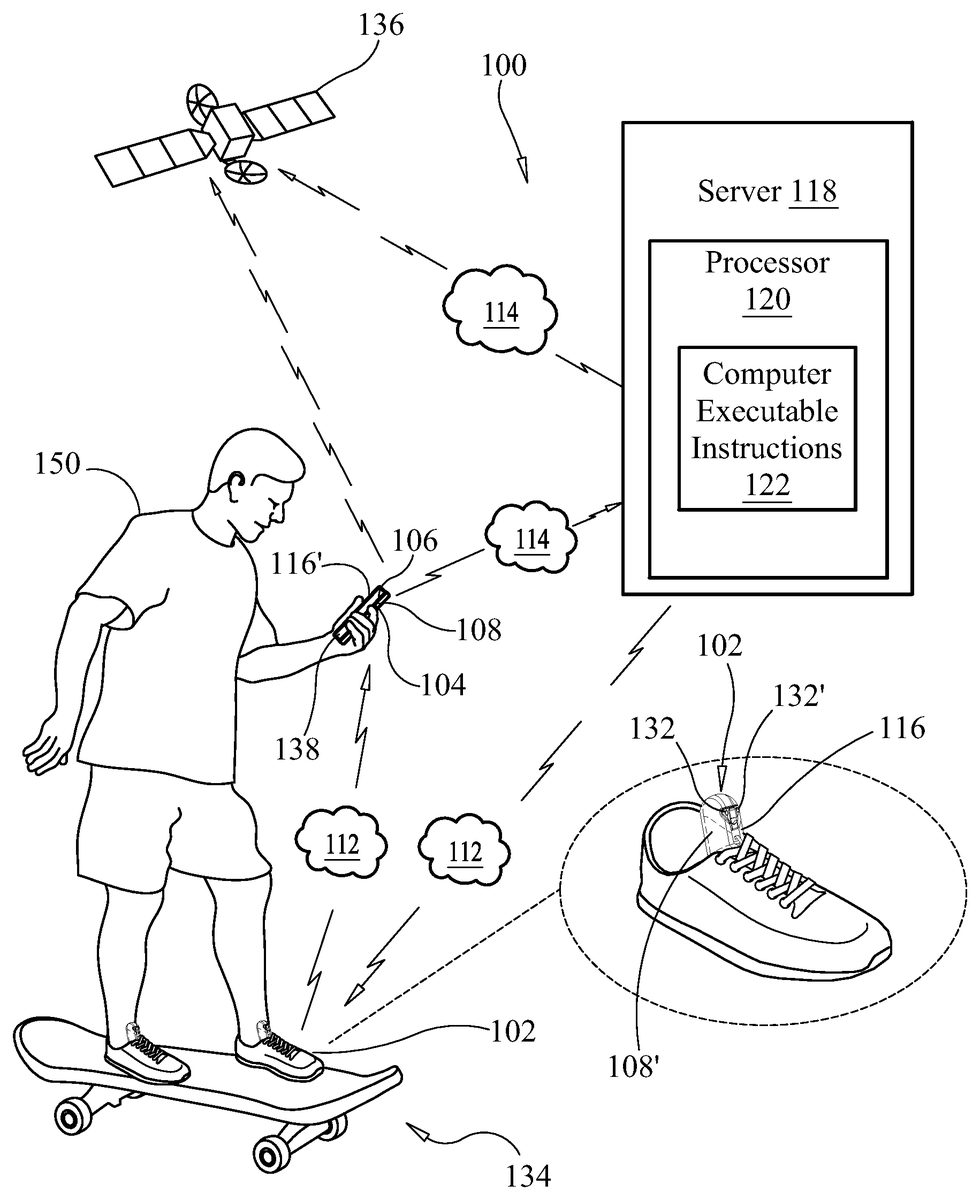
DETAILED DESCRIPTION OF PREFERRED EMBODIMENTS System Level Overview With reference to the drawings,FIG. 1AthroughFIG. 1Cshow embodiments of a social networking game system100comprising of: a standalone, wearable gaming device102configured for activating an application program104stored on a mobile displaying device106, wherein the application program104is configured for activating location determining means108to start a monitoring session110, and wherein the location determining means108is also configured for tracking a game player's moving parameters112,112′ during the monitoring session110while the game players engaged during an actual, real live physical exercise and/or sporting activity; the application program104is further configured for converting the game player's moving parameters112,112′ into game player's statistics114; and communication means116positioned within the mobile displaying device106for transmitting the game player's statistics114to at least one remote server118, wherein the at least one remote server118includes at least one processor120and computer executable instructions122readable by the at least one processor120and operative to conduct a game124, wherein the game124is configured for: receiving remotely the game player statistics114; identifying the game player's account126for which the game player's statistics114will apply; converting the game player's statistics114into virtual mileage128based on a correlation to actual distance travelled130during the monitoring session110; updating the game player's account126in real-time to include the virtual mileage128accumulated during the monitoring session110; awarding virtual mileage128to the game player for each crew member that accesses the game124; displaying the game player's virtual mileage128in real time on the social networking game124; or determining a winner for the game player with the most accumulated virtual mileage128within a prescribed period. Referring toFIG. 1A, an exemplary standalone, wearable gaming device102is in electronic communication with a wireless, portable mobile displaying device106. The wearable gaming device102is enabled for attachment to any one of the following: footwear, clothing apparel or accessories and the like, whereby accessories may include any one of the following: belts, hats, bags, satchels, chains, backpacks and other like ...
DETAILED DESCRIPTION OF PREFERRED EMBODIMENTS
System Level Overview
With reference to the drawings,FIG. 1AthroughFIG. 1Cshow embodiments of a social networking game system100comprising of: a standalone, wearable gaming device102configured for activating an application program104stored on a mobile displaying device106, wherein the application program104is configured for activating location determining means108to start a monitoring session110, and wherein the location determining means108is also configured for tracking a game player's moving parameters112,112′ during the monitoring session110while the game players engaged during an actual, real live physical exercise and/or sporting activity; the application program104is further configured for converting the game player's moving parameters112,112′ into game player's statistics114; and communication means116positioned within the mobile displaying device106for transmitting the game player's statistics114to at least one remote server118, wherein the at least one remote server118includes at least one processor120and computer executable instructions122readable by the at least one processor120and operative to conduct a game124, wherein the game124is configured for: receiving remotely the game player statistics114; identifying the game player's account126for which the game player's statistics114will apply; converting the game player's statistics114into virtual mileage128based on a correlation to actual distance travelled130during the monitoring session110; updating the game player's account126in real-time to include the virtual mileage128accumulated during the monitoring session110; awarding virtual mileage128to the game player for each crew member that accesses the game124; displaying the game player's virtual mileage128in real time on the social networking game124; or determining a winner for the game player with the most accumulated virtual mileage128within a prescribed period.
Referring toFIG. 1A, an exemplary standalone, wearable gaming device102is in electronic communication with a wireless, portable mobile displaying device106. The wearable gaming device102is enabled for attachment to any one of the following: footwear, clothing apparel or accessories and the like, whereby accessories may include any one of the following: belts, hats, bags, satchels, chains, backpacks and other like accessories. InFIG. 1A, the wearable gaming device102is attached to the tongue of the game player's shoe. However, the portable gaming device102being removable may be removed from the shoe's tongue for removable attachment to any other portion of the game player's apparel or accessory.
Both gaming device102and/or the mobile displaying device106may include communication means116,116′, respectively, for communicating with each other and/or with the remote server118by employing short range wireless protocol, such as, but not limited to, a radio frequency transceiver, a radio frequency receiver, and/or a radio frequency transmitter. In some embodiments, wireless communication means116,116′ is a radio frequency receiver that may be any type of radio frequency receiver, including, but not limited to, a positioning system receiver, such as a global positioning system receiver and a local positioning system receiver, such as a Wi-Fi positioning system receiver. In other embodiments, communication means116,116′ may employ wireless protocols like Blue Tooth, ZigBee, 802.11 series, or a wireless modem, such as, but not limited to, a global system for mobile communications (GSM) modem, or any other short range wireless protocol that is well known and used in the arts and other future wireless protocol suitable for transmitting and receiving data communications. In some embodiments, communication means116,116′ include one or more combined wireless transceivers like a Zigbee and/or Bluetooth transceiver with integrated radio and shared antennae in mating engagement with an autonomous power supply128(not shown), e.g. a rechargeable battery.
The monitoring session110may be commenced by activating the gaming device102, which may or may not include activation buttons132, which in turn activates the application program104stored on the mobile displaying device106wherein both the gaming device102and the displaying device communicate via each other's communication means116,116′. Application program104may be any type of software application, such as a mobile application designed to run on a mobile platform, such as a mobile displaying device106running an operating system, such as IOS™, ANDROID™, WINDOWS MOBILE™, BLACKBERRY™, and the like. In another embodiment, the application program104may be designed to run on a social network platform, such as FACEBOOK™ OR JUSTSYNC™. Mobile displaying device106as used herein may be any kind of displaying device106, such as, but not limited to, a cell phone, a personal digital assistant (“PDA”), a computer monitor, a projector, a laptop, an IPAD™, a television, a notebook, a tablet personal computer, IPHONE™, smart phones, mobile phones, a portable screen, a portable processing device and/or any other kind of WLAN communication devices that are readily used in the arts to display, transmit and/or receive wireless communications. Mobile displaying device106is portable and may include a computer processor120′, with computer executable instructions122′ stored thereon and readable by the displaying device's computer processor120′, in electronic communication with the application program104, displaying device's communication means116′ and/or the location determining means108, whereby the processor's computer executable instructions122′ is programmed to access and control the application program104, communication means116′ and/or the location determining means108.
Application program104activates the location determining means108to start a monitoring session110. Location determining means108may be positioned within the mobile displaying device106or the standalone, wearable gaming device102. In either event, location determining means108is provided with a Global Positioning System (GPS) transponder120(not shown) with transmitting and receiving means for communicating with either via a geosynchronous (GEO) or Low Earth Orbit (LEO) satellite in a network to determine for example the location determining means' geographical coordinates and/or other moving parameters112,112′. Moving parameters112,112′ may include but is not limited to any one or more of the following: geographical coordinates of the location determining means, actual distance travelled, speed, stride rate, cycling cadence, date, elevation reached, depth travelled, timestamp, a location determining means' unique identifier and a game player's unique identifier and or any other parameters associated with physical exercises140,140′ that are known and used in the arts.
Upon activation, location determining means108orients itself and determines its geographical position, e.g. longitude and latitude coordinates by searching for signals of GPS satellite constellation, verifying whether it has direct access to a wireless communications network system136, e.g. a satellite network system, and if so, it determines the geographical position of the location determining means108and consequently the game player. In some embodiments, location determining means108may include at least one processor120″ positioned within is in electronic communication with at least one sensor138and the communication means116′ such that the functionality of the location determining means108is centrally controlled by its at least one processor120″.
Location determining means' at least one sensor138, e.g. an accelerometer, works in conjunction with the location determining means108to originate the moving parameters112,112′ whereby, once the location determining means108is activated it uses the at least one sensor138for sensing game player's key performance metrics140,140′ when engaged in physical exercises140. Performance metrics140,140′ may include but is not limited to speed, average speed, maximum speed (calculated and/or recorded every five or ten seconds), number of sprints, distance, distance at high intensity levels, steps, heart rate, heart rate and/or stride rates.
Physical exercise134as used herein is selected from the group consisting essentially of: walking, sprinting, running, dribbling, jumping, batting, swinging, shooting, scoring a goal, skateboarding, lifting, jogging, swimming, hiking, skiing, boxing, snowboarding, dancing, diving, driving, flying, surfing, cycling, sliding, gliding, hurling, bending, pitching, throwing and/or any other physical activity.
The at least one sensor138may be any type of sensor, including, but not limited to, an accelerometer, or gyroscopic sensor camera. In some embodiments, the at least one sensor138, includes an infrared camera, a panoramic sensor, a stereo sensor, a three dimensional sensor and/or camera (“3D sensor”), a thermal imaging camera, a video sensor, a digital camera, and the like. In some embodiments, location determining means108includes an activation button130in electrical communication with or electronically connected to the at least one sensor138such that the activation button130may be used to manually activate or deactivate the location determining means108to start or stop sensing the game player's performance metrics140,140′ during a monitoring session110where the game player is engaged in physical exercise134.
As seen inFIG. 1A, gaming device102is small enough to be fitted in the tongue of a shoe, e.g. sneaker or boots, or may be placed in the game player's pockets, backpack, purse or anywhere else on the person that he/she feels comfortable wearing or carrying the device as an accessory as the gaming device102may be removable. Here, game player is situated on a moving skateboard and the gaming device102. Once the location determining means108′ within the gaming device102or the displaying device106is activated, as the game player skateboards, the location determining means108′ at least one sensor138senses the game player's performance metrics140,140′ during physical exercise114, i.e. skateboarding activity and the location determining means108′ determines moving parameters,112,112′, e.g. the geographical position of the location determining means108or actual distance travelled130. Once the moving parameter112has been generated, location determining means108transmits the at least one moving parameter112via its communication means116′ to the displaying device's communication means116for remote tabulations of a game player's statistics114that are associated with the location determining means108and/or the game player116. In some embodiments, another game player is able to view the game player actively engaging in the physical exercises114incremental virtual mileage128as it is being uploaded to the game player's account126.
InFIG. 1B, no gaming device102is required and the exemplary location determining means108is positioned within the displaying device106with direct access to a wireless communications network system126. The displaying device's communication means116may communicate remotely with the at least one processor120via either a geosynchronous (GEO) or Low Earth Orbit (LEO) satellite in a wireless communications network system136. Communications between the gaming device102and the remote processor120; as well as the communications between the at least one processor120and the displaying device106are bi-directional. In this manner, either the gaming device102or the displaying device106may communicate directly with the at least one processor120.
Upon activation of the displaying device106, the location determining means108is activated for a monitoring session110and the at least one sensor138positioned within senses the game player's key performance metrics140,140′ during physical exercise134, thereby originating the at least one moving parameter112for the game player. Once the at least one moving parameter112has been generated, the displaying device's communication means116′ transmits the at least one moving parameter112to the remote processor120in real time, for remote tabulations of a game player's statistics114for the game player's account142associated with the displaying device106.
In some embodiments, at least one processor(s)120,120′ may be any type of processor, including, but not limited to, a single core processor, a multi core processor, a video processor, and the like.
As shown inFIGS. 1A & 1B, the computer executable instructions122may be loaded directly on at least one processor120or may be stored on storage means144, such as, but not limited to, computer readable media, such as, but not limited to, a hard drive, a solid state drive, a flash memory, random access memory, CD-ROM, CD-R, CD-RW, DVD-ROM, DVD-R, DVD-RW, and the like.
Computer executable instructions122may be any type of computer executable instructions122, which may be in the form of a computer program, the program being composed in any suitable programming language or source code, such as C++, C, JAVA, JavaScript, HTML, XML, and other programming languages. Computer executable instructions122readable by the at least one processor120and operative to conduct a game124, wherein the game124is further configured for: awarding virtual mileage128for actual distance travelled130which correspond to a virtual mileage128requirement for navigating through e.g. a virtual city; awarding virtual mileage128based on the game player successfully navigating through a challenge; conferring a rank146to the game player based on a totality of accumulated virtual mileage128; awarding prizes to top earners of accumulated virtual mileage128within a prescribed period; requiring the game player to complete individual tricks in order to be promoted to a different game level; updating the game player's statistics114or rank146based on the received at least one moving parameter112; or transmitting to or receiving game content148from the displaying device106, which may be displayed on the displaying device's displaying means.
FIG. 2Ashows an exemplary illustration of a snapshot of the game124. In some embodiments, computer executable instructions122are operative to conduct a game124based on the received at least one moving parameter112, where upon receipt of the received at least one moving parameter112, the computer executable instructions122are operative to convert the received at least one moving parameter112to game player's statistics114for the game player associated with the gaming device102and/or the location determining means108.
Computer executable instructions122are further operative to use the converted at least one moving parameter112to update the game player's statistics114and/or rank146in the game124based on the received at least one moving parameter112. Game player's statistics114as used herein include but is not limited to: distance travelled130, virtual miles128, speed202, rank146, elevation height204or any other game player statistics114that are known and used in the arts. In some embodiments, game player's rank146improves as the accumulated virtual miles128increases. Also displayed may be the location determining device's unique identifier206, the date stamp208and timestamp210.
In some embodiments, an object of the game124is to earn as many virtual mileage128as possible and/or attain a higher game player's rank146within a predetermined period, e.g. one month, 6 weeks, 6 months, 1 year, and the like, where the game124may automatically refresh at the end of any such predetermined cycle thereby allowing a game player150to compete with other game players150,150′ to win that predetermined period's competition regardless of how long the game player150has been playing the game124. In some embodiments, actual or virtual prizes, ranks148,148′ and/or titles may be awarded for the game player150with the most virtual mileage128and/or highest rank146at the end of the predetermined cycle. Virtual mileage128travelled may represent a combination of: (i) actual distance travelled130by game player when engaged in actual sports activities being sensed by an activated location determining means108where the game player's performance metrics140,140′ are captured and transmitted as moving parameters112,112′ that are tabulated remotely and added to the game player's statistics114; (ii) virtual mileage128may be purchased using game tokens, real or virtual currency or random virtual mileage128awarded (e.g. 1-5 virtual miles) for performing certain activities, e.g. accessing or logging into the game124within a specified time period, e.g. 24 hours; (iii) virtual mileage128awarded by the processor120each time a game player's crew member118′ logs into the game124; and/or (iv) virtual mileage128earned for completing certain game challenges or tricks212(collectively “challenges212”) that may be specific to a particular rank146and may be directly related to the particular sports activity. For example, in one embodiment, a challenge212may require the game player to complete actual skateboarding of an actual or virtual park which includes ramps and the like, while in another embodiment, the challenge212may be related to the number of dunks accomplished in an actual or virtual basketball game124.
In some embodiments, a challenge212may require game player to complete a virtual mileage128requirement for a given city and/or master any tricks212,212′ associated with that city in order to advance in the game124. Tricks212may be randomly generated virtual challenges208which when played includes an avatar engaging in a related virtual sports activity for which the game player may/may not have any input or control as to the outcome of completed trick208. Nonetheless, game player may earn or lose virtual mileage128or symbols of mastery of the trick, e.g. a virtual accessory like a white hat, virtual money, virtual hearts, etc., depending on the outcome of the trick208. For example in some embodiments, game player is awarded a certain number of hearts and/or virtual currency at the outset of the game124, which are depleted by attempting tricks212according to the level of difficulty involved. As the game player advances through the various tricks212,212′ and/or challenges208, game player is awarded additional symbols of mastery, hearts and the like and/or receives a new rank146. In some embodiments, game player may be required to master certain tricks212by attempting the trick208at least one or more times before game player is considered a master of the trick208and obtain a new rank146.
In some embodiments of the game124, the individual's game player's rank146as displayed is representative of the level attained based on the number of virtual mileage128he/she earned within the predetermined cycle210(not shown). In other embodiments, rank146is additionally representative of a comparison of the level attained by game player as compared to other game players150,150′, for example the top ten game players150,150′. In either embodiment, as discussed supra, at the end of the predetermined cycle210(not shown) game player's rank146may be reset for the beginning of a new game124. In certain embodiments the rank146may be exemplified by a written description, e.g. Rookie, Amateur, professional, veteran, Master”, while in other embodiments the rank is exemplified by a pictorial depiction, e.g. an icon symbolizing the level of accomplishment as per the rules of the game124.
In some embodiments, a game player's statistics114may improve depending on the activities of other game players150,150′,150″ whom the game player of the location determining means108has preselected to be a part of his/her crew. For example, game player may earn virtual mileage128each time a crew member118′ access the game124by logging on and/or reaches a new rank146in the game124. In some embodiments, game player's rank146improves by purchasing virtual mileage128travelled for a monetary fee using actual currency, virtual currency and/or tokens, and/or trading virtual accessories directly for virtual mileage128or for virtual currency to purchase virtual mileage128, all of which may have a direct impact on a game player's rank146.
In some embodiments, computer executable instructions122are operative to determine game player's virtual mileage128based on the game player's20at least one moving parameter112transmitted by or received from the at least one location determining means108or the displaying device106. Computer executable instructions are further operative to update a game player's statistics114and/or rank146based on the received at least one or a plurality of moving parameter112,112′.
FIG. 2Bshows an exemplary illustration of a snapshot of the game124as displayed on a displaying device106according to one embodiment. In some embodiments, computer executable instructions122may be operative to transmit or receive game content148as it would appear on a social network game124, which may be displayed on the displaying device106. Illustratively, computer executable instructions122may update a game player's statistics114and transmit the updated game player's statistics114to the displaying device106, where the game player may view his/her statistics114in real time as the application program104runs in the background. In another embodiment, displaying device106may include its own processor120′, which includes computer executable instructions122operative to update the game player's statistics114that are transmitted to and received by the processor120such that the information stored on the displaying device106and the processor120are synchronized.
Displaying device106is equipped with at least one or more displaying means214(not shown) for displaying game content148. Displaying means214(not shown) may include but is not limited to a liquid crystal display (“LCD”) or light emitting diode (“LED”) type, plasma, touch screen or any other types of displays that are well known and used in the arts. Displaying device106may display the game content148either in text and/or visual format. In some embodiments, displaying device106may display game content148, which may include an update in realtime of game player's statistics114and/or rank146. Game content148as used herein may be any type of content, including but not limited to, game player's statistics114, login status214, crew member's login status214′, login history216(not shown), and crew member's game player's statistics114′, and the like. In other embodiments, game player may access his or her game player's statistics114from an application accessible from a media website, e.g. FaceBook, where game player may view his/her game player's statistics114as updated by the processor120using the at least one moving parameter112transmitted by the displaying device106or the location determining means106.
Accordingly, in the various embodiments, when the location determining means108has been activated, the game player's at least one physical movement114, can be measured and the moving parameter originating108from the location determining means108or the displaying device106can be incorporated into a game124. Thus, any type of physical exercises140,140′, including but not limited to, a walking movement, a running movement, a dribbling movement, a jumping movement, a batting movement, a swinging movement, a shooting movement, a scoring a goal movement, a skateboarding movement, a lifting movement, a jogging movement, a swimming movement, a hiking movement, a skiing movement, a boxing movement, a snowboarding movement, a dancing movement, a diving movement, a driving movement, a flying movement, a surfing movement, a cycling movement, a sliding movement, a gliding movement, a hurling movement, a bending movement, a pitching movement, a throwing movement and the like, as experienced outdoors or indoors can be incorporated into the game124.
In another embodiment, the computer executable instructions122may be operative to use communication means116for transmitting or receiving the moving parameters112,112′ or the game content148, wherein the communication means116may comprise a wired communications means, such as a land line modem, cable modem, DSL modem, and the like, or a wireless communications means, such as a wireless modem, a GSM modem, a satellite modem, and Wi-Fi adapter, and the like.
In some embodiments, system100may be integrated with or may be a component of a user system or a central station, such as a computer, a gaming console, a set top box, a displaying device, or a server.
Referring now toFIG. 3, one embodiment of system300is shown, comprising of at least at least one location determining module302in communication with at least one sensor module304to sense game player's performance metrics140,140′, translate the performance metrics140,140′ into the at least one moving parameter112and transmit the at least one moving parameter112to at least one processor module306for tabulations of a game player's statistics114that are associated with the at least one location determining module302, and wherein the at least one processor module306updates the game player's statistics114, e.g. virtual mileage128or rank146based on the received at least one moving parameter112; and at least one communications module308to transmit or receive the at least one moving parameter112.
In one embodiment the at least one processor module306may comprise a software aspect, such as, but not limited to, processing software, such as processing computer program, an operating system, and the like. In another embodiment, at least one processor module306may comprise of a hardware aspect, such as a computer processor120. In some embodiments, at least one processor module306may be any type of processor, including, but not limited to, a single core processor, a multi core processor, a video processor, and the like. In yet another embodiment, at least one processor module306may comprise both a software aspect and a hardware aspect.
In some embodiments, at least one location determining module302may comprise of a hardware aspect, such as, but not limited to, a sensor138. In such embodiments, at least one location determining module302may include any type of sensor138, including, but not limited to, an accelerometer, or gyroscopic sensor camera. In some embodiments, the at least one sensor138, includes an infrared camera, a panoramic sensor, a stereo sensor, a three dimensional sensor and/or camera (“3D sensor”), a thermal imaging camera, a video sensor, a digital camera, and the like. Accordingly, performance metrics140,140′ as previously defined herein can be sensed to and incorporated into the system300of the invention.
In yet another embodiment, at least one location determining module302may comprise a software aspect, such as a computer program. In such an embodiment, at least one location determining module302may comprise sensor and/or camera firmware. In yet another embodiment, at least one location determining module302may comprise both a software aspect and a hardware aspect.
In one embodiment, at least one processor module306may be electronically connected, electronic communication, or in software communication with at least one location determining module302.
In a further embodiment, system300comprises at least one display module310to display the at least one piece of game content148. The at least one display module310may comprise a hardware aspect, such as a displaying device106, which may include, but is not limited to, may be any kind of displaying device106, such as, but not limited to, a cell phone, a personal digital assistant (“PDA”), a computer monitor, a projector, a laptop, an ipad, a television, a notebook, a tablet personal computer, iPhone, smart phones, mobile phones, a portable screen, a portable processing device and/or any other kind of WLAN communication devices that are readily used in the arts to display, transmit and/or receive wireless communications. In another embodiment, the at least one display module310may comprise a software aspect, such as a display computer program or software, such as, but not limited to, a media player, display drivers, and the like. In yet another embodiment, the at least one display module310may comprise both a hardware aspect and a software aspect.
In yet another embodiment, system300may comprise at least one communications module308to transmit or receive game information. Game information may comprise any type of information, such as, but not limited to, information based on the moving parameters112,112′ and/or game content148, and/or such as those types of information described above with reference toFIGS. 1 through 2B. Game content148as used herein may be any type of content, including but not limited to, game player's statistics114, login status214, crew member's login status214′, login history216(not shown), and crew member's game player's statistics114′, and the like.
In one embodiment, the at least one communications module308may comprise a hardware aspect, such as but not limited to, wireless communications hardware, such as, but not limited to, a wireless modem, a GSM modem, a Wi-Fi modem, an antenna, a satellite modem, a Bluetooth modem, and the like, or wired hardware, such as a DSL modem, a cable modem, a network card, a telephone modem, and the like. In yet another embodiment, the at least one communications module308may comprise a software aspect, such as, but not limited to, a computer program or software, such as, but not limited to, a communications program, communications protocol, and the like. In yet another embodiment, the at least one communications module308may comprise both a hardware aspect and a software aspect.
In some embodiments, the at least one processor module306is operative to conduct a game124based on at least one moving parameter112received from either the location determining module302and/or a display module310, as used and/or worn by the game player. Upon receipt of game player's at least one moving parameter112, the at least one processor module306is operative to determine game player's virtual mileage128based on game player's at least one moving parameter112that was received from either the at least one location determining module302or the display module310. Processor module306is operative to use at least one moving parameter112, e.g. distance travelled130, to update game player's statistics114, e.g. game player's virtual mileage128, by adding for example the actual distance travelled130to game player's virtual mileage128. As previously discussed in conjunction withFIGS. 1A-3, as game player's virtual mileage128increase his/her game statistics114and/or rank146may improve. Accordingly, the at least one processor module306is operative to confer a new rank146to the game player based on at least one received moving parameters112,112′.
In some embodiments, at least one processor module306may be operative to transmit or receive game content148, which may be displayed via a display module310. Illustratively, the at least one processor module306may contain computer executable instructions122which may be programmed to update a game player's statistics114and transmit the updated game player's statistics114to be displayed via a display module310on the displaying device106. Display module310may be in electrical or wireless communication with at least one or more displaying means214(not shown) for displaying game content148. Displaying module310may be enabled to display the game content148on the displaying device in either in text and/or visual format, where game content may include an update in realtime of game player's statistics114and/or rank146. Game content148as used herein may be any type of content, including but not limited to, game player's statistics114, login status214, crew member's login status214′, login history216(not shown), and crew member's game player's statistics114′, and the like. In other embodiments, game player150may access his or her game player's statistics114from an application accessible from a media website, e.g. Facebook, where game player150may view his/her game player's statistics114as updated by the processor120using the at least one moving parameter112transmitted by the displaying device106or the location determining means106.
FIG. 4shows a system400in accordance with one embodiment, wherein system400comprises of at least one processor module306to update game players statistics114and/or rank146based on received at least one moving parameters112,112′ from a location determining means108and/or a displaying device106, and at least one communications module308to transmit or receive at least one moving parameter112and/or game content148.
In one embodiment at least one processor module306may comprise of a software aspect, such as, but not limited to, processing software, such as processing computer program, an operating system, and the like. In another embodiment, at least one processor module306may comprise a hardware aspect, such as a computer processor. In some embodiments, at least one processor module306may be any type of processor, including, but not limited to, a single core processor, a multi core processor, a video processor, and the like. In yet another embodiment, at least one processor module306may comprise both a software aspect and a hardware aspect.
Game content148as used herein may be any type of content, including but not limited to, game player's statistics114, login status214, crew member's login status214′, login history216(not shown), and crew member's game player's statistics114′, and the like as described above with reference toFIGS. 1 through 3.
In one embodiment, at least one communications module308may comprise a hardware aspect, such as but not limited to, wireless communications hardware, such as, but not limited to, a wireless modem, a GSM modem, a Wi-Fi modem, an antenna, a satellite modem, a Bluetooth modem, and the like, or wired hardware, such as a DSL modem, a cable modem, a network card, a telephone modem, and the like. In yet another embodiment, at least one communications module308may comprise a software aspect, such as, but not limited to, a computer program or software, such as, but not limited to, a communications program, communications protocol, and the like. In yet another embodiment, at least one communications module308may comprise both a hardware aspect and a software aspect.
In yet another embodiment, system400may comprise of at least one server module402to host a game124. In some embodiments, the game124may be a game124based on a game player accumulating the highest number of virtual mileage128as possible and/or attain the highest game player's rank146within a predetermined cycle, e.g. one month, 6 weeks, 6 months, 1 year, and the like. In accomplishing the highest number of virtual mileage128and/or the highest rank146game player may be required to earn virtual mileage128in the manner previously described in conjunction withFIGS. 1-3.
In some embodiments, the at least one server module402may comprise of a hardware aspect, such, as but not limited to, server hardware, such as, but not limited to, a server processor120, a server computer, and the like. In yet another embodiment, the at least one server module402may comprise a software aspect, such as, but not limited to, a computer program and/or software, such as, but not limited to, server software, game hosting software, and the like. In a further embodiment, the at least one server module may comprise both a software aspect and a hardware aspect.
FIG. 5shows a system500in accordance with another embodiment, wherein system500comprises at least one display module310to display at least one piece of game content148, and at least one input module502to receive information about game player's physical exercise114and/or moving parameters112,112′.
In one embodiment, at least one display module310may comprise a hardware aspect, such as a displaying device106, which may include, but is not limited to, such as a displaying device106, which may include, but is not limited to, may be any kind of displaying device106, such as, but not limited to, a cell phone, a personal digital assistant (“PDA”), a computer monitor, a projector, a laptop, an ipad, a television, a notebook, a tablet personal computer, iPhone, smart phones, mobile phones, a portable screen, a portable processing device and/or any other kind of WLAN communication devices that are readily used in the arts. In another embodiment, at least one display module310may comprise a software aspect, such as, but not limited to, a display computer program or software, such as, but not limited to, a media player, display drivers, and the like. In yet another embodiment, at least one display module310may comprise both a hardware aspect and a software aspect.
In yet another embodiment, at least one input module502may comprise a hardware aspect, such as input hardware and/or a device, which may include, but is not limited to, a mouse, a keyboard, buttons, a touch screen, or a gesture control system. In another embodiment, at least one input module502may comprise a software aspect, such as, but not limited to, input software or an input computer program, which may include, but is not limited to, a user interface, a gesture user interface, input software, keystroke or input interpretation software, and the like. In yet another embodiment, at least one input module502may comprise both a hardware aspect and a software aspect.
In some embodiments, at least one piece of content may be any type of game content148. Game content148as used herein may be any type of content, including but not limited to, game player's statistics114, login status214, crew member's login status214′, login history216(not shown), and crew member's game player's statistics114′, and the like as described above with reference toFIGS. 1 through 3.
In some embodiments, the at least one display module310comprises at least one displaying device106and/or display software, at least one input module502comprising of at least one user interface hardware and/or software, such as a keyboard for accessing the user interface to play the game124.
Overview of Method Embodiments
Referring now toFIG. 6, a method600is shown, wherein method600comprises of providing a standalone, wearable gaming device102configured for activating an application program104stored on a mobile displaying device106, wherein the application program104is configured for activating location determining means108to start a monitoring session110, and wherein the location determining means108is also configured for tracking a game player's moving parameters112,112′ during the monitoring session110while the game players engaged during an actual, real live sporting activity (step602); providing the application program104which is further configured for converting the game player's moving parameters112,112′ into game player's statistics114(step604); and communication means116positioned within the mobile displaying device106for transmitting the game player's statistics114to at least one remote server118, wherein the at least one remote server118includes at least one processor120and computer executable instructions122readable by the at least one processor120and operative to conduct a game124(step606).
Gaming device102as described herein is in electronic communication with a wireless, portable mobile displaying device106and/or the remote processor118. Gaming device102is enabled for attachment to any one of the following: footwear, clothing apparel or accessories and the like, whereby accessories may include any one of the following, belt, hat, bags, satchel, backpack and other like accessories. In some embodiments, the wearable gaming device102may be permanently attached to game player's shoe, apparel or other accessory while in other embodiments the gaming device102is portable and may be removably attached to game player's footwear, e.g. shoe's tongue, apparel, e.g. belt, pockets, etc. or an accessory, e.g. hat, backpack, satchel and the like providing for a variety of different game playing experiences.
Mobile displaying device106as used herein may be any kind of displaying device106, such as, but not limited to, a cell phone, a personal digital assistant (“PDA”), a computer monitor, a projector, a laptop, an IPAD™, a television, a notebook, a tablet personal computer, IPHONE™, smart phones, mobile phones, a portable screen, a portable processing device and/or any other kind of WLAN communication devices that are readily used in the arts to display, transmit and/or receive wireless communications. Displaying device106may include a computer processor120′, with computer executable instructions122′ stored thereon and readable by the displaying device's computer processor120′, in electronic communication with the application program104, displaying device's communication means116′ and/or the location determining means108, whereby the processor's computer executable instructions122′ is programmed to access and control the application program104, communication means116′ and/or the location determining means108. As such, once the application program104has been activated, the processor120can communicate with the application program104and the communication means116′ to obtain the game player's moving parameters112,112′ for transmission to the remote processor for tabulations and uploading the virtual mileage128earned into the social networking game124. Processor120may be any type of processor120, such as those processors102,102′ which include processor modules304as previously described in reference toFIGS. 1A through 5.
In some embodiments, displaying device106is equipped with communication means116and location determining means108that are each either electrically or mechanically connected to at least one processor120′ positioned within the displaying device106. In the case of electronic connections, the electronic connections may be wired and/or wireless. In some embodiments, location determining means108may comprise of the communication means116, where the communication means116may be a wireless communication means116, which employ short range wireless protocol, such as, but not limited to, a radio frequency transceiver, a radio frequency receiver, and/or a radio frequency transmitter.
Moving parameters112,112′ as used herein includes but is not limited to any one or more of the following: a game player's unique identifier134, a location determining means unique identifier136, a geographical position132of the location determining means108, distance travelled130, speed202, date 142, elevation height144, timestamp146and or any other parameters associated with physical exercises140,140′ that are known and used in the arts.
In some embodiments, the at least one moving parameter112originates from a location determining means108as previously described in conjunction withFIGS. 1A through 3, which when activated uses its at least one sensor138positioned within, to sense a game player of the location determining means physical exercises140,140′. The at least one sensor138may be any type of sensor, including, but not limited to, an accelerometer, or gyroscopic sensor camera. In some embodiments, the at least one sensor138, includes an infrared camera, a panoramic sensor, a stereo sensor, a three dimensional sensor and/or camera (“3D sensor”), a thermal imaging camera, a video sensor, a digital camera, and the like. Physical exercises140,140′ as used herein is selected from the group consisting essentially of: walking, sprinting, running, dribbling, jumping, batting, swinging, shooting, scoring a goal, skateboarding, lifting, jogging, swimming, hiking, skiing, boxing, snowboarding, dancing, diving, driving, flying, surfing, cycling, sliding, gliding, hurling, bending, pitching, throwing and/or any other physical activity.
Location determining means108includes communication means116that includes at least one communication means116′ for communicating with the displaying device106and/or the at least one processor120for transmitting and/or receiving at least one moving parameter112as previously described in conjunction withFIGS. 1-5.
In one embodiment, method600further comprises using at least one processor120to conduct a game124based on the received at least one moving parameter112. For instance, after the location determining means108has been activated and the distance travelled130has been captured and transmitted to the processor120, upon receipt of the same, processor120may use the distance travelled110of the game player's moving parameters112,112′ to update the game player's statistics118or rank146based on the received at least one moving parameter112. Game player's statistics118include but is not limited to a: distance travelled110, virtual miles (accumulated)204, speed202, or any other game player statistics114that are known and used in the arts.
In yet a further embodiment, method600further comprises providing computer executable instructions122readable by the at least one processor120and operative to conduct a game124, wherein the game124is further configured for: awarding virtual mileage128for actual distance travelled130which correspond to a virtual mileage128requirement for navigating through e.g. a virtual city; awarding virtual mileage128based on the game player successfully navigating through a challenge; conferring a rank146to the game player based on a totality of accumulated virtual mileage128; awarding prizes to top earners of accumulated virtual mileage128within a prescribed period; requiring the game player to complete individual tricks in order to be promoted to a different game level; updating the game player's statistics114or rank146based on the received at least one moving parameter112; or transmitting to or receiving game content148from the displaying device106, which may be displayed on the displaying device's displaying means.
Method further comprises conducting a social networking game124where the game content148may be transmitted or received by the displaying device106. Game content148as used herein may be any type of content148, including but not limited to, game player's statistics114, rank146, login status214, login history216(not shown), crew member's login status206′, and crew member's game player's statistics114′, and the like. In this manner, a game player may view his/her rank146or virtual mileage128on the displaying device106wherein the displaying device106is equipped with displaying means for displaying the game content148. In other embodiments, game player150may access his or her game player's statistics114from an application accessible from a media website, e.g. Facebook, where game player may view his/her game player's statistics114as updated by the processor120using the at least one moving parameter112transmitted by the displaying device106or the location determining means108.
In yet a further embodiment, method600further comprises using at least one processor120to determine game player's virtual mileage128based on the game player's statistics114which are converted into virtual mileage128. As previously discussed, the more virtual mileage128a game player accumulates it will improve his or her rank146.
In some embodiments, method600further comprises using at least one processor120to confer a rank146on the game player based on a plurality of received moving parameters112,112′. For instance, if game player has accumulated virtual mileage128based on the distance travelled110, then the processor120may upgrade game player to a new rank146commensurate with the distance travelled110for that particular rank146.
Referring now toFIG. 7, which shows a block diagram depicting a method700in accordance with another embodiment. In some embodiments, displaying device106is equipped with displaying means214for displaying game content148. Displaying means214may include but is not limited to a liquid crystal display (“LCD”) or light emitting diode (“LED”) type, plasma, touch screen or any other types of displays that are well known and used in the arts. Displaying device106may display the game content148either in text and/or visual format. In some embodiments, displaying device106may be equipped with speakers such that the game content148may be broadcasted orally.
As such, method700comprises of providing at least one location determining module302to sense at least one physical movement114(step702), wherein the at least one location determining module302translates the physical exercises140,140′ into the at least one moving parameter112(step704). Location determining module302may be in direct communication with a communications module308′ which communicate with the processor module302, such that the communications module308transmits the at least one moving parameter112to at least one processor module102for tabulations of a game player's statistics114that are associated with the at least one location determining module302(step706). Upon receipt of the at least one moving parameter112, processor module302may update the game player's statistics or rank based on the received at least one moving parameter (step708).
In some embodiments, the at least one location determining module302also includes a processor module102programmable to update the game player's statistics or rank based on the received at least one moving parameter (step708).
Overview of Computer Readable Medium Embodiments
Another embodiment may comprise of a computer readable medium having computer executable instructions122operative to use at least one sensor138to sense a game player of the location determining means physical exercise114.
The computer readable medium may be any type of computer readable medium, such as, but not limited to, a memory chip, a hard drive, a CD-ROM, a DVD-ROM, a CD-RW, a USB memory stick, flash memory, random access memory, and the like.
Another embodiment may comprise a computer readable medium having computer executable instructions122operative to perform any of the operations previously described with reference toFIGS. 1A through 7.
Overview of Hardware and Operating Environment
This section provides an overview of example hardware and the operating environments in conjunction with which embodiments of the inventive subject matter can be implemented.
A software program may be launched from a computer readable medium in a computer-based system to execute function defined in the software program. Various programming languages may be employed to create software programs designed to implement and perform the methods disclosed herein. The programs may be structured in an object-orientated format using an object-oriented language such as Java or C++. Alternatively the programs may be structured in a procedure-oriented format using a procedural language, such as assembly or C. The software components may communicate using a number of mechanisms, such as application program interfaces, or inter-process communication techniques, including remote procedure calls. The teachings of various embodiments are not limited to any particular programming language or environment. Thus, other embodiments may be realized, as discussed regardingFIG. 10below.
FIG. 8is a block diagram representing an article according to various embodiments. Such embodiments may comprise a computer, a memory system, a magnetic or optical disk, some other storage device, or any type of electronic device or system. The article800may include one or more processor(s)802coupled to a machine-accessible medium such as a memory804(e.g., a memory including electrical, optical, or electromagnetic elements). The medium may contain associated information806(e.g., computer program instructions, data, or both) which, when accessed, results in a machine (e.g., the processor(s)802) performing the activities previously described herein.
The principles of the present disclosure may be applied to all types of computers, systems, and the like, include desktop computers, servers, notebook computers, personal digital assistants, and the like. However, the present disclosure may not be limited to the personal computer.
While the principles of the disclosure have been described herein, it is to be understood by those skilled in the art that this description is made only by way of example and not as a limitation as to the scope of the disclosure. Other embodiments are contemplated within the scope of the present disclosure in addition to the exemplary embodiments shown and described herein. Modifications and substitutions by one of ordinary skill in the art are considered to be within the scope of the present disclosure.
Claims
- A social networking game system comprising of: (a) standalone, wearable gaming device configured for activating an application program stored on a mobile displaying device, wherein the application program is configured for activating location determining means to start a monitoring session where upon activation, a location determining means calculates a geographical position and a game player's performance metrics, and wherein a location determining means includes at least one sensor for sensing the game player's performance metrics during physical exercise during the monitoring session thereby originating at least one moving parameter for the game player;(b) the application program is further configured for converting the at least one game player's moving parameters into a plurality of game player's statistics;and (c) communication means positioned within the mobile displaying device for transmitting the game player's statistics to at least one remote server, wherein the at least one remote server includes at least one processor and computer executable instructions readable by the at least one processor and operative to conduct a game, wherein the game is configured for: (i) receiving the game player statistics;(ii) identifying a game player's account for which the game player's statistics will apply;(iii) converting the game player's statistics into virtual mileage based on a correlation to actual distance travelled during the monitoring session;(iv) updating the game player's account to include a game player virtual mileage accumulated during the monitoring session;(v) awarding virtual mileage to the game player for each crew member that accesses the game;(vi) displaying the game player's virtual mileage on the social networking game;or (vii) determining a winner for the game player with the most accumulated virtual mileage within a prescribed period.
- The system of claim 1 , wherein the wearable gaming device is enabled for attachment to any one of the following: footwear, apparel or accessories.
- The system of claim 1 , wherein the moving parameters include but is not limited to any one or more of the following: geographical coordinates of the location determining means, actual distance travelled, speed, stride rate, cycling cadence, date, elevation reached, depth travelled, timestamp, a location determining means' unique identifier and a game player's unique identifier.
- The system of claim 1 , wherein the location determining means may be positioned within the mobile displaying device or the gaming device.
- The system of claim 2 , wherein the wearable gaming device is attached to the footwear's tongue.
- The system of claim 5 , wherein physical exercises are selected from the group consisting essentially of: walking, sprinting, running, dribbling, jumping, batting, swinging, shooting, scoring a goal, skateboarding, lifting, jogging, swimming, hiking, skiing, boxing, snowboarding, dancing, diving, driving, flying, surfing, cycling, sliding, gliding, hurling, bending, pitching and throwing.
- The system of claim 5 , wherein performance metrics may include but is not limited to speed, average speed, maximum speed, number of sprints, distance, distance at high intensity levels, steps, heart rate, heart rate and/or stride rates.
- The system of claim 1 , wherein the game is further configured for: (a) awarding virtual mileage for actual distance travelled which correspond to a virtual mileage requirement for navigating through a virtual city;(b) awarding virtual mileage based on the game player successfully navigating through a challenge;(c) conferring a rank to the game player based on a totality of accumulated virtual mileage;(d) awarding prizes to top earners of accumulated virtual mileage within a prescribed period;(e) requiring the game player to complete individual tricks in order to be promoted to a different game level (f) updating the game player's statistics or rank based on the received at least one moving parameter;or (g) transmitting to or receiving game content from the mobile displaying device.
- The system of claim 1 , wherein game player's statistics include but is not limited to a: virtual miles, actual distance travelled, speed, or rank.
- The system of claim 1 , wherein the displaying device is equipped with at least one displaying means for displaying game content.
- The system of claim 10 , wherein game content includes but is not limited to a: game player's statistics, login status, login history, crew member's login status, and crew member's game player's statistics.
- The system of claim 1 , wherein the computer executable instructions are further operative to determine game player's virtual miles based on the game player's at least one moving parameter transmitted or received to or from the at least one location determining means or the displaying device.
- A method of conducting a social networking game comprising of: (a) standalone, wearable gaming device configured for activating an application program stored on a mobile displaying device, wherein the application program is configured for activating location determining means to start a monitoring session where upon activation, a location determining means calculates a geographical position and a game player's performance metrics, and wherein a location determining means includes at least one sensor for sensing the game player's performance metrics during physical exercise during the monitoring session thereby originating at least one moving parameter for the game player;(b) providing the application program further configured for converting the game player's at least one moving parameter into a plurality of game player's statistics;and (c) providing communication means positioned within the mobile displaying device for transmitting the game player's statistics to at least one remote server, wherein the at least one remote server includes at least one processor and computer executable instructions readable by the at least one processor and operative to conduct a game, wherein the game is configured for: (i) receiving the game player statistics;(ii) identifying a game player's account for which the game player's statistics will apply;(iii) converting the game player's statistics into virtual mileage based on a correlation to actual distance travelled during the monitoring session;(iv) updating the game player's account to include a game player virtual mileage accumulated during the monitoring session;(v) awarding virtual mileage to the game player for each crew member that accesses the game;(vi) displaying the game player's virtual mileage on the social networking game;or (vii) determining a winner for the game player with the most accumulated virtual mileage within a prescribed period.
- The method of claim 13 , wherein the wearable gaming device is enabled for attachment to any one of the following: footwear, apparel or accessories.
- The method of claim 13 , wherein the moving parameters include but is not limited to any one or more of the following: geographical coordinates of the location determining means, actual distance travelled, speed, stride rate, cycling cadence, date, elevation reached, depth travelled, timestamp, a location determining means' unique identifier and a game player's unique identifier.
- The method of claim 13 , wherein the location determining means may be positioned within the mobile displaying device or the gaming device.
- The method of claim 14 , wherein the wearable gaming device is attached to the footwear's tongue.
- The method of claim 17 , wherein physical exercises are selected from the group consisting essentially of: walking, sprinting, running, dribbling, jumping, batting, swinging, shooting, scoring a goal, skateboarding, lifting, jogging, swimming, hiking, skiing, boxing, snowboarding, dancing, diving, driving, flying, surfing, cycling, sliding, gliding, hurling, bending, pitching and throwing.
- The method of claim 17 , wherein performance metrics may include but is not limited to speed, average speed, maximum speed, number of sprints, distance, distance at high intensity levels, steps, heart rate, heart rate and/or stride rates.
- The method of claim 13 , wherein the game is further configured for: (a) awarding virtual mileage for actual distance travelled which correspond to a virtual mileage requirement for navigating through a virtual city;(b) awarding virtual mileage based on the game player successfully navigating through a challenge;(c) conferring a rank to the game player based on a totality of accumulated virtual mileage;(d) awarding prizes to top earners of accumulated virtual mileage within a prescribed period;(e) requiring the game player to complete individual tricks in order to be promoted to a different game level (f) updating the game player's statistics or rank based on the received at least one moving parameter;or (g) transmitting to or receiving game content from the displaying device.
- The method of claim 13 , wherein game player's statistics include but is not limited to a: virtual miles, actual distance travelled, speed, or rank.
- The method of claim 13 , wherein the displaying device is equipped with at least one displaying means for displaying game content.
- The method of claim 20 , wherein game content includes but is not limited to a: game player's statistics, login status, login history, crew member's login status, and crew member's game player's statistics.
- The method of claim 13 , wherein the computer executable instructions are further operative to determine game player's virtual miles based on the game player's at least one moving parameter transmitted or received to or from the at least one location determining means or the displaying device.
Disclaimer: Data collected from the USPTO and may be malformed, incomplete, and/or otherwise inaccurate.